


 Abstract
 HTML
 Reference
 Related
 PDF



-
Black holes have emerged as indispensable theoretical and observational tools for probing the nature of gravity. Initially conceived as idealized solutions to the Einstein field equations [1], they have now been confirmed as genuine astrophysical objects by extensive observational evidence. Observations of supermassive black holes at galactic centers, notably M87* [2] and Sagittarius A* [3], provide compelling evidence for event horizons and relativistic gravitational dynamics. The direct imaging of black hole shadows by the Event Horizon Telescope [4, 5] provides the strongest empirical evidence for their existence by enabling observational access to spacetime geometry and gravitational effects, thereby confirming the presence of an event horizon, extreme curvature, and strong gravity in their vicinity [6]. Complementary evidence for black holes comes from stellar-mass compact objects in X-ray binaries, particularly Cygnus X-1 [7]. The high orbital velocity of the companion star and the absence of detectable surface emission indicate that the compact object in this system has a mass exceeding the theoretical limit for a neutron star [8, 9]. Furthermore, the detection of gravitational waves by the LIGO and Virgo collaborations [10] revealed the coalescence of binary black holes, constituting the first direct observation of gravitational waves and confirming the century-old prediction of general relativity [11]. The successful detection and analysis of the merger and ringdown phases provide independent confirmation of their existence and enable precise measurements of their fundamental properties.
Among the notable features of black hole spacetimes, the innermost stable circular orbit (ISCO) represents the smallest radius at which a massive particle can maintain a stable circular trajectory. The ISCO defines the inner edge of the standard accretion disk and governs key physical processes in black hole accretion systems [12]. The ISCO is closely associated with regions where relativistic jets originate, establishing a connection between inner disk dynamics and jet formation [13]. Measurements of X-ray binaries reveal features arising from the innermost accretion region near the ISCO, including characteristic shifts in spectral hardness [14], quasi-periodic oscillations [15, 16], and a broadened iron Kα line [17]. Furthermore, determining the ISCO radius is essential for inferring the black hole spin and radiative efficiency [18, 19]. In compact binaries, the ISCO parameters are critical for numerical relativity simulations of highly curved spacetime regions. Accordingly, various methods have been developed to determine the ISCO location, including Hamiltonian approaches [20−22], Padé approximations [23], post-Newtonian approximations [24−28], and variational principles [29]. Since the existence and properties of the ISCO are not restricted to a particular gravitational background, extensive studies have investigated the ISCO in a wide range of spacetime geometries [30−45].
A recent study has shown that a universal upper bound exists for the ISCO in four-dimensional spacetimes [46]. However, higher-dimensional black holes remain largely unexplored in this context, and no corresponding universal bound has yet been identified. Higher-dimensional black holes have significant implications for extensions of general relativity [47−51]. These implications arise in the AdS/CFT correspondence, brane-world scenarios, and string theory, where the presence of extra dimensions modifies gravitational dynamics. Extra dimensions alter the balance between gravitational attraction and centrifugal forces that governs orbital stability in four dimensions, leading to distinct behavior for circular orbits in higher-dimensional spacetimes. Determining whether universal limits on the ISCO persist in higher dimensions is essential for understanding the effects of spacetime geometry and higher dimensions on orbital stability in strong gravitational fields. Accordingly, our analysis demonstrates that the physical properties of matter impose constraints on particle motion in higher dimensions, providing a higher-dimensional analogue of the four-dimensional result of [46]. These findings offer indirect insights into the effects of extra dimensions and their potential observational signatures.
In this study, we examined the existence and possible upper bound of the ISCO radius in higher-dimensional spacetimes using a general, model-independent setup. The analysis considered matter subject to physical constraints imposed by the energy–momentum tensor. We determined the ISCO condition by analyzing equatorial timelike geodesics and conserved quantities in higher-dimensional spacetimes, while accounting for anisotropic pressures. Our analysis extends the existence of a finite upper bound in four dimensions [46] to higher-dimensional spacetimes. In higher dimensions, the existence of an ISCO is demonstrated, and no finite upper bound on its radius is observed. Moreover, the allowed equations of state depend explicitly on the spacetime dimension.
The remainder of this paper is organized as follows. Section II reviews the ISCO in four-dimensional Schwarzschild black holes. Section III presents the construction of higher-dimensional black hole spacetimes and the associated energy–momentum conditions. Section IV investigates the existence and possible upper bounds of the ISCO in higher dimensions. Finally, Section V summarizes the main results and outlines possible directions for future research.
-
This review examines the existence of an ISCO in the Schwarzschild black hole background when the metric is expressed as
$ \begin{aligned} {\rm{d}}s^2 = - h(r) {\rm{d}}t^2 + \frac{{\rm{d}}r^2}{h(r)} + r^2 {\rm{d}}\theta^2 + r^2 \sin^2\theta {\rm{d}}\phi^2, \end{aligned} $
(1) where
$ \begin{aligned} h(r) = 1 - \frac{2 m}{r}, \end{aligned} $
(2) with the speed of light is set to
$ c = 1 $ , and m denotes the mass of the Schwarzschild black hole. We consider the equatorial motion$ ( \theta = \pi / 2 ) $ of a particle along a timelike geodesic with normalized four-velocity$ {\bf{v}} $ , defined as$ \begin{aligned} {\bf{v}} = \dot{t} \partial_t + \dot{r} \partial_r + \dot{\phi} \partial_\phi, \end{aligned} $
(3) where the dot denotes differentiation with respect to the affine parameter. In the equatorial plane, the timelike geodesic condition
$ {\bf{v}}^2 = -1 $ reduces to$ \begin{aligned} -h(r) \dot{t}^2 + \frac{\dot{r}^2}{h(r)} + r^2 \dot{\phi}^2 = -1. \end{aligned} $
(4) For the static, spherically symmetric metric (1), the two conserved quantities associated with the timelike Killing vector
$ {\boldsymbol{\zeta}}_{(t)} $ and the rotational Killing vector$ {\boldsymbol{\zeta}}_{(\phi)} $ are given as follows:$ \begin{aligned} E \equiv - \zeta^{(t)}_\mu v^\mu = h(r) \dot{t}, \qquad L \equiv \zeta^{(\phi)}_\mu v^\mu = r^2 \dot{\phi}, \end{aligned} $
(5) where
$ {\boldsymbol{\zeta}}_{(t)} = \partial_t $ and$ {\boldsymbol{\zeta}}_{(\phi)} = \partial_\phi $ , and E and L represent the energy and angular momentum per unit rest mass of a particle, respectively. Using the conserved quantities (5), the timelike geodesic equation (4) can be written as$ \begin{aligned} \frac{\dot{r}^2}{2} + V_{{\rm{eff}}}(r) = 0, \end{aligned} $
(6) where the effective potential is given by
$ \begin{aligned} V_{\rm{eff}}(r) = - \frac{E^2}{2} + \frac{1}{2} \left( 1 + \frac{L^2}{r^2} \right) h(r). \end{aligned} $
(7) The ISCO radius, hereafter denoted by
$ r_{\rm{I}} $ , corresponds to a circular orbit satisfying$ \begin{aligned} V_{\rm{eff}}(r_{\rm{I}}) = 0, \qquad V_{\rm{eff}}'(r_{\rm{I}}) = 0, \end{aligned} $
(8) which determine the conserved quantities as
$ \begin{aligned} E^2 = \left. \frac{2 h(r)^2}{2 h(r) - r h'(r)} \right|_{r = r_{\rm{I}}}, \qquad L^2 = \left. \frac{r^3 h'(r)}{2 h(r) - r h'(r)} \right|_{r = r_{\rm{I}}}, \end{aligned} $
(9) where the prime denotes differentiation with respect to the radial coordinate r. The ISCO is further defined by the condition that the second derivative of the effective potential vanishes,
$ \begin{aligned} 0 &= V_{\rm{eff}}''(r_{\rm{I}}) \end{aligned} $
(10) $ \begin{aligned} &= \left. \frac{h''(r)}{2} + \frac{L^2}{r^2} \left( \frac{h''(r)}{2} - \frac{2 h'(r)}{r} + \frac{3 h(r)}{r^2} \right) \right|_{r = r_{\rm{I}}} \end{aligned} $
(11) $ \begin{aligned} &= \left. \frac{\left( r - 6 m \right) m}{r^3 \left( r - 3 m \right)} \right|_{r = r_{\rm{I}}}, \end{aligned} $
(12) which results in
$ \begin{aligned} r_{\rm{I}} = 6 m. \end{aligned} $
(13) Thus, the ISCO in Schwarzschild spacetime is located at
$ r_{\rm{I}} = 6 m $ , corresponding to three times the radius of the Schwarzschild black hole's event horizon. -
To investigate the ISCO in higher-dimensional spacetimes containing matter fields, we begin with the D-dimensional Einstein–Hilbert action:
$ \begin{aligned} I = \int {\rm{d}}^Dx \sqrt{-g} \left( \frac{R}{2 \kappa} + {\cal{L}}_{{\rm{M}}} \right), \end{aligned} $
(14) where
$ \kappa = 8 \pi G $ , G is the D-dimensional gravitational constant, and$ {\cal{L}}_{\rm{M}} $ is the matter Lagrangian density. The most general static, spherically symmetric D-dimensional metric can be written as$ \begin{aligned} {\rm{d}}s^2 = - {\rm e}^{2 g(r)} f(r) {\rm{d}}t^2 + \frac{{\rm{d}}r^2}{f(r)} + r^2 {\rm{d}}\Omega_{D-2}^2, \end{aligned} $
(15) where
$ {\rm{d}}\Omega_{D - 2}^2 $ denotes the line element on the unit$ (D-2) $ -sphere,$ \begin{aligned} {\rm{d}}\Omega_{D - 2}^2 = {\rm{d}}\theta_1^2 + \sin^2\theta_1 {\rm{d}}\theta_2^2 + \cdots + \sin^2\theta_1 \cdots \sin^2\theta_{D - 3} {\rm{d}}\theta_{D - 2}^2. \end{aligned} $
(16) The condition of asymptotic flatness requires
$ \begin{aligned} \lim_{r \to \infty} f(r) = 1, \qquad \lim_{r \to \infty} g(r) = 0. \end{aligned} $
(17) We consider the static, diagonal energy–momentum tensor for anisotropic matter, expressed as
$ \begin{aligned} \left( T^{\mu}{}_{\nu} \right) = {\rm{diag}} ( - \rho(r), \, p_{\rm{r}}(r), \, \underbrace{p_{\rm{t}}(r), \, \cdots , \, p_{\rm{t}}(r)}_{D - 2 \rm{ terms}} ), \end{aligned} $
(18) where
$ p_{\rm{r}} $ and$ p_{\rm{t}} $ are the radial and transverse pressures, respectively. From the Einstein equations,$ G^{\mu}{}_{\nu} = \kappa T^{\mu}{}_{\nu} $ , the temporal and radial components are$ \begin{aligned} 0 &= f'(r) - \frac{\left( D - 3 \right) \left( 1 - f(r) \right)}{r} + \frac{2 \kappa r \rho}{D - 2}, \end{aligned} $
(19) $ \begin{aligned} 0 &= g'(r) - \frac{\kappa r \left( \rho(r) + p_{\rm{r}}(r) \right)}{\left( D - 2 \right) f(r)}. \end{aligned} $
(20) Taking the second derivatives of Eqs. (19) and (20) yields
$ \begin{aligned} f''(r) &= - \frac{\left( D - 3 \right) \left( r f'(r) - f(r) + 1 \right)}{r^2} - \frac{2 \kappa \left( r \rho'(r) + \rho(r) \right)}{D - 2}, \end{aligned} $
(21) ${ \begin{aligned} &g''(r) =\\ &- \frac{\kappa \left\{ r \left( \rho(r) + p_{\rm{r}}(r) \right) f'(r) - \left[ r \left( \rho'(r) + p_{\rm{r}}'(r) \right) + \rho(r) + p_{\rm{r}}(r) \right] f(r) \right\}}{\left( D - 2 \right) f(r)^2}. \end{aligned}} $
(22) The metric function
$ f(r) $ vanishes at the event horizon$ r_{\rm{h}} $ and remains nonnegative outside the horizon, satisfying$ \begin{aligned} f(r_{\rm{h}}) = 0, \qquad f'(r_{\rm{h}}) \geqslant 0. \end{aligned} $
(23) The metric function evaluated at the event horizon (23) yields
$ \begin{aligned} \rho(r_{\rm{h}}) \leqslant \frac{\left( D - 3 \right) \left( D - 2 \right)}{2 \kappa r_{\rm{h}}^2}, \qquad \rho(r_{\rm{h}}) = - p_{\rm{r}}(r_{\rm{h}}), \end{aligned} $
(24) where the first inequality follows from Eq. (19), whereas the second follows from Eq. (20). The metric function
$ f(r) $ is assumed to take the form$ \begin{aligned} f(r) \equiv 1 - \frac{2 M(r)}{r^{D - 3}}, \end{aligned} $
(25) where
$ M(r) $ is the mass function, which encodes the spacetime curvature generated by the energy density outside the event horizon. Using Eq. (19), the function$ M(r) $ can be written as$ \begin{aligned} M(r) = M_{\rm{h}} + \frac{\kappa}{D - 2} \int_{r_{\rm{h}}}^{r} s^{D - 2} \rho(s) \, {\rm{d}}s, \end{aligned} $
(26) where
$ M_{\rm{h}} = r_{\rm{h}}^{D - 3} / 2 $ . For a nonnegative energy density that decreases monotonically for large r, the finiteness of$ M(r) $ imposes the following condition:$ \begin{aligned} \lim_{r \to \infty} r^{D - 1} \rho(r) = 0. \end{aligned} $
(27) Applying the energy–momentum conservation law
$ \nabla_\mu T^{\mu}{}_{r} = 0 $ and substituting Eqs. (19) and (20) yields the Tolman–Oppenheimer–Volkoff (TOV) equation for the radial pressure:$ \begin{split} p_{\rm{r}}'(r) =& \frac{\left( D - 2 \right) \left( p_{\rm{t}}(r) - p_{\rm{r}}(r) \right)}{r} + \frac{\left( D - 3 \right) \left( \rho(r) + p_{\rm{r}}(r) \right)}{2 r} \\ & - \left( \frac{D - 3}{2 r} + \frac{\kappa r p_{\rm{r}}(r)}{D - 2} \right) \frac{\rho(r) + p_{\rm{r}}(r)}{f(r)} \end{split} $
(28) $ \begin{split} = &\frac{2 {\bf{T}}(r) + \left( D - 1 \right) \rho(r)- \left( D + 1 \right) p_{\rm{r}}(r)}{2 r}\\ & - \left( \frac{D - 3}{2 r} + \frac{\kappa r p_{\rm{r}}(r)}{D - 2} \right) \frac{\rho(r) + p_{\rm{r}}(r)}{f(r)}, \end{split} $
(29) where
$ {\bf{T}} $ denotes the trace of the energy–momentum tensor$ T^{\mu}{}_{\mu} $ . The energy–momentum conditions are imposed as follows: (i) the energy–momentum tensor is required to satisfy the weak energy condition$ \begin{aligned} \rho(r) \geqslant 0, \qquad \rho(r) + p_{\rm{r}}(r) \geqslant 0, \qquad \rho(r) + p_{\rm{t}}(r) \geqslant 0, \end{aligned} $
(30) which ensures a non-negative energy density for all timelike observers. (ii) The trace of the energy–momentum tensor is assumed to be non-positive,
$ \begin{aligned} {\bf{T}}(r) \leqslant 0, \end{aligned} $
(31) which is consistent with a broad class of astrophysical and cosmological fluids. (iii) The radial and tangential pressures must satisfy
$ \begin{aligned} p_{\rm{t}}(r) \geqslant \left| p_{\rm{r}}(r) \right|. \end{aligned} $
(32) The condition (32) ensures that the
$ p_{\rm{t}} - p_{\rm{r}} $ term in Eq. (28) is nonnegative, providing an opposing effect to gravitational collapse and supporting the stability of the system. Combining conditions (i), (ii), and (iii) yields the dominant energy condition together with additional constraints, which can be summarized as follows:$\begin{split} &\rho(r) \geqslant \left| p_{\rm{r}}(r) \right|, \qquad \rho(r) \geqslant p_{\rm{t}}(r) , \qquad \\ &\rho(r) \geqslant p_{\rm{r}}(r) + \left( D - 2 \right) p_{\rm{t}}(r), \qquad p_{\rm{t}}(r) \geqslant \left| p_{\rm{r}}(r) \right|. \end{split} $
(33) We next introduce an effective equation-of-state parameter w that relates the energy density and pressure and is defined as
$ \begin{aligned} w_{\rm{r}}(r) \equiv \frac{p_{\rm{r}}(r)}{\rho(r)}, \qquad w_{\rm{t}}(r) \equiv \frac{p_{\rm{t}}(r)}{\rho(r)}. \end{aligned} $
(34) In terms of
$ w_{\rm{r}} $ and$ w_{\rm{t}} $ , the energy–momentum conditions can be rewritten as$ \begin{split} &-1 \leqslant w_{\rm{r}}(r) \leqslant 1, \quad 0 \leqslant w_{\rm{t}}(r) \leqslant 1, \quad \\ &w_{\rm{r}}(r) + \left( D - 2 \right) w_{\rm{t}}(r) \leqslant 1, \quad w_{\rm{t}}(r) \geqslant \left| w_{\rm{r}}(r) \right|. \end{split} $
(35) -
We consider the equatorial motion of a particle in D dimensions along a timelike geodesic with normalized D-velocity
$ {\bf{u}} $ , defined as$ \begin{aligned} u^\mu = ( \dot{t}, \, \dot{r}, \, \dot{\theta}_1, \, \cdots, \, \dot{\theta}_{D-2} ). \end{aligned} $
(36) The D-dimensional equatorial plane is defined by setting all polar angles to
$ \pi / 2 $ , as follows:$ \begin{aligned} \theta_1 = \cdots = \theta_{D-3} = \frac{\pi}{2}, \qquad \theta_{D-2} \equiv \phi, \end{aligned} $
(37) where ϕ denotes the redefined azimuthal coordinate. The energy E and angular momentum L are defined by the D-dimensional timelike Killing vector
$ {\boldsymbol{\xi}}_{(t)} $ and the rotational Killing vector$ {\boldsymbol{\xi}}_{(\phi)} $ , respectively,$ \begin{aligned} E \equiv - \xi^{(t)}_\mu u^\mu = e^{2 g(r)} f(r) \dot{t}, \qquad L \equiv \xi^{(\phi)}_\mu u^\mu = r^2 \dot{\phi}, \end{aligned} $
(38) where
$ {\boldsymbol{\xi}}_{(t)} = \partial_t $ and$ {\boldsymbol{\xi}}_{(\phi)} = \partial_\phi $ . In the equatorial plane, the timelike geodesic condition$ {\bf{u}}^2 = -1 $ , together with the two conserved quantities in (38), reduces to$ \begin{aligned} \frac{\dot{r}^2}{2} + \frac{f(r)}{2} \left( - \frac{E^2 {\rm e}^{- 2 g(r)}}{f(r)} + \frac{L^2}{r^2} + 1 \right) = 0. \end{aligned} $
(39) Using the timelike geodesic equation (39), the effective potential is defined as
$ \begin{aligned} V_{\rm{eff}}(r) \equiv - \frac{E^2}{2} {\rm e}^{-2 g(r)} + \frac{1}{2} \left( 1 + \frac{L^2}{r^2} \right) f(r). \end{aligned} $
(40) The energy E and angular momentum L of a particle at the ISCO are determined by the circular-orbit conditions (8),
$ \begin{split} &E^2 = \left. \frac{2 e^{2 g(r)} f(r)^2}{2 f(r) - r \left( f'(r) + 2 f(r) g'(r) \right)} \right|_{r = r_{\rm{I}}}, \qquad\\ &L^2 = \left. \frac{r^3 \left( f'(r) + 2 f(r) g'(r) \right)}{2 f(r) - r \left( f'(r) + 2 f(r) g'(r) \right)} \right|_{r = r_{\rm{I}}}. \end{split} $
(41) Using Eqs. (19), (20), (21), (22), (29), and (41), the condition
$ V_{\rm{eff}}''(r_{\rm{I}}) = 0 $ reduces to$ \begin{aligned}[b] 0 =\;& \frac{2 \kappa^2 r^4 p_{\rm{r}}(r) \left( \rho(r) - 3 p_{\rm{r}}(r) \right)}{\left( D - 2 \right)^2} - \left( D - 3 \right) \left( D - 1 \right) f(r)^2 + \left( 3 D - 7 \right) \left( D - 3 \right) f(r) - 2 \left( D - 3 \right)^2 \\ & \left. + \frac{\kappa r^2 \left\{ 2 f(r) {\bf{T}}(r) + \left[ \left( D - 1 \right) f(r) + D - 3 \right] \rho(r) + \left[ \left( 5 D - 11 \right) f(r) - 7 \left( D - 3 \right) \right] p_{\rm{r}}(r) \right\}}{D - 2} \right|_{r = r_{\rm{I}}}. \end{aligned}$
(42) The vacuum ISCO radius,
$ r_{\rm{I, vac}} $ , can be determined directly from condition (42), yielding$ \begin{aligned} r_{\rm{I, vac}} = \left( - \frac{2 \left( D - 1 \right) M_{\rm{h}}}{D - 5} \right)^\frac{1}{D - 3}, \end{aligned} $
(43) where
$ M_{\rm{h}} $ denotes the value of the mass function at the event horizon. For$ D = 4 $ , Eq. (43) gives$ r_{\rm{I, vac}} = 6 M_{\rm{h}} $ , consistent with Eq. (13). In contrast, no physical solution exists in vacuum for$ D \geqslant 5 $ , indicating the absence of$ r_{\rm{I, vac}} $ in higher dimensions. This behavior can be understood in terms of the effective radial force in vacuum, defined as the negative radial derivative of the effective potential:$ \begin{aligned} F_{\rm{eff, vac}}(r) \equiv - V_{\rm{eff, vac}}'(r) = - \frac{\left( D - 3 \right) M_{\rm{h}}}{r^{D - 2}} + \frac{L^2}{r^3} - \frac{\left( D - 1 \right) M L^2}{r^D}. \end{aligned} $
(44) The gravitational attraction, centrifugal repulsion, and general relativistic correction terms scale as
$ r^{-( D - 2 )} $ ,$ r^{-3} $ , and$ r^{-D} $ , respectively. In higher dimensions, these dimension-dependent scalings do not provide the balance between gravitational attraction and centrifugal repulsion required for marginally stable circular orbits, thereby precluding a vacuum ISCO for$ D \geqslant 5 $ . More generally, to account for the presence of the energy–momentum tensor (18), the ISCO condition (42) can be reformulated in terms of the ISCO function$ {\cal{C}}(r) $ :$ \begin{split} {\cal{C}}(r) \equiv &\frac{2 \kappa^2 r^4 p_{\rm{r}}(r) \left( \rho(r) - 3 p_{\rm{r}}(r) \right)}{\left( D - 2 \right)^2} - \left( D - 3 \right) \left( D - 1 \right) f(r)^2 + \left( 3 D - 7 \right) \left( D - 3 \right) f(r) - 2 \left( D - 3 \right)^2 \\ & + \frac{\kappa r^2 \left\{ 2 f(r) {\bf{T}}(r) + \left[ \left( D - 1 \right) f(r) + D - 3 \right] \rho(r) + \left[ \left( 5 D - 11 \right) f(r) - 7 \left( D - 3 \right) \right] p_{\rm{r}}(r) \right\}}{D - 2} \end{split}$
(45) The ISCO function
$ {\cal{C}}(r) $ can be decomposed as$ \begin{aligned} {\cal{C}}(r) = {\cal{A}}(r) + {\cal{B}}(r), \end{aligned} $
(46) with
$ {\cal{A}}(r) \equiv \frac{2 \kappa^2 r^4 p_{\rm{r}}(r) \left( \rho(r) - 3 p_{\rm{r}}(r) \right)}{\left( D - 2 \right)^2} + \frac{2 \kappa r^2 f(r) {\bf{T}}(r)}{D - 2}, + \frac{\kappa r^2 \left\{ \left[ \left( D - 1 \right) f(r) + D - 3 \right] \rho(r) + \left[ \left( 5 D - 11 \right) f(r) - 7 \left( D - 3 \right) \right] p_{\rm{r}}(r) \right\}}{D - 2} $
(47) $ \begin{split} {\cal{B}}(r) \equiv &- \left( D - 3 \right) \left( D - 1 \right) f(r)^2 + \left( 3 D - 7 \right) \left( D - 3 \right) f(r) \\ & - 2 \left( D - 3 \right)^2. \end{split} $
(48) Using the Einstein equation (19), together with the event-horizon condition (24) and the energy–momentum conditions (33), we obtain
$ \begin{aligned} {\cal{C}}(r_{\rm{h}}) = -2 r_{\rm{h}}^2 f'(r_{\rm{h}})^2 \leqslant 0. \end{aligned} $
(49) This shows that
$ {\cal{C}}(r_{\rm{h}}) $ is non-positive at the event horizon. In the asymptotic region, condition (27) and the energy–momentum conditions (33) together imply that$ {\cal{C}}(r) $ takes the following form:$ \begin{aligned} {\cal{C}}(r \to \infty) \sim \begin{cases} \dfrac{2 M_\infty}{r} \gt 0 & \left( D = 4 \right) \\ - \dfrac{32 M_\infty^2}{r^4} + \dfrac{2 \kappa}{3} r^2 \left( 2 \rho + p_{\rm{r}} + 3 p_{\rm{t}} \right) & \left( D = 5 \right) \\ - \dfrac{2 \left( D - 5 \right) \left( D - 3 \right) M_\infty}{r^{D - 3}} \lt 0 & \left( D \geqslant 6 \right) \end{cases}, \end{aligned} $
(50) where
$ M_\infty $ denotes the asymptotic value of the mass function at spatial infinity. Consequently, the asymptotic sign of$ {\cal{C}}(r) $ depends explicitly on the spacetime dimension. For$ D = 4 $ ,$ {\cal{C}}(r) $ approaches zero from above, whereas$ {\cal{C}}(r_{\mathrm h}) \leqslant 0 $ for a nonextremal event horizon; therefore, the continuity of$ {\cal{C}}(r) $ guarantees at least one root in the exterior region. For$ D = 5 $ , the asymptotic sign is determined by the balance between the mass and matter contributions, and an exterior root exists when the positive matter contribution dominates at large r. By contrast, for$ D \geqslant 6 $ ,$ {\cal{C}}(r) $ approaches zero from below, and this asymptotic behavior does not ensure the existence of an ISCO. Nevertheless, a suitable matter distribution can yield$ {\cal{C}}(r) \gt 0 $ at an intermediate radius, thereby allowing an ISCO to form. An explicit construction establishing the existence of an ISCO for$ D \geqslant 5 $ and further demonstrating that the ISCO radius has no finite upper bound is presented in Appendix A. Thus, depending on the spacetime dimension and the matter distribution,$ {\cal{C}}(r) = 0 $ can admit one or more roots in the exterior region. When such roots exist, the ISCO radius$ r_{\rm{I}} $ is defined as the smallest among them and satisfies$ \begin{aligned} {\cal{C}}(r_{\rm{I}}) = 0. \end{aligned} $
(51) Requiring the particle at the ISCO in Eq. (41) to have positive energy and nonzero angular momentum imposes the constraint
$ \begin{aligned} \frac{2 \kappa r^2 p_{\rm{r}}(r_{\rm{I}}) + \left( D - 3 \right) \left( D - 2 \right)}{\left( D - 2 \right) \left( D - 1 \right)} \lt f(r_{\rm{I}}) \lt 1 + \frac{2 \kappa r^2 p_{\rm{r}}(r_{\rm{I}})}{\left( D - 3 \right) \left( D - 2 \right)}, \end{aligned} $
(52) Within the domain
$ r_{\rm{h}} \lt r_{\rm{I}} \lt \infty $ , where$ f(r_{\rm{I}}) \gt 0 $ , the following inequality holds:$ \begin{aligned} 0 \lt 1 + \frac{2 \kappa r^2 p_{\rm{r}}(r_{\rm{I}})}{\left( D - 3 \right) \left( D - 2 \right)}. \end{aligned} $
(53) To simplify the subsequent analysis, we introduce two functions.
$ \begin{aligned} \delta(r_{\rm{I}}) \equiv 1 + \frac{2 \kappa r_{\rm{I}}^2 p_{\rm{r}}(r_{\rm{I}})}{\left( D - 3 \right) \left( D - 2 \right)} \gt 0, \qquad \sigma(r_{\rm{I}}) \equiv p_{\rm{r}}(r_{\rm{I}}) + p_{\rm{t}}(r_{\rm{I}}) \geqslant 0. \end{aligned} $
(54) -
The analysis can be classified according to the sign of
$ p_{\rm{r}}(r_{\rm{I}}) $ . For positive radial pressure$ ( p_{\rm{r}}(r_{\rm{I}}) \gt 0 ) $ , the relation$ \delta(r_{\rm{I}}) \gt 1 $ holds. Moreover, from the energy–momentum conditions (33) and condition (52), we obtain$ \begin{aligned}[b] {\cal{A}}(r_{\rm{I}}) >& \frac{4 \kappa^2 r_{\rm{I}}^4 p_{\rm{r}}(r_{\rm{I}}) \left\{ \left( D - 4 \right) \left( D - 1 \right) \rho(r_{\rm{I}}) + \left[ \left( D - 3 \right)^2 + 2 \right] p_{\rm{r}}(r_{\rm{I}}) + \left( D - 2 \right) \left( D - 1 \right) p_{\rm{t}}(r_{\rm{I}}) \right\}}{\left( D - 3 \right) \left( D - 2 \right)^2 \left( D - 1 \right)} \\ & + \frac{2 \kappa r_{\rm{I}}^2 \left\{ \left( D - 4 \right) \left( D - 1 \right) \rho(r_{\rm{I}}) - \left[ \left( D - 1 \right)^2 - 6 \right] p_{\rm{r}}(r_{\rm{I}}) + \left( D - 2 \right) \left( D - 1 \right) p_{\rm{t}}(r_{\rm{I}}) \right\}}{\left( D - 2 \right) \left( D - 1 \right)} \end{aligned} $
(55) $ \begin{aligned}[b] \quad\quad =\;& \frac{2 \left( D - 4 \right) \kappa r_{\rm{I}}^2 \delta(r_{\rm{I}}) \rho(r_{\rm{I}})}{D - 2} + \frac{4 \kappa^2 r_{\rm{I}}^4 p_{\rm{r}}(r_{\rm{I}}) \left\{ \left[ \left( D - 3 \right)^2 + 2 \right] \sigma(r_{\rm{I}}) + 3 \left( D - 3 \right) p_{\rm{t}}(r_{\rm{I}}) \right\}}{\left( D - 3 \right) \left( D - 2 \right)^2 \left( D - 1 \right)} \\ & + \frac{2 \kappa r_{\rm{I}}^2 \left\{ - \left[ \left( D - 1 \right)^2 - 6 \right] p_{\rm{r}}(r_{\rm{I}}) + \left( D - 2 \right) \left( D - 1 \right) p_{\rm{t}}(r_{\rm{I}}) \right\}}{\left( D - 2 \right) \left( D - 1 \right)} \end{aligned} $
(56) $ \begin{aligned} \quad\quad &> \frac{2 \kappa r_{\rm{I}}^2 \left[ - \left( D - 7 \right) p_{\rm{r}}(r_{\rm{I}}) + \left( D - 2 \right) \left( D - 1 \right) \left( p_{\rm{t}}(r_{\rm{I}}) - p_{\rm{r}}(r_{\rm{I}}) \right) \right]}{\left( D - 2 \right) \left( D - 1 \right)} \end{aligned} $
(57) $ \begin{aligned} \geqslant - \frac{2 \left( D - 7 \right) \kappa r_{\rm{I}}^2 p_{\rm{r}}(r_{\rm{I}})}{\left( D - 2 \right) \left( D - 1 \right)}. \end{aligned} $
(58) For
$ 4 \leqslant D \leqslant 7 $ , the function$ {\cal{A}}(r_{\rm{I}}) $ remains nonnegative. Therefore, the condition$ {\cal{C}}(r_{\rm{I}}) = 0 $ requires$ {\cal{B}}(r_{\rm{I}}) \leqslant 0 $ , yielding$ \begin{aligned} \frac{2 M(r_{\rm{I}})}{r_{\rm{I}}^{D - 3}} \geqslant - \frac{D - 5}{D - 1}. \end{aligned} $
(59) For
$ D = 4 $ , the lower bound on$ {\cal{A}}(r_{\rm{I}}) $ is strictly positive owing to the positive pressure, thereby strengthening inequality (59) to$ \begin{aligned} r_{\rm{h}} \lt r_{\rm{I}} \lt 6 M(r_{\rm{I}}) \leqslant 6 M_\infty, \end{aligned} $
(60) This is consistent with the result of a previous study [46]. For
$ 5 \leqslant D \leqslant 7 $ , inequality (59) does not impose any additional constraint on$ r_{\rm{I}} $ ; thus, the ISCO radius remains unbounded above:$ \begin{aligned} r_{\rm{h}} \lt r_{\rm{I}} \lt \infty. \end{aligned} $
(61) For
$ D \geqslant 8 $ ,$ {\cal{A}}(r) $ can be either positive or negative. When$ {\cal{A}}(r_{\rm{I}}) \geqslant 0 $ , no finite upper bound is imposed on$ r_{\rm{I}} $ , as for$ 5 \leqslant D \leqslant 7 $ . By contrast, when$ {\cal{A}}(r_{\rm{I}}) \lt 0 $ , the condition$ {\cal{B}}(r) \gt 0 $ yields$ \begin{aligned} r_{\rm{I}}^{D - 3} \lt - \frac{2 \left( D - 1 \right) M(r_{\rm{I}})}{D - 5} \lt 0, \end{aligned} $
(62) demonstrating the nonexistence of
$ r_{\rm{I}} $ . Consequently, for positive radial pressure, the existence of an ISCO requires$ {\cal{A}}(r_{\rm{I}}) \geqslant 0 $ for all$ D \geqslant 4 $ . The ISCO radius has an upper bound only in four dimensions; no finite upper bound exists for$ D \geqslant 5 $ .The condition
$ {\cal{A}}(r_{\rm{I}}) \geqslant 0 $ , shown above to be necessary for the existence of an ISCO, can be examined further by expressing the right-hand side of inequality (57) as$ 2 \kappa r_{\rm{I}}^2 {\cal{P}}(r_{\rm{I}}) $ , where$ \begin{aligned} {\cal{P}}(r_{\rm{I}}) \equiv p_{\rm{t}}(r_{\rm{I}}) - \left[ 1 + \frac{D - 7}{\left( D - 2 \right) \left( D - 1 \right)} \right] p_{\rm{r}}(r_{\rm{I}}). \end{aligned} $
(63) For
$ 4 \leqslant D \leqslant 7 $ , inequality (58) guarantees that$ {\cal{P}}(r_{\rm{I}}) \geqslant 0 $ . For$ D \geqslant 8 $ , it imposes no definite sign on$ {\cal{P}}(r_{\rm{I}}) $ , which may be positive, negative, or zero. Thus, we first assume$ {\cal{P}}(r_{\rm{I}}) \geqslant 0 $ , which leads to$ \begin{aligned} p_{\rm{t}}(r_{\rm{I}}) \geqslant \left[ 1 + \frac{D - 7}{\left( D - 2 \right) \left( D - 1 \right)} \right] p_{\rm{r}}(r_{\rm{I}}). \end{aligned} $
(64) Condition (64) is more restrictive than the pressure condition (32) and, for dimensions
$ D \geqslant 8 $ , imposes a nontrivial constraint on the subsequent analysis. Applying condition (64) to the nonpositive trace of the energy–momentum tensor (31) yields$ \begin{aligned} \rho(r_{\rm{I}}) \geqslant \begin{cases} \left( D - 1 \right) p_{\rm{r}}(r_{\rm{I}}) & \left( 4 \leqslant D \leqslant 7 \right) \\ \dfrac{\left( D - 3 \right) \left( D + 2 \right)}{D - 1} p_{\rm{r}}(r_{\rm{I}}) & \left( D \geqslant 8 \right) \end{cases}. \end{aligned} $
(65) The expression (65) shows that the energy density ρ is bounded below by a multiple of the radial pressure
$ p_{\rm{r}} $ , with a coefficient that depends on the dimension. In particular, this constraint becomes more restrictive for$ D \geqslant 8 $ . Combining the energy–momentum conditions (33) with the bound (65) yields the following constraints on$ w_{\rm{r}} $ and$ w_{\rm{t}} $ :$ 0 \lt w_{\rm{r}}(r_{\rm{I}}) \leqslant \begin{cases} \dfrac{1}{D - 1} & \left( 4 \leqslant D \leqslant 7 \right) \\ \dfrac{D - 1}{\left( D - 3 \right) \left( D + 2 \right)} & \left( D \geqslant 8 \right) \end{cases}, \qquad w_{\rm{r}}(r_{\rm{I}}) \leqslant w_{\rm{t}}(r_{\rm{I}}) \lt \dfrac{1}{D - 2} \;\;\, \left( D \geqslant 4 \right). $
(66) The conditions (66) imply that the equation-of-state parameters evaluated at the ISCO must satisfy dimension-dependent bounds, which constitute a requirement for the existence of an ISCO radius in the presence of matter. Equivalently, matter at the ISCO radius is characterized by equation-of-state parameters restricted to the ranges specified in the conditions (66). For
$ D = 4 $ , the conditions (66) reduce to$ w_{\rm{r}}(r_{\rm{I}}) \leqslant 1/3 $ and$ w_{\rm{t}}(r_{\rm{I}}) \lt 1/2 $ , permitting isotropic ultrarelativistic matter with$ w_{\rm{r}}(r_{\rm{I}}) = w_{\rm{t}}(r_{\rm{I}}) = 1/3 $ . As D increases, the bounds become more restrictive; in the large-D limit, both equation-of-state parameters approach zero, and the matter at the ISCO becomes asymptotically pressureless.For
$ D \geqslant 8 $ , with$ p_{\rm{r}}(r_{\rm{I}}) \gt 0 $ and$ {\cal{P}}(r_{\rm{I}}) \lt 0 $ , we obtain$ \begin{aligned} p_{\rm{t}}(r_{\rm{I}}) \lt \left[ 1 + \frac{D - 7}{\left( D - 2 \right) \left( D - 1 \right)} \right] p_{\rm{r}}(r_{\rm{I}}). \end{aligned} $
(67) Combining inequality (67) with the nonpositive trace condition (31) yields the corresponding lower bound for the energy density, expressed in terms of the tangential pressure, as
$ \begin{aligned} \rho(r_{\rm{I}}) \gt \left[ D - \frac{\left( D - 4 \right) \left( D + 3 \right)}{\left( D - 1 \right)^2 - 6} \right] p_{\rm{t}}(r_{\rm{I}}). \end{aligned} $
(68) Rewriting condition (68) in terms of
$ w_{\rm{t}} $ and combining the resulting constraint with the energy–momentum condition (33) yields$ \begin{split} & 0 \lt w_{\rm{r}}(r_{\rm{I}}) \leqslant \frac{1}{D - 1}, \qquad \\ & w_{\rm{r}}(r_{\rm{I}}) \leqslant w_{\rm{t}}(r_{\rm{I}}) \lt \frac{\left( D - 1 \right)^2 - 6}{\left( D - 3 \right) \left( D - 2 \right) \left( D + 2 \right)}, \end{split}$
(69) and inequality (55) reduces to
$ \begin{aligned} {\cal{A}}(r_{\rm{I}}) \gt \frac{2 \left[ D \left( D - 4 \right) \left( D - 2 \right) + 3\right] \kappa r_{\rm{I}}^2 p_{\rm{r}}(r_{\rm{I}})}{\left( D - 2 \right) \left( D - 1 \right)} \gt 0. \end{aligned} $
(70) This confirms that the necessary condition
$ {\cal{A}}(r_{\rm{I}}) \geqslant 0 $ for the existence of an ISCO is also satisfied in the case$ {\cal{P}}(r_{\rm{I}}) \lt 0 $ . -
For a nonpositive radial pressure
$ (p_{\rm{r}}(r_{\rm{I}}) \leqslant 0) $ , which implies$ 0 \lt \delta(r_{\rm{I}}) \leqslant 1 $ and$ {\cal{P}}(r_{\rm{I}}) \geqslant 0 $ , we obtain$ \begin{split} {\cal{A}}(r_{\rm{I}}) \geqslant &\frac{4 \kappa^2 r_{\rm{I}}^4 p_{\rm{r}}(r_{\rm{I}}) \left[ \left( D - 4 \right) \rho(r_{\rm{I}}) + D p_{\rm{r}}(r_{\rm{I}}) + \left( D - 2 \right) p_{\rm{t}}(r_{\rm{I}}) \right]}{\left( D - 3 \right) \left( D - 2 \right)^2} \\ & + \frac{2 \kappa r_{\rm{I}}^2 \left[ \left( D - 4 \right) \rho(r_{\rm{I}}) - \left( D - 6 \right) p_{\rm{r}}(r_{\rm{I}}) + \left( D - 2 \right) p_{\rm{t}}(r_{\rm{I}}) \right]}{D - 2} \end{split} $
(71) $ \begin{aligned}[b] =\;& \frac{2 \kappa r_{\rm{I}}^2 \delta(r_{\rm{I}})}{D - 2} \left[ \left( D - 4 \right) \rho(r_{\rm{I}}) + \left( D - 2 \right) \sigma(r_{\rm{I}}) \right] \\&+ 2 \left( D - 3 \right) \left( D - 3 - \delta(r_{\rm{I}}) \right) \left( 1 - \delta(r_{\rm{I}}) \right) \end{aligned} $
(72) $ \begin{aligned} &\geqslant 0, \end{aligned} $
(73) which holds in all dimensions
$ D \geqslant 4 $ . Applying the argument presented for the case of positive radial pressure (Sec. 4.1) shows that the condition$ {\cal{A}}(r_{\rm{I}}) \geqslant 0 $ yields an expression equivalent to inequality (59). Consequently, for$ D \geqslant 5 $ , the ISCO radius$ r_{\rm{I}} $ is unbounded above. This result is identical to that obtained for positive radial pressure in Eq. (61), and the equations of state derived from the energy–momentum conditions (33) satisfy$ \begin{aligned} - \frac{1}{D - 3} \leqslant w_{\rm{r}}(r_{\rm{I}}) \leqslant 0, \qquad \left| w_{\rm{r}}(r_{\rm{I}}) \right| \leqslant w_{\rm{t}}(r_{\rm{I}}) \leqslant \frac{1}{D - 3}. \end{aligned} $
(74) In the large-D limit, the radial and transverse equations of state both vanish.
-
In this study, we investigated the upper bound on the ISCO radius in higher-dimensional, static, spherically symmetric, and asymptotically flat black hole backgrounds. We considered an anisotropic energy–momentum tensor satisfying the weak energy condition with a nonpositive trace, together with constraints on the radial and tangential pressures. These combined requirements are equivalent to the dominant energy condition with additional constraints.
In vacuum spacetimes, an ISCO exists only in four dimensions; no ISCO is present for
$ D \geqslant 5 $ . However, when the aforementioned energy–momentum tensor is introduced, an ISCO can exist even in higher-dimensional spacetimes. For a positive radial pressure, an upper bound on the ISCO radius arises exclusively in four dimensions. For all dimensions$ D \geqslant 5 $ , however, the ISCO radius is unbounded from above. For a nonpositive radial pressure, as in the positive-pressure case, the ISCO radius remains unbounded for all$ D \geqslant 5 $ , with the four-dimensional case being the only exception. In addition, the existence of an ISCO constrains the equation-of-state parameter of matter located at the ISCO radius, with the allowed ranges depending explicitly on the spacetime dimension. The overall results are summarized in Tables 1 and 2, where a dash denotes an undefined quantity.Radial Pressure Dimensions ISCO Vacuum — $ D = 4 $ Present $ r_{\rm{I}} = 6 M_{\rm{h}} $ $ D \geqslant 5 $ Absent — Matter $ p_{\rm{r}}(r_{\rm{I}})> 0 $ $ D = 4 $ Bounded [46] $ r_{\rm{I}} \leqslant 6 M_\infty $ $ D \geqslant 5 $ Unbounded $ r_{\rm{I}}< \infty $ $ p_{\rm{r}}(r_{\rm{I}}) \leqslant 0 $ $ D = 4 $ Bounded [46] $ r_{\rm{I}} \leqslant 6 M_\infty $ $ D \geqslant 5 $ Unbounded $ r_{\rm{I}}< \infty $ Table 1. Existence and Upper Bounds for the ISCO in Four and Higher Dimensions.
Radial Pressure Dimensions $ {\cal{P}}({{\bf{r}}}_{{\bf{I}}}) $ $ {\bf{w}}_{{\bf{r}}}({{\bf{r}}}_{{\bf{I}}}) $ $ {\bf{w}}_{{\bf{t}}}({{\bf{r}}}_{{\bf{I}}}) $ $ p_{\rm{r}}(r_{\rm{I}})> 0 $ $ 4 \leqslant D \leqslant 7 $ $ \geqslant 0 $ $ 0< w_{\rm{r}} \leqslant \dfrac{1}{D - 1} $ $ w_{\rm{r}} \leqslant w_{\rm{t}}< \dfrac{1}{D - 2} $ $ D \geqslant 8 $ $ \geqslant 0 $ $ 0< w_{\rm{r}} \leqslant \dfrac{D - 1}{\left( D + 2 \right) \left( D - 3 \right)} $ $ w_{\rm{r}} \leqslant w_{\rm{t}}< \dfrac{1}{D - 2} $ $< 0 $ $ 0< w_{\rm{r}} \leqslant \dfrac{1}{D - 1} $ $ w_{\rm{r}} \leqslant w_{\rm{t}}< \dfrac{\left( D - 1 \right)^2 - 6}{\left( D - 3 \right) \left( D - 2 \right) \left( D + 2 \right)} $ $ p_{\rm{r}}(r_{\rm{I}}) \leqslant 0 $ $ D \geqslant 4 $ $ \geqslant 0 $ $ - \dfrac{1}{D - 3} \leqslant w_{\rm{r}} \leqslant 0 $ $ \left| w_{\rm{r}} \right| \leqslant w_{\rm{t}} \leqslant \dfrac{1}{D - 3} $ Table 2. Equations of State for Matter at the ISCO in Higher Dimensions.
Therefore, our analysis clarifies the dimensional dependence of the ISCO under the dominant energy condition with additional constraints on the pressures. In contrast to the vacuum case, we demonstrate that an energy–momentum tensor satisfying the dominant energy condition, together with these additional constraints, permits the existence of an ISCO in higher-dimensional black hole spacetimes. The results show that there is no upper bound on the ISCO radius in higher dimensions, indicating that spherical symmetry and the dominant energy condition alone do not impose a finite limit on the ISCO radius. Furthermore, we demonstrate that the allowed equations of state for matter at the ISCO depend explicitly on the spacetime dimension. In the large-D limit, the radial and transverse equations of state vanish, yielding pressureless dust behavior. The possibility of an arbitrarily large ISCO radius also warrants consideration from an astrophysical perspective. In thin disk models, the ISCO is regarded as the inner edge of the accretion disk, because stable circular motion is no longer possible inside the ISCO radius. Accordingly, a large ISCO radius would place the inner edge of the thin disk at a correspondingly large radius. This outward shift of the disk inner edge may therefore lead to a lower maximum disk temperature, weaker gravitational redshift and Doppler effects, and lower frequencies of quasi-periodic oscillations. These features could provide observational indications that the underlying spacetime is higher-dimensional. The unboundedness of the ISCO radius also raises the question of whether extensions of the present framework incorporating black hole rotation, higher-curvature corrections, or matter fields with specific properties could yield a finite upper bound. A natural direction for future study is to extend the present framework to rotating spacetimes, asymptotically dS/AdS backgrounds, and modified gravity to assess whether a finite upper bound on the ISCO radius emerges.
-
As discussed in Sec. IV, for
$ D \geqslant 5 $ , the existence of an ISCO is not guaranteed; rather, it depends on the detailed configuration of the surrounding matter. Here, we present a simple, explicit model that supports an ISCO in higher dimensions. For simplicity, we impose the condition of vanishing radial pressure,$ p_{\rm{r}}(r) = 0 $ . Under this assumption, the Einstein equations and the TOV equation reduce to the following expressions:$\begin{split} & g'(r) = \frac{M'(r)}{r^{D - 3} f(r)}, \qquad \rho(r) = \frac{\left( D - 2 \right) M'(r)}{\kappa r^{D - 2}}, \qquad \\ &p_{\rm{t}}(r) = \frac{\left( D - 3 \right) M(r) \rho(r)}{\left( D - 2 \right) r^{D - 3} f(r)}. \end{split} $
(A1) The corresponding ISCO function
$ {\cal{C}}(r) $ is therefore given by$ \begin{aligned} {\cal{C}}(r) = 2 \left( D - 3 \right) \left( \frac{M'(r)}{r^{D - 4}} - \frac{2 \left( D - 1 \right) M(r)^2}{r^{2 ( D - 3 )}} - \frac{\left( D - 5 \right) M(r)}{r^{D - 3}} \right). \end{aligned} $
(A2) We next consider the following smooth mass function:
$ \begin{split} &M(r) \equiv M_{\rm{h}} + \left( M_\infty - M_{\rm{h}} \right) S(r), \qquad \\ &S(r) \equiv \begin{cases} 0 & \left( r \leqslant r_0 \right) \\ \exp\left( - \dfrac{1}{{\rm e}^{\alpha ( r - r_0 )} - 1} \right) & \left( r \gt r_0 \right) \end{cases}, \end{split} $
(A3) where
$ \alpha \gt 0 $ and$ r_0 \geqslant r_{\rm{h}} $ . The function$ S(r) $ is smooth throughout the entire domain, including at$ r = r_0 $ , and increases monotonically from zero, approaching unity as$ r \to \infty $ . The properties of$ S(r) $ are as follows:$ \begin{aligned} S(r_{\rm{h}}) = 0, \qquad S(r \to \infty) \sim 1- {\rm e}^{-\alpha ( r - r_0 )}. \end{aligned} $
(A4) Thus,
$ M(r) $ smoothly interpolates between$ M_{\rm{h}} $ and$ M_\infty $ , with the difference$ M_\infty - M(r) $ decaying exponentially at large r. For$ r \leqslant r_0 $ , the conditions$ M(r) = M_{\rm{h}} $ and$ M'(r) = 0 $ yield$ \begin{split} {\cal{C}}(r) =& - 2 \left( D - 3 \right) \left( \frac{2 \left( D - 1 \right) M_{\rm{h}}^2}{r^{2 ( D - 3 )}} + \frac{\left( D - 5 \right) M_{\rm{h}}}{r^{D - 3}} \right) \lt 0 \;\;\, \\ &\left( { \rm for }\quad r \leqslant r_0 \right), \end{split} $
(A5) for
$ D \geqslant 5 $ . To analyze the sign change of$ {\cal{C}}(r) $ , we define$ r_\ast = r_0 + \ln(2)/\alpha $ , for which$ \begin{aligned} S(r_\ast) = \frac{1}{e}, \qquad S'(r_\ast) = \frac{2 \alpha}{e}, \end{aligned} $
(A6) and hence
$ \begin{split} {\cal{C}}(r_\ast) =& 2 \left( D - 3 \right) \\ &\left( \frac{2 \alpha \left( M_\infty - M_{\rm{h}} \right)}{e r_\ast^{D - 4}} - \frac{2 \left( D - 1 \right) M(r_\ast)^2}{r_\ast^{2 ( D - 3 )}} - \frac{\left( D - 5 \right) M(r_\ast)}{r_\ast^{D - 3}} \right). \end{split} $
(A7) The condition
$ {\cal{C}}(r_\ast) \gt 0 $ is satisfied if$ \begin{aligned} \alpha \gt \frac{e}{2 \left( M_\infty - M_{\rm{h}} \right)} \left[ \frac{2 \left( D - 1 \right) M(r_\ast)^2}{r_\ast^{D - 2}} + \frac{\left( D - 5 \right) M(r_\ast)}{r_\ast} \right]. \end{aligned} $
(A8) Since
$ r_\ast \gt r_0 $ , the preceding condition reduces to$ \begin{aligned} \alpha r_0 \gt \frac{e M(r_\ast)}{2 \left( M_\infty - M_{\rm{h}} \right)} \left[ \left( D - 5 \right) + \frac{2 \left( D - 1 \right) M(r_\ast)}{r_0^{D - 3}} \right]. \end{aligned} $
(A9) For any
$ D \geqslant 5 $ , this condition is satisfied for sufficiently large α. Therefore, the corresponding matter distribution with vanishing radial pressure admits at least one ISCO, with the ISCO radius$ r_{\rm{I}} $ lying in the interval$ r_0 \lt r_{\rm{I}} \lt r_\ast $ . The requirements for positive energy and nonzero angular momentum, together with the energy conditions, reduce to$ \begin{aligned} r_{\rm{I}}^{D - 3} \gt \left( D - 1 \right) M(r_{\rm{I}}), \quad r^{D - 3} \geqslant \left( D - 1 \right) M(r) \;\;\, \left( {\rm for}\quad r \gt r_0 \right), \end{aligned} $
(A10) Since
$ r^{D - 3} \gt r_0^{D - 3} $ and$ M(r) \leqslant M_\infty $ for$ r \gt r_0 $ , it suffices to impose$ \begin{aligned} r_0^{D - 3} \geqslant \left( D - 1 \right) M_\infty. \end{aligned} $
(A11) With
$ w_{\rm{t}} = 0 $ defined by convention in the vacuum region$ r\leqslant r_0 $ , the tangential equation-of-state parameter is given by$ \begin{aligned} w_{\rm{t}}(r) &= \begin{cases} 0 & \left( r \leqslant r_0 \right) \\ \dfrac{\left( D - 3 \right) M(r)}{\left( D - 2 \right) \left( r^{D - 3} - 2 M(r) \right)} & \left( r \gt r_0 \right) \end{cases}. \end{aligned} $
(A12) To illustrate the dependence of the solution on the spacetime dimension, we fix the overall scale by setting
$ M_{\rm{h}} = 1 $ and choose the following parameter values:$ \begin{aligned} \alpha = 2, \quad r_0 = 5, \quad M_{\rm{h}} = 1, \quad M_\infty = 2, \end{aligned} $
(A13) For this choice of parameters,
$ r_\ast = 5.3466 $ . The resulting ISCO radius and the tangential equation-of-state parameter evaluated at the ISCO are shown in Fig. A1.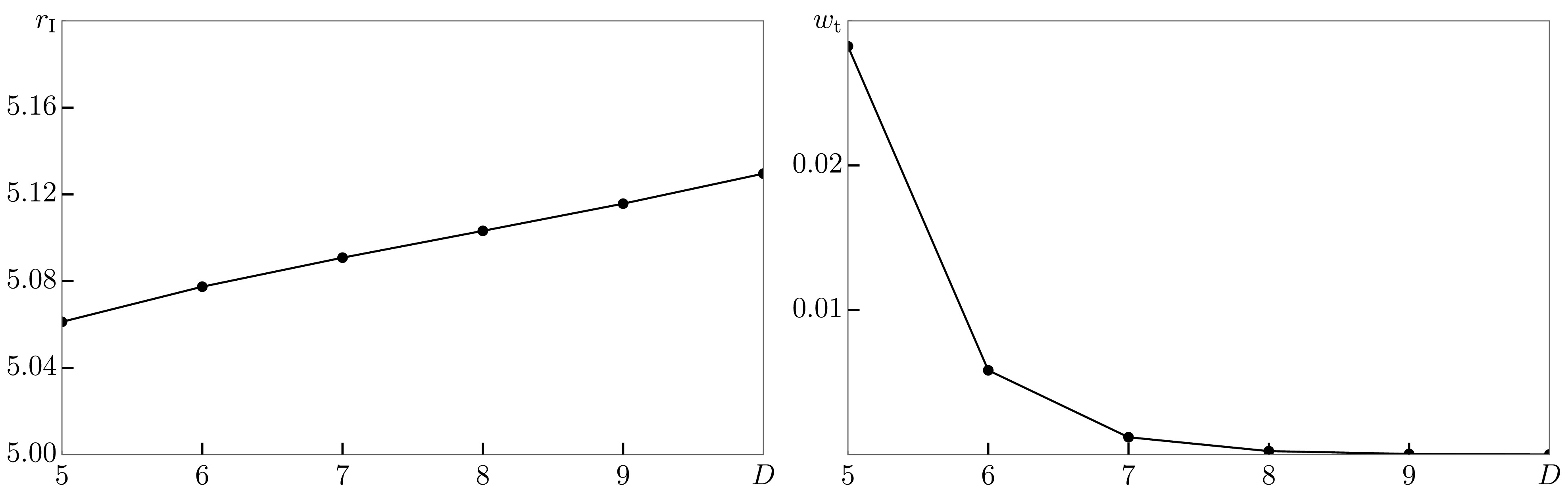
Figure A1. Dependence of the ISCO radius
$ r_{\rm{I}} $ and the tangential equation-of-state parameter evaluated at the ISCO,$ w_{\rm{t}}(r_{\rm{I}}) $ , on the spacetime dimension D.As shown in Fig. A1, in this particular model, the ISCO radius increases monotonically with the number of spacetime dimensions, whereas the tangential equation-of-state parameter rapidly approaches zero. Thus, as the spacetime dimension increases, the ISCO occurs at progressively larger radii, and the matter at the ISCO behaves like pressureless dust. Furthermore, the ISCO radius can be made arbitrarily large through appropriate choices of α and
$ r_0 $ , explicitly demonstrating the absence of a finite upper bound for$ D \geqslant 5 $ .
Unbounded radius of innermost stable circular orbit in higher-dimensional black holes
- Received Date: 2026-07-23
- Available Online: 2026-09-01
Abstract: The innermost stable circular orbit (ISCO) provides a fundamental test of spacetime structure. However, the influence of anisotropic energy–momentum tensors on its properties in higher-dimensional black hole spacetimes remains incompletely understood. In this work, we investigate the upper bound on the ISCO radius in higher-dimensional, static, spherically symmetric, and asymptotically flat black hole spacetimes in the presence of an anisotropic energy–momentum tensor. We assume that the energy–momentum tensor satisfies the weak energy condition, has a nonpositive trace, and obeys constraints on the radial and tangential pressures, which are collectively equivalent to the dominant energy condition with additional restrictions. By analyzing the effective potential for timelike geodesics and imposing the ISCO conditions, we demonstrate that, in general, no upper bound exists on the ISCO radius in higher-dimensional spacetimes. The results show that the allowed equations of state of matter at the ISCO depend explicitly on the spacetime dimension. In the large-D limit, both the radial and tangential equations of state vanish, corresponding to pressureless dust behavior. These findings advance our understanding of orbital stability in higher-dimensional gravitational systems and highlight fundamental differences from four-dimensional black hole dynamics.



 DownLoad: