


 Abstract
 HTML
HTML Reference
 Related
 PDF
PDF




-
Semileptonic b-hadron decays provide an ideal platform for testing heavy-to-light transition form factors [1–6]. Mediated by the quark-level
$ b\to u\ell\bar\nu_\ell $ weak transition, they offer one of the most reliable avenues for determining the Cabibbo–Kobayashi–Maskawa (CKM) matrix element$ |V_{ub}| $ [7–15], a key parameter that governs the overall magnitude of CP violation in the Standard Model. Moreover, owing to their relatively small hadronic uncertainties, these decays provide a sensitive probe for potential contributions from physics beyond the Standard Model [16–18].The four-body decay channel
$ B\to\pi\pi\ell\bar\nu_\ell $ is among the semileptonic B decays that have been measured experimentally [19–23]. In this process, the quasi-two-body contribution$ B\to\rho\ell\bar\nu_\ell $ , followed by the decay$ \rho\to\pi\pi $ , plays a dominant role. Accordingly, this decay has been extensively studied within various theoretical frameworks, including factorization approaches [24–27], QCD light-cone sum rules [28–33], lattice QCD [34], model-independent parameterizations [35], and phenomenological analyses [36]. However, the nonresonant contribution to$ B\to\pi\pi\ell\bar\nu_\ell $ represents a genuine four-body decay topology but is often treated as a negligible background and has received comparatively little attention.The Belle Collaboration has recently measured the branching fractions of
$ B^{-}\to\pi^{+}\pi^{-}\ell^{-}\bar\nu_\ell $ over the full$ \pi\pi $ invariant-mass ($ M_{\pi\pi} $ ) spectrum, as reported in [23].$ {\cal B}_{\text{T}}(B^-\to\pi^+\pi^-\ell^-\bar\nu_\ell) =(22.7^{+1.9}_{-1.6}\pm 3.5)\times 10^{-5}\,, $
(1) with
$ \ell^-=e^- $ or$ \mu^- $ . Here, the total branching fraction$ {\cal B}_{\text{T}} $ includes contributions from resonant processes of the form$ B^{-}\to R\ell^{-}\bar\nu_\ell $ followed by$ R\to\pi^{+}\pi^{-} $ , with$ R=\rho^0 $ or$ R=f_2\equiv f_2(1270) $ . Because the$ \pi\pi $ invariant-mass spectrum is measured over the full kinematic range, potential non-resonant contributions are also expected. However, a dedicated statistical analysis of the non-resonant component has not yet been performed. Assuming$ {\cal B}_{\text{T}}\simeq{\cal B}_\rho+ {\cal B}_{f_2}+{\cal B}_{\text{N}} $ , where$ {\cal B}_{\rho}(B^{-}\to\rho^0\ell^{-}\bar\nu_\ell,\rho^0\to\pi^{+}\pi^{-}) =(15.8\pm 1.1)\times 10^{-5} $ [15] and$ {\cal B}_{f_2}(B^{-}\to f_2\ell^{-}\bar\nu_\ell,f_2\to\pi^{+}\pi^{-}) =(1.8\pm 0.9^{+0.2}_{-0.1})\times 10^{-5} $ [37], the non-resonant branching fraction can be estimated as$ {\cal B}_{\text{N}}(B^{-}\to\pi^{+}\pi^{-}\ell^{-}\bar\nu_\ell) \sim{\cal O}(10^{-5}) $ . This indicates that the non-resonant contribution is comparable in magnitude to the resonant components and should not be regarded as a negligible background, thereby warranting dedicated investigation.The non-resonant decay channel
$ B^{-}\to\pi^{+}\pi^{-}\ell^{-}\bar\nu_\ell $ is governed by the$ B\to\pi\pi $ non-resonant form factors, denoted$ F_{\pi\pi} $ . Notably, the non-leptonic B decay channel$ B^-\to\pi^-\pi^+\pi^- $ also requires$ F_{\pi\pi} $ to account for its sizable non-resonant contribution [15], although these form factors remain poorly determined. Currently, little information is available in the literature [7, 24–43]. This situation motivates us to extract$ F_{\pi\pi} $ from the measured$ \pi\pi $ invariant-mass distribution in$ B^{-}\to\pi^{+}\pi^{-}\ell^{-}\bar\nu_\ell $ . To this end, we will separate the resonant contributions from the non-resonant component and perform a numerical analysis of the branching fractions and angular distributions. In addition, we will examine the sensitivity of the current data to the CKM matrix element$ |V_{ub}| $ . -
Semileptonic b-hadron decays provide an ideal platform for testing heavy-to-light transition form factors [1–6]. Mediated by the quark-level
$ b\to u\ell\bar\nu_\ell $ weak transition, they offer one of the most reliable avenues for determining the Cabibbo–Kobayashi–Maskawa (CKM) matrix element$ |V_{ub}| $ [7–15], a key parameter that governs the overall magnitude of CP violation in the Standard Model. Moreover, owing to their relatively small hadronic uncertainties, these decays provide a sensitive probe for potential contributions from physics beyond the Standard Model [16–18].The four-body decay channel
$ B\to\pi\pi\ell\bar\nu_\ell $ is among the semileptonic B decays that have been measured experimentally [19–23]. In this process, the quasi-two-body contribution$ B\to\rho\ell\bar\nu_\ell $ , followed by the decay$ \rho\to\pi\pi $ , plays a dominant role. Accordingly, this decay has been extensively studied within various theoretical frameworks, including factorization approaches [24–27], QCD light-cone sum rules [28–33], lattice QCD [34], model-independent parameterizations [35], and phenomenological analyses [36]. However, the nonresonant contribution to$ B\to\pi\pi\ell\bar\nu_\ell $ represents a genuine four-body decay topology but is often treated as a negligible background and has received comparatively little attention.The Belle Collaboration has recently measured the branching fractions of
$ B^{-}\to\pi^{+}\pi^{-}\ell^{-}\bar\nu_\ell $ over the full$ \pi\pi $ invariant-mass ($ M_{\pi\pi} $ ) spectrum, as reported in [23].$ {\cal B}_{T}(B^-\to\pi^+\pi^-\ell^-\bar\nu_\ell) =(22.7^{+1.9}_{-1.6}\pm 3.5)\times 10^{-5}\,, $
(1) with
$ \ell^-=e^- $ or$ \mu^- $ . Here, the total branching fraction$ {\cal B}_{T} $ includes contributions from resonant processes of the form$ B^{-}\to R\ell^{-}\bar\nu_\ell $ followed by$ R\to\pi^{+}\pi^{-} $ , with$ R=\rho^0 $ or$ R=f_2\equiv f_2(1270) $ . Because the$ \pi\pi $ invariant-mass spectrum is measured over the full kinematic range, potential non-resonant contributions are also expected. However, a dedicated statistical analysis of the non-resonant component has not yet been performed. Assuming$ {\cal B}_{T}\simeq{\cal B}_\rho+ {\cal B}_{f_2}+ {\cal B}_{N} $ , where$ {\cal B}_{\rho}(B^{-}\to\rho^0\ell^{-}\bar\nu_\ell,\rho^0\to\pi^{+}\pi^{-}) =(15.8\pm 1.1)\times 10^{-5} $ [15] and$ {\cal B}_{f_2}(B^{-}\to f_2\ell^{-}\bar\nu_\ell,f_2\to\pi^{+}\pi^{-}) =(1.8\pm 0.9^{+0.2}_{-0.1})\times 10^{-5} $ [37], the non-resonant branching fraction can be estimated as$ {\cal B}_{N}(B^{-}\to\pi^{+}\pi^{-}\ell^{-}\bar\nu_\ell) \sim{\cal O}(10^{-5}) $ . This indicates that the non-resonant contribution is comparable in magnitude to the resonant components and should not be regarded as a negligible background, thereby warranting dedicated investigation.The non-resonant decay channel
$ B^{-}\to\pi^{+}\pi^{-}\ell^{-}\bar\nu_\ell $ is governed by the$ B\to\pi\pi $ non-resonant form factors, denoted$ F_{\pi\pi} $ . Notably, the non-leptonic B decay channel$ B^-\to\pi^-\pi^+\pi^- $ also requires$ F_{\pi\pi} $ to account for its sizable non-resonant contribution [15], although these form factors remain poorly determined. Currently, little information is available in the literature [7, 24–43]. This situation motivates us to extract$ F_{\pi\pi} $ from the measured$ \pi\pi $ invariant-mass distribution in$ B^{-}\to\pi^{+}\pi^{-}\ell^{-}\bar\nu_\ell $ . To this end, we will separate the resonant contributions from the non-resonant component and perform a numerical analysis of the branching fractions and angular distributions. In addition, we will examine the sensitivity of the current data to the CKM matrix element$ |V_{ub}| $ . -
Semileptonic b-hadron decays provide an ideal platform for testing heavy-to-light transition form factors [1–6]. Mediated by the quark-level
$ b\to u\ell\bar\nu_\ell $ weak transition, they offer one of the most reliable avenues for determining the Cabibbo–Kobayashi–Maskawa (CKM) matrix element$ |V_{ub}| $ [7–15], a key parameter that governs the overall magnitude of CP violation in the Standard Model. Moreover, owing to their relatively small hadronic uncertainties, these decays provide a sensitive probe for potential contributions from physics beyond the Standard Model [16–18].The four-body decay channel
$ B\to\pi\pi\ell\bar\nu_\ell $ is among the semileptonic B decays that have been measured experimentally [19–23]. In this process, the quasi-two-body contribution$ B\to\rho\ell\bar\nu_\ell $ , followed by the decay$ \rho\to\pi\pi $ , plays a dominant role. Accordingly, this decay has been extensively studied within various theoretical frameworks, including factorization approaches [24–27], QCD light-cone sum rules [28–33], lattice QCD [34], model-independent parameterizations [35], and phenomenological analyses [36]. However, the nonresonant contribution to$ B\to\pi\pi\ell\bar\nu_\ell $ represents a genuine four-body decay topology but is often treated as a negligible background and has received comparatively little attention.The Belle Collaboration has recently measured the branching fractions of
$ B^{-}\to\pi^{+}\pi^{-}\ell^{-}\bar\nu_\ell $ over the full$ \pi\pi $ invariant-mass ($ M_{\pi\pi} $ ) spectrum, as reported in [23].$ {\cal B}_{T}(B^-\to\pi^+\pi^-\ell^-\bar\nu_\ell) =(22.7^{+1.9}_{-1.6}\pm 3.5)\times 10^{-5}\,, $
(1) with
$ \ell^-=e^- $ or$ \mu^- $ . Here, the total branching fraction$ {\cal B}_{T} $ includes contributions from resonant processes of the form$ B^{-}\to R\ell^{-}\bar\nu_\ell $ followed by$ R\to\pi^{+}\pi^{-} $ , with$ R=\rho^0 $ or$ R=f_2\equiv f_2(1270) $ . Because the$ \pi\pi $ invariant-mass spectrum is measured over the full kinematic range, potential non-resonant contributions are also expected. However, a dedicated statistical analysis of the non-resonant component has not yet been performed. Assuming$ {\cal B}_{T}\simeq{\cal B}_\rho+ {\cal B}_{f_2}+ {\cal B}_{N} $ , where$ {\cal B}_{\rho}(B^{-}\to\rho^0\ell^{-}\bar\nu_\ell,\rho^0\to\pi^{+}\pi^{-}) =(15.8\pm 1.1)\times 10^{-5} $ [15] and$ {\cal B}_{f_2}(B^{-}\to f_2\ell^{-}\bar\nu_\ell,f_2\to\pi^{+}\pi^{-}) =(1.8\pm 0.9^{+0.2}_{-0.1})\times 10^{-5} $ [37], the non-resonant branching fraction can be estimated as$ {\cal B}_{N}(B^{-}\to\pi^{+}\pi^{-}\ell^{-}\bar\nu_\ell) \sim{\cal O}(10^{-5}) $ . This indicates that the non-resonant contribution is comparable in magnitude to the resonant components and should not be regarded as a negligible background, thereby warranting dedicated investigation.The non-resonant decay channel
$ B^{-}\to\pi^{+}\pi^{-}\ell^{-}\bar\nu_\ell $ is governed by the$ B\to\pi\pi $ non-resonant form factors, denoted$ F_{\pi\pi} $ . Notably, the non-leptonic B decay channel$ B^-\to\pi^-\pi^+\pi^- $ also requires$ F_{\pi\pi} $ to account for its sizable non-resonant contribution [15], although these form factors remain poorly determined. Currently, little information is available in the literature [7, 24–43]. This situation motivates us to extract$ F_{\pi\pi} $ from the measured$ \pi\pi $ invariant-mass distribution in$ B^{-}\to\pi^{+}\pi^{-}\ell^{-}\bar\nu_\ell $ . To this end, we will separate the resonant contributions from the non-resonant component and perform a numerical analysis of the branching fractions and angular distributions. In addition, we will examine the sensitivity of the current data to the CKM matrix element$ |V_{ub}| $ . -
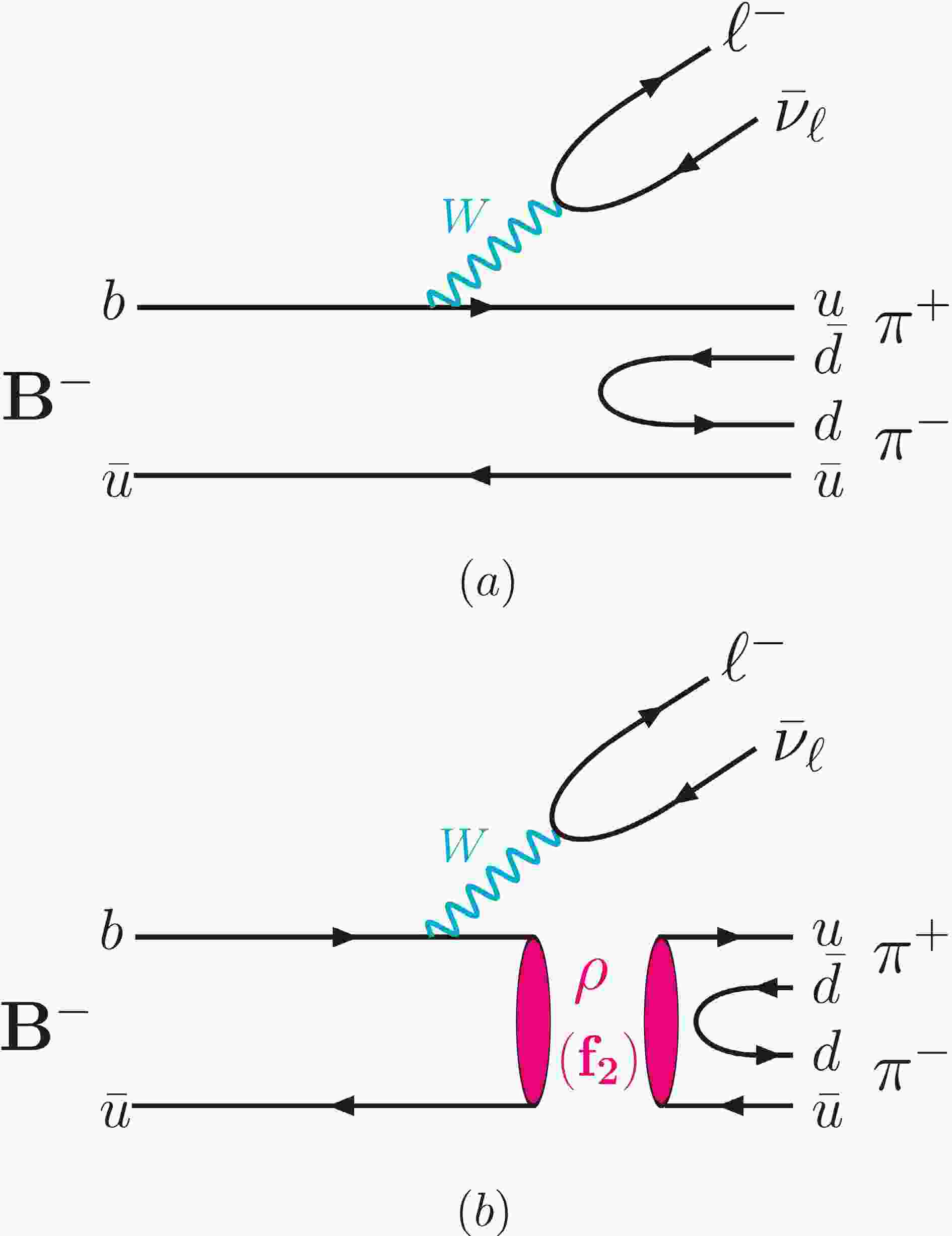
As depicted in Figs. 1(a) and 1(b), the decay
$ B^{-}\to \pi^{+}\pi^{-}\ell^{-}\bar\nu_\ell $ proceeds via resonant and non-resonant$ B\to \pi\pi $ transitions, respectively, with the lepton pair produced by the emitted W boson. In the measured$ M_{\pi\pi} $ spectrum, a dominant peak and a small bump are identified as arising from the processes$ B^-\to \rho^0\ell^-\bar\nu_\ell $ and$ B^-\to f_2\ell^-\bar\nu_\ell $ , respectively, where the vector meson$ \rho^0 $ and the tensor meson$ f_2 $ appear as intermediate resonances decaying into$ \pi^+\pi^- $ . In addition, a non-resonant component is expected to contribute and can, in principle, be extracted from the data. For our analysis, we express the total amplitude of$ B^-\to \pi^+\pi^-\ell^-\bar\nu_\ell $ as [44]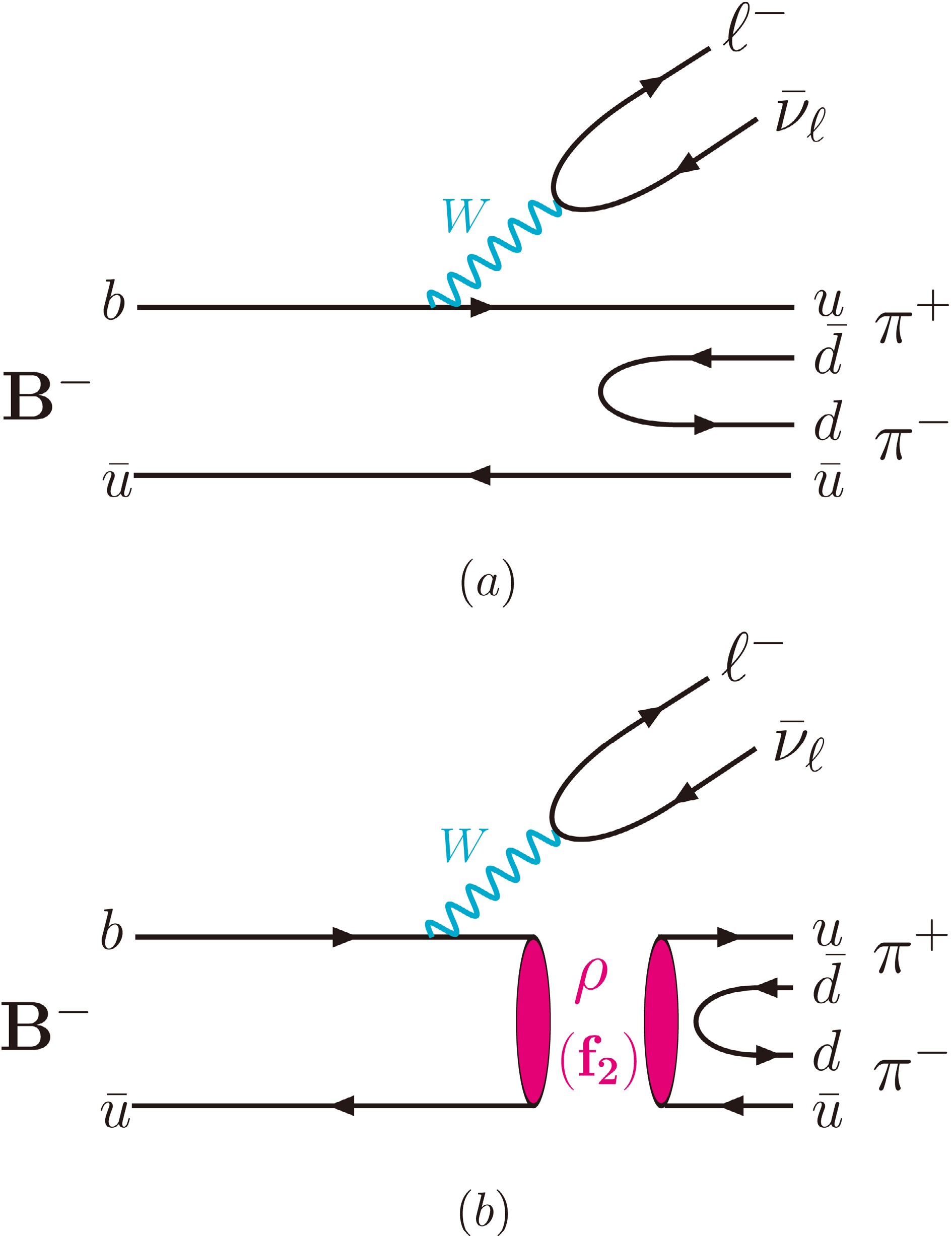
Figure 1. (color online) Semileptonic
$ B^{-}\to\pi^{+}\pi^{-}\ell^{-}\bar\nu_\ell $ decay: (a) nonresonant contribution; (b) resonant contributions via the intermediate states$ \rho^0 $ and$ f_2 $ .$ \begin{aligned}[b] {\cal M}_{\text T} =\;&{\cal M}_{\text N}(B^-\to \pi^+\pi^-\ell\bar \nu_\ell) +{\cal M}_{\rho}(B^-\to \rho^0\ell^-\bar \nu_\ell,\rho^0\to \pi^+\pi^-)\\ +&{\cal M}_{f_2}(B^-\to f_2\ell^-\bar \nu_\ell,f_2\to \pi^+\pi^-)\,,\\ {\cal M}_{\text {N(R)}} =\;&\frac{G_F V_{ub}}{\sqrt 2}\langle \pi^+\pi^-|\bar u\gamma_\mu(1-\gamma_5)b|B^-\rangle_{\text{N(R)}}\, \bar u_\ell\gamma^\mu(1-\gamma_5)v_\nu\,, \end{aligned} $
(2) where the subscripts T, N, and
$ R=(\rho,f_2) $ denote the total, non-resonant, and resonant contributions, respectively. The hadronic matrix elements for the (non-)resonant$ B\to\pi\pi $ transitions are parameterized as in Refs. [1, 45]$ \begin{aligned}[b] &\langle \pi^+(p_a)\pi^-(p_b)|\bar u\gamma_\mu(1-\gamma_5)b|B^-\rangle_N\\ =\;& h\epsilon_{\mu\nu\alpha\beta}p_B^\nu p^\alpha (p_b-p_a)^\beta +{\rm i}rq_\mu+{\rm i}w_+ p_\mu+{\rm i}w_-(p_b-p_a)\,,\\ &\langle \pi^+(p_a)\pi^-(p_b)|\bar u\gamma_\mu(1-\gamma_5)b|B^-\rangle_{\rho(f_2)}\\ =\;& \langle \pi^+\pi^-|\rho(f_2)\rangle \frac{\rm i}{(t-m_{\rho(f_2)}^2)+im_{\rho(f_2)}\Gamma_{\rho(f_2)}}\\& \times\langle \rho(f_2)|\bar u\gamma_\mu(1-\gamma_5)b|B^-\rangle\,, \end{aligned} $
(3) where
$ p=p_b+p_a $ ,$ q=p_B-p=p_\ell+p_\nu $ , and$ (s,t)\equiv (q^2,p^2) $ . The non-resonant form factors are denoted by$ F_{\pi\pi}= (h, r, w_{\pm}) $ . The$ B\to \rho(f_2) $ transition matrix elements are parameterized as in Refs. [46–48]$ \begin{aligned}[b] \langle \rho(f_2)|\bar u\gamma_\mu b|B\rangle=\;&\epsilon_{\mu\nu\alpha\beta} \epsilon^{(\prime)\nu}p_B^{\alpha}p_{\rho(f_2)}^{\beta} \frac{2V_1^{(\prime)}}{m_{B}+m_{\rho(f_2)}}\;,\\ \langle \rho(f_2)|\bar u\gamma_\mu \gamma_5 b|B\rangle =\;&{\rm i}\bigg[\epsilon^{(\prime)}_\mu -\frac{\epsilon^{(\prime)}\cdot p_B}{s}q_\mu\bigg](m_B+m_{\rho(f_2)})A_1^{(\prime)} \\&+ {\rm i}\frac{\epsilon^{(\prime)}\cdot p_B}{s}q_\mu(2m_{\rho(f_2)})A_0^{(\prime)}\\ &-{\rm i}\bigg[(p_B+p_{\rho(f_2)})_\mu- \frac{m^2_B-m^2_{\rho(f_2)}}{s}q_\mu \bigg]\\&\times(\epsilon^{(\prime)}\cdot p_B) \frac{A_2^{(\prime)}}{m_B+m_{\rho(f_2)}}\;, \end{aligned} $
(4) where
$ \epsilon^{\prime\mu}\equiv \epsilon^{\mu\nu}p_{B\nu}/m_B $ . Here,$ \epsilon^\nu $ and$ \epsilon^{\mu\nu} $ denote the polarization vector and tensor, respectively, and$ F_{\rho(f_2)}=(V_1^{(\prime)}, A_{0,1,2}^{(\prime)}) $ collects the corresponding transition form factors. The strong decay vertices$ \langle \pi\pi|\rho,f_2\rangle $ are given in Refs. [10, 49, 50]$ \begin{aligned}[b] \langle \pi\pi|\rho\rangle=&g_1 \epsilon\cdot (p_b-p_a)\,,\;\\ \langle \pi\pi|f_2\rangle=&g_2\epsilon^{\mu\nu}p_{a\mu}p_{b\nu}\,, \end{aligned} $
(5) where
$ g_{1,2} $ denote strong coupling constants. To perform the sums over the vector and tensor polarizations of the intermediate ρ and$ f_2 $ states, we follow Refs. [46–48].$ \begin{aligned}[b] \Sigma\epsilon_\mu \epsilon^*_{\mu'} =&M_{\mu\mu'}\,,\\ \Sigma\epsilon_{\mu\nu} \epsilon^*_{\mu'\nu'} =&{1\over 2}M_{\mu\mu'}M_{\nu\nu'}+{1\over 2}M_{\mu\nu'}M_{\nu\mu'} -{1\over 3}M_{\mu\nu}M_{\mu'\nu'}\,, \end{aligned} $
(6) with
$ M_{\mu\mu'} = -g_{\mu\mu'} + p_\mu p_{\mu'}/p^2 $ . The form factors in Eqs. (3) and (4) are momentum-dependent and are modeled using either single- or double-pole parametrizations [46–48]:$ \begin{align} F_\rho(s)=&\frac{F_\rho(0)}{1-s/m_V^2}\,,\\ F_{f_2}(s)=&\frac{F_{f_2}(0)}{(1-s/m_B^2)^2}\,,\\ F_{\pi\pi}(t)=&\frac{F_{\pi\pi}(0)}{1-a\,(t/m_B^2)+b\,(t/m_B^2)^2}\,, \end{align} $
(7) where
$ F_{\rho} $ and$ F_{f_2} $ have been studied within QCD-based approaches [48, 51], while the parameters$ (a,b,F_{\pi\pi}(0)) $ are extracted from a global fit.For the four-body decay channel
$B^-(p_B)\to $ $ \pi^+(p_a)\pi^-(p_b)\ell^-(p_\ell)\bar \nu_\ell(p_\nu) $ , the phase-space integration is performed over the kinematic variables$ (s,t,\theta_M,\theta_L,\phi) $ . As illustrated in Fig. 2,$ \theta_{M(L)} $ denotes the angle between the momenta of the$ \pi^+ $ and$ \pi^- $ (of the$ \ell^- $ and$ \bar \nu_\ell $ ) in the$ \pi^+\pi^- $ ($ \ell^-\bar \nu_\ell $ ) rest frame. In addition, the angle ϕ is defined as the angle between the decay planes of the$ \pi^+\pi^- $ and$ \ell^-\bar \nu_\ell $ systems, which are formed by$ \vec{p}_{a,b} $ and$ \vec{p}_{\ell,\bar \nu_\ell} $ , respectively, in the B-meson rest frame. The differential decay width is given by [1, 3, 4]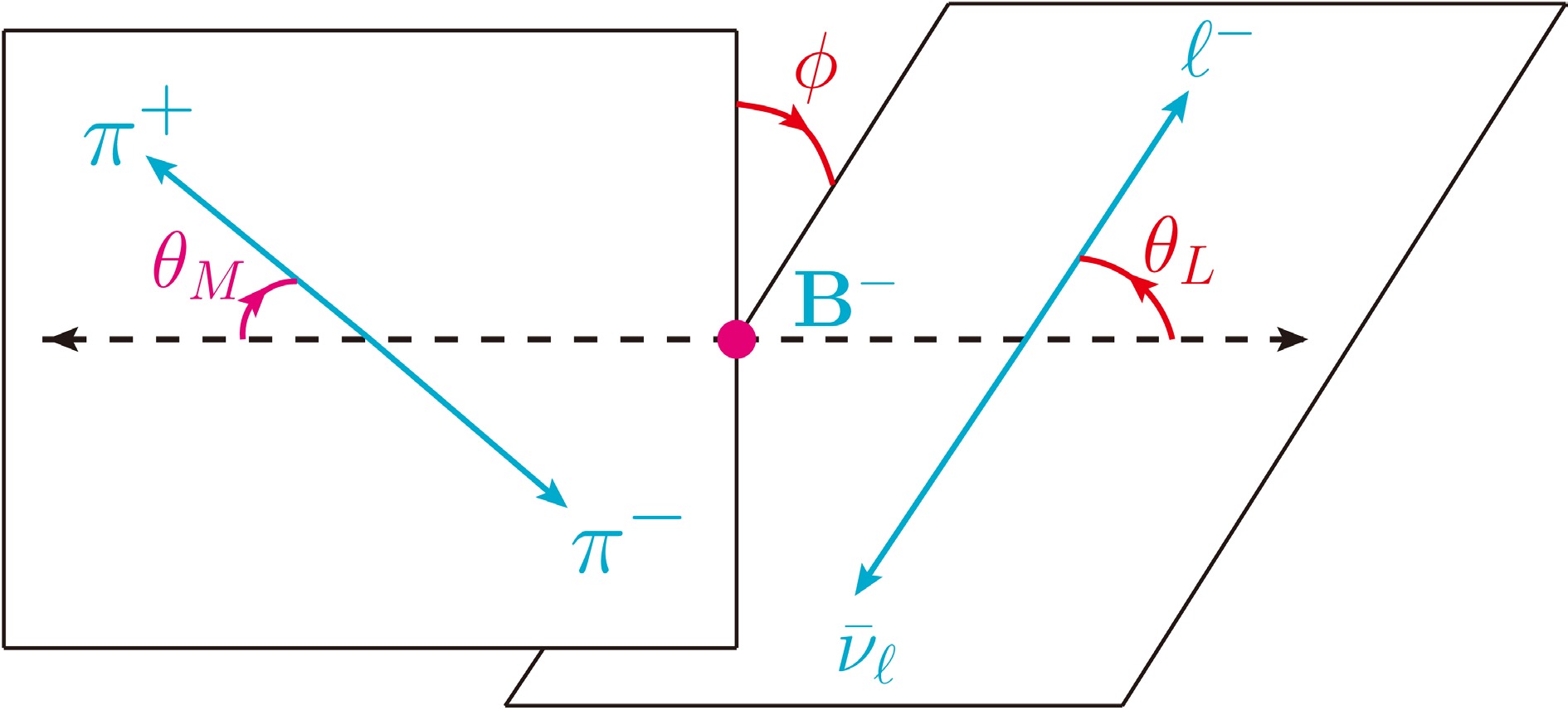
Figure 2. (color online) The angular variables
$ (\theta_{M}, \theta_{L}, \phi) $ in the four-body$ B^-\to\pi^+\pi^-\ell^-\bar \nu_\ell $ decay.$ {\rm d}\Gamma=\frac{|{\cal M}|^2}{4(4\pi)^6 m_B^3}X \alpha_M\alpha_L\, {\rm d}s\, {\rm d}t\, {\rm d}\text{cos}\,\theta_M\, {\rm d}\text{cos}\,\theta_L\, {\rm d}\phi\,, $
(8) where X,
$ \alpha_{M} $ , and$ \alpha_{L} $ are defined as in [43, 52, 53]$ \begin{aligned}[b] X=&\bigg[\frac{1}{4}(m_B^2-s-t)^2-st\bigg]^{1/2}\,,\\ \alpha_{M}=&\frac{1}{t}\lambda^{1/2}(t,m_{\pi}^2,m_{\pi}^2)\,,\\ \alpha_{L}=&\frac{1}{s}\lambda^{1/2}(s,m_{\ell}^2,m_{\bar \nu}^2)\,, \end{aligned} $
(9) with
$ \lambda(a,b,c)=a^2+b^2+c^2-2ab-2bc-2ca $ . The allowed ranges for$ (s,t) $ and the angular variables ($ \theta_M,\theta_L,\phi $ ) are:$ \begin{align} &(m_{\ell}+m_{\bar \nu_\ell})^2\leq s\leq (m_{B}-\sqrt{t})^2\,,\; 4m_\pi^2\leq t\leq (m_B-m_{\ell}-m_{\bar \nu_{\ell}})^2\,,\\ &0\leq \theta_{M,L}\leq \pi\,,\;\; 0\leq \phi\leq 2\pi\,, \end{align} $
(10) with
$ m_{\ell}+m_{\bar \nu_\ell}\simeq 0 $ , the angular asymmetry is defined from Eq. (8), as in Refs. [54–56].$ {A}_{\theta_M}\equiv\dfrac{\displaystyle\int^{+1}_0\dfrac{{\rm d}\Gamma}{{\rm d}\cos\theta_{M}}{\rm d}\cos\theta_M -\displaystyle\int^0_{-1}\dfrac{{\rm d}\Gamma}{{\rm d}\cos\theta_M}{\rm d}\cos\theta_M}{\displaystyle\int^{+1}_0\dfrac{{\rm d}\Gamma}{{\rm d}\cos\theta_M} {\rm d}\cos\theta_M+ \displaystyle\int^0_{-1}\dfrac{{\rm d}\Gamma}{{\rm d}\cos\theta_M}{\rm d}\cos\theta_M}\;,$
(11) where
${\rm d}\Gamma/{\rm d}\cos\theta_M$ represents the angular distribution. -
As depicted in Figs. 1a and 1b, the decay
$ B^{-}\to\pi^{+}\pi^{-}\ell^{-}\bar\nu_\ell $ proceeds via resonant and non-resonant$ B\to \pi\pi $ transitions, respectively, with the lepton pair produced by the emitted W boson. In the measured$ M_{\pi\pi} $ spectrum, a dominant peak and a small bump are identified as arising from the processes$ B^-\to \rho^0\ell^-\bar\nu_\ell $ and$ B^-\to f_2\ell^-\bar\nu_\ell $ , respectively, where the vector meson$ \rho^0 $ and the tensor meson$ f_2 $ appear as intermediate resonances decaying into$ \pi^+\pi^- $ . In addition, a non-resonant component is expected to contribute and can, in principle, be extracted from the data. For our analysis, we express the total amplitude of$ B^-\to \pi^+\pi^-\ell^-\bar\nu_\ell $ as [44]
Figure 1. (color online) Semileptonic
$ B^{-}\to\pi^{+}\pi^{-}\ell^{-}\bar\nu_\ell $ decay: (a) nonresonant contribution; (b) resonant contributions via the intermediate states$ \rho^0 $ and$ f_2 $ .$ \begin{aligned}[b] {\cal M}_{\text T} =\;&{\cal M}_{\text N}(B^-\to \pi^+\pi^-\ell\bar \nu_\ell) +{\cal M}_{\rho}(B^-\to \rho^0\ell^-\bar \nu_\ell,\rho^0\to \pi^+\pi^-)\\ +&{\cal M}_{f_2}(B^-\to f_2\ell^-\bar \nu_\ell,f_2\to \pi^+\pi^-)\,,\\ {\cal M}_{\text {N(R)}} =\;&\frac{G_F V_{ub}}{\sqrt 2}\langle \pi^+\pi^-|\bar u\gamma_\mu(1-\gamma_5)b|B^-\rangle_{\text{N(R)}}\, \bar u_\ell\gamma^\mu(1-\gamma_5)v_\nu\,, \end{aligned} $
(2) where the subscripts T, N, and
$ R=(\rho,f_2) $ denote the total, non-resonant, and resonant contributions, respectively. The hadronic matrix elements for the (non-)resonant$ B\to\pi\pi $ transitions are parameterized as in Refs. [1, 45]$ \begin{aligned}[b] &\langle \pi^+(p_a)\pi^-(p_b)|\bar u\gamma_\mu(1-\gamma_5)b|B^-\rangle_N\\ =\;& h\epsilon_{\mu\nu\alpha\beta}p_B^\nu p^\alpha (p_b-p_a)^\beta +irq_\mu+iw_+ p_\mu+iw_-(p_b-p_a)\,,\\ &\langle \pi^+(p_a)\pi^-(p_b)|\bar u\gamma_\mu(1-\gamma_5)b|B^-\rangle_{\rho(f_2)}\\ =\;& \langle \pi^+\pi^-|\rho(f_2)\rangle \frac{i}{(t-m_{\rho(f_2)}^2)+im_{\rho(f_2)}\Gamma_{\rho(f_2)}}\\& \langle \rho(f_2)|\bar u\gamma_\mu(1-\gamma_5)b|B^-\rangle\,, \end{aligned} $
(3) where
$ p=p_b+p_a $ ,$ q=p_B-p=p_\ell+p_\nu $ , and$ (s,t)\equiv (q^2,p^2) $ . The non-resonant form factors are denoted by$ F_{\pi\pi}=(h, r, w_{\pm}) $ . The$ B\to \rho(f_2) $ transition matrix elements are parameterized as in Refs. [46–48]$ \begin{aligned}[b] \langle \rho(f_2)|\bar u\gamma_\mu b|B\rangle=\;&\epsilon_{\mu\nu\alpha\beta} \epsilon^{(\prime)\nu}p_B^{\alpha}p_{\rho(f_2)}^{\beta} \frac{2V_1^{(\prime)}}{m_{B}+m_{\rho(f_2)}}\;,\\ \langle \rho(f_2)|\bar u\gamma_\mu \gamma_5 b|B\rangle =\;&i\bigg[\epsilon^{(\prime)}_\mu -\frac{\epsilon^{(\prime)}\cdot p_B}{s}q_\mu\bigg](m_B+m_{\rho(f_2)})A_1^{(\prime)} \\&+ i\frac{\epsilon^{(\prime)}\cdot p_B}{s}q_\mu(2m_{\rho(f_2)})A_0^{(\prime)}\\ &-i\bigg[(p_B+p_{\rho(f_2)})_\mu- \frac{m^2_B-m^2_{\rho(f_2)}}{s}q_\mu \bigg]\\&\times(\epsilon^{(\prime)}\cdot p_B) \frac{A_2^{(\prime)}}{m_B+m_{\rho(f_2)}}\;, \end{aligned} $
(4) where
$ \epsilon^{\prime\mu}\equiv \epsilon^{\mu\nu}p_{B\nu}/m_B $ . Here,$ \epsilon^\nu $ and$ \epsilon^{\mu\nu} $ denote the polarization vector and tensor, respectively, and$ F_{\rho(f_2)}=(V_1^{(\prime)}, A_{0,1,2}^{(\prime)}) $ collects the corresponding transition form factors. The strong decay vertices$ \langle \pi\pi|\rho,f_2\rangle $ are given in Refs. [10, 50, 51]$ \begin{aligned}[b] \langle \pi\pi|\rho\rangle=&g_1 \epsilon\cdot (p_b-p_a)\,,\;\\ \langle \pi\pi|f_2\rangle=&g_2\epsilon^{\mu\nu}p_{a\mu}p_{b\nu}\,, \end{aligned} $
(5) where
$ g_{1,2} $ denote strong coupling constants. To perform the sums over the vector and tensor polarizations of the intermediate ρ and$ f_2 $ states, we follow Refs. [46–48].$ \begin{aligned}[b] \Sigma\epsilon_\mu \epsilon^*_{\mu'} =&M_{\mu\mu'}\,,\\ \Sigma\epsilon_{\mu\nu} \epsilon^*_{\mu'\nu'} =&{1\over 2}M_{\mu\mu'}M_{\nu\nu'}+{1\over 2}M_{\mu\nu'}M_{\nu\mu'} -{1\over 3}M_{\mu\nu}M_{\mu'\nu'}\,, \end{aligned} $
(6) with
$ M_{\mu\mu'} = -g_{\mu\mu'} + p_\mu p_{\mu'}/p^2 $ . The form factors in Eqs. (3) and (4) are momentum-dependent and are modeled using either single- or double-pole parametrizations [46–48]:$ \begin{align} F_\rho(s)=&\frac{F_\rho(0)}{1-s/m_V^2}\,,\\ F_{f_2}(s)=&\frac{F_{f_2}(0)}{(1-s/m_B^2)^2}\,,\\ F_{\pi\pi}(t)=&\frac{F_{\pi\pi}(0)}{1-a\,(t/m_B^2)+b\,(t/m_B^2)^2}\,, \end{align} $
(7) where
$ F_{\rho} $ and$ F_{f_2} $ have been studied within QCD-based approaches [48, 49], while the parameters$ (a,b,F_{\pi\pi}(0)) $ are extracted from a global fit.For the four-body decay channel
$ B^-(p_B)\to \pi^+(p_a)\pi^-(p_b)\ell^-(p_\ell)\bar \nu_\ell(p_\nu) $ , the phase-space integration is performed over the kinematic variables$ (s,t,\theta_M,\theta_L,\phi) $ . As illustrated in Fig. 2,$ \theta_{M(L)} $ denotes the angle between the momenta of the$ \pi^+ $ and$ \pi^- $ (of the$ \ell^- $ and$ \bar \nu_\ell $ ) in the$ \pi^+\pi^- $ ($ \ell^-\bar \nu_\ell $ ) rest frame. In addition, the angle ϕ is defined as the angle between the decay planes of the$ \pi^+\pi^- $ and$ \ell^-\bar \nu_\ell $ systems, which are formed by$ \vec{p}_{a,b} $ and$ \vec{p}_{\ell,\bar \nu_\ell} $ , respectively, in the B-meson rest frame. The differential decay width is given by [1, 3, 4]
Figure 2. (color online) The angular variables
$ (\theta_{M}, \theta_{L}, \phi) $ in the four-body$ B^-\to\pi^+\pi^-\ell^-\bar \nu_\ell $ decay.$ d\Gamma=\frac{|{\cal M}|^2}{4(4\pi)^6 m_B^3}X \alpha_M\alpha_L\, ds\, dt\, d\text{cos}\,\theta_M\, d\text{cos}\,\theta_L\, d\phi\,, $
(8) where X,
$ \alpha_{M} $ , and$ \alpha_{L} $ are defined as in [43, 52, 53]$ \begin{aligned}[b] X=&\bigg[\frac{1}{4}(m_B^2-s-t)^2-st\bigg]^{1/2}\,,\\ \alpha_{M}=&\frac{1}{t}\lambda^{1/2}(t,m_{\pi}^2,m_{\pi}^2)\,,\\ \alpha_{L}=&\frac{1}{s}\lambda^{1/2}(s,m_{\ell}^2,m_{\bar \nu}^2)\,, \end{aligned} $
(9) With
$ \lambda(a,b,c)=a^2+b^2+c^2-2ab-2bc-2ca $ . The allowed ranges for$ (s,t) $ and the angular variables ($ \theta_M,\theta_L,\phi $ ) are:$ \begin{align} &(m_{\ell}+m_{\bar \nu_\ell})^2\leq s\leq (m_{B}-\sqrt{t})^2\,,\; 4m_\pi^2\leq t\leq (m_B-m_{\ell}-m_{\bar \nu_{\ell}})^2\,,\\ &0\leq \theta_{M,L}\leq \pi\,,\;\; 0\leq \phi\leq 2\pi\,, \end{align} $
(10) With
$ m_{\ell}+m_{\bar \nu_\ell}\simeq 0 $ , the angular asymmetry is defined from Eq. (8), as in Refs. [54–56].$ {A}_{\theta_M}\equiv\dfrac{\int^{+1}_0\dfrac{d\Gamma}{d\cos\theta_{M}}d\cos\theta_M -\int^0_{-1}\dfrac{d\Gamma}{d\cos\theta_M}d\cos\theta_M}{\int^{+1}_0\dfrac{d\Gamma}{d\cos\theta_M} d\cos\theta_M+\int^0_{-1}\dfrac{d\Gamma}{d\cos\theta_M}d\cos\theta_M}\;,$
(11) where
$ d\Gamma/d\cos\theta_M $ represents the angular distribution. -
As depicted in Figs. 1(a) and 1(b), the decay
$ B^{-}\to \pi^{+}\pi^{-}\ell^{-}\bar\nu_\ell $ proceeds via resonant and non-resonant$ B\to \pi\pi $ transitions, respectively, with the lepton pair produced by the emitted W boson. In the measured$ M_{\pi\pi} $ spectrum, a dominant peak and a small bump are identified as arising from the processes$ B^-\to \rho^0\ell^-\bar\nu_\ell $ and$ B^-\to f_2\ell^-\bar\nu_\ell $ , respectively, where the vector meson$ \rho^0 $ and the tensor meson$ f_2 $ appear as intermediate resonances decaying into$ \pi^+\pi^- $ . In addition, a non-resonant component is expected to contribute and can, in principle, be extracted from the data. For our analysis, we express the total amplitude of$ B^-\to \pi^+\pi^-\ell^-\bar\nu_\ell $ as [44]
Figure 1. (color online) Semileptonic
$ B^{-}\to\pi^{+}\pi^{-}\ell^{-}\bar\nu_\ell $ decay: (a) nonresonant contribution; (b) resonant contributions via the intermediate states$ \rho^0 $ and$ f_2 $ .$ \begin{aligned}[b] {\cal M}_{\text T} =\;&{\cal M}_{\text N}(B^-\to \pi^+\pi^-\ell\bar \nu_\ell) +{\cal M}_{\rho}(B^-\to \rho^0\ell^-\bar \nu_\ell,\rho^0\to \pi^+\pi^-)\\ +&{\cal M}_{f_2}(B^-\to f_2\ell^-\bar \nu_\ell,f_2\to \pi^+\pi^-)\,,\\ {\cal M}_{\text {N(R)}} =\;&\frac{G_F V_{ub}}{\sqrt 2}\langle \pi^+\pi^-|\bar u\gamma_\mu(1-\gamma_5)b|B^-\rangle_{\text{N(R)}}\, \bar u_\ell\gamma^\mu(1-\gamma_5)v_\nu\,, \end{aligned} $
(2) where the subscripts T, N, and
$ R=(\rho,f_2) $ denote the total, non-resonant, and resonant contributions, respectively. The hadronic matrix elements for the (non-)resonant$ B\to\pi\pi $ transitions are parameterized as in Refs. [1, 45]$ \begin{aligned}[b] &\langle \pi^+(p_a)\pi^-(p_b)|\bar u\gamma_\mu(1-\gamma_5)b|B^-\rangle_N\\ =\;& h\epsilon_{\mu\nu\alpha\beta}p_B^\nu p^\alpha (p_b-p_a)^\beta +{\rm i}rq_\mu+{\rm i}w_+ p_\mu+{\rm i}w_-(p_b-p_a)\,,\\ &\langle \pi^+(p_a)\pi^-(p_b)|\bar u\gamma_\mu(1-\gamma_5)b|B^-\rangle_{\rho(f_2)}\\ =\;& \langle \pi^+\pi^-|\rho(f_2)\rangle \frac{\rm i}{(t-m_{\rho(f_2)}^2)+im_{\rho(f_2)}\Gamma_{\rho(f_2)}}\\& \times\langle \rho(f_2)|\bar u\gamma_\mu(1-\gamma_5)b|B^-\rangle\,, \end{aligned} $
(3) where
$ p=p_b+p_a $ ,$ q=p_B-p=p_\ell+p_\nu $ , and$ (s,t)\equiv (q^2,p^2) $ . The non-resonant form factors are denoted by$ F_{\pi\pi}= (h, r, w_{\pm}) $ . The$ B\to \rho(f_2) $ transition matrix elements are parameterized as in Refs. [46–48]$ \begin{aligned}[b] \langle \rho(f_2)|\bar u\gamma_\mu b|B\rangle=\;&\epsilon_{\mu\nu\alpha\beta} \epsilon^{(\prime)\nu}p_B^{\alpha}p_{\rho(f_2)}^{\beta} \frac{2V_1^{(\prime)}}{m_{B}+m_{\rho(f_2)}}\;,\\ \langle \rho(f_2)|\bar u\gamma_\mu \gamma_5 b|B\rangle =\;&{\rm i}\bigg[\epsilon^{(\prime)}_\mu -\frac{\epsilon^{(\prime)}\cdot p_B}{s}q_\mu\bigg](m_B+m_{\rho(f_2)})A_1^{(\prime)} \\&+ {\rm i}\frac{\epsilon^{(\prime)}\cdot p_B}{s}q_\mu(2m_{\rho(f_2)})A_0^{(\prime)}\\ &-{\rm i}\bigg[(p_B+p_{\rho(f_2)})_\mu- \frac{m^2_B-m^2_{\rho(f_2)}}{s}q_\mu \bigg]\\&\times(\epsilon^{(\prime)}\cdot p_B) \frac{A_2^{(\prime)}}{m_B+m_{\rho(f_2)}}\;, \end{aligned} $
(4) where
$ \epsilon^{\prime\mu}\equiv \epsilon^{\mu\nu}p_{B\nu}/m_B $ . Here,$ \epsilon^\nu $ and$ \epsilon^{\mu\nu} $ denote the polarization vector and tensor, respectively, and$ F_{\rho(f_2)}=(V_1^{(\prime)}, A_{0,1,2}^{(\prime)}) $ collects the corresponding transition form factors. The strong decay vertices$ \langle \pi\pi|\rho,f_2\rangle $ are given in Refs. [10, 49, 50]$ \begin{aligned}[b] \langle \pi\pi|\rho\rangle=&g_1 \epsilon\cdot (p_b-p_a)\,,\;\\ \langle \pi\pi|f_2\rangle=&g_2\epsilon^{\mu\nu}p_{a\mu}p_{b\nu}\,, \end{aligned} $
(5) where
$ g_{1,2} $ denote strong coupling constants. To perform the sums over the vector and tensor polarizations of the intermediate ρ and$ f_2 $ states, we follow Refs. [46–48].$ \begin{aligned}[b] \Sigma\epsilon_\mu \epsilon^*_{\mu'} =&M_{\mu\mu'}\,,\\ \Sigma\epsilon_{\mu\nu} \epsilon^*_{\mu'\nu'} =&{1\over 2}M_{\mu\mu'}M_{\nu\nu'}+{1\over 2}M_{\mu\nu'}M_{\nu\mu'} -{1\over 3}M_{\mu\nu}M_{\mu'\nu'}\,, \end{aligned} $
(6) with
$ M_{\mu\mu'} = -g_{\mu\mu'} + p_\mu p_{\mu'}/p^2 $ . The form factors in Eqs. (3) and (4) are momentum-dependent and are modeled using either single- or double-pole parametrizations [46–48]:$ \begin{align} F_\rho(s)=&\frac{F_\rho(0)}{1-s/m_V^2}\,,\\ F_{f_2}(s)=&\frac{F_{f_2}(0)}{(1-s/m_B^2)^2}\,,\\ F_{\pi\pi}(t)=&\frac{F_{\pi\pi}(0)}{1-a\,(t/m_B^2)+b\,(t/m_B^2)^2}\,, \end{align} $
(7) where
$ F_{\rho} $ and$ F_{f_2} $ have been studied within QCD-based approaches [48, 51], while the parameters$ (a,b,F_{\pi\pi}(0)) $ are extracted from a global fit.For the four-body decay channel
$B^-(p_B)\to $ $ \pi^+(p_a)\pi^-(p_b)\ell^-(p_\ell)\bar \nu_\ell(p_\nu) $ , the phase-space integration is performed over the kinematic variables$ (s,t,\theta_M,\theta_L,\phi) $ . As illustrated in Fig. 2,$ \theta_{M(L)} $ denotes the angle between the momenta of the$ \pi^+ $ and$ \pi^- $ (of the$ \ell^- $ and$ \bar \nu_\ell $ ) in the$ \pi^+\pi^- $ ($ \ell^-\bar \nu_\ell $ ) rest frame. In addition, the angle ϕ is defined as the angle between the decay planes of the$ \pi^+\pi^- $ and$ \ell^-\bar \nu_\ell $ systems, which are formed by$ \vec{p}_{a,b} $ and$ \vec{p}_{\ell,\bar \nu_\ell} $ , respectively, in the B-meson rest frame. The differential decay width is given by [1, 3, 4]
Figure 2. (color online) The angular variables
$ (\theta_{M}, \theta_{L}, \phi) $ in the four-body$ B^-\to\pi^+\pi^-\ell^-\bar \nu_\ell $ decay.$ {\rm d}\Gamma=\frac{|{\cal M}|^2}{4(4\pi)^6 m_B^3}X \alpha_M\alpha_L\, {\rm d}s\, {\rm d}t\, {\rm d}\text{cos}\,\theta_M\, {\rm d}\text{cos}\,\theta_L\, {\rm d}\phi\,, $
(8) where X,
$ \alpha_{M} $ , and$ \alpha_{L} $ are defined as in [43, 52, 53]$ \begin{aligned}[b] X=&\bigg[\frac{1}{4}(m_B^2-s-t)^2-st\bigg]^{1/2}\,,\\ \alpha_{M}=&\frac{1}{t}\lambda^{1/2}(t,m_{\pi}^2,m_{\pi}^2)\,,\\ \alpha_{L}=&\frac{1}{s}\lambda^{1/2}(s,m_{\ell}^2,m_{\bar \nu}^2)\,, \end{aligned} $
(9) with
$ \lambda(a,b,c)=a^2+b^2+c^2-2ab-2bc-2ca $ . The allowed ranges for$ (s,t) $ and the angular variables ($ \theta_M,\theta_L,\phi $ ) are:$ \begin{align} &(m_{\ell}+m_{\bar \nu_\ell})^2\leq s\leq (m_{B}-\sqrt{t})^2\,,\; 4m_\pi^2\leq t\leq (m_B-m_{\ell}-m_{\bar \nu_{\ell}})^2\,,\\ &0\leq \theta_{M,L}\leq \pi\,,\;\; 0\leq \phi\leq 2\pi\,, \end{align} $
(10) with
$ m_{\ell}+m_{\bar \nu_\ell}\simeq 0 $ , the angular asymmetry is defined from Eq. (8), as in Refs. [54–56].$ {A}_{\theta_M}\equiv\dfrac{\displaystyle\int^{+1}_0\dfrac{{\rm d}\Gamma}{{\rm d}\cos\theta_{M}}{\rm d}\cos\theta_M -\displaystyle\int^0_{-1}\dfrac{{\rm d}\Gamma}{{\rm d}\cos\theta_M}{\rm d}\cos\theta_M}{\displaystyle\int^{+1}_0\dfrac{{\rm d}\Gamma}{{\rm d}\cos\theta_M} {\rm d}\cos\theta_M+ \displaystyle\int^0_{-1}\dfrac{{\rm d}\Gamma}{{\rm d}\cos\theta_M}{\rm d}\cos\theta_M}\;,$
(11) where
${\rm d}\Gamma/{\rm d}\cos\theta_M$ represents the angular distribution. -
In the numerical analysis, we perform a minimum
$ \chi^2 $ fit to extract, as free parameters,$ |V_{ub}| $ , the nonresonant form factors$ F_{\pi\pi} $ , and$ \delta_{1,2} $ , where$ \delta_{1(2)} $ denotes the relative phase associated with$ {\cal M}_{\rho(f_2)} $ . The$ \chi^2 $ function is defined as$ \begin{aligned}[b] \chi^2=\;& \bigg(\frac{{\cal B}_{\rho\,{\rm th}}-{\cal B}_{\rho\,{\rm ex}}}{\sigma_{\rho\,{\rm ex}}}\bigg)^2+ \bigg(\frac{{\cal B}_{f_2\,{\rm th}}-{\cal B}_{f_2\,{\rm ex}}}{\sigma_{f_2\,{\rm ex}}}\bigg)^2 \,\\ &+ \sum_{i} \bigg(\frac{\frac{{\rm d}{\cal B}^i_{{\rm th}}}{{\rm d}M_{\pi\pi}}-\frac{{\rm d}{\cal B}^i_{{\rm ex}}}{{\rm d}M_{\pi\pi}}}{\sigma_{{\rm ex}}^i}\bigg)^2 +\sum_{j} \bigg(\frac{F_{\rho}^j-F_{{\rm th}\,\rho}^j}{\delta F_{{\rm th}\,\rho}^j}\bigg)^2\\& +\sum_{k} \bigg(\frac{F_{f_2}^k-F_{{\rm th}\,f_2}^k}{\delta F_{{\rm th}\,f_2}^k}\bigg)^2\,, \end{aligned} $
(12) where
${\rm d}{\cal B}/{\rm d}M_{\pi\pi}$ denotes the differential branching fraction, and$ \sigma_{\rm ex} $ ($ \delta F_{\rm th} $ ) represents the experimental (theoretical form-factor) uncertainty. The theoretical inputs$ {\cal B}_{\rho(f_2)\,{\rm th}} $ and${\rm d}{\cal B}_{\rm th}/{\rm d}M_{\pi\pi}$ are obtained from the amplitudes in Eq. (2), whereas the experimental inputs are taken from Eq. (1) and Fig. 3. We use$ F_\rho^{(j)}=(V_1(0),A_1(0),A_2(0)) $ and$ F_{f_2}^{(k)}=(V'_1(0),A'_1(0),A'_2(0)) $ from Table 1 as input values for Eq. (12), together with$ |g_1|=5.98 $ and$ |g_2|=18.56 $ in units of GeV-1 [50, 57].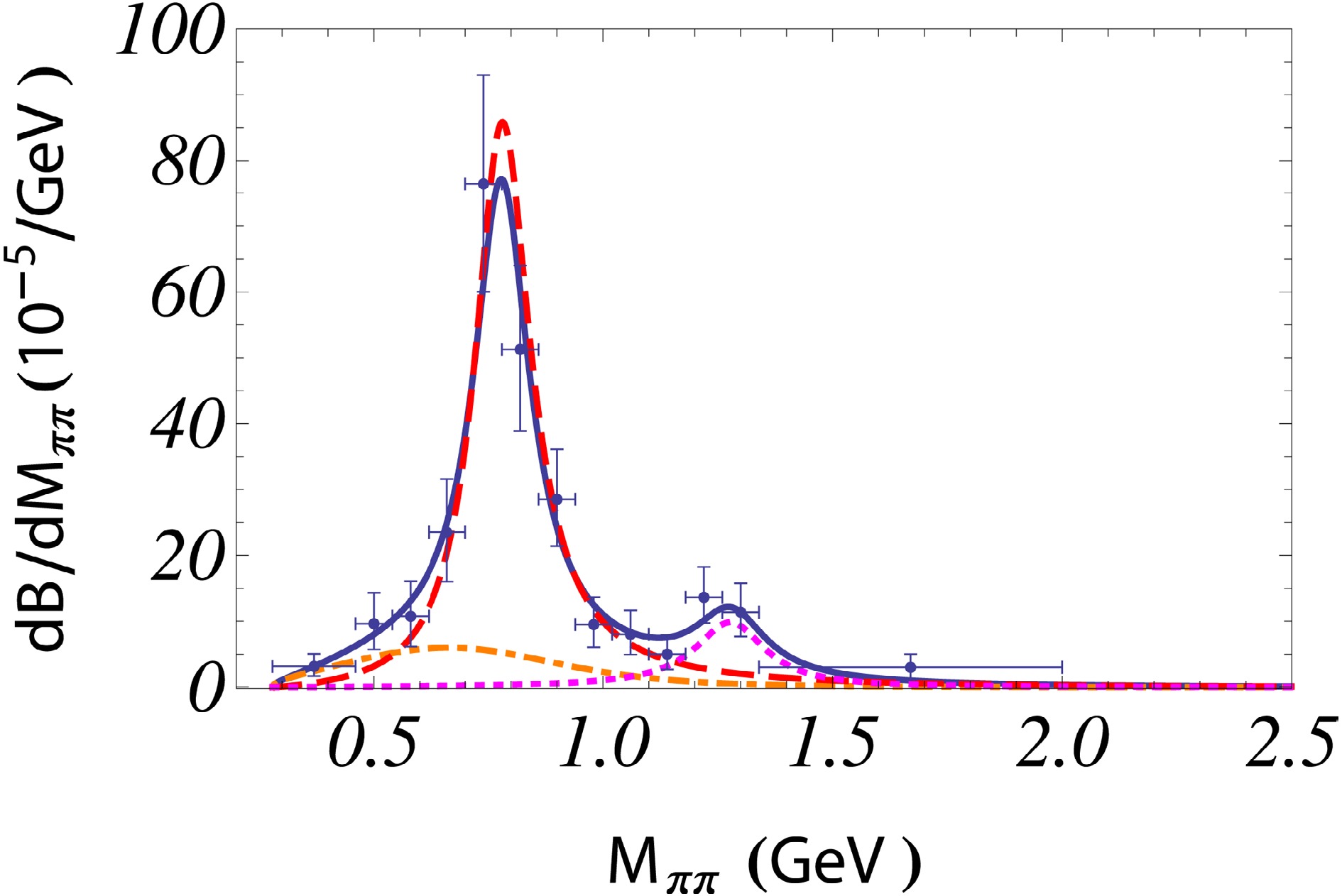
Figure 3. (color online) The
$ \pi\pi $ invariant-mass spectrum. The solid curve includes all contributions and reproduces the data points from Belle [23]. The dashed (dotted) curve represents the contributions from$ B^-\to\rho(f_2)\ell\bar \nu $ , with$ \rho(f_2)\to \pi^+\pi^- $ , while the dot-dashed curve denotes the nonresonant contribution.$ V_1^{(\prime)} $ $ A_1^{(\prime)} $ $ A_2^{(\prime)} $ $ \sqrt 2 F_{\rho^0}(0) $ $ 0.35^{+0.06}_{-0.05} $ $ 0.27^{+0.05}_{-0.04} $ $ 0.26^{+0.05}_{-0.03} $ $ F_{f_2}(0) $ $ (0.18\pm 0.02) $ $ (0.13\pm 0.02) $ $ (0.12\pm 0.02) $ From the fit, we obtain
$ \begin{align} & |V_{ub}|=(3.31\pm 0.61)\times 10^{-3}\,,\\ & a=(26.8\pm 25.9),\; b=(1430.1\pm 680.1)\,,\;\\ & h(0)=(1.90\pm 0.43)\; \text{GeV}^{-3}\,,\,\\ & w_+(0)=(6.16\pm 3.41)\; \text{GeV}^{-1}\,,\, w_-(0)=(3.67\pm 1.79)\; \text{GeV}^{-1}\,,\\ & (\delta_1,\delta_2)=(-111.6\pm 29.3,0.0\pm 1.4)^\circ\,,\\ & \chi^2/n.d.f.=1.1\,, \end{align} $
(13) with
$ n.d.f.=7 $ denoting the number of degrees of freedom. We note that the form factor r in Eq. (3) and$ A_0^{(\prime)} $ in Eq. (4) do not contribute to the fit, as their contributions to the amplitudes vanish since$ q_\mu\bar u_\ell\gamma^\mu(1-\gamma_5)v_\nu=0 $ for nearly massless leptons.Using the fitted parameters in Eq. (13), we obtain
$ \begin{aligned}[b] &{\cal B}_{T}(B^-\to\pi^+\pi^-\ell^-\bar\nu_\ell) =(19.6\pm 7.9^{+7.5+0.7}_{-5.4-0.1})\times 10^{-5}\,,\\ &{\cal B}_{\rho}(B^-\to\rho^0\ell^-\bar\nu_\ell,\rho^0\to\pi^+\pi^-) =(15.8\pm 6.4^{+7.1}_{-5.7})\times 10^{-5}\,,\\ &{\cal B}_{f_2}(B^-\to f_2\ell^-\bar\nu_\ell,f_2\to\pi^+\pi^-) =(2.6\pm 1.1^{+1.2}_{-0.9})\times 10^{-5}\,,\\ &{\cal B}_{N}(B^-\to\pi^+\pi^-\ell^-\bar\nu_\ell) =(3.5\pm 1.4^{+4.3}_{-2.4})\times 10^{-5}\,, \end{aligned} $
(14) where the first uncertainty arises from
$ |V_{ub}| $ , the second from the form factors, and the third (for$ {\cal B}_T $ ) from the phase$ \delta_1 $ . The partial branching fractions as functions of$ M_{\pi\pi} $ and$ \cos\theta_M $ are shown in Fig. 3 and Fig. 4, respectively. We further evaluate the angular asymmetries using Eq. (11) and obtain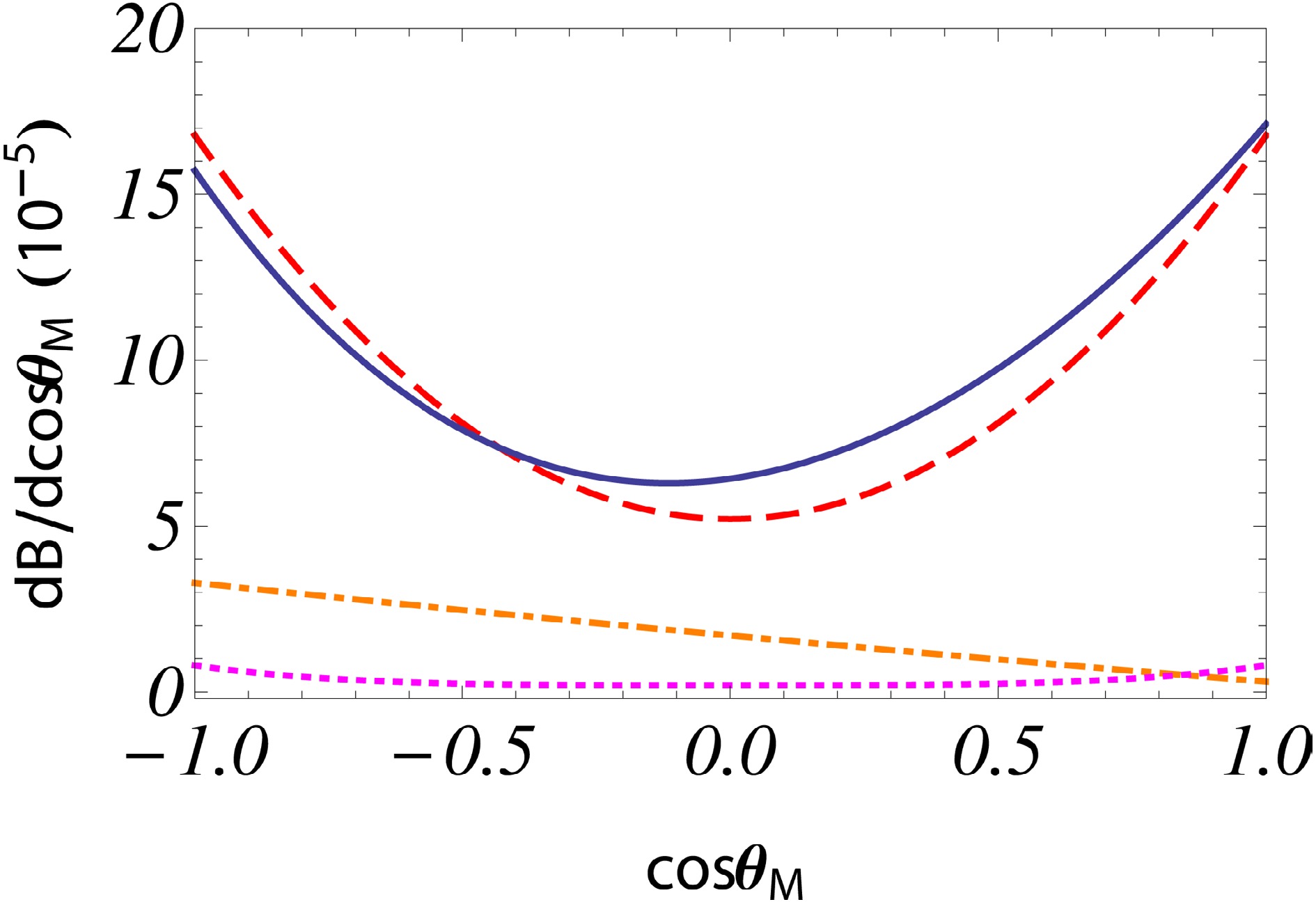
Figure 4. (color online) Angular distributions for the decay
$ B^{-}\to\pi^{+}\pi^{-}\ell^{-}\bar\nu_\ell $ . The solid, dashed, dotted, and dot-dashed curves represent the same contributions as in Fig. 3.$ \begin{aligned}[b] & {A}_{\theta_M,T}(B^-\to\pi^+\pi^-\ell^-\bar\nu_\ell) =(1.3\pm 8.9^{+0.8}_{-2.5})\%\,,\\ & {A}_{\theta_M,\rho}(B^-\to\rho^0\ell^-\bar\nu_\ell,\rho^0\to\pi^+\pi^-) =(0.20\pm 0.04)\%\,,\\ & {A}_{\theta_M,f_2}(B^-\to f_2\ell^-\bar\nu_\ell,f_2\to\pi^+\pi^-) =(0.31\pm 0.08)\%\,,\\ & {A}_{\theta_M,N}(B^-\to\pi^+\pi^-\ell^-\bar\nu_\ell) =(-43.0\pm 22.3)\%\,, \end{aligned} $
(15) where the first set of uncertainties arises from the form factors, and the second (for
${A}_{\theta_M,T}$ ) arises from the phase$ \delta_1 $ . -
In the numerical analysis, we perform a minimum
$ \chi^2 $ fit to extract, as free parameters,$ |V_{ub}| $ , the nonresonant form factors$ F_{\pi\pi} $ , and$ \delta_{1,2} $ , where$ \delta_{1(2)} $ denotes the relative phase associated with$ {\cal M}_{\rho(f_2)} $ . The$ \chi^2 $ function is defined as$ \begin{aligned}[b] \chi^2=\;& \bigg(\frac{{\cal B}_{\rho\,{\rm th}}-{\cal B}_{\rho\,{\rm ex}}}{\sigma_{\rho\,{\rm ex}}}\bigg)^2+ \bigg(\frac{{\cal B}_{f_2\,{\rm th}}-{\cal B}_{f_2\,{\rm ex}}}{\sigma_{f_2\,{\rm ex}}}\bigg)^2 \,\\ &+ \sum_{i} \bigg(\frac{\frac{{\rm d}{\cal B}^i_{{\rm th}}}{{\rm d}M_{\pi\pi}}-\frac{{\rm d}{\cal B}^i_{{\rm ex}}}{{\rm d}M_{\pi\pi}}}{\sigma_{{\rm ex}}^i}\bigg)^2 +\sum_{j} \bigg(\frac{F_{\rho}^j-F_{{\rm th}\,\rho}^j}{\delta F_{{\rm th}\,\rho}^j}\bigg)^2\\& +\sum_{k} \bigg(\frac{F_{f_2}^k-F_{{\rm th}\,f_2}^k}{\delta F_{{\rm th}\,f_2}^k}\bigg)^2\,, \end{aligned} $
(12) where
${\rm d}{\cal B}/{\rm d}M_{\pi\pi}$ denotes the differential branching fraction, and$ \sigma_{\rm ex} $ ($ \delta F_{\rm th} $ ) represents the experimental (theoretical form-factor) uncertainty. The theoretical inputs$ {\cal B}_{\rho(f_2)\,{\rm th}} $ and${\rm d}{\cal B}_{\rm th}/{\rm d}M_{\pi\pi}$ are obtained from the amplitudes in Eq. (2), whereas the experimental inputs are taken from Eq. (1) and Fig. 3. We use$ F_\rho^{(j)}=(V_1(0),A_1(0),A_2(0)) $ and$ F_{f_2}^{(k)}=(V'_1(0),A'_1(0),A'_2(0)) $ from Table 1 as input values for Eq. (12), together with$ |g_1|=5.98 $ and$ |g_2|=18.56 $ in units of GeV-1 [50, 57].
Figure 3. (color online) The
$ \pi\pi $ invariant-mass spectrum. The solid curve includes all contributions and reproduces the data points from Belle [23]. The dashed (dotted) curve represents the contributions from$ B^-\to\rho(f_2)\ell\bar \nu $ , with$ \rho(f_2)\to \pi^+\pi^- $ , while the dot-dashed curve denotes the nonresonant contribution.$ V_1^{(\prime)} $ $ A_1^{(\prime)} $ $ A_2^{(\prime)} $ $ \sqrt 2 F_{\rho^0}(0) $ $ 0.35^{+0.06}_{-0.05} $ $ 0.27^{+0.05}_{-0.04} $ $ 0.26^{+0.05}_{-0.03} $ $ F_{f_2}(0) $ $ (0.18\pm 0.02) $ $ (0.13\pm 0.02) $ $ (0.12\pm 0.02) $ From the fit, we obtain
$ \begin{align} & |V_{ub}|=(3.31\pm 0.61)\times 10^{-3}\,,\\ & a=(26.8\pm 25.9),\; b=(1430.1\pm 680.1)\,,\;\\ & h(0)=(1.90\pm 0.43)\; \text{GeV}^{-3}\,,\,\\ & w_+(0)=(6.16\pm 3.41)\; \text{GeV}^{-1}\,,\, w_-(0)=(3.67\pm 1.79)\; \text{GeV}^{-1}\,,\\ & (\delta_1,\delta_2)=(-111.6\pm 29.3,0.0\pm 1.4)^\circ\,,\\ & \chi^2/n.d.f.=1.1\,, \end{align} $
(13) with
$ n.d.f.=7 $ denoting the number of degrees of freedom. We note that the form factor r in Eq. (3) and$ A_0^{(\prime)} $ in Eq. (4) do not contribute to the fit, as their contributions to the amplitudes vanish since$ q_\mu\bar u_\ell\gamma^\mu(1-\gamma_5)v_\nu=0 $ for nearly massless leptons.Using the fitted parameters in Eq. (13), we obtain
$ \begin{aligned}[b] &{\cal B}_{T}(B^-\to\pi^+\pi^-\ell^-\bar\nu_\ell) =(19.6\pm 7.9^{+7.5+0.7}_{-5.4-0.1})\times 10^{-5}\,,\\ &{\cal B}_{\rho}(B^-\to\rho^0\ell^-\bar\nu_\ell,\rho^0\to\pi^+\pi^-) =(15.8\pm 6.4^{+7.1}_{-5.7})\times 10^{-5}\,,\\ &{\cal B}_{f_2}(B^-\to f_2\ell^-\bar\nu_\ell,f_2\to\pi^+\pi^-) =(2.6\pm 1.1^{+1.2}_{-0.9})\times 10^{-5}\,,\\ &{\cal B}_{N}(B^-\to\pi^+\pi^-\ell^-\bar\nu_\ell) =(3.5\pm 1.4^{+4.3}_{-2.4})\times 10^{-5}\,, \end{aligned} $
(14) where the first uncertainty arises from
$ |V_{ub}| $ , the second from the form factors, and the third (for$ {\cal B}_T $ ) from the phase$ \delta_1 $ . The partial branching fractions as functions of$ M_{\pi\pi} $ and$ \cos\theta_M $ are shown in Fig. 3 and Fig. 4, respectively. We further evaluate the angular asymmetries using Eq. (11) and obtain
Figure 4. (color online) Angular distributions for the decay
$ B^{-}\to\pi^{+}\pi^{-}\ell^{-}\bar\nu_\ell $ . The solid, dashed, dotted, and dot-dashed curves represent the same contributions as in Fig. 3.$ \begin{aligned}[b] & {A}_{\theta_M,T}(B^-\to\pi^+\pi^-\ell^-\bar\nu_\ell) =(1.3\pm 8.9^{+0.8}_{-2.5})\%\,,\\ & {A}_{\theta_M,\rho}(B^-\to\rho^0\ell^-\bar\nu_\ell,\rho^0\to\pi^+\pi^-) =(0.20\pm 0.04)\%\,,\\ & {A}_{\theta_M,f_2}(B^-\to f_2\ell^-\bar\nu_\ell,f_2\to\pi^+\pi^-) =(0.31\pm 0.08)\%\,,\\ & {A}_{\theta_M,N}(B^-\to\pi^+\pi^-\ell^-\bar\nu_\ell) =(-43.0\pm 22.3)\%\,, \end{aligned} $
(15) where the first set of uncertainties arises from the form factors, and the second (for
${A}_{\theta_M,T}$ ) arises from the phase$ \delta_1 $ . -
In the numerical analysis, we perform a minimum
$ \chi^2 $ fit to extract, as free parameters,$ |V_{ub}| $ , the nonresonant form factors$ F_{\pi\pi} $ , and$ \delta_{1,2} $ , where$ \delta_{1(2)} $ denotes the relative phase associated with$ {\cal M}_{\rho(f_2)} $ . The$ \chi^2 $ function is defined as$ \begin{aligned}[b] \chi^2=\;& \bigg(\frac{{\cal B}_{\rho\,th}-{\cal B}_{\rho\,ex}}{\sigma_{\rho\,ex}}\bigg)^2+ \bigg(\frac{{\cal B}_{f_2\,th}-{\cal B}_{f_2\,ex}}{\sigma_{f_2\,ex}}\bigg)^2 \,\\ &+ \sum_{i} \bigg(\frac{\frac{d{\cal B}^i_{th}}{dM_{\pi\pi}}-\frac{d{\cal B}^i_{ex}}{dM_{\pi\pi}}}{\sigma_{ex}^i}\bigg)^2 +\sum_{j} \bigg(\frac{F_{\rho}^j-F_{th\,\rho}^j}{\delta F_{th\,\rho}^j}\bigg)^2\\& +\sum_{k} \bigg(\frac{F_{f_2}^k-F_{th\,f_2}^k}{\delta F_{th\,f_2}^k}\bigg)^2\,, \end{aligned} $
(12) where
$ d{\cal B}/dM_{\pi\pi} $ denotes the differential branching fraction, and$ \sigma_{ex} $ ($ \delta F_{th} $ ) represents the experimental (theoretical form-factor) uncertainty. The theoretical inputs$ {\cal B}_{\rho(f_2)\,th} $ and$ d{\cal B}_{th}/dM_{\pi\pi} $ are obtained from the amplitudes in Eq. (2), whereas the experimental inputs are taken from Eq. (1) and Fig. 3. We use$ F_\rho^{(j)}=(V_1(0),A_1(0),A_2(0)) $ and$ F_{f_2}^{(k)}=(V'_1(0),A'_1(0),A'_2(0)) $ from Table 1 as input values for Eq. (12), together with$ |g_1|=5.98 $ and$ |g_2|=18.56 $ in units of GeV-1 [51, 57].
Figure 3. (color online) The
$ \pi\pi $ invariant-mass spectrum. The solid curve includes all contributions and reproduces the data points from Belle [23]. The dashed (dotted) curve represents the contributions from$ B^-\to\rho(f_2)\ell\bar \nu $ , with$ \rho(f_2)\to \pi^+\pi^- $ , while the dot-dashed curve denotes the nonresonant contribution.$ V_1^{(\prime)} $ $ A_1^{(\prime)} $ $ A_2^{(\prime)} $ $ \sqrt 2 F_{\rho^0}(0) $ $ 0.35^{+0.06}_{-0.05} $ $ 0.27^{+0.05}_{-0.04} $ $ 0.26^{+0.05}_{-0.03} $ $ F_{f_2}(0) $ $ (0.18\pm 0.02) $ $ (0.13\pm 0.02) $ $ (0.12\pm 0.02) $ From the fit, we obtain
$ \begin{align} & |V_{ub}|=(3.31\pm 0.61)\times 10^{-3}\,,\\ & a=(26.8\pm 25.9),\; b=(1430.1\pm 680.1)\,,\;\\ & h(0)=(1.90\pm 0.43)\; \text{GeV}^{-3}\,,\,\\ & w_+(0)=(6.16\pm 3.41)\; \text{GeV}^{-1}\,,\, w_-(0)=(3.67\pm 1.79)\; \text{GeV}^{-1}\,,\\ & (\delta_1,\delta_2)=(-111.6\pm 29.3,0.0\pm 1.4)^\circ\,,\\ & \chi^2/n.d.f.=1.1\,, \end{align} $
(13) with
$ n.d.f.=7 $ denoting the number of degrees of freedom. We note that the form factor r in Eq. (3) and$ A_0^{(\prime)} $ in Eq. (4) do not contribute to the fit, as their contributions to the amplitudes vanish since$ q_\mu\bar u_\ell\gamma^\mu(1-\gamma_5)v_\nu=0 $ for nearly massless leptons.Using the fitted parameters in Eq. (13), we obtain
$ \begin{aligned}[b] &{\cal B}_{\text{T}}(B^-\to\pi^+\pi^-\ell^-\bar\nu_\ell) =(19.6\pm 7.9^{+7.5+0.7}_{-5.4-0.1})\times 10^{-5}\,,\\ &{\cal B}_{\rho}(B^-\to\rho^0\ell^-\bar\nu_\ell,\rho^0\to\pi^+\pi^-) =(15.8\pm 6.4^{+7.1}_{-5.7})\times 10^{-5}\,,\\ &{\cal B}_{f_2}(B^-\to f_2\ell^-\bar\nu_\ell,f_2\to\pi^+\pi^-) =(2.6\pm 1.1^{+1.2}_{-0.9})\times 10^{-5}\,,\\ &{\cal B}_{\text{N}}(B^-\to\pi^+\pi^-\ell^-\bar\nu_\ell) =(3.5\pm 1.4^{+4.3}_{-2.4})\times 10^{-5}\,, \end{aligned} $
(14) where the first uncertainty arises from
$ |V_{ub}| $ , the second from the form factors, and the third (for$ {\cal B}_T $ ) from the phase$ \delta_1 $ . The partial branching fractions as functions of$ M_{\pi\pi} $ and$ \cos\theta_M $ are shown in Fig. 3 and Fig. 4, respectively. We further evaluate the angular asymmetries using Eq. (11) and obtain
Figure 4. (color online) Angular distributions for the decay
$ B^{-}\to\pi^{+}\pi^{-}\ell^{-}\bar\nu_\ell $ . The solid, dashed, dotted, and dot-dashed curves represent the same contributions as in Fig. 3$ \begin{aligned}[b] & {A}_{\theta_M,\text{T}}(B^-\to\pi^+\pi^-\ell^-\bar\nu_\ell) =(1.3\pm 8.9^{+0.8}_{-2.5})\%\,,\\ & {A}_{\theta_M,\rho}(B^-\to\rho^0\ell^-\bar\nu_\ell,\rho^0\to\pi^+\pi^-) =(0.20\pm 0.04)\%\,,\\ & {A}_{\theta_M,f_2}(B^-\to f_2\ell^-\bar\nu_\ell,f_2\to\pi^+\pi^-) =(0.31\pm 0.08)\%\,,\\ & {A}_{\theta_M,\text{N}}(B^-\to\pi^+\pi^-\ell^-\bar\nu_\ell) =(-43.0\pm 22.3)\%\,, \end{aligned} $
(15) where the first set of uncertainties arises from the form factors, and the second (for
$ {A}_{\theta_M,\text{T}} $ ) arises from the phase$ \delta_1 $ . -
We investigate the four-body decay channel
$ B^-\to \pi^+\pi^-\ell^-\bar \nu_\ell $ by performing a global fit to the$ M_{\pi\pi} $ invariant mass spectrum shown in Fig. 3. The resulting$ \chi^2/n.d.f.\simeq 1 $ indicates that our model provides a statistically robust description of the data. By employing the form factors extracted from the global fit (as detailed in Eq. (13)), we present the differential branching fractions${\rm d}{\cal B}_{(T,\rho,f_2,N)}/{\rm d}M_{\pi\pi}$ in Fig. 3, illustrating the individual and total contributions to the mass spectrum. The solid curve representing${\rm d}{\cal B}_T/{\rm d}M_{\pi\pi}$ is in good agreement with the experimental data. Notably, the non-resonant contribution (${\rm d}{\cal B}_N/{\rm d}M_{\pi\pi}$ ), shown by the dot-dashed curve, plays a critical role in shaping the overall distribution, particularly in the low$ M_{\pi\pi} $ region. Our analysis yields the first estimate of the non-resonant branching fraction,$ {\cal B}_{N}=(3.5\pm 1.4^{+4.3}_{-2.4})\times 10^{-5} $ . This result indicates that$ {\cal B}_{N} $ can reach the$ 10^{-5} $ level and, therefore, should no longer be neglected in precision studies.The fitted relative phase
$ \delta_1 $ leads to destructive interference involving the resonant process$ B^-\to(\rho^0\to) \pi^+\pi^-\ell^-\bar \nu_\ell $ , an effect that is most prominent in the$ M_{\pi\pi}\simeq m_\rho $ region. In contrast,$ \delta_2 $ is found to be consistent with zero. This reflects the suppression of the non-resonant contribution for$ M_{\pi\pi}>1 $ GeV, leading to negligible interference with the$ B^-\to (f_2\to)\pi^+\pi^- \ell\bar \nu $ channel. From the fit results in Eq. (13), we obtain$ |V_{ub}|=(3.31\pm 0.61)\times 10^{-3} $ , which is consistent with current determinations. Although the relatively large uncertainty renders this result less competitive than existing extractions reported by the PDG [15], it nevertheless demonstrates that the four-body semileptonic decay$ B\to\pi\pi\ell\bar \nu $ is sensitive to$ |V_{ub}| $ . This provides a novel and independent avenue for its determination. Future high-precision measurements will be essential to reduce the experimental uncertainty and fully exploit the potential of this decay channel.The angular asymmetries provide stringent constraints on the underlying form factors [54–56]. Our analysis, as summarized in Eq. (15), shows that
$ {A}_{\theta_M,\rho} $ and$ {A}_{\theta_M,f_2} $ are both approximately zero. Specifically,$ {A}_{\theta_M,\rho} $ exhibits a symmetric distribution, as shown in Fig. 4, while$ {A}_{\theta_M,f_2} $ remains nearly flat. By contrast,$ {A}_{\theta_M, N}\sim -40\% $ displays a clear, decreasing dependence on$ \cos\theta_M $ . This behavior is dominated by the form factor associated with the structure$ w_-(p_b-p_a) $ . In the$ \pi^+(p_a)\pi^-(p_b) $ rest frame (see Fig. 2), the term$ p_b-p_a=(0,2\vec{p}_b) $ from the$ w_- $ contribution projects onto the four-momentum of the lepton-pair system, inducing a pronounced$ \cos\theta_M $ dependence. Consequently, future experimental measurements of these angular asymmetries will serve as a powerful tool to test the existence and magnitude of the non-resonant contribution.In summary, we have investigated the four-body semileptonic decay
$ B^-\to\pi^+\pi^-\ell\bar \nu $ . By analyzing the full$ \pi\pi $ invariant mass spectrum measured by the Belle Collaboration, we have determined$ |V_{ub}|=(3.31\pm 0.61)\times 10^{-3} $ , a value consistent with current determinations. Furthermore, we have extracted the non-resonant$ B\to\pi\pi $ transition form factors and predicted the non-resonant branching fraction to be$ {\cal B}_{\text{N}}(B^{-}\to\pi^{+}\pi^{-}\ell^{-}\bar\nu_\ell) = (3.5\pm 1.4^{+4.3}_{-2.4})\times 10^{-5} $ . We have also presented the non-resonant angular asymmetry$ {A}_{\theta_M,\text{N}}(B^{-}\to\pi^{+}\pi^{-}\ell^{-}\bar\nu_\ell)=(-43.0\pm 22.3){\text{%}} $ . These predictions offer a clear signature of the non-resonant component and can be rigorously tested in future high-precision measurements at Belle II and LHCb. -
We investigate the four-body decay channel
$ B^-\to\pi^+\pi^-\ell^-\bar \nu_\ell $ by performing a global fit to the$ M_{\pi\pi} $ invariant mass spectrum shown in Fig. 3. The resulting$ \chi^2/n.d.f.\simeq 1 $ indicates that our model provides a statistically robust description of the data. By employing the form factors extracted from the global fit (as detailed in Eq. (13)), we present the differential branching fractions$ d{\cal B}_{(T,\rho,f_2,N)}/dM_{\pi\pi} $ in Fig. 3, illustrating the individual and total contributions to the mass spectrum. The solid curve representing$ d{\cal B}_T/dM_{\pi\pi} $ is in good agreement with the experimental data. Notably, the non-resonant contribution ($ d{\cal B}_N/dM_{\pi\pi} $ ), shown by the dot-dashed curve, plays a critical role in shaping the overall distribution, particularly in the low$ M_{\pi\pi} $ region. Our analysis yields the first estimate of the non-resonant branching fraction,$ {\cal B}_{\text{N}}=(3.5\pm 1.4^{+4.3}_{-2.4})\times 10^{-5} $ . This result indicates that$ {\cal B}_{\text{N}} $ can reach the$ 10^{-5} $ level and, therefore, should no longer be neglected in precision studies.The fitted relative phase
$ \delta_1 $ leads to destructive interference involving the resonant process$ B^-\to(\rho^0\to)\pi^+\pi^-\ell^-\bar \nu_\ell $ , an effect that is most prominent in the$ M_{\pi\pi}\simeq m_\rho $ region. In contrast,$ \delta_2 $ is found to be consistent with zero. This reflects the suppression of the non-resonant contribution for$ M_{\pi\pi}>1 $ GeV, leading to negligible interference with the$ B^-\to (f_2\to)\pi^+\pi^- \ell\bar \nu $ channel. From the fit results in Eq. (13), we obtain$ |V_{ub}|=(3.31\pm 0.61)\times 10^{-3} $ , which is consistent with current determinations. Although the relatively large uncertainty renders this result less competitive than existing extractions reported by the PDG [15], it nevertheless demonstrates that the four-body semileptonic decay$ B\to\pi\pi\ell\bar \nu $ is sensitive to$ |V_{ub}| $ . This provides a novel and independent avenue for its determination. Future high-precision measurements will be essential to reduce the experimental uncertainty and fully exploit the potential of this decay channel.The angular asymmetries provide stringent constraints on the underlying form factors [54–56]. Our analysis, as summarized in Eq. (15), shows that
$ {A}_{\theta_M,\rho} $ and$ {A}_{\theta_M,f_2} $ are both approximately zero. Specifically,$ {A}_{\theta_M,\rho} $ exhibits a symmetric distribution, as shown in Fig. 4, while$ {A}_{\theta_M,f_2} $ remains nearly flat. By contrast,$ {A}_{\theta_M,\text{N}}\sim -40\% $ displays a clear, decreasing dependence on$ \cos\theta_M $ . This behavior is dominated by the form factor associated with the structure$ w_-(p_b-p_a) $ . In the$ \pi^+(p_a)\pi^-(p_b) $ rest frame (see Fig. 2), the term$ p_b-p_a=(0,2\vec{p}_b) $ from the$ w_- $ contribution projects onto the four-momentum of the lepton-pair system, inducing a pronounced$ \cos\theta_M $ dependence. Consequently, future experimental measurements of these angular asymmetries will serve as a powerful tool to test the existence and magnitude of the non-resonant contribution.In summary, we have investigated the four-body semileptonic decay
$ B^-\to\pi^+\pi^-\ell\bar \nu $ . By analyzing the full$ \pi\pi $ invariant mass spectrum measured by the Belle Collaboration, we have determined$ |V_{ub}|=(3.31\pm 0.61)\times 10^{-3} $ , a value consistent with current determinations. Furthermore, we have extracted the non-resonant$ B\to\pi\pi $ transition form factors and predicted the non-resonant branching fraction to be$ {\cal B}_{\text{N}}(B^{-}\to\pi^{+}\pi^{-}\ell^{-}\bar\nu_\ell) = (3.5\pm 1.4^{+4.3}_{-2.4})\times 10^{-5} $ . We have also presented the non-resonant angular asymmetry$ {A}_{\theta_M,\text{N}}(B^{-}\to\pi^{+}\pi^{-}\ell^{-}\bar\nu_\ell)=(-43.0\pm 22.3){\text{%}} $ . These predictions offer a clear signature of the non-resonant component and can be rigorously tested in future high-precision measurements at Belle II and LHCb. -
We investigate the four-body decay channel
$ B^-\to \pi^+\pi^-\ell^-\bar \nu_\ell $ by performing a global fit to the$ M_{\pi\pi} $ invariant mass spectrum shown in Fig. 3. The resulting$ \chi^2/n.d.f.\simeq 1 $ indicates that our model provides a statistically robust description of the data. By employing the form factors extracted from the global fit (as detailed in Eq. (13)), we present the differential branching fractions${\rm d}{\cal B}_{(T,\rho,f_2,N)}/{\rm d}M_{\pi\pi}$ in Fig. 3, illustrating the individual and total contributions to the mass spectrum. The solid curve representing${\rm d}{\cal B}_T/{\rm d}M_{\pi\pi}$ is in good agreement with the experimental data. Notably, the non-resonant contribution (${\rm d}{\cal B}_N/{\rm d}M_{\pi\pi}$ ), shown by the dot-dashed curve, plays a critical role in shaping the overall distribution, particularly in the low$ M_{\pi\pi} $ region. Our analysis yields the first estimate of the non-resonant branching fraction,$ {\cal B}_{N}=(3.5\pm 1.4^{+4.3}_{-2.4})\times 10^{-5} $ . This result indicates that$ {\cal B}_{N} $ can reach the$ 10^{-5} $ level and, therefore, should no longer be neglected in precision studies.The fitted relative phase
$ \delta_1 $ leads to destructive interference involving the resonant process$ B^-\to(\rho^0\to) \pi^+\pi^-\ell^-\bar \nu_\ell $ , an effect that is most prominent in the$ M_{\pi\pi}\simeq m_\rho $ region. In contrast,$ \delta_2 $ is found to be consistent with zero. This reflects the suppression of the non-resonant contribution for$ M_{\pi\pi}>1 $ GeV, leading to negligible interference with the$ B^-\to (f_2\to)\pi^+\pi^- \ell\bar \nu $ channel. From the fit results in Eq. (13), we obtain$ |V_{ub}|=(3.31\pm 0.61)\times 10^{-3} $ , which is consistent with current determinations. Although the relatively large uncertainty renders this result less competitive than existing extractions reported by the PDG [15], it nevertheless demonstrates that the four-body semileptonic decay$ B\to\pi\pi\ell\bar \nu $ is sensitive to$ |V_{ub}| $ . This provides a novel and independent avenue for its determination. Future high-precision measurements will be essential to reduce the experimental uncertainty and fully exploit the potential of this decay channel.The angular asymmetries provide stringent constraints on the underlying form factors [54–56]. Our analysis, as summarized in Eq. (15), shows that
$ {A}_{\theta_M,\rho} $ and$ {A}_{\theta_M,f_2} $ are both approximately zero. Specifically,$ {A}_{\theta_M,\rho} $ exhibits a symmetric distribution, as shown in Fig. 4, while$ {A}_{\theta_M,f_2} $ remains nearly flat. By contrast,$ {A}_{\theta_M, N}\sim -40\% $ displays a clear, decreasing dependence on$ \cos\theta_M $ . This behavior is dominated by the form factor associated with the structure$ w_-(p_b-p_a) $ . In the$ \pi^+(p_a)\pi^-(p_b) $ rest frame (see Fig. 2), the term$ p_b-p_a=(0,2\vec{p}_b) $ from the$ w_- $ contribution projects onto the four-momentum of the lepton-pair system, inducing a pronounced$ \cos\theta_M $ dependence. Consequently, future experimental measurements of these angular asymmetries will serve as a powerful tool to test the existence and magnitude of the non-resonant contribution.In summary, we have investigated the four-body semileptonic decay
$ B^-\to\pi^+\pi^-\ell\bar \nu $ . By analyzing the full$ \pi\pi $ invariant mass spectrum measured by the Belle Collaboration, we have determined$ |V_{ub}|=(3.31\pm 0.61)\times 10^{-3} $ , a value consistent with current determinations. Furthermore, we have extracted the non-resonant$ B\to\pi\pi $ transition form factors and predicted the non-resonant branching fraction to be$ {\cal B}_{\text{N}}(B^{-}\to\pi^{+}\pi^{-}\ell^{-}\bar\nu_\ell) = (3.5\pm 1.4^{+4.3}_{-2.4})\times 10^{-5} $ . We have also presented the non-resonant angular asymmetry$ {A}_{\theta_M,\text{N}}(B^{-}\to\pi^{+}\pi^{-}\ell^{-}\bar\nu_\ell)=(-43.0\pm 22.3){\text{%}} $ . These predictions offer a clear signature of the non-resonant component and can be rigorously tested in future high-precision measurements at Belle II and LHCb.
Semileptonic ${B^{-}\to\pi^{+}\pi^{-}\ell^{-}\bar\nu_\ell}$ decay over the full ${\pi\pi}$ invariant mass spectrum
- Received Date: 2026-04-10
- Available Online: 2026-07-15
Abstract: The Belle Collaboration has recently reported a measurement of the branching fraction for the semileptonic decay $ B^{-}\to\pi^{+}\pi^{-}\ell^{-}\bar\nu_\ell $, with $ \ell=e $ or μ. Using the newly available data across the full $ \pi\pi $ invariant-mass spectrum, we determine the non-resonant $ B\to\pi\pi $ transition form factors. We obtain a non-resonant branching fraction $ {\cal B}_N(B^{-}\to\pi^{+}\pi^{-}\ell^{-}\bar\nu_\ell)=(3.5\pm 1.4^{+4.3}_{-2.4})\times 10^{-5} $. This result indicates that the non-resonant contribution can be comparable in magnitude to the resonant components and should not be treated as a negligible background in precision measurements. Our findings highlight the importance of dedicated experimental efforts at Belle II and LHCb to further probe the non-resonant contribution.



 DownLoad: