


 Abstract
 HTML
 Reference
 Related
 PDF



-
Conventional quark models have successfully described the spectra of mesons (
$ q{\bar{q}} $ ) and baryons ($ qqq $ or$ {\bar{q}}{\bar{q}}{\bar{q}} $ ) [1–6]. However, since the discovery of the$ X(3872) $ in 2003 [7], numerous exotic hadrons beyond the conventional meson–baryon framework have been observed [8–18]. Understanding their internal structures and formation mechanisms has therefore become a central question in hadron spectroscopy (for reviews, see Refs. [19–38]).Although multiquark states have been studied for more than half a century [39, 40], the nature of many exotic hadrons remains unsettled. Recently, CMS reported three resonance structures near 6.6, 6.9, and 7.1 GeV in the
$ J/\psi J/\psi $ invariant-mass spectrum, denoted as$ X(6600) $ ,$ X(6900) $ , and$ X(7100) $ , respectively [41, 42]. These states are widely regarded as candidates for fully charm tetraquarks [42–44], and the existence of$ X(6900) $ has been independently confirmed by LHCb and ATLAS [17, 45]. In addition, CMS determined that the three structures are consistent with a$ J^{PC}=2^{++} $ assignment, with$ J=0 $ and$ J=1 $ excluded at the 95% and 99% confidence levels, respectively [46]. This result provides important constraints on their possible internal structures.Theoretical investigations of fully charm tetraquarks have employed various approaches [47–142]. However, several assumptions adopted in previous studies require reassessment in light of the experimentally established
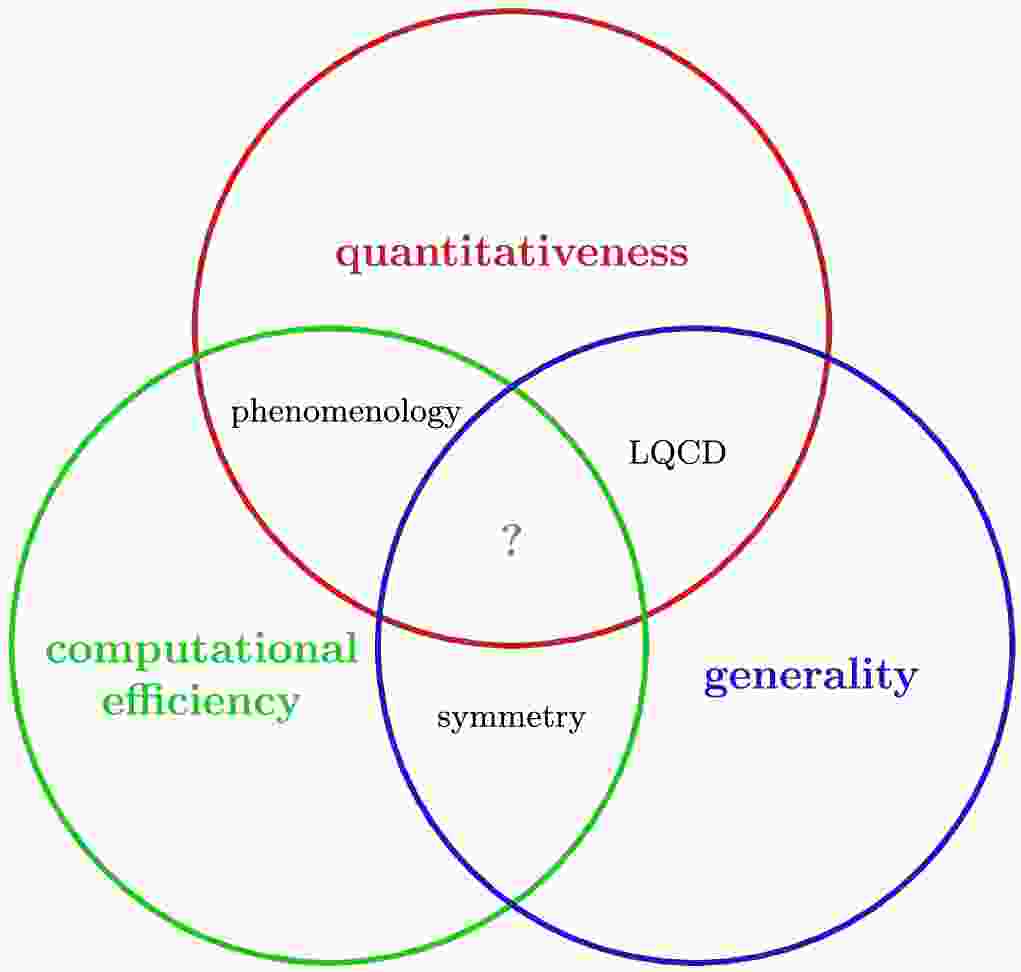
$ J^{PC}=2^{++} $ quantum numbers. The$ X(6600) $ ,$ X(6900) $ , and$ X(7100) $ states therefore provide a useful experimental setting for exploring compact multiquark dynamics.Since perturbative quantum chromodynamics (QCD) is not applicable in the low-energy regime, hadron spectroscopy relies on nonperturbative methods. These include lattice QCD (LQCD) [143–171], phenomenological models such as diquark models [172–175], chiral effective field theory [176–179], QCD sum rules [180–182], hadronic molecular models [183–191], and symmetry-based analyses [192]. LQCD provides a systematic first-principles description but remains computationally demanding [193, 194], whereas phenomenological approaches often depend on model assumptions [37]. Symmetry-based methods offer a complementary perspective by determining the allowed quantum numbers from group-theoretical constraints without detailed dynamical input. Fig. 1 illustrates the relative positioning of LQCD, phenomenological approaches, and symmetry-based methods within the "impossible trinity" of quantitativeness, generality, and computational efficiency.
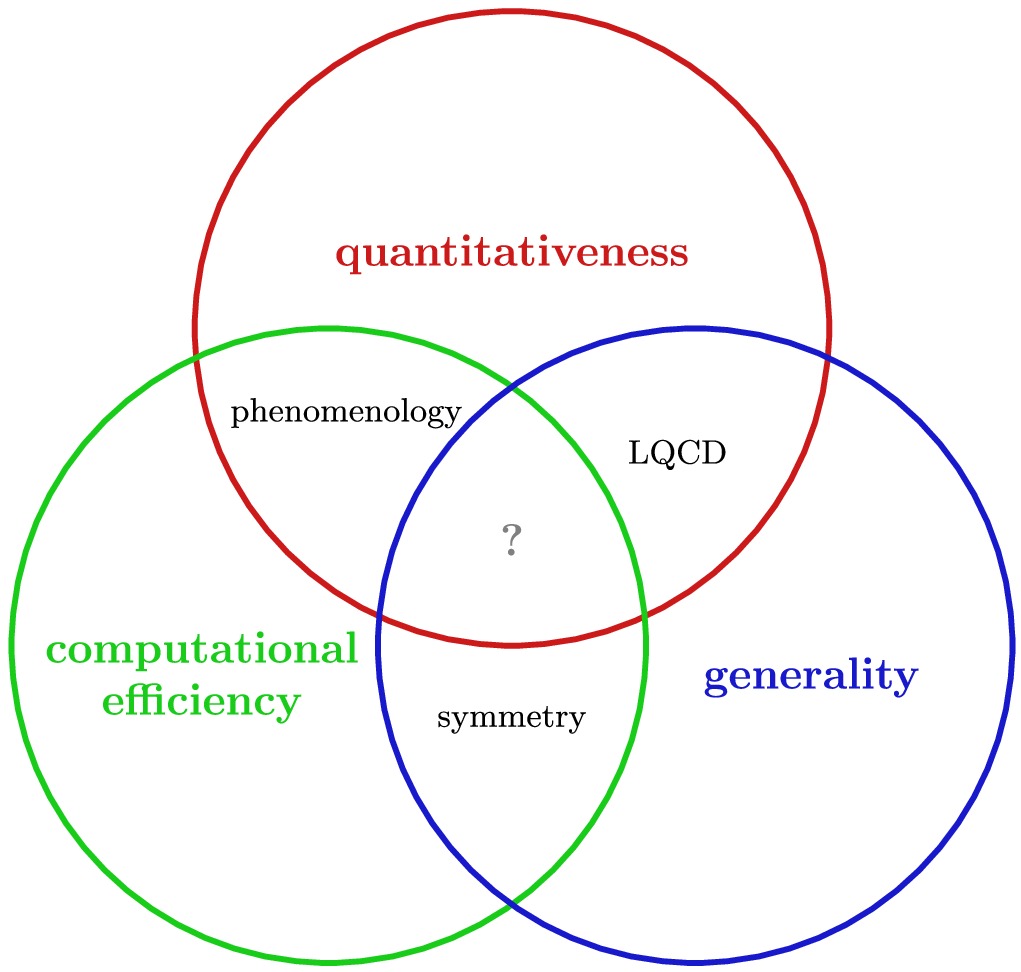
Figure 1. Schematic illustration of the positions of LQCD, phenomenological approaches, and symmetry-based approaches within the "impossible trinity" defined by quantitative capability, generality, and computational efficiency.
Symmetry analyses of compact multiquark systems originated in the MIT bag model and chromomagnetic interaction (CMI) framework [195–197]. Subsequent studies established the connection between spatial symmetries, permutation groups, and the allowed quantum numbers in few-body systems [198–206]. In particular, the inherent nodal surface (INS) framework provides a model-independent classification of low-energy states according to spatial symmetry constraints.
Using INS analysis for identical-particle four-body systems, Ref. [192] showed that the low-lying pentaquark states
$ \text{P}_c^+ $ may favor states with$ J^P=\dfrac{3}{2}^{\pm} $ and$ \dfrac{5}{2}^{\pm} $ , demonstrating the predictive capability of symmetry-based methods. Motivated by this approach, we investigate the low-energy state space of compact tetraquark systems using group-theoretical methods within the INS framework.The remainder of this paper is organized as follows. In Sec. II, we derive the allowed tetraquark states under spin–statistics and color-singlet constraints. In Sec. III, we analyze the INS structure and establish the qualitative ordering of low-lying states for
$ L\leq3 $ . A phenomenological weighting scheme inspired by CMI is then introduced to test the robustness of the symmetry-based ordering, and the results are compared with QCD sum-rule predictions. Finally, we summarize our conclusions. -
Compact QCD bound states include mesons, baryons, multiquark states, glueballs, and hybrid hadrons. Their internal structures are characterized by four degrees of freedom: orbital, spin, flavor, and color. Neglecting electromagnetic interactions and flavor-dependent effects, quarks and antiquarks can be treated as two distinct types of identical fermions, whereas gluons behave as identical bosons.
The wave function of a compact QCD bound state is constrained by two fundamental principles. First, the spin–statistics theorem requires the total wave function to be antisymmetric under the exchange of any two quarks or any two antiquarks and symmetric under the exchange of identical bosons. Second, color confinement requires physical hadrons to be color singlets; that is, the color wave function must transform according to the trivial representation of
$ SU(3)_{\text C} $ . These constraints are independent of any dynamical model.We denote the complete Hilbert space of compact tetraquark states by
$ \mathfrak{T} $ . It can be decomposed into the product of the quark and antiquark sectors as$ \mathfrak{T}=\mathfrak{q}^2\otimes\bar{\mathfrak{q}}^2. $
(1) Using the Schur–Weyl duality expansion to express
$ \mathfrak{q}^2 $ and$ {\mathfrak{{\bar{q}}}}^2 $ , we obtain$ \begin{array}{l} \left\{\begin{array}{l} \mathfrak{q}^2 =\bigoplus\limits_{[f]}[f]\otimes\mathfrak{q}_{[f]}^2,\\ \mathfrak{{\bar{q}}}^2 =\bigoplus\limits_{[{\bar{f}}]}[{\bar{f}}]\otimes\mathfrak{{\bar{q}}}_{[{\bar{f}}]}^2, \end{array}\right. \end{array} $
(2) where
$ [f] $ and$ [{\bar{f}}] $ denote the irreducible representations (IRREPs) of the permutation group$ S_2 $ . Next, we decompose$ \mathfrak{q}^2 $ and$ \bar{\mathfrak{q}}^2 $ into direct products of subspaces corresponding to the four degrees of freedom: orbital (O), spin (S), flavor (F), and color (C), as$ \begin{array}{l} \left\{\begin{array}{l} \mathfrak{q}^2 =\text O^2\otimes\text S^2\otimes\text F^2\otimes\text C^2,\\ \mathfrak{{\bar{q}}}^2 ={\bar{\text O}}^2\otimes{\bar{\text S}}^2\otimes{\bar{\text F}}^2\otimes{\bar{\text C}}^2. \end{array}\right. \end{array} $
(3) We then apply the Schur–Weyl duality expansion to each degree of freedom, yielding
$ \begin{array}{l} \left\{\begin{array}{l} \mathfrak{q}^2 =\bigoplus\limits_{[f]_R}\left[\left(\bigotimes_R[f]_R\right)\otimes\left(\bigotimes_RR_{[f]_R}^2\right)\right],\\ \mathfrak{{\bar{q}}}^2 =\bigoplus\limits_{[{\bar{f}}]_R}\left[\left(\bigotimes_R[{\bar{f}}]_R\right)\otimes\left(\bigotimes_R{\bar{R}}_{[{\bar{f}}]_R}^2\right)\right], \end{array}\right. \end{array} $
(4) where
$ R\in\{\text O,\text S,\text F,\text C\} $ . Comparing Eqs. (2) and (4), we obtain$ \left\{\begin{aligned} [f] =\bigotimes\limits_R[f]_R,\\ [{\bar{f}}] =\bigotimes\limits_R[{\bar{f}}]_R. \end{aligned}\right. $
(5) In the decomposition of Eq. (2), the physically allowed terms must satisfy the fermionic spin–statistics constraint, which requires
$ \begin{array}{l} [f]=[{\bar{f}}]=[11]. \end{array} $
(6) If compact tetraquark states are regarded as comprising a diquark and an antidiquark, the color-singlet constraint can be formulated as follows: the symmetry properties of the color wave function under exchange of the two quarks must match those under exchange of the two antiquarks. Equivalently, the diquark and antidiquark sectors must transform consistently to yield an overall color-singlet state:
$ \begin{array}{l} [f]_{\text C}=[{\bar{f}}]_{\text C}. \end{array} $
(7) By combining Eqs. (6) and (7), the full set of allowed IRREP combinations is obtained by solving for the associated Kronecker coefficients, as listed in Table 1.
$ [f]_{\text O} $ $ [f]_{\text S} $ $ [f]_{\text F} $ $ [f]_{\text C} $ $ [{\bar{f}}]_{\text O} $ $ [{\bar{f}}]_{\text S} $ $ [{\bar{f}}]_{\text F} $ $ [{\bar{f}}]_{\text C} $ [2] [2] [2] [11] [2] [2] [2] [11] [2] [2] [2] [11] [2] [11] [11] [11] [2] [2] [2] [11] [11] [2] [11] [11] [2] [2] [2] [11] [11] [11] [2] [11] [2] [2] [11] [2] [2] [2] [11] [2] [2] [2] [11] [2] [2] [11] [2] [2] [2] [2] [11] [2] [11] [2] [2] [2] [2] [2] [11] [2] [11] [11] [11] [2] [2] [11] [2] [2] [2] [2] [11] [2] [2] [11] [2] [2] [2] [11] [2] [2] [2] [11] [2] [2] [11] [2] [2] [2] [2] [11] [2] [2] [11] [11] [11] [2] [2] [11] [11] [11] [2] [2] [2] [11] [2] [11] [11] [11] [2] [11] [11] [11] [2] [11] [11] [11] [11] [2] [11] [11] [2] [11] [11] [11] [11] [11] [2] [11] [11] [2] [2] [2] [2] [2] [11] [2] [11] [2] [2] [2] [2] [11] [2] [2] [11] [2] [2] [2] [11] [2] [2] [2] [11] [2] [2] [2] [11] [11] [11] [2] [11] [2] [11] [11] [2] [2] [2] [11] [11] [2] [11] [11] [2] [11] [11] [11] [11] [2] [11] [11] [11] [2] [11] [11] [11] [2] [11] [11] [11] [11] [2] [11] [11] [11] [2] [11] [2] [2] [2] [11] [11] [11] [2] [11] [2] [11] [11] [11] [11] [11] [2] [11] [11] [2] [11] [11] [11] [11] [2] [11] [11] [11] [2] [11] [11] [11] [11] [2] [2] [2] [11] [2] [11] [11] [11] [2] [2] [11] [2] [2] [11] [11] [11] [2] [11] [2] [2] [2] [11] [11] [11] [2] [11] [11] [11] [2] Table 1. Allowed irreducible representation combinations for compact tetraquark wave functions under the spin–statistics and color-singlet constraints.
-
A nodal surface is a hypersurface in configuration space on which the orbital wave function vanishes. When this surface is determined solely by geometric symmetry and is independent of the dynamics, it is termed an invariant nodal surface (INS). The INS framework identifies accessible quantum states by solving the constraints imposed by symmetry transformations, without requiring a specific interaction model. The general formalism for identical-particle few-body systems has been developed in Refs. [198–206]. Combining the INS constraints with the spin–statistics and color-singlet conditions introduced above enables a systematic analysis of the low-energy structure of compact tetraquark systems.
-
We consider two representative spatial configurations: the equilateral tetrahedron (ETH), in which the four particles occupy the vertices of a regular tetrahedron, and the square (Sqr), in which they occupy the vertices of a square. These configurations characterize the dominant spatial correlations in low-energy four-body systems. Following Ref. [192], we also introduce partially symmetric configurations, ETH
$ _3 $ and Sqr$ _3 $ , in which only a subset of the full symmetry constraints is imposed.In the Sqr configuration, two possible arrangements of quark–antiquark pairs are considered: parallel (Sqr
$ ^{\parallel} $ ) and perpendicular (Sqr$ ^{\perp} $ ). The corresponding orbital permutation symmetries of the quark and antiquark pairs are denoted by$ \lambda^2 $ and$ \bar\lambda^2 $ , respectively.By introducing the body-fixed coordinate system
$ Ox'y'z' $ , as shown in Fig. 2, and restricting the$ S_4 $ IRREPs to the subgroup$ S_2\times S_2 $ , one obtains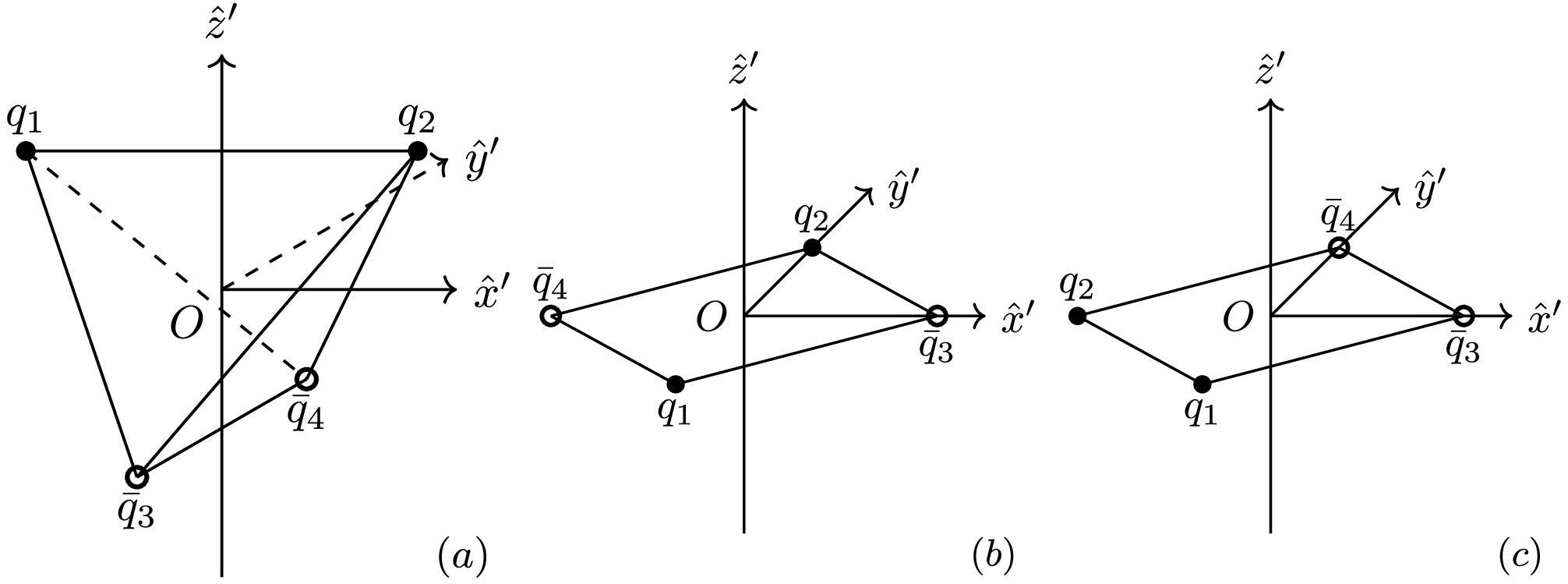
$ \left\{\begin{aligned} &[4] \downarrow[2]\otimes[2],\\ &[31] \downarrow\left([2]\otimes[2]\right)\oplus\left([2]\otimes[11]\right)\oplus\left([11]\otimes[2]\right),\\ &[22] \downarrow\left([2]\otimes[2]\right)\oplus\left([11]\otimes[11]\right),\\ &[211] \downarrow\left([2]\otimes[11]\right)\oplus\left([11]\otimes[2]\right)\oplus\left([11]\otimes[11]\right),\\ &[1^4] \downarrow[11]\otimes[11]. \end{aligned}\right. $
(8) By combining these branching relations with the accessibility results listed in Table 6 of Ref. [192], all allowed
$ L^\pi\lambda^2\bar\lambda^2 $ components for the ETH, ETH$ _3 $ , Sqr, and Sqr$ _3 $ configurations can be determined. The results are summarized in Table 2.$ L^\pi $ $ [2]\otimes[2] $ $ [2]\otimes[11] $ $ [11]\otimes[2] $ $ [11]\otimes[11] $ ETH $ 0^+ $ A A A A $ 1^- $ B B B C $ 2^+ $ C B B C $ 3^- $ C B B C Sqr $ 0^+ $ B – – A $ 1^- $ A B B A $ 2^+ $ C B B C $ 3^- $ A B B A ETH $ _3 $ $ 0^+ $ B A A B $ 1^- $ B B B C $ 2^+ $ C B B C $ 3^- $ C B B C Sqr $ _3 $ $ 0^+ $ C B B B $ 1^- $ A B B A $ 2^+ $ C B B C $ 3^- $ A B B A Table 2. Accessibility of the
$ L^\pi\lambda^2\bar{\lambda}^2 $ IRREP components of the orbital wave functions for compact tetraquark states, obtained by restricting$ S_4 $ to$ S_2\times S_2 $ , with orbital angular momentum$ L\leq3 $ , in the ETH and Sqr configurations and in the ETH$ _3 $ and Sqr$ _3 $ configurations. The capital letters A, B, and C denote cases in which the total multiplicity of the corresponding$ S_2\times S_2 $ representation in the restriction of an accessible$ S_4 $ IRREP is 1, 2, and 3, respectively. The symbol "–" indicates that the corresponding IRREP is inaccessible in the given configuration.Let
$ \mathcal{A} $ denote the spatial configuration and Z the IRREP of the color wave function. The full state space of compact tetraquark states can be decomposed into a direct sum according to$ L^\pi $ ,$ \lambda^2\bar{\lambda}^2 $ ,$ \mathcal{A} $ ,$ s^2{\bar{s}}^2 $ , and Z. We denote the subspaces resulting from this decomposition by$ \mathfrak{T}_{L^\pi,\lambda^2\bar{\lambda}^2}^{s^2{\bar{s}}^2,Z}[\mathcal{A}] $ .For compact tetraquark states in the ETH and Sqr configurations, as well as in the partially symmetric ETH
$ _3 $ and Sqr$ _3 $ configurations, the distributions of accessible states as functions of$ J^P $ for$ L \leq 3 $ are obtained by combining the results in Tables 1 and 2 with the standard angular-momentum coupling relations. The resulting distributions are summarized in Table 3. For comparison, Table 7 of Ref. [192] presents the corresponding statistical results for the number of accessible states in the three-flavor four-quark system.Configuration $ 0^+ $ $ 0^- $ $ 1^+ $ $ 1^- $ $ 2^+ $ $ 2^- $ $ 3^+ $ $ 3^- $ $ 4^+ $ $ 4^- $ $ 5^+ $ $ 5^- $ ETH 36 54 104 128 128 152 80 138 20 80 0 20 Sqr 32 36 98 84 126 96 80 84 20 48 0 12 ETH $ _3 $ 44 54 116 128 132 152 80 138 20 80 0 20 Sqr $ _3 $ 56 36 134 84 138 96 80 84 20 48 0 12 Table 3. Distribution of the number of accessible states as a function of
$ J^P $ for compact tetraquark states in the ETH, Sqr, ETH$ _3 $ , and Sqr$ _3 $ configurations, with orbital angular momentum restricted to$ L\leq3 $ .For each selected set of spatial configurations, such as {ETH, Sqr} or {ETH
$ _3 $ , Sqr$ _3 $ }, we define the total number of accessible states associated with a given$ J^P $ as the sum of all allowed states with that quantum number; this quantity is referred to as the accessible-state number of$ J^P $ . Fig. 3 shows the resulting distributions:$ N_{\text a} $ denotes the number of accessible states for compact tetraquark systems, and$ N_{\text a}' $ denotes the corresponding quantity for three-flavor four-quark systems, both plotted as functions of$ J^P $ .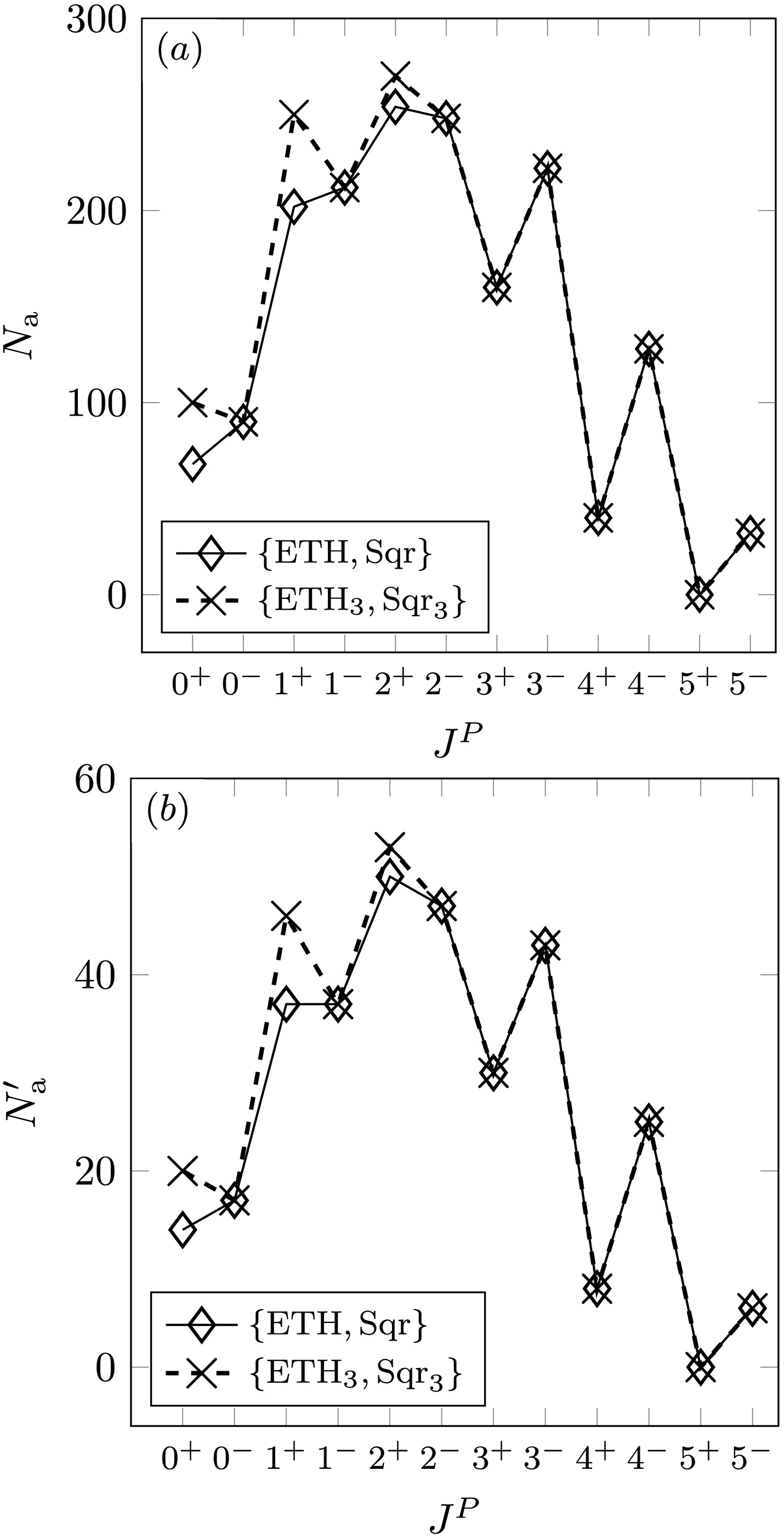
Figure 3. Distributions of the number of accessible states as a function of
$ J^P $ for (a) compact tetraquark states,$ N_{\text a} $ , and (b) three-flavor four-quark systems,$ N_{\text a}' $ . The configuration space is restricted to the sets {ETH, Sqr} and {ETH$ _3 $ , Sqr$ _3 $ }, respectively.For a given
$ J^P $ ,$ N(J^P) $ is defined as the number of subspaces$ \mathfrak{T}_{L^\pi,\lambda^2\bar{\lambda}^2}^{s^2{\bar{s}}^2,Z}[\mathcal{A}] $ with those quantum numbers, and its distribution encodes the qualitative ordering of the low-lying spectrum. States with fewer nodal surfaces generally have lower energies. For low-L configurations, a larger$ N(J^P) $ indicates greater variational flexibility, allowing smoother redistribution of the wavefunction density without additional nodes and thereby generally reducing the kinetic-energy expectation value. We therefore adopt$ N(J^P) $ as a heuristic indicator of the relative ordering among competing$ J^P $ channels. We emphasize that this indicator is purely qualitative: it neglects dynamical effects such as color–spin interactions, internal correlations, and threshold couplings, which may modify the actual ordering. For {ETH, Sqr}, the inferred lowest states are$ 2^+ $ ,$ 2^- $ ,$ 3^- $ , and$ 1^- $ ; for {ETH$ _3 $ , Sqr$ _3 $ }, they are$ 2^+ $ ,$ 1^+ $ ,$ 2^- $ , and$ 3^- $ .Further analysis shows that, when restricted to the configuration sets {ETH, Sqr} and {ETH
$ _3 $ , Sqr$ _3 $ }, the ratio$ N_{\text a}/N_{\text a}' $ fluctuates about mean values of 5.24 and 5.25, with standard deviations of 0.23 and 0.21, respectively. This notable consistency indicates that, for$ L \leq 3 $ , the accessible-state distributions of compact tetraquark systems and three-flavor four-quark systems exhibit nearly identical dependence on$ J^P $ . In other words, although the two systems differ in their color-singlet constraints and in the representation structures of their flavor and color degrees of freedom, these differences have only a negligible effect on the overall shape of the accessible-state distribution.A caveat is warranted regarding the scope of the INS-based ordering presented above. Accessible-state counting does not determine absolute masses or provide a rigorous dynamical ordering; it only suggests a qualitative tendency under the assumption that fewer nodal structures correlate with lower excitation energies. Actual spectra may be modified by color–spin interactions, correlations, and threshold couplings. The following sensitivity analysis examines the robustness of the qualitative ordering against one class of such effects.
-
The CMI model describes the color–spin interaction between (anti)quarks and provides an important mechanism for understanding hadron spectroscopy [195]. For a
$ qq $ (or$ {\bar{q}}{\bar{q}} $ ) pair, antisymmetric color and spin configurations are generally more favorable than symmetric configurations [207]. Accordingly, diquarks with antisymmetric color and spin structures are referred to as "good diquarks", whereas the corresponding symmetric configurations are termed "bad diquarks". Different color–spin symmetries lead to distinct chromomagnetic energies, resulting in the splitting and ordering of low-lying states.To qualitatively assess whether these dynamical effects could modify the symmetry-based counting, we introduce a phenomenological weight factor for each color–spin configuration:
$ \begin{array}{l} w\left(s^2,{\bar{s}}^2,Z\right)=W_0^{-1}\exp\left[-\delta E\left(s^2,{\bar{s}}^2,Z\right)/\Lambda\right], \end{array} $
(9) where Λ is a parameter with dimensions of energy, and
$ \delta E $ denotes the phenomenological energy correction associated with spin symmetries and color representations. Retaining only the leading-order contribution, we parameterize the energy correction as$ \delta E\left(s^2,{\bar{s}}^2,Z\right)\\ = \left(s^2-\frac12\right)E_1+\left({\bar{s}}^2-\frac12\right)E_2+\frac{\delta_{Z,S}-\delta_{Z,A}}{2}E_3, $
(10) where
$ E_1 $ ,$ E_2 $ , and$ E_3 $ characterize the relative shifts among different color–spin configurations. The normalization factor$ W_0 $ is determined by$ \begin{array}{l} \sum\limits_{J^P}\rho_{\text a}=1, \end{array} $
(11) where
$ \rho_{\text a} $ denotes the normalized, weighted number of accessible states.The energy correction in Eq. (9) is parameterized by three terms corresponding to the spin symmetries of the quark and antiquark pairs and the color configuration, retaining the leading-order dependence with a minimal number of parameters. The exponential form is the simplest positive, monotonic, and multiplicative function that suppresses higher-energy configurations and reduces to the symmetry-counting limit as
$ \Lambda\to\infty $ .This construction is closely related in spirit to statistical descriptions of strongly interacting matter. Statistical thermodynamic approaches to hadrons, beginning with the Hagedorn description of highly excited hadronic states [208], employ statistical weights that decrease exponentially with energy or mass [209]. Modern statistical hadronization approaches likewise use thermal distributions to describe the relative populations of hadronic species [210]. These applications provide an analogy for adopting the exponential suppression factor as a simple and physically transparent interpolation between pure symmetry counting and an energy-ordered statistical distribution.
As a baseline choice for the sensitivity scan, we adopt:
$ \begin{array}{l} E_1=E_2=E_3. \end{array} $
(12) To characterize the strength of dynamical effects, we introduce the dimensionless parameter
$ \theta=\Lambda/E_1 $ , sampled from the discrete set$ \{0.01,0.5,1,5,\infty\} $ , where$ \theta=\infty $ corresponds to the symmetry-dominated limit.It is important to emphasize that this weighting scheme does not constitute a dynamical calculation of the tetraquark spectrum. Rather, it provides a controlled phenomenological method for testing whether the symmetry-induced state distribution remains robust when a generic preference for lower-energy configurations is introduced. The parameter θ is therefore treated as a model parameter, and our conclusions are based on the qualitative stability of the results over the representative range explored in the sensitivity analysis, rather than on a unique fitted value.
The resulting distributions
$ \rho_{\text a}(J^P) $ are shown in Fig. 4. Several channels, including$ 0^- $ ,$ 1^+ $ ,$ 2^- $ ,$ 3^+ $ ,$ 4^+ $ ,$ 4^- $ ,$ 5^+ $ , and$ 5^- $ , are strongly suppressed as the dynamical weighting is enhanced (i.e., as θ decreases), while the distribution becomes concentrated mainly in the$ 0^+ $ ,$ 1^- $ ,$ 2^+ $ , and$ 3^- $ channels.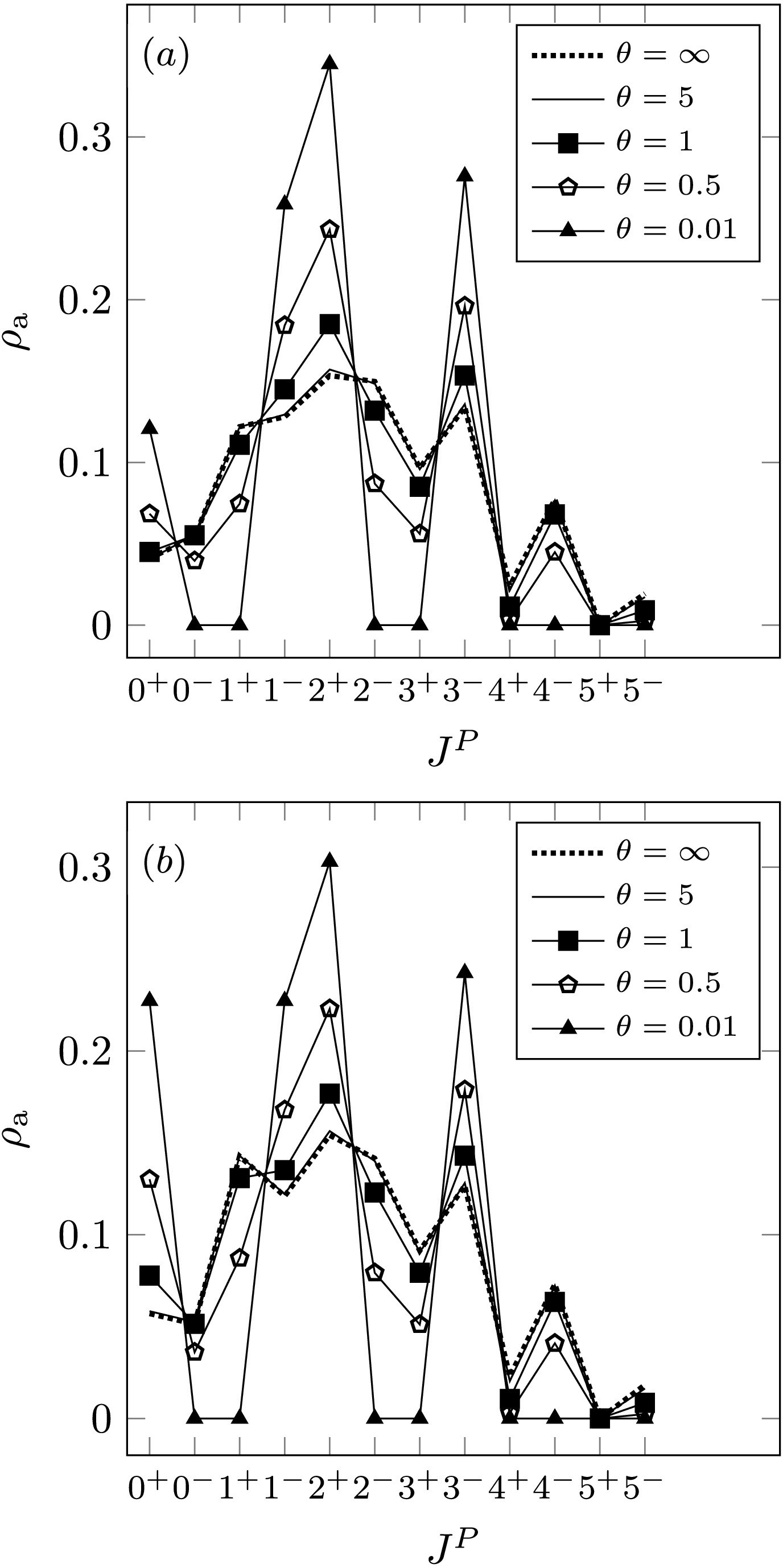
Figure 4. Distributions of the weighted, normalized number of accessible states,
$ \rho_{\text a} $ , as functions of$ J^P $ for compact tetraquark states, evaluated for different values of the parameter$ \theta\in\{0.01,0.5,1,5,\infty\} $ with the configuration space restricted to (a) {ETH, Sqr} and (b) {ETH$ _3 $ , Sqr$ _3 $ }.Despite these modifications, the
$ 2^+ $ component remains the dominant contribution across the explored parameter region. Its relative weight increases further as the dynamical weighting becomes more pronounced, suggesting that the symmetry-based preference for$ 2^+ $ states is robust and is further reinforced under this phenomenological weighting scheme. For the partially symmetric configuration set {ETH$ _3 $ , Sqr$ _3 $ }, the$ 0^+ $ contribution decreases and becomes comparable to the$ 1^- $ component.Comparison of the weighted distributions with the symmetry-only case at
$ \theta=\infty $ shows that the overall pattern remains qualitatively unchanged. Thus, the INS-induced structure provides a robust constraint on the low-energy spectrum even after dynamical effects are included. -
A recent QCD sum-rule analysis investigated fully charm compact tetraquark states with the color structure
$ 8_{[c{\bar{c}}]}\otimes8_{[c{\bar{c}}]} $ [122]. The study considered several$ J^{PC} $ channels, including$ 0^{-+} $ ,$ 0^{-} $ ,$ 1^{-+} $ ,$ 1^{+-} $ ,$ 1^{-} $ , and$ 2^{++} $ . The predicted masses indicate that the$ 1^{+-} $ and$ 2^{++} $ states lie around 6.48–6.62 GeV, whereas the remaining channels are predicted at higher masses, 6.85–7.02 GeV [122].To compare with these results, we project our symmetry-based counting onto states with definite charge-conjugation parity and compute
$ N(J^{P,C=\pm}) $ .$ N(J^{P,C=\pm})=\frac{1}{2}\left[N(J^P)\pm\sum\limits_{f\in \mathfrak{T}_{J^P}}<f|\hat{C}|f>\right], $
(13) where
$ \hat{C} $ is the charge-conjugation operator, which exchanges the quark and antiquark sectors, and the sum runs over$ \mathfrak{T}_{J^P} $ . Restricting the flavor wave functions to$ [f]_{\text F}=[{\bar{f}}]_{\text F}=[2] $ , corresponding to the fully charm$ cc{\bar{c}}{\bar{c}} $ system, we compute$ N(J^P) $ and$ N(J^{P,C=\pm}) $ .The determination of
$ N(J^{P,C=\pm}) $ relies on evaluating$ \sum_{f\in \mathfrak{T}_{J^P}}\left<f\right|\hat{C}\left|f\right> $ . We continue to use the degree-of-freedom decomposition scheme described in Sec. 2. For$ [f]_{\text F}=[{\bar{f}}]_{\text F}=[2] $ , the contributions to the C-parity from the flavor and color degrees of freedom are fixed to be$ + $ . For the orbital part, each accessible$ S_4 $ IRREP λ branches under$ S_4\to S_2\times S_2 $ as$ \left\{ \begin{aligned} &[4] \downarrow[2]\otimes[2],\\ &[1^4] \downarrow[11]\otimes[11],\\ &[31] \downarrow[2]\otimes[2],\\ &[211] \downarrow[11]\otimes[11], \end{aligned}\right. $
(14) with orbital C-parity
$ C_{\text{orb}}=+ $ for$ [4] $ and$ [1^4] $ and$ C_{\text{orb}}=- $ for$ [31] $ and$ [211] $ . The IRREP$ [22] $ has two branches,$ \begin{array}{l} [22]\downarrow\left([2]\otimes[2]\right)\oplus\left([11]\otimes[11]\right), \end{array} $
(15) both having
$ C_{\text{orb}}=+ $ . For the spin component, the quark and antiquark spins are coupled as$ s_2{\bar{s}}_2\to s_{\text{tot}} $ .$ \begin{array}{l} C_{\text{spin}}= \begin{cases} (-1)^{s_2+{\bar{s}}_2-s_{\text{tot}}}, & s_2={\bar{s}}_2,\\ 0, & s_2\neq{\bar{s}}_2. \end{cases} \end{array} $
(16) When
$ s_2\neq{\bar{s}}_2 $ , charge conjugation interchanges the spin-coupling configurations$ (s_2,{\bar{s}}_2) $ and$ ({\bar{s}}_2,s_2) $ . Because these configurations are distinct, the corresponding diagonal matrix elements of the charge-conjugation operator vanish within this subspace. Equivalently, the two linear combinations with definite C-parity have opposite eigenvalues and equal multiplicities, yielding zero net contribution to the trace$ \sum_f\left<f\right|\hat{C}\left|f\right> $ . Accordingly, we set$ C_{\text{spin}}=0 $ for$ s_2\neq{\bar{s}}_2 $ .For a given
$ J^P $ , the state space is first decomposed into all allowed$ (L^P,s_{\text{tot}}) $ satisfying$ |L-s_{\text{tot}}|\leq J\leq L+s_{\text{tot}} $ and$ P=(-1)^L $ , and then further into all allowed$ (s_2,{\bar{s}}_2) $ . Each accessible state has a total charge-conjugation parity$ C_{\text{tot}}=C_{\text{orb}}C_{\text{spin}} $ , so that$ \left<f\right|\hat{C}\left|f\right>=C_{\text{orb}}C_{\text{spin}} $ . Summing this sign over all accessible branches in$ \mathfrak{T}_{J^P} $ and inserting the results into Eq. (13) yields$ N(J^{P,C=\pm}) $ , which are summarized in Table 4.Configuration $ 0^+ $ $ 0^- $ $ 1^+ $ $ 1^- $ $ 2^+ $ $ 2^- $ $ 3^+ $ $ 3^- $ $ 4^+ $ $ 4^- $ $ 5^+ $ $ 5^- $ ETH 10 13 26 34 34 38 20 37 6 20 0 6 Sqr 12 10 23 18 35 24 20 18 6 12 0 2 ETH $ _3 $ 14 13 28 34 36 38 20 37 6 20 0 6 Sqr $ _3 $ 16 10 33 18 37 24 20 18 6 12 0 2 Total 52 46 110 104 142 124 80 110 24 64 0 16 Configuration $ 0^{++} $ $ 0^{-+} $ $ 1^{++} $ $ 1^{-+} $ $ 2^{++} $ $ 2^{-+} $ $ 3^{++} $ $ 3^{-+} $ $ 4^{++} $ $ 4^{-+} $ $ 5^{++} $ $ 5^{-+} $ ETH 6 6 13 19 19 19 10 21 4 10 0 4 Sqr 10 6 10 6 21 12 10 6 4 6 0 0 ETH $ _3 $ 10 6 13 19 21 19 10 21 4 10 0 4 Sqr $ _3 $ 10 6 16 6 21 12 10 6 4 6 0 0 Total 36 24 52 50 82 62 40 54 16 32 0 8 Configuration $ 0^{+-} $ $ 0^{-} $ $ 1^{+-} $ $ 1^{-} $ $ 2^{+-} $ $ 2^{-} $ $ 3^{+-} $ $ 3^{-} $ $ 4^{+-} $ $ 4^{-} $ $ 5^{+-} $ $ 5^{-} $ ETH 4 7 13 15 15 19 10 16 2 10 0 2 Sqr 2 4 13 12 14 12 10 12 2 6 0 2 ETH $ _3 $ 4 7 15 15 15 19 10 16 2 10 0 2 Sqr $ _3 $ 6 4 17 12 16 12 10 12 2 6 0 2 Total 16 22 58 54 60 62 40 56 8 32 0 8 Table 4. Distribution of the number of accessible compact tetraquark states as a function of
$ J^P $ in the flavor subspace$ [f]_{\text F}=[{\bar{f}}]_{\text F}=[2] $ , for the ETH and Sqr configurations, as well as the ETH$ _3 $ and Sqr$ _3 $ configurations, with orbital angular momentum restricted to$ L\leq3 $ . The upper rows list$ N(J^P) $ and the total number of accessible states across the four configurations, whereas the lower rows list the corresponding$ C=\pm $ projections,$ N(J^{P,C=\pm}) $ , and the total number.The results in Table 4 satisfy
$ \begin{array}{l} N(J^{P,C=+})+N(J^{P,C=-})=N(J^P), \end{array} $
(17) for every
$ J^P $ channel in each configuration, providing an important consistency check for the counting procedure. For the$ cc{\bar{c}}{\bar{c}} $ system, we find that the$ 2^+ $ channel without a C-parity restriction and the$ 2^{++} $ channel in the$ C=+ $ subspace are both dominant in terms of the total number of accessible states across the four configurations. The latter is consistent with the recent CMS result [46].A comparison between the ordering obtained here and the QCD sum-rule results shows a common feature: the
$ 2^{++} $ state is favored among the low-lying states. Therefore, if the experimentally observed states$ X(6600) $ ,$ X(6900) $ , and$ X(7100) $ are compact fully charm tetraquarks, their experimentally determined quantum numbers,$ J^{PC}=2^{++} $ , are consistent with their interpretation as low-lying compact tetraquark states.This consistency supports the interpretation that the
$ 2^+ $ state is naturally favored by the symmetry structure. However, for the relative ordering of the$ 1^- $ and$ 1^+ $ states, the present analysis reveals notable sensitivity to the phenomenological smoothing parameter, as shown in Fig. 5. Whereas Fig. 4 shows the distributions at several representative values of θ, Fig. 5 presents a continuous sensitivity scan over the range$ 0.05\leq\theta\leq10 $ . The intersections of different curves in Fig. 5 correspond to changes in the relative ordering of the symmetry-based accessibility measure. For the configuration set {ETH$ _3 $ , Sqr$ _3 $ }, the$ 1^- $ and$ 1^+ $ channels cross at$ \theta\simeq1.0 $ . This crossing indicates that the$ 1^-/1^+ $ ordering is sensitive to the phenomenological weighting scheme, highlighting a theoretical uncertainty that warrants further investigation using more rigorous methods.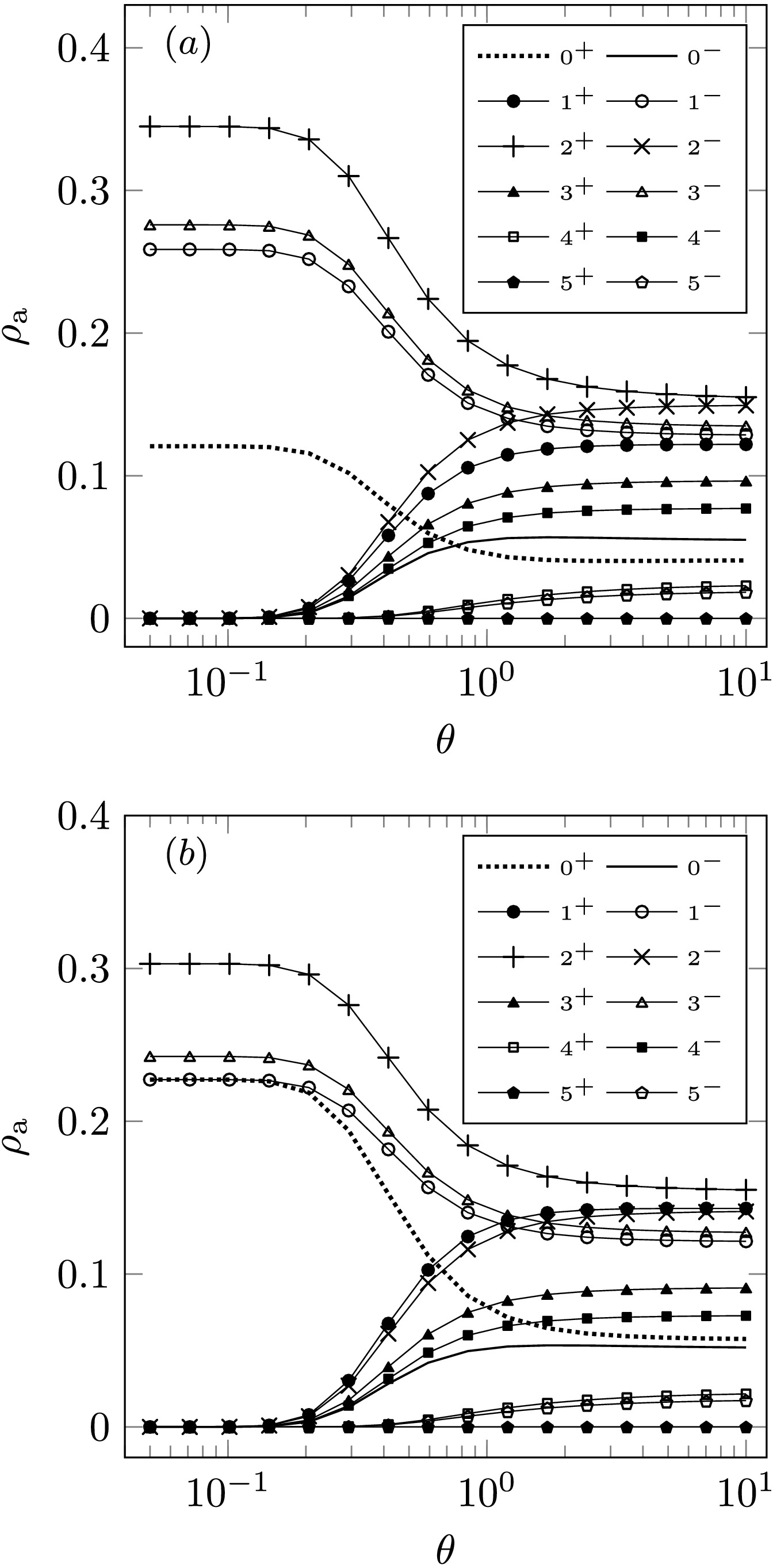
Figure 5. Dependence of the weighted and normalized number of accessible states,
$ \rho_{\text a} $ , on the parameter θ for each$ J^P $ channel in compact tetraquark states, with$ \theta\in[0.05,10] $ and the configuration space restricted to the sets (a) {ETH, Sqr} and (b) {ETH$ _3 $ , Sqr$ _3 $ }.Although no unique physical value of θ can be determined within the present framework, the crossing at
$ \theta\simeq1.0 $ in Fig. 5(b) identifies$ \theta\gtrsim1.0 $ as a representative regime in which the qualitative ordering of the relevant channels is stable and consistent with the QCD sum-rule result [122]. In this region, the subleading channel after$ 2^+ $ is$ 2^- $ in (a) and$ 1^+ $ in (b). We therefore suggest the$ 2^- $ and$ 1^+ $ channels as useful targets for future experimental searches, in addition to the confirmed$ 2^+ $ candidates.Before concluding this section, we revisit the dependence of our results on the phenomenological parameters
$ E_1 $ ,$ E_2 $ , and$ E_3 $ introduced in Sec. IIIB. We have verified that varying the ratios$ E_2/E_1 $ and$ E_3/E_1 $ within a moderate range may affect the ordering of the curves at a fixed value of θ, but does not alter the intersection pattern: whether any two curves intersect, and the sequence in which these intersections occur as θ increases, remain unchanged. This indicates that the qualitative evolution of the level ordering with θ is robust against the specific values of the energy parameters and that the conclusions drawn from the sensitivity analysis are not artifacts of the adopted parametrization. -
In this work, we investigate the low-energy structure of compact tetraquark states using symmetry constraints from the INS framework, together with spin–statistics and color-singlet conditions. We find that the distribution of accessible states is dominated by higher-angular-momentum components, particularly
$ J^P=2^+ $ ,$ 2^- $ , and$ 3^- $ , whereas lower-angular-momentum states such as$ 0^+ $ and$ 0^- $ are comparatively suppressed.After dynamical weighting factors are introduced, the
$ 0^+ $ contribution increases significantly, but the dominance of the$ 2^+ $ and$ 3^- $ components remains. This indicates that the spatial symmetry constraints encoded by INS play a leading role in determining the qualitative structure of the low-energy spectrum.When these results are applied to the fully charm candidates
$ X(6600) $ ,$ X(6900) $ , and$ X(7100) $ , the present analysis suggests that$ 2^{++} $ configurations are natural candidates for these structures, which is noteworthy given their observed$ J^{PC}=2^{++} $ assignment. However, individual peak assignments require dynamical calculations beyond the present symmetry analysis.Within the scanned range, for
$ \theta\gtrsim1.0 $ , where the ordering is consistent with the QCD sum-rule result, the subleading channels after$ 2^+ $ are$ 2^- $ and$ 1^+ $ . These channels may therefore be useful targets for future experimental searches for fully charm tetraquarks.Furthermore, the comparison between compact tetraquark systems and three-flavor four-quark systems shows that their accessible-state distributions exhibit similar qualitative patterns despite differences in color-singlet constraints and representation structures. This suggests that, for multiquark systems with equal numbers of quarks and antiquarks, the INS-induced distribution may be largely insensitive to the detailed internal organization of the quark and antiquark degrees of freedom.
Nevertheless, when dynamical effects are incorporated through phenomenological weighting factors, the distribution can shift in a system-dependent manner. Thus, although symmetry provides a robust framework for classifying possible states, the actual ordering is likely influenced by dynamical details that require further investigation.
Symmetry analysis of compact tetraquark states and implications for the fully charm candidates X(6600), X(6900), and X(7100)
- Received Date: 2026-08-10
- Available Online: 2026-10-01
Abstract: Motivated by recent experimental observations, we investigate the $J^P$ distribution of low-energy compact tetraquark states using a symmetry analysis based on inherent nodal structures. Assuming tetrahedral and square configurations for the $qq{\bar{q}}{\bar{q}}$ system, we derive the allowed orbital structures from the restricted representations of $S_4$ to $S_2\times S_2$ for $L\leq3$. The distribution of accessible states is particularly pronounced in the $J^P=2^+$, $2^-$, and $1^+$ sectors, with the $2^+$ sector exhibiting the strongest low-energy preference. We further find that the symmetry-driven distribution is qualitatively similar to that of the three-flavor four-quark system and that the dominant $J^P=2^+$ pattern persists under phenomenological weightings inspired by chromomagnetic interaction (CMI) considerations. These results suggest that the low-lying compact tetraquark spectrum is primarily constrained by symmetry, whereas its detailed distribution is sensitive to dynamical weightings. Applying this framework to the fully charm candidates $X(6600)$, $X(6900)$, and $X(7100)$, we find that their observed $J^{PC}=2^{++}$ quantum numbers are consistent with a low-lying compact tetraquark interpretation. The relative ordering of the $1^-$ and $1^+$ states is particularly sensitive to the phenomenological weighting, indicating a direction for future investigation using more rigorous methods. Furthermore, the $2^-$ and $1^+$ channels emerge as potential subleading candidates after $2^+$, providing useful targets for future experimental searches.



 DownLoad: