


 Abstract
 HTML
HTML Reference
 Related
 PDF
PDF


-
Black holes are among the most striking predictions of general relativity, and their strong gravitational fields provide natural laboratories for testing gravitational theories and exploring physical laws under extreme conditions. However, classical black hole solutions inevitably contain curvature singularities inside the event horizon, signaling the breakdown of classical general relativity at extremely high energy scales. The existence of singularities not only leads to geodesic incompleteness of spacetime but also fundamentally conflicts with the unitarity requirements of quantum mechanics, giving rise to the well-known black hole information paradox. To address this issue, researchers have proposed various mechanisms for avoiding singularities, including nonlinear electrodynamics, string theory, loop quantum gravity, and the gravitational decoupling method. These approaches have motivated the important research direction of regular black holes [1−15].
On the other hand, astronomical observations indicate that black holes in the real universe are not isolated but are embedded in galactic environments dominated by dark matter halos [16, 17]. Although the microscopic nature of dark matter remains unknown, N-body simulations and studies of galactic dynamics have established several phenomenological density distribution models, such as the Navarro-Frenk-White (NFW) profile [16], the Hernquist profile [18], the Einasto profile [19−21], and the Dehnen-type profile [22]. This opens the possibility of using dark matter halos both as gravitational sources and as a mechanism for singularity avoidance.
Motivated by this idea, Konoplya and Zhidenko [23] recently constructed a class of static, spherically symmetric regular black hole solutions sourced by dark matter halos by imposing the radial pressure condition
$ P_r = -\rho $ . They also demonstrated their linear stability against axial perturbations. This model elevates the dark matter halo from a passive environmental background to an active mechanism for resolving singularities, thereby providing a novel theoretical platform for exploring the intersection of strong-field gravity and dark matter physics.For such black holes embedded in dark matter halos, existing studies have extensively investigated observable signals, including quasinormal modes, shadows, lensing, and accretion disk radiation. For instance, Datta [24] analyzed in detail the energy conditions for singular black holes within Einasto and Dehnen-type dark matter halos. Konoplya et al. [25, 26] examined the axial perturbation stability and shadow characteristics of black holes surrounded by dark halos. Anjan and Sayan [27] systematically reviewed the asymptotic behavior and horizon structure of regular black holes in the Dehnen-type distribution. Furthermore, for loop quantum gravity regular black holes (LQRNBH) and quantum-corrected black holes (QCBH), Yu-Heng Shu [28] used EHT observational data for M87* and Sgr A* to impose high-precision constraints on quantum parameters and systematically studied the radiative efficiency, redshift distribution, and imaging characteristics of thin accretion disks. In other modified gravity frameworks, the radiative properties of thin accretion disks have also been extensively investigated. For example, Liu et al. [29] revisited the thin accretion disk around brane-world black holes, corrected previous errors in the flux formula, and presented revised results. He et al. [30] analyzed the effects of model parameters on the energy flux, temperature, and emission spectrum in Einstein-Aether-scalar theory. Gravitational wave counterparts were explored in Ref. [31]. Optical images of the Kerr–Sen black hole were investigated in [32]. Feng et al. [33] systematically calculated the radiative flux, spectrum, and shadow of Kerr–Sen black holes in a plasma environment and constrained the dilaton parameter using M87* and Sgr A* observations. These studies indicate that black hole shadow radii and accretion disk radiation spectra are powerful probes for distinguishing different modified gravity models and constraining dark matter halo parameters.
However, for regular black holes embedded in a Dehnen-type dark matter halo (hereafter referred to as Dehnen regular black holes), a systematic study of thin accretion disk imaging is still lacking. How does the parameter a modulate the circular orbit dynamics, local radiative flux, redshift factor distribution, and observed radiation image? What variation patterns emerge from its influence at different viewing angles? What confidence-level constraints can be placed on a using existing EHT observations? These questions require further investigation.
This paper aims to fill this gap. Taking the Dehnen regular black hole metric as the research object, we conduct the following systematic analysis. First, based on EHT observations of M87* and Sgr A* [34, 35], we provide quantitative constraints on the parameter a at both
$ 1\sigma $ and$ 2\sigma $ confidence levels. Second, we systematically investigate the timelike geodesic structure, revealing the influence of a on the ISCO radius, orbital energy, angular momentum, and angular velocity. Subsequently, employing the Page–Thorne thin accretion disk model [36] combined with the backward ray-tracing method [37], we numerically simulate isoredshift curves and observed radiative flux distributions for different viewing angles, systematically examining the modulation effects of the parameter a on the characteristics of direct and secondary images. To further assess whether the observed features are generic to regular black holes or specific to the Dehnen model, we also perform a comparative study with two other widely discussed regular black hole solutions: a black hole sourced by an Einasto dark matter halo and the phenomenological Hayward black hole. We compute their ISCO radii and thin-disk flux profiles, highlighting the distinctive signatures of the Dehnen case. This comparison provides physical insight into how different regularization mechanisms affect the observable accretion disk images. Finally, we summarize the multiple observational imprints of the parameter a in black hole shadows, orbital dynamics, and accretion disk imaging, and discuss potential future research directions.The structure of this paper is organized as follows. Section II briefly reviews the Dehnen regular black hole metric and provides parameter constraints based on EHT data. Section III derives timelike geodesics and circular orbit conditions and analyzes the impact of a on the ISCO and orbital dynamics. Section IV establishes the thin accretion disk model, calculates the redshift factor and observed radiative flux, and presents direct and secondary imaging results for different parameters. Section V compares the Dehnen black hole with the Einasto and Hayward regular black holes in terms of ISCO radii and radiative flux profiles. Section VI summarizes the findings and discusses future prospects. For simplicity, we use natural units (
$ G=c=1 $ ) throughout this paper. -
Finding black hole solutions without singularities is an important research direction in general relativity. This paper considers a class of regular black hole solutions constructed from the density distribution of dark matter halos, for which the density profile is assumed to be of the Dehnen type. This profile takes the following form [22, 23]:
$ \rho(r) = \rho_0\left(\dfrac{r}{a}\right)^{-\alpha}\left(1 + \dfrac{r^k}{a^k}\right)^{-(\gamma -\alpha) / k}, $
(1) where
$ \rho_0 $ is the central density, a is the scale parameter, and α, γ, and k are shape parameters. Setting$ \alpha = 0 $ ensures that the density remains finite at$ r=0 $ and satisfies the weak energy condition. Assuming$ \gamma \gt 3 $ guarantees a finite total mass. Further setting$ k = 1 $ and$ \gamma = 4 $ yields the following simplified density distribution:$ \rho(r) = \rho_0 \left(1 + \dfrac{r}{a}\right)^{-4}. $
(2) Using the Einstein field equations and assuming that the radial pressure satisfies
$ P_r = -\rho $ , one obtains the metric in the following form [23]$ {\rm d}s^{2} = -f(r)\text{d}t^{2} + \dfrac{\text{d}r^{2}}{f(r)} + r^{2}(\text{d}\theta^{2} + \sin^{2}\theta \text{d}\phi^{2}), $
(3) where the metric function
$ f(r) $ is given by$ f(r) = 1 - \dfrac{2M r^2}{(r + a)^3}, $
(4) where M denotes the total mass, which is obtained by integrating the density profile over all space:
$ M = 4\pi\int_{0}^{\infty} r^{2}\rho(r)\,{\rm d}r = \dfrac{4\pi\rho_{0} a^{3}}{3}. $
(5) This metric describes a regular black hole embedded in a Dehnen-type dark matter halo.
We now study null geodesics in this spacetime. For photons in the equatorial plane (
$ \theta = \pi/2 $ ), we have$ \begin{aligned}[b] 0 &= g_{\mu\nu} \left( \dfrac{\partial}{\partial \lambda} \right)^\mu \left( \dfrac{\partial}{\partial \lambda} \right)^\nu \\& = -f(r) \left( \dfrac{{\rm d}t}{{\rm d}\lambda} \right)^2 + f(r)^{-1} \left( \dfrac{{\rm d}r}{{\rm d}\lambda} \right)^2 + r^2 \left( \dfrac{{\rm d}\phi}{{\rm d}\lambda} \right)^2, \end{aligned} $
(6) where λ is an affine parameter. The metric
$ g_{\mu\nu} $ is independent of the coordinates t and ϕ; therefore, this spacetime possesses two independent Killing vector fields. For a geodesic in this spacetime, two conserved quantities can be derived: the energy E and the angular momentum L$ E \equiv -g_{00}\dfrac{{\rm d}t}{{\rm d}\lambda}=f(r)\dfrac{{\rm d}t}{{\rm d}\lambda}, $
(7) $ L \equiv g_{33}\dfrac{{\rm d}\phi}{{\rm d}\lambda}=r^2\dfrac{{\rm d}\phi}{{\rm d}\lambda}, $
(8) Substituting Eqs. (7), (8) into Eq. (6), we obtain the geodesic equation
$ \left( \dfrac{{\rm d}r}{{\rm d}\lambda} \right)^2 = L^2\left[\dfrac{1}{b^2} - V_{\text{eff}}(r)\right] , $
(9) where
$ V_{\text{eff}}(r) \equiv \dfrac{f(r)}{r^2}, $
(10) is the effective potential, and
$ b = L/E $ is the photon impact parameter. Photon trajectories are determined by their impact parameter. The photon sphere corresponds to unstable circular null orbits at radius$ r_{\text{ph}} $ , which can be determined by solving$ V'_{\text{eff}}(r_{\text{ph}}) = 0 $ . The critical impact parameter$ b_c $ at this radius is$ b_c = \dfrac{r_{\text{ph}}}{\sqrt{f(r_{\text{ph}})}}. $
(11) Figure 1 shows the constraints on the metric parameter from EHT observations. For M87*, the upper bound on the parameter a is
$ 0.0819328 $ at the$ 1\sigma $ confidence level and$ 0.20034 $ at the$ 2\sigma $ confidence level. For Sgr A*, the upper bound on the parameter a is$ 0.1932 $ at the$ 1\sigma $ confidence level and$ 0.279249 $ at the$ 2\sigma $ confidence level. These results indicate that the observational data for the two black holes impose different constraint ranges on the parameter a, with the constraints from Sgr A* being relatively less stringent.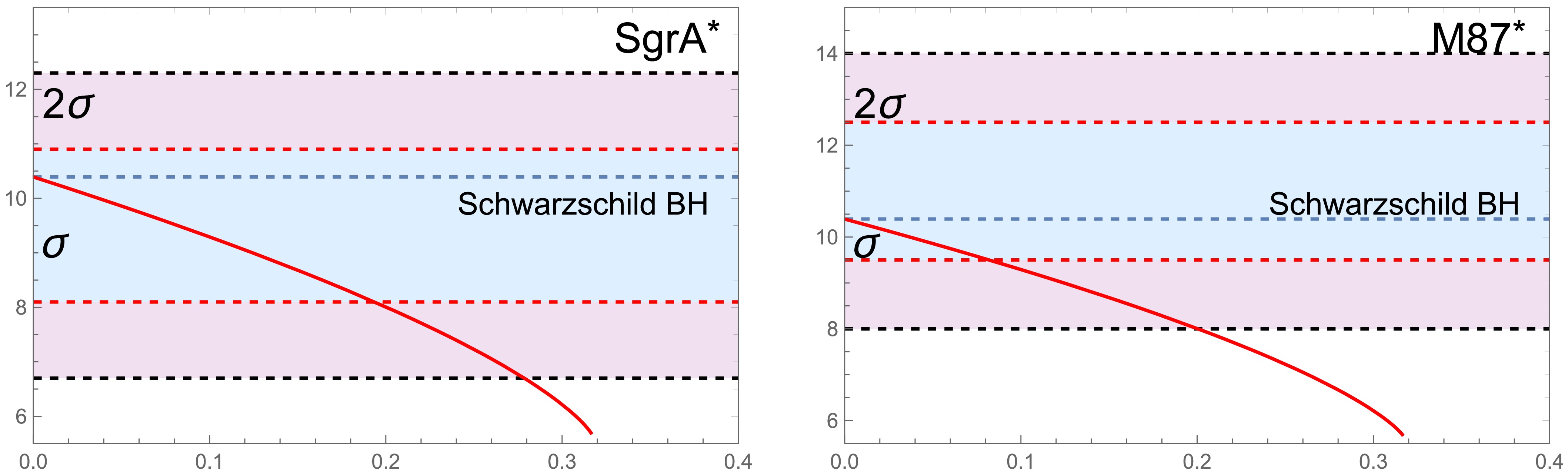
Figure 1. (color online) The left panel shows the constraints on the model parameters from the Sgr A* observational data. The right panel shows the constraints from the M87* observational data. The shadow diameter for this black hole model is indicated by the solid red curve, and that for the Schwarzschild model is indicated by the dashed blue line. The blue and pink shaded regions represent the EHT constraints on the shadow diameter of Sgr A* and M87* at the
$ 1\sigma $ and$ 2\sigma $ confidence levels, respectively. The gray region lies outside the$ 2\sigma $ range. -
By a similar argument, we can also obtain the geodesic equation for a massive particle moving in the equatorial plane
$ \left( \dfrac{{\rm d}r}{{\rm d}\tau} \right)^2 = E^2 - V_{\text{eff}}(r; L), $
(12) where τ is the proper time, and
$ V_{\text{eff}}(r; L) \equiv \left( 1 + \dfrac{L^2}{r^2} \right) f(r), $
(13) is the effective potential. Fig. 2 shows the variation of
$ V_{\text{eff}}(r; L) $ for different values of the parameter a. As a increases, the maximum of the effective potential curve shifts outward, and the height of the potential barrier increases.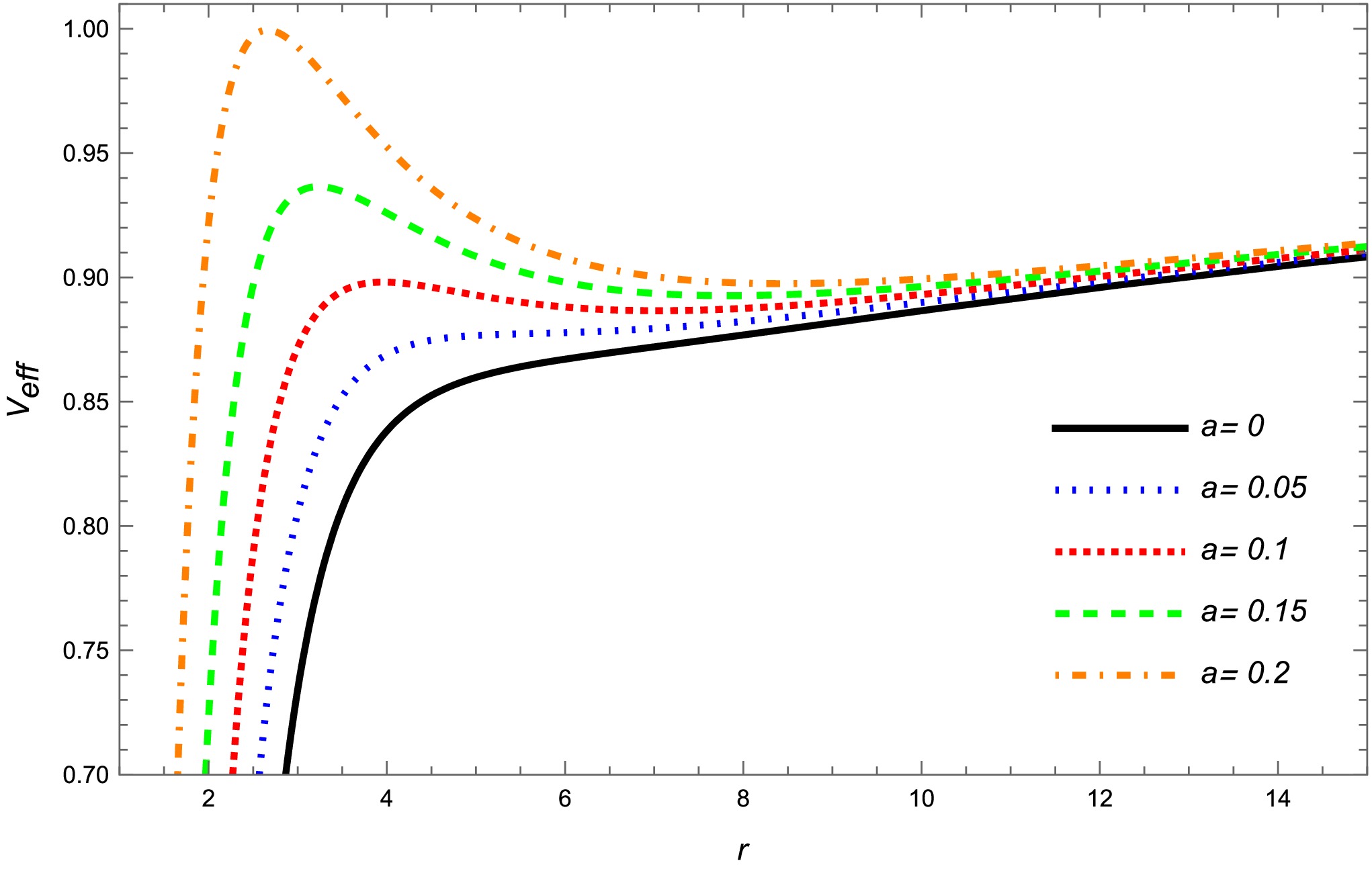
Figure 2. (color online) The
$ V_{\text{eff}} $ curves are shown for different values of a, with$ M=1 $ and$ L = 3.29 $ .Rewriting Eq. (12) using the chain rule
$\dfrac{{\rm d}r}{{\rm d}\tau} = \dfrac{{\rm d}r}{{\rm d}\phi}\dfrac{{\rm d}\phi}{{\rm d}\tau}$ , we obtain the equation for the particle's trajectory$ \left( \dfrac{{\rm d}r}{{\rm d}\phi} \right)^2 = r^4 \left[ \dfrac{E^2}{L^2} - \dfrac{V_{\text{eff}}(r; L)}{L^2} \right]. $
(14) Circular particle orbits are determined by the following conditions
$ V_{\text{eff}}(r; L) = E^2, \quad \dfrac{{\rm d}V_{\text{eff}}(r; L)}{{\rm d}r} = 0. $
(15) Under these conditions, we can obtain the energy E, angular momentum L, and angular velocity Ω of a particle in an equatorial circular orbit of radius r
$ \Omega = \dfrac{{\rm d}\phi}{{\rm d}t} = \sqrt{-\dfrac{g_{tt,r}}{g_{\phi\phi,r}}} = \sqrt{\dfrac{f'(r)}{2r}}, $
(16) $ E = -\dfrac{g_{tt}}{\sqrt{g_{tt} - g_{\phi\phi}\Omega^2}} = \sqrt{\dfrac{2f(r)^2}{2f(r) - r f'(r)}}, $
(17) $ L = \dfrac{g_{\phi\phi}\Omega}{\sqrt{g_{tt} - g_{\phi\phi}\Omega^2}} = \sqrt{\dfrac{r^3 f'(r)}{2f(r) - r f'(r)}}. $
(18) In particular, the ISCO is the orbit that satisfies the following conditions
$ V_{\text{eff}}(r; L) = E_{\text{ISCO}}^2, \quad \dfrac{{\rm d}V_{\text{eff}}(r; L)}{{\rm d}r} = 0, \quad \dfrac{{\rm d}^2V_{\text{eff}}(r; L)}{{\rm d}r^2} = 0. $
(19) Using Eq. (19), the orbital parameters of the ISCO around the black hole are obtained as
$ r_{\text{ISCO}} = \dfrac{3f(r_{\text{ISCO}}) f'(r_{\text{ISCO}})}{2(f'(r_{\text{ISCO}}))^2 - f(r_{\text{ISCO}}) f''(r_{\text{ISCO}})}, $
(20) $ L_{\text{ISCO}} = r_{\text{ISCO}}^{3/2} \sqrt{\dfrac{f'(r_{\text{ISCO}})}{2f(r_{\text{ISCO}}) - r_{\text{ISCO}} f'(r_{\text{ISCO}})}}, $
(21) $ E_{\text{ISCO}} = \dfrac{f(r_{\text{ISCO}})}{\sqrt{f(r_{\text{ISCO}}) - \dfrac{1}{2}r_{\text{ISCO}} f'(r_{\text{ISCO}})}}. $
(22) Figure 3 shows the variation in circular-orbit parameters for different values of the metric parameter a. Changes in this parameter significantly affect the orbital parameters in the strong-field region, whereas both the angular velocity and the energy approach those of the Schwarzschild black hole case in the weak-field region. Moreover, for larger values of a, circular orbits at the same radius have lower angular momentum.
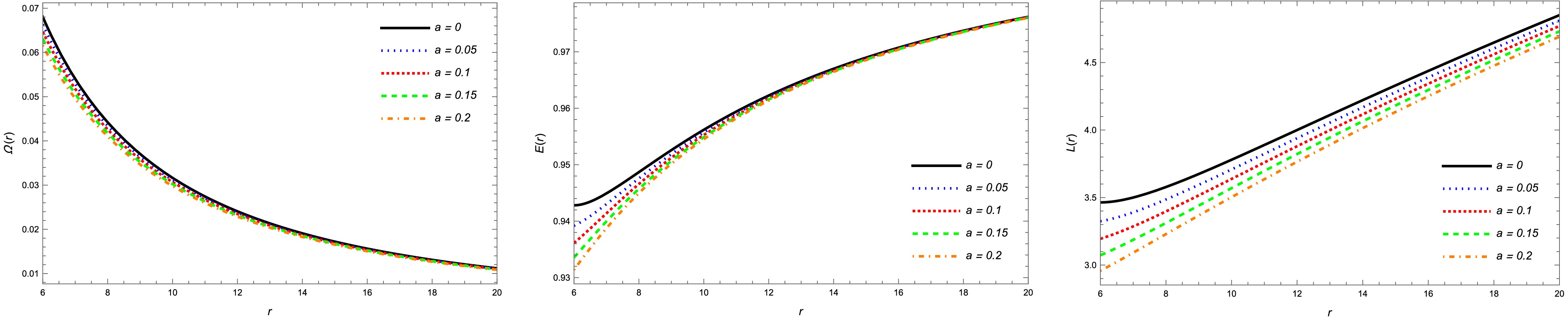
Figure 3. (color online) Variations in the circular-orbit parameters Ω, E, and L with r for different values of the parameter a, with
$ M=1 $ fixed.Table 1 presents the calculated ISCO-related parameters as the metric parameter a varies. The analysis shows that, as a increases, the ISCO exhibits systematic trends: the orbital radius
$ r_{\text{ISCO}} $ decreases markedly toward the black hole horizon, and the corresponding orbital angular velocity$ \Omega_{\text{ISCO}} $ increases significantly. Meanwhile, the particle energy$ E_{\text{ISCO}} $ on this orbit decreases slightly, whereas the angular momentum$ L_{\text{ISCO}} $ decreases more rapidly. These trends reflect the direct influence of the metric parameter a on the spacetime geometry and the structure of the gravitational field around the black hole, thereby modulating the range of existence and dynamical characteristics of stable orbits.a $r_{\text{ISCO}}$ $\Omega_{\text{ISCO}}$ $E_{\text{ISCO}}$ $L_{\text{ISCO}}$ 0 6 0.0680414 0.942809 3.4641 0.05 5.54138 0.0746133 0.938508 3.31485 0.1 5.06204 0.0827497 0.933276 3.15404 0.15 4.55439 0.0931991 0.926689 2.9781 0.2 4.00497 0.10738 0.917965 2.78092 Table 1. Numerical results for the ISCO orbital parameters as functions of the metric parameter a, with
$ M=1 $ fixed. -
According to the relativistic thin accretion disk model proposed in [36, 38], the local radiation flux on the disk surface can be expressed as
$ F(r) = -\dfrac{\dot{M} \Omega_{,r}}{4\pi\sqrt{-g/g_{\theta\theta}}(E - \Omega L)^2}\int_{r_{\text{ISCO}}}^{r} (E - \Omega L)L_{,r}\,{\rm d}r, $
(23) where g is the metric determinant and
$ \dot{M} $ is the mass accretion rate. In our numerical calculations, we set$ \dot{M}=1 $ . This model applies to geometrically thin, optically thick accretion disks, with the integration extending from the ISCO to the radius r. This integration represents the cumulative contribution of all radiation emitted from the inner edge to this radius. For the static spherically symmetric metric (3), the metric determinant satisfies$ \sqrt{-g}=r^2 $ and$ g_{\theta\theta}=r^2 $ on the equatorial plane, so that$ \sqrt{-g/g_{\theta\theta}} = r $ . Substituting this relation into the above formula gives the explicit flux expression used in our calculations:$ F(r) = -\dfrac{\dot{M}\,\Omega_{,r}}{4\pi r\,(E-\Omega L)^2} \int_{r_{\rm ISCO}}^{r} (E-\Omega L)\,L_{,r}\,{\rm d}r, $
(24) where the orbital quantities E, L, and Ω are given by Eqs. (16), (17), and (18).
Owing to the gravitational redshift effect in strong gravitational fields and the Doppler effect caused by the orbital motion of the accretion disk material, the radiation flux received by a distant observer,
$ F_{\text{obs}} $ , differs from the locally emitted flux,$ F(r) $ . These quantities are related through the total redshift factor z$ F_{\text{obs}} = \dfrac{F(r)}{(1 + z)^4}. $
(25) Following the method of Refs. [37, 39], the total redshift factor z is defined as
$ 1+z \equiv E_{\rm em}/E_{\rm obs} $ , where$ E_{\rm em} $ is the photon energy measured in the local rest frame of the emitting fluid element and$ E_{\rm obs} $ is the energy received by a distant static observer. For a fluid element moving on a circular equatorial orbit, its four-velocity is$ u^\mu = u^t(1,0,0,\Omega) $ . The normalization condition$ u^\mu u_\mu=-1 $ gives$ u^t = 1/\sqrt{-g_{tt}-g_{\phi\phi}\Omega^2} $ . Using the conserved quantities$ E = -p_t $ and$ L = p_\phi $ , the impact parameter$ b \equiv L/E $ , and the relation$ E_{\rm em} = -p_\mu u^\mu $ , one obtains$ E_{\rm em} = u^t E\,(1 - \Omega b) $ , and hence$1+z = u^t(1 - \Omega b) $ . Substituting the image-plane projection$ p_\phi/p_t = -b\sin\theta_0\cos\alpha $ yields$ 1 + z = \dfrac{1 + \Omega\,b\sin\theta_0\cos\alpha} {\sqrt{-g_{tt} - g_{\phi\phi}\Omega^2}}, $
(26) where
$ \theta_0 $ is the observer's inclination angle, and α is the polar angle on the observer's image plane. The denominator arises from gravitational redshift, whereas the numerator represents the coupling between the Doppler effect and the observational geometry.Combining equations (23), (25), and (26), we obtain the radiation flux distribution received by the observer
$ F_{\text{obs}} = \dfrac{ -\dfrac{\dot{M}\Omega_{,r}}{4\pi r(E - \Omega L)^2}\displaystyle\int_{r_{\text{ISCO}}}^{r}(E - \Omega L)L_{,r}\,{\rm d}r}{ \left(\dfrac{1 + \Omega b\sin\theta_0\cos\alpha}{\sqrt{-g_{tt} - g_{\phi\phi}\Omega^2}}\right)^4}. $
(27) Figures 4 and 5 illustrate the influence of the parameter a on the redshift factor z for the direct and secondary images of the black hole accretion disk at different viewing angles. When the viewing angle is
$ \theta_0 = 0 $ , the spacetime exhibits spherical symmetry, the Doppler redshift effect vanishes, and the gravitational redshift of the disk structure shows a rotationally symmetric distribution. As the viewing angle increases, the Doppler redshift effect becomes significantly stronger. On one side of the disk, where the material moves toward the observer, the Doppler blueshift partially cancels the gravitational redshift, causing the total redshift factor z to decrease. On the other side, the Doppler redshift adds to the gravitational redshift, causing z to increase. This asymmetry intensifies markedly with increasing$ \theta_0 $ , resulting in a pronounced left-right asymmetry in the redshift-factor image.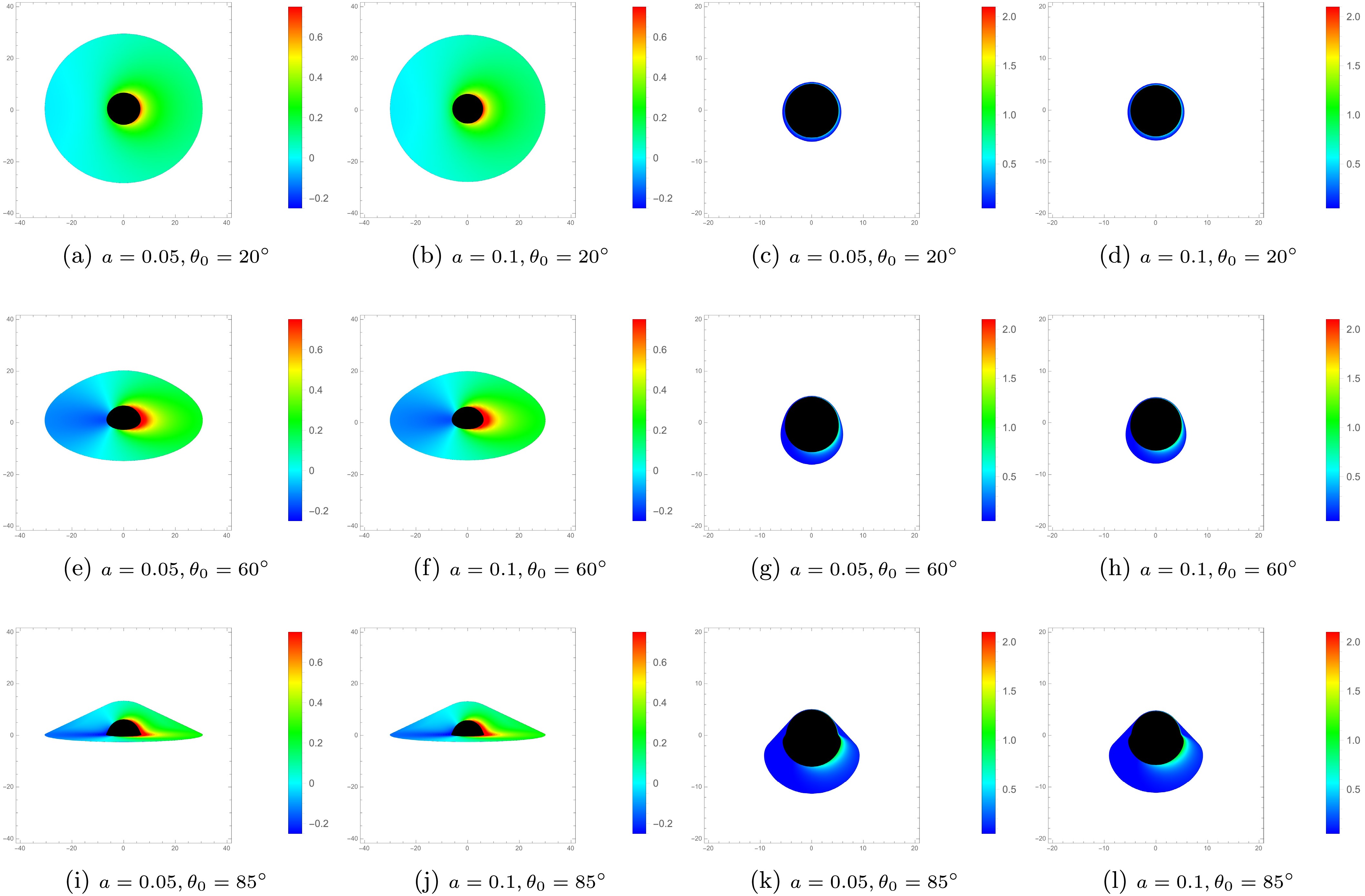
Figure 4. (color online) Influence of the parameter a on the redshift factor z in the direct and secondary images of the black hole accretion disk at different viewing angles. The outer edge of the accretion disk is located at
$ r=30M $ , with$ M=1 $ fixed.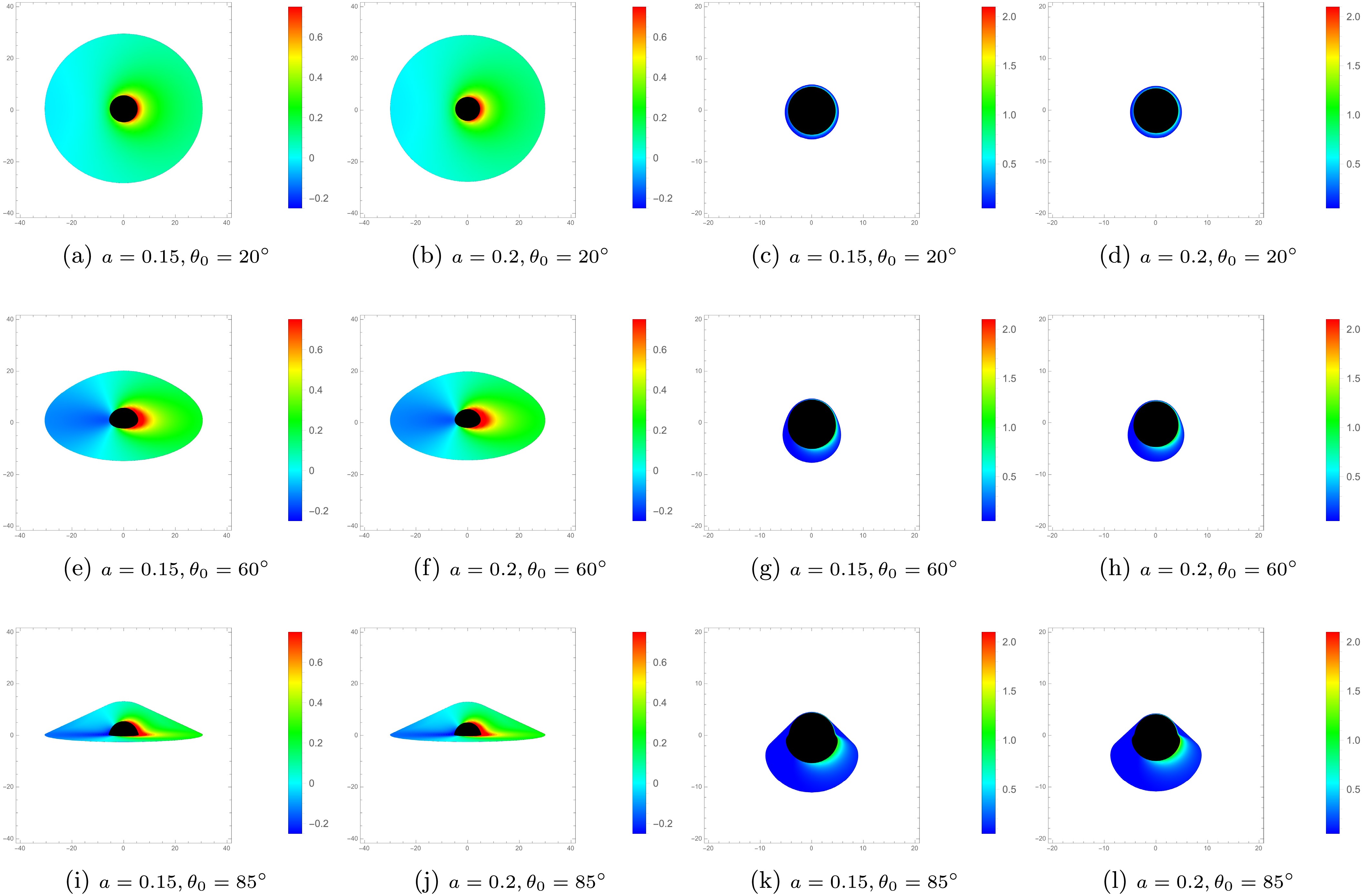
Figure 5. (color online) Influence of the parameter a on the direct and secondary images of the redshift factor z for a black hole accretion disk at different viewing angles. The outer edge of the accretion disk is located at
$ r=30M $ , with$ M=1 $ fixed.The parameter a also affects the degree of this asymmetry. A larger a corresponds to a more extended Dehnen dark-matter halo, which dilutes the central mass concentration and weakens the gravitational field. This weakening allows stable circular orbits to exist closer to the black hole, causing the inner edge of the accretion disk to move inward. Because the inner edge then lies at a smaller radius, the orbital velocity of the disk material there is higher. The Doppler shift is directly related to this velocity; therefore, increasing a amplifies the Doppler contrast between the approaching and receding sides. As a result, the left-right brightness asymmetry becomes more pronounced for larger a, an effect that is particularly evident when the disk is viewed at high inclination.
Figures 6 and 7 illustrate the effect of the parameter a on the observed radiation flux
$ F_{\text{obs}} $ for direct and secondary images at different viewing angles. When the viewing angle is small, the radiation flux distribution of the direct image is approximately disk-symmetric. As the viewing angle increases, the asymmetry of the distribution becomes significantly more pronounced. In addition, increasing the parameter a decreases the ISCO radius, thereby increasing the effective area of the accretion disk. Physically, the parameter a sets the characteristic scale of the Dehnen halo density$ \rho(r)\propto(1+r/a)^{-4} $ : a larger a corresponds to a more extended and less centrally concentrated mass distribution, which weakens the gravitational field near the center. This weakening is encoded in the spacetime geometry through the metric function$ f(r)= 1-2Mr^2/(r+a)^3 $ , which approaches unity more rapidly as a increases. Consequently, the spacetime curvature in the inner region is reduced, and a test particle can maintain a stable circular orbit at a smaller radius, shifting the ISCO inward. The inward shift of the inner disk edge therefore enlarges the luminous area that contributes to the observed flux, increasing the effective area of the accretion disk. Secondary images correspond to photons that, after being emitted from the disk surface, travel along paths that orbit the black hole by more than$ 90^\circ $ but less than$ 180^\circ $ (deflection angle greater than$ \pi/2 $ ) before reaching the observer. Such photons are subject to stronger gravitational lensing and carry information from the far side of the disk relative to the observer. As the viewing inclination increases, the visible region and intensity of the secondary image change. The secondary image provides a promising independent observational probe. Its angular radius is essentially determined by the photon sphere, which in this model depends on the dark-matter parameter a. Because the secondary image is produced by photons that have probed the spacetime extremely close to the photon sphere, it provides a direct measurement of the critical impact parameter that is largely insensitive to the detailed astrophysics of the accretion flow. Distinguishing the secondary image from the dominant direct image requires very high angular resolution and dynamic range, capabilities that may be achieved with future high-resolution interferometric observations. If the secondary ring can be resolved, its angular separation from the direct image would yield a clean determination of the photon-sphere scale, providing a constraint on a that is complementary to the shadow diameter. This makes the secondary image a valuable tool for testing the Dehnen-type dark-matter halo scenario with upcoming detector improvements.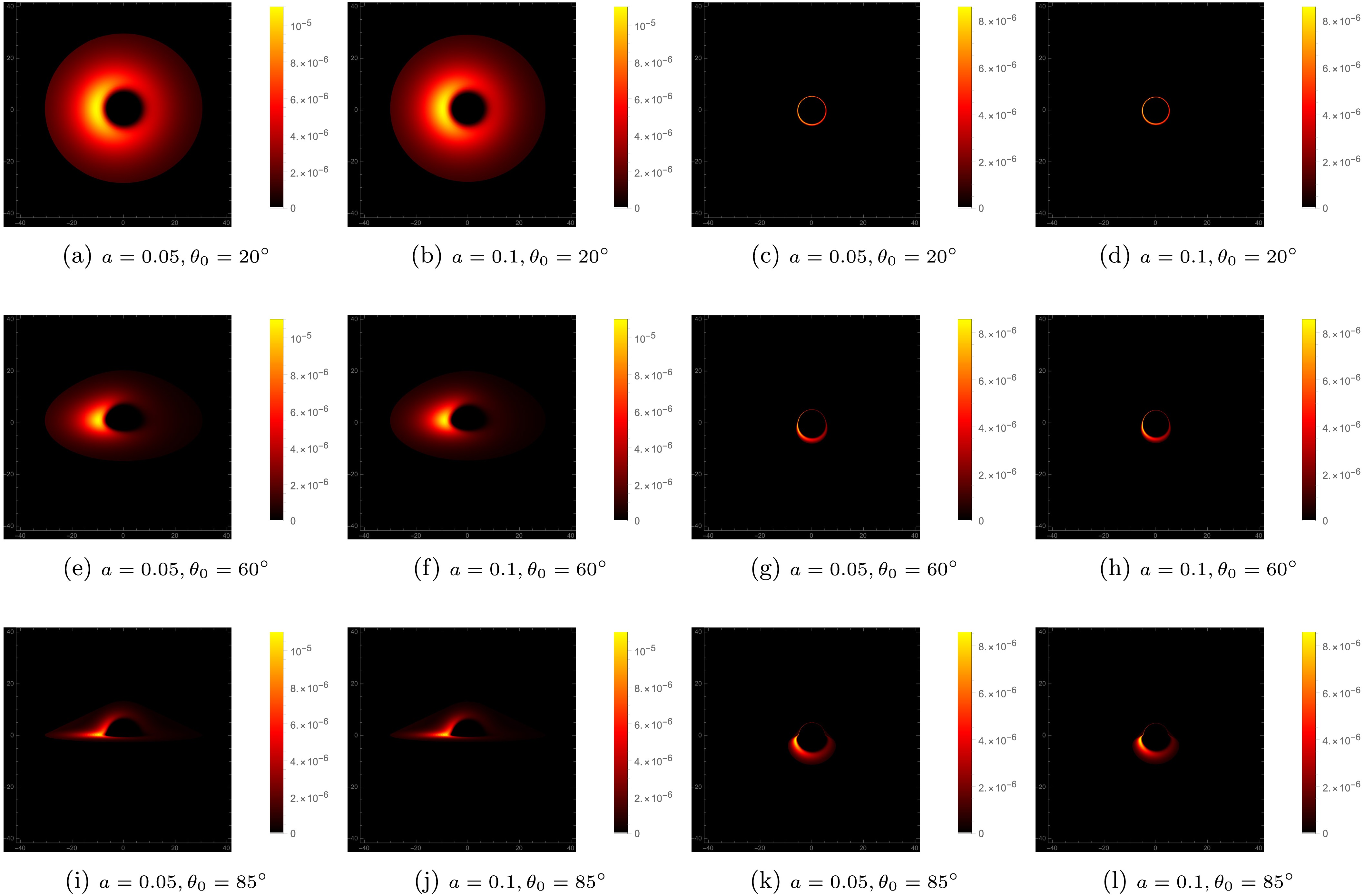
Figure 6. (color online) The influence of the parameter a on the direct and secondary images of the observed radiative flux
$ F_{\text{obs}} $ for different viewing angles. The outer edge of the accretion disk is located at$ r=30M $ , with$ M=1 $ fixed.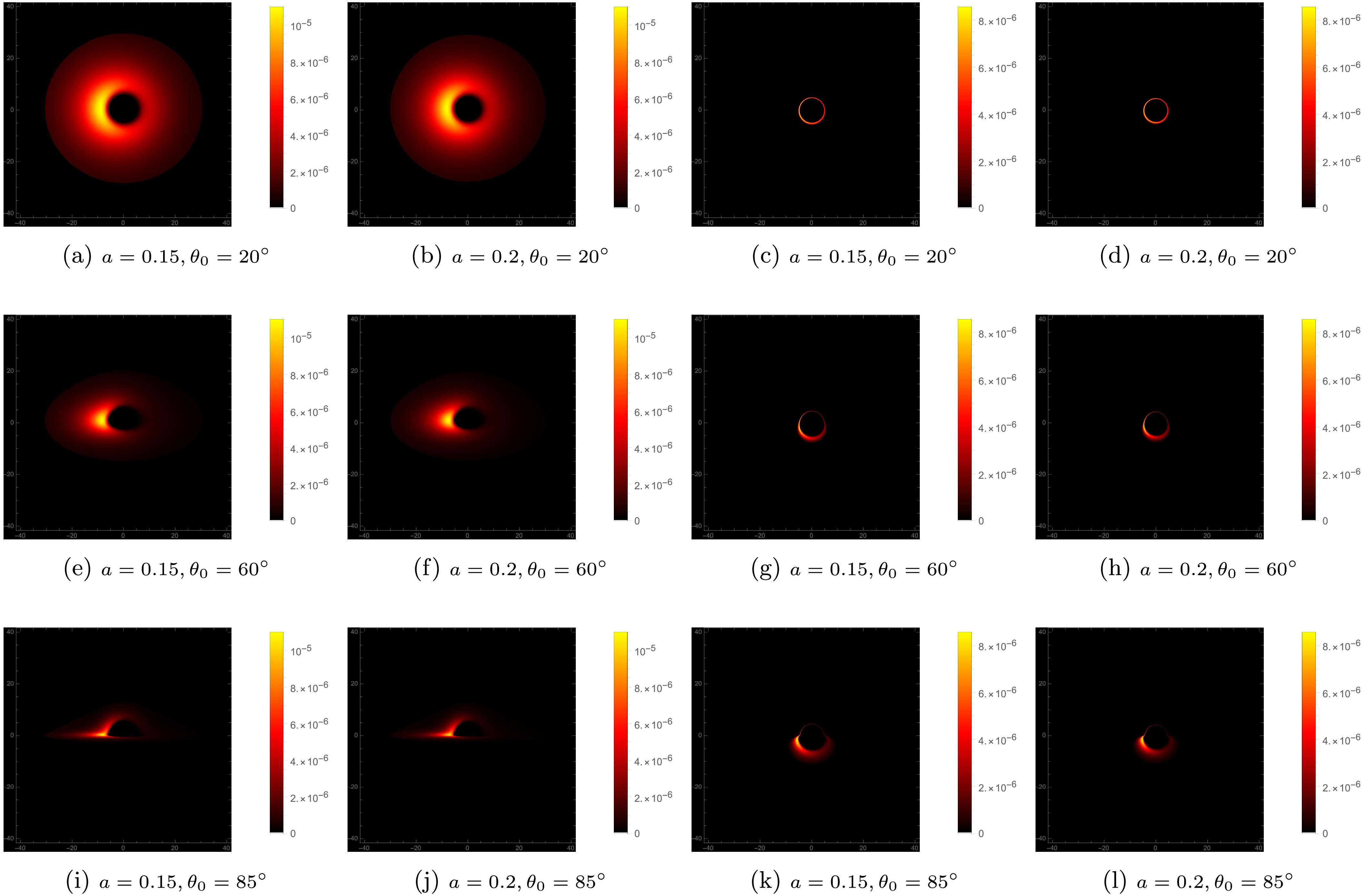
Figure 7. (color online) The influence of the parameter a on the direct and secondary images of the observed radiative flux
$ F_{\text{obs}} $ at different viewing angles. The outer edge of the accretion disk is located at$ r=30M $ , with$ M=1 $ fixed.For each pixel on the observer's image plane, the initial photon four-momentum was constructed from the pixel coordinates and the chosen inclination angle
$ \theta_0 $ of the observer. The corresponding null geodesic was then integrated backward in time until the photon either intersected the equatorial plane, where the thin accretion disk is located, or did not contribute to the image. If the photon intersected the disk, the local redshift factor and the emitted flux were evaluated at the intersection point and projected back onto the image plane to form the direct image or, for photons that orbited the black hole before intersecting the disk, the secondary image. -
To further assess how thin-disk properties depend on the physical origin of the regularizing core, we extend the comparison to two additional regular black hole geometries beyond the Dehnen model studied in the previous sections. The three metrics considered here are static, spherically symmetric, and asymptotically flat, but they differ in the mechanism by which the central singularity is resolved. The Dehnen and Einasto solutions are sourced by anisotropic dark-matter halos satisfying
$ P_r = -\rho $ and were derived in Ref. [23], whereas the Hayward metric is a phenomenological model with a de Sitter core motivated by quantum gravity arguments [40]. In this section, we compare the ISCO radii and radiative fluxes of thin accretion disks around these three regular black holes, with the total mass fixed at$ M=1 $ in all cases.We first introduce the Einasto dark-matter halo model. The Einasto density profile is
$ \rho(r) = \rho_0\exp[-(r/h)^{1/n}] $ ; for the analytic case$ n=1/2 $ , the metric function takes the form$ f_{\rm Ein}(r) = 1 - \dfrac{2M}{r}\,\mathrm{erf} \left(\dfrac{r}{h}\right) + \dfrac{4M {\rm e}^{-r^{2}/h^{2}}}{\sqrt{\pi}\,h}, $
(28) where
$\mathrm{erf}(z) \equiv \dfrac{2}{\sqrt{\pi}}\displaystyle\int_{0}^{z} {\rm e}^{-t^{2}}{\rm d}t$ is the error function, and M denotes the total gravitational mass obtained by integrating the Einasto density profile over all space,$ M = 4\pi\int_{0}^{\infty} r^{2}\rho(r)\,{\rm d}r = \pi^{3/2}\rho_{0} h^{3}. $
(29) As shown in Ref. [23], for
$ n=1/2 $ the metric possesses an event horizon when$ h \lesssim 1.05M $ . In the following analysis, we consider three representative values,$ h = 0.10, 0.20,\;0.30 $ , which are taken from the examples explicitly presented in Ref. [23].The second comparison model is the Hayward regular black hole [40], whose metric function is given by
$ f_{\rm Hay}(r) = 1 - \dfrac{2Mr^{2}}{r^{3} + 2l^{2}M}, $
(30) where l is a length scale that characterises the size of the regular de Sitter core. In the limit
$ l\to0 $ , the Schwarzschild solution is recovered, whereas for$ l>0 $ the central region approaches a de Sitter spacetime with an effective cosmological constant$ 3/l^{2} $ . Unlike the halo models, the Hayward metric is not sourced by a specific matter distribution derived from observational density profiles; rather, it is a minimal phenomenological construction designed to remove the curvature singularity while retaining the Schwarzschild form at large distances [40]. The black-hole existence condition is$ M \gt (3\sqrt{3}/4)l $ ; we adopt the three representative values$ l = 0.20,\;0.50,\;0.70 $ , which span the range from a weakly regularised configuration to one approaching the critical extremal limit.For the Dehnen dark-matter halo model, already analysed in detail in the preceding sections, we retain the same parameter set as before, namely
$ a = 0.05,\;0.15,\;0.20 $ .Figure 8 displays the ISCO radius as a function of the respective scale parameter for the three regular black holes. For the Dehnen model,
$ r_{\rm ISCO} $ decreases almost linearly with a, indicating that a more extended dark-matter halo weakens the central gravitational field in a nearly uniform manner. By contrast, the Hayward black hole shows a nonlinear trend: the ISCO shrinks slowly at small l but decreases sharply once l becomes large. This behaviour arises because the regularising core of the Hayward metric, governed by l, only weakly modifies the spacetime near the ISCO when l is small. Only when l becomes sufficiently large to appreciably alter the gravitational field at intermediate radii does the stable orbit shift rapidly inward. The Einasto black hole exhibits an ISCO that is nearly insensitive to h, as a consequence of the exponential decay of its density profile, which keeps the mass highly concentrated near the centre. Thus, varying h produces only a negligible change in the gravitational field at the ISCO radius.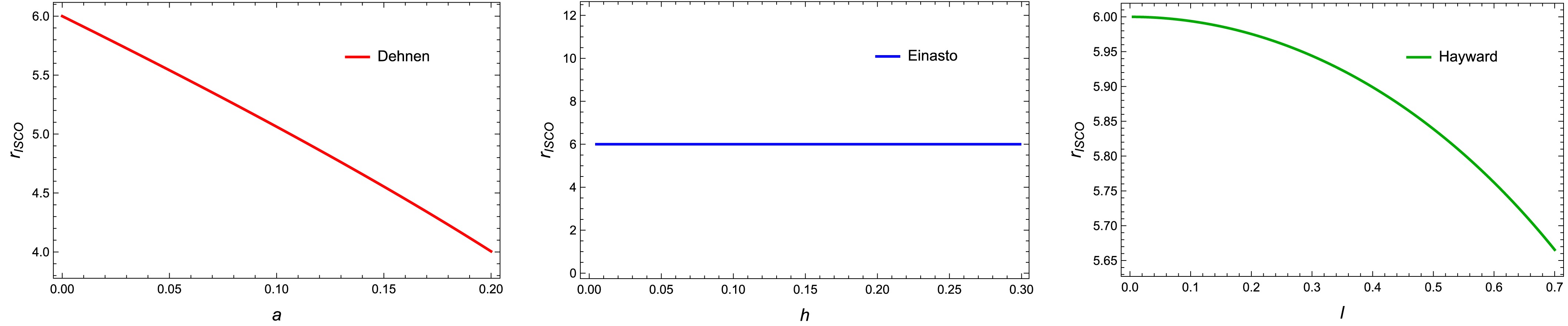
Figure 8. (color online) ISCO radii for Dehnen, Einasto, and Hayward regular black holes as functions of their respective scale parameters.
Figure 9 displays the local radiative flux
$ F(r) $ of a thin accretion disk around the three regular black holes for different values of their respective scale parameters. In all cases, the flux rises sharply from zero at the ISCO, reaches a maximum, and then declines gradually at larger radii, approaching a common asymptotic behaviour. This overall shape follows directly from the Page–Thorne flux integral. The integrand involves the product of the orbital energy, angular momentum, and their radial derivatives, which peaks just outside the ISCO, where the orbital angular velocity and its gradient are largest, producing a maximum in$ F(r) $ . At radii far beyond the ISCO, all orbital quantities approach their Newtonian limits, causing the flux to decay slowly and become insensitive to the details of the inner metric.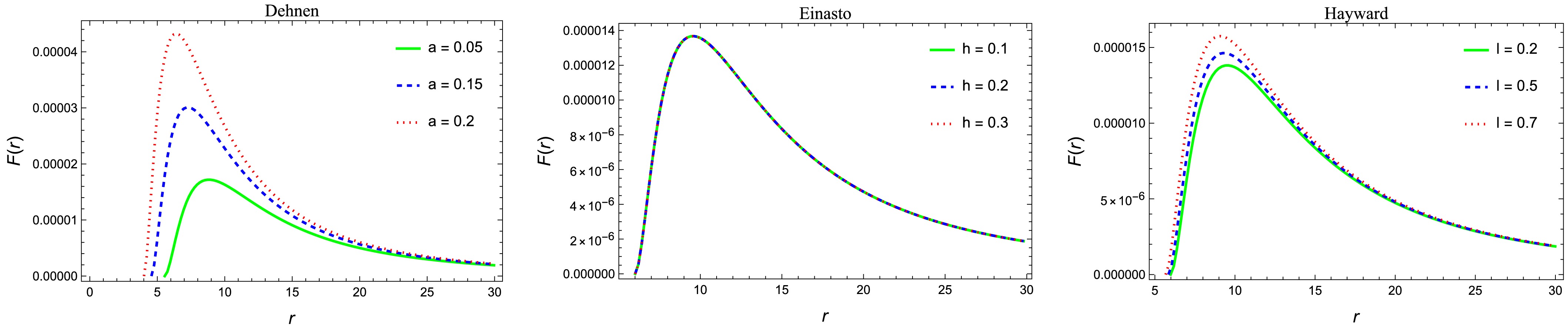
Figure 9. (color online) Radiative Flux Profiles of Thin Accretion Disks around Dehnen, Einasto, and Hayward Regular Black Holes.
However, the three models differ in how the flux profile responds to changes in the regularisation parameter. For the Dehnen black hole, increasing a not only raises the peak value of
$ F(r) $ but also shifts the peak position to a smaller radius. This trend is a direct consequence of the ISCO contraction discussed earlier: a larger a dilutes the central mass concentration through the factor$ (r+a)^{-3} $ in the metric function, weakening the gravitational field and moving the inner disk edge closer to the horizon. Because the radial derivative of the angular velocity$ \partial_r\Omega $ and the orbital energy E both increase more steeply at smaller radii for larger a, the integrand in the flux formula attains a larger amplitude. Moreover, the integral from the reduced lower limit$ r_{\rm ISCO} $ accumulates more gravitational energy release, thereby simultaneously increasing the flux maximum and shifting it inward.In the Einasto model, the flux curves for the three values of h nearly coincide over the entire radial range, indicating that the disk radiation is essentially insensitive to h. This near-coincidence follows analytically from the form of the Einasto metric: the exponential decay of the density profile, together with the error-function factor in
$ f(r) $ , causes the metric function to change extremely slowly with h at the radii where the ISCO and flux peak are located. As a result, the orbital quantities E, L, and Ω, together with their derivatives that enter the flux integral, remain practically unchanged when h is varied, producing overlapping flux profiles.The Hayward black hole occupies an intermediate position: the peak flux increases only mildly with l, and the peak location moves only slightly inward. This behaviour arises from the same physical mechanism that operates in the Dehnen model—a larger regularisation parameter weakens the effective gravitational pull at the inner edge of the disk, thereby enhancing the local radiative efficiency—but the effect is much weaker in the Hayward case. The reason is that the Hayward metric deviates from Schwarzschild only in a very narrow region near the centre. Over most of the disk area, the spacetime remains nearly Schwarzschild, so varying l produces only a modest modification of the orbital quantities that determine the flux integral.
-
We systematically investigated the shadow, dynamics of particle circular orbits, radiation properties of thin accretion disks, and optical imaging characteristics of a static, spherically symmetric regular black hole embedded in a Dehnen-type dark matter halo. Quantitative constraints on the model parameter were also obtained using EHT observational data for M87* and Sgr A*. Furthermore, we compared the Dehnen regular black hole with the Einasto and Hayward regular black holes by evaluating their ISCO radii and thin-disk flux profiles. The main conclusions are summarized as follows:
First, by solving the null geodesics, we obtained analytical expressions for the black hole shadow radius and critical impact parameter. Combining these expressions with observational data for the shadow angular diameters of M87* and Sgr A*, we derived the allowed ranges of the model parameter a at the
$ 1\sigma $ and$ 2\sigma $ confidence levels. The results show that the observational constraints from Sgr A* are less stringent than those from M87*, providing an opportunity for cross-checking future multi-messenger constraints.Second, through a detailed analysis of timelike geodesics, we found that the parameter a has a significant effect on the dynamics of circular orbits. As a increases, the ISCO radius decreases monotonically, the orbital angular velocity increases, and the binding energy of the particles decreases slightly, while the angular momentum exhibits a clear decreasing trend. Even in the weak-field region far from the horizon, the angular momentum distribution remains sensitive to a, indicating the potential to infer dark matter halo parameters from the kinematic features of accretion disks.
Third, regarding radiation properties, we calculated the local radiative flux, redshift factor, and observed flux for a distant observer. We employed the backward ray-tracing method to simulate the distributions of isoredshift curves and observed radiative flux in both direct and secondary images. The results show that an increase in the parameter a reduces the ISCO radius and expands the effective radiation area of the accretion disk, thereby enhancing the overall observed radiative flux. Analysis of the redshift factor indicates that at small viewing angles, gravitational redshift dominates and exhibits a rotationally symmetric distribution. As the viewing angle increases, the Doppler redshift effect becomes significantly enhanced, the image exhibits pronounced left-right asymmetry, and the redshift contours are compressed toward one side of the disk. These image features provide intuitive observational criteria for distinguishing between different dark matter halo models and testing black hole metrics.
Fourth, the comparison with the Einasto and Hayward models reveals that the Dehnen black hole exhibits the strongest ISCO contraction and the most pronounced Doppler asymmetry among the three. The Einasto black hole shows an ISCO and a flux profile that are nearly independent of its scale parameter h because the exponentially decaying density profile keeps the central mass highly concentrated. The Hayward black hole displays nonlinear ISCO behavior and a weak flux dependence on the regularisation parameter l, reflecting the limited spatial extent of its de Sitter core. These differences demonstrate that the observational signatures of regular black holes are not universal but are sensitive to the specific regularisation mechanism. They also provide a potential pathway for using future high-resolution observations to discriminate between competing dark matter halo models and phenomenological regular black hole solutions.
In summary, this work reveals the systematic modulation patterns induced by the Dehnen-type dark matter halo parameter in the observational signals of regular black holes, clarifying the intrinsic relationships among the black hole shadow, orbital dynamics, and accretion disk imaging. Future research can be extended in the following directions: (1) considering the spin effect of the dark matter halo and generalizing the model to axisymmetric rotating cases to explore imaging characteristics and polarization signals in Kerr-like metrics; (2) incorporating radiation magnetohydrodynamic simulations and accretion flow models with different thicknesses to construct black hole image templates that more closely resemble realistic astrophysical environments; (3) extending the model to include a cosmological constant to study the evolution characteristics of Einstein rings and timelike geodesic structures on cosmological scales; and (4) combining next-generation EHT observations and gravitational wave detectors such as LISA to achieve multi-band, multi-messenger joint constraints on dark matter halo parameters. These investigations will help reveal the microscopic physical nature of the interaction between dark matter and black holes in the strong-field regime.
Radiation properties of a regular black hole embedded in a Dehnen-type dark matter halo with a thin accretion disk
- Received Date: 2026-05-15
- Available Online: 2026-10-15
Abstract: We study the shadow, timelike geodesic structure, and thin-accretion-disk radiation properties of a static, spherically symmetric regular black hole embedded in a Dehnen-type dark matter halo. Using EHT observations of M87* and Sgr A*, we constrain the halo scale parameter a at the $ 1\sigma$ and $ 2\sigma$ levels. Based on the Page–Thorne model and a backward ray-tracing method, we compute the local radiative flux, redshift factor distribution, and observed flux images for different viewing angles. We further compare the Dehnen regular black hole with the Einasto and Hayward regular black holes by evaluating their ISCO radii and disk flux profiles. The results show that increasing a reduces the ISCO radius, expands the effective radiation area, and amplifies the Doppler asymmetry of both direct and secondary images. Compared with the Einasto and Hayward models, the Dehnen black hole exhibits the strongest ISCO contraction and the most pronounced left–right brightness asymmetry, whereas the Einasto model is nearly insensitive to its scale parameter and the Hayward black hole shows only a mild dependence. These findings demonstrate that regular black holes with different regularization mechanisms can be distinguished by their accretion disk images, providing a potential tool for testing dark matter halo models with future high-resolution observations.



 DownLoad: