


 Abstract
 HTML
HTML Reference
 Related
 PDF
PDF


-
In recent years, a number of charmonium-like states have been observed [1], which cannot be comfortably accommodated within the traditional quark model. They play an important role in understanding long-distance QCD dynamics and have inspired extensive studies, especially of the complicated Y states. In the present study, we focus on the
$ Y(4660) $ in the tetraquark scenario.The
$ Y(4660) $ was first observed by the Belle collaboration in the process$ e^+e^-\rightarrow \pi^+\pi^-\psi( {\rm{2S}}) $ in 2007 [2] and was later confirmed by the Belle, BaBar, and BESIII collaborations [3−5]. The masses and widths of the$ Y(4660) $ and related states from different experiments are presented in Table 1.Year Mass/MeV Width/MeV channel Experiment 2007 $ Y(4660) $ $ 4664\pm 11\pm 5 $ $ 48\pm 15\pm 3 $ $ e^+e^-\rightarrow \pi^+\pi^-\psi(2{\rm{S}}) $ Belle[2] 2008 $ Y(4630) $ $ 4634^{+8}_{-7}{}^{+5}_{-8} $ $ 92^{+40}_{-24}{}^{+10}_{-21} $ $ e^+e^-\rightarrow \Lambda^+_c\Lambda^-_c $ Belle[6] 2023 not seen not seen BESIII[7] 2012 $ Y(4660) $ $ 4669\pm 21\pm 3 $ $ 104\pm 48\pm 10 $ $ e^+e^-\rightarrow \psi(2{\rm{S}})\pi^+\pi^- $ BaBar[3] 2014 $ Y(4660) $ $ 4652\pm10\pm 8 $ $ 68\pm 11\pm 1 $ $ e^+e^-\rightarrow \pi^+\pi^-\psi(2{\rm{S}}) $ Belle[4] 2019 $ Y(4626) $ $ 4625.9^{+6.2}_{-6.0}\pm0.4 $ $ 49.8^{+13.9}_{-11.5}\pm4.0 $ $ e^+e^-\rightarrow D^+_s D_{s1}(2536)^- $ Belle [8] 2020 $ Y(4626) $ $ 4619.8^{+8.9}_{-8.0}\pm2.3 $ $ 47.0^{+31.3}_{-14.8}\pm4.6 $ $ e^+e^-\rightarrow D^+_s D^*_{s2}(2573)^- $ Belle [9] 2021 $ Y(4660) $ $ 4651.0\pm37.8\pm2.1 $ $ 155.4\pm24.8\pm0.8 $ $ e^+e^-\rightarrow \pi^+\pi^-\psi(3686) $ BESIII 2023 $ Y(4660) $ $ 4675.3\pm29.5 $ $ 218.3\pm72.9 $ $ e^+e^-\rightarrow D^{*0} D^{*-}\pi^+ $ BESIII[5] Table 1. The masses, widths, and channels measured in different experiments.
In 2008, the Belle collaboration reported a measurement of the exclusive process
$ e^+e^-\rightarrow \Lambda^+_c\Lambda^-_c $ and observed a significant structure, which was denoted as$ Y(4630) $ [6]. Owing to their similar masses and widths, the$ Y(4630) $ and$ Y(4660) $ are regarded as the same state by the Particle Data Group [1] and several groups [10−12]. However, the BESIII collaboration studied the process$ e^+e^-\rightarrow \Lambda^+_c\bar{\Lambda}^-_c $ with higher statistics in 2023 [7], and the measured cross section indicated no enhancement around the$ Y(4630) $ structure, which is significantly different from the Belle result [6].In 2019, the Belle collaboration studied the
$ e^+e^-\rightarrow D^+_s D_{s1}(2536)^- $ cross section and observed a charmonium-like state,$ Y(4626) $ , with a measured mass and width close to those of the$ Y(4660) $ [8]. This was the first discovery of a Y state around$ 4.6\; {\rm{GeV}} $ in an open-charm channel. Later, the$ Y(4626) $ was also confirmed in the$ e^+e^-\rightarrow D^+_s D^*_{s2}(2573)^- $ channel [9]. If the$ Y(4626) $ and$ Y(4660) $ are the same state [1], it could be assigned as a$ [sc][\bar{s}\bar{c}] $ state according to its decay into a$ D^+_s D_{s1}^- $ pair.On the theoretical side, after its discovery, the
$ Y(4660) $ was interpreted as a$ \psi^\prime f_0(980) $ molecular state [10, 13−15], a tetraquark state [11, 16−28], a hadro-charmonium state [29],$ \psi( {\rm{5S}}) $ [30−33],$ \psi( {\rm{6S}}) $ [34, 35], and so on.In Ref. [36], the authors studied the mass spectrum of prospective hidden-bottom and hidden-charm hexaquark states via QCD sum rules and found that the
$ Y(4660) $ is close in magnitude to the$ \Lambda_c \bar{\Lambda}_c $ -type baryonium state. The$ \Lambda_c \bar{\Lambda}_c $ -type baryonium states have been studied in several works [37−40]. In Ref. [41], we also studied$ \Lambda_c \bar{\Lambda}_c $ -type baryonium states via QCD sum rules and obtained a conclusion consistent with that of Ref. [36]. The interpretation of the$ Y(4660) $ in the baryonium scenario provides meaningful insight into understanding the Y states.In Table 2, we list the predictions for the masses of the
$ Y(4660) $ in the framework of QCD sum rules, which have achieved several successes in the study of exotic states [42−44]. It is clear that the experimental mass of the$ Y(4660) $ can be reproduced with different structures; thus, we should explore its decay widths to shed light on its nature. Alternatively, the$ Y(4660) $ might have several important Fock components, such as molecular and tetraquark components, and embody their collective effects.Structures OPE (No) mass/GeV References $ Y(4660) $ $ \psi^\prime f_0(980) $ $ 10 $ $ 4.71 $ [15] $ 6 $ $ 4.67 $ [14] $ Y(4660) $ $ [sc]_S[\bar{s}\bar{c}]_V+[sc]_V[\bar{s}\bar{c}]_S $ $ 8\,(7) $ $ 4.65 $ [16] $ 10 $ $ 4.68 $ [21] $ Y(4660) $ $ [sc]_{\widetilde{V}}[\bar{s}\bar{c}]_A-[sc]_A[\bar{s}\bar{c}]_{\widetilde{V}} $ $ 8\,(7) $ $ 4.64 $ [18] $ Y(4660) $ $ [qc]_S[\bar{q}\bar{c}]_V+[qc]_V[\bar{q}\bar{c}]_S $ $ 8\,(7) $ $ 4.64 $ [18] $ Y(4360) $ $ [qc]_S[\bar{q}\bar{c}]_V+[qc]_V[\bar{q}\bar{c}]_S $ $ 10 $ $ 4.34 $ [23] $ Y(4660) $ $ [sc]_P[\bar{s}\bar{c}]_A-[sc]_A[\bar{s}\bar{c}]_P $ $ 10 $ $ 4.70 $ [24] $ 4.66 $ [23] $ 4.66 $ [24] $ Y(4660) $ $ [qc]_P[\bar{q}\bar{c}]_A-[qc]_A[\bar{q}\bar{c}]_P $ $ 10 $ $ 4.59 $ [23] $ 4.66 $ [26] $ Y(4660) $ $ [qc]_A[\bar{q}\bar{c}]_A $ $ 10 $ $ 4.66 $ [25] $ 4.69 $ [26] $ Y(4660) $ $ [sc]_S[\bar{s}\bar{c}]_S $ $ 6 $ $ 4.69 $ [19] $ Y(4660) $ $ [sc]_{\widetilde{A}}[\bar{s}\bar{c}]_V+[sc]_V[\bar{s}\bar{c}]_{\widetilde{A}} $ $ 10 $ $ 4.65 $ [27] $ Y(4660) $ $ [sc]_S[\bar{s}\bar{c}]_{\widetilde{V}}-[sc]_{\widetilde{V}}[\bar{s}\bar{c}]_S $ $ 10 $ $ 4.68 $ [27] $ Y(4660) $ $ \Lambda_c \bar{\Lambda}_c $ $ 12 $ $ 4.78 $ [36] $ Y(4660) $ $ \Lambda_c \bar{\Lambda}_c $ $ 16 $ $ 4.68 $ [41] Table 2. The masses are obtained from the QCD sum rules with different quark structures, where OPE denotes the truncation of the operator product expansion up to vacuum condensates of dimension n, and No indicates that the vacuum condensates of dimension
$ n^\prime $ are not included.Considering that the
$ Y(4260) $ and$ Y(4660) $ decay into$ J/\psi\pi^+\pi^- $ and$ \psi({\rm{2S}})\pi^+\pi^- $ , respectively [2, 45], one might assign the$ Y(4660) $ as the radial excitation of the$ Y(4260) $ [22]. However, the process$ Y(4230)\to \psi({\rm{2S}}) \pi^+\pi^- $ was observed by the BESIII collaboration [46–47]. In Ref. [48], we investigated the ground states and first radial excitations of the vector hidden-charm tetraquark states with an explicit P-wave via QCD sum rules. The results support assigning the$ Y(4260) $ as the 1P tetraquark state, leaving no room to accommodate the$ Y(4660) $ among the first radial excitations.In Refs. [23−25, 48−50], we studied the mass spectrum of the vector hidden-charm tetraquark states with or without an explicit P-wave via QCD sum rules, and the results support assigning the
$ Y(4660) $ as the$ [sc]_P[\bar{s}\bar{c}]_A- [sc]_A[\bar{s}\bar{c}]_P $ type tetraquark state. In Ref. [51], we studied the decay behaviors of the$ [sc]_P[\bar{s}\bar{c}]_A-[sc]_A[\bar{s}\bar{c}]_P $ type tetraquark state. Later, in Refs. [26–27], we took the scalar$ (S) $ , pseudoscalar$ (P) $ , vector$ (V) $ , axial-vector$ (A) $ , and tensor$ (\widetilde{A},\widetilde{V}) $ (anti)diquark operators as the elementary building blocks to construct local four-quark currents with or without hidden strangeness in a comprehensive and consistent way, and updated the previous calculations. The$ \widetilde{A} $ and$ \widetilde{V} $ denote the$ J^P=1^+ $ and$ J^P=1^- $ components of the tensor diquarks$ \varepsilon^{ijk}q^T_j C\sigma_{\mu\nu}c_k $ or$ \varepsilon^{ijk}q^T_j C\sigma_{\mu\nu}\gamma_5 c_k $ . We studied the mass spectrum of those tetraquark states with$ J^{PC}=1^{--} $ and$ 1^{-+} $ in detail and revisited the assignments of the Y states. The results favor assigning the$ Y(4660) $ as the$ [sc]_{\widetilde{A}}[\bar{s}\bar{c}]_V+[sc]_V[\bar{s}\bar{c}]_{\widetilde{A}} $ ,$ [sc]_S[\bar{s}\bar{c}]_{\widetilde{V}}-[sc]_{\widetilde{V}}[\bar{s}\bar{c}]_S $ ,$ [uc]_P[\bar{u}\bar{c}]_A+[dc]_P[\bar{d}\bar{c}]_A- [uc]_A[\bar{u}\bar{c}]_P- [dc]_A[\bar{d}\bar{c}]_P $ , or$ [uc]_A[\bar{u}\bar{c}]_A+[dc]_A[\bar{d}\bar{c}]_A $ type tetraquark state.In the present work, we take these four tetraquark configurations into account to explore the strong decay behaviors of the
$ Y(4660) $ . We study the hadronic coupling constants and partial decay widths of the two-body strong decays, which can occur through the Okubo-Zweig-Iizuka super-allowed fall-apart mechanism without annihilation or creation of a quark-antiquark pair. Specifically, we take into account the channels$ Y\to \bar{D}_{(s)}D_{(s)} $ ,$ \bar{D}^*_{(s)}D_{(s)} $ ,$ \bar{D}^*_{(s)}D^*_{(s)} $ ,$ \bar{D}_{(s)0}D^*_{(s)} $ ,$ \bar{D}_{(s)1}D_{(s)} $ ,$ \eta_c\omega(\phi(1020)) $ ,$ J/\psi\omega(\phi(1020)) $ ,$ \chi_{c0}\omega(\phi(1020)) $ ,$ \chi_{c1}\omega(\phi(1020)) $ , and$ J/\psi f_0(500)(f_0(980)) $ .The article is organized as follows: in Section II, we obtain the hadronic coupling constants in the two-body strong decays of the four vector tetraquark states via QCD sum rules; in Section III, we present the numerical results and discussion; finally, the conclusion is presented in Section IV.
-
In recent years, a number of charmonium-like states have been observed [1], which cannot be comfortably accommodated within the traditional quark model. They play an important role in understanding long-distance QCD dynamics and have inspired extensive studies, especially of the complicated Y states. In the present study, we focus on the
$ Y(4660) $ in the tetraquark scenario.The
$ Y(4660) $ was first observed by the Belle collaboration in the process$ e^+e^-\rightarrow \pi^+\pi^-\psi( {\rm{2S}}) $ in 2007 [2] and was later confirmed by the Belle, BaBar, and BESIII collaborations [3−6]. The masses and widths of the$ Y(4660) $ and related states from different experiments are presented in Table 1.Year Mass (MeV) Width (MeV) channel Experiment 2007 $ Y(4660) $ $ 4664\pm 11\pm 5 $ $ 48\pm 15\pm 3 $ $ e^+e^-\rightarrow \pi^+\pi^-\psi(2{\rm{S}}) $ Belle[2] 2008 $ Y(4630) $ $ 4634^{+8}_{-7}{}^{+5}_{-8} $ $ 92^{+40}_{-24}{}^{+10}_{-21} $ $ e^+e^-\rightarrow \Lambda^+_c\Lambda^-_c $ Belle[7] 2023 not seen not seen BESIII[11] 2012 $ Y(4660) $ $ 4669\pm 21\pm 3 $ $ 104\pm 48\pm 10 $ $ e^+e^-\rightarrow \psi(2{\rm{S}})\pi^+\pi^- $ BaBar[3] 2014 $ Y(4660) $ $ 4652\pm10\pm 8 $ $ 68\pm 11\pm 1 $ $ e^+e^-\rightarrow \pi^+\pi^-\psi(2{\rm{S}}) $ Belle[4] 2019 $ Y(4626) $ $ 4625.9^{+6.2}_{-6.0}\pm0.4 $ $ 49.8^{+13.9}_{-11.5}\pm4.0 $ $ e^+e^-\rightarrow D^+_s D_{s1}(2536)^- $ Belle [12] 2020 $ Y(4626) $ $ 4619.8^{+8.9}_{-8.0}\pm2.3 $ $ 47.0^{+31.3}_{-14.8}\pm4.6 $ $ e^+e^-\rightarrow D^+_s D^*_{s2}(2573)^- $ Belle [13] 2021 $ Y(4660) $ $ 4651.0\pm37.8\pm2.1 $ $ 155.4\pm24.8\pm0.8 $ $ e^+e^-\rightarrow \pi^+\pi^-\psi(3686) $ BESIII[5] 2023 $ Y(4660) $ $ 4675.3\pm29.5 $ $ 218.3\pm72.9 $ $ e^+e^-\rightarrow D^{*0} D^{*-}\pi^+ $ BESIII[6] Table 1. The masses, widths, and channels measured in different experiments.
In 2008, the Belle collaboration reported a measurement of the exclusive process
$ e^+e^-\rightarrow \Lambda^+_c\Lambda^-_c $ and observed a significant structure, which was denoted as$ Y(4630) $ [7]. Owing to their similar masses and widths, the$ Y(4630) $ and$ Y(4660) $ are regarded as the same state by the Particle Data Group [1] and several groups [8−10]. However, the BESIII collaboration studied the process$ e^+e^-\rightarrow \Lambda^+_c\bar{\Lambda}^-_c $ with higher statistics in 2023 [11], and the measured cross section indicated no enhancement around the$ Y(4630) $ structure, which is significantly different from the Belle result [7].In 2019, the Belle collaboration studied the
$ e^+e^-\rightarrow D^+_s D_{s1}(2536)^- $ cross section and observed a charmonium-like state,$ Y(4626) $ , with a measured mass and width close to those of the$ Y(4660) $ [12]. This was the first discovery of a Y state around$ 4.6\, {\rm{GeV}} $ in an open-charm channel. Later, the$ Y(4626) $ was also confirmed in the$ e^+e^-\rightarrow D^+_s D^*_{s2}(2573)^- $ channel [13]. If the$ Y(4626) $ and$ Y(4660) $ are the same state [1], it could be assigned as a$ [sc][\bar{s}\bar{c}] $ state according to its decay into a$ D^+_s D_{s1}^- $ pair.On the theoretical side, after its discovery, the
$ Y(4660) $ was interpreted as a$ \psi^\prime f_0(980) $ molecular state [8, 14−16], a tetraquark state [9, 17−29], a hadro-charmonium state [30],$ \psi( {\rm{5S}}) $ [31−34],$ \psi( {\rm{6S}}) $ [35, 36], and so on.In Ref.[37], the authors studied the mass spectrum of prospective hidden-bottom and hidden-charm hexaquark states via QCD sum rules and found that the
$ Y(4660) $ is close in magnitude to the$ \Lambda_c \bar{\Lambda}_c $ -type baryonium state. The$ \Lambda_c \bar{\Lambda}_c $ -type baryonium states have been studied in several works [38−41]. In Ref.[42], we also studied$ \Lambda_c \bar{\Lambda}_c $ -type baryonium states via QCD sum rules and obtained a conclusion consistent with that of Ref.[37]. The interpretation of the$ Y(4660) $ in the baryonium scenario provides meaningful insight into understanding the Y states.In Table 2, we list the predictions for the masses of the
$ Y(4660) $ in the framework of QCD sum rules, which have achieved several successes in the study of exotic states [43−45]. It is clear that the experimental mass of the$ Y(4660) $ can be reproduced with different structures; thus, we should explore its decay widths to shed light on its nature. Alternatively, the$ Y(4660) $ might have several important Fock components, such as molecular and tetraquark components, and embody their collective effects.Structures OPE (No) mass(GeV) References $ Y(4660) $ $ \psi^\prime f_0(980) $ $ 10 $ $ 4.71 $ [16] $ 6 $ $ 4.67 $ [15] $ Y(4660) $ $ [sc]_S[\bar{s}\bar{c}]_V+[sc]_V[\bar{s}\bar{c}]_S $ $ 8\,(7) $ $ 4.65 $ [17] $ 10 $ $ 4.68 $ [22] $ Y(4660) $ $ [sc]_{\widetilde{V}}[\bar{s}\bar{c}]_A-[sc]_A[\bar{s}\bar{c}]_{\widetilde{V}} $ $ 8\,(7) $ $ 4.64 $ [19] $ Y(4660) $ $ [qc]_S[\bar{q}\bar{c}]_V+[qc]_V[\bar{q}\bar{c}]_S $ $ 8\,(7) $ $ 4.64 $ [19] $ Y(4360) $ $ [qc]_S[\bar{q}\bar{c}]_V+[qc]_V[\bar{q}\bar{c}]_S $ $ 10 $ $ 4.34 $ [24] $ Y(4660) $ $ [sc]_P[\bar{s}\bar{c}]_A-[sc]_A[\bar{s}\bar{c}]_P $ $ 10 $ $ 4.70 $ [25] $ 4.66 $ [24] $ 4.66 $ [25] $ Y(4660) $ $ [qc]_P[\bar{q}\bar{c}]_A-[qc]_A[\bar{q}\bar{c}]_P $ $ 10 $ $ 4.59 $ [24] $ 4.66 $ [27] $ Y(4660) $ $ [qc]_A[\bar{q}\bar{c}]_A $ $ 10 $ $ 4.66 $ [26] $ 4.69 $ [27] $ Y(4660) $ $ [sc]_S[\bar{s}\bar{c}]_S $ $ 6 $ $ 4.69 $ [20] $ Y(4660) $ $ [sc]_{\widetilde{A}}[\bar{s}\bar{c}]_V+[sc]_V[\bar{s}\bar{c}]_{\widetilde{A}} $ $ 10 $ $ 4.65 $ [28] $ Y(4660) $ $ [sc]_S[\bar{s}\bar{c}]_{\widetilde{V}}-[sc]_{\widetilde{V}}[\bar{s}\bar{c}]_S $ $ 10 $ $ 4.68 $ [28] $ Y(4660) $ $ \Lambda_c \bar{\Lambda}_c $ $ 12 $ $ 4.78 $ [37] $ Y(4660) $ $ \Lambda_c \bar{\Lambda}_c $ $ 16 $ $ 4.68 $ [42] Table 2. The masses are obtained from the QCD sum rules with different quark structures, where OPE denotes the truncation of the operator product expansion up to vacuum condensates of dimension n, and No indicates that the vacuum condensates of dimension
$ n^\prime $ are not included.Considering that the
$ Y(4260) $ and$ Y(4660) $ decay into$ J/\psi\pi^+\pi^- $ and$ \psi({\rm{2S}})\pi^+\pi^- $ , respectively [2, 46], one might assign the$ Y(4660) $ as the radial excitation of the$ Y(4260) $ [23]. However, the process$ Y(4230)\to \psi({\rm{2S}}) \pi^+\pi^- $ was observed by the BESIII collaboration [47, 48]. In Ref.[49], we investigated the ground states and first radial excitations of the vector hidden-charm tetraquark states with an explicit P-wave via QCD sum rules. The results support assigning the$ Y(4260) $ as the 1P tetraquark state, leaving no room to accommodate the$ Y(4660) $ among the first radial excitations.In Refs.[24−26, 49−51], we studied the mass spectrum of the vector hidden-charm tetraquark states with or without an explicit P-wave via QCD sum rules, and the results support assigning the
$ Y(4660) $ as the$ [sc]_P[\bar{s}\bar{c}]_A-[sc]_A[\bar{s}\bar{c}]_P $ type tetraquark state. In Ref.[52], we studied the decay behaviors of the$ [sc]_P[\bar{s}\bar{c}]_A-[sc]_A[\bar{s}\bar{c}]_P $ type tetraquark state. Later, in Refs.[27, 28], we took the scalar$ (S) $ , pseudoscalar$ (P) $ , vector$ (V) $ , axial-vector$ (A) $ , and tensor$ (\widetilde{A},\widetilde{V}) $ (anti)diquark operators as the elementary building blocks to construct local four-quark currents with or without hidden strangeness in a comprehensive and consistent way, and updated the previous calculations. The$ \widetilde{A} $ and$ \widetilde{V} $ denote the$ J^P=1^+ $ and$ J^P=1^- $ components of the tensor diquarks$ \varepsilon^{ijk}q^T_j C\sigma_{\mu\nu}c_k $ or$ \varepsilon^{ijk}q^T_j C\sigma_{\mu\nu}\gamma_5 c_k $ . We studied the mass spectrum of those tetraquark states with$ J^{PC}=1^{--} $ and$ 1^{-+} $ in detail and revisited the assignments of the Y states. The results favor assigning the$ Y(4660) $ as the$ [sc]_{\widetilde{A}}[\bar{s}\bar{c}]_V+[sc]_V[\bar{s}\bar{c}]_{\widetilde{A}} $ ,$ [sc]_S[\bar{s}\bar{c}]_{\widetilde{V}}-[sc]_{\widetilde{V}}[\bar{s}\bar{c}]_S $ ,$ [uc]_P[\bar{u}\bar{c}]_A+[dc]_P[\bar{d}\bar{c}]_A-[uc]_A[\bar{u}\bar{c}]_P-[dc]_A[\bar{d}\bar{c}]_P $ , or$ [uc]_A[\bar{u}\bar{c}]_A+[dc]_A[\bar{d}\bar{c}]_A $ type tetraquark state.In the present work, we take these four tetraquark configurations into account to explore the strong decay behaviors of the
$ Y(4660) $ . We study the hadronic coupling constants and partial decay widths of the two-body strong decays, which can occur through the Okubo-Zweig-Iizuka super-allowed fall-apart mechanism without annihilation or creation of a quark-antiquark pair. Specifically, we take into account the channels$ Y\to \bar{D}_{(s)}D_{(s)} $ ,$ \bar{D}^*_{(s)}D_{(s)} $ ,$ \bar{D}^*_{(s)}D^*_{(s)} $ ,$ \bar{D}_{(s)0}D^*_{(s)} $ ,$ \bar{D}_{(s)1}D_{(s)} $ ,$ \eta_c\omega(\phi(1020)) $ ,$ J/\psi\omega(\phi(1020)) $ ,$ \chi_{c0}\omega(\phi(1020)) $ ,$ \chi_{c1}\omega(\phi(1020)) $ , and$ J/\psi f_0(500)(f_0(980)) $ .The article is organized as follows: in Section 2, we obtain the hadronic coupling constants in the two-body strong decays of the four vector tetraquark states via QCD sum rules; in Section 3, we present the numerical results and discussion; finally, the conclusion is presented in Section 4.
-
In recent years, a number of charmonium-like states have been observed [1], which cannot be comfortably accommodated within the traditional quark model. They play an important role in understanding long-distance QCD dynamics and have inspired extensive studies, especially of the complicated Y states. In the present study, we focus on the
$ Y(4660) $ in the tetraquark scenario.The
$ Y(4660) $ was first observed by the Belle collaboration in the process$ e^+e^-\rightarrow \pi^+\pi^-\psi( {\rm{2S}}) $ in 2007 [2] and was later confirmed by the Belle, BaBar, and BESIII collaborations [3−5]. The masses and widths of the$ Y(4660) $ and related states from different experiments are presented in Table 1.Year Mass/MeV Width/MeV channel Experiment 2007 $ Y(4660) $ $ 4664\pm 11\pm 5 $ $ 48\pm 15\pm 3 $ $ e^+e^-\rightarrow \pi^+\pi^-\psi(2{\rm{S}}) $ Belle[2] 2008 $ Y(4630) $ $ 4634^{+8}_{-7}{}^{+5}_{-8} $ $ 92^{+40}_{-24}{}^{+10}_{-21} $ $ e^+e^-\rightarrow \Lambda^+_c\Lambda^-_c $ Belle[6] 2023 not seen not seen BESIII[7] 2012 $ Y(4660) $ $ 4669\pm 21\pm 3 $ $ 104\pm 48\pm 10 $ $ e^+e^-\rightarrow \psi(2{\rm{S}})\pi^+\pi^- $ BaBar[3] 2014 $ Y(4660) $ $ 4652\pm10\pm 8 $ $ 68\pm 11\pm 1 $ $ e^+e^-\rightarrow \pi^+\pi^-\psi(2{\rm{S}}) $ Belle[4] 2019 $ Y(4626) $ $ 4625.9^{+6.2}_{-6.0}\pm0.4 $ $ 49.8^{+13.9}_{-11.5}\pm4.0 $ $ e^+e^-\rightarrow D^+_s D_{s1}(2536)^- $ Belle [8] 2020 $ Y(4626) $ $ 4619.8^{+8.9}_{-8.0}\pm2.3 $ $ 47.0^{+31.3}_{-14.8}\pm4.6 $ $ e^+e^-\rightarrow D^+_s D^*_{s2}(2573)^- $ Belle [9] 2021 $ Y(4660) $ $ 4651.0\pm37.8\pm2.1 $ $ 155.4\pm24.8\pm0.8 $ $ e^+e^-\rightarrow \pi^+\pi^-\psi(3686) $ BESIII 2023 $ Y(4660) $ $ 4675.3\pm29.5 $ $ 218.3\pm72.9 $ $ e^+e^-\rightarrow D^{*0} D^{*-}\pi^+ $ BESIII[5] Table 1. The masses, widths, and channels measured in different experiments.
In 2008, the Belle collaboration reported a measurement of the exclusive process
$ e^+e^-\rightarrow \Lambda^+_c\Lambda^-_c $ and observed a significant structure, which was denoted as$ Y(4630) $ [6]. Owing to their similar masses and widths, the$ Y(4630) $ and$ Y(4660) $ are regarded as the same state by the Particle Data Group [1] and several groups [10−12]. However, the BESIII collaboration studied the process$ e^+e^-\rightarrow \Lambda^+_c\bar{\Lambda}^-_c $ with higher statistics in 2023 [7], and the measured cross section indicated no enhancement around the$ Y(4630) $ structure, which is significantly different from the Belle result [6].In 2019, the Belle collaboration studied the
$ e^+e^-\rightarrow D^+_s D_{s1}(2536)^- $ cross section and observed a charmonium-like state,$ Y(4626) $ , with a measured mass and width close to those of the$ Y(4660) $ [8]. This was the first discovery of a Y state around$ 4.6\; {\rm{GeV}} $ in an open-charm channel. Later, the$ Y(4626) $ was also confirmed in the$ e^+e^-\rightarrow D^+_s D^*_{s2}(2573)^- $ channel [9]. If the$ Y(4626) $ and$ Y(4660) $ are the same state [1], it could be assigned as a$ [sc][\bar{s}\bar{c}] $ state according to its decay into a$ D^+_s D_{s1}^- $ pair.On the theoretical side, after its discovery, the
$ Y(4660) $ was interpreted as a$ \psi^\prime f_0(980) $ molecular state [10, 13−15], a tetraquark state [11, 16−28], a hadro-charmonium state [29],$ \psi( {\rm{5S}}) $ [30−33],$ \psi( {\rm{6S}}) $ [34, 35], and so on.In Ref. [36], the authors studied the mass spectrum of prospective hidden-bottom and hidden-charm hexaquark states via QCD sum rules and found that the
$ Y(4660) $ is close in magnitude to the$ \Lambda_c \bar{\Lambda}_c $ -type baryonium state. The$ \Lambda_c \bar{\Lambda}_c $ -type baryonium states have been studied in several works [37−40]. In Ref. [41], we also studied$ \Lambda_c \bar{\Lambda}_c $ -type baryonium states via QCD sum rules and obtained a conclusion consistent with that of Ref. [36]. The interpretation of the$ Y(4660) $ in the baryonium scenario provides meaningful insight into understanding the Y states.In Table 2, we list the predictions for the masses of the
$ Y(4660) $ in the framework of QCD sum rules, which have achieved several successes in the study of exotic states [42−44]. It is clear that the experimental mass of the$ Y(4660) $ can be reproduced with different structures; thus, we should explore its decay widths to shed light on its nature. Alternatively, the$ Y(4660) $ might have several important Fock components, such as molecular and tetraquark components, and embody their collective effects.Structures OPE (No) mass/GeV References $ Y(4660) $ $ \psi^\prime f_0(980) $ $ 10 $ $ 4.71 $ [15] $ 6 $ $ 4.67 $ [14] $ Y(4660) $ $ [sc]_S[\bar{s}\bar{c}]_V+[sc]_V[\bar{s}\bar{c}]_S $ $ 8\,(7) $ $ 4.65 $ [16] $ 10 $ $ 4.68 $ [21] $ Y(4660) $ $ [sc]_{\widetilde{V}}[\bar{s}\bar{c}]_A-[sc]_A[\bar{s}\bar{c}]_{\widetilde{V}} $ $ 8\,(7) $ $ 4.64 $ [18] $ Y(4660) $ $ [qc]_S[\bar{q}\bar{c}]_V+[qc]_V[\bar{q}\bar{c}]_S $ $ 8\,(7) $ $ 4.64 $ [18] $ Y(4360) $ $ [qc]_S[\bar{q}\bar{c}]_V+[qc]_V[\bar{q}\bar{c}]_S $ $ 10 $ $ 4.34 $ [23] $ Y(4660) $ $ [sc]_P[\bar{s}\bar{c}]_A-[sc]_A[\bar{s}\bar{c}]_P $ $ 10 $ $ 4.70 $ [24] $ 4.66 $ [23] $ 4.66 $ [24] $ Y(4660) $ $ [qc]_P[\bar{q}\bar{c}]_A-[qc]_A[\bar{q}\bar{c}]_P $ $ 10 $ $ 4.59 $ [23] $ 4.66 $ [26] $ Y(4660) $ $ [qc]_A[\bar{q}\bar{c}]_A $ $ 10 $ $ 4.66 $ [25] $ 4.69 $ [26] $ Y(4660) $ $ [sc]_S[\bar{s}\bar{c}]_S $ $ 6 $ $ 4.69 $ [19] $ Y(4660) $ $ [sc]_{\widetilde{A}}[\bar{s}\bar{c}]_V+[sc]_V[\bar{s}\bar{c}]_{\widetilde{A}} $ $ 10 $ $ 4.65 $ [27] $ Y(4660) $ $ [sc]_S[\bar{s}\bar{c}]_{\widetilde{V}}-[sc]_{\widetilde{V}}[\bar{s}\bar{c}]_S $ $ 10 $ $ 4.68 $ [27] $ Y(4660) $ $ \Lambda_c \bar{\Lambda}_c $ $ 12 $ $ 4.78 $ [36] $ Y(4660) $ $ \Lambda_c \bar{\Lambda}_c $ $ 16 $ $ 4.68 $ [41] Table 2. The masses are obtained from the QCD sum rules with different quark structures, where OPE denotes the truncation of the operator product expansion up to vacuum condensates of dimension n, and No indicates that the vacuum condensates of dimension
$ n^\prime $ are not included.Considering that the
$ Y(4260) $ and$ Y(4660) $ decay into$ J/\psi\pi^+\pi^- $ and$ \psi({\rm{2S}})\pi^+\pi^- $ , respectively [2, 45], one might assign the$ Y(4660) $ as the radial excitation of the$ Y(4260) $ [22]. However, the process$ Y(4230)\to \psi({\rm{2S}}) \pi^+\pi^- $ was observed by the BESIII collaboration [46–47]. In Ref. [48], we investigated the ground states and first radial excitations of the vector hidden-charm tetraquark states with an explicit P-wave via QCD sum rules. The results support assigning the$ Y(4260) $ as the 1P tetraquark state, leaving no room to accommodate the$ Y(4660) $ among the first radial excitations.In Refs. [23−25, 48−50], we studied the mass spectrum of the vector hidden-charm tetraquark states with or without an explicit P-wave via QCD sum rules, and the results support assigning the
$ Y(4660) $ as the$ [sc]_P[\bar{s}\bar{c}]_A- [sc]_A[\bar{s}\bar{c}]_P $ type tetraquark state. In Ref. [51], we studied the decay behaviors of the$ [sc]_P[\bar{s}\bar{c}]_A-[sc]_A[\bar{s}\bar{c}]_P $ type tetraquark state. Later, in Refs. [26–27], we took the scalar$ (S) $ , pseudoscalar$ (P) $ , vector$ (V) $ , axial-vector$ (A) $ , and tensor$ (\widetilde{A},\widetilde{V}) $ (anti)diquark operators as the elementary building blocks to construct local four-quark currents with or without hidden strangeness in a comprehensive and consistent way, and updated the previous calculations. The$ \widetilde{A} $ and$ \widetilde{V} $ denote the$ J^P=1^+ $ and$ J^P=1^- $ components of the tensor diquarks$ \varepsilon^{ijk}q^T_j C\sigma_{\mu\nu}c_k $ or$ \varepsilon^{ijk}q^T_j C\sigma_{\mu\nu}\gamma_5 c_k $ . We studied the mass spectrum of those tetraquark states with$ J^{PC}=1^{--} $ and$ 1^{-+} $ in detail and revisited the assignments of the Y states. The results favor assigning the$ Y(4660) $ as the$ [sc]_{\widetilde{A}}[\bar{s}\bar{c}]_V+[sc]_V[\bar{s}\bar{c}]_{\widetilde{A}} $ ,$ [sc]_S[\bar{s}\bar{c}]_{\widetilde{V}}-[sc]_{\widetilde{V}}[\bar{s}\bar{c}]_S $ ,$ [uc]_P[\bar{u}\bar{c}]_A+[dc]_P[\bar{d}\bar{c}]_A- [uc]_A[\bar{u}\bar{c}]_P- [dc]_A[\bar{d}\bar{c}]_P $ , or$ [uc]_A[\bar{u}\bar{c}]_A+[dc]_A[\bar{d}\bar{c}]_A $ type tetraquark state.In the present work, we take these four tetraquark configurations into account to explore the strong decay behaviors of the
$ Y(4660) $ . We study the hadronic coupling constants and partial decay widths of the two-body strong decays, which can occur through the Okubo-Zweig-Iizuka super-allowed fall-apart mechanism without annihilation or creation of a quark-antiquark pair. Specifically, we take into account the channels$ Y\to \bar{D}_{(s)}D_{(s)} $ ,$ \bar{D}^*_{(s)}D_{(s)} $ ,$ \bar{D}^*_{(s)}D^*_{(s)} $ ,$ \bar{D}_{(s)0}D^*_{(s)} $ ,$ \bar{D}_{(s)1}D_{(s)} $ ,$ \eta_c\omega(\phi(1020)) $ ,$ J/\psi\omega(\phi(1020)) $ ,$ \chi_{c0}\omega(\phi(1020)) $ ,$ \chi_{c1}\omega(\phi(1020)) $ , and$ J/\psi f_0(500)(f_0(980)) $ .The article is organized as follows: in Section II, we obtain the hadronic coupling constants in the two-body strong decays of the four vector tetraquark states via QCD sum rules; in Section III, we present the numerical results and discussion; finally, the conclusion is presented in Section IV.
-
In recent years, a number of charmonium-like states have been observed [1], which cannot be comfortably accommodated within the traditional quark model. They play an important role in understanding long-distance QCD dynamics and have inspired extensive studies, especially of the complicated Y states. In the present study, we focus on the
$ Y(4660) $ in the tetraquark scenario.The
$ Y(4660) $ was first observed by the Belle collaboration in the process$ e^+e^-\rightarrow \pi^+\pi^-\psi( {\rm{2S}}) $ in 2007 [2] and was later confirmed by the Belle, BaBar, and BESIII collaborations [3−5]. The masses and widths of the$ Y(4660) $ and related states from different experiments are presented in Table 1.Year Mass/MeV Width/MeV channel Experiment 2007 $ Y(4660) $ $ 4664\pm 11\pm 5 $ $ 48\pm 15\pm 3 $ $ e^+e^-\rightarrow \pi^+\pi^-\psi(2{\rm{S}}) $ Belle[2] 2008 $ Y(4630) $ $ 4634^{+8}_{-7}{}^{+5}_{-8} $ $ 92^{+40}_{-24}{}^{+10}_{-21} $ $ e^+e^-\rightarrow \Lambda^+_c\Lambda^-_c $ Belle[6] 2023 not seen not seen BESIII[7] 2012 $ Y(4660) $ $ 4669\pm 21\pm 3 $ $ 104\pm 48\pm 10 $ $ e^+e^-\rightarrow \psi(2{\rm{S}})\pi^+\pi^- $ BaBar[3] 2014 $ Y(4660) $ $ 4652\pm10\pm 8 $ $ 68\pm 11\pm 1 $ $ e^+e^-\rightarrow \pi^+\pi^-\psi(2{\rm{S}}) $ Belle[4] 2019 $ Y(4626) $ $ 4625.9^{+6.2}_{-6.0}\pm0.4 $ $ 49.8^{+13.9}_{-11.5}\pm4.0 $ $ e^+e^-\rightarrow D^+_s D_{s1}(2536)^- $ Belle [8] 2020 $ Y(4626) $ $ 4619.8^{+8.9}_{-8.0}\pm2.3 $ $ 47.0^{+31.3}_{-14.8}\pm4.6 $ $ e^+e^-\rightarrow D^+_s D^*_{s2}(2573)^- $ Belle [9] 2021 $ Y(4660) $ $ 4651.0\pm37.8\pm2.1 $ $ 155.4\pm24.8\pm0.8 $ $ e^+e^-\rightarrow \pi^+\pi^-\psi(3686) $ BESIII 2023 $ Y(4660) $ $ 4675.3\pm29.5 $ $ 218.3\pm72.9 $ $ e^+e^-\rightarrow D^{*0} D^{*-}\pi^+ $ BESIII[5] Table 1. The masses, widths, and channels measured in different experiments.
In 2008, the Belle collaboration reported a measurement of the exclusive process
$ e^+e^-\rightarrow \Lambda^+_c\Lambda^-_c $ and observed a significant structure, which was denoted as$ Y(4630) $ [6]. Owing to their similar masses and widths, the$ Y(4630) $ and$ Y(4660) $ are regarded as the same state by the Particle Data Group [1] and several groups [10−12]. However, the BESIII collaboration studied the process$ e^+e^-\rightarrow \Lambda^+_c\bar{\Lambda}^-_c $ with higher statistics in 2023 [7], and the measured cross section indicated no enhancement around the$ Y(4630) $ structure, which is significantly different from the Belle result [6].In 2019, the Belle collaboration studied the
$ e^+e^-\rightarrow D^+_s D_{s1}(2536)^- $ cross section and observed a charmonium-like state,$ Y(4626) $ , with a measured mass and width close to those of the$ Y(4660) $ [8]. This was the first discovery of a Y state around$ 4.6\; {\rm{GeV}} $ in an open-charm channel. Later, the$ Y(4626) $ was also confirmed in the$ e^+e^-\rightarrow D^+_s D^*_{s2}(2573)^- $ channel [9]. If the$ Y(4626) $ and$ Y(4660) $ are the same state [1], it could be assigned as a$ [sc][\bar{s}\bar{c}] $ state according to its decay into a$ D^+_s D_{s1}^- $ pair.On the theoretical side, after its discovery, the
$ Y(4660) $ was interpreted as a$ \psi^\prime f_0(980) $ molecular state [10, 13−15], a tetraquark state [11, 16−28], a hadro-charmonium state [29],$ \psi( {\rm{5S}}) $ [30−33],$ \psi( {\rm{6S}}) $ [34, 35], and so on.In Ref. [36], the authors studied the mass spectrum of prospective hidden-bottom and hidden-charm hexaquark states via QCD sum rules and found that the
$ Y(4660) $ is close in magnitude to the$ \Lambda_c \bar{\Lambda}_c $ -type baryonium state. The$ \Lambda_c \bar{\Lambda}_c $ -type baryonium states have been studied in several works [37−40]. In Ref. [41], we also studied$ \Lambda_c \bar{\Lambda}_c $ -type baryonium states via QCD sum rules and obtained a conclusion consistent with that of Ref. [36]. The interpretation of the$ Y(4660) $ in the baryonium scenario provides meaningful insight into understanding the Y states.In Table 2, we list the predictions for the masses of the
$ Y(4660) $ in the framework of QCD sum rules, which have achieved several successes in the study of exotic states [42−44]. It is clear that the experimental mass of the$ Y(4660) $ can be reproduced with different structures; thus, we should explore its decay widths to shed light on its nature. Alternatively, the$ Y(4660) $ might have several important Fock components, such as molecular and tetraquark components, and embody their collective effects.Structures OPE (No) mass/GeV References $ Y(4660) $ $ \psi^\prime f_0(980) $ $ 10 $ $ 4.71 $ [15] $ 6 $ $ 4.67 $ [14] $ Y(4660) $ $ [sc]_S[\bar{s}\bar{c}]_V+[sc]_V[\bar{s}\bar{c}]_S $ $ 8\,(7) $ $ 4.65 $ [16] $ 10 $ $ 4.68 $ [21] $ Y(4660) $ $ [sc]_{\widetilde{V}}[\bar{s}\bar{c}]_A-[sc]_A[\bar{s}\bar{c}]_{\widetilde{V}} $ $ 8\,(7) $ $ 4.64 $ [18] $ Y(4660) $ $ [qc]_S[\bar{q}\bar{c}]_V+[qc]_V[\bar{q}\bar{c}]_S $ $ 8\,(7) $ $ 4.64 $ [18] $ Y(4360) $ $ [qc]_S[\bar{q}\bar{c}]_V+[qc]_V[\bar{q}\bar{c}]_S $ $ 10 $ $ 4.34 $ [23] $ Y(4660) $ $ [sc]_P[\bar{s}\bar{c}]_A-[sc]_A[\bar{s}\bar{c}]_P $ $ 10 $ $ 4.70 $ [24] $ 4.66 $ [23] $ 4.66 $ [24] $ Y(4660) $ $ [qc]_P[\bar{q}\bar{c}]_A-[qc]_A[\bar{q}\bar{c}]_P $ $ 10 $ $ 4.59 $ [23] $ 4.66 $ [26] $ Y(4660) $ $ [qc]_A[\bar{q}\bar{c}]_A $ $ 10 $ $ 4.66 $ [25] $ 4.69 $ [26] $ Y(4660) $ $ [sc]_S[\bar{s}\bar{c}]_S $ $ 6 $ $ 4.69 $ [19] $ Y(4660) $ $ [sc]_{\widetilde{A}}[\bar{s}\bar{c}]_V+[sc]_V[\bar{s}\bar{c}]_{\widetilde{A}} $ $ 10 $ $ 4.65 $ [27] $ Y(4660) $ $ [sc]_S[\bar{s}\bar{c}]_{\widetilde{V}}-[sc]_{\widetilde{V}}[\bar{s}\bar{c}]_S $ $ 10 $ $ 4.68 $ [27] $ Y(4660) $ $ \Lambda_c \bar{\Lambda}_c $ $ 12 $ $ 4.78 $ [36] $ Y(4660) $ $ \Lambda_c \bar{\Lambda}_c $ $ 16 $ $ 4.68 $ [41] Table 2. The masses are obtained from the QCD sum rules with different quark structures, where OPE denotes the truncation of the operator product expansion up to vacuum condensates of dimension n, and No indicates that the vacuum condensates of dimension
$ n^\prime $ are not included.Considering that the
$ Y(4260) $ and$ Y(4660) $ decay into$ J/\psi\pi^+\pi^- $ and$ \psi({\rm{2S}})\pi^+\pi^- $ , respectively [2, 45], one might assign the$ Y(4660) $ as the radial excitation of the$ Y(4260) $ [22]. However, the process$ Y(4230)\to \psi({\rm{2S}}) \pi^+\pi^- $ was observed by the BESIII collaboration [46–47]. In Ref. [48], we investigated the ground states and first radial excitations of the vector hidden-charm tetraquark states with an explicit P-wave via QCD sum rules. The results support assigning the$ Y(4260) $ as the 1P tetraquark state, leaving no room to accommodate the$ Y(4660) $ among the first radial excitations.In Refs. [23−25, 48−50], we studied the mass spectrum of the vector hidden-charm tetraquark states with or without an explicit P-wave via QCD sum rules, and the results support assigning the
$ Y(4660) $ as the$ [sc]_P[\bar{s}\bar{c}]_A- [sc]_A[\bar{s}\bar{c}]_P $ type tetraquark state. In Ref. [51], we studied the decay behaviors of the$ [sc]_P[\bar{s}\bar{c}]_A-[sc]_A[\bar{s}\bar{c}]_P $ type tetraquark state. Later, in Refs. [26–27], we took the scalar$ (S) $ , pseudoscalar$ (P) $ , vector$ (V) $ , axial-vector$ (A) $ , and tensor$ (\widetilde{A},\widetilde{V}) $ (anti)diquark operators as the elementary building blocks to construct local four-quark currents with or without hidden strangeness in a comprehensive and consistent way, and updated the previous calculations. The$ \widetilde{A} $ and$ \widetilde{V} $ denote the$ J^P=1^+ $ and$ J^P=1^- $ components of the tensor diquarks$ \varepsilon^{ijk}q^T_j C\sigma_{\mu\nu}c_k $ or$ \varepsilon^{ijk}q^T_j C\sigma_{\mu\nu}\gamma_5 c_k $ . We studied the mass spectrum of those tetraquark states with$ J^{PC}=1^{--} $ and$ 1^{-+} $ in detail and revisited the assignments of the Y states. The results favor assigning the$ Y(4660) $ as the$ [sc]_{\widetilde{A}}[\bar{s}\bar{c}]_V+[sc]_V[\bar{s}\bar{c}]_{\widetilde{A}} $ ,$ [sc]_S[\bar{s}\bar{c}]_{\widetilde{V}}-[sc]_{\widetilde{V}}[\bar{s}\bar{c}]_S $ ,$ [uc]_P[\bar{u}\bar{c}]_A+[dc]_P[\bar{d}\bar{c}]_A- [uc]_A[\bar{u}\bar{c}]_P- [dc]_A[\bar{d}\bar{c}]_P $ , or$ [uc]_A[\bar{u}\bar{c}]_A+[dc]_A[\bar{d}\bar{c}]_A $ type tetraquark state.In the present work, we take these four tetraquark configurations into account to explore the strong decay behaviors of the
$ Y(4660) $ . We study the hadronic coupling constants and partial decay widths of the two-body strong decays, which can occur through the Okubo-Zweig-Iizuka super-allowed fall-apart mechanism without annihilation or creation of a quark-antiquark pair. Specifically, we take into account the channels$ Y\to \bar{D}_{(s)}D_{(s)} $ ,$ \bar{D}^*_{(s)}D_{(s)} $ ,$ \bar{D}^*_{(s)}D^*_{(s)} $ ,$ \bar{D}_{(s)0}D^*_{(s)} $ ,$ \bar{D}_{(s)1}D_{(s)} $ ,$ \eta_c\omega(\phi(1020)) $ ,$ J/\psi\omega(\phi(1020)) $ ,$ \chi_{c0}\omega(\phi(1020)) $ ,$ \chi_{c1}\omega(\phi(1020)) $ , and$ J/\psi f_0(500)(f_0(980)) $ .The article is organized as follows: in Section II, we obtain the hadronic coupling constants in the two-body strong decays of the four vector tetraquark states via QCD sum rules; in Section III, we present the numerical results and discussion; finally, the conclusion is presented in Section IV.
-
We choose the following four tetraquark currents with quantum numbers
$ J^{PC}=1^{--} $ to study the$ Y(4660) $ :$ \begin{aligned}[b] J_{\mu}^{PA}(x)=\;&\frac{\varepsilon^{ijk}\varepsilon^{imn}}{2} \Big[u^{T}_j(x)C c_k(x)\bar{u}_m(x)\gamma_\mu C \bar{c}^{T}_n(x) +d^{T}_j(x)C c_k(x)\bar{d}_m(x)\gamma_\mu C \bar{c}^{T}_n(x) -u^{T}_j(x)C\gamma_\mu c_k(x)\bar{u}_m(x) C \bar{c}^{T}_n(x)\\ & -d^{T}_j(x)C\gamma_\mu c_k(x)\bar{d}_m(x) C \bar{c}^{T}_n(x) \Big] \, , \end{aligned} $
(1) $ \begin{aligned}[b] J_{\mu\nu}^{AA}(x)=\;&\frac{\varepsilon^{ijk}\varepsilon^{imn}}{2} \Big[u^{T}_j(x)C\gamma_\mu c_k(x)\bar{u}_m(x)\gamma_\nu C \bar{c}^{T}_n(x) +d^{T}_j(x)C\gamma_\mu c_k(x)\bar{d}_m(x)\gamma_\nu C \bar{c}^{T}_n(x) -u^{T}_j(x)C\gamma_\nu c_k(x)\bar{u}_m(x)\gamma_\mu C \bar{c}^{T}_n(x)\\& -d^{T}_j(x)C\gamma_\nu c_k(x)\bar{d}_m(x)\gamma_\mu C \bar{c}^{T}_n(x) \Big] \, , \end{aligned} $
(2) $ J_{\mu}^{\widetilde{A}V}(x)=\frac{\varepsilon^{ijk}\varepsilon^{imn}}{\sqrt{2}} \Big[s^{T}_j(x)C\sigma_{\mu\nu}\gamma_5 c_k(x)\bar{s}_m(x)\gamma_5\gamma^\nu C \bar{c}^{T}_n(x) +s^{T}_j(x)C\gamma^\nu\gamma_5 c_k(x)\bar{s}_m(x)\gamma_5\sigma_{\mu\nu} C \bar{c}^{T}_n(x) \Big] \, , $
(3) $ J^{S\widetilde{V}}_{\mu\nu}(x)=\frac{\varepsilon^{ijk}\varepsilon^{imn}}{\sqrt{2}} \Big[s^{T}_j(x)C\gamma_5 c_k(x) \bar{s}_m(x)\sigma_{\mu\nu} C \bar{c}^{T}_n(x) - s^{T}_j(x)C\sigma_{\mu\nu} c_k(x) \bar{s}_m(x)\gamma_5 C \bar{c}^{T}_n(x) \Big] \, , $
(4) where i, j, k, m, and n are color indices, and the superscripts S, P, A (
$ \widetilde{A} $ ), and V ($ \widetilde{V} $ ) denote scalar, pseudoscalar, axialvector, and vector diquarks or antidiquarks, respectively. For conventional mesons, we adopt the following currents,$ \begin{aligned}[b] J^{\bar{D}}(x)=\;&\bar{c}(x)i\gamma_{5} u(x) \, , \\ J^{D}(y)=\;&\bar{u}(y)i\gamma_{5} c(y) \, , \\ J_{\alpha}^{\bar{D}^*}(x)=\;&\bar{c}(x)\gamma_{\alpha} u(x) \, ,\\ J_{\beta}^{D^*}(y)=\;&\bar{u}(y)\gamma_{\beta} c(y) \, , \end{aligned} $
$ \begin{aligned}[b] J^{\bar{D}_0}(x)=\;&\bar{c}(x) u(x) \, , \\ J_{\alpha}^{\bar{D}_1}(x)=\;&\bar{c}(x)\gamma_\alpha \gamma_5 u(x)\, , \\ J^{\bar{D}_s}(x)=\;&\bar{c}(x)i\gamma_{5} s(x) \, , \\ J^{D_s}(y)=\;&\bar{s}(y)i\gamma_{5} c(y) \, , \\ J_{\alpha}^{\bar{D}^*_s}(x)=\;&\bar{c}(x)\gamma_{\alpha} s(x) \, , \\ J_{\beta}^{D^*_s}(y)=\;&\bar{s}(y)\gamma_{\beta} c(y) \, , \\ J^{\bar{D}_{s0}}(x)=\;&\bar{c}(x) s(x) \, , \\ J_{\alpha}^{\bar{D}_{s1}}(x)=\;&\bar{c}(x)\gamma_\alpha \gamma_5 s(x) \, , \end{aligned} $
$ \begin{aligned}[b] J^{\eta_c}(x)=\;&\bar{c}(x)i \gamma_5 c(x) \, , \\ J_{\alpha}^{J/\psi}(x)=\;&\bar{c}(x)\gamma_{\alpha} c(x) \, , \\ J^{\chi_{c0}}(x)=\;&\bar{c}(x) c(x) \, , \\ J_{\alpha}^{\chi_{c1}}(x)=\;&\bar{c}(x)\gamma_{\alpha}\gamma_5 c(x) \, , \\ J_{\alpha}^{\omega}(y)=\;&\frac{\bar{u}(y) \gamma_\alpha u(y)+\bar{d}(y) \gamma_\alpha d(y)}{\sqrt{2}} \, , \end{aligned} $
$ \begin{aligned}[b] J_{\alpha}^{\phi(1020)}(y)=\;&\bar{s}(y) \gamma_\alpha s(y) \, , \\ J^{f_0(500)}(y)=\;&\frac{\bar{u}(y) u(y)+\bar{d}(y) d(y)}{\sqrt{2}} \, , \\ J^{f_0(980)}(y)=\;& \bar{s}(y) s(y) \, . \end{aligned} $
(5) Now we introduce the following three-point correlation functions to study the hadronic coupling constants within QCD sum rules,
$ \Pi^{\bar{D}D PA}_{\mu}(p,q)=i^2\int d^4xd^4y \, e^{ip\cdot x}e^{iq\cdot y}\, \langle 0|T\left\{J^{\bar{D}}(x)J^{D}(y)J_{\mu}^{PA}{}^\dagger(0)\right\}|0\rangle\, , $
(6) $ \Pi^{\bar{D}^*D PA}_{\alpha\mu}(p,q)=i^2\int d^4xd^4y \, e^{ip\cdot x}e^{iq\cdot y}\, \langle 0|T\left\{J_{\alpha}^{\bar{D}^*}(x)J^{D}(y)J_{\mu}^{PA}{}^\dagger(0)\right\}|0\rangle\, , $
(7) $ \Pi^{\bar{D}^*D^* PA}_{\alpha\beta\mu}(p,q)=i^2\int d^4xd^4y \, e^{ip\cdot x}e^{iq\cdot y}\, \langle 0|T\left\{J_{\alpha}^{\bar{D}^*}(x)J_\beta^{D^*}(y)J_{\mu}^{PA}{}^\dagger(0)\right\}|0\rangle\, , $
(8) $ \Pi^{\bar{D}_0D^* PA}_{\alpha\mu}(p,q)=i^2\int d^4xd^4y \, e^{ip\cdot x}e^{iq\cdot y}\, \langle 0|T\left\{J^{\bar{D}_0}(x)J_\alpha^{D^*}(y)J_{\mu}^{PA}{}^\dagger(0)\right\}|0\rangle\, , $
(9) $ \Pi^{\bar{D}_1D PA}_{\alpha\mu}(p,q)=i^2\int d^4xd^4y \, e^{ip\cdot x}e^{iq\cdot y}\, \langle 0|T\left\{J_{\alpha}^{\bar{D}_1}(x)J^{D}(y)J_{\mu}^{PA}{}^\dagger(0)\right\}|0\rangle\, , $
(10) $ \Pi^{\eta_c\omega PA}_{\alpha\mu}(p,q)=i^2\int d^4xd^4y \, e^{ip\cdot x}e^{iq\cdot y}\, \langle 0|T\left\{J^{\eta_c}(x)J_\alpha^{\omega}(y)J_{\mu}^{PA}{}^\dagger(0)\right\}|0\rangle\, , $
(11) $ \Pi^{J/\psi\omega PA}_{\alpha\beta\mu}(p,q)=i^2\int d^4xd^4y \, e^{ip\cdot x}e^{iq\cdot y}\, \langle 0|T\left\{J_{\alpha}^{J/\psi}(x)J_\beta^{\omega}(y)J_{\mu}^{PA}{}^\dagger(0)\right\}|0\rangle\, , $
(12) $ \Pi^{\chi_{c0}\omega PA}_{\alpha\mu}(p,q)=i^2\int d^4xd^4y \, e^{ip\cdot x}e^{iq\cdot y}\, \langle 0|T\left\{J^{\chi_{c0}}(x)J_\alpha^{\omega}(y)J_{\mu}^{PA}{}^\dagger(0)\right\}|0\rangle\, , $
(13) $ \Pi^{\chi_{c1}\omega PA}_{\alpha\beta\mu}(p,q)=i^2\int d^4xd^4y \, e^{ip\cdot x}e^{iq\cdot y}\, \langle 0|T\left\{J_\alpha^{\chi_{c1}}(x)J_\beta^{\omega}(y)J_{\mu}^{PA}{}^\dagger(0)\right\}|0\rangle\, , $
(14) $ \Pi^{J/\psi f_0(500) PA}_{\alpha\mu}(p,q)=i^2\int d^4xd^4y \, e^{ip\cdot x}e^{iq\cdot y}\, \langle 0|T\left\{J_\alpha^{J/\psi}(x)J^{f_0(500)}(y)J_{\mu}^{PA}{}^\dagger(0)\right\}|0\rangle\, . $
(15) We can obtain the other correlation functions by making the following replacements:
$ \mu \to \mu\nu $ ,$ PA \to AA $ for the current$ J_{\mu\nu}^{AA} $ ;$ (\bar{D} $ , D,$ \bar{D}^* $ ,$ D^* $ ,$ \bar{D}_0 $ ,$ \bar{D}_1 $ , ω,$ f_0(500)) \to (\bar{D}_s $ ,$ D_s $ ,$ \bar{D}^*_s $ ,$ D^*_s $ ,$ \bar{D}_{s0} $ ,$ \bar{D}_{s1} $ ,$ \phi(1020) $ ,$ f_0(980)) $ ,$ PA \to \widetilde{A}V $ for the current$ J_{\mu}^{\widetilde{A}V} $ ; and$ \mu \to \mu\nu $ ,$ (\bar{D} $ , D,$ \bar{D}^* $ ,$ D^* $ ,$ \bar{D}_0 $ ,$ \bar{D}_1 $ , ω,$ f_0(500)) \to (\bar{D}_s $ ,$ D_s $ ,$ \bar{D}^*_s $ ,$ D^*_s $ ,$ \bar{D}_{s0} $ ,$ \bar{D}_{s1} $ ,$ \phi(1020) $ ,$ f_0(980)) $ ,$ PA \to S\widetilde{V} $ for the current$ J_{\mu\nu}^{S\widetilde{V}} $ .On the phenomenological side, we insert a complete set of intermediate hadronic states with the same quantum numbers as the interpolating currents and adopt the following definitions of the decay constants or pole residues,
$ \begin{aligned}[b] \langle 0| J^{S}(0)|S(p)\rangle =\;& f_{S} m_{S}\, , \\ \langle 0| J^{P}(0)|P(p)\rangle = \;&\frac{f_P m_P^2}{m_c}\, , \\ \langle 0| J_\alpha^{A}(0)|A(p)\rangle =\;& f_{A} m_{A}\xi_\alpha\, , \\ \langle 0| J_\alpha^{V}(0)|V(p)\rangle =\;& f_{V} m_{V}\xi_\alpha\, , \end{aligned} $
(16) $ \begin{aligned}[b] \langle 0| J_{\mu}^{PA/\widetilde{A}V}(0)|Y_{PA/\widetilde{A}V}(p^\prime)\rangle =\;& \lambda_{PA/\widetilde{A}V}\,\varepsilon_\mu\, , \\ \langle 0| J_{\mu\nu}^{S\widetilde{V}}(0)|Y_{S\widetilde{V}}(p^\prime)\rangle =\;& \lambda_{S\widetilde{V}}\,\varepsilon_{\mu\nu\alpha\beta}\,\varepsilon^\alpha p^{\prime\beta}\, , \\ \langle 0| J_{\mu\nu}^{S\widetilde{V}}(0)|X_{S\widetilde{A}}(p^\prime)\rangle =\;& \bar{\lambda}_{S\widetilde{A}}\left(\varepsilon_{\mu}p^{\prime}_\nu -\varepsilon_{\nu}p^{\prime}_\mu\right)\, ,\\ \langle 0| J_{\mu\nu}^{AA}(0)|Y_{AA}(p^\prime)\rangle =\;& \lambda_{AA}\left(\varepsilon_{\mu}p^{\prime}_\nu -\varepsilon_{\nu}p^{\prime}_\mu\right)\, , \\ \langle 0| J_{\mu\nu}^{AA}(0)|X_{AA}(p^\prime)\rangle =\;& \bar{\lambda}_{AA}\,\varepsilon_{\mu\nu\alpha\beta}\,\varepsilon^\alpha p^{\prime\beta}\, , \end{aligned} $
(17) where
$ \xi_\mu $ and$ \varepsilon_{\mu} $ denote the polarization vectors of the corresponding mesons or tetraquark states; S denotes the scalar mesons, including$ D_0 $ ,$ D_{s0} $ ,$ \chi_{c0} $ ,$ f_{0}(500) $ , and$ f_{0}(980) $ ; P denotes the pseudoscalar mesons, including D,$ D_s $ , and$ \eta_c $ (note that we should make the replacement$ m_c\to m_c+m_s $ for the$ D_s $ meson and$ m_c\to 2m_c $ for the$ \eta_c $ meson); A denotes the axial-vector mesons, including$ D_1 $ ,$ D_{s1} $ , and$ \chi_{c1} $ ; and V denotes the vector mesons, including$ D^* $ ,$ D_s^* $ ,$ J/\psi $ , ω, and$ \phi(1020) $ . The$ X_{AA} $ and$ X_{S\widetilde{A}} $ denote tetraquark states with$ J^{PC}=1^{+-} $ , which can couple to the currents$ J_{\mu\nu}^{AA} $ and$ J_{\mu\nu}^{S\widetilde{V}} $ , respectively. Furthermore, the hadronic coupling constants are defined as follows,$ \begin{aligned}[b]\langle \bar{D}(p)D(q)|Y_{PA}(p^\prime)\rangle =\;& i(p-q)\cdot \varepsilon \,G_{\bar{D}D PA}\, , \\ \langle \bar{D}(p)D(q)|Y_{AA}(p^\prime)\rangle =\;& -i(p-q)\cdot \varepsilon \,G_{\bar{D}D AA}\, , \\ \langle \bar{D}_s(p)D_s(q)|Y_{\widetilde{A}V}(p^\prime)\rangle =\;& (p-q)\cdot \varepsilon \,G_{\bar{D}_s D_s\widetilde{A}V}\, , \\ \langle \bar{D}_s(p)D_s(q)|Y_{S\widetilde{V}}(p^\prime)\rangle =\;& i(p-q)\cdot \varepsilon \,G_{\bar{D}_s D_s S\widetilde{V}}\, , \end{aligned} $
(18) $ \begin{aligned}[b] \langle \bar{D}^*(p)D(q)|Y_{PA}(p^\prime)\rangle =\;& -\varepsilon^{\lambda\tau\rho\sigma} p_\lambda \xi^*_\tau p^\prime_\rho \varepsilon_\sigma \,G_{\bar{D}^*D PA}\, , \\ \langle \bar{D}^*(p)D(q)|Y_{AA}(p^\prime)\rangle =\;& -i\varepsilon^{\lambda\tau\rho\sigma} p_\lambda \xi^*_\tau p^\prime_\rho \varepsilon_\sigma \,G_{\bar{D}^*D AA}\, , \\ \langle \bar{D}_s^*(p)D_s(q)|Y_{\widetilde{A}V}(p^\prime)\rangle =\;& -\varepsilon^{\lambda\tau\rho\sigma} p_\lambda \xi^*_\tau p^\prime_\rho \varepsilon_\sigma \,G_{\bar{D}_s^* D_s\widetilde{A}V}\, , \\ \langle \bar{D}_s^*(p)D_s(q)|Y_{S\widetilde{V}}(p^\prime)\rangle = \;&-i \varepsilon^{\lambda\tau\rho\sigma} p_\lambda \xi^*_\tau p^\prime_\rho \varepsilon_\sigma \,G_{\bar{D}^*DS\widetilde{V}}\, . \end{aligned} $
(19) For simplicity, the definitions of the other hadronic coupling constants are given in Appendix A.
By isolating the ground-state contributions, we obtain the following correlation functions [53, 54]:
$ \Pi^{\bar{D}D PA}_{\mu}(p,q) = \Pi_{\bar{D}D PA}(p^{\prime2},p^2,q^2) \,\left(q-p\right)_\mu+\cdots\, , $
(20) $ \Pi^{\bar{D}^*D PA}_{\alpha\mu}(p,q) = \Pi_{\bar{D}^*D PA}(p^{\prime2},p^2,q^2) \,\left(-i\varepsilon_{\alpha\mu\lambda\tau}p^\lambda q^\tau\right)+\cdots\, , $
(21) $ \Pi^{\bar{D}^*D^* PA}_{\alpha\beta\mu}(p,q) = \Pi_{\bar{D}^*D^* PA}(p^{\prime2},p^2,q^2) \,\left(-g_{\alpha\beta}p_\mu\right)+\cdots\, , $
(22) $ \Pi^{\bar{D}_0D^* PA}_{\alpha\mu}(p,q) = \Pi_{\bar{D}_0D^* PA}(p^{\prime2},p^2,q^2) \,\left(-ig_{\alpha\mu}p \cdot q\right)+\cdots\, , $
(23) $ \Pi^{\bar{D}_1D PA}_{\alpha\mu}(p,q) = \Pi_{\bar{D}_1D PA}(p^{\prime2},p^2,q^2) \,\left(ig_{\alpha\mu}\right)+\cdots\, , $
(24) $ \Pi^{\eta_c\omega PA}_{\alpha\mu}(p,q) = \Pi_{\eta_c\omega PA}(p^{\prime2},p^2,q^2) \,\left(\varepsilon_{\alpha\mu\lambda\tau}p^\lambda q^\tau\right)+\cdots\, , $
(25) $ \Pi^{J/\psi\omega PA}_{\alpha\beta\mu}(p,q) = \Pi_{J/\psi\omega PA}(p^{\prime2},p^2,q^2)\, \left(ig_{\alpha\beta}p_\mu\right)+\cdots\, , $
(26) $ \Pi^{\chi_{c0}\omega PA}_{\alpha\mu}(p,q) = \Pi_{\chi_{c0}\omega PA}(p^{\prime2},p^2,q^2) \,\left(g_{\alpha\mu}\right)+\cdots\, , $
(27) $ \Pi^{\chi_{c1}\omega PA}_{\alpha\beta\mu}(p,q) = \Pi_{\chi_{c1}\omega PA}(p^{\prime2},p^2,q^2) \,\left(-i\varepsilon_{\alpha\beta\mu\lambda}p^\lambda \,p \cdot q\right)+\cdots\, , $
(28) $ \Pi^{J/\psi f_0(500) PA}_{\alpha\mu}(p,q) = \Pi_{J/\psi f_0(500) PA}(p^{\prime2},p^2,q^2) \,\left(-g_{\alpha\mu}\right)+\cdots\, . $
(29) The other correlation functions for the currents
$ J_{\mu\nu}^{AA} $ ,$ J_{\mu}^{\widetilde{A}V} $ , and$ J_{\mu\nu}^{S\widetilde{V}} $ are presented in Appendix B. In the above equations, the scalar invariant components are expressed as follows:$ \begin{aligned}[b] \Pi_{\bar{D}D PA}(p^{\prime2},p^2,q^2) = \;&\frac{\lambda_{\bar{D}D PA}}{(m_Y^2-p^{\prime2})(m_D^2-p^2)(m_D^2-q^2)}\\& +\frac{C_{\bar{D}D PA}}{(m_D^2-p^2)(m_D^2-q^2)} +\cdots\, , \end{aligned} $
(30) $ \begin{aligned}[b] \Pi_{\bar{D}^*D PA}(p^{\prime2},p^2,q^2) =\;& \frac{\lambda_{\bar{D}^*D PA}}{(m_Y^2-p^{\prime2})(m_{D^*}^2-p^2)(m_D^2-q^2)}\\& +\frac{C_{\bar{D}^*D PA}}{(m_{D^*}^2-p^2)(m_D^2-q^2)} +\cdots\, , \end{aligned} $
(31) $ \begin{aligned}[b] \Pi_{\bar{D}^*D^* PA}(p^{\prime2},p^2,q^2) =\;& \frac{\lambda_{\bar{D}^*D^* PA}}{(m_Y^2-p^{\prime2})(m_{D^*}^2-p^2)(m_{D^*}^2-q^2)} \\&+\frac{C_{\bar{D}^*D^* PA}}{(m_{D^*}^2-p^2)(m_{D^*}^2-q^2)} +\cdots\, , \end{aligned} $
(32) $ \begin{aligned}[b] \Pi_{\bar{D}_0D^* PA}(p^{\prime2},p^2,q^2) =\;& \frac{\lambda_{\bar{D}_0D^* PA}}{(m_Y^2-p^{\prime2})(m_{D_0}^2-p^2)(m_{D^*}^2-q^2)}\\& +\frac{C_{\bar{D}_0D^* PA}}{(m_{D_0}^2-p^2)(m_{D^*}^2-q^2)} +\cdots\, , \end{aligned} $
(33) $ \begin{aligned}[b] \Pi_{\bar{D}_1D PA}(p^{\prime2},p^2,q^2) =\;& \frac{\lambda_{\bar{D}_1D PA}}{(m_Y^2-p^{\prime2})(m_{D_1}^2-p^2)(m_{D}^2-q^2)}\\& +\frac{C_{\bar{D}_1D PA}}{(m_{D_1}^2-p^2)(m_{D}^2-q^2)} +\cdots\, , \end{aligned} $
(34) $ \begin{aligned}[b] \Pi_{\eta_c\omega PA}(p^{\prime2},p^2,q^2) =\;& \frac{\lambda_{\eta_c\omega PA}}{(m_Y^2-p^{\prime2}) (m_{\eta_c}^2-p^2)(m_{\omega}^2-q^2)}\\& +\frac{C_{\eta_c\omega PA}}{(m_{\eta_c}^2-p^2)(m_{\omega}^2-q^2)} +\cdots\, , \end{aligned} $
(35) $ \begin{aligned}[b] \Pi_{J/\psi\omega PA}(p^{\prime2},p^2,q^2) = \;& \frac{\lambda_{J/\psi\omega PA}}{(m_Y^2-p^{\prime2}) (m_{J/\psi}^2-p^2)(m_{\omega}^2-q^2)} \\&+\frac{C_{J/\psi\omega PA}}{(m_{J/\psi}^2-p^2)(m_{\omega}^2-q^2)}+\cdots\, , \end{aligned} $
(36) $ \begin{aligned}[b] \Pi_{\chi_{c0}\omega PA}(p^{\prime2},p^2,q^2) = \;& \frac{\lambda_{\chi_{c0}\omega PA}}{(m_Y^2-p^{\prime2}) (m_{\chi_{c0}}^2-p^2)(m_{\omega}^2-q^2)} \\&+\frac{C_{\chi_{c0}\omega PA}}{(m_{\chi_{c0}}^2-p^2)(m_{\omega}^2-q^2)} +\cdots\, , \end{aligned} $
(37) $ \begin{aligned}[b] \Pi_{\chi_{c1}\omega PA}(p^{\prime2},p^2,q^2) = \;& \frac{\lambda_{\chi_{c1}\omega PA}}{(m_Y^2-p^{\prime2}) (m_{\chi_{c1}}^2-p^2)(m_{\omega}^2-q^2)} \\&+\frac{C_{\chi_{c1}\omega PA}}{(m_{\chi_{c1}}^2-p^2)(m_{\omega}^2-q^2)} +\cdots\, , \end{aligned} $
(38) $ \begin{aligned}[b] \Pi_{J/\psi f_0(500) PA}(p^{\prime2},p^2,q^2) = \;& \frac{\lambda_{J/\psi f_0(500) PA}}{(m_Y^2-p^{\prime2}) (m_{J/\psi}^2-p^2)(m_{f_0(500)}^2-q^2)} \\&+\frac{C_{J/\psi f_0(500) PA}}{(m_{J/\psi}^2-p^2)(m_{f_0(500)}^2-q^2)}+\cdots\, . \end{aligned} $
(39) By making the replacement
$ PA \to AA $ , we can obtain the corresponding scalar invariant components for the current$ J_{\mu\nu}^{AA} $ . With the replacements$ (\bar{D} $ , D,$ \bar{D}^* $ ,$ D^* $ ,$ \bar{D}_0 $ ,$ \bar{D}_1 $ , ω,$ f_0(500)) \to (\bar{D}_s $ ,$ D_s $ ,$ \bar{D}^*_s $ ,$ D^*_s $ ,$ \bar{D}_{s0} $ ,$ \bar{D}_{s1} $ ,$ \phi(1020) $ ,$ f_0(980)) $ and$ PA \to \widetilde{A}V (S\widetilde{V}) $ , we can obtain the corresponding scalar invariant components for the current$ J_{\mu}^{\widetilde{A}V} (J_{\mu\nu}^{S\widetilde{V}}) $ .Since both currents
$ J_{\mu\nu}^{AA} $ and$ J_{\mu\nu}^{S\widetilde{V}} $ can potentially couple to the tetraquark states with the quantum numbers$ J^{PC}=1^{--} $ and$ J^{PC}=1^{+-} $ , we cannot clearly eliminate the contamination from the axial-vector components in the$ Y_{AA}\to \bar{D}_0D^* $ ,$ Y_{AA}\to \bar{D}_1D $ ,$ Y_{AA}\to \chi_{c0}\omega $ ,$ Y_{AA}\to J/\psi f_0(500) $ and$ Y_{S\widetilde{V}}\to \eta_c\phi $ channels in the calculations. Therefore, we parameterize the contributions of the axial-vector components on the hadron side as$ \bar{\lambda} $ to obtain collective QCD sum rules. The corresponding scalar invariant components are expressed as follows:$ \begin{aligned}[b] &\Pi_{\bar{D}_0D^* AA}(p^{\prime2},p^2,q^2) \\= \;& \frac{\lambda_{\bar{D}_0D^* AA}}{(m_Y^2-p^{\prime2}) (m_{D_0}^2-p^2)(m_{D^*}^2-q^2)}\\& +\frac{C_{\bar{D}_0D^* AA}}{(m_{D_0}^2-p^2)(m_{D^*}^2-q^2)}\\ & +\frac{\bar{\lambda}_{\bar{D}_0D^* AA}}{(m_X^2-p^{\prime2}) (m_{D_0}^2-p^2)(m_{D^*}^2-q^2)}+\cdots\, , \end{aligned} $
(40) $ \begin{aligned}[b]& \Pi_{\bar{D}_1D AA}(p^{\prime2},p^2,q^2) \\=\;& \frac{\lambda_{\bar{D}_1D AA}}{(m_Y^2-p^{\prime2}) (m_{D_1}^2-p^2)(m_{D}^2-q^2)} \\&+\frac{C_{\bar{D}_1D AA}}{(m_{D_1}^2-p^2)(m_{D}^2-q^2)}\\ & +\frac{\bar{\lambda}_{\bar{D}_1D AA}}{(m_X^2-p^{\prime2}) (m_{D_1}^2-p^2)(m_{D}^2-q^2)}+\cdots\, , \end{aligned} $
(41) $ \begin{aligned}[b]& \Pi_{\chi_{c0}\omega AA}(p^{\prime2},p^2,q^2) \\=\;& \frac{\lambda_{\chi_{c0}\omega AA}}{(m_Y^2-p^{\prime2}) (m_{\chi_{c0}}^2-p^2)(m_{\omega}^2-q^2)} \\&+\frac{C_{\chi_{c0}\omega AA}}{(m_{\chi_{c0}}^2-p^2)(m_{\omega}^2-q^2)}\\& +\frac{\bar{\lambda}_{\chi_{c0}\omega AA}}{(m_X^2-p^{\prime2}) (m_{\chi_{c0}}^2-p^2)(m_{\omega}^2-q^2)}+\cdots\, , \end{aligned} $
(42) $ \begin{aligned}[b] &\Pi_{J/\psi f_0(500) AA}(p^{\prime2},p^2,q^2) \\=\;& \frac{\lambda_{J/\psi f_0(500) AA}}{(m_Y^2-p^{\prime2}) (m_{J/\psi}^2-p^2)(m_{f_0(500)}^2-q^2)}\\& +\frac{C_{J/\psi f_0(500) AA}}{(m_{J/\psi}^2-p^2)(m_{f_0(500)}^2-q^2)}\\ & +\frac{\bar{\lambda}_{J/\psi f_0(500) AA}}{(m_X^2-p^{\prime2}) (m_{J/\psi}^2-p^2)(m_{f_0(500)}^2-q^2)}+\cdots\, , \end{aligned} $
(43) $ \begin{aligned}[b] &\Pi_{\eta_c\phi S\widetilde{V}}(p^{\prime2},p^2,q^2) \\= \;& \frac{\lambda_{\eta_c\phi S\widetilde{V}}}{(m_Y^2-p^{\prime2}) (m_{\eta_c}^2-p^2)(m_{\phi}^2-q^2)} \\&+\frac{C_{\eta_c\phi S\widetilde{V}}}{(m_{\eta_c}^2-p^2)(m_{\phi}^2-q^2)}\\& +\frac{\bar{\lambda}_{\eta_c\phi S\widetilde{A}}}{(m_X^2-p^{\prime2}) (m_{\eta_c}^2-p^2)(m_{\phi}^2-q^2)}+\cdots\, . \end{aligned} $
(44) In the above equations, we introduce the following notation to simplify the formulas.
$ \begin{aligned}[b] \lambda_{\bar{D}D PA} = \;&\frac{f_D^2m_D^4}{m_c^2} \lambda_{PA}G_{\bar{D}D PA} \, , \\\lambda_{\bar{D}^*D PA} =\;& \frac{f_{D^*}m_{D^*}f_D m_D^2}{m_c} \lambda_{PA}G_{\bar{D}^*D PA} \, , \\\lambda_{\bar{D}^*D^* PA} =\;& f_{D^*}^2m_{D^*}^2 \lambda_{PA}G_{\bar{D}^*D^* PA}\, , \\ \lambda_{\bar{D}_0D^* PA} =\;& f_{D_0}m_{D_0}f_{D^*}m_{D^*} \lambda_{PA}G_{\bar{D}_0D^* PA} \, , \\ \lambda_{\bar{D}_1D PA} =\;& \frac{f_{D_1}m_{D_1}f_{D}m_{D}^2}{m_c} \lambda_{PA}G_{\bar{D}_1D PA} \, , \end{aligned} $
(45) $ \begin{aligned}[b]\lambda_{\eta_c\omega PA} =\;& \frac{f_{\eta_c}m_{\eta_c}^2f_{\omega} m_{\omega}}{2m_c} \lambda_{PA}G_{\eta_c\omega PA} \, , \\ \lambda_{J/\psi\omega PA} =\;& f_{J/\psi}m_{J/\psi}f_{\omega} m_{\omega}\lambda_{PA}G_{J/\psi\omega PA} \left(1+\frac{m_\omega^2}{m_Y^2}-\frac{m_{J/\psi}^2}{m_Y^2} \right)\, , \\ \lambda_{\chi_{c0}\omega PA} =\;& f_{\chi_{c0}}m_{\chi_{c0}}f_{\omega} m_{\omega}\lambda_{PA}G_{\chi_{c0}\omega PA}\, , \\ \lambda_{\chi_{c1}\omega PA} =\;& f_{\chi_{c1}}m_{\chi_{c1}}f_{\omega} m_{\omega}\lambda_{PA}G_{\chi_{c1}\omega PA}\, , \\ \lambda_{J/\psi f_0(500) PA} =\;& f_{J/\psi}m_{J/\psi}f_{f_0(500)} m_{f_0(500)}\lambda_{PA}G_{J/\psi f_0(500) PA}\, . \end{aligned} $
(46) With replacements similar to those for the scalar invariant components, we can obtain the corresponding notation for the currents
$ J_{\mu\nu}^{AA} $ ,$ J_{\mu}^{\widetilde{A}V} $ , and$ J_{\mu\nu}^{S\widetilde{V}} $ , except for$ \begin{aligned}[b] \lambda_{J/\psi\omega AA} =\;& f_{J/\psi}m_{J/\psi}f_{\omega} m_{\omega}\lambda_{AA}G_{J/\psi\omega AA}\, , \\\lambda_{\eta_c\phi S\widetilde{V}} =\;& \frac{f_{\eta_c}m_{\eta_c}^2f_{\phi} m_{\phi}^3}{2m_c} \lambda_{S \widetilde{V}}G_{\eta_c\phi S \widetilde{V}} \, , \\\lambda_{J/\psi\phi S\widetilde{V}} =\;& f_{J/\psi}m_{J/\psi}f_{\phi} m_{\phi}\lambda_{S\widetilde{V}}G_{J/\psi\phi S\widetilde{V}}\, , \\ \lambda_{\chi_{c1}\phi S\widetilde{V}} =\;& f_{\chi_{c1}}m_{\chi_{c1}}^3f_{\phi} m_{\phi}\lambda_{S \widetilde{V}}G_{\chi_{c1}\phi S \widetilde{V}}\, , \end{aligned} $
(47) and the notation for the axial-vector components is
$ \begin{aligned}[b]\bar{\lambda}_{\bar{D}_0D^* AA} =\;& f_{D_0}m_{D_0}^3f_{D^*}m_{D^*} \bar{\lambda}_{AA}\bar{G}_{\bar{D}_0D^* AA}\, , \\\bar{\lambda}_{\bar{D}_1D AA} =\;& -\frac{f_{D_1}m_{D_1}f_{D}m_{D}^4}{m_c} \bar{\lambda}_{AA}\bar{G}_{\bar{D}_1D AA}\, , \\ \bar{\lambda}_{\chi_{c0}\omega AA} = \;&f_{\chi_{c0}}m_{\chi_{c0}}^3f_{\omega}m_{\omega} \bar{\lambda}_{AA}\bar{G}_{\chi_{c0}\omega AA}\, , \\ \bar{\lambda}_{J/\psi f_0(500) AA} =\;& -f_{J/\psi}m_{J/\psi}f_{f_0(500)}m_{f_0(500)}^3 \bar{\lambda}_{AA}\bar{G}_{J/\psi f_0(500) AA}\, , \\ \bar{\lambda}_{\eta_c\phi S\widetilde{A}} =\;& \frac{f_{\eta_c}m_{\eta_c}^2f_{\phi} m_{\phi}}{2m_c}\bar{\lambda}_{S\widetilde{A}}\bar{G}_{\eta_c\phi S\widetilde{A}}\, . \end{aligned} $
(48) Applying the triple dispersion relation, we obtain the following equation:
$\begin{aligned}[b]& \Pi_{H}(p^{\prime2},p^2,q^2) \\=\;& \int_{\Delta_s^{\prime2}}^\infty ds^{\prime} \int_{\Delta_s^2}^\infty ds \int_{\Delta_u^2}^\infty du \frac{\rho_{H}(s^\prime,s,u)}{(s^\prime-p^{\prime2})(s-p^2)(u-q^2)}\, ,\end{aligned} $
(49) where
$ \Delta_{s}^{\prime2} $ ,$ \Delta_{s}^{2} $ , and$ \Delta_{u}^{2} $ are thresholds, and the subscript H denotes the hadronic side.On the QCD side, we carry out the operator product expansion up to dimension-5 vacuum condensates and apply double dispersion relations to obtain,
$ \Pi_{QCD}(p^{\prime2},p^2,q^2) = \int_{\Delta_s^2}^\infty ds \int_{\Delta_u^2}^\infty du \frac{\rho_{QCD}(p^{\prime2},s,u)}{(s-p^2)(u-q^2)}\, , $
(50) as
$ {\rm{lim}}_{\epsilon \to 0}\frac{{\rm{Im}}\,\Pi_{QCD}(s^\prime+i\epsilon,p^2,q^2)}{\pi} = 0\, . $
(51) The triple dispersion relation in Eq.(49) on the hadron side cannot be matched with the double dispersion relation in Eq.(49) on the QCD side. Therefore, we should first perform the integration over
$ ds^\prime $ and then match the hadron side with the QCD side below the continuum thresholds to obtain rigorous quark-hadron duality [52, 55],$\begin{aligned}[b]& \int_{\Delta_s^2}^{s_{0}}ds \int_{\Delta_u^2}^{u_0}du \frac{\rho_{QCD}(p^{\prime2},s,u)}{(s-p^2)(u-q^2)}\\ =\;& \int_{\Delta_s^2}^{s_0}ds \int_{\Delta_u^2}^{u_0}du \left[ \int_{\Delta_{s}^{\prime2}}^{\infty}ds^\prime \frac{\rho_H(s^\prime,s,u)}{(s^\prime-p^{\prime2})(s-p^2)(u-q^2)} \right]\, ,\end{aligned} $
(52) where
$ s_0 $ and$ u_0 $ are the continuum thresholds. We introduce a set of free parameters, C, to parameterize the contributions of transitions between the higher resonances (continuum states) in the$ s^\prime $ channel and the ground-state conventional meson pairs. We take the parameter$ C_{\bar{D}DPA} $ in the$ Y_{PA}\to \bar{D}D $ channel as an example.$ C_{\bar{D}DPA} = \int_{s_0^\prime}^{\infty} ds^\prime \frac{\rho_H(s^\prime,m_{\bar{D}}^2,m_D^2)}{\left(s^\prime-m_Y^2\right) \left(p^2-m_{\bar{D}}^2 \right)\left(q^2-m_D^2 \right)}\, , $
(53) where
$ s_0^\prime $ is the continuum threshold parameter for the ground state, and$ \rho_H(s^\prime,m_{\bar{D}}^2,m_D^2) $ is the formal hadronic spectral density for transitions between the higher resonances (continuum states) in the$ s^\prime $ channel and the ground-state meson pairs$ D\bar{D} $ . It is obvious that, in the s and u channels, the hadron-side and QCD-side spectral densities have a one-to-one correspondence below the continuum thresholds$ s_0 $ and$ u_0 $ , respectively, whereas in the$ s^\prime $ channel, there is no corresponding contribution on the QCD side. Experimentally, the spectroscopy of the hidden-charm tetraquark states has not yet been established. Although some exotic states are excellent candidates for tetraquark states, no definite conclusion can be drawn. We introduce a free parameter$ C_{\bar{D}DPA} $ to parameterize the contributions involving the higher resonances (continuum states) in the$ s^\prime $ channel, which results in model dependence. At present, we have no choice but to accept this model dependence. For more detailed discussions, the reader is referred to Sect.7 in Ref.[43].Then, we set
$ p^{\prime2}=p^2 $ in the correlation functions$ \Pi(p^{\prime 2},p^2,q^2) $ , perform the double Borel transformation with respect to the variables$ P^2=-p^2 $ and$ Q^2=-q^2 $ , respectively, and set the Borel parameters$ T_1^2=T_2^2=T^2 $ to obtain the QCD sum rules,$ \frac{\lambda_{\bar{D}DPA}}{m_Y^2-m_D^2} \left[\exp\left(-\frac{m_D^2}{T^2} \right)-\exp\left(-\frac{m_Y^2}{T^2} \right) \right]\exp\left(-\frac{m_D^2}{T^2}\right)+C_{\bar{D}DPA}\exp\left( -\frac{m_D^2}{T^2}-\frac{m_D^2}{T^2}\right) =\Pi^{QCD}_{\bar{D}DPA}(T^2)\, , \cdots\, . $
(54) In the following, we illustrate the QCD side of the QCD sum rules for the
$ Y_{PA}\to \bar{D}D $ channel as an example.$ \begin{aligned}[b] \Pi^{QCD}_{\bar{D}D PA}(T^2) =\;& \frac{3m_c}{128\pi^4} \int_{m_c^2}^{s^0_{D}}ds \int_{m_c^2}^{s^0_{D}}du \left(1-\frac{m_c^2}{s}\right)^2\left(1-\frac{m_c^2}{u}\right)^2 u \, \exp\left(-\frac{s+u}{T^2} \right) -\frac{\langle\bar{q}q\rangle}{16\pi^2}\int_{m_c^2}^{s^0_{D}}ds \left(1-\frac{m_c^2}{s}\right)^2 \\&\times\left(s+m_c^2\right) \,\exp\left(-\frac{s+m_c^2}{T^2} \right) -\frac{\langle\bar{q}g_s\sigma G q\rangle}{384\pi^2} \int_{m_c^2}^{s^0_{D}}du\left(1-\frac{m_c^2}{u}\right) \left(3+\frac{5m_c^2}{u}\right)\, \exp\left(-\frac{u+m_c^2}{T^2} \right) +\frac{m_c^2\langle\bar{q}g_s\sigma G q\rangle}{64\pi^2 T^4} \\&\times\int_{m_c^2}^{s^0_{D}}du \left(1-\frac{m_c^2}{u}\right)^2 u \, \exp\left(-\frac{u+m_c^2}{T^2} \right) -\frac{m_c^2\langle\bar{q}g_s\sigma G q\rangle}{64\pi^2 T^2} \left(2-\frac{m_c^2}{T^2}\right) \int_{m_c^2}^{s^0_{D}}ds \left(1-\frac{m_c^2}{s}\right)^2 \exp\left(-\frac{s+m_c^2}{T^2} \right)\, . \end{aligned} $
(55) Other QCD spectral densities are shown explicitly in Appendix C, while the expressions on the hadron side of the QCD sum rules have the same form.
In the calculations, we neglect the gluon condensates due to their tiny contributions [52, 55]. In addition, endpoint divergences appear in some channels at the thresholds
$ s=m_c^2 $ ,$ s=4m_c^2 $ and$ u=m_c^2 $ due to the factors$ s-m_c^2 $ ,$ s-4m_c^2 $ and$ u-m_c^2 $ in the denominators. The replacements$ s-m_c^2\to s-m_c^2+\Delta^2 $ ,$ s-4m_c^2\to s-4m_c^2+\Delta^2 $ and$ u-m_c^2\to u-m_c^2+\Delta^2 $ with$ \Delta^2=m_c^2 $ are adopted to eliminate these divergences, as in our previous works [56, 57]. -
We choose the following four tetraquark currents with quantum numbers
$ J^{PC}=1^{--} $ to study the$ Y(4660) $ :$ \begin{aligned}[b] J_{\mu}^{PA}(x)=\;&\frac{\varepsilon^{ijk}\varepsilon^{imn}}{2} \Big[u^{T}_j(x)C c_k(x)\bar{u}_m(x)\gamma_\mu C \bar{c}^{T}_n(x) +d^{T}_j(x)C c_k(x)\bar{d}_m(x)\gamma_\mu C \bar{c}^{T}_n(x) -u^{T}_j(x)C\gamma_\mu c_k(x)\bar{u}_m(x) C \bar{c}^{T}_n(x)\\ & -d^{T}_j(x)C\gamma_\mu c_k(x)\bar{d}_m(x) C \bar{c}^{T}_n(x) \Big] \, , \end{aligned} $
(1) $ \begin{aligned}[b] J_{\mu\nu}^{AA}(x)=\;&\frac{\varepsilon^{ijk}\varepsilon^{imn}}{2} \Big[u^{T}_j(x)C\gamma_\mu c_k(x)\bar{u}_m(x)\gamma_\nu C \bar{c}^{T}_n(x) +d^{T}_j(x)C\gamma_\mu c_k(x)\bar{d}_m(x)\gamma_\nu C \bar{c}^{T}_n(x) -u^{T}_j(x)C\gamma_\nu c_k(x)\bar{u}_m(x)\gamma_\mu C \bar{c}^{T}_n(x)\\& -d^{T}_j(x)C\gamma_\nu c_k(x)\bar{d}_m(x)\gamma_\mu C \bar{c}^{T}_n(x) \Big] \, , \end{aligned} $
(2) $ J_{\mu}^{\widetilde{A}V}(x)=\frac{\varepsilon^{ijk}\varepsilon^{imn}}{\sqrt{2}} \Big[s^{T}_j(x)C\sigma_{\mu\nu}\gamma_5 c_k(x)\bar{s}_m(x)\gamma_5\gamma^\nu C \bar{c}^{T}_n(x) +s^{T}_j(x)C\gamma^\nu\gamma_5 c_k(x)\bar{s}_m(x)\gamma_5\sigma_{\mu\nu} C \bar{c}^{T}_n(x) \Big] \, , $
(3) $ J^{S\widetilde{V}}_{\mu\nu}(x)=\frac{\varepsilon^{ijk}\varepsilon^{imn}}{\sqrt{2}} \Big[s^{T}_j(x)C\gamma_5 c_k(x) \bar{s}_m(x)\sigma_{\mu\nu} C \bar{c}^{T}_n(x) - s^{T}_j(x)C\sigma_{\mu\nu} c_k(x) \bar{s}_m(x)\gamma_5 C \bar{c}^{T}_n(x) \Big] \, , $
(4) where i, j, k, m, and n are color indices, and the superscripts S, P, A (
$ \widetilde{A} $ ), and V ($ \widetilde{V} $ ) denote scalar, pseudoscalar, axialvector, and vector diquarks or antidiquarks, respectively. For conventional mesons, we adopt the following currents,$ \begin{aligned}[b] J^{\bar{D}}(x)=\;&\bar{c}(x){\rm i}\gamma_{5} u(x) \, , \\ J^{D}(y)=\;&\bar{u}(y){\rm i}\gamma_{5} c(y) \, , \\ J_{\alpha}^{\bar{D}^*}(x)=\;&\bar{c}(x)\gamma_{\alpha} u(x) \, ,\\ J_{\beta}^{D^*}(y)=\;&\bar{u}(y)\gamma_{\beta} c(y) \, , \end{aligned} $
$ \begin{aligned}[b] J^{\bar{D}_0}(x)=\;&\bar{c}(x) u(x) \, , \\ J_{\alpha}^{\bar{D}_1}(x)=\;&\bar{c}(x)\gamma_\alpha \gamma_5 u(x)\, , \\ J^{\bar{D}_s}(x)=\;&\bar{c}(x){\rm i}\gamma_{5} s(x) \, , \\ J^{D_s}(y)=\;&\bar{s}(y){\rm i}\gamma_{5} c(y) \, , \\ J_{\alpha}^{\bar{D}^*_s}(x)=\;&\bar{c}(x)\gamma_{\alpha} s(x) \, , \\ J_{\beta}^{D^*_s}(y)=\;&\bar{s}(y)\gamma_{\beta} c(y) \, , \\ J^{\bar{D}_{s0}}(x)=\;&\bar{c}(x) s(x) \, , \\ J_{\alpha}^{\bar{D}_{s1}}(x)=\;&\bar{c}(x)\gamma_\alpha \gamma_5 s(x) \, , \end{aligned} $
$ \begin{aligned}[b] J^{\eta_c}(x)=\;&\bar{c}(x){\rm i} \gamma_5 c(x) \, , \\ J_{\alpha}^{J/\psi}(x)=\;&\bar{c}(x)\gamma_{\alpha} c(x) \, , \\ J^{\chi_{c0}}(x)=\;&\bar{c}(x) c(x) \, , \\ J_{\alpha}^{\chi_{c1}}(x)=\;&\bar{c}(x)\gamma_{\alpha}\gamma_5 c(x) \, , \\ J_{\alpha}^{\omega}(y)=\;&\frac{\bar{u}(y) \gamma_\alpha u(y)+\bar{d}(y) \gamma_\alpha d(y)}{\sqrt{2}} \, , \end{aligned} $
$ \begin{aligned}[b] J_{\alpha}^{\phi(1020)}(y)=\;&\bar{s}(y) \gamma_\alpha s(y) \, , \\ J^{f_0(500)}(y)=\;&\frac{\bar{u}(y) u(y)+\bar{d}(y) d(y)}{\sqrt{2}} \, , \\ J^{f_0(980)}(y)=\;& \bar{s}(y) s(y) \, . \end{aligned} $
(5) Now we introduce the following three-point correlation functions to study the hadronic coupling constants within QCD sum rules,
$ \Pi^{\bar{D}D PA}_{\mu}(p,q)={\rm i}^2\int {\rm d}^4x{\rm d}^4y \, {\rm e}^{{\rm i}p\cdot x} {\rm e}^{{\rm i}q\cdot y}\, \langle 0|T\left\{J^{\bar{D}}(x)J^{D}(y)J_{\mu}^{PA}{}^\dagger(0)\right\}|0\rangle\, , $
(6) $ \Pi^{\bar{D}^*D PA}_{\alpha\mu}(p,q)={\rm i}^2\int {\rm d}^4x{\rm d}^4y \, {\rm e}^{{\rm i}p\cdot x} {\rm e}^{{\rm i}q\cdot y}\, \langle 0|T\left\{J_{\alpha}^{\bar{D}^*}(x)J^{D}(y)J_{\mu}^{PA}{}^\dagger(0)\right\}|0\rangle\, , $
(7) $ \Pi^{\bar{D}^*D^* PA}_{\alpha\beta\mu}(p,q)={\rm i}^2\int {\rm d}^4x{\rm d}^4y \, {\rm e}^{{\rm i}p\cdot x} {\rm e}^{{\rm i}q\cdot y}\, \langle 0|T\left\{J_{\alpha}^{\bar{D}^*}(x)J_\beta^{D^*}(y)J_{\mu}^{PA}{}^\dagger(0)\right\}|0\rangle\, , $
(8) $ \Pi^{\bar{D}_0D^* PA}_{\alpha\mu}(p,q)={\rm i}^2\int {\rm d}^4x{\rm d}^4y \, {\rm e}^{{\rm i}p\cdot x} {\rm e}^{{\rm i}q\cdot y}\, \langle 0|T\left\{J^{\bar{D}_0}(x)J_\alpha^{D^*}(y)J_{\mu}^{PA}{}^\dagger(0)\right\}|0\rangle\, , $
(9) $ \Pi^{\bar{D}_1D PA}_{\alpha\mu}(p,q)={\rm i}^2\int {\rm d}^4x{\rm d}^4y \, {\rm e}^{{\rm i}p\cdot x} {\rm e}^{{\rm i}q\cdot y}\, \langle 0|T\left\{J_{\alpha}^{\bar{D}_1}(x)J^{D}(y)J_{\mu}^{PA}{}^\dagger(0)\right\}|0\rangle\, , $
(10) $ \Pi^{\eta_c\omega PA}_{\alpha\mu}(p,q)={\rm i}^2\int {\rm d}^4x{\rm d}^4y \, {\rm e}^{{\rm i}p\cdot x} {\rm e}^{{\rm i}q\cdot y}\, \langle 0|T\left\{J^{\eta_c}(x)J_\alpha^{\omega}(y)J_{\mu}^{PA}{}^\dagger(0)\right\}|0\rangle\, , $
(11) $ \Pi^{J/\psi\omega PA}_{\alpha\beta\mu}(p,q)={\rm i}^2\int {\rm d}^4x{\rm d}^4y \, {\rm e}^{{\rm i}p\cdot x} {\rm e}^{{\rm i}q\cdot y}\, \langle 0|T\left\{J_{\alpha}^{J/\psi}(x)J_\beta^{\omega}(y)J_{\mu}^{PA}{}^\dagger(0)\right\}|0\rangle\, , $
(12) $ \Pi^{\chi_{c0}\omega PA}_{\alpha\mu}(p,q)={\rm i}^2\int {\rm d}^4x{\rm d}^4y \, {\rm e}^{{\rm i}p\cdot x} {\rm e}^{{\rm i}q\cdot y}\, \langle 0|T\left\{J^{\chi_{c0}}(x)J_\alpha^{\omega}(y)J_{\mu}^{PA}{}^\dagger(0)\right\}|0\rangle\, , $
(13) $ \Pi^{\chi_{c1}\omega PA}_{\alpha\beta\mu}(p,q)={\rm i}^2\int {\rm d}^4x{\rm d}^4y \, {\rm e}^{{\rm i}p\cdot x} {\rm e}^{{\rm i}q\cdot y}\, \langle 0|T\left\{J_\alpha^{\chi_{c1}}(x)J_\beta^{\omega}(y)J_{\mu}^{PA}{}^\dagger(0)\right\}|0\rangle\, , $
(14) $ \Pi^{J/\psi f_0(500) PA}_{\alpha\mu}(p,q)={\rm i}^2\int {\rm d}^4x{\rm d}^4y \, {\rm e}^{{\rm i}p\cdot x} {\rm e}^{{\rm i}q\cdot y}\, \langle 0|T\left\{J_\alpha^{J/\psi}(x)J^{f_0(500)}(y)J_{\mu}^{PA}{}^\dagger(0)\right\}|0\rangle\, . $
(15) We can obtain the other correlation functions by making the following replacements:
$ \mu \to \mu\nu $ ,$ PA \to AA $ for the current$ J_{\mu\nu}^{AA} $ ;$ (\bar{D} $ , D,$ \bar{D}^* $ ,$ D^* $ ,$ \bar{D}_0 $ ,$ \bar{D}_1 $ , ω,$ f_0(500)) \to (\bar{D}_s $ ,$ D_s $ ,$ \bar{D}^*_s $ ,$ D^*_s $ ,$ \bar{D}_{s0} $ ,$ \bar{D}_{s1} $ ,$ \phi(1020) $ ,$ f_0(980)) $ ,$ PA \to \widetilde{A}V $ for the current$ J_{\mu}^{\widetilde{A}V} $ ; and$ \mu \to \mu\nu $ ,$ (\bar{D} $ , D,$ \bar{D}^* $ ,$ D^* $ ,$ \bar{D}_0 $ ,$ \bar{D}_1 $ , ω,$ f_0(500)) \to (\bar{D}_s $ ,$ D_s $ ,$ \bar{D}^*_s $ ,$ D^*_s $ ,$ \bar{D}_{s0} $ ,$ \bar{D}_{s1} $ ,$ \phi(1020) $ ,$ f_0(980)) $ ,$ PA \to S\widetilde{V} $ for the current$ J_{\mu\nu}^{S\widetilde{V}} $ .On the phenomenological side, we insert a complete set of intermediate hadronic states with the same quantum numbers as the interpolating currents and adopt the following definitions of the decay constants or pole residues,
$ \begin{aligned}[b] \langle 0| J^{S}(0)|S(p)\rangle =\;& f_{S} m_{S}\, , \\ \langle 0| J^{P}(0)|P(p)\rangle = \;&\frac{f_P m_P^2}{m_c}\, , \\ \langle 0| J_\alpha^{A}(0)|A(p)\rangle =\;& f_{A} m_{A}\xi_\alpha\, , \\ \langle 0| J_\alpha^{V}(0)|V(p)\rangle =\;& f_{V} m_{V}\xi_\alpha\, , \end{aligned} $
(16) $ \begin{aligned}[b] \langle 0| J_{\mu}^{PA/\widetilde{A}V}(0)|Y_{PA/\widetilde{A}V}(p^\prime)\rangle =\;& \lambda_{PA/\widetilde{A}V}\,\varepsilon_\mu\, , \\ \langle 0| J_{\mu\nu}^{S\widetilde{V}}(0)|Y_{S\widetilde{V}}(p^\prime)\rangle =\;& \lambda_{S\widetilde{V}}\,\varepsilon_{\mu\nu\alpha\beta}\,\varepsilon^\alpha p^{\prime\beta}\, , \\ \langle 0| J_{\mu\nu}^{S\widetilde{V}}(0)|X_{S\widetilde{A}}(p^\prime)\rangle =\;& \bar{\lambda}_{S\widetilde{A}}\left(\varepsilon_{\mu}p^{\prime}_\nu -\varepsilon_{\nu}p^{\prime}_\mu\right)\, ,\\ \langle 0| J_{\mu\nu}^{AA}(0)|Y_{AA}(p^\prime)\rangle =\;& \lambda_{AA}\left(\varepsilon_{\mu}p^{\prime}_\nu -\varepsilon_{\nu}p^{\prime}_\mu\right)\, , \\ \langle 0| J_{\mu\nu}^{AA}(0)|X_{AA}(p^\prime)\rangle =\;& \bar{\lambda}_{AA}\,\varepsilon_{\mu\nu\alpha\beta}\,\varepsilon^\alpha p^{\prime\beta}\, , \end{aligned} $
(17) where
$ \xi_\mu $ and$ \varepsilon_{\mu} $ denote the polarization vectors of the corresponding mesons or tetraquark states; S denotes the scalar mesons, including$ D_0 $ ,$ D_{s0} $ ,$ \chi_{c0} $ ,$ f_{0}(500) $ , and$ f_{0}(980) $ ; P denotes the pseudoscalar mesons, including D,$ D_s $ , and$ \eta_c $ (note that we should make the replacement$ m_c\to m_c+m_s $ for the$ D_s $ meson and$ m_c\to 2m_c $ for the$ \eta_c $ meson); A denotes the axial-vector mesons, including$ D_1 $ ,$ D_{s1} $ , and$ \chi_{c1} $ ; and V denotes the vector mesons, including$ D^* $ ,$ D_s^* $ ,$ J/\psi $ , ω, and$ \phi(1020) $ . The$ X_{AA} $ and$ X_{S\widetilde{A}} $ denote tetraquark states with$ J^{PC}=1^{+-} $ , which can couple to the currents$ J_{\mu\nu}^{AA} $ and$ J_{\mu\nu}^{S\widetilde{V}} $ , respectively. Furthermore, the hadronic coupling constants are defined as follows,$ \begin{aligned}[b]\langle \bar{D}(p)D(q)|Y_{PA}(p^\prime)\rangle =\;& {\rm i}(p-q)\cdot \varepsilon \,G_{\bar{D}D PA}\, , \\ \langle \bar{D}(p)D(q)|Y_{AA}(p^\prime)\rangle =\;& -{\rm i}(p-q)\cdot \varepsilon \,G_{\bar{D}D AA}\, , \\ \langle \bar{D}_s(p)D_s(q)|Y_{\widetilde{A}V}(p^\prime)\rangle =\;& (p-q)\cdot \varepsilon \,G_{\bar{D}_s D_s\widetilde{A}V}\, , \\ \langle \bar{D}_s(p)D_s(q)|Y_{S\widetilde{V}}(p^\prime)\rangle =\;& {\rm i}(p-q)\cdot \varepsilon \,G_{\bar{D}_s D_s S\widetilde{V}}\, , \end{aligned} $
(18) $ \begin{aligned}[b] \langle \bar{D}^*(p)D(q)|Y_{PA}(p^\prime)\rangle =\;& -\varepsilon^{\lambda\tau\rho\sigma} p_\lambda \xi^*_\tau p^\prime_\rho \varepsilon_\sigma \,G_{\bar{D}^*D PA}\, , \\ \langle \bar{D}^*(p)D(q)|Y_{AA}(p^\prime)\rangle =\;& -{\rm i}\varepsilon^{\lambda\tau\rho\sigma} p_\lambda \xi^*_\tau p^\prime_\rho \varepsilon_\sigma \,G_{\bar{D}^*D AA}\, , \\ \langle \bar{D}_s^*(p)D_s(q)|Y_{\widetilde{A}V}(p^\prime)\rangle =\;& -\varepsilon^{\lambda\tau\rho\sigma} p_\lambda \xi^*_\tau p^\prime_\rho \varepsilon_\sigma \,G_{\bar{D}_s^* D_s\widetilde{A}V}\, , \\ \langle \bar{D}_s^*(p)D_s(q)|Y_{S\widetilde{V}}(p^\prime)\rangle = \;&-{\rm i} \varepsilon^{\lambda\tau\rho\sigma} p_\lambda \xi^*_\tau p^\prime_\rho \varepsilon_\sigma \,G_{\bar{D}^*DS\widetilde{V}}\, . \end{aligned} $
(19) For simplicity, the definitions of the other hadronic coupling constants are given in Appendix A.
By isolating the ground-state contributions, we obtain the following correlation functions [52–53]:
$ \Pi^{\bar{D}D PA}_{\mu}(p,q) = \Pi_{\bar{D}D PA}(p^{\prime2},p^2,q^2) \,\left(q-p\right)_\mu+\cdots\, , $
(20) $ \Pi^{\bar{D}^*D PA}_{\alpha\mu}(p,q) = \Pi_{\bar{D}^*D PA}(p^{\prime2},p^2,q^2) \,\left(-{\rm i}\varepsilon_{\alpha\mu\lambda\tau}p^\lambda q^\tau\right)+\cdots\, , $
(21) $ \Pi^{\bar{D}^*D^* PA}_{\alpha\beta\mu}(p,q) = \Pi_{\bar{D}^*D^* PA}(p^{\prime2},p^2,q^2) \,\left(-g_{\alpha\beta}p_\mu\right)+\cdots\, , $
(22) $ \Pi^{\bar{D}_0D^* PA}_{\alpha\mu}(p,q) = \Pi_{\bar{D}_0D^* PA}(p^{\prime2},p^2,q^2) \,\left(-{\rm i}g_{\alpha\mu}p \cdot q\right)+\cdots\, , $
(23) $ \Pi^{\bar{D}_1D PA}_{\alpha\mu}(p,q) = \Pi_{\bar{D}_1D PA}(p^{\prime2},p^2,q^2) \,\left({\rm i}g_{\alpha\mu}\right)+\cdots\, , $
(24) $ \Pi^{\eta_c\omega PA}_{\alpha\mu}(p,q) = \Pi_{\eta_c\omega PA}(p^{\prime2},p^2,q^2) \,\left(\varepsilon_{\alpha\mu\lambda\tau}p^\lambda q^\tau\right)+\cdots\, , $
(25) $ \Pi^{J/\psi\omega PA}_{\alpha\beta\mu}(p,q) = \Pi_{J/\psi\omega PA}(p^{\prime2},p^2,q^2)\, \left({\rm i}g_{\alpha\beta}p_\mu\right)+\cdots\, , $
(26) $ \Pi^{\chi_{c0}\omega PA}_{\alpha\mu}(p,q) = \Pi_{\chi_{c0}\omega PA}(p^{\prime2},p^2,q^2) \,\left(g_{\alpha\mu}\right)+\cdots\, , $
(27) $ \Pi^{\chi_{c1}\omega PA}_{\alpha\beta\mu}(p,q) = \Pi_{\chi_{c1}\omega PA}(p^{\prime2},p^2,q^2) \,\left(-{\rm i}\varepsilon_{\alpha\beta\mu\lambda}p^\lambda \,p \cdot q\right)+\cdots\, , $
(28) $ \Pi^{J/\psi f_0(500) PA}_{\alpha\mu}(p,q) = \Pi_{J/\psi f_0(500) PA}(p^{\prime2},p^2,q^2) \,\left(-g_{\alpha\mu}\right)+\cdots\, . $
(29) The other correlation functions for the currents
$ J_{\mu\nu}^{AA} $ ,$ J_{\mu}^{\widetilde{A}V} $ , and$ J_{\mu\nu}^{S\widetilde{V}} $ are presented in Appendix B. In the above equations, the scalar invariant components are expressed as follows:$ \begin{aligned}[b] \Pi_{\bar{D}D PA}(p^{\prime2},p^2,q^2) = \;&\frac{\lambda_{\bar{D}D PA}}{(m_Y^2-p^{\prime2})(m_D^2-p^2)(m_D^2-q^2)}\\& +\frac{C_{\bar{D}D PA}}{(m_D^2-p^2)(m_D^2-q^2)} +\cdots\, , \end{aligned} $
(30) $ \begin{aligned}[b] \Pi_{\bar{D}^*D PA}(p^{\prime2},p^2,q^2) =\;& \frac{\lambda_{\bar{D}^*D PA}}{(m_Y^2-p^{\prime2})(m_{D^*}^2-p^2)(m_D^2-q^2)}\\& +\frac{C_{\bar{D}^*D PA}}{(m_{D^*}^2-p^2)(m_D^2-q^2)} +\cdots\, , \end{aligned} $
(31) $ \begin{aligned}[b] \Pi_{\bar{D}^*D^* PA}(p^{\prime2},p^2,q^2) =\;& \frac{\lambda_{\bar{D}^*D^* PA}}{(m_Y^2-p^{\prime2})(m_{D^*}^2-p^2)(m_{D^*}^2-q^2)} \\&+\frac{C_{\bar{D}^*D^* PA}}{(m_{D^*}^2-p^2)(m_{D^*}^2-q^2)} +\cdots\, , \end{aligned} $
(32) $ \begin{aligned}[b] \Pi_{\bar{D}_0D^* PA}(p^{\prime2},p^2,q^2) =\;& \frac{\lambda_{\bar{D}_0D^* PA}}{(m_Y^2-p^{\prime2})(m_{D_0}^2-p^2)(m_{D^*}^2-q^2)}\\& +\frac{C_{\bar{D}_0D^* PA}}{(m_{D_0}^2-p^2)(m_{D^*}^2-q^2)} +\cdots\, , \end{aligned} $
(33) $ \begin{aligned}[b] \Pi_{\bar{D}_1D PA}(p^{\prime2},p^2,q^2) =\;& \frac{\lambda_{\bar{D}_1D PA}}{(m_Y^2-p^{\prime2})(m_{D_1}^2-p^2)(m_{D}^2-q^2)}\\& +\frac{C_{\bar{D}_1D PA}}{(m_{D_1}^2-p^2)(m_{D}^2-q^2)} +\cdots\, , \end{aligned} $
(34) $ \begin{aligned}[b] \Pi_{\eta_c\omega PA}(p^{\prime2},p^2,q^2) =\;& \frac{\lambda_{\eta_c\omega PA}}{(m_Y^2-p^{\prime2}) (m_{\eta_c}^2-p^2)(m_{\omega}^2-q^2)}\\& +\frac{C_{\eta_c\omega PA}}{(m_{\eta_c}^2-p^2)(m_{\omega}^2-q^2)} +\cdots\, , \end{aligned} $
(35) $ \begin{aligned}[b] \Pi_{J/\psi\omega PA}(p^{\prime2},p^2,q^2) = \;& \frac{\lambda_{J/\psi\omega PA}}{(m_Y^2-p^{\prime2}) (m_{J/\psi}^2-p^2)(m_{\omega}^2-q^2)} \\&+\frac{C_{J/\psi\omega PA}}{(m_{J/\psi}^2-p^2)(m_{\omega}^2-q^2)}+\cdots\, , \end{aligned} $
(36) $ \begin{aligned}[b] \Pi_{\chi_{c0}\omega PA}(p^{\prime2},p^2,q^2) = \;& \frac{\lambda_{\chi_{c0}\omega PA}}{(m_Y^2-p^{\prime2}) (m_{\chi_{c0}}^2-p^2)(m_{\omega}^2-q^2)} \\&+\frac{C_{\chi_{c0}\omega PA}}{(m_{\chi_{c0}}^2-p^2)(m_{\omega}^2-q^2)} +\cdots\, , \end{aligned} $
(37) $ \begin{aligned}[b] \Pi_{\chi_{c1}\omega PA}(p^{\prime2},p^2,q^2) = \;& \frac{\lambda_{\chi_{c1}\omega PA}}{(m_Y^2-p^{\prime2}) (m_{\chi_{c1}}^2-p^2)(m_{\omega}^2-q^2)} \\&+\frac{C_{\chi_{c1}\omega PA}}{(m_{\chi_{c1}}^2-p^2)(m_{\omega}^2-q^2)} +\cdots\, , \end{aligned} $
(38) $ \begin{aligned}[b] \Pi_{J/\psi f_0(500) PA}(p^{\prime2},p^2,q^2) = \;& \frac{\lambda_{J/\psi f_0(500) PA}}{(m_Y^2-p^{\prime2}) (m_{J/\psi}^2-p^2)(m_{f_0(500)}^2-q^2)} \\&+\frac{C_{J/\psi f_0(500) PA}}{(m_{J/\psi}^2-p^2)(m_{f_0(500)}^2-q^2)}+\cdots\, . \end{aligned} $
(39) By making the replacement
$ PA \to AA $ , we can obtain the corresponding scalar invariant components for the current$ J_{\mu\nu}^{AA} $ . With the replacements$ (\bar{D} $ , D,$ \bar{D}^* $ ,$ D^* $ ,$ \bar{D}_0 $ ,$ \bar{D}_1 $ , ω,$ f_0(500)) \to (\bar{D}_s $ ,$ D_s $ ,$ \bar{D}^*_s $ ,$ D^*_s $ ,$ \bar{D}_{s0} $ ,$ \bar{D}_{s1} $ ,$ \phi(1020) $ ,$ f_0(980)) $ and$ PA \to \widetilde{A}V (S\widetilde{V}) $ , we can obtain the corresponding scalar invariant components for the current$ J_{\mu}^{\widetilde{A}V} (J_{\mu\nu}^{S\widetilde{V}}) $ .Since both currents
$ J_{\mu\nu}^{AA} $ and$ J_{\mu\nu}^{S\widetilde{V}} $ can potentially couple to the tetraquark states with the quantum numbers$ J^{PC}=1^{--} $ and$ J^{PC}=1^{+-} $ , we cannot clearly eliminate the contamination from the axial-vector components in the$ Y_{AA}\to \bar{D}_0D^* $ ,$ Y_{AA}\to \bar{D}_1D $ ,$ Y_{AA}\to \chi_{c0}\omega $ ,$ Y_{AA}\to J/\psi f_0(500) $ and$ Y_{S\widetilde{V}}\to \eta_c\phi $ channels in the calculations. Therefore, we parameterize the contributions of the axial-vector components on the hadron side as$ \bar{\lambda} $ to obtain collective QCD sum rules. The corresponding scalar invariant components are expressed as follows:$ \begin{aligned}[b] &\Pi_{\bar{D}_0D^* AA}(p^{\prime2},p^2,q^2) \\= \;& \frac{\lambda_{\bar{D}_0D^* AA}}{(m_Y^2-p^{\prime2}) (m_{D_0}^2-p^2)(m_{D^*}^2-q^2)}\\& +\frac{C_{\bar{D}_0D^* AA}}{(m_{D_0}^2-p^2)(m_{D^*}^2-q^2)}\\ & +\frac{\bar{\lambda}_{\bar{D}_0D^* AA}}{(m_X^2-p^{\prime2}) (m_{D_0}^2-p^2)(m_{D^*}^2-q^2)}+\cdots\, , \end{aligned} $
(40) $ \begin{aligned}[b]& \Pi_{\bar{D}_1D AA}(p^{\prime2},p^2,q^2) \\=\;& \frac{\lambda_{\bar{D}_1D AA}}{(m_Y^2-p^{\prime2}) (m_{D_1}^2-p^2)(m_{D}^2-q^2)} \\&+\frac{C_{\bar{D}_1D AA}}{(m_{D_1}^2-p^2)(m_{D}^2-q^2)}\\ & +\frac{\bar{\lambda}_{\bar{D}_1D AA}}{(m_X^2-p^{\prime2}) (m_{D_1}^2-p^2)(m_{D}^2-q^2)}+\cdots\, , \end{aligned} $
(41) $ \begin{aligned}[b]& \Pi_{\chi_{c0}\omega AA}(p^{\prime2},p^2,q^2) \\=\;& \frac{\lambda_{\chi_{c0}\omega AA}}{(m_Y^2-p^{\prime2}) (m_{\chi_{c0}}^2-p^2)(m_{\omega}^2-q^2)} \\&+\frac{C_{\chi_{c0}\omega AA}}{(m_{\chi_{c0}}^2-p^2)(m_{\omega}^2-q^2)}\\& +\frac{\bar{\lambda}_{\chi_{c0}\omega AA}}{(m_X^2-p^{\prime2}) (m_{\chi_{c0}}^2-p^2)(m_{\omega}^2-q^2)}+\cdots\, , \end{aligned} $
(42) $ \begin{aligned}[b] &\Pi_{J/\psi f_0(500) AA}(p^{\prime2},p^2,q^2) \\=\;& \frac{\lambda_{J/\psi f_0(500) AA}}{(m_Y^2-p^{\prime2}) (m_{J/\psi}^2-p^2)(m_{f_0(500)}^2-q^2)}\\& +\frac{C_{J/\psi f_0(500) AA}}{(m_{J/\psi}^2-p^2)(m_{f_0(500)}^2-q^2)}\\ & +\frac{\bar{\lambda}_{J/\psi f_0(500) AA}}{(m_X^2-p^{\prime2}) (m_{J/\psi}^2-p^2)(m_{f_0(500)}^2-q^2)}+\cdots\, , \end{aligned} $
(43) $ \begin{aligned}[b] &\Pi_{\eta_c\phi S\widetilde{V}}(p^{\prime2},p^2,q^2) \\= \;& \frac{\lambda_{\eta_c\phi S\widetilde{V}}}{(m_Y^2-p^{\prime2}) (m_{\eta_c}^2-p^2)(m_{\phi}^2-q^2)} \\&+\frac{C_{\eta_c\phi S\widetilde{V}}}{(m_{\eta_c}^2-p^2)(m_{\phi}^2-q^2)}\\& +\frac{\bar{\lambda}_{\eta_c\phi S\widetilde{A}}}{(m_X^2-p^{\prime2}) (m_{\eta_c}^2-p^2)(m_{\phi}^2-q^2)}+\cdots\, . \end{aligned} $
(44) In the above equations, we introduce the following notation to simplify the formulas.
$ \begin{aligned}[b] \lambda_{\bar{D}D PA} = \;&\frac{f_D^2m_D^4}{m_c^2} \lambda_{PA}G_{\bar{D}D PA} \, , \\\lambda_{\bar{D}^*D PA} =\;& \frac{f_{D^*}m_{D^*}f_D m_D^2}{m_c} \lambda_{PA}G_{\bar{D}^*D PA} \, , \\\lambda_{\bar{D}^*D^* PA} =\;& f_{D^*}^2m_{D^*}^2 \lambda_{PA}G_{\bar{D}^*D^* PA}\, , \\ \lambda_{\bar{D}_0D^* PA} =\;& f_{D_0}m_{D_0}f_{D^*}m_{D^*} \lambda_{PA}G_{\bar{D}_0D^* PA} \, , \\ \lambda_{\bar{D}_1D PA} =\;& \frac{f_{D_1}m_{D_1}f_{D}m_{D}^2}{m_c} \lambda_{PA}G_{\bar{D}_1D PA} \, , \end{aligned} $
(45) $ \begin{aligned}[b]\lambda_{\eta_c\omega PA} =\;& \frac{f_{\eta_c}m_{\eta_c}^2f_{\omega} m_{\omega}}{2m_c} \lambda_{PA}G_{\eta_c\omega PA} \, , \\ \lambda_{J/\psi\omega PA} =\;& f_{J/\psi}m_{J/\psi}f_{\omega} m_{\omega}\lambda_{PA}G_{J/\psi\omega PA} \left(1+\frac{m_\omega^2}{m_Y^2}-\frac{m_{J/\psi}^2}{m_Y^2} \right)\, , \\ \lambda_{\chi_{c0}\omega PA} =\;& f_{\chi_{c0}}m_{\chi_{c0}}f_{\omega} m_{\omega}\lambda_{PA}G_{\chi_{c0}\omega PA}\, , \\ \lambda_{\chi_{c1}\omega PA} =\;& f_{\chi_{c1}}m_{\chi_{c1}}f_{\omega} m_{\omega}\lambda_{PA}G_{\chi_{c1}\omega PA}\, , \\ \lambda_{J/\psi f_0(500) PA} =\;& f_{J/\psi}m_{J/\psi}f_{f_0(500)} m_{f_0(500)}\lambda_{PA}G_{J/\psi f_0(500) PA}\, . \end{aligned} $
(46) With replacements similar to those for the scalar invariant components, we can obtain the corresponding notation for the currents
$ J_{\mu\nu}^{AA} $ ,$ J_{\mu}^{\widetilde{A}V} $ , and$ J_{\mu\nu}^{S\widetilde{V}} $ , except for$ \begin{aligned}[b] \lambda_{J/\psi\omega AA} =\;& f_{J/\psi}m_{J/\psi}f_{\omega} m_{\omega}\lambda_{AA}G_{J/\psi\omega AA}\, , \\\lambda_{\eta_c\phi S\widetilde{V}} =\;& \frac{f_{\eta_c}m_{\eta_c}^2f_{\phi} m_{\phi}^3}{2m_c} \lambda_{S \widetilde{V}}G_{\eta_c\phi S \widetilde{V}} \, , \\\lambda_{J/\psi\phi S\widetilde{V}} =\;& f_{J/\psi}m_{J/\psi}f_{\phi} m_{\phi}\lambda_{S\widetilde{V}}G_{J/\psi\phi S\widetilde{V}}\, , \\ \lambda_{\chi_{c1}\phi S\widetilde{V}} =\;& f_{\chi_{c1}}m_{\chi_{c1}}^3f_{\phi} m_{\phi}\lambda_{S \widetilde{V}}G_{\chi_{c1}\phi S \widetilde{V}}\, , \end{aligned} $
(47) and the notation for the axial-vector components is
$ \begin{aligned}[b]\bar{\lambda}_{\bar{D}_0D^* AA} =\;& f_{D_0}m_{D_0}^3f_{D^*}m_{D^*} \bar{\lambda}_{AA}\bar{G}_{\bar{D}_0D^* AA}\, , \\\bar{\lambda}_{\bar{D}_1D AA} =\;& -\frac{f_{D_1}m_{D_1}f_{D}m_{D}^4}{m_c} \bar{\lambda}_{AA}\bar{G}_{\bar{D}_1D AA}\, , \\ \bar{\lambda}_{\chi_{c0}\omega AA} = \;&f_{\chi_{c0}}m_{\chi_{c0}}^3f_{\omega}m_{\omega} \bar{\lambda}_{AA}\bar{G}_{\chi_{c0}\omega AA}\, , \\ \bar{\lambda}_{J/\psi f_0(500) AA} =\;& -f_{J/\psi}m_{J/\psi}f_{f_0(500)}m_{f_0(500)}^3 \bar{\lambda}_{AA}\bar{G}_{J/\psi f_0(500) AA}\, , \\ \bar{\lambda}_{\eta_c\phi S\widetilde{A}} =\;& \frac{f_{\eta_c}m_{\eta_c}^2f_{\phi} m_{\phi}}{2m_c}\bar{\lambda}_{S\widetilde{A}}\bar{G}_{\eta_c\phi S\widetilde{A}}\, . \end{aligned} $
(48) Applying the triple dispersion relation, we obtain the following equation:
$\begin{aligned}[b]& \Pi_{H}(p^{\prime2},p^2,q^2) \\=\;& \int_{\Delta_s^{\prime2}}^\infty {\rm d}s^{\prime} \int_{\Delta_s^2}^\infty {\rm d}s \int_{\Delta_u^2}^\infty {\rm d}u \frac{\rho_{H}(s^\prime,s,u)}{(s^\prime-p^{\prime2})(s-p^2)(u-q^2)}\, ,\end{aligned} $
(49) where
$ \Delta_{s}^{\prime2} $ ,$ \Delta_{s}^{2} $ , and$ \Delta_{u}^{2} $ are thresholds, and the subscript H denotes the hadronic side.On the QCD side, we carry out the operator product expansion up to dimension-5 vacuum condensates and apply double dispersion relations to obtain,
$ \Pi_{\rm QCD}(p^{\prime2},p^2,q^2) = \int_{\Delta_s^2}^\infty {\rm d}s \int_{\Delta_u^2}^\infty {\rm d}u \frac{\rho_{\rm QCD}(p^{\prime2},s,u)}{(s-p^2)(u-q^2)}\, , $
(50) as
$ {\rm{lim}}_{\epsilon \to 0}\frac{{\rm{Im}}\,\Pi_{\rm QCD}(s^\prime+{\rm i}\epsilon,p^2,q^2)}{\pi} = 0\, . $
(51) The triple dispersion relation in Eq. (49) on the hadron side cannot be matched with the double dispersion relation in Eq. (50) on the QCD side. Therefore, we should first perform the integration over
${\rm d}s^\prime$ and then match the hadron side with the QCD side below the continuum thresholds to obtain rigorous quark-hadron duality [51, 54],$\begin{aligned}[b]& \int_{\Delta_s^2}^{s_{0}}{\rm d}s \int_{\Delta_u^2}^{u_0}{\rm d}u \frac{\rho_{\rm QCD}(p^{\prime2},s,u)}{(s-p^2)(u-q^2)}\\ =\;& \int_{\Delta_s^2}^{s_0}{\rm d}s \int_{\Delta_u^2}^{u_0}{\rm d}u \left[ \int_{\Delta_{s}^{\prime2}}^{\infty}{\rm d}s^\prime \frac{\rho_H(s^\prime,s,u)}{(s^\prime-p^{\prime2})(s-p^2)(u-q^2)} \right]\, ,\end{aligned} $
(52) where
$ s_0 $ and$ u_0 $ are the continuum thresholds. We introduce a set of free parameters, C, to parameterize the contributions of transitions between the higher resonances (continuum states) in the$ s^\prime $ channel and the ground-state conventional meson pairs. We take the parameter$ C_{\bar{D}DPA} $ in the$ Y_{PA}\to \bar{D}D $ channel as an example.$ C_{\bar{D}DPA} = \int_{s_0^\prime}^{\infty} {\rm d}s^\prime \frac{\rho_H(s^\prime,m_{\bar{D}}^2,m_D^2)}{\left(s^\prime-m_Y^2\right) \left(p^2-m_{\bar{D}}^2 \right)\left(q^2-m_D^2 \right)}\, , $
(53) where
$ s_0^\prime $ is the continuum threshold parameter for the ground state, and$ \rho_H(s^\prime,m_{\bar{D}}^2,m_D^2) $ is the formal hadronic spectral density for transitions between the higher resonances (continuum states) in the$ s^\prime $ channel and the ground-state meson pairs$ D\bar{D} $ . It is obvious that, in the s and u channels, the hadron-side and QCD-side spectral densities have a one-to-one correspondence below the continuum thresholds$ s_0 $ and$ u_0 $ , respectively, whereas in the$ s^\prime $ channel, there is no corresponding contribution on the QCD side. Experimentally, the spectroscopy of the hidden-charm tetraquark states has not yet been established. Although some exotic states are excellent candidates for tetraquark states, no definite conclusion can be drawn. We introduce a free parameter$ C_{\bar{D}DPA} $ to parameterize the contributions involving the higher resonances (continuum states) in the$ s^\prime $ channel, which results in model dependence. At present, we have no choice but to accept this model dependence. For more detailed discussions, the reader is referred to Sec. 7 in Ref. [42].Then, we set
$ p^{\prime2}=p^2 $ in the correlation functions$ \Pi(p^{\prime 2},p^2,q^2) $ , perform the double Borel transformation with respect to the variables$ P^2=-p^2 $ and$ Q^2=-q^2 $ , respectively, and set the Borel parameters$ T_1^2=T_2^2=T^2 $ to obtain the QCD sum rules,$ \frac{\lambda_{\bar{D}DPA}}{m_Y^2-m_D^2} \left[\exp\left(-\frac{m_D^2}{T^2} \right)-\exp\left(-\frac{m_Y^2}{T^2} \right) \right]\exp\left(-\frac{m_D^2}{T^2}\right)+C_{\bar{D}DPA}\exp\left( -\frac{m_D^2}{T^2}-\frac{m_D^2}{T^2}\right) =\Pi^{QCD}_{\bar{D}DPA}(T^2)\, , \cdots\, . $
(54) In the following, we illustrate the QCD side of the QCD sum rules for the
$ Y_{PA}\to \bar{D}D $ channel as an example.$ \begin{aligned}[b] \Pi^{\rm QCD}_{\bar{D}D PA}(T^2) =\;& \frac{3m_c}{128\pi^4} \int_{m_c^2}^{s^0_{D}}{\rm d}s \int_{m_c^2}^{s^0_{D}}{\rm d}u \left(1-\frac{m_c^2}{s}\right)^2\left(1-\frac{m_c^2}{u}\right)^2 u \, \exp\left(-\frac{s+u}{T^2} \right) -\frac{\langle\bar{q}q\rangle}{16\pi^2}\int_{m_c^2}^{s^0_{D}}{\rm d}s \left(1-\frac{m_c^2}{s}\right)^2 \\&\times\left(s+m_c^2\right) \,\exp\left(-\frac{s+m_c^2}{T^2} \right) -\frac{\langle\bar{q}g_s\sigma G q\rangle}{384\pi^2} \int_{m_c^2}^{s^0_{D}}{\rm d}u\left(1-\frac{m_c^2}{u}\right) \left(3+\frac{5m_c^2}{u}\right)\, \exp\left(-\frac{u+m_c^2}{T^2} \right) +\frac{m_c^2\langle\bar{q}g_s\sigma G q\rangle}{64\pi^2 T^4} \\&\times\int_{m_c^2}^{s^0_{D}}{\rm d}u \left(1-\frac{m_c^2}{u}\right)^2 u \, \exp\left(-\frac{u+m_c^2}{T^2} \right) -\frac{m_c^2\langle\bar{q}g_s\sigma G q\rangle}{64\pi^2 T^2} \left(2-\frac{m_c^2}{T^2}\right) \int_{m_c^2}^{s^0_{D}}{\rm d}s \left(1-\frac{m_c^2}{s}\right)^2 \exp\left(-\frac{s+m_c^2}{T^2} \right)\, . \end{aligned} $
(55) Other QCD spectral densities are shown explicitly in Appendix C, while the expressions on the hadron side of the QCD sum rules have the same form.
In the calculations, we neglect the gluon condensates due to their tiny contributions [51, 54]. In addition, endpoint divergences appear in some channels at the thresholds
$ s=m_c^2 $ ,$ s=4m_c^2 $ and$ u=m_c^2 $ due to the factors$ s-m_c^2 $ ,$ s-4m_c^2 $ and$ u-m_c^2 $ in the denominators. The replacements$ s-m_c^2\to s-m_c^2+\Delta^2 $ ,$ s-4m_c^2\to s-4m_c^2+\Delta^2 $ and$ u-m_c^2\to u-m_c^2+\Delta^2 $ with$ \Delta^2=m_c^2 $ are adopted to eliminate these divergences, as in our previous works [55–56]. -
We choose the following four tetraquark currents with quantum numbers
$ J^{PC}=1^{--} $ to study the$ Y(4660) $ :$ \begin{aligned}[b] J_{\mu}^{PA}(x)=\;&\frac{\varepsilon^{ijk}\varepsilon^{imn}}{2} \Big[u^{T}_j(x)C c_k(x)\bar{u}_m(x)\gamma_\mu C \bar{c}^{T}_n(x) +d^{T}_j(x)C c_k(x)\bar{d}_m(x)\gamma_\mu C \bar{c}^{T}_n(x) -u^{T}_j(x)C\gamma_\mu c_k(x)\bar{u}_m(x) C \bar{c}^{T}_n(x)\\ & -d^{T}_j(x)C\gamma_\mu c_k(x)\bar{d}_m(x) C \bar{c}^{T}_n(x) \Big] \, , \end{aligned} $
(1) $ \begin{aligned}[b] J_{\mu\nu}^{AA}(x)=\;&\frac{\varepsilon^{ijk}\varepsilon^{imn}}{2} \Big[u^{T}_j(x)C\gamma_\mu c_k(x)\bar{u}_m(x)\gamma_\nu C \bar{c}^{T}_n(x) +d^{T}_j(x)C\gamma_\mu c_k(x)\bar{d}_m(x)\gamma_\nu C \bar{c}^{T}_n(x) -u^{T}_j(x)C\gamma_\nu c_k(x)\bar{u}_m(x)\gamma_\mu C \bar{c}^{T}_n(x)\\& -d^{T}_j(x)C\gamma_\nu c_k(x)\bar{d}_m(x)\gamma_\mu C \bar{c}^{T}_n(x) \Big] \, , \end{aligned} $
(2) $ J_{\mu}^{\widetilde{A}V}(x)=\frac{\varepsilon^{ijk}\varepsilon^{imn}}{\sqrt{2}} \Big[s^{T}_j(x)C\sigma_{\mu\nu}\gamma_5 c_k(x)\bar{s}_m(x)\gamma_5\gamma^\nu C \bar{c}^{T}_n(x) +s^{T}_j(x)C\gamma^\nu\gamma_5 c_k(x)\bar{s}_m(x)\gamma_5\sigma_{\mu\nu} C \bar{c}^{T}_n(x) \Big] \, , $
(3) $ J^{S\widetilde{V}}_{\mu\nu}(x)=\frac{\varepsilon^{ijk}\varepsilon^{imn}}{\sqrt{2}} \Big[s^{T}_j(x)C\gamma_5 c_k(x) \bar{s}_m(x)\sigma_{\mu\nu} C \bar{c}^{T}_n(x) - s^{T}_j(x)C\sigma_{\mu\nu} c_k(x) \bar{s}_m(x)\gamma_5 C \bar{c}^{T}_n(x) \Big] \, , $
(4) where i, j, k, m, and n are color indices, and the superscripts S, P, A (
$ \widetilde{A} $ ), and V ($ \widetilde{V} $ ) denote scalar, pseudoscalar, axialvector, and vector diquarks or antidiquarks, respectively. For conventional mesons, we adopt the following currents,$ \begin{aligned}[b] J^{\bar{D}}(x)=\;&\bar{c}(x){\rm i}\gamma_{5} u(x) \, , \\ J^{D}(y)=\;&\bar{u}(y){\rm i}\gamma_{5} c(y) \, , \\ J_{\alpha}^{\bar{D}^*}(x)=\;&\bar{c}(x)\gamma_{\alpha} u(x) \, ,\\ J_{\beta}^{D^*}(y)=\;&\bar{u}(y)\gamma_{\beta} c(y) \, , \end{aligned} $
$ \begin{aligned}[b] J^{\bar{D}_0}(x)=\;&\bar{c}(x) u(x) \, , \\ J_{\alpha}^{\bar{D}_1}(x)=\;&\bar{c}(x)\gamma_\alpha \gamma_5 u(x)\, , \\ J^{\bar{D}_s}(x)=\;&\bar{c}(x){\rm i}\gamma_{5} s(x) \, , \\ J^{D_s}(y)=\;&\bar{s}(y){\rm i}\gamma_{5} c(y) \, , \\ J_{\alpha}^{\bar{D}^*_s}(x)=\;&\bar{c}(x)\gamma_{\alpha} s(x) \, , \\ J_{\beta}^{D^*_s}(y)=\;&\bar{s}(y)\gamma_{\beta} c(y) \, , \\ J^{\bar{D}_{s0}}(x)=\;&\bar{c}(x) s(x) \, , \\ J_{\alpha}^{\bar{D}_{s1}}(x)=\;&\bar{c}(x)\gamma_\alpha \gamma_5 s(x) \, , \end{aligned} $
$ \begin{aligned}[b] J^{\eta_c}(x)=\;&\bar{c}(x){\rm i} \gamma_5 c(x) \, , \\ J_{\alpha}^{J/\psi}(x)=\;&\bar{c}(x)\gamma_{\alpha} c(x) \, , \\ J^{\chi_{c0}}(x)=\;&\bar{c}(x) c(x) \, , \\ J_{\alpha}^{\chi_{c1}}(x)=\;&\bar{c}(x)\gamma_{\alpha}\gamma_5 c(x) \, , \\ J_{\alpha}^{\omega}(y)=\;&\frac{\bar{u}(y) \gamma_\alpha u(y)+\bar{d}(y) \gamma_\alpha d(y)}{\sqrt{2}} \, , \end{aligned} $
$ \begin{aligned}[b] J_{\alpha}^{\phi(1020)}(y)=\;&\bar{s}(y) \gamma_\alpha s(y) \, , \\ J^{f_0(500)}(y)=\;&\frac{\bar{u}(y) u(y)+\bar{d}(y) d(y)}{\sqrt{2}} \, , \\ J^{f_0(980)}(y)=\;& \bar{s}(y) s(y) \, . \end{aligned} $
(5) Now we introduce the following three-point correlation functions to study the hadronic coupling constants within QCD sum rules,
$ \Pi^{\bar{D}D PA}_{\mu}(p,q)={\rm i}^2\int {\rm d}^4x{\rm d}^4y \, {\rm e}^{{\rm i}p\cdot x} {\rm e}^{{\rm i}q\cdot y}\, \langle 0|T\left\{J^{\bar{D}}(x)J^{D}(y)J_{\mu}^{PA}{}^\dagger(0)\right\}|0\rangle\, , $
(6) $ \Pi^{\bar{D}^*D PA}_{\alpha\mu}(p,q)={\rm i}^2\int {\rm d}^4x{\rm d}^4y \, {\rm e}^{{\rm i}p\cdot x} {\rm e}^{{\rm i}q\cdot y}\, \langle 0|T\left\{J_{\alpha}^{\bar{D}^*}(x)J^{D}(y)J_{\mu}^{PA}{}^\dagger(0)\right\}|0\rangle\, , $
(7) $ \Pi^{\bar{D}^*D^* PA}_{\alpha\beta\mu}(p,q)={\rm i}^2\int {\rm d}^4x{\rm d}^4y \, {\rm e}^{{\rm i}p\cdot x} {\rm e}^{{\rm i}q\cdot y}\, \langle 0|T\left\{J_{\alpha}^{\bar{D}^*}(x)J_\beta^{D^*}(y)J_{\mu}^{PA}{}^\dagger(0)\right\}|0\rangle\, , $
(8) $ \Pi^{\bar{D}_0D^* PA}_{\alpha\mu}(p,q)={\rm i}^2\int {\rm d}^4x{\rm d}^4y \, {\rm e}^{{\rm i}p\cdot x} {\rm e}^{{\rm i}q\cdot y}\, \langle 0|T\left\{J^{\bar{D}_0}(x)J_\alpha^{D^*}(y)J_{\mu}^{PA}{}^\dagger(0)\right\}|0\rangle\, , $
(9) $ \Pi^{\bar{D}_1D PA}_{\alpha\mu}(p,q)={\rm i}^2\int {\rm d}^4x{\rm d}^4y \, {\rm e}^{{\rm i}p\cdot x} {\rm e}^{{\rm i}q\cdot y}\, \langle 0|T\left\{J_{\alpha}^{\bar{D}_1}(x)J^{D}(y)J_{\mu}^{PA}{}^\dagger(0)\right\}|0\rangle\, , $
(10) $ \Pi^{\eta_c\omega PA}_{\alpha\mu}(p,q)={\rm i}^2\int {\rm d}^4x{\rm d}^4y \, {\rm e}^{{\rm i}p\cdot x} {\rm e}^{{\rm i}q\cdot y}\, \langle 0|T\left\{J^{\eta_c}(x)J_\alpha^{\omega}(y)J_{\mu}^{PA}{}^\dagger(0)\right\}|0\rangle\, , $
(11) $ \Pi^{J/\psi\omega PA}_{\alpha\beta\mu}(p,q)={\rm i}^2\int {\rm d}^4x{\rm d}^4y \, {\rm e}^{{\rm i}p\cdot x} {\rm e}^{{\rm i}q\cdot y}\, \langle 0|T\left\{J_{\alpha}^{J/\psi}(x)J_\beta^{\omega}(y)J_{\mu}^{PA}{}^\dagger(0)\right\}|0\rangle\, , $
(12) $ \Pi^{\chi_{c0}\omega PA}_{\alpha\mu}(p,q)={\rm i}^2\int {\rm d}^4x{\rm d}^4y \, {\rm e}^{{\rm i}p\cdot x} {\rm e}^{{\rm i}q\cdot y}\, \langle 0|T\left\{J^{\chi_{c0}}(x)J_\alpha^{\omega}(y)J_{\mu}^{PA}{}^\dagger(0)\right\}|0\rangle\, , $
(13) $ \Pi^{\chi_{c1}\omega PA}_{\alpha\beta\mu}(p,q)={\rm i}^2\int {\rm d}^4x{\rm d}^4y \, {\rm e}^{{\rm i}p\cdot x} {\rm e}^{{\rm i}q\cdot y}\, \langle 0|T\left\{J_\alpha^{\chi_{c1}}(x)J_\beta^{\omega}(y)J_{\mu}^{PA}{}^\dagger(0)\right\}|0\rangle\, , $
(14) $ \Pi^{J/\psi f_0(500) PA}_{\alpha\mu}(p,q)={\rm i}^2\int {\rm d}^4x{\rm d}^4y \, {\rm e}^{{\rm i}p\cdot x} {\rm e}^{{\rm i}q\cdot y}\, \langle 0|T\left\{J_\alpha^{J/\psi}(x)J^{f_0(500)}(y)J_{\mu}^{PA}{}^\dagger(0)\right\}|0\rangle\, . $
(15) We can obtain the other correlation functions by making the following replacements:
$ \mu \to \mu\nu $ ,$ PA \to AA $ for the current$ J_{\mu\nu}^{AA} $ ;$ (\bar{D} $ , D,$ \bar{D}^* $ ,$ D^* $ ,$ \bar{D}_0 $ ,$ \bar{D}_1 $ , ω,$ f_0(500)) \to (\bar{D}_s $ ,$ D_s $ ,$ \bar{D}^*_s $ ,$ D^*_s $ ,$ \bar{D}_{s0} $ ,$ \bar{D}_{s1} $ ,$ \phi(1020) $ ,$ f_0(980)) $ ,$ PA \to \widetilde{A}V $ for the current$ J_{\mu}^{\widetilde{A}V} $ ; and$ \mu \to \mu\nu $ ,$ (\bar{D} $ , D,$ \bar{D}^* $ ,$ D^* $ ,$ \bar{D}_0 $ ,$ \bar{D}_1 $ , ω,$ f_0(500)) \to (\bar{D}_s $ ,$ D_s $ ,$ \bar{D}^*_s $ ,$ D^*_s $ ,$ \bar{D}_{s0} $ ,$ \bar{D}_{s1} $ ,$ \phi(1020) $ ,$ f_0(980)) $ ,$ PA \to S\widetilde{V} $ for the current$ J_{\mu\nu}^{S\widetilde{V}} $ .On the phenomenological side, we insert a complete set of intermediate hadronic states with the same quantum numbers as the interpolating currents and adopt the following definitions of the decay constants or pole residues,
$ \begin{aligned}[b] \langle 0| J^{S}(0)|S(p)\rangle =\;& f_{S} m_{S}\, , \\ \langle 0| J^{P}(0)|P(p)\rangle = \;&\frac{f_P m_P^2}{m_c}\, , \\ \langle 0| J_\alpha^{A}(0)|A(p)\rangle =\;& f_{A} m_{A}\xi_\alpha\, , \\ \langle 0| J_\alpha^{V}(0)|V(p)\rangle =\;& f_{V} m_{V}\xi_\alpha\, , \end{aligned} $
(16) $ \begin{aligned}[b] \langle 0| J_{\mu}^{PA/\widetilde{A}V}(0)|Y_{PA/\widetilde{A}V}(p^\prime)\rangle =\;& \lambda_{PA/\widetilde{A}V}\,\varepsilon_\mu\, , \\ \langle 0| J_{\mu\nu}^{S\widetilde{V}}(0)|Y_{S\widetilde{V}}(p^\prime)\rangle =\;& \lambda_{S\widetilde{V}}\,\varepsilon_{\mu\nu\alpha\beta}\,\varepsilon^\alpha p^{\prime\beta}\, , \\ \langle 0| J_{\mu\nu}^{S\widetilde{V}}(0)|X_{S\widetilde{A}}(p^\prime)\rangle =\;& \bar{\lambda}_{S\widetilde{A}}\left(\varepsilon_{\mu}p^{\prime}_\nu -\varepsilon_{\nu}p^{\prime}_\mu\right)\, ,\\ \langle 0| J_{\mu\nu}^{AA}(0)|Y_{AA}(p^\prime)\rangle =\;& \lambda_{AA}\left(\varepsilon_{\mu}p^{\prime}_\nu -\varepsilon_{\nu}p^{\prime}_\mu\right)\, , \\ \langle 0| J_{\mu\nu}^{AA}(0)|X_{AA}(p^\prime)\rangle =\;& \bar{\lambda}_{AA}\,\varepsilon_{\mu\nu\alpha\beta}\,\varepsilon^\alpha p^{\prime\beta}\, , \end{aligned} $
(17) where
$ \xi_\mu $ and$ \varepsilon_{\mu} $ denote the polarization vectors of the corresponding mesons or tetraquark states; S denotes the scalar mesons, including$ D_0 $ ,$ D_{s0} $ ,$ \chi_{c0} $ ,$ f_{0}(500) $ , and$ f_{0}(980) $ ; P denotes the pseudoscalar mesons, including D,$ D_s $ , and$ \eta_c $ (note that we should make the replacement$ m_c\to m_c+m_s $ for the$ D_s $ meson and$ m_c\to 2m_c $ for the$ \eta_c $ meson); A denotes the axial-vector mesons, including$ D_1 $ ,$ D_{s1} $ , and$ \chi_{c1} $ ; and V denotes the vector mesons, including$ D^* $ ,$ D_s^* $ ,$ J/\psi $ , ω, and$ \phi(1020) $ . The$ X_{AA} $ and$ X_{S\widetilde{A}} $ denote tetraquark states with$ J^{PC}=1^{+-} $ , which can couple to the currents$ J_{\mu\nu}^{AA} $ and$ J_{\mu\nu}^{S\widetilde{V}} $ , respectively. Furthermore, the hadronic coupling constants are defined as follows,$ \begin{aligned}[b]\langle \bar{D}(p)D(q)|Y_{PA}(p^\prime)\rangle =\;& {\rm i}(p-q)\cdot \varepsilon \,G_{\bar{D}D PA}\, , \\ \langle \bar{D}(p)D(q)|Y_{AA}(p^\prime)\rangle =\;& -{\rm i}(p-q)\cdot \varepsilon \,G_{\bar{D}D AA}\, , \\ \langle \bar{D}_s(p)D_s(q)|Y_{\widetilde{A}V}(p^\prime)\rangle =\;& (p-q)\cdot \varepsilon \,G_{\bar{D}_s D_s\widetilde{A}V}\, , \\ \langle \bar{D}_s(p)D_s(q)|Y_{S\widetilde{V}}(p^\prime)\rangle =\;& {\rm i}(p-q)\cdot \varepsilon \,G_{\bar{D}_s D_s S\widetilde{V}}\, , \end{aligned} $
(18) $ \begin{aligned}[b] \langle \bar{D}^*(p)D(q)|Y_{PA}(p^\prime)\rangle =\;& -\varepsilon^{\lambda\tau\rho\sigma} p_\lambda \xi^*_\tau p^\prime_\rho \varepsilon_\sigma \,G_{\bar{D}^*D PA}\, , \\ \langle \bar{D}^*(p)D(q)|Y_{AA}(p^\prime)\rangle =\;& -{\rm i}\varepsilon^{\lambda\tau\rho\sigma} p_\lambda \xi^*_\tau p^\prime_\rho \varepsilon_\sigma \,G_{\bar{D}^*D AA}\, , \\ \langle \bar{D}_s^*(p)D_s(q)|Y_{\widetilde{A}V}(p^\prime)\rangle =\;& -\varepsilon^{\lambda\tau\rho\sigma} p_\lambda \xi^*_\tau p^\prime_\rho \varepsilon_\sigma \,G_{\bar{D}_s^* D_s\widetilde{A}V}\, , \\ \langle \bar{D}_s^*(p)D_s(q)|Y_{S\widetilde{V}}(p^\prime)\rangle = \;&-{\rm i} \varepsilon^{\lambda\tau\rho\sigma} p_\lambda \xi^*_\tau p^\prime_\rho \varepsilon_\sigma \,G_{\bar{D}^*DS\widetilde{V}}\, . \end{aligned} $
(19) For simplicity, the definitions of the other hadronic coupling constants are given in Appendix A.
By isolating the ground-state contributions, we obtain the following correlation functions [52–53]:
$ \Pi^{\bar{D}D PA}_{\mu}(p,q) = \Pi_{\bar{D}D PA}(p^{\prime2},p^2,q^2) \,\left(q-p\right)_\mu+\cdots\, , $
(20) $ \Pi^{\bar{D}^*D PA}_{\alpha\mu}(p,q) = \Pi_{\bar{D}^*D PA}(p^{\prime2},p^2,q^2) \,\left(-{\rm i}\varepsilon_{\alpha\mu\lambda\tau}p^\lambda q^\tau\right)+\cdots\, , $
(21) $ \Pi^{\bar{D}^*D^* PA}_{\alpha\beta\mu}(p,q) = \Pi_{\bar{D}^*D^* PA}(p^{\prime2},p^2,q^2) \,\left(-g_{\alpha\beta}p_\mu\right)+\cdots\, , $
(22) $ \Pi^{\bar{D}_0D^* PA}_{\alpha\mu}(p,q) = \Pi_{\bar{D}_0D^* PA}(p^{\prime2},p^2,q^2) \,\left(-{\rm i}g_{\alpha\mu}p \cdot q\right)+\cdots\, , $
(23) $ \Pi^{\bar{D}_1D PA}_{\alpha\mu}(p,q) = \Pi_{\bar{D}_1D PA}(p^{\prime2},p^2,q^2) \,\left({\rm i}g_{\alpha\mu}\right)+\cdots\, , $
(24) $ \Pi^{\eta_c\omega PA}_{\alpha\mu}(p,q) = \Pi_{\eta_c\omega PA}(p^{\prime2},p^2,q^2) \,\left(\varepsilon_{\alpha\mu\lambda\tau}p^\lambda q^\tau\right)+\cdots\, , $
(25) $ \Pi^{J/\psi\omega PA}_{\alpha\beta\mu}(p,q) = \Pi_{J/\psi\omega PA}(p^{\prime2},p^2,q^2)\, \left({\rm i}g_{\alpha\beta}p_\mu\right)+\cdots\, , $
(26) $ \Pi^{\chi_{c0}\omega PA}_{\alpha\mu}(p,q) = \Pi_{\chi_{c0}\omega PA}(p^{\prime2},p^2,q^2) \,\left(g_{\alpha\mu}\right)+\cdots\, , $
(27) $ \Pi^{\chi_{c1}\omega PA}_{\alpha\beta\mu}(p,q) = \Pi_{\chi_{c1}\omega PA}(p^{\prime2},p^2,q^2) \,\left(-{\rm i}\varepsilon_{\alpha\beta\mu\lambda}p^\lambda \,p \cdot q\right)+\cdots\, , $
(28) $ \Pi^{J/\psi f_0(500) PA}_{\alpha\mu}(p,q) = \Pi_{J/\psi f_0(500) PA}(p^{\prime2},p^2,q^2) \,\left(-g_{\alpha\mu}\right)+\cdots\, . $
(29) The other correlation functions for the currents
$ J_{\mu\nu}^{AA} $ ,$ J_{\mu}^{\widetilde{A}V} $ , and$ J_{\mu\nu}^{S\widetilde{V}} $ are presented in Appendix B. In the above equations, the scalar invariant components are expressed as follows:$ \begin{aligned}[b] \Pi_{\bar{D}D PA}(p^{\prime2},p^2,q^2) = \;&\frac{\lambda_{\bar{D}D PA}}{(m_Y^2-p^{\prime2})(m_D^2-p^2)(m_D^2-q^2)}\\& +\frac{C_{\bar{D}D PA}}{(m_D^2-p^2)(m_D^2-q^2)} +\cdots\, , \end{aligned} $
(30) $ \begin{aligned}[b] \Pi_{\bar{D}^*D PA}(p^{\prime2},p^2,q^2) =\;& \frac{\lambda_{\bar{D}^*D PA}}{(m_Y^2-p^{\prime2})(m_{D^*}^2-p^2)(m_D^2-q^2)}\\& +\frac{C_{\bar{D}^*D PA}}{(m_{D^*}^2-p^2)(m_D^2-q^2)} +\cdots\, , \end{aligned} $
(31) $ \begin{aligned}[b] \Pi_{\bar{D}^*D^* PA}(p^{\prime2},p^2,q^2) =\;& \frac{\lambda_{\bar{D}^*D^* PA}}{(m_Y^2-p^{\prime2})(m_{D^*}^2-p^2)(m_{D^*}^2-q^2)} \\&+\frac{C_{\bar{D}^*D^* PA}}{(m_{D^*}^2-p^2)(m_{D^*}^2-q^2)} +\cdots\, , \end{aligned} $
(32) $ \begin{aligned}[b] \Pi_{\bar{D}_0D^* PA}(p^{\prime2},p^2,q^2) =\;& \frac{\lambda_{\bar{D}_0D^* PA}}{(m_Y^2-p^{\prime2})(m_{D_0}^2-p^2)(m_{D^*}^2-q^2)}\\& +\frac{C_{\bar{D}_0D^* PA}}{(m_{D_0}^2-p^2)(m_{D^*}^2-q^2)} +\cdots\, , \end{aligned} $
(33) $ \begin{aligned}[b] \Pi_{\bar{D}_1D PA}(p^{\prime2},p^2,q^2) =\;& \frac{\lambda_{\bar{D}_1D PA}}{(m_Y^2-p^{\prime2})(m_{D_1}^2-p^2)(m_{D}^2-q^2)}\\& +\frac{C_{\bar{D}_1D PA}}{(m_{D_1}^2-p^2)(m_{D}^2-q^2)} +\cdots\, , \end{aligned} $
(34) $ \begin{aligned}[b] \Pi_{\eta_c\omega PA}(p^{\prime2},p^2,q^2) =\;& \frac{\lambda_{\eta_c\omega PA}}{(m_Y^2-p^{\prime2}) (m_{\eta_c}^2-p^2)(m_{\omega}^2-q^2)}\\& +\frac{C_{\eta_c\omega PA}}{(m_{\eta_c}^2-p^2)(m_{\omega}^2-q^2)} +\cdots\, , \end{aligned} $
(35) $ \begin{aligned}[b] \Pi_{J/\psi\omega PA}(p^{\prime2},p^2,q^2) = \;& \frac{\lambda_{J/\psi\omega PA}}{(m_Y^2-p^{\prime2}) (m_{J/\psi}^2-p^2)(m_{\omega}^2-q^2)} \\&+\frac{C_{J/\psi\omega PA}}{(m_{J/\psi}^2-p^2)(m_{\omega}^2-q^2)}+\cdots\, , \end{aligned} $
(36) $ \begin{aligned}[b] \Pi_{\chi_{c0}\omega PA}(p^{\prime2},p^2,q^2) = \;& \frac{\lambda_{\chi_{c0}\omega PA}}{(m_Y^2-p^{\prime2}) (m_{\chi_{c0}}^2-p^2)(m_{\omega}^2-q^2)} \\&+\frac{C_{\chi_{c0}\omega PA}}{(m_{\chi_{c0}}^2-p^2)(m_{\omega}^2-q^2)} +\cdots\, , \end{aligned} $
(37) $ \begin{aligned}[b] \Pi_{\chi_{c1}\omega PA}(p^{\prime2},p^2,q^2) = \;& \frac{\lambda_{\chi_{c1}\omega PA}}{(m_Y^2-p^{\prime2}) (m_{\chi_{c1}}^2-p^2)(m_{\omega}^2-q^2)} \\&+\frac{C_{\chi_{c1}\omega PA}}{(m_{\chi_{c1}}^2-p^2)(m_{\omega}^2-q^2)} +\cdots\, , \end{aligned} $
(38) $ \begin{aligned}[b] \Pi_{J/\psi f_0(500) PA}(p^{\prime2},p^2,q^2) = \;& \frac{\lambda_{J/\psi f_0(500) PA}}{(m_Y^2-p^{\prime2}) (m_{J/\psi}^2-p^2)(m_{f_0(500)}^2-q^2)} \\&+\frac{C_{J/\psi f_0(500) PA}}{(m_{J/\psi}^2-p^2)(m_{f_0(500)}^2-q^2)}+\cdots\, . \end{aligned} $
(39) By making the replacement
$ PA \to AA $ , we can obtain the corresponding scalar invariant components for the current$ J_{\mu\nu}^{AA} $ . With the replacements$ (\bar{D} $ , D,$ \bar{D}^* $ ,$ D^* $ ,$ \bar{D}_0 $ ,$ \bar{D}_1 $ , ω,$ f_0(500)) \to (\bar{D}_s $ ,$ D_s $ ,$ \bar{D}^*_s $ ,$ D^*_s $ ,$ \bar{D}_{s0} $ ,$ \bar{D}_{s1} $ ,$ \phi(1020) $ ,$ f_0(980)) $ and$ PA \to \widetilde{A}V (S\widetilde{V}) $ , we can obtain the corresponding scalar invariant components for the current$ J_{\mu}^{\widetilde{A}V} (J_{\mu\nu}^{S\widetilde{V}}) $ .Since both currents
$ J_{\mu\nu}^{AA} $ and$ J_{\mu\nu}^{S\widetilde{V}} $ can potentially couple to the tetraquark states with the quantum numbers$ J^{PC}=1^{--} $ and$ J^{PC}=1^{+-} $ , we cannot clearly eliminate the contamination from the axial-vector components in the$ Y_{AA}\to \bar{D}_0D^* $ ,$ Y_{AA}\to \bar{D}_1D $ ,$ Y_{AA}\to \chi_{c0}\omega $ ,$ Y_{AA}\to J/\psi f_0(500) $ and$ Y_{S\widetilde{V}}\to \eta_c\phi $ channels in the calculations. Therefore, we parameterize the contributions of the axial-vector components on the hadron side as$ \bar{\lambda} $ to obtain collective QCD sum rules. The corresponding scalar invariant components are expressed as follows:$ \begin{aligned}[b] &\Pi_{\bar{D}_0D^* AA}(p^{\prime2},p^2,q^2) \\= \;& \frac{\lambda_{\bar{D}_0D^* AA}}{(m_Y^2-p^{\prime2}) (m_{D_0}^2-p^2)(m_{D^*}^2-q^2)}\\& +\frac{C_{\bar{D}_0D^* AA}}{(m_{D_0}^2-p^2)(m_{D^*}^2-q^2)}\\ & +\frac{\bar{\lambda}_{\bar{D}_0D^* AA}}{(m_X^2-p^{\prime2}) (m_{D_0}^2-p^2)(m_{D^*}^2-q^2)}+\cdots\, , \end{aligned} $
(40) $ \begin{aligned}[b]& \Pi_{\bar{D}_1D AA}(p^{\prime2},p^2,q^2) \\=\;& \frac{\lambda_{\bar{D}_1D AA}}{(m_Y^2-p^{\prime2}) (m_{D_1}^2-p^2)(m_{D}^2-q^2)} \\&+\frac{C_{\bar{D}_1D AA}}{(m_{D_1}^2-p^2)(m_{D}^2-q^2)}\\ & +\frac{\bar{\lambda}_{\bar{D}_1D AA}}{(m_X^2-p^{\prime2}) (m_{D_1}^2-p^2)(m_{D}^2-q^2)}+\cdots\, , \end{aligned} $
(41) $ \begin{aligned}[b]& \Pi_{\chi_{c0}\omega AA}(p^{\prime2},p^2,q^2) \\=\;& \frac{\lambda_{\chi_{c0}\omega AA}}{(m_Y^2-p^{\prime2}) (m_{\chi_{c0}}^2-p^2)(m_{\omega}^2-q^2)} \\&+\frac{C_{\chi_{c0}\omega AA}}{(m_{\chi_{c0}}^2-p^2)(m_{\omega}^2-q^2)}\\& +\frac{\bar{\lambda}_{\chi_{c0}\omega AA}}{(m_X^2-p^{\prime2}) (m_{\chi_{c0}}^2-p^2)(m_{\omega}^2-q^2)}+\cdots\, , \end{aligned} $
(42) $ \begin{aligned}[b] &\Pi_{J/\psi f_0(500) AA}(p^{\prime2},p^2,q^2) \\=\;& \frac{\lambda_{J/\psi f_0(500) AA}}{(m_Y^2-p^{\prime2}) (m_{J/\psi}^2-p^2)(m_{f_0(500)}^2-q^2)}\\& +\frac{C_{J/\psi f_0(500) AA}}{(m_{J/\psi}^2-p^2)(m_{f_0(500)}^2-q^2)}\\ & +\frac{\bar{\lambda}_{J/\psi f_0(500) AA}}{(m_X^2-p^{\prime2}) (m_{J/\psi}^2-p^2)(m_{f_0(500)}^2-q^2)}+\cdots\, , \end{aligned} $
(43) $ \begin{aligned}[b] &\Pi_{\eta_c\phi S\widetilde{V}}(p^{\prime2},p^2,q^2) \\= \;& \frac{\lambda_{\eta_c\phi S\widetilde{V}}}{(m_Y^2-p^{\prime2}) (m_{\eta_c}^2-p^2)(m_{\phi}^2-q^2)} \\&+\frac{C_{\eta_c\phi S\widetilde{V}}}{(m_{\eta_c}^2-p^2)(m_{\phi}^2-q^2)}\\& +\frac{\bar{\lambda}_{\eta_c\phi S\widetilde{A}}}{(m_X^2-p^{\prime2}) (m_{\eta_c}^2-p^2)(m_{\phi}^2-q^2)}+\cdots\, . \end{aligned} $
(44) In the above equations, we introduce the following notation to simplify the formulas.
$ \begin{aligned}[b] \lambda_{\bar{D}D PA} = \;&\frac{f_D^2m_D^4}{m_c^2} \lambda_{PA}G_{\bar{D}D PA} \, , \\\lambda_{\bar{D}^*D PA} =\;& \frac{f_{D^*}m_{D^*}f_D m_D^2}{m_c} \lambda_{PA}G_{\bar{D}^*D PA} \, , \\\lambda_{\bar{D}^*D^* PA} =\;& f_{D^*}^2m_{D^*}^2 \lambda_{PA}G_{\bar{D}^*D^* PA}\, , \\ \lambda_{\bar{D}_0D^* PA} =\;& f_{D_0}m_{D_0}f_{D^*}m_{D^*} \lambda_{PA}G_{\bar{D}_0D^* PA} \, , \\ \lambda_{\bar{D}_1D PA} =\;& \frac{f_{D_1}m_{D_1}f_{D}m_{D}^2}{m_c} \lambda_{PA}G_{\bar{D}_1D PA} \, , \end{aligned} $
(45) $ \begin{aligned}[b]\lambda_{\eta_c\omega PA} =\;& \frac{f_{\eta_c}m_{\eta_c}^2f_{\omega} m_{\omega}}{2m_c} \lambda_{PA}G_{\eta_c\omega PA} \, , \\ \lambda_{J/\psi\omega PA} =\;& f_{J/\psi}m_{J/\psi}f_{\omega} m_{\omega}\lambda_{PA}G_{J/\psi\omega PA} \left(1+\frac{m_\omega^2}{m_Y^2}-\frac{m_{J/\psi}^2}{m_Y^2} \right)\, , \\ \lambda_{\chi_{c0}\omega PA} =\;& f_{\chi_{c0}}m_{\chi_{c0}}f_{\omega} m_{\omega}\lambda_{PA}G_{\chi_{c0}\omega PA}\, , \\ \lambda_{\chi_{c1}\omega PA} =\;& f_{\chi_{c1}}m_{\chi_{c1}}f_{\omega} m_{\omega}\lambda_{PA}G_{\chi_{c1}\omega PA}\, , \\ \lambda_{J/\psi f_0(500) PA} =\;& f_{J/\psi}m_{J/\psi}f_{f_0(500)} m_{f_0(500)}\lambda_{PA}G_{J/\psi f_0(500) PA}\, . \end{aligned} $
(46) With replacements similar to those for the scalar invariant components, we can obtain the corresponding notation for the currents
$ J_{\mu\nu}^{AA} $ ,$ J_{\mu}^{\widetilde{A}V} $ , and$ J_{\mu\nu}^{S\widetilde{V}} $ , except for$ \begin{aligned}[b] \lambda_{J/\psi\omega AA} =\;& f_{J/\psi}m_{J/\psi}f_{\omega} m_{\omega}\lambda_{AA}G_{J/\psi\omega AA}\, , \\\lambda_{\eta_c\phi S\widetilde{V}} =\;& \frac{f_{\eta_c}m_{\eta_c}^2f_{\phi} m_{\phi}^3}{2m_c} \lambda_{S \widetilde{V}}G_{\eta_c\phi S \widetilde{V}} \, , \\\lambda_{J/\psi\phi S\widetilde{V}} =\;& f_{J/\psi}m_{J/\psi}f_{\phi} m_{\phi}\lambda_{S\widetilde{V}}G_{J/\psi\phi S\widetilde{V}}\, , \\ \lambda_{\chi_{c1}\phi S\widetilde{V}} =\;& f_{\chi_{c1}}m_{\chi_{c1}}^3f_{\phi} m_{\phi}\lambda_{S \widetilde{V}}G_{\chi_{c1}\phi S \widetilde{V}}\, , \end{aligned} $
(47) and the notation for the axial-vector components is
$ \begin{aligned}[b]\bar{\lambda}_{\bar{D}_0D^* AA} =\;& f_{D_0}m_{D_0}^3f_{D^*}m_{D^*} \bar{\lambda}_{AA}\bar{G}_{\bar{D}_0D^* AA}\, , \\\bar{\lambda}_{\bar{D}_1D AA} =\;& -\frac{f_{D_1}m_{D_1}f_{D}m_{D}^4}{m_c} \bar{\lambda}_{AA}\bar{G}_{\bar{D}_1D AA}\, , \\ \bar{\lambda}_{\chi_{c0}\omega AA} = \;&f_{\chi_{c0}}m_{\chi_{c0}}^3f_{\omega}m_{\omega} \bar{\lambda}_{AA}\bar{G}_{\chi_{c0}\omega AA}\, , \\ \bar{\lambda}_{J/\psi f_0(500) AA} =\;& -f_{J/\psi}m_{J/\psi}f_{f_0(500)}m_{f_0(500)}^3 \bar{\lambda}_{AA}\bar{G}_{J/\psi f_0(500) AA}\, , \\ \bar{\lambda}_{\eta_c\phi S\widetilde{A}} =\;& \frac{f_{\eta_c}m_{\eta_c}^2f_{\phi} m_{\phi}}{2m_c}\bar{\lambda}_{S\widetilde{A}}\bar{G}_{\eta_c\phi S\widetilde{A}}\, . \end{aligned} $
(48) Applying the triple dispersion relation, we obtain the following equation:
$\begin{aligned}[b]& \Pi_{H}(p^{\prime2},p^2,q^2) \\=\;& \int_{\Delta_s^{\prime2}}^\infty {\rm d}s^{\prime} \int_{\Delta_s^2}^\infty {\rm d}s \int_{\Delta_u^2}^\infty {\rm d}u \frac{\rho_{H}(s^\prime,s,u)}{(s^\prime-p^{\prime2})(s-p^2)(u-q^2)}\, ,\end{aligned} $
(49) where
$ \Delta_{s}^{\prime2} $ ,$ \Delta_{s}^{2} $ , and$ \Delta_{u}^{2} $ are thresholds, and the subscript H denotes the hadronic side.On the QCD side, we carry out the operator product expansion up to dimension-5 vacuum condensates and apply double dispersion relations to obtain,
$ \Pi_{\rm QCD}(p^{\prime2},p^2,q^2) = \int_{\Delta_s^2}^\infty {\rm d}s \int_{\Delta_u^2}^\infty {\rm d}u \frac{\rho_{\rm QCD}(p^{\prime2},s,u)}{(s-p^2)(u-q^2)}\, , $
(50) as
$ {\rm{lim}}_{\epsilon \to 0}\frac{{\rm{Im}}\,\Pi_{\rm QCD}(s^\prime+{\rm i}\epsilon,p^2,q^2)}{\pi} = 0\, . $
(51) The triple dispersion relation in Eq. (49) on the hadron side cannot be matched with the double dispersion relation in Eq. (50) on the QCD side. Therefore, we should first perform the integration over
${\rm d}s^\prime$ and then match the hadron side with the QCD side below the continuum thresholds to obtain rigorous quark-hadron duality [51, 54],$\begin{aligned}[b]& \int_{\Delta_s^2}^{s_{0}}{\rm d}s \int_{\Delta_u^2}^{u_0}{\rm d}u \frac{\rho_{\rm QCD}(p^{\prime2},s,u)}{(s-p^2)(u-q^2)}\\ =\;& \int_{\Delta_s^2}^{s_0}{\rm d}s \int_{\Delta_u^2}^{u_0}{\rm d}u \left[ \int_{\Delta_{s}^{\prime2}}^{\infty}{\rm d}s^\prime \frac{\rho_H(s^\prime,s,u)}{(s^\prime-p^{\prime2})(s-p^2)(u-q^2)} \right]\, ,\end{aligned} $
(52) where
$ s_0 $ and$ u_0 $ are the continuum thresholds. We introduce a set of free parameters, C, to parameterize the contributions of transitions between the higher resonances (continuum states) in the$ s^\prime $ channel and the ground-state conventional meson pairs. We take the parameter$ C_{\bar{D}DPA} $ in the$ Y_{PA}\to \bar{D}D $ channel as an example.$ C_{\bar{D}DPA} = \int_{s_0^\prime}^{\infty} {\rm d}s^\prime \frac{\rho_H(s^\prime,m_{\bar{D}}^2,m_D^2)}{\left(s^\prime-m_Y^2\right) \left(p^2-m_{\bar{D}}^2 \right)\left(q^2-m_D^2 \right)}\, , $
(53) where
$ s_0^\prime $ is the continuum threshold parameter for the ground state, and$ \rho_H(s^\prime,m_{\bar{D}}^2,m_D^2) $ is the formal hadronic spectral density for transitions between the higher resonances (continuum states) in the$ s^\prime $ channel and the ground-state meson pairs$ D\bar{D} $ . It is obvious that, in the s and u channels, the hadron-side and QCD-side spectral densities have a one-to-one correspondence below the continuum thresholds$ s_0 $ and$ u_0 $ , respectively, whereas in the$ s^\prime $ channel, there is no corresponding contribution on the QCD side. Experimentally, the spectroscopy of the hidden-charm tetraquark states has not yet been established. Although some exotic states are excellent candidates for tetraquark states, no definite conclusion can be drawn. We introduce a free parameter$ C_{\bar{D}DPA} $ to parameterize the contributions involving the higher resonances (continuum states) in the$ s^\prime $ channel, which results in model dependence. At present, we have no choice but to accept this model dependence. For more detailed discussions, the reader is referred to Sec. 7 in Ref. [42].Then, we set
$ p^{\prime2}=p^2 $ in the correlation functions$ \Pi(p^{\prime 2},p^2,q^2) $ , perform the double Borel transformation with respect to the variables$ P^2=-p^2 $ and$ Q^2=-q^2 $ , respectively, and set the Borel parameters$ T_1^2=T_2^2=T^2 $ to obtain the QCD sum rules,$ \frac{\lambda_{\bar{D}DPA}}{m_Y^2-m_D^2} \left[\exp\left(-\frac{m_D^2}{T^2} \right)-\exp\left(-\frac{m_Y^2}{T^2} \right) \right]\exp\left(-\frac{m_D^2}{T^2}\right)+C_{\bar{D}DPA}\exp\left( -\frac{m_D^2}{T^2}-\frac{m_D^2}{T^2}\right) =\Pi^{QCD}_{\bar{D}DPA}(T^2)\, , \cdots\, . $
(54) In the following, we illustrate the QCD side of the QCD sum rules for the
$ Y_{PA}\to \bar{D}D $ channel as an example.$ \begin{aligned}[b] \Pi^{\rm QCD}_{\bar{D}D PA}(T^2) =\;& \frac{3m_c}{128\pi^4} \int_{m_c^2}^{s^0_{D}}{\rm d}s \int_{m_c^2}^{s^0_{D}}{\rm d}u \left(1-\frac{m_c^2}{s}\right)^2\left(1-\frac{m_c^2}{u}\right)^2 u \, \exp\left(-\frac{s+u}{T^2} \right) -\frac{\langle\bar{q}q\rangle}{16\pi^2}\int_{m_c^2}^{s^0_{D}}{\rm d}s \left(1-\frac{m_c^2}{s}\right)^2 \\&\times\left(s+m_c^2\right) \,\exp\left(-\frac{s+m_c^2}{T^2} \right) -\frac{\langle\bar{q}g_s\sigma G q\rangle}{384\pi^2} \int_{m_c^2}^{s^0_{D}}{\rm d}u\left(1-\frac{m_c^2}{u}\right) \left(3+\frac{5m_c^2}{u}\right)\, \exp\left(-\frac{u+m_c^2}{T^2} \right) +\frac{m_c^2\langle\bar{q}g_s\sigma G q\rangle}{64\pi^2 T^4} \\&\times\int_{m_c^2}^{s^0_{D}}{\rm d}u \left(1-\frac{m_c^2}{u}\right)^2 u \, \exp\left(-\frac{u+m_c^2}{T^2} \right) -\frac{m_c^2\langle\bar{q}g_s\sigma G q\rangle}{64\pi^2 T^2} \left(2-\frac{m_c^2}{T^2}\right) \int_{m_c^2}^{s^0_{D}}{\rm d}s \left(1-\frac{m_c^2}{s}\right)^2 \exp\left(-\frac{s+m_c^2}{T^2} \right)\, . \end{aligned} $
(55) Other QCD spectral densities are shown explicitly in Appendix C, while the expressions on the hadron side of the QCD sum rules have the same form.
In the calculations, we neglect the gluon condensates due to their tiny contributions [51, 54]. In addition, endpoint divergences appear in some channels at the thresholds
$ s=m_c^2 $ ,$ s=4m_c^2 $ and$ u=m_c^2 $ due to the factors$ s-m_c^2 $ ,$ s-4m_c^2 $ and$ u-m_c^2 $ in the denominators. The replacements$ s-m_c^2\to s-m_c^2+\Delta^2 $ ,$ s-4m_c^2\to s-4m_c^2+\Delta^2 $ and$ u-m_c^2\to u-m_c^2+\Delta^2 $ with$ \Delta^2=m_c^2 $ are adopted to eliminate these divergences, as in our previous works [55–56]. -
We choose the following four tetraquark currents with quantum numbers
$ J^{PC}=1^{--} $ to study the$ Y(4660) $ :$ \begin{aligned}[b] J_{\mu}^{PA}(x)=\;&\frac{\varepsilon^{ijk}\varepsilon^{imn}}{2} \Big[u^{T}_j(x)C c_k(x)\bar{u}_m(x)\gamma_\mu C \bar{c}^{T}_n(x) +d^{T}_j(x)C c_k(x)\bar{d}_m(x)\gamma_\mu C \bar{c}^{T}_n(x) -u^{T}_j(x)C\gamma_\mu c_k(x)\bar{u}_m(x) C \bar{c}^{T}_n(x)\\ & -d^{T}_j(x)C\gamma_\mu c_k(x)\bar{d}_m(x) C \bar{c}^{T}_n(x) \Big] \, , \end{aligned} $
(1) $ \begin{aligned}[b] J_{\mu\nu}^{AA}(x)=\;&\frac{\varepsilon^{ijk}\varepsilon^{imn}}{2} \Big[u^{T}_j(x)C\gamma_\mu c_k(x)\bar{u}_m(x)\gamma_\nu C \bar{c}^{T}_n(x) +d^{T}_j(x)C\gamma_\mu c_k(x)\bar{d}_m(x)\gamma_\nu C \bar{c}^{T}_n(x) -u^{T}_j(x)C\gamma_\nu c_k(x)\bar{u}_m(x)\gamma_\mu C \bar{c}^{T}_n(x)\\& -d^{T}_j(x)C\gamma_\nu c_k(x)\bar{d}_m(x)\gamma_\mu C \bar{c}^{T}_n(x) \Big] \, , \end{aligned} $
(2) $ J_{\mu}^{\widetilde{A}V}(x)=\frac{\varepsilon^{ijk}\varepsilon^{imn}}{\sqrt{2}} \Big[s^{T}_j(x)C\sigma_{\mu\nu}\gamma_5 c_k(x)\bar{s}_m(x)\gamma_5\gamma^\nu C \bar{c}^{T}_n(x) +s^{T}_j(x)C\gamma^\nu\gamma_5 c_k(x)\bar{s}_m(x)\gamma_5\sigma_{\mu\nu} C \bar{c}^{T}_n(x) \Big] \, , $
(3) $ J^{S\widetilde{V}}_{\mu\nu}(x)=\frac{\varepsilon^{ijk}\varepsilon^{imn}}{\sqrt{2}} \Big[s^{T}_j(x)C\gamma_5 c_k(x) \bar{s}_m(x)\sigma_{\mu\nu} C \bar{c}^{T}_n(x) - s^{T}_j(x)C\sigma_{\mu\nu} c_k(x) \bar{s}_m(x)\gamma_5 C \bar{c}^{T}_n(x) \Big] \, , $
(4) where i, j, k, m, and n are color indices, and the superscripts S, P, A (
$ \widetilde{A} $ ), and V ($ \widetilde{V} $ ) denote scalar, pseudoscalar, axialvector, and vector diquarks or antidiquarks, respectively. For conventional mesons, we adopt the following currents,$ \begin{aligned}[b] J^{\bar{D}}(x)=\;&\bar{c}(x){\rm i}\gamma_{5} u(x) \, , \\ J^{D}(y)=\;&\bar{u}(y){\rm i}\gamma_{5} c(y) \, , \\ J_{\alpha}^{\bar{D}^*}(x)=\;&\bar{c}(x)\gamma_{\alpha} u(x) \, ,\\ J_{\beta}^{D^*}(y)=\;&\bar{u}(y)\gamma_{\beta} c(y) \, , \end{aligned} $
$ \begin{aligned}[b] J^{\bar{D}_0}(x)=\;&\bar{c}(x) u(x) \, , \\ J_{\alpha}^{\bar{D}_1}(x)=\;&\bar{c}(x)\gamma_\alpha \gamma_5 u(x)\, , \\ J^{\bar{D}_s}(x)=\;&\bar{c}(x){\rm i}\gamma_{5} s(x) \, , \\ J^{D_s}(y)=\;&\bar{s}(y){\rm i}\gamma_{5} c(y) \, , \\ J_{\alpha}^{\bar{D}^*_s}(x)=\;&\bar{c}(x)\gamma_{\alpha} s(x) \, , \\ J_{\beta}^{D^*_s}(y)=\;&\bar{s}(y)\gamma_{\beta} c(y) \, , \\ J^{\bar{D}_{s0}}(x)=\;&\bar{c}(x) s(x) \, , \\ J_{\alpha}^{\bar{D}_{s1}}(x)=\;&\bar{c}(x)\gamma_\alpha \gamma_5 s(x) \, , \end{aligned} $
$ \begin{aligned}[b] J^{\eta_c}(x)=\;&\bar{c}(x){\rm i} \gamma_5 c(x) \, , \\ J_{\alpha}^{J/\psi}(x)=\;&\bar{c}(x)\gamma_{\alpha} c(x) \, , \\ J^{\chi_{c0}}(x)=\;&\bar{c}(x) c(x) \, , \\ J_{\alpha}^{\chi_{c1}}(x)=\;&\bar{c}(x)\gamma_{\alpha}\gamma_5 c(x) \, , \\ J_{\alpha}^{\omega}(y)=\;&\frac{\bar{u}(y) \gamma_\alpha u(y)+\bar{d}(y) \gamma_\alpha d(y)}{\sqrt{2}} \, , \end{aligned} $
$ \begin{aligned}[b] J_{\alpha}^{\phi(1020)}(y)=\;&\bar{s}(y) \gamma_\alpha s(y) \, , \\ J^{f_0(500)}(y)=\;&\frac{\bar{u}(y) u(y)+\bar{d}(y) d(y)}{\sqrt{2}} \, , \\ J^{f_0(980)}(y)=\;& \bar{s}(y) s(y) \, . \end{aligned} $
(5) Now we introduce the following three-point correlation functions to study the hadronic coupling constants within QCD sum rules,
$ \Pi^{\bar{D}D PA}_{\mu}(p,q)={\rm i}^2\int {\rm d}^4x{\rm d}^4y \, {\rm e}^{{\rm i}p\cdot x} {\rm e}^{{\rm i}q\cdot y}\, \langle 0|T\left\{J^{\bar{D}}(x)J^{D}(y)J_{\mu}^{PA}{}^\dagger(0)\right\}|0\rangle\, , $
(6) $ \Pi^{\bar{D}^*D PA}_{\alpha\mu}(p,q)={\rm i}^2\int {\rm d}^4x{\rm d}^4y \, {\rm e}^{{\rm i}p\cdot x} {\rm e}^{{\rm i}q\cdot y}\, \langle 0|T\left\{J_{\alpha}^{\bar{D}^*}(x)J^{D}(y)J_{\mu}^{PA}{}^\dagger(0)\right\}|0\rangle\, , $
(7) $ \Pi^{\bar{D}^*D^* PA}_{\alpha\beta\mu}(p,q)={\rm i}^2\int {\rm d}^4x{\rm d}^4y \, {\rm e}^{{\rm i}p\cdot x} {\rm e}^{{\rm i}q\cdot y}\, \langle 0|T\left\{J_{\alpha}^{\bar{D}^*}(x)J_\beta^{D^*}(y)J_{\mu}^{PA}{}^\dagger(0)\right\}|0\rangle\, , $
(8) $ \Pi^{\bar{D}_0D^* PA}_{\alpha\mu}(p,q)={\rm i}^2\int {\rm d}^4x{\rm d}^4y \, {\rm e}^{{\rm i}p\cdot x} {\rm e}^{{\rm i}q\cdot y}\, \langle 0|T\left\{J^{\bar{D}_0}(x)J_\alpha^{D^*}(y)J_{\mu}^{PA}{}^\dagger(0)\right\}|0\rangle\, , $
(9) $ \Pi^{\bar{D}_1D PA}_{\alpha\mu}(p,q)={\rm i}^2\int {\rm d}^4x{\rm d}^4y \, {\rm e}^{{\rm i}p\cdot x} {\rm e}^{{\rm i}q\cdot y}\, \langle 0|T\left\{J_{\alpha}^{\bar{D}_1}(x)J^{D}(y)J_{\mu}^{PA}{}^\dagger(0)\right\}|0\rangle\, , $
(10) $ \Pi^{\eta_c\omega PA}_{\alpha\mu}(p,q)={\rm i}^2\int {\rm d}^4x{\rm d}^4y \, {\rm e}^{{\rm i}p\cdot x} {\rm e}^{{\rm i}q\cdot y}\, \langle 0|T\left\{J^{\eta_c}(x)J_\alpha^{\omega}(y)J_{\mu}^{PA}{}^\dagger(0)\right\}|0\rangle\, , $
(11) $ \Pi^{J/\psi\omega PA}_{\alpha\beta\mu}(p,q)={\rm i}^2\int {\rm d}^4x{\rm d}^4y \, {\rm e}^{{\rm i}p\cdot x} {\rm e}^{{\rm i}q\cdot y}\, \langle 0|T\left\{J_{\alpha}^{J/\psi}(x)J_\beta^{\omega}(y)J_{\mu}^{PA}{}^\dagger(0)\right\}|0\rangle\, , $
(12) $ \Pi^{\chi_{c0}\omega PA}_{\alpha\mu}(p,q)={\rm i}^2\int {\rm d}^4x{\rm d}^4y \, {\rm e}^{{\rm i}p\cdot x} {\rm e}^{{\rm i}q\cdot y}\, \langle 0|T\left\{J^{\chi_{c0}}(x)J_\alpha^{\omega}(y)J_{\mu}^{PA}{}^\dagger(0)\right\}|0\rangle\, , $
(13) $ \Pi^{\chi_{c1}\omega PA}_{\alpha\beta\mu}(p,q)={\rm i}^2\int {\rm d}^4x{\rm d}^4y \, {\rm e}^{{\rm i}p\cdot x} {\rm e}^{{\rm i}q\cdot y}\, \langle 0|T\left\{J_\alpha^{\chi_{c1}}(x)J_\beta^{\omega}(y)J_{\mu}^{PA}{}^\dagger(0)\right\}|0\rangle\, , $
(14) $ \Pi^{J/\psi f_0(500) PA}_{\alpha\mu}(p,q)={\rm i}^2\int {\rm d}^4x{\rm d}^4y \, {\rm e}^{{\rm i}p\cdot x} {\rm e}^{{\rm i}q\cdot y}\, \langle 0|T\left\{J_\alpha^{J/\psi}(x)J^{f_0(500)}(y)J_{\mu}^{PA}{}^\dagger(0)\right\}|0\rangle\, . $
(15) We can obtain the other correlation functions by making the following replacements:
$ \mu \to \mu\nu $ ,$ PA \to AA $ for the current$ J_{\mu\nu}^{AA} $ ;$ (\bar{D} $ , D,$ \bar{D}^* $ ,$ D^* $ ,$ \bar{D}_0 $ ,$ \bar{D}_1 $ , ω,$ f_0(500)) \to (\bar{D}_s $ ,$ D_s $ ,$ \bar{D}^*_s $ ,$ D^*_s $ ,$ \bar{D}_{s0} $ ,$ \bar{D}_{s1} $ ,$ \phi(1020) $ ,$ f_0(980)) $ ,$ PA \to \widetilde{A}V $ for the current$ J_{\mu}^{\widetilde{A}V} $ ; and$ \mu \to \mu\nu $ ,$ (\bar{D} $ , D,$ \bar{D}^* $ ,$ D^* $ ,$ \bar{D}_0 $ ,$ \bar{D}_1 $ , ω,$ f_0(500)) \to (\bar{D}_s $ ,$ D_s $ ,$ \bar{D}^*_s $ ,$ D^*_s $ ,$ \bar{D}_{s0} $ ,$ \bar{D}_{s1} $ ,$ \phi(1020) $ ,$ f_0(980)) $ ,$ PA \to S\widetilde{V} $ for the current$ J_{\mu\nu}^{S\widetilde{V}} $ .On the phenomenological side, we insert a complete set of intermediate hadronic states with the same quantum numbers as the interpolating currents and adopt the following definitions of the decay constants or pole residues,
$ \begin{aligned}[b] \langle 0| J^{S}(0)|S(p)\rangle =\;& f_{S} m_{S}\, , \\ \langle 0| J^{P}(0)|P(p)\rangle = \;&\frac{f_P m_P^2}{m_c}\, , \\ \langle 0| J_\alpha^{A}(0)|A(p)\rangle =\;& f_{A} m_{A}\xi_\alpha\, , \\ \langle 0| J_\alpha^{V}(0)|V(p)\rangle =\;& f_{V} m_{V}\xi_\alpha\, , \end{aligned} $
(16) $ \begin{aligned}[b] \langle 0| J_{\mu}^{PA/\widetilde{A}V}(0)|Y_{PA/\widetilde{A}V}(p^\prime)\rangle =\;& \lambda_{PA/\widetilde{A}V}\,\varepsilon_\mu\, , \\ \langle 0| J_{\mu\nu}^{S\widetilde{V}}(0)|Y_{S\widetilde{V}}(p^\prime)\rangle =\;& \lambda_{S\widetilde{V}}\,\varepsilon_{\mu\nu\alpha\beta}\,\varepsilon^\alpha p^{\prime\beta}\, , \\ \langle 0| J_{\mu\nu}^{S\widetilde{V}}(0)|X_{S\widetilde{A}}(p^\prime)\rangle =\;& \bar{\lambda}_{S\widetilde{A}}\left(\varepsilon_{\mu}p^{\prime}_\nu -\varepsilon_{\nu}p^{\prime}_\mu\right)\, ,\\ \langle 0| J_{\mu\nu}^{AA}(0)|Y_{AA}(p^\prime)\rangle =\;& \lambda_{AA}\left(\varepsilon_{\mu}p^{\prime}_\nu -\varepsilon_{\nu}p^{\prime}_\mu\right)\, , \\ \langle 0| J_{\mu\nu}^{AA}(0)|X_{AA}(p^\prime)\rangle =\;& \bar{\lambda}_{AA}\,\varepsilon_{\mu\nu\alpha\beta}\,\varepsilon^\alpha p^{\prime\beta}\, , \end{aligned} $
(17) where
$ \xi_\mu $ and$ \varepsilon_{\mu} $ denote the polarization vectors of the corresponding mesons or tetraquark states; S denotes the scalar mesons, including$ D_0 $ ,$ D_{s0} $ ,$ \chi_{c0} $ ,$ f_{0}(500) $ , and$ f_{0}(980) $ ; P denotes the pseudoscalar mesons, including D,$ D_s $ , and$ \eta_c $ (note that we should make the replacement$ m_c\to m_c+m_s $ for the$ D_s $ meson and$ m_c\to 2m_c $ for the$ \eta_c $ meson); A denotes the axial-vector mesons, including$ D_1 $ ,$ D_{s1} $ , and$ \chi_{c1} $ ; and V denotes the vector mesons, including$ D^* $ ,$ D_s^* $ ,$ J/\psi $ , ω, and$ \phi(1020) $ . The$ X_{AA} $ and$ X_{S\widetilde{A}} $ denote tetraquark states with$ J^{PC}=1^{+-} $ , which can couple to the currents$ J_{\mu\nu}^{AA} $ and$ J_{\mu\nu}^{S\widetilde{V}} $ , respectively. Furthermore, the hadronic coupling constants are defined as follows,$ \begin{aligned}[b]\langle \bar{D}(p)D(q)|Y_{PA}(p^\prime)\rangle =\;& {\rm i}(p-q)\cdot \varepsilon \,G_{\bar{D}D PA}\, , \\ \langle \bar{D}(p)D(q)|Y_{AA}(p^\prime)\rangle =\;& -{\rm i}(p-q)\cdot \varepsilon \,G_{\bar{D}D AA}\, , \\ \langle \bar{D}_s(p)D_s(q)|Y_{\widetilde{A}V}(p^\prime)\rangle =\;& (p-q)\cdot \varepsilon \,G_{\bar{D}_s D_s\widetilde{A}V}\, , \\ \langle \bar{D}_s(p)D_s(q)|Y_{S\widetilde{V}}(p^\prime)\rangle =\;& {\rm i}(p-q)\cdot \varepsilon \,G_{\bar{D}_s D_s S\widetilde{V}}\, , \end{aligned} $
(18) $ \begin{aligned}[b] \langle \bar{D}^*(p)D(q)|Y_{PA}(p^\prime)\rangle =\;& -\varepsilon^{\lambda\tau\rho\sigma} p_\lambda \xi^*_\tau p^\prime_\rho \varepsilon_\sigma \,G_{\bar{D}^*D PA}\, , \\ \langle \bar{D}^*(p)D(q)|Y_{AA}(p^\prime)\rangle =\;& -{\rm i}\varepsilon^{\lambda\tau\rho\sigma} p_\lambda \xi^*_\tau p^\prime_\rho \varepsilon_\sigma \,G_{\bar{D}^*D AA}\, , \\ \langle \bar{D}_s^*(p)D_s(q)|Y_{\widetilde{A}V}(p^\prime)\rangle =\;& -\varepsilon^{\lambda\tau\rho\sigma} p_\lambda \xi^*_\tau p^\prime_\rho \varepsilon_\sigma \,G_{\bar{D}_s^* D_s\widetilde{A}V}\, , \\ \langle \bar{D}_s^*(p)D_s(q)|Y_{S\widetilde{V}}(p^\prime)\rangle = \;&-{\rm i} \varepsilon^{\lambda\tau\rho\sigma} p_\lambda \xi^*_\tau p^\prime_\rho \varepsilon_\sigma \,G_{\bar{D}^*DS\widetilde{V}}\, . \end{aligned} $
(19) For simplicity, the definitions of the other hadronic coupling constants are given in Appendix A.
By isolating the ground-state contributions, we obtain the following correlation functions [52–53]:
$ \Pi^{\bar{D}D PA}_{\mu}(p,q) = \Pi_{\bar{D}D PA}(p^{\prime2},p^2,q^2) \,\left(q-p\right)_\mu+\cdots\, , $
(20) $ \Pi^{\bar{D}^*D PA}_{\alpha\mu}(p,q) = \Pi_{\bar{D}^*D PA}(p^{\prime2},p^2,q^2) \,\left(-{\rm i}\varepsilon_{\alpha\mu\lambda\tau}p^\lambda q^\tau\right)+\cdots\, , $
(21) $ \Pi^{\bar{D}^*D^* PA}_{\alpha\beta\mu}(p,q) = \Pi_{\bar{D}^*D^* PA}(p^{\prime2},p^2,q^2) \,\left(-g_{\alpha\beta}p_\mu\right)+\cdots\, , $
(22) $ \Pi^{\bar{D}_0D^* PA}_{\alpha\mu}(p,q) = \Pi_{\bar{D}_0D^* PA}(p^{\prime2},p^2,q^2) \,\left(-{\rm i}g_{\alpha\mu}p \cdot q\right)+\cdots\, , $
(23) $ \Pi^{\bar{D}_1D PA}_{\alpha\mu}(p,q) = \Pi_{\bar{D}_1D PA}(p^{\prime2},p^2,q^2) \,\left({\rm i}g_{\alpha\mu}\right)+\cdots\, , $
(24) $ \Pi^{\eta_c\omega PA}_{\alpha\mu}(p,q) = \Pi_{\eta_c\omega PA}(p^{\prime2},p^2,q^2) \,\left(\varepsilon_{\alpha\mu\lambda\tau}p^\lambda q^\tau\right)+\cdots\, , $
(25) $ \Pi^{J/\psi\omega PA}_{\alpha\beta\mu}(p,q) = \Pi_{J/\psi\omega PA}(p^{\prime2},p^2,q^2)\, \left({\rm i}g_{\alpha\beta}p_\mu\right)+\cdots\, , $
(26) $ \Pi^{\chi_{c0}\omega PA}_{\alpha\mu}(p,q) = \Pi_{\chi_{c0}\omega PA}(p^{\prime2},p^2,q^2) \,\left(g_{\alpha\mu}\right)+\cdots\, , $
(27) $ \Pi^{\chi_{c1}\omega PA}_{\alpha\beta\mu}(p,q) = \Pi_{\chi_{c1}\omega PA}(p^{\prime2},p^2,q^2) \,\left(-{\rm i}\varepsilon_{\alpha\beta\mu\lambda}p^\lambda \,p \cdot q\right)+\cdots\, , $
(28) $ \Pi^{J/\psi f_0(500) PA}_{\alpha\mu}(p,q) = \Pi_{J/\psi f_0(500) PA}(p^{\prime2},p^2,q^2) \,\left(-g_{\alpha\mu}\right)+\cdots\, . $
(29) The other correlation functions for the currents
$ J_{\mu\nu}^{AA} $ ,$ J_{\mu}^{\widetilde{A}V} $ , and$ J_{\mu\nu}^{S\widetilde{V}} $ are presented in Appendix B. In the above equations, the scalar invariant components are expressed as follows:$ \begin{aligned}[b] \Pi_{\bar{D}D PA}(p^{\prime2},p^2,q^2) = \;&\frac{\lambda_{\bar{D}D PA}}{(m_Y^2-p^{\prime2})(m_D^2-p^2)(m_D^2-q^2)}\\& +\frac{C_{\bar{D}D PA}}{(m_D^2-p^2)(m_D^2-q^2)} +\cdots\, , \end{aligned} $
(30) $ \begin{aligned}[b] \Pi_{\bar{D}^*D PA}(p^{\prime2},p^2,q^2) =\;& \frac{\lambda_{\bar{D}^*D PA}}{(m_Y^2-p^{\prime2})(m_{D^*}^2-p^2)(m_D^2-q^2)}\\& +\frac{C_{\bar{D}^*D PA}}{(m_{D^*}^2-p^2)(m_D^2-q^2)} +\cdots\, , \end{aligned} $
(31) $ \begin{aligned}[b] \Pi_{\bar{D}^*D^* PA}(p^{\prime2},p^2,q^2) =\;& \frac{\lambda_{\bar{D}^*D^* PA}}{(m_Y^2-p^{\prime2})(m_{D^*}^2-p^2)(m_{D^*}^2-q^2)} \\&+\frac{C_{\bar{D}^*D^* PA}}{(m_{D^*}^2-p^2)(m_{D^*}^2-q^2)} +\cdots\, , \end{aligned} $
(32) $ \begin{aligned}[b] \Pi_{\bar{D}_0D^* PA}(p^{\prime2},p^2,q^2) =\;& \frac{\lambda_{\bar{D}_0D^* PA}}{(m_Y^2-p^{\prime2})(m_{D_0}^2-p^2)(m_{D^*}^2-q^2)}\\& +\frac{C_{\bar{D}_0D^* PA}}{(m_{D_0}^2-p^2)(m_{D^*}^2-q^2)} +\cdots\, , \end{aligned} $
(33) $ \begin{aligned}[b] \Pi_{\bar{D}_1D PA}(p^{\prime2},p^2,q^2) =\;& \frac{\lambda_{\bar{D}_1D PA}}{(m_Y^2-p^{\prime2})(m_{D_1}^2-p^2)(m_{D}^2-q^2)}\\& +\frac{C_{\bar{D}_1D PA}}{(m_{D_1}^2-p^2)(m_{D}^2-q^2)} +\cdots\, , \end{aligned} $
(34) $ \begin{aligned}[b] \Pi_{\eta_c\omega PA}(p^{\prime2},p^2,q^2) =\;& \frac{\lambda_{\eta_c\omega PA}}{(m_Y^2-p^{\prime2}) (m_{\eta_c}^2-p^2)(m_{\omega}^2-q^2)}\\& +\frac{C_{\eta_c\omega PA}}{(m_{\eta_c}^2-p^2)(m_{\omega}^2-q^2)} +\cdots\, , \end{aligned} $
(35) $ \begin{aligned}[b] \Pi_{J/\psi\omega PA}(p^{\prime2},p^2,q^2) = \;& \frac{\lambda_{J/\psi\omega PA}}{(m_Y^2-p^{\prime2}) (m_{J/\psi}^2-p^2)(m_{\omega}^2-q^2)} \\&+\frac{C_{J/\psi\omega PA}}{(m_{J/\psi}^2-p^2)(m_{\omega}^2-q^2)}+\cdots\, , \end{aligned} $
(36) $ \begin{aligned}[b] \Pi_{\chi_{c0}\omega PA}(p^{\prime2},p^2,q^2) = \;& \frac{\lambda_{\chi_{c0}\omega PA}}{(m_Y^2-p^{\prime2}) (m_{\chi_{c0}}^2-p^2)(m_{\omega}^2-q^2)} \\&+\frac{C_{\chi_{c0}\omega PA}}{(m_{\chi_{c0}}^2-p^2)(m_{\omega}^2-q^2)} +\cdots\, , \end{aligned} $
(37) $ \begin{aligned}[b] \Pi_{\chi_{c1}\omega PA}(p^{\prime2},p^2,q^2) = \;& \frac{\lambda_{\chi_{c1}\omega PA}}{(m_Y^2-p^{\prime2}) (m_{\chi_{c1}}^2-p^2)(m_{\omega}^2-q^2)} \\&+\frac{C_{\chi_{c1}\omega PA}}{(m_{\chi_{c1}}^2-p^2)(m_{\omega}^2-q^2)} +\cdots\, , \end{aligned} $
(38) $ \begin{aligned}[b] \Pi_{J/\psi f_0(500) PA}(p^{\prime2},p^2,q^2) = \;& \frac{\lambda_{J/\psi f_0(500) PA}}{(m_Y^2-p^{\prime2}) (m_{J/\psi}^2-p^2)(m_{f_0(500)}^2-q^2)} \\&+\frac{C_{J/\psi f_0(500) PA}}{(m_{J/\psi}^2-p^2)(m_{f_0(500)}^2-q^2)}+\cdots\, . \end{aligned} $
(39) By making the replacement
$ PA \to AA $ , we can obtain the corresponding scalar invariant components for the current$ J_{\mu\nu}^{AA} $ . With the replacements$ (\bar{D} $ , D,$ \bar{D}^* $ ,$ D^* $ ,$ \bar{D}_0 $ ,$ \bar{D}_1 $ , ω,$ f_0(500)) \to (\bar{D}_s $ ,$ D_s $ ,$ \bar{D}^*_s $ ,$ D^*_s $ ,$ \bar{D}_{s0} $ ,$ \bar{D}_{s1} $ ,$ \phi(1020) $ ,$ f_0(980)) $ and$ PA \to \widetilde{A}V (S\widetilde{V}) $ , we can obtain the corresponding scalar invariant components for the current$ J_{\mu}^{\widetilde{A}V} (J_{\mu\nu}^{S\widetilde{V}}) $ .Since both currents
$ J_{\mu\nu}^{AA} $ and$ J_{\mu\nu}^{S\widetilde{V}} $ can potentially couple to the tetraquark states with the quantum numbers$ J^{PC}=1^{--} $ and$ J^{PC}=1^{+-} $ , we cannot clearly eliminate the contamination from the axial-vector components in the$ Y_{AA}\to \bar{D}_0D^* $ ,$ Y_{AA}\to \bar{D}_1D $ ,$ Y_{AA}\to \chi_{c0}\omega $ ,$ Y_{AA}\to J/\psi f_0(500) $ and$ Y_{S\widetilde{V}}\to \eta_c\phi $ channels in the calculations. Therefore, we parameterize the contributions of the axial-vector components on the hadron side as$ \bar{\lambda} $ to obtain collective QCD sum rules. The corresponding scalar invariant components are expressed as follows:$ \begin{aligned}[b] &\Pi_{\bar{D}_0D^* AA}(p^{\prime2},p^2,q^2) \\= \;& \frac{\lambda_{\bar{D}_0D^* AA}}{(m_Y^2-p^{\prime2}) (m_{D_0}^2-p^2)(m_{D^*}^2-q^2)}\\& +\frac{C_{\bar{D}_0D^* AA}}{(m_{D_0}^2-p^2)(m_{D^*}^2-q^2)}\\ & +\frac{\bar{\lambda}_{\bar{D}_0D^* AA}}{(m_X^2-p^{\prime2}) (m_{D_0}^2-p^2)(m_{D^*}^2-q^2)}+\cdots\, , \end{aligned} $
(40) $ \begin{aligned}[b]& \Pi_{\bar{D}_1D AA}(p^{\prime2},p^2,q^2) \\=\;& \frac{\lambda_{\bar{D}_1D AA}}{(m_Y^2-p^{\prime2}) (m_{D_1}^2-p^2)(m_{D}^2-q^2)} \\&+\frac{C_{\bar{D}_1D AA}}{(m_{D_1}^2-p^2)(m_{D}^2-q^2)}\\ & +\frac{\bar{\lambda}_{\bar{D}_1D AA}}{(m_X^2-p^{\prime2}) (m_{D_1}^2-p^2)(m_{D}^2-q^2)}+\cdots\, , \end{aligned} $
(41) $ \begin{aligned}[b]& \Pi_{\chi_{c0}\omega AA}(p^{\prime2},p^2,q^2) \\=\;& \frac{\lambda_{\chi_{c0}\omega AA}}{(m_Y^2-p^{\prime2}) (m_{\chi_{c0}}^2-p^2)(m_{\omega}^2-q^2)} \\&+\frac{C_{\chi_{c0}\omega AA}}{(m_{\chi_{c0}}^2-p^2)(m_{\omega}^2-q^2)}\\& +\frac{\bar{\lambda}_{\chi_{c0}\omega AA}}{(m_X^2-p^{\prime2}) (m_{\chi_{c0}}^2-p^2)(m_{\omega}^2-q^2)}+\cdots\, , \end{aligned} $
(42) $ \begin{aligned}[b] &\Pi_{J/\psi f_0(500) AA}(p^{\prime2},p^2,q^2) \\=\;& \frac{\lambda_{J/\psi f_0(500) AA}}{(m_Y^2-p^{\prime2}) (m_{J/\psi}^2-p^2)(m_{f_0(500)}^2-q^2)}\\& +\frac{C_{J/\psi f_0(500) AA}}{(m_{J/\psi}^2-p^2)(m_{f_0(500)}^2-q^2)}\\ & +\frac{\bar{\lambda}_{J/\psi f_0(500) AA}}{(m_X^2-p^{\prime2}) (m_{J/\psi}^2-p^2)(m_{f_0(500)}^2-q^2)}+\cdots\, , \end{aligned} $
(43) $ \begin{aligned}[b] &\Pi_{\eta_c\phi S\widetilde{V}}(p^{\prime2},p^2,q^2) \\= \;& \frac{\lambda_{\eta_c\phi S\widetilde{V}}}{(m_Y^2-p^{\prime2}) (m_{\eta_c}^2-p^2)(m_{\phi}^2-q^2)} \\&+\frac{C_{\eta_c\phi S\widetilde{V}}}{(m_{\eta_c}^2-p^2)(m_{\phi}^2-q^2)}\\& +\frac{\bar{\lambda}_{\eta_c\phi S\widetilde{A}}}{(m_X^2-p^{\prime2}) (m_{\eta_c}^2-p^2)(m_{\phi}^2-q^2)}+\cdots\, . \end{aligned} $
(44) In the above equations, we introduce the following notation to simplify the formulas.
$ \begin{aligned}[b] \lambda_{\bar{D}D PA} = \;&\frac{f_D^2m_D^4}{m_c^2} \lambda_{PA}G_{\bar{D}D PA} \, , \\\lambda_{\bar{D}^*D PA} =\;& \frac{f_{D^*}m_{D^*}f_D m_D^2}{m_c} \lambda_{PA}G_{\bar{D}^*D PA} \, , \\\lambda_{\bar{D}^*D^* PA} =\;& f_{D^*}^2m_{D^*}^2 \lambda_{PA}G_{\bar{D}^*D^* PA}\, , \\ \lambda_{\bar{D}_0D^* PA} =\;& f_{D_0}m_{D_0}f_{D^*}m_{D^*} \lambda_{PA}G_{\bar{D}_0D^* PA} \, , \\ \lambda_{\bar{D}_1D PA} =\;& \frac{f_{D_1}m_{D_1}f_{D}m_{D}^2}{m_c} \lambda_{PA}G_{\bar{D}_1D PA} \, , \end{aligned} $
(45) $ \begin{aligned}[b]\lambda_{\eta_c\omega PA} =\;& \frac{f_{\eta_c}m_{\eta_c}^2f_{\omega} m_{\omega}}{2m_c} \lambda_{PA}G_{\eta_c\omega PA} \, , \\ \lambda_{J/\psi\omega PA} =\;& f_{J/\psi}m_{J/\psi}f_{\omega} m_{\omega}\lambda_{PA}G_{J/\psi\omega PA} \left(1+\frac{m_\omega^2}{m_Y^2}-\frac{m_{J/\psi}^2}{m_Y^2} \right)\, , \\ \lambda_{\chi_{c0}\omega PA} =\;& f_{\chi_{c0}}m_{\chi_{c0}}f_{\omega} m_{\omega}\lambda_{PA}G_{\chi_{c0}\omega PA}\, , \\ \lambda_{\chi_{c1}\omega PA} =\;& f_{\chi_{c1}}m_{\chi_{c1}}f_{\omega} m_{\omega}\lambda_{PA}G_{\chi_{c1}\omega PA}\, , \\ \lambda_{J/\psi f_0(500) PA} =\;& f_{J/\psi}m_{J/\psi}f_{f_0(500)} m_{f_0(500)}\lambda_{PA}G_{J/\psi f_0(500) PA}\, . \end{aligned} $
(46) With replacements similar to those for the scalar invariant components, we can obtain the corresponding notation for the currents
$ J_{\mu\nu}^{AA} $ ,$ J_{\mu}^{\widetilde{A}V} $ , and$ J_{\mu\nu}^{S\widetilde{V}} $ , except for$ \begin{aligned}[b] \lambda_{J/\psi\omega AA} =\;& f_{J/\psi}m_{J/\psi}f_{\omega} m_{\omega}\lambda_{AA}G_{J/\psi\omega AA}\, , \\\lambda_{\eta_c\phi S\widetilde{V}} =\;& \frac{f_{\eta_c}m_{\eta_c}^2f_{\phi} m_{\phi}^3}{2m_c} \lambda_{S \widetilde{V}}G_{\eta_c\phi S \widetilde{V}} \, , \\\lambda_{J/\psi\phi S\widetilde{V}} =\;& f_{J/\psi}m_{J/\psi}f_{\phi} m_{\phi}\lambda_{S\widetilde{V}}G_{J/\psi\phi S\widetilde{V}}\, , \\ \lambda_{\chi_{c1}\phi S\widetilde{V}} =\;& f_{\chi_{c1}}m_{\chi_{c1}}^3f_{\phi} m_{\phi}\lambda_{S \widetilde{V}}G_{\chi_{c1}\phi S \widetilde{V}}\, , \end{aligned} $
(47) and the notation for the axial-vector components is
$ \begin{aligned}[b]\bar{\lambda}_{\bar{D}_0D^* AA} =\;& f_{D_0}m_{D_0}^3f_{D^*}m_{D^*} \bar{\lambda}_{AA}\bar{G}_{\bar{D}_0D^* AA}\, , \\\bar{\lambda}_{\bar{D}_1D AA} =\;& -\frac{f_{D_1}m_{D_1}f_{D}m_{D}^4}{m_c} \bar{\lambda}_{AA}\bar{G}_{\bar{D}_1D AA}\, , \\ \bar{\lambda}_{\chi_{c0}\omega AA} = \;&f_{\chi_{c0}}m_{\chi_{c0}}^3f_{\omega}m_{\omega} \bar{\lambda}_{AA}\bar{G}_{\chi_{c0}\omega AA}\, , \\ \bar{\lambda}_{J/\psi f_0(500) AA} =\;& -f_{J/\psi}m_{J/\psi}f_{f_0(500)}m_{f_0(500)}^3 \bar{\lambda}_{AA}\bar{G}_{J/\psi f_0(500) AA}\, , \\ \bar{\lambda}_{\eta_c\phi S\widetilde{A}} =\;& \frac{f_{\eta_c}m_{\eta_c}^2f_{\phi} m_{\phi}}{2m_c}\bar{\lambda}_{S\widetilde{A}}\bar{G}_{\eta_c\phi S\widetilde{A}}\, . \end{aligned} $
(48) Applying the triple dispersion relation, we obtain the following equation:
$\begin{aligned}[b]& \Pi_{H}(p^{\prime2},p^2,q^2) \\=\;& \int_{\Delta_s^{\prime2}}^\infty {\rm d}s^{\prime} \int_{\Delta_s^2}^\infty {\rm d}s \int_{\Delta_u^2}^\infty {\rm d}u \frac{\rho_{H}(s^\prime,s,u)}{(s^\prime-p^{\prime2})(s-p^2)(u-q^2)}\, ,\end{aligned} $
(49) where
$ \Delta_{s}^{\prime2} $ ,$ \Delta_{s}^{2} $ , and$ \Delta_{u}^{2} $ are thresholds, and the subscript H denotes the hadronic side.On the QCD side, we carry out the operator product expansion up to dimension-5 vacuum condensates and apply double dispersion relations to obtain,
$ \Pi_{\rm QCD}(p^{\prime2},p^2,q^2) = \int_{\Delta_s^2}^\infty {\rm d}s \int_{\Delta_u^2}^\infty {\rm d}u \frac{\rho_{\rm QCD}(p^{\prime2},s,u)}{(s-p^2)(u-q^2)}\, , $
(50) as
$ {\rm{lim}}_{\epsilon \to 0}\frac{{\rm{Im}}\,\Pi_{\rm QCD}(s^\prime+{\rm i}\epsilon,p^2,q^2)}{\pi} = 0\, . $
(51) The triple dispersion relation in Eq. (49) on the hadron side cannot be matched with the double dispersion relation in Eq. (50) on the QCD side. Therefore, we should first perform the integration over
${\rm d}s^\prime$ and then match the hadron side with the QCD side below the continuum thresholds to obtain rigorous quark-hadron duality [51, 54],$\begin{aligned}[b]& \int_{\Delta_s^2}^{s_{0}}{\rm d}s \int_{\Delta_u^2}^{u_0}{\rm d}u \frac{\rho_{\rm QCD}(p^{\prime2},s,u)}{(s-p^2)(u-q^2)}\\ =\;& \int_{\Delta_s^2}^{s_0}{\rm d}s \int_{\Delta_u^2}^{u_0}{\rm d}u \left[ \int_{\Delta_{s}^{\prime2}}^{\infty}{\rm d}s^\prime \frac{\rho_H(s^\prime,s,u)}{(s^\prime-p^{\prime2})(s-p^2)(u-q^2)} \right]\, ,\end{aligned} $
(52) where
$ s_0 $ and$ u_0 $ are the continuum thresholds. We introduce a set of free parameters, C, to parameterize the contributions of transitions between the higher resonances (continuum states) in the$ s^\prime $ channel and the ground-state conventional meson pairs. We take the parameter$ C_{\bar{D}DPA} $ in the$ Y_{PA}\to \bar{D}D $ channel as an example.$ C_{\bar{D}DPA} = \int_{s_0^\prime}^{\infty} {\rm d}s^\prime \frac{\rho_H(s^\prime,m_{\bar{D}}^2,m_D^2)}{\left(s^\prime-m_Y^2\right) \left(p^2-m_{\bar{D}}^2 \right)\left(q^2-m_D^2 \right)}\, , $
(53) where
$ s_0^\prime $ is the continuum threshold parameter for the ground state, and$ \rho_H(s^\prime,m_{\bar{D}}^2,m_D^2) $ is the formal hadronic spectral density for transitions between the higher resonances (continuum states) in the$ s^\prime $ channel and the ground-state meson pairs$ D\bar{D} $ . It is obvious that, in the s and u channels, the hadron-side and QCD-side spectral densities have a one-to-one correspondence below the continuum thresholds$ s_0 $ and$ u_0 $ , respectively, whereas in the$ s^\prime $ channel, there is no corresponding contribution on the QCD side. Experimentally, the spectroscopy of the hidden-charm tetraquark states has not yet been established. Although some exotic states are excellent candidates for tetraquark states, no definite conclusion can be drawn. We introduce a free parameter$ C_{\bar{D}DPA} $ to parameterize the contributions involving the higher resonances (continuum states) in the$ s^\prime $ channel, which results in model dependence. At present, we have no choice but to accept this model dependence. For more detailed discussions, the reader is referred to Sec. 7 in Ref. [42].Then, we set
$ p^{\prime2}=p^2 $ in the correlation functions$ \Pi(p^{\prime 2},p^2,q^2) $ , perform the double Borel transformation with respect to the variables$ P^2=-p^2 $ and$ Q^2=-q^2 $ , respectively, and set the Borel parameters$ T_1^2=T_2^2=T^2 $ to obtain the QCD sum rules,$ \frac{\lambda_{\bar{D}DPA}}{m_Y^2-m_D^2} \left[\exp\left(-\frac{m_D^2}{T^2} \right)-\exp\left(-\frac{m_Y^2}{T^2} \right) \right]\exp\left(-\frac{m_D^2}{T^2}\right)+C_{\bar{D}DPA}\exp\left( -\frac{m_D^2}{T^2}-\frac{m_D^2}{T^2}\right) =\Pi^{QCD}_{\bar{D}DPA}(T^2)\, , \cdots\, . $
(54) In the following, we illustrate the QCD side of the QCD sum rules for the
$ Y_{PA}\to \bar{D}D $ channel as an example.$ \begin{aligned}[b] \Pi^{\rm QCD}_{\bar{D}D PA}(T^2) =\;& \frac{3m_c}{128\pi^4} \int_{m_c^2}^{s^0_{D}}{\rm d}s \int_{m_c^2}^{s^0_{D}}{\rm d}u \left(1-\frac{m_c^2}{s}\right)^2\left(1-\frac{m_c^2}{u}\right)^2 u \, \exp\left(-\frac{s+u}{T^2} \right) -\frac{\langle\bar{q}q\rangle}{16\pi^2}\int_{m_c^2}^{s^0_{D}}{\rm d}s \left(1-\frac{m_c^2}{s}\right)^2 \\&\times\left(s+m_c^2\right) \,\exp\left(-\frac{s+m_c^2}{T^2} \right) -\frac{\langle\bar{q}g_s\sigma G q\rangle}{384\pi^2} \int_{m_c^2}^{s^0_{D}}{\rm d}u\left(1-\frac{m_c^2}{u}\right) \left(3+\frac{5m_c^2}{u}\right)\, \exp\left(-\frac{u+m_c^2}{T^2} \right) +\frac{m_c^2\langle\bar{q}g_s\sigma G q\rangle}{64\pi^2 T^4} \\&\times\int_{m_c^2}^{s^0_{D}}{\rm d}u \left(1-\frac{m_c^2}{u}\right)^2 u \, \exp\left(-\frac{u+m_c^2}{T^2} \right) -\frac{m_c^2\langle\bar{q}g_s\sigma G q\rangle}{64\pi^2 T^2} \left(2-\frac{m_c^2}{T^2}\right) \int_{m_c^2}^{s^0_{D}}{\rm d}s \left(1-\frac{m_c^2}{s}\right)^2 \exp\left(-\frac{s+m_c^2}{T^2} \right)\, . \end{aligned} $
(55) Other QCD spectral densities are shown explicitly in Appendix C, while the expressions on the hadron side of the QCD sum rules have the same form.
In the calculations, we neglect the gluon condensates due to their tiny contributions [51, 54]. In addition, endpoint divergences appear in some channels at the thresholds
$ s=m_c^2 $ ,$ s=4m_c^2 $ and$ u=m_c^2 $ due to the factors$ s-m_c^2 $ ,$ s-4m_c^2 $ and$ u-m_c^2 $ in the denominators. The replacements$ s-m_c^2\to s-m_c^2+\Delta^2 $ ,$ s-4m_c^2\to s-4m_c^2+\Delta^2 $ and$ u-m_c^2\to u-m_c^2+\Delta^2 $ with$ \Delta^2=m_c^2 $ are adopted to eliminate these divergences, as in our previous works [55–56]. -
The input parameters used in this work are listed in Table 3. We set
$ m_u=m_d=0 $ and take the$ \overline{MS} $ masses$ m_{s}(2\,{\rm{GeV}})=(0.095\pm0.005)\,{\rm{GeV}} $ and$ m_{c}(m_c)=(1.275\pm 0.025)\,{\rm{GeV}} $ from the Particle Data Group [1]. We also take into account the energy-scale dependence of the vacuum condensates and the quark masses$ m_s $ and$ m_c $ using the renormalization group equations.Parameters Values(GeV) Parameters Values [69] Parameters Values $ m_{J/\psi} $ $ 3.0969 $ [1]$ m_{D_0} $ $ 2.40\,{\rm{GeV}} $ $ f_{\omega} $ ,$ f_{\rho} $ $ 0.215\,{\rm{GeV}} $ [70]$ m_{\eta_c} $ $ 2.9839 $ [1]$ m_{D_{s0}} $ $ 2.32\,{\rm{GeV}} $ $ f_{f_0(500)} $ $ 0.350\,{\rm{GeV}} $ [71, 72]$ m_{\phi} $ $ 1.019460 $ [1]$ m_{D_1} $ $ 2.42\,{\rm{GeV}} $ $ f_{f_0(980)} $ $ 0.180\,{\rm{GeV}} $ [73]$ m_{\chi_{c0}} $ $ 3.41471 $ [1]$ m_{D_{s1}} $ $ 2.46\,{\rm{GeV}} $ $ \lambda_{PA} $ $ 7.19\times 10^{-2}\, {\rm{GeV}}^5 $ [27]$ m_{\chi_{c1}} $ $ 3.51067 $ [1]$ f_{D} $ $ 0.208\,{\rm{GeV}} $ $ \lambda_{AA} $ $ 6.65\times 10^{-2}\, {\rm{GeV}}^5 $ [27]$ m_{D} $ $ 1.86484 $ [1]$ f_{D_s} $ $ 0.240\,{\rm{GeV}} $ $ \lambda_{\widetilde{A}V} $ $ 1.23\times 10^{-1}\, {\rm{GeV}}^5 $ [28]$ m_{D_s} $ $ 1.96835 $ [1]$ f_{D^*} $ $ 0.263\,{\rm{GeV}} $ $ \lambda_{S\widetilde{V}} $ $ 6.22\times 10^{-2}\, {\rm{GeV}}^5 $ [28]$ m_{D^*} $ $ 2.00685 $ [1]$ f_{D_s^*} $ $ 0.308\,{\rm{GeV}} $ $ s^0_\omega $ ,$ s^0_{\rho} $ $ (1.2\,{\rm{GeV}})^2 $ [70]$ m_{D_s^*} $ $ 2.1066 $ [1]$ f_{D_0} $ $ 0.373\,{\rm{GeV}} $ $ s^0_{f_0(500)} $ $ 1.0\,{\rm{GeV}}^2 $ [71, 72]$ m_\omega $ $ 0.78266 $ [1]$ f_{D_{s0}} $ $ 0.333\,{\rm{GeV}} $ $ s^0_{f_0(980)} $ $ (1.3\,{\rm{GeV}})^2 $ [73]$ m_{f_0(500)} $ $ 0.550 $ [1]$ f_{D_1} $ $ 0.332\,{\rm{GeV}} $ $ s^0_{J/\psi} $ $ (3.6\,{\rm{GeV}})^2 $ [1, 67, 68]$ m_{f_0(980)} $ $ 0.990 $ [1]$ f_{D_{s1}} $ $ 0.345\,{\rm{GeV}} $ $ s^0_{\eta_c} $ $ (3.5\,{\rm{GeV}})^2 $ [1, 67, 68]$ M_{Y(PA)} $ $ 4.66 $ [27]$ s^0_{D} $ $ 6.2\,{\rm{GeV}}^2 $ $ s^0_{\chi_{c0}} $ $ (3.9\,{\rm{GeV}})^2 $ [1, 67, 68]$ M_{Y(AA)} $ $ 4.69 $ [27]$ s^0_{D_s} $ $ 7.3\,{\rm{GeV}}^2 $ $ s^0_{\chi_{c1}} $ $ (4.0\,{\rm{GeV}})^2 $ [1, 67, 68]$ M_{Y(\widetilde{A}V)} $ $ 4.65 $ [28]$ s^0_{D^*} $ $ 6.4\,{\rm{GeV}}^2 $ $ \langle\bar{q}q\rangle $ $ -(0.24\pm 0.01\, {\rm{GeV}})^3 $ [53, 54, 66]$ M_{Y(S\widetilde{V})} $ $ 4.68 $ [28]$ s^0_{D_s^*} $ $ 7.5\,{\rm{GeV}}^2 $ $ \langle\bar{s}s\rangle $ $ (0.8\pm0.1)\langle\bar{q}q\rangle $ [53, 54, 66]$ f_{J/\psi} $ $ 0.418 $ [67]$ s^0_{D_0} $ $ 8.3\,{\rm{GeV}}^2 $ $ \langle\bar{q}g_s\sigma Gq\rangle $ $ m_0^2\langle\bar{q}q\rangle $ [53, 54, 66]$ f_{\eta_c} $ $ 0.387 $ [67]$ s^0_{D_{s0}} $ $ 7.4\,{\rm{GeV}}^2 $ $ \langle\bar{s}g_s\sigma Gs\rangle $ $ m_0^2\langle\bar{s}s\rangle $ [53, 54, 66]$ f_{\chi_{c0}} $ $ 0.359 $ [68]$ s^0_{D_1} $ $ 8.6\,{\rm{GeV}}^2 $ $ m_0^2 $ $ (0.8\pm0.1)\,{\rm{GeV}}^2 $ [53, 54, 66]$ f_{\chi_{c1}} $ $ 0.338 $ [68]$ s^0_{D_{s1}} $ $ 9.3\,{\rm{GeV}}^2 $ − − Table 3. The input parameters used in the numerical calculations are given below, with the values of the vacuum condensates taken at the energy scale
$ \mu=1\,{\rm{GeV}} $ .$ \begin{aligned}[b] \langle\bar{q}q \rangle(\mu) =\;& \langle\bar{q}q \rangle({\rm{1GeV}})\left[\frac{\alpha_{s}({\rm{1GeV}})}{\alpha_{s}(\mu)}\right]^{\frac{12}{33-2n_f}}\, , \\ \langle\bar{s}s \rangle(\mu) =\;& \langle\bar{s}s \rangle({\rm{1GeV}})\left[\frac{\alpha_{s}({\rm{1GeV}})}{\alpha_{s}(\mu)}\right]^{\frac{12}{33-2n_f}}\, , \\ \langle\bar{q}g_s \sigma Gq \rangle(\mu) =\;& \langle\bar{q}g_s \sigma Gq \rangle({\rm{1GeV}})\left[\frac{\alpha_{s}({\rm{1GeV}})}{\alpha_{s}(\mu)}\right]^{\frac{2}{33-2n_f}}\, , \\ \langle\bar{s}g_s \sigma Gs \rangle(\mu) =\;& \langle\bar{s}g_s \sigma Gs \rangle({\rm{1GeV}})\left[\frac{\alpha_{s}({\rm{1GeV}})}{\alpha_{s}(\mu)}\right]^{\frac{2}{33-2n_f}}\, , \end{aligned} $
$ \begin{aligned}[b] \\ m_c(\mu) =\;& m_c(m_c)\left[\frac{\alpha_{s}(\mu)}{\alpha_{s}(m_c)}\right]^{\frac{12}{33-2n_f}} \, ,\\ m_s(\mu) =\;& m_s({\rm{2GeV}} )\left[\frac{\alpha_{s}(\mu)}{\alpha_{s}({\rm{2GeV}})}\right]^{\frac{12}{33-2n_f}}\, ,\\ \alpha_s(\mu) =\;& \frac{1}{b_0t}\left[1-\frac{b_1}{b_0^2}\frac{\log t}{t} +\frac{b_1^2(\log^2{t}-\log{t}-1)+b_0b_2}{b_0^4t^2}\right]\, , \end{aligned} $
(56) where
$ t=\log \dfrac{\mu^2}{\Lambda_{QCD}^2} $ ,$ b_0=\dfrac{33-2n_f}{12\pi} $ ,$ b_1=\dfrac{153-19n_f}{24\pi^2} $ ,$ b_2=\dfrac{2857-\dfrac{5033}{9}n_f+\dfrac{325}{27}n_f^2}{128\pi^3} $ ,$ \Lambda_{QCD}=210\,{\rm{MeV}} $ ,$ 292\,{\rm{MeV}} $ and$ 332\,{\rm{MeV}} $ for the flavor numbers$ n_f=5 $ ,$ 4 $ and$ 3 $ , respectively [1, 58]. Specifically, we choose$ n_f=4 $ for the hidden-charm tetraquark states and evolve all the input parameters to the typical energy scale$ \mu=1\,{\rm{GeV}} $ .We intend to study the exotic states in our unique scheme step by step: first, we study the mass spectrum, and then we study the two-body strong decays. When studying the mass spectrum of the hidden-charm (bottom) tetraquark (molecular) states, we compute the terms
$ g_s^2\langle\bar{q}q\rangle^2 $ with$ q=u $ , d or s [25, 59−62]. In the full light-quark propagators, there are terms$ \langle\bar{q}_j\gamma_{\mu}q_i\rangle $ [25, 59−62], which absorb the gluons emitted from the other quark lines to form$ \langle\bar{q}_j\gamma_{\mu}q_ig_s D_\nu G_{\alpha\beta}\rangle $ and contribute to the four-quark condensate$ g_s^2\langle\bar{q}q\rangle^2 $ . The four-quark condensate$ g_s^2\langle \bar{q}q\rangle^2 $ originates from the terms$ \langle \bar{q}\gamma_\mu q g_s D_\eta G_{\lambda\tau}\rangle $ ,$ \langle\bar{q}_jD^{\dagger}_{\mu}D^{\dagger}_{\nu}D^{\dagger}_{\alpha}q_i\rangle $ and$ \langle\bar{q}_jD_{\mu}D_{\nu}D_{\alpha}q_i\rangle $ rather than from the radiative$ {\cal{O}}(\alpha_s) $ corrections to the four-quark condensate$ \langle \bar{q}q\rangle^2 $ , where$ D_\alpha=\partial_\alpha-ig_sG_\alpha $ . The strong coupling constant$ \alpha_s(\mu)=\dfrac{g_s^2(\mu)}{4\pi} $ appears at tree level and is energy-scale dependent. In fact, the contributions of such terms are tiny. In the present work, as in other works on the two-body strong decays of the hidden-charm tetraquark states, we neglect such terms because we only take into account vacuum condensates up to dimension 5 [43], but we consider the energy-scale dependence of the input parameters for consistency with our previous works [25, 59−62]. In Ref.[45], the vacuum condensates are taken at the energy scale$ \mu=1\,{\rm{GeV}} $ , while the c-quark mass is taken as the$ \overline{MS} $ mass$ m_c(m_c) $ or the approximate pole mass; this is another scheme for choosing the input parameters. In the two-point QCD sum rules for the hidden-charm tetraquark (molecular) states, the largest contributions do not come from the perturbative terms but from the vacuum condensates. Therefore, one has to calculate the radiative$ {\cal{O}}(\alpha_s) $ corrections to the perturbative terms and vacuum condensates, at least those to$ \langle\bar{q}q\rangle $ , at the same time if the next-to-leading contributions are required. Up to now, only the radiative$ {\cal{O}}(\alpha_s) $ corrections to the perturbative terms have been studied partially [63−65].As we take the rigorous quark-hadron duality in the s and u channels (see Eq.(52)), which correspond to the traditional mesons, it is reasonable to choose the typical energy scale
$ \mu=1\,{\rm{GeV}} $ as in the usual two-point QCD sum rules. If we choose a slightly larger energy scale, the integral ranges$ m_c^2(\mu)-s_0/u_0 $ and$ 4m_c^2(\mu)-s_0/u_0 $ would be slightly larger; therefore, we expect a slightly larger hadronic coupling constant. As far as the light mesons$ f_0(500) $ , ω,$ f_0(980) $ and$ \phi(1020) $ are concerned, we prefer to choose$ \mu=1\,{\rm{GeV}} $ as the universal energy scale.In order to obtain flat platforms, the free parameters are fitted as follows:
$ \begin{aligned}[b] C_{\bar{D}_sD_s\widetilde{A}V} =\;& 0.0023\,{{\rm{GeV}}^5}\times T^2\, , \\ C_{\bar{D}_s^*D_s\widetilde{A}V} =\;& -0.0000035\,{{\rm{GeV}}^4}\times T^2\, , \\ C_{\bar{D}_s^*D_s^*\widetilde{A}V} =\;& 0.0004\,{{\rm{GeV}}^5}\times T^2\, , \\C_{\bar{D}_{s0}D_s^*\widetilde{A}V} =\;& 0.00009\,{{\rm{GeV}}^6}\times T^2\, , \\ C_{\bar{D}_{s1}D_s\widetilde{A}V} =\;& 0.0126\,{{\rm{GeV}}^6}\times T^2\, , \\ C_{\eta_c\phi\widetilde{A}V} =\;& 0.00017\,{{\rm{GeV}}^4}\times T^2\, , \\ C_{J/\psi\phi\widetilde{A}V} =\;& 0.0\, ,\\ C_{\chi_{c0}\phi\widetilde{A}V} =\;& 0.002\,{{\rm{GeV}}^6}\times T^2\, , \end{aligned} $
$ \begin{aligned}[b] C_{\chi_{c1}\phi\widetilde{A}V} =\;& 0.000012\,{{\rm{GeV}}^5}\times T^2\, , \\ C_{J/\psi f_0(980)\widetilde{A}V} =\;& 0.0027\,{{\rm{GeV}}^6}\times T^2\, , \end{aligned} $
(57) $ \begin{aligned}[b] C_{\bar{D}D PA} =\;& 0.00016\,{{\rm{GeV}}^5}\times T^2\, , \\ C_{\bar{D}^*D PA} =\;& -0.0000018\,{{\rm{GeV}}^4}\times T^2\, , \\ C_{\bar{D}^*D^* PA} =\;& 0.00013\,{{\rm{GeV}}^5}\times T^2\, , \\ C_{\bar{D}_0D^* PA} =\;& 0.0001\,{{\rm{GeV}}^6}\times T^2\, , \\ C_{\bar{D}_1D PA} =\;& 0.001\,{{\rm{GeV}}^6}\times T^2\, , \\C_{\eta_c\omega PA} =\;& 0.00009\,{{\rm{GeV}}^4}\times T^2\, , \\ C_{J/\omega\omega PA} =\;& 0.0\, , \\ C_{\chi_{c0}\omega PA} =\;& 0.00026\,{{\rm{GeV}}^6}\times T^2\, , \\ C_{\chi_{c1}\omega PA} =\;& 0.000016\,{{\rm{GeV}}^5}\times T^2\, , \\ C_{J/\psi f_0(500) PA} =\;& 0.00037\,{{\rm{GeV}}^6}\times T^2\, , \end{aligned} $
(58) $ \begin{aligned}[b]C_{\bar{D}D AA} =\;& -0.0000013\,{{\rm{GeV}}^4}\times T^2\, , \\C_{\bar{D}^*D AA} =\;& -0.0000012\,{{\rm{GeV}}^3}\times T^2\, , \\C_{\bar{D}^*D^* AA} =\;& 0.0\, , \\C_{\bar{D}_0D^* AA} =\;& 0.0003\,{{\rm{GeV}}^7}\, , \\\bar{\lambda}_{\bar{D}_0D^* AA} =\;& 0.0044\, {{\rm{GeV}}^7}\times T^2\, , \\C_{\bar{D}_1D AA} =\;& 0.00055\,{{\rm{GeV}}^7}\, , \\\bar{\lambda}_{\bar{D}_1D AA} =\;& 0.0037\, {{\rm{GeV}}^7}\times T^2\, , \\C_{\eta_c\omega AA} =\;& 0.0\, , \\C_{J/\omega\omega AA} =\;& 0.0\, , \\C_{\chi_{c0}\omega AA} =\;& 0.00013\,{{\rm{GeV}}^7}\, , \\\bar{\lambda}_{\chi_{c0}\omega AA} =\;& 0.0034\, {{\rm{GeV}}^7}\times T^2\, , \\C_{\chi_{c1}\omega AA} =\;& 0.043\,{{\rm{GeV}}^6}\, , \\C_{J/\psi f_0(500) AA} =\;& 0.000044\,{{\rm{GeV}}^7}\, ,\\\bar{\lambda}_{J/\psi f_0(500) AA} =\;& 0.0011\, {{\rm{GeV}}^7}\times T^2\, , \end{aligned} $
(59) $ \begin{aligned}[b] C_{\bar{D}_s D_s S\widetilde{V}} =\;& 0.000081\,{{\rm{GeV}}^4}\times T^2\, ,\\C_{\bar{D}_s^*D_s S\widetilde{V}} =\;& -0.0000013\,{{\rm{GeV}}^5}\times T^2\, , \\C_{\bar{D}_s^*D_s^* S\widetilde{V}} =\;& 0.000025\,{{\rm{GeV}}^4}\times T^2\, , \\C_{\bar{D}_{s0}D_s^* S\widetilde{V}} =\;& 0.00013\,{{\rm{GeV}}^5}\times T^2\, , \\C_{\bar{D}_{s1}D_s S\widetilde{V}} =\;& 0.0007\,{{\rm{GeV}}^5}\times T^2\, ,\\C_{\eta_c \phi S\widetilde{V}} =\;& 0.00015\, {{\rm{GeV}}^7}\, ,\\\bar{\lambda}_{\eta_c\phi S\widetilde{A}} =\;& 0.0033\, {{\rm{GeV}}^7}\times T^2\, , \end{aligned} $
$ \begin{aligned}[b] C_{J/\psi\phi S\widetilde{V}} =\;& 0.00002\,{{\rm{GeV}}^4}\times T^2\, , \\C_{\chi_{c0}\phi S\widetilde{V}} =\;& 0.00032\,{{\rm{GeV}}^5}\times T^2\, , \\C_{\chi_{c1}\phi S\widetilde{V}} =\;& 0.0004\,{{\rm{GeV}}^6}\times T^2\, , \\C_{J/\psi f_0(980) S\widetilde{V}} =\;& 0.00022\,{{\rm{GeV}}^5}\times T^2\, . \end{aligned} $
(60) We then obtain uniform flat Borel windows,
$ T^2_{max}-T^2_{min}=1\,{\rm{GeV}}^2 $ , which are presented explicitly in Table 4.Channels $ T^2({\rm{GeV}}^2) $ G $ \bar{D}D AA $ $ 4.7-5.7 $ $ (2.04\pm0.09)\times\rm{10^{-2}}\,{\rm{GeV}}^{-1} $ $ \bar{D}^*D AA $ $ 4.2-5.2 $ $ (1.92\pm0.07)\times\rm{10^{-2}}\,{\rm{GeV}}^{-2} $ $ \bar{D}^*D^* AA $ $ --- $ $ 0.0 $ $ \bar{D}_0D^* AA $ $ 4.0-5.0 $ $ 1.99\pm0.16 $ $ \bar{D}_1D AA $ $ 2.7-3.7 $ $ 0.83\pm0.08 $ $ \eta_c\omega AA $ $ 3.3-4.3 $ $ (1.03\pm0.06)\times\rm{10^{-2}}\,{\rm{GeV}}^{-2} $ $ J/\psi\omega AA $ $ --- $ $ 0.0 $ $ \chi_{c0}\omega AA $ $ 4.9-5.9 $ $ 1.79\pm0.22 $ $ \chi_{c1}\omega AA $ $ 3.8-4.8 $ $ (3.27\pm0.1)\times\rm{10^{-1}}\,{\rm{GeV}}^{-1} $ $ J/\psi f_0(500) AA $ $ 3.0-4.0 $ $ 0.36\pm0.07 $ $ \bar{D}_s D_s \widetilde{A}V $ $ 2.2-3.2 $ $ 3.35\pm0.27 $ $ \bar{D}^*_s D_s \widetilde{A}V $ $ 4.8-5.8 $ $ (2.52\pm0.11)\times\rm{10^{-2}}\,{\rm{GeV}}^{-1} $ $ \bar{D}^*_s D^*_s \widetilde{A}V $ $ 4.1-5.1 $ $ 1.83\pm0.13 $ $ \bar{D}_{s0}D^*_s \widetilde{A}V $ $ 3.5-4.5 $ $ 0.29\pm0.02\,{\rm{GeV}}^{-1} $ $ \bar{D}_{s1}D_s \widetilde{A}V $ $ 1.8-2.8 $ $ 6.34\pm0.65\,{\rm{GeV}} $ $ \eta_c\phi \widetilde{A}V $ $ 2.3-3.3 $ $ 0.61\pm0.05\,{\rm{GeV}}^{-1} $ $ J/\psi\phi \widetilde{A}V $ $ --- $ $ 0.0 $ $ \chi_{c0}\phi \widetilde{A}V $ $ 3.0-4.0 $ $ 4.02\pm0.47\,{\rm{GeV}} $ $ \chi_{c1}\phi \widetilde{A}V $ $ 4.7-5.7 $ $ 0.24\pm0.01\,{\rm{GeV}}^{-2} $ $ J/\psi f_0(980)\widetilde{A}V $ $ 1.8-2.8 $ $ 6.19\pm0.78\,{\rm{GeV}} $ $ \bar{D}D PA $ $ 2.3-3.3 $ $ 1.13\pm0.08 $ $ \bar{D}^*DPA $ $ 4.0-5.0 $ $ (2.45\pm0.10)\times\rm{10^{-2}}\,{\rm{GeV}}^{-1} $ $ \bar{D}^*D^* PA $ $ 4.1-5.1 $ $ 0.34\pm0.08 $ $ \bar{D}_0D^*PA $ $ 4.9-5.9 $ $ 1.25\pm0.06\,{\rm{GeV}}^{-1} $ $ \bar{D}_1DPA $ $ 3.0-4.0 $ $ 3.23\pm0.31\,{\rm{GeV}} $ $ \eta_c\omega PA $ $ 2.2-3.2 $ $ 0.69\pm0.05\,{\rm{GeV}} $ $ J/\psi\omega PA $ $ --- $ $ 0.0 $ $ \chi_{c0}\omega PA $ $ 2.6-3.6 $ $ 1.41\pm0.19\,{\rm{GeV}} $ $ \chi_{c1}\omega PA $ $ 5.0-6.0 $ $ 0.38\pm0.02\,{\rm{GeV}}^{-2} $ $ J/\psi f_0(500) PA $ $ 1.8-2.8 $ $ 1.05\pm0.18\,{\rm{GeV}} $ $ \bar{D}_s D_s S\widetilde{V} $ $ 2.6-3.6 $ $ 0.52\pm0.03\,{\rm{GeV}}^{-1} $ $ \bar{D}^*_s D_s S\widetilde{V} $ $ 4.6-5.6 $ $ (1.35\pm0.05)\times 10^{-2}\,{\rm{GeV}}^{-2} $ $ \bar{D}^*_s D^*_s S\widetilde{V} $ $ 3.3-4.3 $ $ 0.28\pm0.02\,{\rm{GeV}}^{-1} $ $ \bar{D}_{s0}D^*_s S\widetilde{V} $ $ 4.7-5.7 $ $ 3.16\pm0.19 $ $ \bar{D}_{s1}D_s S\widetilde{V} $ $ 3.9-4.9 $ $ 3.02\pm0.21 $ $ \eta_c\phi S\widetilde{V} $ $ 4.6-5.6 $ $ 0.73\pm0.13\,{\rm{GeV}}^{-2} $ $ J/\psi\phi S\widetilde{V} $ $ 3.8-4.8 $ $ 0.22\pm0.02\,{\rm{GeV}}^{-1} $ $ \chi_{c0}\phi S\widetilde{V} $ $ 4.7-5.7 $ $ 2.49\pm0.23 $ $ \chi_{c1}\phi S\widetilde{V} $ $ 2.7-3.7 $ $ 0.22\pm0.02\,{\rm{GeV}}^{-1} $ $ J/\psi f_0(980) S\widetilde{V} $ $ 2.3-3.3 $ $ 1.36\pm0.17 $ Table 4. The Borel parameters (windows)
$ T^2 $ and the hadronic coupling constants G. Here, "Channels" denotes the subscripts of the hadronic coupling constants defined in Eqs.(18)-(19) and in Appendix A.In Fig. 1, the curves of the hadronic coupling constants
$ G_{\bar{D}_{s0}D_s^* S\widetilde{V}} $ ,$ G_{\bar{D}_{s1}D_s S\widetilde{V}} $ ,$ G_{\bar{D}_s D_s S\widetilde{V}} $ ,$ G_{\bar{D}_s^* D_s^* S\widetilde{V}} $ ,$ G_{\chi_{c0}\phi S\widetilde{V}} $ and$ G_{J/\psi \phi S\widetilde{V}} $ are plotted as functions of the Borel parameters$ T^2 $ over large intervals as examples. In the Borel windows, clear flat platforms appear, and thus the hadronic coupling constants can be extracted reliably.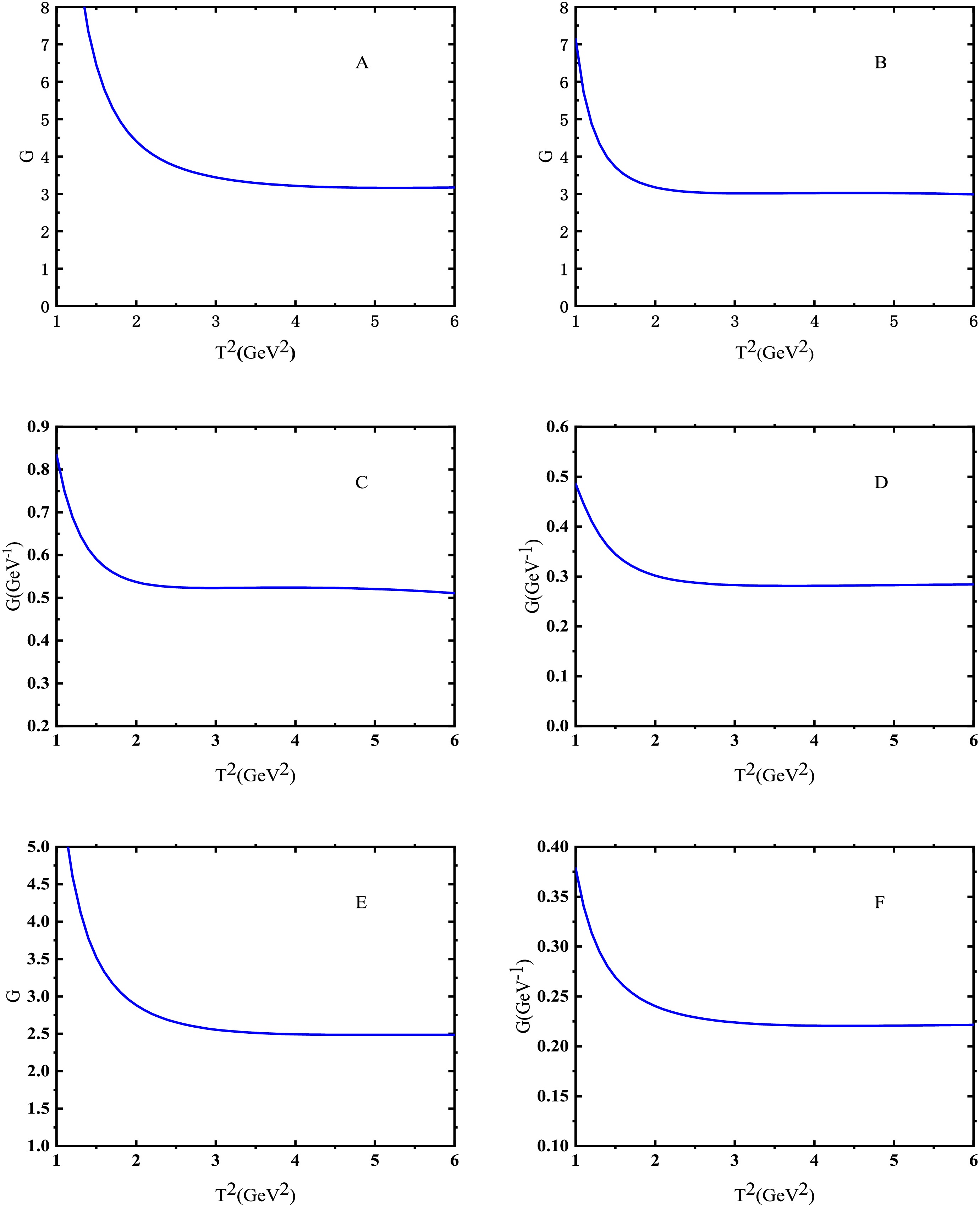
Figure 1. (color online) The hadronic coupling constants as functions of the Borel parameters, where A, B, C, D, E, and F denote the hadronic coupling constants
$ G_{\bar{D}_{s0}D_s^* S\widetilde{V}} $ ,$ G_{\bar{D}_{s1}D_s S\widetilde{V}} $ ,$ G_{\bar{D}_s D_s S\widetilde{V}} $ ,$ G_{\bar{D}_s^* D_s^* S\widetilde{V}} $ ,$ G_{\chi_{c0}\phi S\widetilde{V}} $ , and$ G_{J/\psi \phi S\widetilde{V}} $ , respectively.The uncertainties of the hadronic coupling constants are analyzed routinely. They originate not only from the coupling constants but also from other input parameters. Taking the QCD sum rule for the channel
$ Y_{PA}\to \bar{D}D $ as an example, the uncertainties on the hadronic side can be written as$ \lambda_{PA}f_{\bar{D}}f_{D}G_{\bar{D}DPA} = \bar{\lambda}_{PA}\bar{f}_{\bar{D}}\bar{f}_{D}\bar{G}_{\bar{D}DPA} +$ $ \delta\,\lambda_{PA}f_{\bar{D}}f_{D}G_{\bar{D}DPA} $ ,$ C_{\bar{D}DPA} = \bar{C}_{\bar{D}DPA}+\delta C_{\bar{D}DPA} $ ,$ \cdots $ , where$\begin{aligned}[b] \delta\,\lambda_{PA}f_{\bar{D}}f_{D}G_{\bar{D}DPA} =\;& \bar{\lambda}_{PA}\bar{f}_{\bar{D}}\bar{f}_{D}\bar{G}_{\bar{D}DPA} \\&\times\left( \frac{\delta f_{\bar{D}}}{\bar{f}_{\bar{D}}} +\frac{\delta f_{D}}{\bar{f}_{D}}+\frac{\delta \lambda_{PA}}{\bar{\lambda}_{PA}} +\frac{\delta G_{\bar{D}DPA}}{\bar{G}_{\bar{D}DPA}}\right)\, ,\end{aligned} $
(61) where the short overline denotes the central value. To avoid overestimating the uncertainties of the hadronic coupling constants, we approximately set
$ \delta C_{\bar{D}DPA}=0 $ ,$ \dfrac{\delta f_{\bar{D}}}{\bar{f}_{\bar{D}}} =\dfrac{\delta f_{D}}{\bar{f}_{D}}=\dfrac{\delta \lambda_{PA}}{\bar{\lambda}_{PA}} =\dfrac{\delta G_{\bar{D}DPS}}{\bar{G}_{\bar{D}DPS}} $ ,$ \cdots $ .After taking into account the relevant uncertainties, the numerical values of the hadronic coupling constants can be obtained directly and are shown explicitly in Table 4. Thereafter, the partial decay widths are obtained directly using the formula,
$ \begin{aligned}[b] \Gamma(Y\to F F^\prime) =\;& \frac{|T|^2 p(m_Y,m_F,m_{F^\prime})}{24\pi m_Y^2} \, , \\ |T|^2 =\;& \Sigma |\langle F(p) F^\prime(q)|Y(p^\prime)\rangle|^2 \, , \end{aligned} $
(62) where
$ p(A,B,C)=\dfrac{\sqrt{[A^2-(B+C)^2][A^2-(B-C)^2]}}{2A} $ , and F and$ F^\prime $ represent the final states. The partial decay widths for the different channels are shown in Table 5.Channels $ \Gamma({\rm{MeV}}) $ $ Y_{AA}\to \bar{D}^0D^0 $ ,$ \bar{D}^-D^+ $ $ 0.003\pm0.0 $ $ Y_{AA}\to \frac{\bar{D}^{0*}D^0+\bar{D}^{0}D^{*0}}{\sqrt{2}} $ ,$ \frac{\bar{D}^{-*}D^+ +\bar{D}^{-}D^{*+}}{\sqrt{2}} $ $ 0.023\pm0.002 $ $ Y_{AA}\to \bar{D}^{*0}D^{*0} $ ,$ \bar{D}^{*-}D^{*+} $ $ 0.0 $ $ Y_{AA}\to\frac{\bar{D}^0_0D^{*0}+\bar{D}^{*0}D^{0}_0}{\sqrt{2}} $ ,$ \frac{\bar{D}^-_0D^{*+}+\bar{D}^{*-}D^{+}_0}{\sqrt{2}} $ $ 6.03\pm0.97 $ $ Y_{AA}\to\frac{\bar{D}^0_1D^{0}-\bar{D}^{0}D^{0}_1}{\sqrt{2}} $ ,$ \frac{\bar{D}^-_1D^{+}-\bar{D}^{-}D^{+}_1}{\sqrt{2}} $ $ 1.23\pm0.25 $ $ Y_{AA}\to\eta_c\omega $ $ 0.005\pm0.0 $ $ Y_{AA}\to J/\psi\omega $ $ 0.0 $ $ Y_{AA}\to\chi_{c0}\omega $ $ 7.07\pm1.74 $ $ Y_{AA}\to\chi_{c1}\omega $ $ 5.81\pm0.36 $ $ Y_{AA}\to J/\psi f_0(500) $ $ 0.31\pm0.12 $ $ Y_{\widetilde{A}V}\to \bar{D}_s D_s $ $ 52.04\pm8.39 $ $ Y_{\widetilde{A}V}\to \frac{\bar{D}^{*}_s D_s +\bar{D}_s D^{*}_s}{\sqrt{2}} $ $ 0.023\pm0.002 $ $ Y_{\widetilde{A}V}\to \bar{D}^{*}_s D^{*}_s $ $ 30.35\pm4.31 $ $ Y_{\widetilde{A}V}\to\frac{\bar{D}_{s0} D^{*}_s+\bar{D}^{*}_s D_{s0}}{\sqrt{2}} $ $ 3.96\pm0.57 $ $ Y_{\widetilde{A}V}\to\frac{\bar{D}_{s1}D_s-\bar{D}_s D_{s1}}{\sqrt{2}} $ $ 53.52\pm10.97 $ $ Y_{\widetilde{A}V}\to\eta_c\phi $ $ 12.24\pm1.92 $ $ Y_{\widetilde{A}V}\to J/\psi\phi $ $ 0.0 $ $ Y_{\widetilde{A}V}\to\chi_{c0}\phi $ $ 19.91\pm4.65 $ $ Y_{\widetilde{A}V}\to\chi_{c1}\phi $ $ 22.56\pm2.23 $ $ Y_{\widetilde{A}V}\to J/\psi f_0(980) $ $ 72.08\pm18.16 $ $ Y_{PA}\to \bar{D}^0D^0 $ ,$ \bar{D}^-D^+ $ $ 8.50\pm1.20 $ $ Y_{PA}\to \frac{\bar{D}^{0*}D^0+\bar{D}^{0}D^{*0}}{\sqrt{2}} $ ,$ \frac{\bar{D}^{-*}D^+ +\bar{D}^{-}D^{*+}}{\sqrt{2}} $ $ 0.035\pm0.003 $ $ Y_{PA}\to \bar{D}^{*0}D^{*0} $ ,$ \bar{D}^{*-}D^{*+} $ $ 2.26\pm1.00 $ $ Y_{PA}\to\frac{\bar{D}^0_0D^{*0}+\bar{D}^{*0}D^{0}_0}{\sqrt{2}} $ ,$ \frac{\bar{D}^-_0D^{*+}+\bar{D}^{*-}D^{+}_0}{\sqrt{2}} $ $ 80.49\pm7.73 $ $ Y_{PA}\to\frac{\bar{D}^0_1D^{0}-\bar{D}^{0}D^{0}_1}{\sqrt{2}} $ ,$ \frac{\bar{D}^-_1D^{+}-\bar{D}^{-}D^{+}_1}{\sqrt{2}} $ $ 18.20\pm3.49 $ $ Y_{PA}\to\eta_c\omega $ $ 22.52\pm3.51 $ $ Y_{PA}\to J/\psi\omega $ $ 0.0 $ $ Y_{PA}\to\chi_{c0}\omega $ $ 4.20\pm1.13 $ $ Y_{PA}\to\chi_{c1}\omega $ $ 142.85\pm17.20 $ $ Y_{PA}\to J/\psi f_0(500) $ $ 2.58\pm0.88 $ $ Y_{S\widetilde{V}}\to \bar{D}_s D_s $ $ 1.34\pm0.14 $ $ Y_{S\widetilde{V}}\to \frac{\bar{D}^{*}_s D_s +\bar{D}_s D^{*}_s}{\sqrt{2}} $ $ 0.007\pm0.001 $ $ Y_{S\widetilde{V}}\to \bar{D}^{*}_s D^{*}_s $ $ 0.80\pm0.09 $ $ Y_{S\widetilde{V}}\to\frac{\bar{D}_{s0} D^{*}_s+\bar{D}^{*}_s D_{s0}}{\sqrt{2}} $ $ 14.19\pm1.71 $ $ Y_{S\widetilde{V}}\to\frac{\bar{D}_{s1}D_s-\bar{D}_s D_{s1}}{\sqrt{2}} $ $ 12.85\pm1.79 $ $ Y_{S\widetilde{V}}\to\eta_c\phi $ $ 18.71\pm6.63 $ $ Y_{S\widetilde{V}}\to J/\psi\phi $ $ 0.60\pm0.08 $ $ Y_{S\widetilde{V}}\to\chi_{c0}\phi $ $ 8.20\pm1.52 $ $ Y_{S\widetilde{V}}\to \chi_{c1}\phi $ $ 1.24\pm0.24 $ $ Y_{S\widetilde{V}}\to J/\psi f_0(980) $ $ 3.54\pm0.89 $ Table 5. Partial decay widths of the vector tetraquark states
$ Y_{AA} $ ,$ Y_{\widetilde{A}V} $ ,$ Y_{PA} $ , and$ Y_{S\widetilde{V}} $ .Finally, we sum all the partial decay widths to obtain the total widths of these four tetraquark states.
$ \begin{aligned}[b] \Gamma\left(Y_{PA}\right) = 391.1\pm 21.4\, {\rm{MeV}}\, , \end{aligned} $
$ \begin{aligned}[b] \Gamma\left(Y_{AA}\right)& = 27.8\pm 2.3\, {\rm{MeV}}\, , \\ \Gamma\left(Y_{\widetilde{A}V}\right)& = 266.7\pm 23.9\, {\rm{MeV}}\, , \\ \Gamma\left(Y_{S\widetilde{V}}\right) &= 61.5\pm 7.3\, {\rm{MeV}}\, . \end{aligned} $
(63) It can be clearly seen that the values of the total widths of the four states are quite different from each other. Therefore, we can distinguish them easily in high-energy experiments. The predicted width
$ 61.5\pm 7.3\, {\rm{MeV}} $ of the$ Y_{S\widetilde{V}} $ is well compatible with the width$ 48\pm15\pm3\, {\rm{MeV}} $ reported by the Belle collaboration [2]. Moreover, our prediction for the width of the$ Y_{S\widetilde{V}} $ is in excellent agreement with the average width$ 55\pm9\, {\rm{MeV}} $ of the$ Y(4660) $ from different experiments reported by the Particle Data Group [1], which supports the assignment of the$ Y(4660) $ as the$ [sc]_S[\bar{s}\bar{c}]_{\widetilde{V}}-[sc]_{\widetilde{V}}[\bar{s}\bar{c}]_S $ tetraquark state. The widths$ 155.4\pm24.8\pm0.8 $ [5] and$ 218.3\pm71.9 $ [6] reported by the BESIII collaboration are larger than those from the Belle and BaBar collaborations, which suggests that the$ Y(4660) $ may have several Fock components. The predictions$ \Gamma\left(Y_{\widetilde{A}V}\right)=266.7\pm 23.9\, {\rm{MeV}} $ and$ \Gamma\left(Y_{PA}\right)=391.1\pm 21.4\, {\rm{MeV}} $ are too large, whereas the prediction$ \Gamma\left(Y_{AA}\right)=27.8\pm 2.3\, {\rm{MeV}} $ is too small to be consistent with the experimental width. Thus, the present study disfavors the assignment of the$ Y(4660) $ as the$ [sc]_{\widetilde{A}}[\bar{s}\bar{c}]_V+ [sc]_V[\bar{s}\bar{c}]_{\widetilde{A}} $ ,$ [uc]_P[\bar{u}\bar{c}]_A+[dc]_P[\bar{d}\bar{c}]_A-[uc]_A[\bar{u}\bar{c}]_P- [dc]_A[\bar{d}\bar{c}]_P $ , or$ [uc]_A[\bar{u}\bar{c}]_A+[dc]_A[\bar{d}\bar{c}]_A $ tetraquark states. These results are useful for diagnosing vector exotic states and await future experimental examination. -
The input parameters used in this work are listed in Table 3. We set
$ m_u=m_d=0 $ and take the$\rm\overline{MS}$ masses$ m_{s}(2\,{\rm{GeV}})=(0.095\pm0.005)\,{\rm{GeV}} $ and$ m_{c}(m_c)=(1.275\pm 0.025)\,{\rm{GeV}} $ from the Particle Data Group [1]. We also take into account the energy-scale dependence of the vacuum condensates and the quark masses$ m_s $ and$ m_c $ using the renormalization group equations.Parameters Values/GeV Parameters Values [57] Parameters Values $ m_{J/\psi} $ $ 3.0969 $ [1]$ m_{D_0} $ $ 2.40\,{\rm{GeV}} $ $ f_{\omega} $ ,$ f_{\rho} $ $ 0.215\,{\rm{GeV}} $ [58]$ m_{\eta_c} $ $ 2.9839 $ [1]$ m_{D_{s0}} $ $ 2.32\,{\rm{GeV}} $ $ f_{f_0(500)} $ $ 0.350\,{\rm{GeV}} $ [59, 60]$ m_{\phi} $ $ 1.019460 $ [1]$ m_{D_1} $ $ 2.42\,{\rm{GeV}} $ $ f_{f_0(980)} $ $ 0.180\,{\rm{GeV}} $ [61]$ m_{\chi_{c0}} $ $ 3.41471 $ [1]$ m_{D_{s1}} $ $ 2.46\,{\rm{GeV}} $ $ \lambda_{PA} $ $ 7.19\times 10^{-2}\, {\rm{GeV}}^5 $ [26]$ m_{\chi_{c1}} $ $ 3.51067 $ [1]$ f_{D} $ $ 0.208\,{\rm{GeV}} $ $ \lambda_{AA} $ $ 6.65\times 10^{-2}\, {\rm{GeV}}^5 $ [26]$ m_{D} $ $ 1.86484 $ [1]$ f_{D_s} $ $ 0.240\,{\rm{GeV}} $ $ \lambda_{\widetilde{A}V} $ $ 1.23\times 10^{-1}\, {\rm{GeV}}^5 $ [27]$ m_{D_s} $ $ 1.96835 $ [1]$ f_{D^*} $ $ 0.263\,{\rm{GeV}} $ $ \lambda_{S\widetilde{V}} $ $ 6.22\times 10^{-2}\, {\rm{GeV}}^5 $ [27]$ m_{D^*} $ $ 2.00685 $ [1]$ f_{D_s^*} $ $ 0.308\,{\rm{GeV}} $ $ s^0_\omega $ ,$ s^0_{\rho} $ $ (1.2\,{\rm{GeV}})^2 $ [58]$ m_{D_s^*} $ $ 2.1066 $ [1]$ f_{D_0} $ $ 0.373\,{\rm{GeV}} $ $ s^0_{f_0(500)} $ $ 1.0\,{\rm{GeV}}^2 $ [59, 60]$ m_\omega $ $ 0.78266 $ [1]$ f_{D_{s0}} $ $ 0.333\,{\rm{GeV}} $ $ s^0_{f_0(980)} $ $ (1.3\,{\rm{GeV}})^2 $ [61]$ m_{f_0(500)} $ $ 0.550 $ [1]$ f_{D_1} $ $ 0.332\,{\rm{GeV}} $ $ s^0_{J/\psi} $ $ (3.6\,{\rm{GeV}})^2 $ [1, 62, 63]$ m_{f_0(980)} $ $ 0.990 $ [1]$ f_{D_{s1}} $ $ 0.345\,{\rm{GeV}} $ $ s^0_{\eta_c} $ $ (3.5\,{\rm{GeV}})^2 $ [1, 62, 63]$ M_{Y(PA)} $ $ 4.66 $ [26]$ s^0_{D} $ $ 6.2\,{\rm{GeV}}^2 $ $ s^0_{\chi_{c0}} $ $ (3.9\,{\rm{GeV}})^2 $ [1, 62, 63]$ M_{Y(AA)} $ $ 4.69 $ [26]$ s^0_{D_s} $ $ 7.3\,{\rm{GeV}}^2 $ $ s^0_{\chi_{c1}} $ $ (4.0\,{\rm{GeV}})^2 $ [1, 62, 63]$ M_{Y(\widetilde{A}V)} $ $ 4.65 $ [27]$ s^0_{D^*} $ $ 6.4\,{\rm{GeV}}^2 $ $ \langle\bar{q}q\rangle $ $ -(0.24\pm 0.01\, {\rm{GeV}})^3 $ [52, 53, 64]$ M_{Y(S\widetilde{V})} $ $ 4.68 $ [27]$ s^0_{D_s^*} $ $ 7.5\,{\rm{GeV}}^2 $ $ \langle\bar{s}s\rangle $ $ (0.8\pm0.1)\langle\bar{q}q\rangle $ [52, 53, 64]$ f_{J/\psi} $ $ 0.418 $ [62]$ s^0_{D_0} $ $ 8.3\,{\rm{GeV}}^2 $ $ \langle\bar{q}g_s\sigma Gq\rangle $ $ m_0^2\langle\bar{q}q\rangle $ [52, 53, 64]$ f_{\eta_c} $ $ 0.387 $ [62]$ s^0_{D_{s0}} $ $ 7.4\,{\rm{GeV}}^2 $ $ \langle\bar{s}g_s\sigma Gs\rangle $ $ m_0^2\langle\bar{s}s\rangle $ [52, 53, 64]$ f_{\chi_{c0}} $ $ 0.359 $ [63]$ s^0_{D_1} $ $ 8.6\,{\rm{GeV}}^2 $ $ m_0^2 $ $ (0.8\pm0.1)\,{\rm{GeV}}^2 $ [52, 53, 64]$ f_{\chi_{c1}} $ $ 0.338 $ [63]$ s^0_{D_{s1}} $ $ 9.3\,{\rm{GeV}}^2 $ − − Table 3. The input parameters used in the numerical calculations are given below, with the values of the vacuum condensates taken at the energy scale
$ \mu=1\,{\rm{GeV}} $ .$ \begin{aligned}[b] \langle\bar{q}q \rangle(\mu) =\;& \langle\bar{q}q \rangle({\rm{1GeV}})\left[\frac{\alpha_{s}({\rm{1GeV}})}{\alpha_{s}(\mu)}\right]^{\frac{12}{33-2n_f}}\, , \\ \langle\bar{s}s \rangle(\mu) =\;& \langle\bar{s}s \rangle({\rm{1GeV}})\left[\frac{\alpha_{s}({\rm{1GeV}})}{\alpha_{s}(\mu)}\right]^{\frac{12}{33-2n_f}}\, , \\ \langle\bar{q}g_s \sigma Gq \rangle(\mu) =\;& \langle\bar{q}g_s \sigma Gq \rangle({\rm{1GeV}})\left[\frac{\alpha_{s}({\rm{1GeV}})}{\alpha_{s}(\mu)}\right]^{\frac{2}{33-2n_f}}\, , \\ \langle\bar{s}g_s \sigma Gs \rangle(\mu) =\;& \langle\bar{s}g_s \sigma Gs \rangle({\rm{1GeV}})\left[\frac{\alpha_{s}({\rm{1GeV}})}{\alpha_{s}(\mu)}\right]^{\frac{2}{33-2n_f}}\, , \end{aligned} $
$ \begin{aligned}[b] \\ m_c(\mu) =\;& m_c(m_c)\left[\frac{\alpha_{s}(\mu)}{\alpha_{s}(m_c)}\right]^{\frac{12}{33-2n_f}} \, ,\\ m_s(\mu) =\;& m_s({\rm{2GeV}} )\left[\frac{\alpha_{s}(\mu)}{\alpha_{s}({\rm{2GeV}})}\right]^{\frac{12}{33-2n_f}}\, ,\\ \alpha_s(\mu) =\;& \frac{1}{b_0t}\left[1-\frac{b_1}{b_0^2}\frac{\log t}{t} +\frac{b_1^2(\log^2{t}-\log{t}-1)+b_0b_2}{b_0^4t^2}\right]\, , \end{aligned} $
(56) where
$t=\log \dfrac{\mu^2}{\Lambda_{\rm QCD}^2}$ ,$ b_0=\dfrac{33-2n_f}{12\pi} $ ,$ b_1=\dfrac{153-19n_f}{24\pi^2} $ ,$ b_2=\dfrac{2857-\dfrac{5033}{9}n_f+\dfrac{325}{27}n_f^2}{128\pi^3} $ ,$\Lambda_{\rm QCD}=210\;{\rm{MeV}}$ ,$292\;{\rm{MeV}}$ and$332\;{\rm{MeV}}$ for the flavor numbers$ n_f=5 $ ,$ 4 $ and$ 3 $ , respectively [1, 65]. Specifically, we choose$ n_f=4 $ for the hidden-charm tetraquark states and evolve all the input parameters to the typical energy scale$\mu=1\;{\rm{GeV}}$ .We intend to study the exotic states in our unique scheme step by step: first, we study the mass spectrum, and then we study the two-body strong decays. When studying the mass spectrum of the hidden-charm (bottom) tetraquark (molecular) states, we compute the terms
$ g_s^2\langle\bar{q}q\rangle^2 $ with$ q=u $ , d or s [24, 66−69]. In the full light-quark propagators, there are terms$ \langle\bar{q}_j\gamma_{\mu}q_i\rangle $ [24, 66−69], which absorb the gluons emitted from the other quark lines to form$ \langle\bar{q}_j\gamma_{\mu}q_ig_s D_\nu G_{\alpha\beta}\rangle $ and contribute to the four-quark condensate$ g_s^2\langle\bar{q}q\rangle^2 $ . The four-quark condensate$ g_s^2\langle \bar{q}q\rangle^2 $ originates from the terms$ \langle \bar{q}\gamma_\mu q g_s D_\eta G_{\lambda\tau}\rangle $ ,$ \langle\bar{q}_jD^{\dagger}_{\mu}D^{\dagger}_{\nu}D^{\dagger}_{\alpha}q_i\rangle $ and$ \langle\bar{q}_jD_{\mu}D_{\nu}D_{\alpha}q_i\rangle $ rather than from the radiative$ {\cal{O}}(\alpha_s) $ corrections to the four-quark condensate$ \langle \bar{q}q\rangle^2 $ , where$ D_\alpha=\partial_\alpha-{\rm i} g_sG_\alpha $ . The strong coupling constant$ \alpha_s(\mu)=\dfrac{g_s^2(\mu)}{4\pi} $ appears at tree level and is energy-scale dependent. In fact, the contributions of such terms are tiny. In the present work, as in other works on the two-body strong decays of the hidden-charm tetraquark states, we neglect such terms because we only take into account vacuum condensates up to dimension 5 [42], but we consider the energy-scale dependence of the input parameters for consistency with our previous works [24, 66−69]. In Ref.[44], the vacuum condensates are taken at the energy scale$\mu=1\;{\rm{GeV}}$ , while the c-quark mass is taken as the$\rm\overline{MS}$ mass$ m_c(m_c) $ or the approximate pole mass; this is another scheme for choosing the input parameters. In the two-point QCD sum rules for the hidden-charm tetraquark (molecular) states, the largest contributions do not come from the perturbative terms but from the vacuum condensates. Therefore, one has to calculate the radiative$ {\cal{O}}(\alpha_s) $ corrections to the perturbative terms and vacuum condensates, at least those to$ \langle\bar{q}q\rangle $ , at the same time if the next-to-leading contributions are required. Up to now, only the radiative$ {\cal{O}}(\alpha_s) $ corrections to the perturbative terms have been studied partially [70−72].As we take the rigorous quark-hadron duality in the s and u channels (see Eq. (52)), which correspond to the traditional mesons, it is reasonable to choose the typical energy scale
$\mu=1\;{\rm{GeV}}$ as in the usual two-point QCD sum rules. If we choose a slightly larger energy scale, the integral ranges$ m_c^2(\mu)-s_0/u_0 $ and$ 4m_c^2(\mu)-s_0/u_0 $ would be slightly larger; therefore, we expect a slightly larger hadronic coupling constant. As far as the light mesons$ f_0(500) $ , ω,$ f_0(980) $ and$ \phi(1020) $ are concerned, we prefer to choose$\mu=1\;{\rm{GeV}}$ as the universal energy scale.In order to obtain flat platforms, the free parameters are fitted as follows:
$ \begin{aligned}[b] C_{\bar{D}_sD_s\widetilde{A}V} =\;& 0.0023\,{{\rm{GeV}}^5}\times T^2\, , \\ C_{\bar{D}_s^*D_s\widetilde{A}V} =\;& -0.0000035\,{{\rm{GeV}}^4}\times T^2\, , \\ C_{\bar{D}_s^*D_s^*\widetilde{A}V} =\;& 0.0004\,{{\rm{GeV}}^5}\times T^2\, , \\C_{\bar{D}_{s0}D_s^*\widetilde{A}V} =\;& 0.00009\,{{\rm{GeV}}^6}\times T^2\, , \\ C_{\bar{D}_{s1}D_s\widetilde{A}V} =\;& 0.0126\,{{\rm{GeV}}^6}\times T^2\, , \\ C_{\eta_c\phi\widetilde{A}V} =\;& 0.00017\,{{\rm{GeV}}^4}\times T^2\, , \\ C_{J/\psi\phi\widetilde{A}V} =\;& 0.0\, ,\\ C_{\chi_{c0}\phi\widetilde{A}V} =\;& 0.002\,{{\rm{GeV}}^6}\times T^2\, , \end{aligned} $
$ \begin{aligned}[b] C_{\chi_{c1}\phi\widetilde{A}V} =\;& 0.000012\,{{\rm{GeV}}^5}\times T^2\, , \\ C_{J/\psi f_0(980)\widetilde{A}V} =\;& 0.0027\,{{\rm{GeV}}^6}\times T^2\, , \end{aligned} $
(57) $ \begin{aligned}[b] C_{\bar{D}D PA} =\;& 0.00016\,{{\rm{GeV}}^5}\times T^2\, , \\ C_{\bar{D}^*D PA} =\;& -0.0000018\,{{\rm{GeV}}^4}\times T^2\, , \\ C_{\bar{D}^*D^* PA} =\;& 0.00013\,{{\rm{GeV}}^5}\times T^2\, , \\ C_{\bar{D}_0D^* PA} =\;& 0.0001\,{{\rm{GeV}}^6}\times T^2\, , \\ C_{\bar{D}_1D PA} =\;& 0.001\,{{\rm{GeV}}^6}\times T^2\, , \\C_{\eta_c\omega PA} =\;& 0.00009\,{{\rm{GeV}}^4}\times T^2\, , \\ C_{J/\omega\omega PA} =\;& 0.0\, , \\ C_{\chi_{c0}\omega PA} =\;& 0.00026\,{{\rm{GeV}}^6}\times T^2\, , \\ C_{\chi_{c1}\omega PA} =\;& 0.000016\,{{\rm{GeV}}^5}\times T^2\, , \\ C_{J/\psi f_0(500) PA} =\;& 0.00037\,{{\rm{GeV}}^6}\times T^2\, , \end{aligned} $
(58) $ \begin{aligned}[b]C_{\bar{D}D AA} =\;& -0.0000013\,{{\rm{GeV}}^4}\times T^2\, , \\C_{\bar{D}^*D AA} =\;& -0.0000012\,{{\rm{GeV}}^3}\times T^2\, , \\C_{\bar{D}^*D^* AA} =\;& 0.0\, , \\C_{\bar{D}_0D^* AA} =\;& 0.0003\,{{\rm{GeV}}^7}\, , \\\bar{\lambda}_{\bar{D}_0D^* AA} =\;& 0.0044\, {{\rm{GeV}}^7}\times T^2\, , \\C_{\bar{D}_1D AA} =\;& 0.00055\,{{\rm{GeV}}^7}\, , \\\bar{\lambda}_{\bar{D}_1D AA} =\;& 0.0037\, {{\rm{GeV}}^7}\times T^2\, , \\C_{\eta_c\omega AA} =\;& 0.0\, , \\C_{J/\omega\omega AA} =\;& 0.0\, , \\C_{\chi_{c0}\omega AA} =\;& 0.00013\,{{\rm{GeV}}^7}\, , \\\bar{\lambda}_{\chi_{c0}\omega AA} =\;& 0.0034\, {{\rm{GeV}}^7}\times T^2\, , \\C_{\chi_{c1}\omega AA} =\;& 0.043\,{{\rm{GeV}}^6}\, , \\C_{J/\psi f_0(500) AA} =\;& 0.000044\,{{\rm{GeV}}^7}\, ,\\\bar{\lambda}_{J/\psi f_0(500) AA} =\;& 0.0011\, {{\rm{GeV}}^7}\times T^2\, , \end{aligned} $
(59) $ \begin{aligned}[b] C_{\bar{D}_s D_s S\widetilde{V}} =\;& 0.000081\,{{\rm{GeV}}^4}\times T^2\, ,\\C_{\bar{D}_s^*D_s S\widetilde{V}} =\;& -0.0000013\,{{\rm{GeV}}^5}\times T^2\, , \\C_{\bar{D}_s^*D_s^* S\widetilde{V}} =\;& 0.000025\,{{\rm{GeV}}^4}\times T^2\, , \\C_{\bar{D}_{s0}D_s^* S\widetilde{V}} =\;& 0.00013\,{{\rm{GeV}}^5}\times T^2\, , \\C_{\bar{D}_{s1}D_s S\widetilde{V}} =\;& 0.0007\,{{\rm{GeV}}^5}\times T^2\, ,\\C_{\eta_c \phi S\widetilde{V}} =\;& 0.00015\, {{\rm{GeV}}^7}\, ,\\\bar{\lambda}_{\eta_c\phi S\widetilde{A}} =\;& 0.0033\, {{\rm{GeV}}^7}\times T^2\, , \end{aligned} $
$ \begin{aligned}[b] C_{J/\psi\phi S\widetilde{V}} =\;& 0.00002\,{{\rm{GeV}}^4}\times T^2\, , \\C_{\chi_{c0}\phi S\widetilde{V}} =\;& 0.00032\,{{\rm{GeV}}^5}\times T^2\, , \\C_{\chi_{c1}\phi S\widetilde{V}} =\;& 0.0004\,{{\rm{GeV}}^6}\times T^2\, , \\C_{J/\psi f_0(980) S\widetilde{V}} =\;& 0.00022\,{{\rm{GeV}}^5}\times T^2\, . \end{aligned} $
(60) We then obtain uniform flat Borel windows,
$T^2_{\max}-T^2_{\min}=1\;{\rm{GeV}}^2$ , which are presented explicitly in Table 4.Channels $ T^2({\rm{GeV}}^2) $ G $ \bar{D}D AA $ $ 4.7-5.7 $ $ (2.04\pm0.09)\times\rm{10^{-2}}\,{\rm{GeV}}^{-1} $ $ \bar{D}^*D AA $ $ 4.2-5.2 $ $ (1.92\pm0.07)\times\rm{10^{-2}}\,{\rm{GeV}}^{-2} $ $ \bar{D}^*D^* AA $ $ --- $ $ 0.0 $ $ \bar{D}_0D^* AA $ $ 4.0-5.0 $ $ 1.99\pm0.16 $ $ \bar{D}_1D AA $ $ 2.7-3.7 $ $ 0.83\pm0.08 $ $ \eta_c\omega AA $ $ 3.3-4.3 $ $ (1.03\pm0.06)\times\rm{10^{-2}}\,{\rm{GeV}}^{-2} $ $ J/\psi\omega AA $ $ --- $ $ 0.0 $ $ \chi_{c0}\omega AA $ $ 4.9-5.9 $ $ 1.79\pm0.22 $ $ \chi_{c1}\omega AA $ $ 3.8-4.8 $ $ (3.27\pm0.1)\times\rm{10^{-1}}\,{\rm{GeV}}^{-1} $ $ J/\psi f_0(500) AA $ $ 3.0-4.0 $ $ 0.36\pm0.07 $ $ \bar{D}_s D_s \widetilde{A}V $ $ 2.2-3.2 $ $ 3.35\pm0.27 $ $ \bar{D}^*_s D_s \widetilde{A}V $ $ 4.8-5.8 $ $ (2.52\pm0.11)\times\rm{10^{-2}}\,{\rm{GeV}}^{-1} $ $ \bar{D}^*_s D^*_s \widetilde{A}V $ $ 4.1-5.1 $ $ 1.83\pm0.13 $ $ \bar{D}_{s0}D^*_s \widetilde{A}V $ $ 3.5-4.5 $ $ 0.29\pm0.02\,{\rm{GeV}}^{-1} $ $ \bar{D}_{s1}D_s \widetilde{A}V $ $ 1.8-2.8 $ $ 6.34\pm0.65\,{\rm{GeV}} $ $ \eta_c\phi \widetilde{A}V $ $ 2.3-3.3 $ $ 0.61\pm0.05\,{\rm{GeV}}^{-1} $ $ J/\psi\phi \widetilde{A}V $ $ --- $ $ 0.0 $ $ \chi_{c0}\phi \widetilde{A}V $ $ 3.0-4.0 $ $ 4.02\pm0.47\,{\rm{GeV}} $ $ \chi_{c1}\phi \widetilde{A}V $ $ 4.7-5.7 $ $ 0.24\pm0.01\,{\rm{GeV}}^{-2} $ $ J/\psi f_0(980)\widetilde{A}V $ $ 1.8-2.8 $ $ 6.19\pm0.78\,{\rm{GeV}} $ $ \bar{D}D PA $ $ 2.3-3.3 $ $ 1.13\pm0.08 $ $ \bar{D}^*DPA $ $ 4.0-5.0 $ $ (2.45\pm0.10)\times\rm{10^{-2}}\,{\rm{GeV}}^{-1} $ $ \bar{D}^*D^* PA $ $ 4.1-5.1 $ $ 0.34\pm0.08 $ $ \bar{D}_0D^*PA $ $ 4.9-5.9 $ $ 1.25\pm0.06\,{\rm{GeV}}^{-1} $ $ \bar{D}_1DPA $ $ 3.0-4.0 $ $ 3.23\pm0.31\,{\rm{GeV}} $ $ \eta_c\omega PA $ $ 2.2-3.2 $ $ 0.69\pm0.05\,{\rm{GeV}} $ $ J/\psi\omega PA $ $ --- $ $ 0.0 $ $ \chi_{c0}\omega PA $ $ 2.6-3.6 $ $ 1.41\pm0.19\,{\rm{GeV}} $ $ \chi_{c1}\omega PA $ $ 5.0-6.0 $ $ 0.38\pm0.02\,{\rm{GeV}}^{-2} $ $ J/\psi f_0(500) PA $ $ 1.8-2.8 $ $ 1.05\pm0.18\,{\rm{GeV}} $ $ \bar{D}_s D_s S\widetilde{V} $ $ 2.6-3.6 $ $ 0.52\pm0.03\,{\rm{GeV}}^{-1} $ $ \bar{D}^*_s D_s S\widetilde{V} $ $ 4.6-5.6 $ $ (1.35\pm0.05)\times 10^{-2}\,{\rm{GeV}}^{-2} $ $ \bar{D}^*_s D^*_s S\widetilde{V} $ $ 3.3-4.3 $ $ 0.28\pm0.02\,{\rm{GeV}}^{-1} $ $ \bar{D}_{s0}D^*_s S\widetilde{V} $ $ 4.7-5.7 $ $ 3.16\pm0.19 $ $ \bar{D}_{s1}D_s S\widetilde{V} $ $ 3.9-4.9 $ $ 3.02\pm0.21 $ $ \eta_c\phi S\widetilde{V} $ $ 4.6-5.6 $ $ 0.73\pm0.13\,{\rm{GeV}}^{-2} $ $ J/\psi\phi S\widetilde{V} $ $ 3.8-4.8 $ $ 0.22\pm0.02\,{\rm{GeV}}^{-1} $ $ \chi_{c0}\phi S\widetilde{V} $ $ 4.7-5.7 $ $ 2.49\pm0.23 $ $ \chi_{c1}\phi S\widetilde{V} $ $ 2.7-3.7 $ $ 0.22\pm0.02\,{\rm{GeV}}^{-1} $ $ J/\psi f_0(980) S\widetilde{V} $ $ 2.3-3.3 $ $ 1.36\pm0.17 $ Table 4. The Borel parameters (windows)
$ T^2 $ and the hadronic coupling constants G. Here, ''Channels'' denotes the subscripts of the hadronic coupling constants defined in Eqs. (18)−(19) and in Appendix A.In Fig. 1, the curves of the hadronic coupling constants
$ G_{\bar{D}_{s0}D_s^* S\widetilde{V}} $ ,$ G_{\bar{D}_{s1}D_s S\widetilde{V}} $ ,$ G_{\bar{D}_s D_s S\widetilde{V}} $ ,$ G_{\bar{D}_s^* D_s^* S\widetilde{V}} $ ,$ G_{\chi_{c0}\phi S\widetilde{V}} $ and$ G_{J/\psi \phi S\widetilde{V}} $ are plotted as functions of the Borel parameters$ T^2 $ over large intervals as examples. In the Borel windows, clear flat platforms appear, and thus the hadronic coupling constants can be extracted reliably.
Figure 1. (color online) The hadronic coupling constants as functions of the Borel parameters, where A, B, C, D, E, and F denote the hadronic coupling constants
$ G_{\bar{D}_{s0}D_s^* S\widetilde{V}} $ ,$ G_{\bar{D}_{s1}D_s S\widetilde{V}} $ ,$ G_{\bar{D}_s D_s S\widetilde{V}} $ ,$ G_{\bar{D}_s^* D_s^* S\widetilde{V}} $ ,$ G_{\chi_{c0}\phi S\widetilde{V}} $ , and$ G_{J/\psi \phi S\widetilde{V}} $ , respectively.The uncertainties of the hadronic coupling constants are analyzed routinely. They originate not only from the coupling constants but also from other input parameters. Taking the QCD sum rule for the channel
$ Y_{PA}\to \bar{D}D $ as an example, the uncertainties on the hadronic side can be written as$ \lambda_{PA}f_{\bar{D}}f_{D}G_{\bar{D}DPA} = \bar{\lambda}_{PA}\bar{f}_{\bar{D}}\bar{f}_{D}\bar{G}_{\bar{D}DPA} +$ $ \delta\,\lambda_{PA}f_{\bar{D}}f_{D}G_{\bar{D}DPA} $ ,$ C_{\bar{D}DPA} = \bar{C}_{\bar{D}DPA}+\delta C_{\bar{D}DPA} $ ,$ \cdots $ , where$\begin{aligned}[b] \delta\,\lambda_{PA}f_{\bar{D}}f_{D}G_{\bar{D}DPA} =\;& \bar{\lambda}_{PA}\bar{f}_{\bar{D}}\bar{f}_{D}\bar{G}_{\bar{D}DPA} \\&\times\left( \frac{\delta f_{\bar{D}}}{\bar{f}_{\bar{D}}} +\frac{\delta f_{D}}{\bar{f}_{D}}+\frac{\delta \lambda_{PA}}{\bar{\lambda}_{PA}} +\frac{\delta G_{\bar{D}DPA}}{\bar{G}_{\bar{D}DPA}}\right)\, ,\end{aligned} $
(61) where the short overline denotes the central value. To avoid overestimating the uncertainties of the hadronic coupling constants, we approximately set
$ \delta C_{\bar{D}DPA}=0 $ ,$ \dfrac{\delta f_{\bar{D}}}{\bar{f}_{\bar{D}}} =\dfrac{\delta f_{D}}{\bar{f}_{D}}=\dfrac{\delta \lambda_{PA}}{\bar{\lambda}_{PA}} =\dfrac{\delta G_{\bar{D}DPS}}{\bar{G}_{\bar{D}DPS}} $ ,$ \cdots $ .After taking into account the relevant uncertainties, the numerical values of the hadronic coupling constants can be obtained directly and are shown explicitly in Table 4. Thereafter, the partial decay widths are obtained directly using the formula,
$ \begin{aligned}[b] \Gamma(Y\to F F^\prime) =\;& \frac{|T|^2 p(m_Y,m_F,m_{F^\prime})}{24\pi m_Y^2} \, , \\ |T|^2 =\;& \Sigma |\langle F(p) F^\prime(q)|Y(p^\prime)\rangle|^2 \, , \end{aligned} $
(62) where
$ p(A,B,C)=\dfrac{\sqrt{[A^2-(B+C)^2][A^2-(B-C)^2]}}{2A} $ , and F and$ F^\prime $ represent the final states. The partial decay widths for the different channels are shown in Table 5.Channels $\Gamma/{\rm{MeV} }$ $ Y_{AA}\to \bar{D}^0D^0 $ ,$ \bar{D}^-D^+ $ $ 0.003\pm0.0 $ $ Y_{AA}\to \frac{\bar{D}^{0*}D^0+\bar{D}^{0}D^{*0}}{\sqrt{2}} $ ,$ \frac{\bar{D}^{-*}D^+ +\bar{D}^{-}D^{*+}}{\sqrt{2}} $ $ 0.023\pm0.002 $ $ Y_{AA}\to \bar{D}^{*0}D^{*0} $ ,$ \bar{D}^{*-}D^{*+} $ $ 0.0 $ $ Y_{AA}\to\frac{\bar{D}^0_0D^{*0}+\bar{D}^{*0}D^{0}_0}{\sqrt{2}} $ ,$ \frac{\bar{D}^-_0D^{*+}+\bar{D}^{*-}D^{+}_0}{\sqrt{2}} $ $ 6.03\pm0.97 $ $ Y_{AA}\to\frac{\bar{D}^0_1D^{0}-\bar{D}^{0}D^{0}_1}{\sqrt{2}} $ ,$ \frac{\bar{D}^-_1D^{+}-\bar{D}^{-}D^{+}_1}{\sqrt{2}} $ $ 1.23\pm0.25 $ $ Y_{AA}\to\eta_c\omega $ $ 0.005\pm0.0 $ $ Y_{AA}\to J/\psi\omega $ $ 0.0 $ $ Y_{AA}\to\chi_{c0}\omega $ $ 7.07\pm1.74 $ $ Y_{AA}\to\chi_{c1}\omega $ $ 5.81\pm0.36 $ $ Y_{AA}\to J/\psi f_0(500) $ $ 0.31\pm0.12 $ $ Y_{\widetilde{A}V}\to \bar{D}_s D_s $ $ 52.04\pm8.39 $ $ Y_{\widetilde{A}V}\to \frac{\bar{D}^{*}_s D_s +\bar{D}_s D^{*}_s}{\sqrt{2}} $ $ 0.023\pm0.002 $ $ Y_{\widetilde{A}V}\to \bar{D}^{*}_s D^{*}_s $ $ 30.35\pm4.31 $ $ Y_{\widetilde{A}V}\to\frac{\bar{D}_{s0} D^{*}_s+\bar{D}^{*}_s D_{s0}}{\sqrt{2}} $ $ 3.96\pm0.57 $ $ Y_{\widetilde{A}V}\to\frac{\bar{D}_{s1}D_s-\bar{D}_s D_{s1}}{\sqrt{2}} $ $ 53.52\pm10.97 $ $ Y_{\widetilde{A}V}\to\eta_c\phi $ $ 12.24\pm1.92 $ $ Y_{\widetilde{A}V}\to J/\psi\phi $ $ 0.0 $ $ Y_{\widetilde{A}V}\to\chi_{c0}\phi $ $ 19.91\pm4.65 $ $ Y_{\widetilde{A}V}\to\chi_{c1}\phi $ $ 22.56\pm2.23 $ $ Y_{\widetilde{A}V}\to J/\psi f_0(980) $ $ 72.08\pm18.16 $ $ Y_{PA}\to \bar{D}^0D^0 $ ,$ \bar{D}^-D^+ $ $ 8.50\pm1.20 $ $ Y_{PA}\to \frac{\bar{D}^{0*}D^0+\bar{D}^{0}D^{*0}}{\sqrt{2}} $ ,$ \frac{\bar{D}^{-*}D^+ +\bar{D}^{-}D^{*+}}{\sqrt{2}} $ $ 0.035\pm0.003 $ $ Y_{PA}\to \bar{D}^{*0}D^{*0} $ ,$ \bar{D}^{*-}D^{*+} $ $ 2.26\pm1.00 $ $ Y_{PA}\to\frac{\bar{D}^0_0D^{*0}+\bar{D}^{*0}D^{0}_0}{\sqrt{2}} $ ,$ \frac{\bar{D}^-_0D^{*+}+\bar{D}^{*-}D^{+}_0}{\sqrt{2}} $ $ 80.49\pm7.73 $ $ Y_{PA}\to\frac{\bar{D}^0_1D^{0}-\bar{D}^{0}D^{0}_1}{\sqrt{2}} $ ,$ \frac{\bar{D}^-_1D^{+}-\bar{D}^{-}D^{+}_1}{\sqrt{2}} $ $ 18.20\pm3.49 $ $ Y_{PA}\to\eta_c\omega $ $ 22.52\pm3.51 $ $ Y_{PA}\to J/\psi\omega $ $ 0.0 $ $ Y_{PA}\to\chi_{c0}\omega $ $ 4.20\pm1.13 $ $ Y_{PA}\to\chi_{c1}\omega $ $ 142.85\pm17.20 $ $ Y_{PA}\to J/\psi f_0(500) $ $ 2.58\pm0.88 $ $ Y_{S\widetilde{V}}\to \bar{D}_s D_s $ $ 1.34\pm0.14 $ $ Y_{S\widetilde{V}}\to \frac{\bar{D}^{*}_s D_s +\bar{D}_s D^{*}_s}{\sqrt{2}} $ $ 0.007\pm0.001 $ $ Y_{S\widetilde{V}}\to \bar{D}^{*}_s D^{*}_s $ $ 0.80\pm0.09 $ $ Y_{S\widetilde{V}}\to\frac{\bar{D}_{s0} D^{*}_s+\bar{D}^{*}_s D_{s0}}{\sqrt{2}} $ $ 14.19\pm1.71 $ $ Y_{S\widetilde{V}}\to\frac{\bar{D}_{s1}D_s-\bar{D}_s D_{s1}}{\sqrt{2}} $ $ 12.85\pm1.79 $ $ Y_{S\widetilde{V}}\to\eta_c\phi $ $ 18.71\pm6.63 $ $ Y_{S\widetilde{V}}\to J/\psi\phi $ $ 0.60\pm0.08 $ $ Y_{S\widetilde{V}}\to\chi_{c0}\phi $ $ 8.20\pm1.52 $ $ Y_{S\widetilde{V}}\to \chi_{c1}\phi $ $ 1.24\pm0.24 $ $ Y_{S\widetilde{V}}\to J/\psi f_0(980) $ $ 3.54\pm0.89 $ Table 5. Partial decay widths of the vector tetraquark states
$ Y_{AA} $ ,$ Y_{\widetilde{A}V} $ ,$ Y_{PA} $ , and$ Y_{S\widetilde{V}} $ .Finally, we sum all the partial decay widths to obtain the total widths of these four tetraquark states.
$ \begin{aligned}[b] \Gamma\left(Y_{PA}\right) = 391.1\pm 21.4\; {\rm{MeV}}\, , \end{aligned} $
$ \begin{aligned}[b] \Gamma\left(Y_{AA}\right)& = 27.8\pm 2.3\; {\rm{MeV}}\, , \\ \Gamma\left(Y_{\widetilde{A}V}\right)& = 266.7\pm 23.9\; {\rm{MeV}}\, , \\ \Gamma\left(Y_{S\widetilde{V}}\right) &= 61.5\pm 7.3\; {\rm{MeV}}\, . \end{aligned} $
(63) It can be clearly seen that the values of the total widths of the four states are quite different from each other. Therefore, we can distinguish them easily in high-energy experiments. The predicted width
$61.5\pm 7.3\; {\rm{MeV}}$ of the$ Y_{S\widetilde{V}} $ is well compatible with the width$48\pm15\pm3\; {\rm{MeV}}$ reported by the Belle collaboration [2]. Moreover, our prediction for the width of the$ Y_{S\widetilde{V}} $ is in excellent agreement with the average width$55\pm9\; {\rm{MeV}}$ of the$ Y(4660) $ from different experiments reported by the Particle Data Group [1], which supports the assignment of the$ Y(4660) $ as the$ [sc]_S[\bar{s}\bar{c}]_{\widetilde{V}}-[sc]_{\widetilde{V}}[\bar{s}\bar{c}]_S $ tetraquark state. The widths$ 155.4\pm24.8\pm0.8 $ and$ 218.3\pm71.9 $ [5] reported by the BESIII collaboration are larger than those from the Belle and BaBar collaborations, which suggests that the$ Y(4660) $ may have several Fock components. The predictions$\Gamma\left(Y_{\widetilde{A}V}\right)=266.7\pm 23.9\; {\rm{MeV}}$ and$\Gamma\left(Y_{PA}\right)=391.1\pm 21.4\; {\rm{MeV}}$ are too large, whereas the prediction$\Gamma\left(Y_{AA}\right)= 27.8\pm 2.3\; {\rm{MeV}}$ is too small to be consistent with the experimental width. Thus, the present study disfavors the assignment of the$ Y(4660) $ as the$ [sc]_{\widetilde{A}}[\bar{s}\bar{c}]_V+ [sc]_V[\bar{s}\bar{c}]_{\widetilde{A}} $ ,$ [uc]_P[\bar{u}\bar{c}]_A+[dc]_P[\bar{d}\bar{c}]_A-[uc]_A[\bar{u}\bar{c}]_P- [dc]_A[\bar{d}\bar{c}]_P $ , or$ [uc]_A[\bar{u}\bar{c}]_A + [dc]_A[\bar{d}\bar{c}]_A $ tetraquark states. These results are useful for diagnosing vector exotic states and await future experimental examination. -
The input parameters used in this work are listed in Table 3. We set
$ m_u=m_d=0 $ and take the$\rm\overline{MS}$ masses$ m_{s}(2\,{\rm{GeV}})=(0.095\pm0.005)\,{\rm{GeV}} $ and$ m_{c}(m_c)=(1.275\pm 0.025)\,{\rm{GeV}} $ from the Particle Data Group [1]. We also take into account the energy-scale dependence of the vacuum condensates and the quark masses$ m_s $ and$ m_c $ using the renormalization group equations.Parameters Values/GeV Parameters Values [57] Parameters Values $ m_{J/\psi} $ $ 3.0969 $ [1]$ m_{D_0} $ $ 2.40\,{\rm{GeV}} $ $ f_{\omega} $ ,$ f_{\rho} $ $ 0.215\,{\rm{GeV}} $ [58]$ m_{\eta_c} $ $ 2.9839 $ [1]$ m_{D_{s0}} $ $ 2.32\,{\rm{GeV}} $ $ f_{f_0(500)} $ $ 0.350\,{\rm{GeV}} $ [59, 60]$ m_{\phi} $ $ 1.019460 $ [1]$ m_{D_1} $ $ 2.42\,{\rm{GeV}} $ $ f_{f_0(980)} $ $ 0.180\,{\rm{GeV}} $ [61]$ m_{\chi_{c0}} $ $ 3.41471 $ [1]$ m_{D_{s1}} $ $ 2.46\,{\rm{GeV}} $ $ \lambda_{PA} $ $ 7.19\times 10^{-2}\, {\rm{GeV}}^5 $ [26]$ m_{\chi_{c1}} $ $ 3.51067 $ [1]$ f_{D} $ $ 0.208\,{\rm{GeV}} $ $ \lambda_{AA} $ $ 6.65\times 10^{-2}\, {\rm{GeV}}^5 $ [26]$ m_{D} $ $ 1.86484 $ [1]$ f_{D_s} $ $ 0.240\,{\rm{GeV}} $ $ \lambda_{\widetilde{A}V} $ $ 1.23\times 10^{-1}\, {\rm{GeV}}^5 $ [27]$ m_{D_s} $ $ 1.96835 $ [1]$ f_{D^*} $ $ 0.263\,{\rm{GeV}} $ $ \lambda_{S\widetilde{V}} $ $ 6.22\times 10^{-2}\, {\rm{GeV}}^5 $ [27]$ m_{D^*} $ $ 2.00685 $ [1]$ f_{D_s^*} $ $ 0.308\,{\rm{GeV}} $ $ s^0_\omega $ ,$ s^0_{\rho} $ $ (1.2\,{\rm{GeV}})^2 $ [58]$ m_{D_s^*} $ $ 2.1066 $ [1]$ f_{D_0} $ $ 0.373\,{\rm{GeV}} $ $ s^0_{f_0(500)} $ $ 1.0\,{\rm{GeV}}^2 $ [59, 60]$ m_\omega $ $ 0.78266 $ [1]$ f_{D_{s0}} $ $ 0.333\,{\rm{GeV}} $ $ s^0_{f_0(980)} $ $ (1.3\,{\rm{GeV}})^2 $ [61]$ m_{f_0(500)} $ $ 0.550 $ [1]$ f_{D_1} $ $ 0.332\,{\rm{GeV}} $ $ s^0_{J/\psi} $ $ (3.6\,{\rm{GeV}})^2 $ [1, 62, 63]$ m_{f_0(980)} $ $ 0.990 $ [1]$ f_{D_{s1}} $ $ 0.345\,{\rm{GeV}} $ $ s^0_{\eta_c} $ $ (3.5\,{\rm{GeV}})^2 $ [1, 62, 63]$ M_{Y(PA)} $ $ 4.66 $ [26]$ s^0_{D} $ $ 6.2\,{\rm{GeV}}^2 $ $ s^0_{\chi_{c0}} $ $ (3.9\,{\rm{GeV}})^2 $ [1, 62, 63]$ M_{Y(AA)} $ $ 4.69 $ [26]$ s^0_{D_s} $ $ 7.3\,{\rm{GeV}}^2 $ $ s^0_{\chi_{c1}} $ $ (4.0\,{\rm{GeV}})^2 $ [1, 62, 63]$ M_{Y(\widetilde{A}V)} $ $ 4.65 $ [27]$ s^0_{D^*} $ $ 6.4\,{\rm{GeV}}^2 $ $ \langle\bar{q}q\rangle $ $ -(0.24\pm 0.01\, {\rm{GeV}})^3 $ [52, 53, 64]$ M_{Y(S\widetilde{V})} $ $ 4.68 $ [27]$ s^0_{D_s^*} $ $ 7.5\,{\rm{GeV}}^2 $ $ \langle\bar{s}s\rangle $ $ (0.8\pm0.1)\langle\bar{q}q\rangle $ [52, 53, 64]$ f_{J/\psi} $ $ 0.418 $ [62]$ s^0_{D_0} $ $ 8.3\,{\rm{GeV}}^2 $ $ \langle\bar{q}g_s\sigma Gq\rangle $ $ m_0^2\langle\bar{q}q\rangle $ [52, 53, 64]$ f_{\eta_c} $ $ 0.387 $ [62]$ s^0_{D_{s0}} $ $ 7.4\,{\rm{GeV}}^2 $ $ \langle\bar{s}g_s\sigma Gs\rangle $ $ m_0^2\langle\bar{s}s\rangle $ [52, 53, 64]$ f_{\chi_{c0}} $ $ 0.359 $ [63]$ s^0_{D_1} $ $ 8.6\,{\rm{GeV}}^2 $ $ m_0^2 $ $ (0.8\pm0.1)\,{\rm{GeV}}^2 $ [52, 53, 64]$ f_{\chi_{c1}} $ $ 0.338 $ [63]$ s^0_{D_{s1}} $ $ 9.3\,{\rm{GeV}}^2 $ − − Table 3. The input parameters used in the numerical calculations are given below, with the values of the vacuum condensates taken at the energy scale
$ \mu=1\,{\rm{GeV}} $ .$ \begin{aligned}[b] \langle\bar{q}q \rangle(\mu) =\;& \langle\bar{q}q \rangle({\rm{1GeV}})\left[\frac{\alpha_{s}({\rm{1GeV}})}{\alpha_{s}(\mu)}\right]^{\frac{12}{33-2n_f}}\, , \\ \langle\bar{s}s \rangle(\mu) =\;& \langle\bar{s}s \rangle({\rm{1GeV}})\left[\frac{\alpha_{s}({\rm{1GeV}})}{\alpha_{s}(\mu)}\right]^{\frac{12}{33-2n_f}}\, , \\ \langle\bar{q}g_s \sigma Gq \rangle(\mu) =\;& \langle\bar{q}g_s \sigma Gq \rangle({\rm{1GeV}})\left[\frac{\alpha_{s}({\rm{1GeV}})}{\alpha_{s}(\mu)}\right]^{\frac{2}{33-2n_f}}\, , \\ \langle\bar{s}g_s \sigma Gs \rangle(\mu) =\;& \langle\bar{s}g_s \sigma Gs \rangle({\rm{1GeV}})\left[\frac{\alpha_{s}({\rm{1GeV}})}{\alpha_{s}(\mu)}\right]^{\frac{2}{33-2n_f}}\, , \end{aligned} $
$ \begin{aligned}[b] \\ m_c(\mu) =\;& m_c(m_c)\left[\frac{\alpha_{s}(\mu)}{\alpha_{s}(m_c)}\right]^{\frac{12}{33-2n_f}} \, ,\\ m_s(\mu) =\;& m_s({\rm{2GeV}} )\left[\frac{\alpha_{s}(\mu)}{\alpha_{s}({\rm{2GeV}})}\right]^{\frac{12}{33-2n_f}}\, ,\\ \alpha_s(\mu) =\;& \frac{1}{b_0t}\left[1-\frac{b_1}{b_0^2}\frac{\log t}{t} +\frac{b_1^2(\log^2{t}-\log{t}-1)+b_0b_2}{b_0^4t^2}\right]\, , \end{aligned} $
(56) where
$t=\log \dfrac{\mu^2}{\Lambda_{\rm QCD}^2}$ ,$ b_0=\dfrac{33-2n_f}{12\pi} $ ,$ b_1=\dfrac{153-19n_f}{24\pi^2} $ ,$ b_2=\dfrac{2857-\dfrac{5033}{9}n_f+\dfrac{325}{27}n_f^2}{128\pi^3} $ ,$\Lambda_{\rm QCD}=210\;{\rm{MeV}}$ ,$292\;{\rm{MeV}}$ and$332\;{\rm{MeV}}$ for the flavor numbers$ n_f=5 $ ,$ 4 $ and$ 3 $ , respectively [1, 65]. Specifically, we choose$ n_f=4 $ for the hidden-charm tetraquark states and evolve all the input parameters to the typical energy scale$\mu=1\;{\rm{GeV}}$ .We intend to study the exotic states in our unique scheme step by step: first, we study the mass spectrum, and then we study the two-body strong decays. When studying the mass spectrum of the hidden-charm (bottom) tetraquark (molecular) states, we compute the terms
$ g_s^2\langle\bar{q}q\rangle^2 $ with$ q=u $ , d or s [24, 66−69]. In the full light-quark propagators, there are terms$ \langle\bar{q}_j\gamma_{\mu}q_i\rangle $ [24, 66−69], which absorb the gluons emitted from the other quark lines to form$ \langle\bar{q}_j\gamma_{\mu}q_ig_s D_\nu G_{\alpha\beta}\rangle $ and contribute to the four-quark condensate$ g_s^2\langle\bar{q}q\rangle^2 $ . The four-quark condensate$ g_s^2\langle \bar{q}q\rangle^2 $ originates from the terms$ \langle \bar{q}\gamma_\mu q g_s D_\eta G_{\lambda\tau}\rangle $ ,$ \langle\bar{q}_jD^{\dagger}_{\mu}D^{\dagger}_{\nu}D^{\dagger}_{\alpha}q_i\rangle $ and$ \langle\bar{q}_jD_{\mu}D_{\nu}D_{\alpha}q_i\rangle $ rather than from the radiative$ {\cal{O}}(\alpha_s) $ corrections to the four-quark condensate$ \langle \bar{q}q\rangle^2 $ , where$ D_\alpha=\partial_\alpha-{\rm i} g_sG_\alpha $ . The strong coupling constant$ \alpha_s(\mu)=\dfrac{g_s^2(\mu)}{4\pi} $ appears at tree level and is energy-scale dependent. In fact, the contributions of such terms are tiny. In the present work, as in other works on the two-body strong decays of the hidden-charm tetraquark states, we neglect such terms because we only take into account vacuum condensates up to dimension 5 [42], but we consider the energy-scale dependence of the input parameters for consistency with our previous works [24, 66−69]. In Ref.[44], the vacuum condensates are taken at the energy scale$\mu=1\;{\rm{GeV}}$ , while the c-quark mass is taken as the$\rm\overline{MS}$ mass$ m_c(m_c) $ or the approximate pole mass; this is another scheme for choosing the input parameters. In the two-point QCD sum rules for the hidden-charm tetraquark (molecular) states, the largest contributions do not come from the perturbative terms but from the vacuum condensates. Therefore, one has to calculate the radiative$ {\cal{O}}(\alpha_s) $ corrections to the perturbative terms and vacuum condensates, at least those to$ \langle\bar{q}q\rangle $ , at the same time if the next-to-leading contributions are required. Up to now, only the radiative$ {\cal{O}}(\alpha_s) $ corrections to the perturbative terms have been studied partially [70−72].As we take the rigorous quark-hadron duality in the s and u channels (see Eq. (52)), which correspond to the traditional mesons, it is reasonable to choose the typical energy scale
$\mu=1\;{\rm{GeV}}$ as in the usual two-point QCD sum rules. If we choose a slightly larger energy scale, the integral ranges$ m_c^2(\mu)-s_0/u_0 $ and$ 4m_c^2(\mu)-s_0/u_0 $ would be slightly larger; therefore, we expect a slightly larger hadronic coupling constant. As far as the light mesons$ f_0(500) $ , ω,$ f_0(980) $ and$ \phi(1020) $ are concerned, we prefer to choose$\mu=1\;{\rm{GeV}}$ as the universal energy scale.In order to obtain flat platforms, the free parameters are fitted as follows:
$ \begin{aligned}[b] C_{\bar{D}_sD_s\widetilde{A}V} =\;& 0.0023\,{{\rm{GeV}}^5}\times T^2\, , \\ C_{\bar{D}_s^*D_s\widetilde{A}V} =\;& -0.0000035\,{{\rm{GeV}}^4}\times T^2\, , \\ C_{\bar{D}_s^*D_s^*\widetilde{A}V} =\;& 0.0004\,{{\rm{GeV}}^5}\times T^2\, , \\C_{\bar{D}_{s0}D_s^*\widetilde{A}V} =\;& 0.00009\,{{\rm{GeV}}^6}\times T^2\, , \\ C_{\bar{D}_{s1}D_s\widetilde{A}V} =\;& 0.0126\,{{\rm{GeV}}^6}\times T^2\, , \\ C_{\eta_c\phi\widetilde{A}V} =\;& 0.00017\,{{\rm{GeV}}^4}\times T^2\, , \\ C_{J/\psi\phi\widetilde{A}V} =\;& 0.0\, ,\\ C_{\chi_{c0}\phi\widetilde{A}V} =\;& 0.002\,{{\rm{GeV}}^6}\times T^2\, , \end{aligned} $
$ \begin{aligned}[b] C_{\chi_{c1}\phi\widetilde{A}V} =\;& 0.000012\,{{\rm{GeV}}^5}\times T^2\, , \\ C_{J/\psi f_0(980)\widetilde{A}V} =\;& 0.0027\,{{\rm{GeV}}^6}\times T^2\, , \end{aligned} $
(57) $ \begin{aligned}[b] C_{\bar{D}D PA} =\;& 0.00016\,{{\rm{GeV}}^5}\times T^2\, , \\ C_{\bar{D}^*D PA} =\;& -0.0000018\,{{\rm{GeV}}^4}\times T^2\, , \\ C_{\bar{D}^*D^* PA} =\;& 0.00013\,{{\rm{GeV}}^5}\times T^2\, , \\ C_{\bar{D}_0D^* PA} =\;& 0.0001\,{{\rm{GeV}}^6}\times T^2\, , \\ C_{\bar{D}_1D PA} =\;& 0.001\,{{\rm{GeV}}^6}\times T^2\, , \\C_{\eta_c\omega PA} =\;& 0.00009\,{{\rm{GeV}}^4}\times T^2\, , \\ C_{J/\omega\omega PA} =\;& 0.0\, , \\ C_{\chi_{c0}\omega PA} =\;& 0.00026\,{{\rm{GeV}}^6}\times T^2\, , \\ C_{\chi_{c1}\omega PA} =\;& 0.000016\,{{\rm{GeV}}^5}\times T^2\, , \\ C_{J/\psi f_0(500) PA} =\;& 0.00037\,{{\rm{GeV}}^6}\times T^2\, , \end{aligned} $
(58) $ \begin{aligned}[b]C_{\bar{D}D AA} =\;& -0.0000013\,{{\rm{GeV}}^4}\times T^2\, , \\C_{\bar{D}^*D AA} =\;& -0.0000012\,{{\rm{GeV}}^3}\times T^2\, , \\C_{\bar{D}^*D^* AA} =\;& 0.0\, , \\C_{\bar{D}_0D^* AA} =\;& 0.0003\,{{\rm{GeV}}^7}\, , \\\bar{\lambda}_{\bar{D}_0D^* AA} =\;& 0.0044\, {{\rm{GeV}}^7}\times T^2\, , \\C_{\bar{D}_1D AA} =\;& 0.00055\,{{\rm{GeV}}^7}\, , \\\bar{\lambda}_{\bar{D}_1D AA} =\;& 0.0037\, {{\rm{GeV}}^7}\times T^2\, , \\C_{\eta_c\omega AA} =\;& 0.0\, , \\C_{J/\omega\omega AA} =\;& 0.0\, , \\C_{\chi_{c0}\omega AA} =\;& 0.00013\,{{\rm{GeV}}^7}\, , \\\bar{\lambda}_{\chi_{c0}\omega AA} =\;& 0.0034\, {{\rm{GeV}}^7}\times T^2\, , \\C_{\chi_{c1}\omega AA} =\;& 0.043\,{{\rm{GeV}}^6}\, , \\C_{J/\psi f_0(500) AA} =\;& 0.000044\,{{\rm{GeV}}^7}\, ,\\\bar{\lambda}_{J/\psi f_0(500) AA} =\;& 0.0011\, {{\rm{GeV}}^7}\times T^2\, , \end{aligned} $
(59) $ \begin{aligned}[b] C_{\bar{D}_s D_s S\widetilde{V}} =\;& 0.000081\,{{\rm{GeV}}^4}\times T^2\, ,\\C_{\bar{D}_s^*D_s S\widetilde{V}} =\;& -0.0000013\,{{\rm{GeV}}^5}\times T^2\, , \\C_{\bar{D}_s^*D_s^* S\widetilde{V}} =\;& 0.000025\,{{\rm{GeV}}^4}\times T^2\, , \\C_{\bar{D}_{s0}D_s^* S\widetilde{V}} =\;& 0.00013\,{{\rm{GeV}}^5}\times T^2\, , \\C_{\bar{D}_{s1}D_s S\widetilde{V}} =\;& 0.0007\,{{\rm{GeV}}^5}\times T^2\, ,\\C_{\eta_c \phi S\widetilde{V}} =\;& 0.00015\, {{\rm{GeV}}^7}\, ,\\\bar{\lambda}_{\eta_c\phi S\widetilde{A}} =\;& 0.0033\, {{\rm{GeV}}^7}\times T^2\, , \end{aligned} $
$ \begin{aligned}[b] C_{J/\psi\phi S\widetilde{V}} =\;& 0.00002\,{{\rm{GeV}}^4}\times T^2\, , \\C_{\chi_{c0}\phi S\widetilde{V}} =\;& 0.00032\,{{\rm{GeV}}^5}\times T^2\, , \\C_{\chi_{c1}\phi S\widetilde{V}} =\;& 0.0004\,{{\rm{GeV}}^6}\times T^2\, , \\C_{J/\psi f_0(980) S\widetilde{V}} =\;& 0.00022\,{{\rm{GeV}}^5}\times T^2\, . \end{aligned} $
(60) We then obtain uniform flat Borel windows,
$T^2_{\max}-T^2_{\min}=1\;{\rm{GeV}}^2$ , which are presented explicitly in Table 4.Channels $ T^2({\rm{GeV}}^2) $ G $ \bar{D}D AA $ $ 4.7-5.7 $ $ (2.04\pm0.09)\times\rm{10^{-2}}\,{\rm{GeV}}^{-1} $ $ \bar{D}^*D AA $ $ 4.2-5.2 $ $ (1.92\pm0.07)\times\rm{10^{-2}}\,{\rm{GeV}}^{-2} $ $ \bar{D}^*D^* AA $ $ --- $ $ 0.0 $ $ \bar{D}_0D^* AA $ $ 4.0-5.0 $ $ 1.99\pm0.16 $ $ \bar{D}_1D AA $ $ 2.7-3.7 $ $ 0.83\pm0.08 $ $ \eta_c\omega AA $ $ 3.3-4.3 $ $ (1.03\pm0.06)\times\rm{10^{-2}}\,{\rm{GeV}}^{-2} $ $ J/\psi\omega AA $ $ --- $ $ 0.0 $ $ \chi_{c0}\omega AA $ $ 4.9-5.9 $ $ 1.79\pm0.22 $ $ \chi_{c1}\omega AA $ $ 3.8-4.8 $ $ (3.27\pm0.1)\times\rm{10^{-1}}\,{\rm{GeV}}^{-1} $ $ J/\psi f_0(500) AA $ $ 3.0-4.0 $ $ 0.36\pm0.07 $ $ \bar{D}_s D_s \widetilde{A}V $ $ 2.2-3.2 $ $ 3.35\pm0.27 $ $ \bar{D}^*_s D_s \widetilde{A}V $ $ 4.8-5.8 $ $ (2.52\pm0.11)\times\rm{10^{-2}}\,{\rm{GeV}}^{-1} $ $ \bar{D}^*_s D^*_s \widetilde{A}V $ $ 4.1-5.1 $ $ 1.83\pm0.13 $ $ \bar{D}_{s0}D^*_s \widetilde{A}V $ $ 3.5-4.5 $ $ 0.29\pm0.02\,{\rm{GeV}}^{-1} $ $ \bar{D}_{s1}D_s \widetilde{A}V $ $ 1.8-2.8 $ $ 6.34\pm0.65\,{\rm{GeV}} $ $ \eta_c\phi \widetilde{A}V $ $ 2.3-3.3 $ $ 0.61\pm0.05\,{\rm{GeV}}^{-1} $ $ J/\psi\phi \widetilde{A}V $ $ --- $ $ 0.0 $ $ \chi_{c0}\phi \widetilde{A}V $ $ 3.0-4.0 $ $ 4.02\pm0.47\,{\rm{GeV}} $ $ \chi_{c1}\phi \widetilde{A}V $ $ 4.7-5.7 $ $ 0.24\pm0.01\,{\rm{GeV}}^{-2} $ $ J/\psi f_0(980)\widetilde{A}V $ $ 1.8-2.8 $ $ 6.19\pm0.78\,{\rm{GeV}} $ $ \bar{D}D PA $ $ 2.3-3.3 $ $ 1.13\pm0.08 $ $ \bar{D}^*DPA $ $ 4.0-5.0 $ $ (2.45\pm0.10)\times\rm{10^{-2}}\,{\rm{GeV}}^{-1} $ $ \bar{D}^*D^* PA $ $ 4.1-5.1 $ $ 0.34\pm0.08 $ $ \bar{D}_0D^*PA $ $ 4.9-5.9 $ $ 1.25\pm0.06\,{\rm{GeV}}^{-1} $ $ \bar{D}_1DPA $ $ 3.0-4.0 $ $ 3.23\pm0.31\,{\rm{GeV}} $ $ \eta_c\omega PA $ $ 2.2-3.2 $ $ 0.69\pm0.05\,{\rm{GeV}} $ $ J/\psi\omega PA $ $ --- $ $ 0.0 $ $ \chi_{c0}\omega PA $ $ 2.6-3.6 $ $ 1.41\pm0.19\,{\rm{GeV}} $ $ \chi_{c1}\omega PA $ $ 5.0-6.0 $ $ 0.38\pm0.02\,{\rm{GeV}}^{-2} $ $ J/\psi f_0(500) PA $ $ 1.8-2.8 $ $ 1.05\pm0.18\,{\rm{GeV}} $ $ \bar{D}_s D_s S\widetilde{V} $ $ 2.6-3.6 $ $ 0.52\pm0.03\,{\rm{GeV}}^{-1} $ $ \bar{D}^*_s D_s S\widetilde{V} $ $ 4.6-5.6 $ $ (1.35\pm0.05)\times 10^{-2}\,{\rm{GeV}}^{-2} $ $ \bar{D}^*_s D^*_s S\widetilde{V} $ $ 3.3-4.3 $ $ 0.28\pm0.02\,{\rm{GeV}}^{-1} $ $ \bar{D}_{s0}D^*_s S\widetilde{V} $ $ 4.7-5.7 $ $ 3.16\pm0.19 $ $ \bar{D}_{s1}D_s S\widetilde{V} $ $ 3.9-4.9 $ $ 3.02\pm0.21 $ $ \eta_c\phi S\widetilde{V} $ $ 4.6-5.6 $ $ 0.73\pm0.13\,{\rm{GeV}}^{-2} $ $ J/\psi\phi S\widetilde{V} $ $ 3.8-4.8 $ $ 0.22\pm0.02\,{\rm{GeV}}^{-1} $ $ \chi_{c0}\phi S\widetilde{V} $ $ 4.7-5.7 $ $ 2.49\pm0.23 $ $ \chi_{c1}\phi S\widetilde{V} $ $ 2.7-3.7 $ $ 0.22\pm0.02\,{\rm{GeV}}^{-1} $ $ J/\psi f_0(980) S\widetilde{V} $ $ 2.3-3.3 $ $ 1.36\pm0.17 $ Table 4. The Borel parameters (windows)
$ T^2 $ and the hadronic coupling constants G. Here, ''Channels'' denotes the subscripts of the hadronic coupling constants defined in Eqs. (18)−(19) and in Appendix A.In Fig. 1, the curves of the hadronic coupling constants
$ G_{\bar{D}_{s0}D_s^* S\widetilde{V}} $ ,$ G_{\bar{D}_{s1}D_s S\widetilde{V}} $ ,$ G_{\bar{D}_s D_s S\widetilde{V}} $ ,$ G_{\bar{D}_s^* D_s^* S\widetilde{V}} $ ,$ G_{\chi_{c0}\phi S\widetilde{V}} $ and$ G_{J/\psi \phi S\widetilde{V}} $ are plotted as functions of the Borel parameters$ T^2 $ over large intervals as examples. In the Borel windows, clear flat platforms appear, and thus the hadronic coupling constants can be extracted reliably.
Figure 1. (color online) The hadronic coupling constants as functions of the Borel parameters, where A, B, C, D, E, and F denote the hadronic coupling constants
$ G_{\bar{D}_{s0}D_s^* S\widetilde{V}} $ ,$ G_{\bar{D}_{s1}D_s S\widetilde{V}} $ ,$ G_{\bar{D}_s D_s S\widetilde{V}} $ ,$ G_{\bar{D}_s^* D_s^* S\widetilde{V}} $ ,$ G_{\chi_{c0}\phi S\widetilde{V}} $ , and$ G_{J/\psi \phi S\widetilde{V}} $ , respectively.The uncertainties of the hadronic coupling constants are analyzed routinely. They originate not only from the coupling constants but also from other input parameters. Taking the QCD sum rule for the channel
$ Y_{PA}\to \bar{D}D $ as an example, the uncertainties on the hadronic side can be written as$ \lambda_{PA}f_{\bar{D}}f_{D}G_{\bar{D}DPA} = \bar{\lambda}_{PA}\bar{f}_{\bar{D}}\bar{f}_{D}\bar{G}_{\bar{D}DPA} +$ $ \delta\,\lambda_{PA}f_{\bar{D}}f_{D}G_{\bar{D}DPA} $ ,$ C_{\bar{D}DPA} = \bar{C}_{\bar{D}DPA}+\delta C_{\bar{D}DPA} $ ,$ \cdots $ , where$\begin{aligned}[b] \delta\,\lambda_{PA}f_{\bar{D}}f_{D}G_{\bar{D}DPA} =\;& \bar{\lambda}_{PA}\bar{f}_{\bar{D}}\bar{f}_{D}\bar{G}_{\bar{D}DPA} \\&\times\left( \frac{\delta f_{\bar{D}}}{\bar{f}_{\bar{D}}} +\frac{\delta f_{D}}{\bar{f}_{D}}+\frac{\delta \lambda_{PA}}{\bar{\lambda}_{PA}} +\frac{\delta G_{\bar{D}DPA}}{\bar{G}_{\bar{D}DPA}}\right)\, ,\end{aligned} $
(61) where the short overline denotes the central value. To avoid overestimating the uncertainties of the hadronic coupling constants, we approximately set
$ \delta C_{\bar{D}DPA}=0 $ ,$ \dfrac{\delta f_{\bar{D}}}{\bar{f}_{\bar{D}}} =\dfrac{\delta f_{D}}{\bar{f}_{D}}=\dfrac{\delta \lambda_{PA}}{\bar{\lambda}_{PA}} =\dfrac{\delta G_{\bar{D}DPS}}{\bar{G}_{\bar{D}DPS}} $ ,$ \cdots $ .After taking into account the relevant uncertainties, the numerical values of the hadronic coupling constants can be obtained directly and are shown explicitly in Table 4. Thereafter, the partial decay widths are obtained directly using the formula,
$ \begin{aligned}[b] \Gamma(Y\to F F^\prime) =\;& \frac{|T|^2 p(m_Y,m_F,m_{F^\prime})}{24\pi m_Y^2} \, , \\ |T|^2 =\;& \Sigma |\langle F(p) F^\prime(q)|Y(p^\prime)\rangle|^2 \, , \end{aligned} $
(62) where
$ p(A,B,C)=\dfrac{\sqrt{[A^2-(B+C)^2][A^2-(B-C)^2]}}{2A} $ , and F and$ F^\prime $ represent the final states. The partial decay widths for the different channels are shown in Table 5.Channels $\Gamma/{\rm{MeV} }$ $ Y_{AA}\to \bar{D}^0D^0 $ ,$ \bar{D}^-D^+ $ $ 0.003\pm0.0 $ $ Y_{AA}\to \frac{\bar{D}^{0*}D^0+\bar{D}^{0}D^{*0}}{\sqrt{2}} $ ,$ \frac{\bar{D}^{-*}D^+ +\bar{D}^{-}D^{*+}}{\sqrt{2}} $ $ 0.023\pm0.002 $ $ Y_{AA}\to \bar{D}^{*0}D^{*0} $ ,$ \bar{D}^{*-}D^{*+} $ $ 0.0 $ $ Y_{AA}\to\frac{\bar{D}^0_0D^{*0}+\bar{D}^{*0}D^{0}_0}{\sqrt{2}} $ ,$ \frac{\bar{D}^-_0D^{*+}+\bar{D}^{*-}D^{+}_0}{\sqrt{2}} $ $ 6.03\pm0.97 $ $ Y_{AA}\to\frac{\bar{D}^0_1D^{0}-\bar{D}^{0}D^{0}_1}{\sqrt{2}} $ ,$ \frac{\bar{D}^-_1D^{+}-\bar{D}^{-}D^{+}_1}{\sqrt{2}} $ $ 1.23\pm0.25 $ $ Y_{AA}\to\eta_c\omega $ $ 0.005\pm0.0 $ $ Y_{AA}\to J/\psi\omega $ $ 0.0 $ $ Y_{AA}\to\chi_{c0}\omega $ $ 7.07\pm1.74 $ $ Y_{AA}\to\chi_{c1}\omega $ $ 5.81\pm0.36 $ $ Y_{AA}\to J/\psi f_0(500) $ $ 0.31\pm0.12 $ $ Y_{\widetilde{A}V}\to \bar{D}_s D_s $ $ 52.04\pm8.39 $ $ Y_{\widetilde{A}V}\to \frac{\bar{D}^{*}_s D_s +\bar{D}_s D^{*}_s}{\sqrt{2}} $ $ 0.023\pm0.002 $ $ Y_{\widetilde{A}V}\to \bar{D}^{*}_s D^{*}_s $ $ 30.35\pm4.31 $ $ Y_{\widetilde{A}V}\to\frac{\bar{D}_{s0} D^{*}_s+\bar{D}^{*}_s D_{s0}}{\sqrt{2}} $ $ 3.96\pm0.57 $ $ Y_{\widetilde{A}V}\to\frac{\bar{D}_{s1}D_s-\bar{D}_s D_{s1}}{\sqrt{2}} $ $ 53.52\pm10.97 $ $ Y_{\widetilde{A}V}\to\eta_c\phi $ $ 12.24\pm1.92 $ $ Y_{\widetilde{A}V}\to J/\psi\phi $ $ 0.0 $ $ Y_{\widetilde{A}V}\to\chi_{c0}\phi $ $ 19.91\pm4.65 $ $ Y_{\widetilde{A}V}\to\chi_{c1}\phi $ $ 22.56\pm2.23 $ $ Y_{\widetilde{A}V}\to J/\psi f_0(980) $ $ 72.08\pm18.16 $ $ Y_{PA}\to \bar{D}^0D^0 $ ,$ \bar{D}^-D^+ $ $ 8.50\pm1.20 $ $ Y_{PA}\to \frac{\bar{D}^{0*}D^0+\bar{D}^{0}D^{*0}}{\sqrt{2}} $ ,$ \frac{\bar{D}^{-*}D^+ +\bar{D}^{-}D^{*+}}{\sqrt{2}} $ $ 0.035\pm0.003 $ $ Y_{PA}\to \bar{D}^{*0}D^{*0} $ ,$ \bar{D}^{*-}D^{*+} $ $ 2.26\pm1.00 $ $ Y_{PA}\to\frac{\bar{D}^0_0D^{*0}+\bar{D}^{*0}D^{0}_0}{\sqrt{2}} $ ,$ \frac{\bar{D}^-_0D^{*+}+\bar{D}^{*-}D^{+}_0}{\sqrt{2}} $ $ 80.49\pm7.73 $ $ Y_{PA}\to\frac{\bar{D}^0_1D^{0}-\bar{D}^{0}D^{0}_1}{\sqrt{2}} $ ,$ \frac{\bar{D}^-_1D^{+}-\bar{D}^{-}D^{+}_1}{\sqrt{2}} $ $ 18.20\pm3.49 $ $ Y_{PA}\to\eta_c\omega $ $ 22.52\pm3.51 $ $ Y_{PA}\to J/\psi\omega $ $ 0.0 $ $ Y_{PA}\to\chi_{c0}\omega $ $ 4.20\pm1.13 $ $ Y_{PA}\to\chi_{c1}\omega $ $ 142.85\pm17.20 $ $ Y_{PA}\to J/\psi f_0(500) $ $ 2.58\pm0.88 $ $ Y_{S\widetilde{V}}\to \bar{D}_s D_s $ $ 1.34\pm0.14 $ $ Y_{S\widetilde{V}}\to \frac{\bar{D}^{*}_s D_s +\bar{D}_s D^{*}_s}{\sqrt{2}} $ $ 0.007\pm0.001 $ $ Y_{S\widetilde{V}}\to \bar{D}^{*}_s D^{*}_s $ $ 0.80\pm0.09 $ $ Y_{S\widetilde{V}}\to\frac{\bar{D}_{s0} D^{*}_s+\bar{D}^{*}_s D_{s0}}{\sqrt{2}} $ $ 14.19\pm1.71 $ $ Y_{S\widetilde{V}}\to\frac{\bar{D}_{s1}D_s-\bar{D}_s D_{s1}}{\sqrt{2}} $ $ 12.85\pm1.79 $ $ Y_{S\widetilde{V}}\to\eta_c\phi $ $ 18.71\pm6.63 $ $ Y_{S\widetilde{V}}\to J/\psi\phi $ $ 0.60\pm0.08 $ $ Y_{S\widetilde{V}}\to\chi_{c0}\phi $ $ 8.20\pm1.52 $ $ Y_{S\widetilde{V}}\to \chi_{c1}\phi $ $ 1.24\pm0.24 $ $ Y_{S\widetilde{V}}\to J/\psi f_0(980) $ $ 3.54\pm0.89 $ Table 5. Partial decay widths of the vector tetraquark states
$ Y_{AA} $ ,$ Y_{\widetilde{A}V} $ ,$ Y_{PA} $ , and$ Y_{S\widetilde{V}} $ .Finally, we sum all the partial decay widths to obtain the total widths of these four tetraquark states.
$ \begin{aligned}[b] \Gamma\left(Y_{PA}\right) = 391.1\pm 21.4\; {\rm{MeV}}\, , \end{aligned} $
$ \begin{aligned}[b] \Gamma\left(Y_{AA}\right)& = 27.8\pm 2.3\; {\rm{MeV}}\, , \\ \Gamma\left(Y_{\widetilde{A}V}\right)& = 266.7\pm 23.9\; {\rm{MeV}}\, , \\ \Gamma\left(Y_{S\widetilde{V}}\right) &= 61.5\pm 7.3\; {\rm{MeV}}\, . \end{aligned} $
(63) It can be clearly seen that the values of the total widths of the four states are quite different from each other. Therefore, we can distinguish them easily in high-energy experiments. The predicted width
$61.5\pm 7.3\; {\rm{MeV}}$ of the$ Y_{S\widetilde{V}} $ is well compatible with the width$48\pm15\pm3\; {\rm{MeV}}$ reported by the Belle collaboration [2]. Moreover, our prediction for the width of the$ Y_{S\widetilde{V}} $ is in excellent agreement with the average width$55\pm9\; {\rm{MeV}}$ of the$ Y(4660) $ from different experiments reported by the Particle Data Group [1], which supports the assignment of the$ Y(4660) $ as the$ [sc]_S[\bar{s}\bar{c}]_{\widetilde{V}}-[sc]_{\widetilde{V}}[\bar{s}\bar{c}]_S $ tetraquark state. The widths$ 155.4\pm24.8\pm0.8 $ and$ 218.3\pm71.9 $ [5] reported by the BESIII collaboration are larger than those from the Belle and BaBar collaborations, which suggests that the$ Y(4660) $ may have several Fock components. The predictions$\Gamma\left(Y_{\widetilde{A}V}\right)=266.7\pm 23.9\; {\rm{MeV}}$ and$\Gamma\left(Y_{PA}\right)=391.1\pm 21.4\; {\rm{MeV}}$ are too large, whereas the prediction$\Gamma\left(Y_{AA}\right)= 27.8\pm 2.3\; {\rm{MeV}}$ is too small to be consistent with the experimental width. Thus, the present study disfavors the assignment of the$ Y(4660) $ as the$ [sc]_{\widetilde{A}}[\bar{s}\bar{c}]_V+ [sc]_V[\bar{s}\bar{c}]_{\widetilde{A}} $ ,$ [uc]_P[\bar{u}\bar{c}]_A+[dc]_P[\bar{d}\bar{c}]_A-[uc]_A[\bar{u}\bar{c}]_P- [dc]_A[\bar{d}\bar{c}]_P $ , or$ [uc]_A[\bar{u}\bar{c}]_A + [dc]_A[\bar{d}\bar{c}]_A $ tetraquark states. These results are useful for diagnosing vector exotic states and await future experimental examination. -
The input parameters used in this work are listed in Table 3. We set
$ m_u=m_d=0 $ and take the$\rm\overline{MS}$ masses$ m_{s}(2\,{\rm{GeV}})=(0.095\pm0.005)\,{\rm{GeV}} $ and$ m_{c}(m_c)=(1.275\pm 0.025)\,{\rm{GeV}} $ from the Particle Data Group [1]. We also take into account the energy-scale dependence of the vacuum condensates and the quark masses$ m_s $ and$ m_c $ using the renormalization group equations.Parameters Values/GeV Parameters Values [57] Parameters Values $ m_{J/\psi} $ $ 3.0969 $ [1]$ m_{D_0} $ $ 2.40\,{\rm{GeV}} $ $ f_{\omega} $ ,$ f_{\rho} $ $ 0.215\,{\rm{GeV}} $ [58]$ m_{\eta_c} $ $ 2.9839 $ [1]$ m_{D_{s0}} $ $ 2.32\,{\rm{GeV}} $ $ f_{f_0(500)} $ $ 0.350\,{\rm{GeV}} $ [59, 60]$ m_{\phi} $ $ 1.019460 $ [1]$ m_{D_1} $ $ 2.42\,{\rm{GeV}} $ $ f_{f_0(980)} $ $ 0.180\,{\rm{GeV}} $ [61]$ m_{\chi_{c0}} $ $ 3.41471 $ [1]$ m_{D_{s1}} $ $ 2.46\,{\rm{GeV}} $ $ \lambda_{PA} $ $ 7.19\times 10^{-2}\, {\rm{GeV}}^5 $ [26]$ m_{\chi_{c1}} $ $ 3.51067 $ [1]$ f_{D} $ $ 0.208\,{\rm{GeV}} $ $ \lambda_{AA} $ $ 6.65\times 10^{-2}\, {\rm{GeV}}^5 $ [26]$ m_{D} $ $ 1.86484 $ [1]$ f_{D_s} $ $ 0.240\,{\rm{GeV}} $ $ \lambda_{\widetilde{A}V} $ $ 1.23\times 10^{-1}\, {\rm{GeV}}^5 $ [27]$ m_{D_s} $ $ 1.96835 $ [1]$ f_{D^*} $ $ 0.263\,{\rm{GeV}} $ $ \lambda_{S\widetilde{V}} $ $ 6.22\times 10^{-2}\, {\rm{GeV}}^5 $ [27]$ m_{D^*} $ $ 2.00685 $ [1]$ f_{D_s^*} $ $ 0.308\,{\rm{GeV}} $ $ s^0_\omega $ ,$ s^0_{\rho} $ $ (1.2\,{\rm{GeV}})^2 $ [58]$ m_{D_s^*} $ $ 2.1066 $ [1]$ f_{D_0} $ $ 0.373\,{\rm{GeV}} $ $ s^0_{f_0(500)} $ $ 1.0\,{\rm{GeV}}^2 $ [59, 60]$ m_\omega $ $ 0.78266 $ [1]$ f_{D_{s0}} $ $ 0.333\,{\rm{GeV}} $ $ s^0_{f_0(980)} $ $ (1.3\,{\rm{GeV}})^2 $ [61]$ m_{f_0(500)} $ $ 0.550 $ [1]$ f_{D_1} $ $ 0.332\,{\rm{GeV}} $ $ s^0_{J/\psi} $ $ (3.6\,{\rm{GeV}})^2 $ [1, 62, 63]$ m_{f_0(980)} $ $ 0.990 $ [1]$ f_{D_{s1}} $ $ 0.345\,{\rm{GeV}} $ $ s^0_{\eta_c} $ $ (3.5\,{\rm{GeV}})^2 $ [1, 62, 63]$ M_{Y(PA)} $ $ 4.66 $ [26]$ s^0_{D} $ $ 6.2\,{\rm{GeV}}^2 $ $ s^0_{\chi_{c0}} $ $ (3.9\,{\rm{GeV}})^2 $ [1, 62, 63]$ M_{Y(AA)} $ $ 4.69 $ [26]$ s^0_{D_s} $ $ 7.3\,{\rm{GeV}}^2 $ $ s^0_{\chi_{c1}} $ $ (4.0\,{\rm{GeV}})^2 $ [1, 62, 63]$ M_{Y(\widetilde{A}V)} $ $ 4.65 $ [27]$ s^0_{D^*} $ $ 6.4\,{\rm{GeV}}^2 $ $ \langle\bar{q}q\rangle $ $ -(0.24\pm 0.01\, {\rm{GeV}})^3 $ [52, 53, 64]$ M_{Y(S\widetilde{V})} $ $ 4.68 $ [27]$ s^0_{D_s^*} $ $ 7.5\,{\rm{GeV}}^2 $ $ \langle\bar{s}s\rangle $ $ (0.8\pm0.1)\langle\bar{q}q\rangle $ [52, 53, 64]$ f_{J/\psi} $ $ 0.418 $ [62]$ s^0_{D_0} $ $ 8.3\,{\rm{GeV}}^2 $ $ \langle\bar{q}g_s\sigma Gq\rangle $ $ m_0^2\langle\bar{q}q\rangle $ [52, 53, 64]$ f_{\eta_c} $ $ 0.387 $ [62]$ s^0_{D_{s0}} $ $ 7.4\,{\rm{GeV}}^2 $ $ \langle\bar{s}g_s\sigma Gs\rangle $ $ m_0^2\langle\bar{s}s\rangle $ [52, 53, 64]$ f_{\chi_{c0}} $ $ 0.359 $ [63]$ s^0_{D_1} $ $ 8.6\,{\rm{GeV}}^2 $ $ m_0^2 $ $ (0.8\pm0.1)\,{\rm{GeV}}^2 $ [52, 53, 64]$ f_{\chi_{c1}} $ $ 0.338 $ [63]$ s^0_{D_{s1}} $ $ 9.3\,{\rm{GeV}}^2 $ − − Table 3. The input parameters used in the numerical calculations are given below, with the values of the vacuum condensates taken at the energy scale
$ \mu=1\,{\rm{GeV}} $ .$ \begin{aligned}[b] \langle\bar{q}q \rangle(\mu) =\;& \langle\bar{q}q \rangle({\rm{1GeV}})\left[\frac{\alpha_{s}({\rm{1GeV}})}{\alpha_{s}(\mu)}\right]^{\frac{12}{33-2n_f}}\, , \\ \langle\bar{s}s \rangle(\mu) =\;& \langle\bar{s}s \rangle({\rm{1GeV}})\left[\frac{\alpha_{s}({\rm{1GeV}})}{\alpha_{s}(\mu)}\right]^{\frac{12}{33-2n_f}}\, , \\ \langle\bar{q}g_s \sigma Gq \rangle(\mu) =\;& \langle\bar{q}g_s \sigma Gq \rangle({\rm{1GeV}})\left[\frac{\alpha_{s}({\rm{1GeV}})}{\alpha_{s}(\mu)}\right]^{\frac{2}{33-2n_f}}\, , \\ \langle\bar{s}g_s \sigma Gs \rangle(\mu) =\;& \langle\bar{s}g_s \sigma Gs \rangle({\rm{1GeV}})\left[\frac{\alpha_{s}({\rm{1GeV}})}{\alpha_{s}(\mu)}\right]^{\frac{2}{33-2n_f}}\, , \end{aligned} $
$ \begin{aligned}[b] \\ m_c(\mu) =\;& m_c(m_c)\left[\frac{\alpha_{s}(\mu)}{\alpha_{s}(m_c)}\right]^{\frac{12}{33-2n_f}} \, ,\\ m_s(\mu) =\;& m_s({\rm{2GeV}} )\left[\frac{\alpha_{s}(\mu)}{\alpha_{s}({\rm{2GeV}})}\right]^{\frac{12}{33-2n_f}}\, ,\\ \alpha_s(\mu) =\;& \frac{1}{b_0t}\left[1-\frac{b_1}{b_0^2}\frac{\log t}{t} +\frac{b_1^2(\log^2{t}-\log{t}-1)+b_0b_2}{b_0^4t^2}\right]\, , \end{aligned} $
(56) where
$t=\log \dfrac{\mu^2}{\Lambda_{\rm QCD}^2}$ ,$ b_0=\dfrac{33-2n_f}{12\pi} $ ,$ b_1=\dfrac{153-19n_f}{24\pi^2} $ ,$ b_2=\dfrac{2857-\dfrac{5033}{9}n_f+\dfrac{325}{27}n_f^2}{128\pi^3} $ ,$\Lambda_{\rm QCD}=210\;{\rm{MeV}}$ ,$292\;{\rm{MeV}}$ and$332\;{\rm{MeV}}$ for the flavor numbers$ n_f=5 $ ,$ 4 $ and$ 3 $ , respectively [1, 65]. Specifically, we choose$ n_f=4 $ for the hidden-charm tetraquark states and evolve all the input parameters to the typical energy scale$\mu=1\;{\rm{GeV}}$ .We intend to study the exotic states in our unique scheme step by step: first, we study the mass spectrum, and then we study the two-body strong decays. When studying the mass spectrum of the hidden-charm (bottom) tetraquark (molecular) states, we compute the terms
$ g_s^2\langle\bar{q}q\rangle^2 $ with$ q=u $ , d or s [24, 66−69]. In the full light-quark propagators, there are terms$ \langle\bar{q}_j\gamma_{\mu}q_i\rangle $ [24, 66−69], which absorb the gluons emitted from the other quark lines to form$ \langle\bar{q}_j\gamma_{\mu}q_ig_s D_\nu G_{\alpha\beta}\rangle $ and contribute to the four-quark condensate$ g_s^2\langle\bar{q}q\rangle^2 $ . The four-quark condensate$ g_s^2\langle \bar{q}q\rangle^2 $ originates from the terms$ \langle \bar{q}\gamma_\mu q g_s D_\eta G_{\lambda\tau}\rangle $ ,$ \langle\bar{q}_jD^{\dagger}_{\mu}D^{\dagger}_{\nu}D^{\dagger}_{\alpha}q_i\rangle $ and$ \langle\bar{q}_jD_{\mu}D_{\nu}D_{\alpha}q_i\rangle $ rather than from the radiative$ {\cal{O}}(\alpha_s) $ corrections to the four-quark condensate$ \langle \bar{q}q\rangle^2 $ , where$ D_\alpha=\partial_\alpha-{\rm i} g_sG_\alpha $ . The strong coupling constant$ \alpha_s(\mu)=\dfrac{g_s^2(\mu)}{4\pi} $ appears at tree level and is energy-scale dependent. In fact, the contributions of such terms are tiny. In the present work, as in other works on the two-body strong decays of the hidden-charm tetraquark states, we neglect such terms because we only take into account vacuum condensates up to dimension 5 [42], but we consider the energy-scale dependence of the input parameters for consistency with our previous works [24, 66−69]. In Ref.[44], the vacuum condensates are taken at the energy scale$\mu=1\;{\rm{GeV}}$ , while the c-quark mass is taken as the$\rm\overline{MS}$ mass$ m_c(m_c) $ or the approximate pole mass; this is another scheme for choosing the input parameters. In the two-point QCD sum rules for the hidden-charm tetraquark (molecular) states, the largest contributions do not come from the perturbative terms but from the vacuum condensates. Therefore, one has to calculate the radiative$ {\cal{O}}(\alpha_s) $ corrections to the perturbative terms and vacuum condensates, at least those to$ \langle\bar{q}q\rangle $ , at the same time if the next-to-leading contributions are required. Up to now, only the radiative$ {\cal{O}}(\alpha_s) $ corrections to the perturbative terms have been studied partially [70−72].As we take the rigorous quark-hadron duality in the s and u channels (see Eq. (52)), which correspond to the traditional mesons, it is reasonable to choose the typical energy scale
$\mu=1\;{\rm{GeV}}$ as in the usual two-point QCD sum rules. If we choose a slightly larger energy scale, the integral ranges$ m_c^2(\mu)-s_0/u_0 $ and$ 4m_c^2(\mu)-s_0/u_0 $ would be slightly larger; therefore, we expect a slightly larger hadronic coupling constant. As far as the light mesons$ f_0(500) $ , ω,$ f_0(980) $ and$ \phi(1020) $ are concerned, we prefer to choose$\mu=1\;{\rm{GeV}}$ as the universal energy scale.In order to obtain flat platforms, the free parameters are fitted as follows:
$ \begin{aligned}[b] C_{\bar{D}_sD_s\widetilde{A}V} =\;& 0.0023\,{{\rm{GeV}}^5}\times T^2\, , \\ C_{\bar{D}_s^*D_s\widetilde{A}V} =\;& -0.0000035\,{{\rm{GeV}}^4}\times T^2\, , \\ C_{\bar{D}_s^*D_s^*\widetilde{A}V} =\;& 0.0004\,{{\rm{GeV}}^5}\times T^2\, , \\C_{\bar{D}_{s0}D_s^*\widetilde{A}V} =\;& 0.00009\,{{\rm{GeV}}^6}\times T^2\, , \\ C_{\bar{D}_{s1}D_s\widetilde{A}V} =\;& 0.0126\,{{\rm{GeV}}^6}\times T^2\, , \\ C_{\eta_c\phi\widetilde{A}V} =\;& 0.00017\,{{\rm{GeV}}^4}\times T^2\, , \\ C_{J/\psi\phi\widetilde{A}V} =\;& 0.0\, ,\\ C_{\chi_{c0}\phi\widetilde{A}V} =\;& 0.002\,{{\rm{GeV}}^6}\times T^2\, , \end{aligned} $
$ \begin{aligned}[b] C_{\chi_{c1}\phi\widetilde{A}V} =\;& 0.000012\,{{\rm{GeV}}^5}\times T^2\, , \\ C_{J/\psi f_0(980)\widetilde{A}V} =\;& 0.0027\,{{\rm{GeV}}^6}\times T^2\, , \end{aligned} $
(57) $ \begin{aligned}[b] C_{\bar{D}D PA} =\;& 0.00016\,{{\rm{GeV}}^5}\times T^2\, , \\ C_{\bar{D}^*D PA} =\;& -0.0000018\,{{\rm{GeV}}^4}\times T^2\, , \\ C_{\bar{D}^*D^* PA} =\;& 0.00013\,{{\rm{GeV}}^5}\times T^2\, , \\ C_{\bar{D}_0D^* PA} =\;& 0.0001\,{{\rm{GeV}}^6}\times T^2\, , \\ C_{\bar{D}_1D PA} =\;& 0.001\,{{\rm{GeV}}^6}\times T^2\, , \\C_{\eta_c\omega PA} =\;& 0.00009\,{{\rm{GeV}}^4}\times T^2\, , \\ C_{J/\omega\omega PA} =\;& 0.0\, , \\ C_{\chi_{c0}\omega PA} =\;& 0.00026\,{{\rm{GeV}}^6}\times T^2\, , \\ C_{\chi_{c1}\omega PA} =\;& 0.000016\,{{\rm{GeV}}^5}\times T^2\, , \\ C_{J/\psi f_0(500) PA} =\;& 0.00037\,{{\rm{GeV}}^6}\times T^2\, , \end{aligned} $
(58) $ \begin{aligned}[b]C_{\bar{D}D AA} =\;& -0.0000013\,{{\rm{GeV}}^4}\times T^2\, , \\C_{\bar{D}^*D AA} =\;& -0.0000012\,{{\rm{GeV}}^3}\times T^2\, , \\C_{\bar{D}^*D^* AA} =\;& 0.0\, , \\C_{\bar{D}_0D^* AA} =\;& 0.0003\,{{\rm{GeV}}^7}\, , \\\bar{\lambda}_{\bar{D}_0D^* AA} =\;& 0.0044\, {{\rm{GeV}}^7}\times T^2\, , \\C_{\bar{D}_1D AA} =\;& 0.00055\,{{\rm{GeV}}^7}\, , \\\bar{\lambda}_{\bar{D}_1D AA} =\;& 0.0037\, {{\rm{GeV}}^7}\times T^2\, , \\C_{\eta_c\omega AA} =\;& 0.0\, , \\C_{J/\omega\omega AA} =\;& 0.0\, , \\C_{\chi_{c0}\omega AA} =\;& 0.00013\,{{\rm{GeV}}^7}\, , \\\bar{\lambda}_{\chi_{c0}\omega AA} =\;& 0.0034\, {{\rm{GeV}}^7}\times T^2\, , \\C_{\chi_{c1}\omega AA} =\;& 0.043\,{{\rm{GeV}}^6}\, , \\C_{J/\psi f_0(500) AA} =\;& 0.000044\,{{\rm{GeV}}^7}\, ,\\\bar{\lambda}_{J/\psi f_0(500) AA} =\;& 0.0011\, {{\rm{GeV}}^7}\times T^2\, , \end{aligned} $
(59) $ \begin{aligned}[b] C_{\bar{D}_s D_s S\widetilde{V}} =\;& 0.000081\,{{\rm{GeV}}^4}\times T^2\, ,\\C_{\bar{D}_s^*D_s S\widetilde{V}} =\;& -0.0000013\,{{\rm{GeV}}^5}\times T^2\, , \\C_{\bar{D}_s^*D_s^* S\widetilde{V}} =\;& 0.000025\,{{\rm{GeV}}^4}\times T^2\, , \\C_{\bar{D}_{s0}D_s^* S\widetilde{V}} =\;& 0.00013\,{{\rm{GeV}}^5}\times T^2\, , \\C_{\bar{D}_{s1}D_s S\widetilde{V}} =\;& 0.0007\,{{\rm{GeV}}^5}\times T^2\, ,\\C_{\eta_c \phi S\widetilde{V}} =\;& 0.00015\, {{\rm{GeV}}^7}\, ,\\\bar{\lambda}_{\eta_c\phi S\widetilde{A}} =\;& 0.0033\, {{\rm{GeV}}^7}\times T^2\, , \end{aligned} $
$ \begin{aligned}[b] C_{J/\psi\phi S\widetilde{V}} =\;& 0.00002\,{{\rm{GeV}}^4}\times T^2\, , \\C_{\chi_{c0}\phi S\widetilde{V}} =\;& 0.00032\,{{\rm{GeV}}^5}\times T^2\, , \\C_{\chi_{c1}\phi S\widetilde{V}} =\;& 0.0004\,{{\rm{GeV}}^6}\times T^2\, , \\C_{J/\psi f_0(980) S\widetilde{V}} =\;& 0.00022\,{{\rm{GeV}}^5}\times T^2\, . \end{aligned} $
(60) We then obtain uniform flat Borel windows,
$T^2_{\max}-T^2_{\min}=1\;{\rm{GeV}}^2$ , which are presented explicitly in Table 4.Channels $ T^2({\rm{GeV}}^2) $ G $ \bar{D}D AA $ $ 4.7-5.7 $ $ (2.04\pm0.09)\times\rm{10^{-2}}\,{\rm{GeV}}^{-1} $ $ \bar{D}^*D AA $ $ 4.2-5.2 $ $ (1.92\pm0.07)\times\rm{10^{-2}}\,{\rm{GeV}}^{-2} $ $ \bar{D}^*D^* AA $ $ --- $ $ 0.0 $ $ \bar{D}_0D^* AA $ $ 4.0-5.0 $ $ 1.99\pm0.16 $ $ \bar{D}_1D AA $ $ 2.7-3.7 $ $ 0.83\pm0.08 $ $ \eta_c\omega AA $ $ 3.3-4.3 $ $ (1.03\pm0.06)\times\rm{10^{-2}}\,{\rm{GeV}}^{-2} $ $ J/\psi\omega AA $ $ --- $ $ 0.0 $ $ \chi_{c0}\omega AA $ $ 4.9-5.9 $ $ 1.79\pm0.22 $ $ \chi_{c1}\omega AA $ $ 3.8-4.8 $ $ (3.27\pm0.1)\times\rm{10^{-1}}\,{\rm{GeV}}^{-1} $ $ J/\psi f_0(500) AA $ $ 3.0-4.0 $ $ 0.36\pm0.07 $ $ \bar{D}_s D_s \widetilde{A}V $ $ 2.2-3.2 $ $ 3.35\pm0.27 $ $ \bar{D}^*_s D_s \widetilde{A}V $ $ 4.8-5.8 $ $ (2.52\pm0.11)\times\rm{10^{-2}}\,{\rm{GeV}}^{-1} $ $ \bar{D}^*_s D^*_s \widetilde{A}V $ $ 4.1-5.1 $ $ 1.83\pm0.13 $ $ \bar{D}_{s0}D^*_s \widetilde{A}V $ $ 3.5-4.5 $ $ 0.29\pm0.02\,{\rm{GeV}}^{-1} $ $ \bar{D}_{s1}D_s \widetilde{A}V $ $ 1.8-2.8 $ $ 6.34\pm0.65\,{\rm{GeV}} $ $ \eta_c\phi \widetilde{A}V $ $ 2.3-3.3 $ $ 0.61\pm0.05\,{\rm{GeV}}^{-1} $ $ J/\psi\phi \widetilde{A}V $ $ --- $ $ 0.0 $ $ \chi_{c0}\phi \widetilde{A}V $ $ 3.0-4.0 $ $ 4.02\pm0.47\,{\rm{GeV}} $ $ \chi_{c1}\phi \widetilde{A}V $ $ 4.7-5.7 $ $ 0.24\pm0.01\,{\rm{GeV}}^{-2} $ $ J/\psi f_0(980)\widetilde{A}V $ $ 1.8-2.8 $ $ 6.19\pm0.78\,{\rm{GeV}} $ $ \bar{D}D PA $ $ 2.3-3.3 $ $ 1.13\pm0.08 $ $ \bar{D}^*DPA $ $ 4.0-5.0 $ $ (2.45\pm0.10)\times\rm{10^{-2}}\,{\rm{GeV}}^{-1} $ $ \bar{D}^*D^* PA $ $ 4.1-5.1 $ $ 0.34\pm0.08 $ $ \bar{D}_0D^*PA $ $ 4.9-5.9 $ $ 1.25\pm0.06\,{\rm{GeV}}^{-1} $ $ \bar{D}_1DPA $ $ 3.0-4.0 $ $ 3.23\pm0.31\,{\rm{GeV}} $ $ \eta_c\omega PA $ $ 2.2-3.2 $ $ 0.69\pm0.05\,{\rm{GeV}} $ $ J/\psi\omega PA $ $ --- $ $ 0.0 $ $ \chi_{c0}\omega PA $ $ 2.6-3.6 $ $ 1.41\pm0.19\,{\rm{GeV}} $ $ \chi_{c1}\omega PA $ $ 5.0-6.0 $ $ 0.38\pm0.02\,{\rm{GeV}}^{-2} $ $ J/\psi f_0(500) PA $ $ 1.8-2.8 $ $ 1.05\pm0.18\,{\rm{GeV}} $ $ \bar{D}_s D_s S\widetilde{V} $ $ 2.6-3.6 $ $ 0.52\pm0.03\,{\rm{GeV}}^{-1} $ $ \bar{D}^*_s D_s S\widetilde{V} $ $ 4.6-5.6 $ $ (1.35\pm0.05)\times 10^{-2}\,{\rm{GeV}}^{-2} $ $ \bar{D}^*_s D^*_s S\widetilde{V} $ $ 3.3-4.3 $ $ 0.28\pm0.02\,{\rm{GeV}}^{-1} $ $ \bar{D}_{s0}D^*_s S\widetilde{V} $ $ 4.7-5.7 $ $ 3.16\pm0.19 $ $ \bar{D}_{s1}D_s S\widetilde{V} $ $ 3.9-4.9 $ $ 3.02\pm0.21 $ $ \eta_c\phi S\widetilde{V} $ $ 4.6-5.6 $ $ 0.73\pm0.13\,{\rm{GeV}}^{-2} $ $ J/\psi\phi S\widetilde{V} $ $ 3.8-4.8 $ $ 0.22\pm0.02\,{\rm{GeV}}^{-1} $ $ \chi_{c0}\phi S\widetilde{V} $ $ 4.7-5.7 $ $ 2.49\pm0.23 $ $ \chi_{c1}\phi S\widetilde{V} $ $ 2.7-3.7 $ $ 0.22\pm0.02\,{\rm{GeV}}^{-1} $ $ J/\psi f_0(980) S\widetilde{V} $ $ 2.3-3.3 $ $ 1.36\pm0.17 $ Table 4. The Borel parameters (windows)
$ T^2 $ and the hadronic coupling constants G. Here, ''Channels'' denotes the subscripts of the hadronic coupling constants defined in Eqs. (18)−(19) and in Appendix A.In Fig. 1, the curves of the hadronic coupling constants
$ G_{\bar{D}_{s0}D_s^* S\widetilde{V}} $ ,$ G_{\bar{D}_{s1}D_s S\widetilde{V}} $ ,$ G_{\bar{D}_s D_s S\widetilde{V}} $ ,$ G_{\bar{D}_s^* D_s^* S\widetilde{V}} $ ,$ G_{\chi_{c0}\phi S\widetilde{V}} $ and$ G_{J/\psi \phi S\widetilde{V}} $ are plotted as functions of the Borel parameters$ T^2 $ over large intervals as examples. In the Borel windows, clear flat platforms appear, and thus the hadronic coupling constants can be extracted reliably.
Figure 1. (color online) The hadronic coupling constants as functions of the Borel parameters, where A, B, C, D, E, and F denote the hadronic coupling constants
$ G_{\bar{D}_{s0}D_s^* S\widetilde{V}} $ ,$ G_{\bar{D}_{s1}D_s S\widetilde{V}} $ ,$ G_{\bar{D}_s D_s S\widetilde{V}} $ ,$ G_{\bar{D}_s^* D_s^* S\widetilde{V}} $ ,$ G_{\chi_{c0}\phi S\widetilde{V}} $ , and$ G_{J/\psi \phi S\widetilde{V}} $ , respectively.The uncertainties of the hadronic coupling constants are analyzed routinely. They originate not only from the coupling constants but also from other input parameters. Taking the QCD sum rule for the channel
$ Y_{PA}\to \bar{D}D $ as an example, the uncertainties on the hadronic side can be written as$ \lambda_{PA}f_{\bar{D}}f_{D}G_{\bar{D}DPA} = \bar{\lambda}_{PA}\bar{f}_{\bar{D}}\bar{f}_{D}\bar{G}_{\bar{D}DPA} +$ $ \delta\,\lambda_{PA}f_{\bar{D}}f_{D}G_{\bar{D}DPA} $ ,$ C_{\bar{D}DPA} = \bar{C}_{\bar{D}DPA}+\delta C_{\bar{D}DPA} $ ,$ \cdots $ , where$\begin{aligned}[b] \delta\,\lambda_{PA}f_{\bar{D}}f_{D}G_{\bar{D}DPA} =\;& \bar{\lambda}_{PA}\bar{f}_{\bar{D}}\bar{f}_{D}\bar{G}_{\bar{D}DPA} \\&\times\left( \frac{\delta f_{\bar{D}}}{\bar{f}_{\bar{D}}} +\frac{\delta f_{D}}{\bar{f}_{D}}+\frac{\delta \lambda_{PA}}{\bar{\lambda}_{PA}} +\frac{\delta G_{\bar{D}DPA}}{\bar{G}_{\bar{D}DPA}}\right)\, ,\end{aligned} $
(61) where the short overline denotes the central value. To avoid overestimating the uncertainties of the hadronic coupling constants, we approximately set
$ \delta C_{\bar{D}DPA}=0 $ ,$ \dfrac{\delta f_{\bar{D}}}{\bar{f}_{\bar{D}}} =\dfrac{\delta f_{D}}{\bar{f}_{D}}=\dfrac{\delta \lambda_{PA}}{\bar{\lambda}_{PA}} =\dfrac{\delta G_{\bar{D}DPS}}{\bar{G}_{\bar{D}DPS}} $ ,$ \cdots $ .After taking into account the relevant uncertainties, the numerical values of the hadronic coupling constants can be obtained directly and are shown explicitly in Table 4. Thereafter, the partial decay widths are obtained directly using the formula,
$ \begin{aligned}[b] \Gamma(Y\to F F^\prime) =\;& \frac{|T|^2 p(m_Y,m_F,m_{F^\prime})}{24\pi m_Y^2} \, , \\ |T|^2 =\;& \Sigma |\langle F(p) F^\prime(q)|Y(p^\prime)\rangle|^2 \, , \end{aligned} $
(62) where
$ p(A,B,C)=\dfrac{\sqrt{[A^2-(B+C)^2][A^2-(B-C)^2]}}{2A} $ , and F and$ F^\prime $ represent the final states. The partial decay widths for the different channels are shown in Table 5.Channels $\Gamma/{\rm{MeV} }$ $ Y_{AA}\to \bar{D}^0D^0 $ ,$ \bar{D}^-D^+ $ $ 0.003\pm0.0 $ $ Y_{AA}\to \frac{\bar{D}^{0*}D^0+\bar{D}^{0}D^{*0}}{\sqrt{2}} $ ,$ \frac{\bar{D}^{-*}D^+ +\bar{D}^{-}D^{*+}}{\sqrt{2}} $ $ 0.023\pm0.002 $ $ Y_{AA}\to \bar{D}^{*0}D^{*0} $ ,$ \bar{D}^{*-}D^{*+} $ $ 0.0 $ $ Y_{AA}\to\frac{\bar{D}^0_0D^{*0}+\bar{D}^{*0}D^{0}_0}{\sqrt{2}} $ ,$ \frac{\bar{D}^-_0D^{*+}+\bar{D}^{*-}D^{+}_0}{\sqrt{2}} $ $ 6.03\pm0.97 $ $ Y_{AA}\to\frac{\bar{D}^0_1D^{0}-\bar{D}^{0}D^{0}_1}{\sqrt{2}} $ ,$ \frac{\bar{D}^-_1D^{+}-\bar{D}^{-}D^{+}_1}{\sqrt{2}} $ $ 1.23\pm0.25 $ $ Y_{AA}\to\eta_c\omega $ $ 0.005\pm0.0 $ $ Y_{AA}\to J/\psi\omega $ $ 0.0 $ $ Y_{AA}\to\chi_{c0}\omega $ $ 7.07\pm1.74 $ $ Y_{AA}\to\chi_{c1}\omega $ $ 5.81\pm0.36 $ $ Y_{AA}\to J/\psi f_0(500) $ $ 0.31\pm0.12 $ $ Y_{\widetilde{A}V}\to \bar{D}_s D_s $ $ 52.04\pm8.39 $ $ Y_{\widetilde{A}V}\to \frac{\bar{D}^{*}_s D_s +\bar{D}_s D^{*}_s}{\sqrt{2}} $ $ 0.023\pm0.002 $ $ Y_{\widetilde{A}V}\to \bar{D}^{*}_s D^{*}_s $ $ 30.35\pm4.31 $ $ Y_{\widetilde{A}V}\to\frac{\bar{D}_{s0} D^{*}_s+\bar{D}^{*}_s D_{s0}}{\sqrt{2}} $ $ 3.96\pm0.57 $ $ Y_{\widetilde{A}V}\to\frac{\bar{D}_{s1}D_s-\bar{D}_s D_{s1}}{\sqrt{2}} $ $ 53.52\pm10.97 $ $ Y_{\widetilde{A}V}\to\eta_c\phi $ $ 12.24\pm1.92 $ $ Y_{\widetilde{A}V}\to J/\psi\phi $ $ 0.0 $ $ Y_{\widetilde{A}V}\to\chi_{c0}\phi $ $ 19.91\pm4.65 $ $ Y_{\widetilde{A}V}\to\chi_{c1}\phi $ $ 22.56\pm2.23 $ $ Y_{\widetilde{A}V}\to J/\psi f_0(980) $ $ 72.08\pm18.16 $ $ Y_{PA}\to \bar{D}^0D^0 $ ,$ \bar{D}^-D^+ $ $ 8.50\pm1.20 $ $ Y_{PA}\to \frac{\bar{D}^{0*}D^0+\bar{D}^{0}D^{*0}}{\sqrt{2}} $ ,$ \frac{\bar{D}^{-*}D^+ +\bar{D}^{-}D^{*+}}{\sqrt{2}} $ $ 0.035\pm0.003 $ $ Y_{PA}\to \bar{D}^{*0}D^{*0} $ ,$ \bar{D}^{*-}D^{*+} $ $ 2.26\pm1.00 $ $ Y_{PA}\to\frac{\bar{D}^0_0D^{*0}+\bar{D}^{*0}D^{0}_0}{\sqrt{2}} $ ,$ \frac{\bar{D}^-_0D^{*+}+\bar{D}^{*-}D^{+}_0}{\sqrt{2}} $ $ 80.49\pm7.73 $ $ Y_{PA}\to\frac{\bar{D}^0_1D^{0}-\bar{D}^{0}D^{0}_1}{\sqrt{2}} $ ,$ \frac{\bar{D}^-_1D^{+}-\bar{D}^{-}D^{+}_1}{\sqrt{2}} $ $ 18.20\pm3.49 $ $ Y_{PA}\to\eta_c\omega $ $ 22.52\pm3.51 $ $ Y_{PA}\to J/\psi\omega $ $ 0.0 $ $ Y_{PA}\to\chi_{c0}\omega $ $ 4.20\pm1.13 $ $ Y_{PA}\to\chi_{c1}\omega $ $ 142.85\pm17.20 $ $ Y_{PA}\to J/\psi f_0(500) $ $ 2.58\pm0.88 $ $ Y_{S\widetilde{V}}\to \bar{D}_s D_s $ $ 1.34\pm0.14 $ $ Y_{S\widetilde{V}}\to \frac{\bar{D}^{*}_s D_s +\bar{D}_s D^{*}_s}{\sqrt{2}} $ $ 0.007\pm0.001 $ $ Y_{S\widetilde{V}}\to \bar{D}^{*}_s D^{*}_s $ $ 0.80\pm0.09 $ $ Y_{S\widetilde{V}}\to\frac{\bar{D}_{s0} D^{*}_s+\bar{D}^{*}_s D_{s0}}{\sqrt{2}} $ $ 14.19\pm1.71 $ $ Y_{S\widetilde{V}}\to\frac{\bar{D}_{s1}D_s-\bar{D}_s D_{s1}}{\sqrt{2}} $ $ 12.85\pm1.79 $ $ Y_{S\widetilde{V}}\to\eta_c\phi $ $ 18.71\pm6.63 $ $ Y_{S\widetilde{V}}\to J/\psi\phi $ $ 0.60\pm0.08 $ $ Y_{S\widetilde{V}}\to\chi_{c0}\phi $ $ 8.20\pm1.52 $ $ Y_{S\widetilde{V}}\to \chi_{c1}\phi $ $ 1.24\pm0.24 $ $ Y_{S\widetilde{V}}\to J/\psi f_0(980) $ $ 3.54\pm0.89 $ Table 5. Partial decay widths of the vector tetraquark states
$ Y_{AA} $ ,$ Y_{\widetilde{A}V} $ ,$ Y_{PA} $ , and$ Y_{S\widetilde{V}} $ .Finally, we sum all the partial decay widths to obtain the total widths of these four tetraquark states.
$ \begin{aligned}[b] \Gamma\left(Y_{PA}\right) = 391.1\pm 21.4\; {\rm{MeV}}\, , \end{aligned} $
$ \begin{aligned}[b] \Gamma\left(Y_{AA}\right)& = 27.8\pm 2.3\; {\rm{MeV}}\, , \\ \Gamma\left(Y_{\widetilde{A}V}\right)& = 266.7\pm 23.9\; {\rm{MeV}}\, , \\ \Gamma\left(Y_{S\widetilde{V}}\right) &= 61.5\pm 7.3\; {\rm{MeV}}\, . \end{aligned} $
(63) It can be clearly seen that the values of the total widths of the four states are quite different from each other. Therefore, we can distinguish them easily in high-energy experiments. The predicted width
$61.5\pm 7.3\; {\rm{MeV}}$ of the$ Y_{S\widetilde{V}} $ is well compatible with the width$48\pm15\pm3\; {\rm{MeV}}$ reported by the Belle collaboration [2]. Moreover, our prediction for the width of the$ Y_{S\widetilde{V}} $ is in excellent agreement with the average width$55\pm9\; {\rm{MeV}}$ of the$ Y(4660) $ from different experiments reported by the Particle Data Group [1], which supports the assignment of the$ Y(4660) $ as the$ [sc]_S[\bar{s}\bar{c}]_{\widetilde{V}}-[sc]_{\widetilde{V}}[\bar{s}\bar{c}]_S $ tetraquark state. The widths$ 155.4\pm24.8\pm0.8 $ and$ 218.3\pm71.9 $ [5] reported by the BESIII collaboration are larger than those from the Belle and BaBar collaborations, which suggests that the$ Y(4660) $ may have several Fock components. The predictions$\Gamma\left(Y_{\widetilde{A}V}\right)=266.7\pm 23.9\; {\rm{MeV}}$ and$\Gamma\left(Y_{PA}\right)=391.1\pm 21.4\; {\rm{MeV}}$ are too large, whereas the prediction$\Gamma\left(Y_{AA}\right)= 27.8\pm 2.3\; {\rm{MeV}}$ is too small to be consistent with the experimental width. Thus, the present study disfavors the assignment of the$ Y(4660) $ as the$ [sc]_{\widetilde{A}}[\bar{s}\bar{c}]_V+ [sc]_V[\bar{s}\bar{c}]_{\widetilde{A}} $ ,$ [uc]_P[\bar{u}\bar{c}]_A+[dc]_P[\bar{d}\bar{c}]_A-[uc]_A[\bar{u}\bar{c}]_P- [dc]_A[\bar{d}\bar{c}]_P $ , or$ [uc]_A[\bar{u}\bar{c}]_A + [dc]_A[\bar{d}\bar{c}]_A $ tetraquark states. These results are useful for diagnosing vector exotic states and await future experimental examination. -
In this work, we consider four four-quark currents to explore the two-body strong decays of the
$ [sc]_{\widetilde{A}}[\bar{s}\bar{c}]_V+[sc]_V[\bar{s}\bar{c}]_{\widetilde{A}} $ ,$ [sc]_S[\bar{s}\bar{c}]_{\widetilde{V}}-[sc]_{\widetilde{V}}[\bar{s}\bar{c}]_S $ ,$ [uc]_P[\bar{u}\bar{c}]_A+ [dc]_P[\bar{d}\bar{c}]_A-[uc]_A[\bar{u}\bar{c}]_P-[dc]_A[\bar{d}\bar{c}]_P $ and$ [uc]_A[\bar{u}\bar{c}]_A+ [dc]_A[\bar{d}\bar{c}]_A $ tetraquark states around$ 4.66\,{\rm{GeV}} $ , all with the quantum numbers$ J^{PC}=1^{--} $ , within the framework of QCD sum rules. We perform the operator product expansion including vacuum condensates up to dimension 5 and match the QCD side with the hadronic side based on rigorous quark-hadron duality. The resulting total widths of these states are quite different from one another. The predicted width of$ 61.5\pm 7.3\, {\rm{MeV}} $ for the$ Y_{S\widetilde{V}} $ is in excellent agreement with the experimental values for the$ Y(4660) $ , favoring the$ [sc]_S[\bar{s}\bar{c}]_{\widetilde{V}}-[sc]_{\widetilde{V}}[\bar{s}\bar{c}]_S $ -type tetraquark interpretation of the$ Y(4660) $ . The predictions for the other tetraquark states serve as a guide for future experiments. -
In this work, we consider four four-quark currents to explore the two-body strong decays of the
$ [sc]_{\widetilde{A}}[\bar{s}\bar{c}]_V+[sc]_V[\bar{s}\bar{c}]_{\widetilde{A}} $ ,$ [sc]_S[\bar{s}\bar{c}]_{\widetilde{V}}-[sc]_{\widetilde{V}}[\bar{s}\bar{c}]_S $ ,$ [uc]_P[\bar{u}\bar{c}]_A+ [dc]_P[\bar{d}\bar{c}]_A-[uc]_A[\bar{u}\bar{c}]_P-[dc]_A[\bar{d}\bar{c}]_P $ and$ [uc]_A[\bar{u}\bar{c}]_A+ [dc]_A[\bar{d}\bar{c}]_A $ tetraquark states around$ 4.66\,{\rm{GeV}} $ , all with the quantum numbers$ J^{PC}=1^{--} $ , within the framework of QCD sum rules. We perform the operator product expansion including vacuum condensates up to dimension 5 and match the QCD side with the hadronic side based on rigorous quark-hadron duality. The resulting total widths of these states are quite different from one another. The predicted width of$ 61.5\pm 7.3\; {\rm{MeV}} $ for the$ Y_{S\widetilde{V}} $ is in excellent agreement with the experimental values for the$ Y(4660) $ , favoring the$ [sc]_S[\bar{s}\bar{c}]_{\widetilde{V}}-[sc]_{\widetilde{V}}[\bar{s}\bar{c}]_S $ -type tetraquark interpretation of the$ Y(4660) $ . The predictions for the other tetraquark states serve as a guide for future experiments. -
In this work, we consider four four-quark currents to explore the two-body strong decays of the
$ [sc]_{\widetilde{A}}[\bar{s}\bar{c}]_V+[sc]_V[\bar{s}\bar{c}]_{\widetilde{A}} $ ,$ [sc]_S[\bar{s}\bar{c}]_{\widetilde{V}}-[sc]_{\widetilde{V}}[\bar{s}\bar{c}]_S $ ,$ [uc]_P[\bar{u}\bar{c}]_A+ [dc]_P[\bar{d}\bar{c}]_A-[uc]_A[\bar{u}\bar{c}]_P-[dc]_A[\bar{d}\bar{c}]_P $ and$ [uc]_A[\bar{u}\bar{c}]_A+ [dc]_A[\bar{d}\bar{c}]_A $ tetraquark states around$ 4.66\,{\rm{GeV}} $ , all with the quantum numbers$ J^{PC}=1^{--} $ , within the framework of QCD sum rules. We perform the operator product expansion including vacuum condensates up to dimension 5 and match the QCD side with the hadronic side based on rigorous quark-hadron duality. The resulting total widths of these states are quite different from one another. The predicted width of$ 61.5\pm 7.3\; {\rm{MeV}} $ for the$ Y_{S\widetilde{V}} $ is in excellent agreement with the experimental values for the$ Y(4660) $ , favoring the$ [sc]_S[\bar{s}\bar{c}]_{\widetilde{V}}-[sc]_{\widetilde{V}}[\bar{s}\bar{c}]_S $ -type tetraquark interpretation of the$ Y(4660) $ . The predictions for the other tetraquark states serve as a guide for future experiments. -
In this work, we consider four four-quark currents to explore the two-body strong decays of the
$ [sc]_{\widetilde{A}}[\bar{s}\bar{c}]_V+[sc]_V[\bar{s}\bar{c}]_{\widetilde{A}} $ ,$ [sc]_S[\bar{s}\bar{c}]_{\widetilde{V}}-[sc]_{\widetilde{V}}[\bar{s}\bar{c}]_S $ ,$ [uc]_P[\bar{u}\bar{c}]_A+ [dc]_P[\bar{d}\bar{c}]_A-[uc]_A[\bar{u}\bar{c}]_P-[dc]_A[\bar{d}\bar{c}]_P $ and$ [uc]_A[\bar{u}\bar{c}]_A+ [dc]_A[\bar{d}\bar{c}]_A $ tetraquark states around$ 4.66\,{\rm{GeV}} $ , all with the quantum numbers$ J^{PC}=1^{--} $ , within the framework of QCD sum rules. We perform the operator product expansion including vacuum condensates up to dimension 5 and match the QCD side with the hadronic side based on rigorous quark-hadron duality. The resulting total widths of these states are quite different from one another. The predicted width of$ 61.5\pm 7.3\; {\rm{MeV}} $ for the$ Y_{S\widetilde{V}} $ is in excellent agreement with the experimental values for the$ Y(4660) $ , favoring the$ [sc]_S[\bar{s}\bar{c}]_{\widetilde{V}}-[sc]_{\widetilde{V}}[\bar{s}\bar{c}]_S $ -type tetraquark interpretation of the$ Y(4660) $ . The predictions for the other tetraquark states serve as a guide for future experiments. -
In this section, we present the definitions of the other hadronic coupling constants.
$ \begin{aligned}[b] \langle \bar{D}^*(p)D^*(q)|Y_{PA}(p^\prime)\rangle=\;&i\xi^*\cdot \xi^*(p-q)\cdot \varepsilon \,G_{\bar{D}^*D^*PA}\, , \\ \langle \bar{D}_s^*(p)D_s^*(q)|Y_{\widetilde{A}V}(p^\prime)\rangle=\;&-\xi^*\cdot \xi^*(p-q)\cdot \varepsilon \,G_{\bar{D}_s^*D_s^*\widetilde{A}V}\, , \\ \langle \bar{D}^*(p)D^*(q)|Y_{AA}(p^\prime)\rangle=\;&i\xi^*\cdot \xi^*(p-q)\cdot \varepsilon \,G_{\bar{D}^*D^*AA}\, , \\ \langle \bar{D}_s^*(p)D_s^*(q)|Y_{S\widetilde{V}}(p^\prime)\rangle=\;&-i\xi^*\cdot \xi^*(p-q)\cdot \varepsilon \,G_{\bar{D}_s^*D_s^*S\widetilde{V}}\, , \end{aligned} $
(A1) $ \begin{aligned}[b] \langle \bar{D}_0(p)D^*(q)|Y_{PA}(p^\prime)\rangle&=-i\xi^*\cdot \varepsilon p\cdot q \,G_{\bar{D}_0D^*PA}\, , \\ \langle \bar{D}_{s0}(p)D_s^*(q)|Y_{\widetilde{A}V}(p^\prime)\rangle&=\xi^*\cdot \varepsilon \,G_{\bar{D}_{s0}D_s^*\widetilde{A}V}\, , \\ \ \ \langle \bar{D}_0(p)D^*(q)|Y_{AA}(p^\prime)\rangle&=i\xi^*\cdot \varepsilon p\cdot q \,G_{\bar{D}_0D^*AA}\, , \\ \langle \bar{D}_0(p)D^*(q)|X_{AA}(p^\prime)\rangle&=i\varepsilon^{\lambda\tau\rho\sigma} q_\lambda \xi^*_\tau p^\prime_\rho \varepsilon_\sigma \,\bar{G}_{\bar{D}_0D^*AA}\, , \\ \langle \bar{D}_{s0}(p)D_s^*(q)|Y_{S\widetilde{V}}(p^\prime)\rangle&=-i\xi^*\cdot \varepsilon \,G_{\bar{D}_{s0}D_s^*S\widetilde{V}}\, , \end{aligned} $
(A2) $ \begin{aligned}[b]\langle \bar{D}_1(p)D(q)|Y_{PA}(p^\prime)\rangle&=-\xi^*\cdot \varepsilon \,G_{\bar{D}_1DPA}\, , \\ \langle \bar{D}_{s1}(p)D_s(q)|Y_{\widetilde{A}V}(p^\prime)\rangle&=i\xi^*\cdot \varepsilon \,G_{\bar{D}_{s1}D_s\widetilde{A}V}\, , \\ \langle \bar{D}_1(p)D(q)|Y_{AA}(p^\prime)\rangle&=-i\xi^*\cdot \varepsilon \,G_{\bar{D}_1DAA}\, , \\ \langle \bar{D}_1(p)D(q)|X_{AA}(p^\prime)\rangle&=i\varepsilon^{\lambda\tau\rho\sigma} p_\lambda \xi^*_\tau p^\prime_\rho \varepsilon_\sigma \,\bar{G}_{\bar{D}_1DAA}\, , \\ \langle \bar{D}_{s1}(p)D_s(q)|Y_{S\widetilde{V}}(p^\prime)\rangle&=-\xi^*\cdot \varepsilon \,G_{\bar{D}_{s1}D_s S\widetilde{V}}\, , \end{aligned} $
(A3) $ \begin{aligned}[b] \langle \eta_c(p)\omega(q)|Y_{PA}(p^\prime)\rangle &=i\varepsilon^{\lambda\tau\rho\sigma} q_\lambda \xi^*_\tau p^\prime_\rho \varepsilon_\sigma \,G_{\eta_c \omega PA}\, , \\ \langle \eta_c(p)\phi(q)|Y_{\widetilde{A}V}(p^\prime)\rangle &=i\varepsilon^{\lambda\tau\rho\sigma} q_\lambda \xi^*_\tau p^\prime_\rho \varepsilon_\sigma \,G_{\eta_c \phi \widetilde{A}V}\, , \\ \langle \eta_c(p)\omega(q)|Y_{AA}(p^\prime)\rangle &=-i\varepsilon^{\lambda\tau\rho\sigma} q_\lambda \xi^*_\tau p^\prime_\rho \varepsilon_\sigma \,G_{\eta_c \omega AA}\, , \\ \langle \eta_c(p)\phi(q)|Y_{S\widetilde{V}}(p^\prime)\rangle &=i\varepsilon^{\lambda\tau\rho\sigma} q_\lambda \xi^*_\tau p^\prime_\rho \varepsilon_\sigma \,G_{\eta_c \phi S\widetilde{V}}\, , \end{aligned} $
$ \begin{aligned}[b] \langle \eta_c(p)\phi(q)|X_{S\widetilde{A}}(p^\prime)\rangle =i \xi^* \cdot \varepsilon \,\bar{G}_{\eta_c \phi S\widetilde{A}}\, , \end{aligned} $
(A4) $ \begin{aligned}[b] \langle J/\psi(p)\omega(q)|Y_{PA}(p^\prime)\rangle &=\xi^*\cdot \xi^*(p-q)\cdot \varepsilon \,G_{J/\psi\omega PA}\, , \\ \langle J/\psi(p)\phi(q)|Y_{\widetilde{A}V}(p^\prime)\rangle &=\xi^*\cdot \xi^*(p-q)\cdot \varepsilon \,G_{J/\psi\phi\widetilde{A}V}\, , \\ \langle J/\psi(p)\omega(q)|Y_{AA}(p^\prime)\rangle &=i\xi^*\cdot \xi^*(p-q)\cdot \varepsilon \,G_{J/\psi\omega AA}\, , \\ \langle J/\psi(p)\phi(q)|Y_{S\widetilde{V}}(p^\prime)\rangle &=-i\xi^*\cdot \xi^*(p-q)\cdot \varepsilon \,G_{J/\psi\phi S\widetilde{V}}\, , \end{aligned} $
(A5) $ \begin{aligned}[b] \langle \chi_{c0}(p)\omega(q)|Y_{PA}(p^\prime)\rangle &=i\xi^*\cdot \varepsilon \,G_{\chi_{c0}\omega PA}\, , \\ \langle \chi_{c0}(p)\phi(q)|Y_{\widetilde{A}V}(p^\prime)\rangle &=-\xi^*\cdot \varepsilon \,G_{\chi_{c0}\phi\widetilde{A}V}\, , \\\langle \chi_{c0}(p)\omega(q)|Y_{AA}(p^\prime)\rangle &=i\xi^*\cdot \varepsilon \,G_{\chi_{c0}\omega AA}\, , \\ \langle \chi_{c0}(p)\omega(q)|X_{AA}(p^\prime)\rangle &=i\varepsilon^{\lambda\tau\rho\sigma} q_\lambda \xi^*_\tau p^\prime_\rho \varepsilon_\sigma \,\bar{G}_{\chi_{c0}\omega AA}\, , \\ \ \langle \chi_{c0}(p)\phi(q)|Y_{S\widetilde{V}}(p^\prime)\rangle &=-i\xi^*\cdot \varepsilon \,G_{\chi_{c0}\phi S\widetilde{V}}\, , \end{aligned} $
(A6) $ \begin{aligned}[b] \langle \chi_{c1}(p)\omega(q)|Y_{PA}(p^\prime)\rangle &= \varepsilon^{\rho\sigma\lambda\tau}p_\rho \xi_\sigma^* \xi^*_\lambda \varepsilon_\tau p \cdot q\,G_{\chi_{c1}\omega PA}\, , \\ \langle \chi_{c1}(p)\phi(q)|Y_{\widetilde{A}V}(p^\prime)\rangle &=-i \varepsilon^{\rho\sigma\lambda\tau}p_\rho \xi_\sigma^* \xi^*_\lambda \varepsilon_\tau p \cdot q\,G_{\chi_{c1}\phi\widetilde{A}V}\, , \\ \langle \chi_{c1}(p)\omega(q)|Y_{AA}(p^\prime)\rangle &= -\varepsilon^{\rho\sigma\lambda\tau}p_\rho \xi_\sigma^* \xi^*_\lambda \varepsilon_\tau p \cdot q\,G_{\chi_{c1}\omega AA}\, , \\ \langle \chi_{c1}(p)\phi(q)|Y_{S\widetilde{V}}(p^\prime)\rangle &= \varepsilon^{\rho\sigma\lambda\tau}p_\rho \xi_\sigma^* \xi^*_\lambda \varepsilon_\tau \,G_{\chi_{c1}\phi S\widetilde{V}}\, , \end{aligned} $
(A7) $ \begin{aligned}[b] \langle J/\psi(p)f_0(500)(q)|Y_{PA}(p^\prime)\rangle &=-i\xi^* \cdot \varepsilon \,G_{J/\psi f_0(500)PA}\, , \\ \langle J/\psi(p)f_0(980)(q)|Y_{\widetilde{A}V}(p^\prime)\rangle &=\xi^* \cdot \varepsilon \,G_{J/\psi f_0(980)\widetilde{A}V}\, , \\ \langle J/\psi(p)f_0(500)(q)|Y_{AA}(p^\prime)\rangle &=i\xi^* \cdot \varepsilon \,G_{J/\psi f_0(500)AA}\, , \\ \langle J/\psi(p)f_0(500)(q)|X_{AA}(p^\prime)\rangle &=i\varepsilon^{\rho\sigma\lambda\tau}p_\rho \xi_\sigma^* p^\prime_\lambda \varepsilon_\tau \,\bar{G}_{J/\psi f_0(500)AA}\, , \\ \ \ \langle J/\psi(p)f_0(980)(q)|Y_{S\widetilde{V}}(p^\prime)\rangle &=-i\xi^* \cdot \varepsilon \,G_{J/\psi f_0(980)S\widetilde{V}}\, . \end{aligned} $
(A8) -
In this section, we present the definitions of the other hadronic coupling constants.
$ \begin{aligned}[b] \langle \bar{D}^*(p)D^*(q)|Y_{PA}(p^\prime)\rangle=\;&{\rm i}\xi^*\cdot \xi^*(p-q)\cdot \varepsilon \,G_{\bar{D}^*D^*PA}\, , \\ \langle \bar{D}_s^*(p)D_s^*(q)|Y_{\widetilde{A}V}(p^\prime)\rangle=\;&-\xi^*\cdot \xi^*(p-q)\cdot \varepsilon \,G_{\bar{D}_s^*D_s^*\widetilde{A}V}\, , \\ \langle \bar{D}^*(p)D^*(q)|Y_{AA}(p^\prime)\rangle=\;&{\rm i}\xi^*\cdot \xi^*(p-q)\cdot \varepsilon \,G_{\bar{D}^*D^*AA}\, , \\ \langle \bar{D}_s^*(p)D_s^*(q)|Y_{S\widetilde{V}}(p^\prime)\rangle=\;&-{\rm i}\xi^*\cdot \xi^*(p-q)\cdot \varepsilon \,G_{\bar{D}_s^*D_s^*S\widetilde{V}}\, , \end{aligned} $
(A1) $ \begin{aligned}[b] \langle \bar{D}_0(p)D^*(q)|Y_{PA}(p^\prime)\rangle&=-{\rm i}\xi^*\cdot \varepsilon p\cdot q \,G_{\bar{D}_0D^*PA}\, , \\ \langle \bar{D}_{s0}(p)D_s^*(q)|Y_{\widetilde{A}V}(p^\prime)\rangle&=\xi^*\cdot \varepsilon \,G_{\bar{D}_{s0}D_s^*\widetilde{A}V}\, , \\ \ \ \langle \bar{D}_0(p)D^*(q)|Y_{AA}(p^\prime)\rangle&={\rm i}\xi^*\cdot \varepsilon p\cdot q \,G_{\bar{D}_0D^*AA}\, , \\ \langle \bar{D}_0(p)D^*(q)|X_{AA}(p^\prime)\rangle&={\rm i}\varepsilon^{\lambda\tau\rho\sigma} q_\lambda \xi^*_\tau p^\prime_\rho \varepsilon_\sigma \,\bar{G}_{\bar{D}_0D^*AA}\, , \\ \langle \bar{D}_{s0}(p)D_s^*(q)|Y_{S\widetilde{V}}(p^\prime)\rangle&=-{\rm i}\xi^*\cdot \varepsilon \,G_{\bar{D}_{s0}D_s^*S\widetilde{V}}\, , \end{aligned} $
(A2) $ \begin{aligned}[b]\langle \bar{D}_1(p)D(q)|Y_{PA}(p^\prime)\rangle&=-\xi^*\cdot \varepsilon \,G_{\bar{D}_1DPA}\, , \\ \langle \bar{D}_{s1}(p)D_s(q)|Y_{\widetilde{A}V}(p^\prime)\rangle&={\rm i}\xi^*\cdot \varepsilon \,G_{\bar{D}_{s1}D_s\widetilde{A}V}\, , \\ \langle \bar{D}_1(p)D(q)|Y_{AA}(p^\prime)\rangle&=-{\rm i}\xi^*\cdot \varepsilon \,G_{\bar{D}_1DAA}\, , \\ \langle \bar{D}_1(p)D(q)|X_{AA}(p^\prime)\rangle&={\rm i}\varepsilon^{\lambda\tau\rho\sigma} p_\lambda \xi^*_\tau p^\prime_\rho \varepsilon_\sigma \,\bar{G}_{\bar{D}_1DAA}\, , \\ \langle \bar{D}_{s1}(p)D_s(q)|Y_{S\widetilde{V}}(p^\prime)\rangle&=-\xi^*\cdot \varepsilon \,G_{\bar{D}_{s1}D_s S\widetilde{V}}\, , \end{aligned} $
(A3) $ \begin{aligned}[b] \langle \eta_c(p)\omega(q)|Y_{PA}(p^\prime)\rangle &={\rm i}\varepsilon^{\lambda\tau\rho\sigma} q_\lambda \xi^*_\tau p^\prime_\rho \varepsilon_\sigma \,G_{\eta_c \omega PA}\, , \\ \langle \eta_c(p)\phi(q)|Y_{\widetilde{A}V}(p^\prime)\rangle &={\rm i}\varepsilon^{\lambda\tau\rho\sigma} q_\lambda \xi^*_\tau p^\prime_\rho \varepsilon_\sigma \,G_{\eta_c \phi \widetilde{A}V}\, , \\ \langle \eta_c(p)\omega(q)|Y_{AA}(p^\prime)\rangle &=-{\rm i}\varepsilon^{\lambda\tau\rho\sigma} q_\lambda \xi^*_\tau p^\prime_\rho \varepsilon_\sigma \,G_{\eta_c \omega AA}\, , \\ \langle \eta_c(p)\phi(q)|Y_{S\widetilde{V}}(p^\prime)\rangle &={\rm i}\varepsilon^{\lambda\tau\rho\sigma} q_\lambda \xi^*_\tau p^\prime_\rho \varepsilon_\sigma \,G_{\eta_c \phi S\widetilde{V}}\, , \end{aligned} $
$ \begin{aligned}[b] \langle \eta_c(p)\phi(q)|X_{S\widetilde{A}}(p^\prime)\rangle ={\rm i} \xi^* \cdot \varepsilon \,\bar{G}_{\eta_c \phi S\widetilde{A}}\, , \end{aligned} $
(A4) $ \begin{aligned}[b] \langle J/\psi(p)\omega(q)|Y_{PA}(p^\prime)\rangle &=\xi^*\cdot \xi^*(p-q)\cdot \varepsilon \,G_{J/\psi\omega PA}\, , \\ \langle J/\psi(p)\phi(q)|Y_{\widetilde{A}V}(p^\prime)\rangle &=\xi^*\cdot \xi^*(p-q)\cdot \varepsilon \,G_{J/\psi\phi\widetilde{A}V}\, , \\ \langle J/\psi(p)\omega(q)|Y_{AA}(p^\prime)\rangle &={\rm i}\xi^*\cdot \xi^*(p-q)\cdot \varepsilon \,G_{J/\psi\omega AA}\, , \\ \langle J/\psi(p)\phi(q)|Y_{S\widetilde{V}}(p^\prime)\rangle &=-{\rm i}\xi^*\cdot \xi^*(p-q)\cdot \varepsilon \,G_{J/\psi\phi S\widetilde{V}}\, , \end{aligned} $
(A5) $ \begin{aligned}[b] \langle \chi_{c0}(p)\omega(q)|Y_{PA}(p^\prime)\rangle &={\rm i}\xi^*\cdot \varepsilon \,G_{\chi_{c0}\omega PA}\, , \\ \langle \chi_{c0}(p)\phi(q)|Y_{\widetilde{A}V}(p^\prime)\rangle &=-\xi^*\cdot \varepsilon \,G_{\chi_{c0}\phi\widetilde{A}V}\, , \\\langle \chi_{c0}(p)\omega(q)|Y_{AA}(p^\prime)\rangle &={\rm i}\xi^*\cdot \varepsilon \,G_{\chi_{c0}\omega AA}\, , \\ \langle \chi_{c0}(p)\omega(q)|X_{AA}(p^\prime)\rangle &={\rm i}\varepsilon^{\lambda\tau\rho\sigma} q_\lambda \xi^*_\tau p^\prime_\rho \varepsilon_\sigma \,\bar{G}_{\chi_{c0}\omega AA}\, , \\ \ \langle \chi_{c0}(p)\phi(q)|Y_{S\widetilde{V}}(p^\prime)\rangle &=-{\rm i}\xi^*\cdot \varepsilon \,G_{\chi_{c0}\phi S\widetilde{V}}\, , \end{aligned} $
(A6) $ \begin{aligned}[b] \langle \chi_{c1}(p)\omega(q)|Y_{PA}(p^\prime)\rangle &= \varepsilon^{\rho\sigma\lambda\tau}p_\rho \xi_\sigma^* \xi^*_\lambda \varepsilon_\tau p \cdot q\,G_{\chi_{c1}\omega PA}\, , \\ \langle \chi_{c1}(p)\phi(q)|Y_{\widetilde{A}V}(p^\prime)\rangle &=-{\rm i} \varepsilon^{\rho\sigma\lambda\tau}p_\rho \xi_\sigma^* \xi^*_\lambda \varepsilon_\tau p \cdot q\,G_{\chi_{c1}\phi\widetilde{A}V}\, , \\ \langle \chi_{c1}(p)\omega(q)|Y_{AA}(p^\prime)\rangle &= -\varepsilon^{\rho\sigma\lambda\tau}p_\rho \xi_\sigma^* \xi^*_\lambda \varepsilon_\tau p \cdot q\,G_{\chi_{c1}\omega AA}\, , \\ \langle \chi_{c1}(p)\phi(q)|Y_{S\widetilde{V}}(p^\prime)\rangle &= \varepsilon^{\rho\sigma\lambda\tau}p_\rho \xi_\sigma^* \xi^*_\lambda \varepsilon_\tau \,G_{\chi_{c1}\phi S\widetilde{V}}\, , \end{aligned} $
(A7) $ \begin{aligned}[b] \langle J/\psi(p)f_0(500)(q)|Y_{PA}(p^\prime)\rangle &=-{\rm i}\xi^* \cdot \varepsilon \,G_{J/\psi f_0(500)PA}\, , \\ \langle J/\psi(p)f_0(980)(q)|Y_{\widetilde{A}V}(p^\prime)\rangle &=\xi^* \cdot \varepsilon \,G_{J/\psi f_0(980)\widetilde{A}V}\, , \\ \langle J/\psi(p)f_0(500)(q)|Y_{AA}(p^\prime)\rangle &={\rm i}\xi^* \cdot \varepsilon \,G_{J/\psi f_0(500)AA}\, , \\ \langle J/\psi(p)f_0(500)(q)|X_{AA}(p^\prime)\rangle &={\rm i}\varepsilon^{\rho\sigma\lambda\tau}p_\rho \xi_\sigma^* p^\prime_\lambda \varepsilon_\tau \,\bar{G}_{J/\psi f_0(500)AA}\, , \\ \ \ \langle J/\psi(p)f_0(980)(q)|Y_{S\widetilde{V}}(p^\prime)\rangle &=-{\rm i}\xi^* \cdot \varepsilon \,G_{J/\psi f_0(980)S\widetilde{V}}\, . \end{aligned} $
(A8) -
In this section, we present the definitions of the other hadronic coupling constants.
$ \begin{aligned}[b] \langle \bar{D}^*(p)D^*(q)|Y_{PA}(p^\prime)\rangle=\;&{\rm i}\xi^*\cdot \xi^*(p-q)\cdot \varepsilon \,G_{\bar{D}^*D^*PA}\, , \\ \langle \bar{D}_s^*(p)D_s^*(q)|Y_{\widetilde{A}V}(p^\prime)\rangle=\;&-\xi^*\cdot \xi^*(p-q)\cdot \varepsilon \,G_{\bar{D}_s^*D_s^*\widetilde{A}V}\, , \\ \langle \bar{D}^*(p)D^*(q)|Y_{AA}(p^\prime)\rangle=\;&{\rm i}\xi^*\cdot \xi^*(p-q)\cdot \varepsilon \,G_{\bar{D}^*D^*AA}\, , \\ \langle \bar{D}_s^*(p)D_s^*(q)|Y_{S\widetilde{V}}(p^\prime)\rangle=\;&-{\rm i}\xi^*\cdot \xi^*(p-q)\cdot \varepsilon \,G_{\bar{D}_s^*D_s^*S\widetilde{V}}\, , \end{aligned} $
(A1) $ \begin{aligned}[b] \langle \bar{D}_0(p)D^*(q)|Y_{PA}(p^\prime)\rangle&=-{\rm i}\xi^*\cdot \varepsilon p\cdot q \,G_{\bar{D}_0D^*PA}\, , \\ \langle \bar{D}_{s0}(p)D_s^*(q)|Y_{\widetilde{A}V}(p^\prime)\rangle&=\xi^*\cdot \varepsilon \,G_{\bar{D}_{s0}D_s^*\widetilde{A}V}\, , \\ \ \ \langle \bar{D}_0(p)D^*(q)|Y_{AA}(p^\prime)\rangle&={\rm i}\xi^*\cdot \varepsilon p\cdot q \,G_{\bar{D}_0D^*AA}\, , \\ \langle \bar{D}_0(p)D^*(q)|X_{AA}(p^\prime)\rangle&={\rm i}\varepsilon^{\lambda\tau\rho\sigma} q_\lambda \xi^*_\tau p^\prime_\rho \varepsilon_\sigma \,\bar{G}_{\bar{D}_0D^*AA}\, , \\ \langle \bar{D}_{s0}(p)D_s^*(q)|Y_{S\widetilde{V}}(p^\prime)\rangle&=-{\rm i}\xi^*\cdot \varepsilon \,G_{\bar{D}_{s0}D_s^*S\widetilde{V}}\, , \end{aligned} $
(A2) $ \begin{aligned}[b]\langle \bar{D}_1(p)D(q)|Y_{PA}(p^\prime)\rangle&=-\xi^*\cdot \varepsilon \,G_{\bar{D}_1DPA}\, , \\ \langle \bar{D}_{s1}(p)D_s(q)|Y_{\widetilde{A}V}(p^\prime)\rangle&={\rm i}\xi^*\cdot \varepsilon \,G_{\bar{D}_{s1}D_s\widetilde{A}V}\, , \\ \langle \bar{D}_1(p)D(q)|Y_{AA}(p^\prime)\rangle&=-{\rm i}\xi^*\cdot \varepsilon \,G_{\bar{D}_1DAA}\, , \\ \langle \bar{D}_1(p)D(q)|X_{AA}(p^\prime)\rangle&={\rm i}\varepsilon^{\lambda\tau\rho\sigma} p_\lambda \xi^*_\tau p^\prime_\rho \varepsilon_\sigma \,\bar{G}_{\bar{D}_1DAA}\, , \\ \langle \bar{D}_{s1}(p)D_s(q)|Y_{S\widetilde{V}}(p^\prime)\rangle&=-\xi^*\cdot \varepsilon \,G_{\bar{D}_{s1}D_s S\widetilde{V}}\, , \end{aligned} $
(A3) $ \begin{aligned}[b] \langle \eta_c(p)\omega(q)|Y_{PA}(p^\prime)\rangle &={\rm i}\varepsilon^{\lambda\tau\rho\sigma} q_\lambda \xi^*_\tau p^\prime_\rho \varepsilon_\sigma \,G_{\eta_c \omega PA}\, , \\ \langle \eta_c(p)\phi(q)|Y_{\widetilde{A}V}(p^\prime)\rangle &={\rm i}\varepsilon^{\lambda\tau\rho\sigma} q_\lambda \xi^*_\tau p^\prime_\rho \varepsilon_\sigma \,G_{\eta_c \phi \widetilde{A}V}\, , \\ \langle \eta_c(p)\omega(q)|Y_{AA}(p^\prime)\rangle &=-{\rm i}\varepsilon^{\lambda\tau\rho\sigma} q_\lambda \xi^*_\tau p^\prime_\rho \varepsilon_\sigma \,G_{\eta_c \omega AA}\, , \\ \langle \eta_c(p)\phi(q)|Y_{S\widetilde{V}}(p^\prime)\rangle &={\rm i}\varepsilon^{\lambda\tau\rho\sigma} q_\lambda \xi^*_\tau p^\prime_\rho \varepsilon_\sigma \,G_{\eta_c \phi S\widetilde{V}}\, , \end{aligned} $
$ \begin{aligned}[b] \langle \eta_c(p)\phi(q)|X_{S\widetilde{A}}(p^\prime)\rangle ={\rm i} \xi^* \cdot \varepsilon \,\bar{G}_{\eta_c \phi S\widetilde{A}}\, , \end{aligned} $
(A4) $ \begin{aligned}[b] \langle J/\psi(p)\omega(q)|Y_{PA}(p^\prime)\rangle &=\xi^*\cdot \xi^*(p-q)\cdot \varepsilon \,G_{J/\psi\omega PA}\, , \\ \langle J/\psi(p)\phi(q)|Y_{\widetilde{A}V}(p^\prime)\rangle &=\xi^*\cdot \xi^*(p-q)\cdot \varepsilon \,G_{J/\psi\phi\widetilde{A}V}\, , \\ \langle J/\psi(p)\omega(q)|Y_{AA}(p^\prime)\rangle &={\rm i}\xi^*\cdot \xi^*(p-q)\cdot \varepsilon \,G_{J/\psi\omega AA}\, , \\ \langle J/\psi(p)\phi(q)|Y_{S\widetilde{V}}(p^\prime)\rangle &=-{\rm i}\xi^*\cdot \xi^*(p-q)\cdot \varepsilon \,G_{J/\psi\phi S\widetilde{V}}\, , \end{aligned} $
(A5) $ \begin{aligned}[b] \langle \chi_{c0}(p)\omega(q)|Y_{PA}(p^\prime)\rangle &={\rm i}\xi^*\cdot \varepsilon \,G_{\chi_{c0}\omega PA}\, , \\ \langle \chi_{c0}(p)\phi(q)|Y_{\widetilde{A}V}(p^\prime)\rangle &=-\xi^*\cdot \varepsilon \,G_{\chi_{c0}\phi\widetilde{A}V}\, , \\\langle \chi_{c0}(p)\omega(q)|Y_{AA}(p^\prime)\rangle &={\rm i}\xi^*\cdot \varepsilon \,G_{\chi_{c0}\omega AA}\, , \\ \langle \chi_{c0}(p)\omega(q)|X_{AA}(p^\prime)\rangle &={\rm i}\varepsilon^{\lambda\tau\rho\sigma} q_\lambda \xi^*_\tau p^\prime_\rho \varepsilon_\sigma \,\bar{G}_{\chi_{c0}\omega AA}\, , \\ \ \langle \chi_{c0}(p)\phi(q)|Y_{S\widetilde{V}}(p^\prime)\rangle &=-{\rm i}\xi^*\cdot \varepsilon \,G_{\chi_{c0}\phi S\widetilde{V}}\, , \end{aligned} $
(A6) $ \begin{aligned}[b] \langle \chi_{c1}(p)\omega(q)|Y_{PA}(p^\prime)\rangle &= \varepsilon^{\rho\sigma\lambda\tau}p_\rho \xi_\sigma^* \xi^*_\lambda \varepsilon_\tau p \cdot q\,G_{\chi_{c1}\omega PA}\, , \\ \langle \chi_{c1}(p)\phi(q)|Y_{\widetilde{A}V}(p^\prime)\rangle &=-{\rm i} \varepsilon^{\rho\sigma\lambda\tau}p_\rho \xi_\sigma^* \xi^*_\lambda \varepsilon_\tau p \cdot q\,G_{\chi_{c1}\phi\widetilde{A}V}\, , \\ \langle \chi_{c1}(p)\omega(q)|Y_{AA}(p^\prime)\rangle &= -\varepsilon^{\rho\sigma\lambda\tau}p_\rho \xi_\sigma^* \xi^*_\lambda \varepsilon_\tau p \cdot q\,G_{\chi_{c1}\omega AA}\, , \\ \langle \chi_{c1}(p)\phi(q)|Y_{S\widetilde{V}}(p^\prime)\rangle &= \varepsilon^{\rho\sigma\lambda\tau}p_\rho \xi_\sigma^* \xi^*_\lambda \varepsilon_\tau \,G_{\chi_{c1}\phi S\widetilde{V}}\, , \end{aligned} $
(A7) $ \begin{aligned}[b] \langle J/\psi(p)f_0(500)(q)|Y_{PA}(p^\prime)\rangle &=-{\rm i}\xi^* \cdot \varepsilon \,G_{J/\psi f_0(500)PA}\, , \\ \langle J/\psi(p)f_0(980)(q)|Y_{\widetilde{A}V}(p^\prime)\rangle &=\xi^* \cdot \varepsilon \,G_{J/\psi f_0(980)\widetilde{A}V}\, , \\ \langle J/\psi(p)f_0(500)(q)|Y_{AA}(p^\prime)\rangle &={\rm i}\xi^* \cdot \varepsilon \,G_{J/\psi f_0(500)AA}\, , \\ \langle J/\psi(p)f_0(500)(q)|X_{AA}(p^\prime)\rangle &={\rm i}\varepsilon^{\rho\sigma\lambda\tau}p_\rho \xi_\sigma^* p^\prime_\lambda \varepsilon_\tau \,\bar{G}_{J/\psi f_0(500)AA}\, , \\ \ \ \langle J/\psi(p)f_0(980)(q)|Y_{S\widetilde{V}}(p^\prime)\rangle &=-{\rm i}\xi^* \cdot \varepsilon \,G_{J/\psi f_0(980)S\widetilde{V}}\, . \end{aligned} $
(A8) -
In this section, we present the definitions of the other hadronic coupling constants.
$ \begin{aligned}[b] \langle \bar{D}^*(p)D^*(q)|Y_{PA}(p^\prime)\rangle=\;&{\rm i}\xi^*\cdot \xi^*(p-q)\cdot \varepsilon \,G_{\bar{D}^*D^*PA}\, , \\ \langle \bar{D}_s^*(p)D_s^*(q)|Y_{\widetilde{A}V}(p^\prime)\rangle=\;&-\xi^*\cdot \xi^*(p-q)\cdot \varepsilon \,G_{\bar{D}_s^*D_s^*\widetilde{A}V}\, , \\ \langle \bar{D}^*(p)D^*(q)|Y_{AA}(p^\prime)\rangle=\;&{\rm i}\xi^*\cdot \xi^*(p-q)\cdot \varepsilon \,G_{\bar{D}^*D^*AA}\, , \\ \langle \bar{D}_s^*(p)D_s^*(q)|Y_{S\widetilde{V}}(p^\prime)\rangle=\;&-{\rm i}\xi^*\cdot \xi^*(p-q)\cdot \varepsilon \,G_{\bar{D}_s^*D_s^*S\widetilde{V}}\, , \end{aligned} $
(A1) $ \begin{aligned}[b] \langle \bar{D}_0(p)D^*(q)|Y_{PA}(p^\prime)\rangle&=-{\rm i}\xi^*\cdot \varepsilon p\cdot q \,G_{\bar{D}_0D^*PA}\, , \\ \langle \bar{D}_{s0}(p)D_s^*(q)|Y_{\widetilde{A}V}(p^\prime)\rangle&=\xi^*\cdot \varepsilon \,G_{\bar{D}_{s0}D_s^*\widetilde{A}V}\, , \\ \ \ \langle \bar{D}_0(p)D^*(q)|Y_{AA}(p^\prime)\rangle&={\rm i}\xi^*\cdot \varepsilon p\cdot q \,G_{\bar{D}_0D^*AA}\, , \\ \langle \bar{D}_0(p)D^*(q)|X_{AA}(p^\prime)\rangle&={\rm i}\varepsilon^{\lambda\tau\rho\sigma} q_\lambda \xi^*_\tau p^\prime_\rho \varepsilon_\sigma \,\bar{G}_{\bar{D}_0D^*AA}\, , \\ \langle \bar{D}_{s0}(p)D_s^*(q)|Y_{S\widetilde{V}}(p^\prime)\rangle&=-{\rm i}\xi^*\cdot \varepsilon \,G_{\bar{D}_{s0}D_s^*S\widetilde{V}}\, , \end{aligned} $
(A2) $ \begin{aligned}[b]\langle \bar{D}_1(p)D(q)|Y_{PA}(p^\prime)\rangle&=-\xi^*\cdot \varepsilon \,G_{\bar{D}_1DPA}\, , \\ \langle \bar{D}_{s1}(p)D_s(q)|Y_{\widetilde{A}V}(p^\prime)\rangle&={\rm i}\xi^*\cdot \varepsilon \,G_{\bar{D}_{s1}D_s\widetilde{A}V}\, , \\ \langle \bar{D}_1(p)D(q)|Y_{AA}(p^\prime)\rangle&=-{\rm i}\xi^*\cdot \varepsilon \,G_{\bar{D}_1DAA}\, , \\ \langle \bar{D}_1(p)D(q)|X_{AA}(p^\prime)\rangle&={\rm i}\varepsilon^{\lambda\tau\rho\sigma} p_\lambda \xi^*_\tau p^\prime_\rho \varepsilon_\sigma \,\bar{G}_{\bar{D}_1DAA}\, , \\ \langle \bar{D}_{s1}(p)D_s(q)|Y_{S\widetilde{V}}(p^\prime)\rangle&=-\xi^*\cdot \varepsilon \,G_{\bar{D}_{s1}D_s S\widetilde{V}}\, , \end{aligned} $
(A3) $ \begin{aligned}[b] \langle \eta_c(p)\omega(q)|Y_{PA}(p^\prime)\rangle &={\rm i}\varepsilon^{\lambda\tau\rho\sigma} q_\lambda \xi^*_\tau p^\prime_\rho \varepsilon_\sigma \,G_{\eta_c \omega PA}\, , \\ \langle \eta_c(p)\phi(q)|Y_{\widetilde{A}V}(p^\prime)\rangle &={\rm i}\varepsilon^{\lambda\tau\rho\sigma} q_\lambda \xi^*_\tau p^\prime_\rho \varepsilon_\sigma \,G_{\eta_c \phi \widetilde{A}V}\, , \\ \langle \eta_c(p)\omega(q)|Y_{AA}(p^\prime)\rangle &=-{\rm i}\varepsilon^{\lambda\tau\rho\sigma} q_\lambda \xi^*_\tau p^\prime_\rho \varepsilon_\sigma \,G_{\eta_c \omega AA}\, , \\ \langle \eta_c(p)\phi(q)|Y_{S\widetilde{V}}(p^\prime)\rangle &={\rm i}\varepsilon^{\lambda\tau\rho\sigma} q_\lambda \xi^*_\tau p^\prime_\rho \varepsilon_\sigma \,G_{\eta_c \phi S\widetilde{V}}\, , \end{aligned} $
$ \begin{aligned}[b] \langle \eta_c(p)\phi(q)|X_{S\widetilde{A}}(p^\prime)\rangle ={\rm i} \xi^* \cdot \varepsilon \,\bar{G}_{\eta_c \phi S\widetilde{A}}\, , \end{aligned} $
(A4) $ \begin{aligned}[b] \langle J/\psi(p)\omega(q)|Y_{PA}(p^\prime)\rangle &=\xi^*\cdot \xi^*(p-q)\cdot \varepsilon \,G_{J/\psi\omega PA}\, , \\ \langle J/\psi(p)\phi(q)|Y_{\widetilde{A}V}(p^\prime)\rangle &=\xi^*\cdot \xi^*(p-q)\cdot \varepsilon \,G_{J/\psi\phi\widetilde{A}V}\, , \\ \langle J/\psi(p)\omega(q)|Y_{AA}(p^\prime)\rangle &={\rm i}\xi^*\cdot \xi^*(p-q)\cdot \varepsilon \,G_{J/\psi\omega AA}\, , \\ \langle J/\psi(p)\phi(q)|Y_{S\widetilde{V}}(p^\prime)\rangle &=-{\rm i}\xi^*\cdot \xi^*(p-q)\cdot \varepsilon \,G_{J/\psi\phi S\widetilde{V}}\, , \end{aligned} $
(A5) $ \begin{aligned}[b] \langle \chi_{c0}(p)\omega(q)|Y_{PA}(p^\prime)\rangle &={\rm i}\xi^*\cdot \varepsilon \,G_{\chi_{c0}\omega PA}\, , \\ \langle \chi_{c0}(p)\phi(q)|Y_{\widetilde{A}V}(p^\prime)\rangle &=-\xi^*\cdot \varepsilon \,G_{\chi_{c0}\phi\widetilde{A}V}\, , \\\langle \chi_{c0}(p)\omega(q)|Y_{AA}(p^\prime)\rangle &={\rm i}\xi^*\cdot \varepsilon \,G_{\chi_{c0}\omega AA}\, , \\ \langle \chi_{c0}(p)\omega(q)|X_{AA}(p^\prime)\rangle &={\rm i}\varepsilon^{\lambda\tau\rho\sigma} q_\lambda \xi^*_\tau p^\prime_\rho \varepsilon_\sigma \,\bar{G}_{\chi_{c0}\omega AA}\, , \\ \ \langle \chi_{c0}(p)\phi(q)|Y_{S\widetilde{V}}(p^\prime)\rangle &=-{\rm i}\xi^*\cdot \varepsilon \,G_{\chi_{c0}\phi S\widetilde{V}}\, , \end{aligned} $
(A6) $ \begin{aligned}[b] \langle \chi_{c1}(p)\omega(q)|Y_{PA}(p^\prime)\rangle &= \varepsilon^{\rho\sigma\lambda\tau}p_\rho \xi_\sigma^* \xi^*_\lambda \varepsilon_\tau p \cdot q\,G_{\chi_{c1}\omega PA}\, , \\ \langle \chi_{c1}(p)\phi(q)|Y_{\widetilde{A}V}(p^\prime)\rangle &=-{\rm i} \varepsilon^{\rho\sigma\lambda\tau}p_\rho \xi_\sigma^* \xi^*_\lambda \varepsilon_\tau p \cdot q\,G_{\chi_{c1}\phi\widetilde{A}V}\, , \\ \langle \chi_{c1}(p)\omega(q)|Y_{AA}(p^\prime)\rangle &= -\varepsilon^{\rho\sigma\lambda\tau}p_\rho \xi_\sigma^* \xi^*_\lambda \varepsilon_\tau p \cdot q\,G_{\chi_{c1}\omega AA}\, , \\ \langle \chi_{c1}(p)\phi(q)|Y_{S\widetilde{V}}(p^\prime)\rangle &= \varepsilon^{\rho\sigma\lambda\tau}p_\rho \xi_\sigma^* \xi^*_\lambda \varepsilon_\tau \,G_{\chi_{c1}\phi S\widetilde{V}}\, , \end{aligned} $
(A7) $ \begin{aligned}[b] \langle J/\psi(p)f_0(500)(q)|Y_{PA}(p^\prime)\rangle &=-{\rm i}\xi^* \cdot \varepsilon \,G_{J/\psi f_0(500)PA}\, , \\ \langle J/\psi(p)f_0(980)(q)|Y_{\widetilde{A}V}(p^\prime)\rangle &=\xi^* \cdot \varepsilon \,G_{J/\psi f_0(980)\widetilde{A}V}\, , \\ \langle J/\psi(p)f_0(500)(q)|Y_{AA}(p^\prime)\rangle &={\rm i}\xi^* \cdot \varepsilon \,G_{J/\psi f_0(500)AA}\, , \\ \langle J/\psi(p)f_0(500)(q)|X_{AA}(p^\prime)\rangle &={\rm i}\varepsilon^{\rho\sigma\lambda\tau}p_\rho \xi_\sigma^* p^\prime_\lambda \varepsilon_\tau \,\bar{G}_{J/\psi f_0(500)AA}\, , \\ \ \ \langle J/\psi(p)f_0(980)(q)|Y_{S\widetilde{V}}(p^\prime)\rangle &=-{\rm i}\xi^* \cdot \varepsilon \,G_{J/\psi f_0(980)S\widetilde{V}}\, . \end{aligned} $
(A8) -
In this section, we present the phenomenological-side correlation functions for the currents
$ J_{\mu\nu}^{AA} $ ,$ J_{\mu}^{\widetilde{A}V} $ , and$ J_{\mu\nu}^{S\widetilde{V}} $ .$ \Pi^{\bar{D}D AA}_{\mu\nu}(p,q) = \Pi_{\bar{D}D AA}(p^{\prime2},p^2,q^2) \,\left[2(p_\mu q_\nu-p_\nu q_\mu)\right]+\cdots\, , $
(B1) $\begin{aligned}[b] \Pi^{\bar{D}^*D AA}_{\alpha\mu\nu}(p,q) =\;& \Pi_{\bar{D}^*D AA}(p^{\prime2},p^2,q^2) \,\Big(\varepsilon_{\alpha\mu\lambda\tau}p^\lambda q^\tau q_\nu\\&-\varepsilon_{\alpha\nu\lambda\tau}p^\lambda q^\tau q_\mu\Big)+\cdots\, ,\end{aligned} $
(B2) $ \Pi^{\bar{D}^*D^*AA}_{\alpha\beta\mu\nu}(p,q) = \Pi_{\bar{D}^*D^*AA}(p^{\prime2},p^2,q^2) \,\left[2g_{\alpha\beta}(p_\nu q_\mu-p_\mu q_\nu)\right]+\cdots\, , $
(B3) $ \Pi^{\bar{D}_0D^*AA}_{\alpha\mu\nu}(p,q) = \Pi_{\bar{D}_0D^*AA}(p^{\prime2},p^2,q^2) \,\left(g_{\alpha\mu}q_\nu\right)+\cdots\, , $
(B4) $ \Pi^{\bar{D}_1DAA}_{\alpha\mu\nu}(p,q) = \Pi_{\bar{D}_1DAA}(p^{\prime2},p^2,q^2) \,\left(-g_{\alpha\mu}p_\nu\right)+\cdots\, , $
(B5) $\begin{aligned}[b] \Pi^{\eta_c\omega AA}_{\alpha\mu\nu}(p,q) =\;& \Pi_{\eta_c\omega AA}(p^{\prime2},p^2,q^2) \,\Big(\varepsilon_{\alpha\mu\lambda\tau}p^\lambda p_\nu q^\tau\\&-\varepsilon_{\alpha\nu\lambda\tau}p^\lambda p_\mu q^\tau\Big)+\cdots\, , \end{aligned} $
(B6) $ \Pi^{J/\psi\omega AA}_{\alpha\beta\mu\nu}(p,q) = \Pi_{J/\psi\omega AA}(p^{\prime2},p^2,q^2) \,\left[2g_{\alpha\beta}(p_\mu q_\nu-p_\nu q_\mu)\right]+\cdots\, , $
(B7) $ \Pi^{\chi_{c0}\omega AA}_{\alpha\mu\nu}(p,q) = \Pi_{\chi_{c0}\omega AA}(p^{\prime2},p^2,q^2) \,\left(g_{\alpha\mu}q_\nu\right)+\cdots\, , $
(B8) $ \begin{aligned}[b]\Pi^{\chi_{c1}\omega AA}_{\alpha\beta\mu\nu}(p,q) =\;& \Pi_{\chi_{c1}\omega AA}(p^{\prime2},p^2,q^2) \,{\rm i}\left(\varepsilon_{\alpha\beta\mu\tau}p^\tau q_\nu-\varepsilon_{\alpha\beta\nu\tau}p^\tau q_\mu \right)\\&+\cdots\, , \end{aligned} $
(B9) $ \Pi^{J/\psi f_0(500)AA}_{\alpha\mu\nu}(p,q) = \Pi_{J/\psi f_0(500)AA}(p^{\prime2},p^2,q^2) \,\left(g_{\alpha\mu}p_\nu\right)+\cdots\, , $
(B10) $ \Pi^{\bar{D}_sD_s\widetilde{A}V}_{\mu}(p,q) = \Pi_{\bar{D}_sD_s\widetilde{A}V}(p^{\prime2},p^2,q^2) \,{\rm i}\left(p-q\right)_\mu+\cdots\, , $
(B11) $ \Pi^{\bar{D}_s^*D_s\widetilde{A}V}_{\alpha\mu}(p,q) = \Pi_{\bar{D}_s^*D_s\widetilde{A}V}(p^{\prime2},p^2,q^2) \,\left(-{\rm i}\varepsilon_{\alpha\mu\lambda\tau}p^\lambda q^\tau\right)+\cdots\, , $
(B12) $ \Pi^{\bar{D}_s^*D_s^*\widetilde{A}V}_{\alpha\beta\mu}(p,q) = \Pi_{\bar{D}_s^*D_s^*\widetilde{A}V}(p^{\prime2},p^2,q^2) \,\left(-{\rm i}g_{\alpha\beta}p_\mu\right)+\cdots\, , $
(B13) $ \Pi^{\bar{D}_{s0}D_s^*\widetilde{A}V}_{\alpha\mu}(p,q) = \Pi_{\bar{D}_{s0}D_s^*\widetilde{A}V}(p^{\prime2},p^2,q^2) \,\left(-{\rm i}g_{\alpha\mu}p \cdot q\right)+\cdots\, , $
(B14) $ \Pi^{\bar{D}_{s1}D_s\widetilde{A}V}_{\alpha\mu}(p,q) = \Pi_{\bar{D}_{s1}D_s\widetilde{A}V}(p^{\prime2},p^2,q^2) \,\left(g_{\alpha\mu}\right)+\cdots\, , $
(B15) $ \Pi^{\eta_c\phi\widetilde{A}V}_{\alpha\mu}(p,q) = \Pi_{\eta_c\phi\widetilde{A}V}(p^{\prime2},p^2,q^2) \,\left(-{\rm i}\varepsilon_{\alpha\mu\lambda\tau}p^\lambda q^\tau\right)+\cdots\, , $
(B16) $ \Pi^{J/\psi\phi\widetilde{A}V}_{\alpha\beta\mu}(p,q) = \Pi_{J/\psi\phi\widetilde{A}V}(p^{\prime2},p^2,q^2) \,\left({\rm i}g_{\alpha\beta}p_\mu\right)+\cdots\, , $
(B17) $ \Pi^{\chi_{c0}\phi\widetilde{A}V}_{\alpha\mu}(p,q) = \Pi_{\chi_{c0}\phi\widetilde{A}V}(p^{\prime2},p^2,q^2) \,\left({\rm i}g_{\alpha\mu}\right)+\cdots\, , $
(B18) $ \Pi^{\chi_{c1}\phi\widetilde{A}V}_{\alpha\beta\mu}(p,q) = \Pi_{\chi_{c1}\phi\widetilde{A}V}(p^{\prime2},p^2,q^2) \,\left(-\varepsilon_{\alpha\beta\mu\tau}p^\tau \,p \cdot q\right)+\cdots\, , $
(B19) $ \Pi^{J/\psi f_0(980)\widetilde{A}V}_{\alpha\mu}(p,q) = \Pi_{J/\psi f_0(980)\widetilde{A}V}(p^{\prime2},p^2,q^2) \,\left(-{\rm i}g_{\alpha\mu}\right)+\cdots\, , $
(B20) $ \Pi^{\bar{D}_s D_s S\widetilde{V}}_{\mu\nu}(p,q) = \Pi_{\bar{D}_s D_s S\widetilde{V}}(p^{\prime2},p^2,q^2) \,\left(-2\varepsilon_{\mu\nu\lambda\tau}p^\lambda q^\tau \right)+\cdots\, , $
(B21) $\begin{aligned}[b] \Pi^{\bar{D}_s^* D_s S\widetilde{V}}_{\alpha\mu\nu}(p,q) =\;& \Pi_{\bar{D}_s^* D_s S\widetilde{V}}(p^{\prime2},p^2,q^2) \,\,p \cdot q \,\Big[ g_{\mu\alpha}(p-q)_\nu\\&-g_{\nu\alpha}(p-q)_\mu\Big]+\cdots\, ,\end{aligned} $
(B22) $ \Pi^{\bar{D}_s^*D_s^*S\widetilde{V}}_{\alpha\beta\mu\nu}(p,q) = \Pi_{\bar{D}_s^*D_s^*S\widetilde{V}}(p^{\prime2},p^2,q^2) \,\left(-2g_{\alpha\beta}\varepsilon_{\mu\nu\lambda\tau} p^\lambda q^\tau \right)+\cdots\, , $
(B23) $ \Pi^{\bar{D}_{s0}D_s^*S\widetilde{V}}_{\alpha\mu\nu}(p,q) = \Pi_{\bar{D}_{s0}D_s^*S\widetilde{V}}(p^{\prime2},p^2,q^2) \,\left(-\varepsilon_{\alpha\mu\nu\tau}p^\tau \right)+\cdots\, , $
(B24) $ \Pi^{\bar{D}_{s1}D_s S\widetilde{V}}_{\alpha\mu\nu}(p,q) = \Pi_{\bar{D}_{s1}D_s S\widetilde{V}}(p^{\prime2},p^2,q^2) \,\left({\rm i}\varepsilon_{\alpha\mu\nu\tau}q^\tau \right)+\cdots\, , $
(B25) $ \Pi^{\eta_c\phi S\widetilde{V}}_{\alpha\mu\nu}(p,q) = \Pi_{\eta_c\phi S\widetilde{V}}(p^{\prime2},p^2,q^2) \,\left(g_{\mu\alpha}p_\nu-g_{\nu\alpha}p_\mu \right)+\cdots\, , $
(B26) $ \Pi^{J/\psi\phi S\widetilde{V}}_{\alpha\beta\mu\nu}(p,q) = \Pi_{J/\psi\phi S\widetilde{V}}(p^{\prime2},p^2,q^2) \,\left(2g_{\alpha\beta}\varepsilon_{\mu\nu\lambda\tau }p^\lambda q^\tau\right)+\cdots\, , $
(B27) $ \Pi^{\chi_{c0}\phi S\widetilde{V}}_{\alpha\mu\nu}(p,q) = \Pi_{\chi_{c0}\phi S\widetilde{V}}(p^{\prime2},p^2,q^2) \,\left(-\varepsilon_{\alpha\mu\nu\tau}q^\tau\right)+\cdots\, , $
(B28) $ \Pi^{\chi_{c1}\omega S\widetilde{V}}_{\alpha\beta\mu\nu}(p,q) = \Pi_{\chi_{c1}\omega S\widetilde{V}}(p^{\prime2},p^2,q^2) \, {\rm i} \left(g_{\alpha\mu}g_{\beta\nu}- g_{\alpha\nu}g_{\beta\mu} \right)+\cdots\, , $
(B29) $ \Pi^{J/\psi f_0(980) S\widetilde{V}}_{\alpha\mu\nu}(p,q) = \Pi_{J/\psi f_0(980) S\widetilde{V}}(p^{\prime2},p^2,q^2) \,\left(-\varepsilon_{\alpha\mu\nu\tau}p^\tau\right)+\cdots\, . $
(B30) -
In this section, we present the phenomenological-side correlation functions for the currents
$ J_{\mu\nu}^{AA} $ ,$ J_{\mu}^{\widetilde{A}V} $ , and$ J_{\mu\nu}^{S\widetilde{V}} $ .$ \Pi^{\bar{D}D AA}_{\mu\nu}(p,q) = \Pi_{\bar{D}D AA}(p^{\prime2},p^2,q^2) \,\left[2(p_\mu q_\nu-p_\nu q_\mu)\right]+\cdots\, , $
(B1) $\begin{aligned}[b] \Pi^{\bar{D}^*D AA}_{\alpha\mu\nu}(p,q) =\;& \Pi_{\bar{D}^*D AA}(p^{\prime2},p^2,q^2) \,\Big(\varepsilon_{\alpha\mu\lambda\tau}p^\lambda q^\tau q_\nu\\&-\varepsilon_{\alpha\nu\lambda\tau}p^\lambda q^\tau q_\mu\Big)+\cdots\, ,\end{aligned} $
(B2) $ \Pi^{\bar{D}^*D^*AA}_{\alpha\beta\mu\nu}(p,q) = \Pi_{\bar{D}^*D^*AA}(p^{\prime2},p^2,q^2) \,\left[2g_{\alpha\beta}(p_\nu q_\mu-p_\mu q_\nu)\right]+\cdots\, , $
(B3) $ \Pi^{\bar{D}_0D^*AA}_{\alpha\mu\nu}(p,q) = \Pi_{\bar{D}_0D^*AA}(p^{\prime2},p^2,q^2) \,\left(g_{\alpha\mu}q_\nu\right)+\cdots\, , $
(B4) $ \Pi^{\bar{D}_1DAA}_{\alpha\mu\nu}(p,q) = \Pi_{\bar{D}_1DAA}(p^{\prime2},p^2,q^2) \,\left(-g_{\alpha\mu}p_\nu\right)+\cdots\, , $
(B5) $\begin{aligned}[b] \Pi^{\eta_c\omega AA}_{\alpha\mu\nu}(p,q) =\;& \Pi_{\eta_c\omega AA}(p^{\prime2},p^2,q^2) \,\Big(\varepsilon_{\alpha\mu\lambda\tau}p^\lambda p_\nu q^\tau\\&-\varepsilon_{\alpha\nu\lambda\tau}p^\lambda p_\mu q^\tau\Big)+\cdots\, , \end{aligned} $
(B6) $ \Pi^{J/\psi\omega AA}_{\alpha\beta\mu\nu}(p,q) = \Pi_{J/\psi\omega AA}(p^{\prime2},p^2,q^2) \,\left[2g_{\alpha\beta}(p_\mu q_\nu-p_\nu q_\mu)\right]+\cdots\, , $
(B7) $ \Pi^{\chi_{c0}\omega AA}_{\alpha\mu\nu}(p,q) = \Pi_{\chi_{c0}\omega AA}(p^{\prime2},p^2,q^2) \,\left(g_{\alpha\mu}q_\nu\right)+\cdots\, , $
(B8) $ \begin{aligned}[b]\Pi^{\chi_{c1}\omega AA}_{\alpha\beta\mu\nu}(p,q) =\;& \Pi_{\chi_{c1}\omega AA}(p^{\prime2},p^2,q^2) \,i\left(\varepsilon_{\alpha\beta\mu\tau}p^\tau q_\nu-\varepsilon_{\alpha\beta\nu\tau}p^\tau q_\mu \right)\\&+\cdots\, , \end{aligned} $
(B9) $ \Pi^{J/\psi f_0(500)AA}_{\alpha\mu\nu}(p,q) = \Pi_{J/\psi f_0(500)AA}(p^{\prime2},p^2,q^2) \,\left(g_{\alpha\mu}p_\nu\right)+\cdots\, , $
(B10) $ \Pi^{\bar{D}_sD_s\widetilde{A}V}_{\mu}(p,q) = \Pi_{\bar{D}_sD_s\widetilde{A}V}(p^{\prime2},p^2,q^2) \,i\left(p-q\right)_\mu+\cdots\, , $
(B11) $ \Pi^{\bar{D}_s^*D_s\widetilde{A}V}_{\alpha\mu}(p,q) = \Pi_{\bar{D}_s^*D_s\widetilde{A}V}(p^{\prime2},p^2,q^2) \,\left(-i\varepsilon_{\alpha\mu\lambda\tau}p^\lambda q^\tau\right)+\cdots\, , $
(B12) $ \Pi^{\bar{D}_s^*D_s^*\widetilde{A}V}_{\alpha\beta\mu}(p,q) = \Pi_{\bar{D}_s^*D_s^*\widetilde{A}V}(p^{\prime2},p^2,q^2) \,\left(-ig_{\alpha\beta}p_\mu\right)+\cdots\, , $
(B13) $ \Pi^{\bar{D}_{s0}D_s^*\widetilde{A}V}_{\alpha\mu}(p,q) = \Pi_{\bar{D}_{s0}D_s^*\widetilde{A}V}(p^{\prime2},p^2,q^2) \,\left(-ig_{\alpha\mu}p \cdot q\right)+\cdots\, , $
(B14) $ \Pi^{\bar{D}_{s1}D_s\widetilde{A}V}_{\alpha\mu}(p,q) = \Pi_{\bar{D}_{s1}D_s\widetilde{A}V}(p^{\prime2},p^2,q^2) \,\left(g_{\alpha\mu}\right)+\cdots\, , $
(B15) $ \Pi^{\eta_c\phi\widetilde{A}V}_{\alpha\mu}(p,q) = \Pi_{\eta_c\phi\widetilde{A}V}(p^{\prime2},p^2,q^2) \,\left(-i\varepsilon_{\alpha\mu\lambda\tau}p^\lambda q^\tau\right)+\cdots\, , $
(B16) $ \Pi^{J/\psi\phi\widetilde{A}V}_{\alpha\beta\mu}(p,q) = \Pi_{J/\psi\phi\widetilde{A}V}(p^{\prime2},p^2,q^2) \,\left(ig_{\alpha\beta}p_\mu\right)+\cdots\, , $
(B17) $ \Pi^{\chi_{c0}\phi\widetilde{A}V}_{\alpha\mu}(p,q) = \Pi_{\chi_{c0}\phi\widetilde{A}V}(p^{\prime2},p^2,q^2) \,\left(ig_{\alpha\mu}\right)+\cdots\, , $
(B18) $ \Pi^{\chi_{c1}\phi\widetilde{A}V}_{\alpha\beta\mu}(p,q) = \Pi_{\chi_{c1}\phi\widetilde{A}V}(p^{\prime2},p^2,q^2) \,\left(-\varepsilon_{\alpha\beta\mu\tau}p^\tau \,p \cdot q\right)+\cdots\, , $
(B19) $ \Pi^{J/\psi f_0(980)\widetilde{A}V}_{\alpha\mu}(p,q) = \Pi_{J/\psi f_0(980)\widetilde{A}V}(p^{\prime2},p^2,q^2) \,\left(-ig_{\alpha\mu}\right)+\cdots\, , $
(B20) $ \Pi^{\bar{D}_s D_s S\widetilde{V}}_{\mu\nu}(p,q) = \Pi_{\bar{D}_s D_s S\widetilde{V}}(p^{\prime2},p^2,q^2) \,\left(-2\varepsilon_{\mu\nu\lambda\tau}p^\lambda q^\tau \right)+\cdots\, , $
(B21) $\begin{aligned}[b] \Pi^{\bar{D}_s^* D_s S\widetilde{V}}_{\alpha\mu\nu}(p,q) =\;& \Pi_{\bar{D}_s^* D_s S\widetilde{V}}(p^{\prime2},p^2,q^2) \,\,p \cdot q \,\Big[ g_{\mu\alpha}(p-q)_\nu\\&-g_{\nu\alpha}(p-q)_\mu\Big]+\cdots\, ,\end{aligned} $
(B22) $ \Pi^{\bar{D}_s^*D_s^*S\widetilde{V}}_{\alpha\beta\mu\nu}(p,q) = \Pi_{\bar{D}_s^*D_s^*S\widetilde{V}}(p^{\prime2},p^2,q^2) \,\left(-2g_{\alpha\beta}\varepsilon_{\mu\nu\lambda\tau} p^\lambda q^\tau \right)+\cdots\, , $
(B23) $ \Pi^{\bar{D}_{s0}D_s^*S\widetilde{V}}_{\alpha\mu\nu}(p,q) = \Pi_{\bar{D}_{s0}D_s^*S\widetilde{V}}(p^{\prime2},p^2,q^2) \,\left(-\varepsilon_{\alpha\mu\nu\tau}p^\tau \right)+\cdots\, , $
(B24) $ \Pi^{\bar{D}_{s1}D_s S\widetilde{V}}_{\alpha\mu\nu}(p,q) = \Pi_{\bar{D}_{s1}D_s S\widetilde{V}}(p^{\prime2},p^2,q^2) \,\left(i\varepsilon_{\alpha\mu\nu\tau}q^\tau \right)+\cdots\, , $
(B25) $ \Pi^{\eta_c\phi S\widetilde{V}}_{\alpha\mu\nu}(p,q) = \Pi_{\eta_c\phi S\widetilde{V}}(p^{\prime2},p^2,q^2) \,\left(g_{\mu\alpha}p_\nu-g_{\nu\alpha}p_\mu \right)+\cdots\, , $
(B26) $ \Pi^{J/\psi\phi S\widetilde{V}}_{\alpha\beta\mu\nu}(p,q) = \Pi_{J/\psi\phi S\widetilde{V}}(p^{\prime2},p^2,q^2) \,\left(2g_{\alpha\beta}\varepsilon_{\mu\nu\lambda\tau }p^\lambda q^\tau\right)+\cdots\, , $
(B27) $ \Pi^{\chi_{c0}\phi S\widetilde{V}}_{\alpha\mu\nu}(p,q) = \Pi_{\chi_{c0}\phi S\widetilde{V}}(p^{\prime2},p^2,q^2) \,\left(-\varepsilon_{\alpha\mu\nu\tau}q^\tau\right)+\cdots\, , $
(B28) $ \Pi^{\chi_{c1}\omega S\widetilde{V}}_{\alpha\beta\mu\nu}(p,q) = \Pi_{\chi_{c1}\omega S\widetilde{V}}(p^{\prime2},p^2,q^2) \, i \left(g_{\alpha\mu}g_{\beta\nu}- g_{\alpha\nu}g_{\beta\mu} \right)+\cdots\, , $
(B29) $ \Pi^{J/\psi f_0(980) S\widetilde{V}}_{\alpha\mu\nu}(p,q) = \Pi_{J/\psi f_0(980) S\widetilde{V}}(p^{\prime2},p^2,q^2) \,\left(-\varepsilon_{\alpha\mu\nu\tau}p^\tau\right)+\cdots\, . $
(B30) -
In this section, we present the phenomenological-side correlation functions for the currents
$ J_{\mu\nu}^{AA} $ ,$ J_{\mu}^{\widetilde{A}V} $ , and$ J_{\mu\nu}^{S\widetilde{V}} $ .$ \Pi^{\bar{D}D AA}_{\mu\nu}(p,q) = \Pi_{\bar{D}D AA}(p^{\prime2},p^2,q^2) \,\left[2(p_\mu q_\nu-p_\nu q_\mu)\right]+\cdots\, , $
(B1) $\begin{aligned}[b] \Pi^{\bar{D}^*D AA}_{\alpha\mu\nu}(p,q) =\;& \Pi_{\bar{D}^*D AA}(p^{\prime2},p^2,q^2) \,\Big(\varepsilon_{\alpha\mu\lambda\tau}p^\lambda q^\tau q_\nu\\&-\varepsilon_{\alpha\nu\lambda\tau}p^\lambda q^\tau q_\mu\Big)+\cdots\, ,\end{aligned} $
(B2) $ \Pi^{\bar{D}^*D^*AA}_{\alpha\beta\mu\nu}(p,q) = \Pi_{\bar{D}^*D^*AA}(p^{\prime2},p^2,q^2) \,\left[2g_{\alpha\beta}(p_\nu q_\mu-p_\mu q_\nu)\right]+\cdots\, , $
(B3) $ \Pi^{\bar{D}_0D^*AA}_{\alpha\mu\nu}(p,q) = \Pi_{\bar{D}_0D^*AA}(p^{\prime2},p^2,q^2) \,\left(g_{\alpha\mu}q_\nu\right)+\cdots\, , $
(B4) $ \Pi^{\bar{D}_1DAA}_{\alpha\mu\nu}(p,q) = \Pi_{\bar{D}_1DAA}(p^{\prime2},p^2,q^2) \,\left(-g_{\alpha\mu}p_\nu\right)+\cdots\, , $
(B5) $\begin{aligned}[b] \Pi^{\eta_c\omega AA}_{\alpha\mu\nu}(p,q) =\;& \Pi_{\eta_c\omega AA}(p^{\prime2},p^2,q^2) \,\Big(\varepsilon_{\alpha\mu\lambda\tau}p^\lambda p_\nu q^\tau\\&-\varepsilon_{\alpha\nu\lambda\tau}p^\lambda p_\mu q^\tau\Big)+\cdots\, , \end{aligned} $
(B6) $ \Pi^{J/\psi\omega AA}_{\alpha\beta\mu\nu}(p,q) = \Pi_{J/\psi\omega AA}(p^{\prime2},p^2,q^2) \,\left[2g_{\alpha\beta}(p_\mu q_\nu-p_\nu q_\mu)\right]+\cdots\, , $
(B7) $ \Pi^{\chi_{c0}\omega AA}_{\alpha\mu\nu}(p,q) = \Pi_{\chi_{c0}\omega AA}(p^{\prime2},p^2,q^2) \,\left(g_{\alpha\mu}q_\nu\right)+\cdots\, , $
(B8) $ \begin{aligned}[b]\Pi^{\chi_{c1}\omega AA}_{\alpha\beta\mu\nu}(p,q) =\;& \Pi_{\chi_{c1}\omega AA}(p^{\prime2},p^2,q^2) \,{\rm i}\left(\varepsilon_{\alpha\beta\mu\tau}p^\tau q_\nu-\varepsilon_{\alpha\beta\nu\tau}p^\tau q_\mu \right)\\&+\cdots\, , \end{aligned} $
(B9) $ \Pi^{J/\psi f_0(500)AA}_{\alpha\mu\nu}(p,q) = \Pi_{J/\psi f_0(500)AA}(p^{\prime2},p^2,q^2) \,\left(g_{\alpha\mu}p_\nu\right)+\cdots\, , $
(B10) $ \Pi^{\bar{D}_sD_s\widetilde{A}V}_{\mu}(p,q) = \Pi_{\bar{D}_sD_s\widetilde{A}V}(p^{\prime2},p^2,q^2) \,{\rm i}\left(p-q\right)_\mu+\cdots\, , $
(B11) $ \Pi^{\bar{D}_s^*D_s\widetilde{A}V}_{\alpha\mu}(p,q) = \Pi_{\bar{D}_s^*D_s\widetilde{A}V}(p^{\prime2},p^2,q^2) \,\left(-{\rm i}\varepsilon_{\alpha\mu\lambda\tau}p^\lambda q^\tau\right)+\cdots\, , $
(B12) $ \Pi^{\bar{D}_s^*D_s^*\widetilde{A}V}_{\alpha\beta\mu}(p,q) = \Pi_{\bar{D}_s^*D_s^*\widetilde{A}V}(p^{\prime2},p^2,q^2) \,\left(-{\rm i}g_{\alpha\beta}p_\mu\right)+\cdots\, , $
(B13) $ \Pi^{\bar{D}_{s0}D_s^*\widetilde{A}V}_{\alpha\mu}(p,q) = \Pi_{\bar{D}_{s0}D_s^*\widetilde{A}V}(p^{\prime2},p^2,q^2) \,\left(-{\rm i}g_{\alpha\mu}p \cdot q\right)+\cdots\, , $
(B14) $ \Pi^{\bar{D}_{s1}D_s\widetilde{A}V}_{\alpha\mu}(p,q) = \Pi_{\bar{D}_{s1}D_s\widetilde{A}V}(p^{\prime2},p^2,q^2) \,\left(g_{\alpha\mu}\right)+\cdots\, , $
(B15) $ \Pi^{\eta_c\phi\widetilde{A}V}_{\alpha\mu}(p,q) = \Pi_{\eta_c\phi\widetilde{A}V}(p^{\prime2},p^2,q^2) \,\left(-{\rm i}\varepsilon_{\alpha\mu\lambda\tau}p^\lambda q^\tau\right)+\cdots\, , $
(B16) $ \Pi^{J/\psi\phi\widetilde{A}V}_{\alpha\beta\mu}(p,q) = \Pi_{J/\psi\phi\widetilde{A}V}(p^{\prime2},p^2,q^2) \,\left({\rm i}g_{\alpha\beta}p_\mu\right)+\cdots\, , $
(B17) $ \Pi^{\chi_{c0}\phi\widetilde{A}V}_{\alpha\mu}(p,q) = \Pi_{\chi_{c0}\phi\widetilde{A}V}(p^{\prime2},p^2,q^2) \,\left({\rm i}g_{\alpha\mu}\right)+\cdots\, , $
(B18) $ \Pi^{\chi_{c1}\phi\widetilde{A}V}_{\alpha\beta\mu}(p,q) = \Pi_{\chi_{c1}\phi\widetilde{A}V}(p^{\prime2},p^2,q^2) \,\left(-\varepsilon_{\alpha\beta\mu\tau}p^\tau \,p \cdot q\right)+\cdots\, , $
(B19) $ \Pi^{J/\psi f_0(980)\widetilde{A}V}_{\alpha\mu}(p,q) = \Pi_{J/\psi f_0(980)\widetilde{A}V}(p^{\prime2},p^2,q^2) \,\left(-{\rm i}g_{\alpha\mu}\right)+\cdots\, , $
(B20) $ \Pi^{\bar{D}_s D_s S\widetilde{V}}_{\mu\nu}(p,q) = \Pi_{\bar{D}_s D_s S\widetilde{V}}(p^{\prime2},p^2,q^2) \,\left(-2\varepsilon_{\mu\nu\lambda\tau}p^\lambda q^\tau \right)+\cdots\, , $
(B21) $\begin{aligned}[b] \Pi^{\bar{D}_s^* D_s S\widetilde{V}}_{\alpha\mu\nu}(p,q) =\;& \Pi_{\bar{D}_s^* D_s S\widetilde{V}}(p^{\prime2},p^2,q^2) \,\,p \cdot q \,\Big[ g_{\mu\alpha}(p-q)_\nu\\&-g_{\nu\alpha}(p-q)_\mu\Big]+\cdots\, ,\end{aligned} $
(B22) $ \Pi^{\bar{D}_s^*D_s^*S\widetilde{V}}_{\alpha\beta\mu\nu}(p,q) = \Pi_{\bar{D}_s^*D_s^*S\widetilde{V}}(p^{\prime2},p^2,q^2) \,\left(-2g_{\alpha\beta}\varepsilon_{\mu\nu\lambda\tau} p^\lambda q^\tau \right)+\cdots\, , $
(B23) $ \Pi^{\bar{D}_{s0}D_s^*S\widetilde{V}}_{\alpha\mu\nu}(p,q) = \Pi_{\bar{D}_{s0}D_s^*S\widetilde{V}}(p^{\prime2},p^2,q^2) \,\left(-\varepsilon_{\alpha\mu\nu\tau}p^\tau \right)+\cdots\, , $
(B24) $ \Pi^{\bar{D}_{s1}D_s S\widetilde{V}}_{\alpha\mu\nu}(p,q) = \Pi_{\bar{D}_{s1}D_s S\widetilde{V}}(p^{\prime2},p^2,q^2) \,\left({\rm i}\varepsilon_{\alpha\mu\nu\tau}q^\tau \right)+\cdots\, , $
(B25) $ \Pi^{\eta_c\phi S\widetilde{V}}_{\alpha\mu\nu}(p,q) = \Pi_{\eta_c\phi S\widetilde{V}}(p^{\prime2},p^2,q^2) \,\left(g_{\mu\alpha}p_\nu-g_{\nu\alpha}p_\mu \right)+\cdots\, , $
(B26) $ \Pi^{J/\psi\phi S\widetilde{V}}_{\alpha\beta\mu\nu}(p,q) = \Pi_{J/\psi\phi S\widetilde{V}}(p^{\prime2},p^2,q^2) \,\left(2g_{\alpha\beta}\varepsilon_{\mu\nu\lambda\tau }p^\lambda q^\tau\right)+\cdots\, , $
(B27) $ \Pi^{\chi_{c0}\phi S\widetilde{V}}_{\alpha\mu\nu}(p,q) = \Pi_{\chi_{c0}\phi S\widetilde{V}}(p^{\prime2},p^2,q^2) \,\left(-\varepsilon_{\alpha\mu\nu\tau}q^\tau\right)+\cdots\, , $
(B28) $ \Pi^{\chi_{c1}\omega S\widetilde{V}}_{\alpha\beta\mu\nu}(p,q) = \Pi_{\chi_{c1}\omega S\widetilde{V}}(p^{\prime2},p^2,q^2) \, {\rm i} \left(g_{\alpha\mu}g_{\beta\nu}- g_{\alpha\nu}g_{\beta\mu} \right)+\cdots\, , $
(B29) $ \Pi^{J/\psi f_0(980) S\widetilde{V}}_{\alpha\mu\nu}(p,q) = \Pi_{J/\psi f_0(980) S\widetilde{V}}(p^{\prime2},p^2,q^2) \,\left(-\varepsilon_{\alpha\mu\nu\tau}p^\tau\right)+\cdots\, . $
(B30) -
In this section, we present the phenomenological-side correlation functions for the currents
$ J_{\mu\nu}^{AA} $ ,$ J_{\mu}^{\widetilde{A}V} $ , and$ J_{\mu\nu}^{S\widetilde{V}} $ .$ \Pi^{\bar{D}D AA}_{\mu\nu}(p,q) = \Pi_{\bar{D}D AA}(p^{\prime2},p^2,q^2) \,\left[2(p_\mu q_\nu-p_\nu q_\mu)\right]+\cdots\, , $
(B1) $\begin{aligned}[b] \Pi^{\bar{D}^*D AA}_{\alpha\mu\nu}(p,q) =\;& \Pi_{\bar{D}^*D AA}(p^{\prime2},p^2,q^2) \,\Big(\varepsilon_{\alpha\mu\lambda\tau}p^\lambda q^\tau q_\nu\\&-\varepsilon_{\alpha\nu\lambda\tau}p^\lambda q^\tau q_\mu\Big)+\cdots\, ,\end{aligned} $
(B2) $ \Pi^{\bar{D}^*D^*AA}_{\alpha\beta\mu\nu}(p,q) = \Pi_{\bar{D}^*D^*AA}(p^{\prime2},p^2,q^2) \,\left[2g_{\alpha\beta}(p_\nu q_\mu-p_\mu q_\nu)\right]+\cdots\, , $
(B3) $ \Pi^{\bar{D}_0D^*AA}_{\alpha\mu\nu}(p,q) = \Pi_{\bar{D}_0D^*AA}(p^{\prime2},p^2,q^2) \,\left(g_{\alpha\mu}q_\nu\right)+\cdots\, , $
(B4) $ \Pi^{\bar{D}_1DAA}_{\alpha\mu\nu}(p,q) = \Pi_{\bar{D}_1DAA}(p^{\prime2},p^2,q^2) \,\left(-g_{\alpha\mu}p_\nu\right)+\cdots\, , $
(B5) $\begin{aligned}[b] \Pi^{\eta_c\omega AA}_{\alpha\mu\nu}(p,q) =\;& \Pi_{\eta_c\omega AA}(p^{\prime2},p^2,q^2) \,\Big(\varepsilon_{\alpha\mu\lambda\tau}p^\lambda p_\nu q^\tau\\&-\varepsilon_{\alpha\nu\lambda\tau}p^\lambda p_\mu q^\tau\Big)+\cdots\, , \end{aligned} $
(B6) $ \Pi^{J/\psi\omega AA}_{\alpha\beta\mu\nu}(p,q) = \Pi_{J/\psi\omega AA}(p^{\prime2},p^2,q^2) \,\left[2g_{\alpha\beta}(p_\mu q_\nu-p_\nu q_\mu)\right]+\cdots\, , $
(B7) $ \Pi^{\chi_{c0}\omega AA}_{\alpha\mu\nu}(p,q) = \Pi_{\chi_{c0}\omega AA}(p^{\prime2},p^2,q^2) \,\left(g_{\alpha\mu}q_\nu\right)+\cdots\, , $
(B8) $ \begin{aligned}[b]\Pi^{\chi_{c1}\omega AA}_{\alpha\beta\mu\nu}(p,q) =\;& \Pi_{\chi_{c1}\omega AA}(p^{\prime2},p^2,q^2) \,{\rm i}\left(\varepsilon_{\alpha\beta\mu\tau}p^\tau q_\nu-\varepsilon_{\alpha\beta\nu\tau}p^\tau q_\mu \right)\\&+\cdots\, , \end{aligned} $
(B9) $ \Pi^{J/\psi f_0(500)AA}_{\alpha\mu\nu}(p,q) = \Pi_{J/\psi f_0(500)AA}(p^{\prime2},p^2,q^2) \,\left(g_{\alpha\mu}p_\nu\right)+\cdots\, , $
(B10) $ \Pi^{\bar{D}_sD_s\widetilde{A}V}_{\mu}(p,q) = \Pi_{\bar{D}_sD_s\widetilde{A}V}(p^{\prime2},p^2,q^2) \,{\rm i}\left(p-q\right)_\mu+\cdots\, , $
(B11) $ \Pi^{\bar{D}_s^*D_s\widetilde{A}V}_{\alpha\mu}(p,q) = \Pi_{\bar{D}_s^*D_s\widetilde{A}V}(p^{\prime2},p^2,q^2) \,\left(-{\rm i}\varepsilon_{\alpha\mu\lambda\tau}p^\lambda q^\tau\right)+\cdots\, , $
(B12) $ \Pi^{\bar{D}_s^*D_s^*\widetilde{A}V}_{\alpha\beta\mu}(p,q) = \Pi_{\bar{D}_s^*D_s^*\widetilde{A}V}(p^{\prime2},p^2,q^2) \,\left(-{\rm i}g_{\alpha\beta}p_\mu\right)+\cdots\, , $
(B13) $ \Pi^{\bar{D}_{s0}D_s^*\widetilde{A}V}_{\alpha\mu}(p,q) = \Pi_{\bar{D}_{s0}D_s^*\widetilde{A}V}(p^{\prime2},p^2,q^2) \,\left(-{\rm i}g_{\alpha\mu}p \cdot q\right)+\cdots\, , $
(B14) $ \Pi^{\bar{D}_{s1}D_s\widetilde{A}V}_{\alpha\mu}(p,q) = \Pi_{\bar{D}_{s1}D_s\widetilde{A}V}(p^{\prime2},p^2,q^2) \,\left(g_{\alpha\mu}\right)+\cdots\, , $
(B15) $ \Pi^{\eta_c\phi\widetilde{A}V}_{\alpha\mu}(p,q) = \Pi_{\eta_c\phi\widetilde{A}V}(p^{\prime2},p^2,q^2) \,\left(-{\rm i}\varepsilon_{\alpha\mu\lambda\tau}p^\lambda q^\tau\right)+\cdots\, , $
(B16) $ \Pi^{J/\psi\phi\widetilde{A}V}_{\alpha\beta\mu}(p,q) = \Pi_{J/\psi\phi\widetilde{A}V}(p^{\prime2},p^2,q^2) \,\left({\rm i}g_{\alpha\beta}p_\mu\right)+\cdots\, , $
(B17) $ \Pi^{\chi_{c0}\phi\widetilde{A}V}_{\alpha\mu}(p,q) = \Pi_{\chi_{c0}\phi\widetilde{A}V}(p^{\prime2},p^2,q^2) \,\left({\rm i}g_{\alpha\mu}\right)+\cdots\, , $
(B18) $ \Pi^{\chi_{c1}\phi\widetilde{A}V}_{\alpha\beta\mu}(p,q) = \Pi_{\chi_{c1}\phi\widetilde{A}V}(p^{\prime2},p^2,q^2) \,\left(-\varepsilon_{\alpha\beta\mu\tau}p^\tau \,p \cdot q\right)+\cdots\, , $
(B19) $ \Pi^{J/\psi f_0(980)\widetilde{A}V}_{\alpha\mu}(p,q) = \Pi_{J/\psi f_0(980)\widetilde{A}V}(p^{\prime2},p^2,q^2) \,\left(-{\rm i}g_{\alpha\mu}\right)+\cdots\, , $
(B20) $ \Pi^{\bar{D}_s D_s S\widetilde{V}}_{\mu\nu}(p,q) = \Pi_{\bar{D}_s D_s S\widetilde{V}}(p^{\prime2},p^2,q^2) \,\left(-2\varepsilon_{\mu\nu\lambda\tau}p^\lambda q^\tau \right)+\cdots\, , $
(B21) $\begin{aligned}[b] \Pi^{\bar{D}_s^* D_s S\widetilde{V}}_{\alpha\mu\nu}(p,q) =\;& \Pi_{\bar{D}_s^* D_s S\widetilde{V}}(p^{\prime2},p^2,q^2) \,\,p \cdot q \,\Big[ g_{\mu\alpha}(p-q)_\nu\\&-g_{\nu\alpha}(p-q)_\mu\Big]+\cdots\, ,\end{aligned} $
(B22) $ \Pi^{\bar{D}_s^*D_s^*S\widetilde{V}}_{\alpha\beta\mu\nu}(p,q) = \Pi_{\bar{D}_s^*D_s^*S\widetilde{V}}(p^{\prime2},p^2,q^2) \,\left(-2g_{\alpha\beta}\varepsilon_{\mu\nu\lambda\tau} p^\lambda q^\tau \right)+\cdots\, , $
(B23) $ \Pi^{\bar{D}_{s0}D_s^*S\widetilde{V}}_{\alpha\mu\nu}(p,q) = \Pi_{\bar{D}_{s0}D_s^*S\widetilde{V}}(p^{\prime2},p^2,q^2) \,\left(-\varepsilon_{\alpha\mu\nu\tau}p^\tau \right)+\cdots\, , $
(B24) $ \Pi^{\bar{D}_{s1}D_s S\widetilde{V}}_{\alpha\mu\nu}(p,q) = \Pi_{\bar{D}_{s1}D_s S\widetilde{V}}(p^{\prime2},p^2,q^2) \,\left({\rm i}\varepsilon_{\alpha\mu\nu\tau}q^\tau \right)+\cdots\, , $
(B25) $ \Pi^{\eta_c\phi S\widetilde{V}}_{\alpha\mu\nu}(p,q) = \Pi_{\eta_c\phi S\widetilde{V}}(p^{\prime2},p^2,q^2) \,\left(g_{\mu\alpha}p_\nu-g_{\nu\alpha}p_\mu \right)+\cdots\, , $
(B26) $ \Pi^{J/\psi\phi S\widetilde{V}}_{\alpha\beta\mu\nu}(p,q) = \Pi_{J/\psi\phi S\widetilde{V}}(p^{\prime2},p^2,q^2) \,\left(2g_{\alpha\beta}\varepsilon_{\mu\nu\lambda\tau }p^\lambda q^\tau\right)+\cdots\, , $
(B27) $ \Pi^{\chi_{c0}\phi S\widetilde{V}}_{\alpha\mu\nu}(p,q) = \Pi_{\chi_{c0}\phi S\widetilde{V}}(p^{\prime2},p^2,q^2) \,\left(-\varepsilon_{\alpha\mu\nu\tau}q^\tau\right)+\cdots\, , $
(B28) $ \Pi^{\chi_{c1}\omega S\widetilde{V}}_{\alpha\beta\mu\nu}(p,q) = \Pi_{\chi_{c1}\omega S\widetilde{V}}(p^{\prime2},p^2,q^2) \, {\rm i} \left(g_{\alpha\mu}g_{\beta\nu}- g_{\alpha\nu}g_{\beta\mu} \right)+\cdots\, , $
(B29) $ \Pi^{J/\psi f_0(980) S\widetilde{V}}_{\alpha\mu\nu}(p,q) = \Pi_{J/\psi f_0(980) S\widetilde{V}}(p^{\prime2},p^2,q^2) \,\left(-\varepsilon_{\alpha\mu\nu\tau}p^\tau\right)+\cdots\, . $
(B30) -
In this section, we present the explicit expressions for the QCD side of the QCD sum rules.
-
In this section, we present the explicit expressions for the QCD side of the QCD sum rules.
-
In this section, we present the explicit expressions for the QCD side of the QCD sum rules.
-
In this section, we present the explicit expressions for the QCD side of the QCD sum rules.
-
$ \begin{aligned}[b] \Pi^{\rm QCD}_{\bar{D}^*D PA}(T^2) = -\frac{m_c\langle\bar{q}g_s\sigma G q\rangle}{192\pi^2}\int_{m_c^2}^{s^0_D}{\rm d}u \left(3-\frac{m_c^2}{u}\right)\frac{1}{u} \exp\left(-\frac{u+m_c^2}{T^2} \right) +\frac{m_c\langle\bar{q}g_s\sigma G q\rangle}{64\pi^2}\int_{m_c^2}^{s^0_{D^*}}{\rm d}s \left(1-\frac{m_c^2}{s}\right)\frac{1}{s} \exp\left(-\frac{s+m_c^2}{T^2} \right)\, , \end{aligned} $
(C1) $ \begin{aligned}[b] \Pi^{\rm QCD}_{\bar{D}^*D^*PA}(T^2) = \;&\frac{m_c}{128\pi^4} \int_{m_c^2}^{s^0_{D^*}}{\rm d}s \int_{m_c^2}^{s^0_{D^*}}{\rm d}u \left(1-\frac{m_c^2}{s}\right)^2\left(1-\frac{m_c^2}{u}\right)^2 \left(2u+m_c^2\right) \, \exp\left(-\frac{s+u}{T^2} \right) +\frac{\langle\bar{q}q\rangle}{24\pi^2}\int_{m_c^2}^{s^0_{D^*}}{\rm d}s \left(1-\frac{m_c^2}{s}\right)^2 \\ &\times\left(s-m_c^2\right)\,\exp\left(-\frac{s+m_c^2}{T^2} \right) +\frac{\langle\bar{q}g_s\sigma G q\rangle}{576\pi^2T^2}\left( 4+\frac{3m_c^2}{T^2}\right)\int_{m_c^2}^{s^0_{D^*}}{\rm d}u\left( 1-\frac{m_c^2}{u}\right)^2 \left(2u+m_c^2\right)\, \exp\left(-\frac{u+m_c^2}{T^2} \right)\\ & +\frac{m_c^4\langle\bar{q}g_s\sigma G q\rangle}{64\pi^2T^4}\int_{m_c^2}^{s^0_{D^*}}{\rm d}s \left(1-\frac{m_c^4}{s^2}\right) \exp\left(-\frac{s+m_c^2}{T^2} \right) -\frac{m_c^2\langle\bar{q}g_s\sigma G q\rangle}{192\pi^2}\int_{m_c^2}^{s^0_{D^*}}{\rm d}s \frac{1}{s}\left(2-\frac{4m_c^2}{s}\right)\, \exp\left(-\frac{s+m_c^2}{T^2} \right)\, , \end{aligned} $
(C2) $ \begin{aligned}[b] \Pi^{\rm QCD}_{\bar{D}_0D^*PA}(T^2) =\;& \frac{3m_c^2}{128\pi^4} \int_{m_c^2}^{s^0_{D_0}}{\rm d}s \int_{m_c^2}^{s^0_{D^*}}{\rm d}u \left(1-\frac{m_c^2}{s}\right)^2\left(1-\frac{m_c^4}{u^2}\right) \, \exp\left(-\frac{s+u}{T^2} \right) -\frac{m_c\langle\bar{q}q\rangle}{16\pi^2}\int_{m_c^2}^{s^0_{D_0}}{\rm d}s \left(1-\frac{m_c^2}{s}\right)^2 \,\exp\left(-\frac{s+m_c^2}{T^2} \right)\\ & +\frac{m_c\langle\bar{q}q\rangle}{16\pi^2}\int_{m_c^2}^{s^0_{D^*}}{\rm d}u \left(1-\frac{m_c^2}{u}\right)^2 \,\exp\left(-\frac{u+m_c^2}{T^2} \right) -\frac{m_c^3\langle\bar{q}g_s\sigma G q\rangle}{64\pi^2T^4} \int_{m_c^2}^{s^0_{D^*}}{\rm d}u \left( 1-\frac{m_c^2}{u}\right)^2 \, \exp\left(-\frac{u+m_c^2}{T^2} \right)\\ & +\frac{m_c\langle\bar{q}g_s\sigma G q\rangle}{192\pi^2T^2}\left(4+\frac{3m_c^2}{T^2}\right) \int_{m_c^2}^{s^0_{D_0}}{\rm d}s \left(1-\frac{m_c^2}{s}\right)^2 \exp\left(-\frac{s+m_c^2}{T^2} \right) +\frac{m_c\langle\bar{q}g_s\sigma G q\rangle}{192\pi^2}\int_{m_c^2}^{s^0_{D^*}}{\rm d}u \left(1+\frac{m_c^4}{u^2}\right)\frac{1}{u-m_c^2}\,\\ &\times \exp\left(-\frac{u+m_c^2}{T^2} \right) +\frac{m_c^3\langle\bar{q}g_s\sigma G q\rangle}{64\pi^2}\int_{m_c^2}^{s^0_{D^*}}{\rm d}u \frac{1}{u^2}\, \exp\left(-\frac{u+m_c^2}{T^2} \right) -\frac{m_c\langle\bar{q}g_s\sigma G q\rangle}{192\pi^2}\int_{m_c^2}^{s^0_{D_0}}{\rm d}s \left(3-\frac{2m_c^2}{s}\right)\\&\times\frac{1}{s}\, \exp\left(-\frac{s+m_c^2}{T^2} \right)\, , \end{aligned} $
(C3) $ \begin{aligned}[b] \Pi^{\rm QCD}_{\bar{D}_1D PA}(T^2) =\;& \frac{1}{128\pi^4}\int_{m_c^2}^{s^0_{D_1}}{\rm d}s \int_{m_c^2}^{s^0_D}{\rm d}u \left(1-\frac{m_c^2}{s}\right)^2\left(1-\frac{m_c^2}{u}\right)^2 \, u\, \left(2s+m_c^2\right) \, \exp\left(-\frac{s+u}{T^2} \right) -\frac{m_c\langle\bar{q}q\rangle}{48\pi^2}\int_{m_c^2}^{s^0_{D_1}}{\rm d}s \left(1-\frac{m_c^2}{s}\right)^2\\ &\times\left(2s+m_c^2\right) \,\exp\left(-\frac{s+m_c^2}{T^2} \right) +\frac{m_c\langle\bar{q}q\rangle}{16\pi^2}\int_{m_c^2}^{s^0_D}{\rm d}u \,u\,\left(1-\frac{m_c^2}{u}\right)^2 \,\exp\left(-\frac{u+m_c^2}{T^2} \right)\\& -\frac{m_c^3\langle\bar{q}g_s\sigma G q\rangle}{64\pi^2T^4}\int_{m_c^2}^{s^0_D}{\rm d}u\, u\,\left( 1-\frac{m_c^2}{u}\right)^2 \, \exp\left(-\frac{u+m_c^2}{T^2} \right) -\frac{m_c\langle\bar{q}g_s\sigma G q\rangle}{192\pi^2T^2}\left(2-\frac{m_c^2}{T^2}\right)\int_{m_c^2}^{s^0_{D_1}}{\rm d}s \left(1-\frac{m_c^2}{s}\right)^2\\&\times\left(2s+m_c^2\right)\exp\left(-\frac{s+m_c^2}{T^2} \right) +\frac{m_c\langle\bar{q}g_s\sigma G q\rangle}{192\pi^2}\int_{m_c^2}^{s^0_D}{\rm d}u \left(3-\frac{2m_c^2}{u}\right)\, \exp\left(-\frac{u+m_c^2}{T^2} \right) \\ & -\frac{m_c^3\langle\bar{q}g_s\sigma G q\rangle}{192\pi^2}\int_{m_c^2}^{s^0_{D_1}}{\rm d}s \frac{1}{s}\, \exp\left(-\frac{s+m_c^2}{T^2} \right)\, , \end{aligned} $
(C4) $ \begin{aligned}[b] \Pi^{\rm QCD}_{\eta_c\omega PA}(T^2) =\;& -\frac{m_c\langle\bar{q}q\rangle}{2\sqrt{2}\pi^2}\int_{4m_c^2}^{s^0_{\eta_c}}{\rm d}s \frac{\sqrt{\lambda(s,m_c^2,m_c^2)}}{s} \, \exp\left(-\frac{s}{T^2} \right)+\frac{m_c\langle\bar{q}g_s\sigma G q\rangle}{6\sqrt{2}\pi^2T^2}\int_{4m_c^2}^{s^0_{\eta_c}}{\rm d}s \frac{\sqrt{\lambda(s,m_c^2,m_c^2)}}{s} \, \exp\left(-\frac{s}{T^2} \right)\\ & -\frac{m_c\langle\bar{q}g_s\sigma G q\rangle}{24\sqrt{2}\pi^2}\int_{4m_c^2}^{s^0_{\eta_c}}{\rm d}s \frac{1}{\sqrt{s(s-4m_c^2)}} \, \exp\left(-\frac{s}{T^2} \right)\, , \end{aligned} $
(C5) $ \Pi^{\rm QCD}_{J/\psi\omega PA}(T^2) = 0\, , $
(C6) $ \Pi^{\rm QCD}_{\chi_{c0}\omega PA}(T^2) = \frac{1}{32\sqrt{2}\pi^4} \int_{4m_c^2}^{s^0_{\chi_{c0}}}{\rm d}s \int_{0}^{s^0_\omega}{\rm d}u \frac{\sqrt{\lambda(s,m_c^2,m_c^2)}}{s}\, u \left(s-4m_c^2\right) \, \exp\left(-\frac{s+u}{T^2} \right)\, , $
(C7) $ \begin{aligned}[b] \Pi^{\rm QCD}_{\chi_{c1}\omega PA}(T^2) = \;& -\frac{\langle\bar{q}q\rangle}{12\sqrt{2}\pi^2}\int_{4m_c^2}^{s^0_{\chi_{c1}}}{\rm d}s \frac{\sqrt{\lambda(s,m_c^2,m_c^2)}}{s} \left(1+\frac{2m_c^2}{s}\right) \exp\left(-\frac{s}{T^2} \right)\\ & +\frac{\langle\bar{q}g_s\sigma G q\rangle}{36\sqrt{2}\pi^2T^2}\int_{4m_c^2}^{s^0_{\chi_{c1}}}{\rm d}s \frac{\sqrt{\lambda(s,m_c^2,m_c^2)}}{s} \left(1+\frac{2m_c^2}{s}\right) \exp\left(-\frac{s}{T^2} \right)\, , \end{aligned} $
(C8) $ \Pi^{\rm QCD}_{J/\psi f_0(500)PA}(T^2) = \frac{1}{32\sqrt{2}\pi^4}\int_{4m_c^2}^{s^0_{J/\psi}}{\rm d}s \int_{0}^{s^0_{f_0(500)}}{\rm d}u \frac{\sqrt{\lambda(s,m_c^2,m_c^2)}}{s}\,u\left(s+2m_c^2\right) \exp\left(-\frac{s+u}{T^2} \right)\, , $
(C9) -
$ \begin{aligned}[b] \Pi^{QCD}_{\bar{D}^*D PA}(T^2) = -\frac{m_c\langle\bar{q}g_s\sigma G q\rangle}{192\pi^2}\int_{m_c^2}^{s^0_D}du \left(3-\frac{m_c^2}{u}\right)\frac{1}{u} \exp\left(-\frac{u+m_c^2}{T^2} \right) +\frac{m_c\langle\bar{q}g_s\sigma G q\rangle}{64\pi^2}\int_{m_c^2}^{s^0_{D^*}}ds \left(1-\frac{m_c^2}{s}\right)\frac{1}{s} \exp\left(-\frac{s+m_c^2}{T^2} \right)\, , \end{aligned} $
(C1) $ \begin{aligned}[b] \Pi^{QCD}_{\bar{D}^*D^*PA}(T^2) = \;&\frac{m_c}{128\pi^4} \int_{m_c^2}^{s^0_{D^*}}ds \int_{m_c^2}^{s^0_{D^*}}du \left(1-\frac{m_c^2}{s}\right)^2\left(1-\frac{m_c^2}{u}\right)^2 \left(2u+m_c^2\right) \, \exp\left(-\frac{s+u}{T^2} \right) +\frac{\langle\bar{q}q\rangle}{24\pi^2}\int_{m_c^2}^{s^0_{D^*}}ds \left(1-\frac{m_c^2}{s}\right)^2 \\ &\times\left(s-m_c^2\right)\,\exp\left(-\frac{s+m_c^2}{T^2} \right) +\frac{\langle\bar{q}g_s\sigma G q\rangle}{576\pi^2T^2}\left( 4+\frac{3m_c^2}{T^2}\right)\int_{m_c^2}^{s^0_{D^*}}du\left( 1-\frac{m_c^2}{u}\right)^2 \left(2u+m_c^2\right)\, \exp\left(-\frac{u+m_c^2}{T^2} \right)\\ & +\frac{m_c^4\langle\bar{q}g_s\sigma G q\rangle}{64\pi^2T^4}\int_{m_c^2}^{s^0_{D^*}}ds \left(1-\frac{m_c^4}{s^2}\right) \exp\left(-\frac{s+m_c^2}{T^2} \right) -\frac{m_c^2\langle\bar{q}g_s\sigma G q\rangle}{192\pi^2}\int_{m_c^2}^{s^0_{D^*}}ds \frac{1}{s}\left(2-\frac{4m_c^2}{s}\right)\, \exp\left(-\frac{s+m_c^2}{T^2} \right)\, , \end{aligned} $
(C2) $ \begin{aligned}[b] \Pi^{QCD}_{\bar{D}_0D^*PA}(T^2) =\;& \frac{3m_c^2}{128\pi^4} \int_{m_c^2}^{s^0_{D_0}}ds \int_{m_c^2}^{s^0_{D^*}}du \left(1-\frac{m_c^2}{s}\right)^2\left(1-\frac{m_c^4}{u^2}\right) \, \exp\left(-\frac{s+u}{T^2} \right) -\frac{m_c\langle\bar{q}q\rangle}{16\pi^2}\int_{m_c^2}^{s^0_{D_0}}ds \left(1-\frac{m_c^2}{s}\right)^2 \,\exp\left(-\frac{s+m_c^2}{T^2} \right)\\ & +\frac{m_c\langle\bar{q}q\rangle}{16\pi^2}\int_{m_c^2}^{s^0_{D^*}}du \left(1-\frac{m_c^2}{u}\right)^2 \,\exp\left(-\frac{u+m_c^2}{T^2} \right) -\frac{m_c^3\langle\bar{q}g_s\sigma G q\rangle}{64\pi^2T^4} \int_{m_c^2}^{s^0_{D^*}}du \left( 1-\frac{m_c^2}{u}\right)^2 \, \exp\left(-\frac{u+m_c^2}{T^2} \right)\\ & +\frac{m_c\langle\bar{q}g_s\sigma G q\rangle}{192\pi^2T^2}\left(4+\frac{3m_c^2}{T^2}\right) \int_{m_c^2}^{s^0_{D_0}}ds \left(1-\frac{m_c^2}{s}\right)^2 \exp\left(-\frac{s+m_c^2}{T^2} \right) +\frac{m_c\langle\bar{q}g_s\sigma G q\rangle}{192\pi^2}\int_{m_c^2}^{s^0_{D^*}}du \left(1+\frac{m_c^4}{u^2}\right)\frac{1}{u-m_c^2}\,\\ &\times \exp\left(-\frac{u+m_c^2}{T^2} \right) +\frac{m_c^3\langle\bar{q}g_s\sigma G q\rangle}{64\pi^2}\int_{m_c^2}^{s^0_{D^*}}du \frac{1}{u^2}\, \exp\left(-\frac{u+m_c^2}{T^2} \right) -\frac{m_c\langle\bar{q}g_s\sigma G q\rangle}{192\pi^2}\int_{m_c^2}^{s^0_{D_0}}ds \left(3-\frac{2m_c^2}{s}\right)\\&\times\frac{1}{s}\, \exp\left(-\frac{s+m_c^2}{T^2} \right)\, , \end{aligned} $
(C3) $ \begin{aligned}[b] \Pi^{QCD}_{\bar{D}_1D PA}(T^2) =\;& \frac{1}{128\pi^4}\int_{m_c^2}^{s^0_{D_1}}ds \int_{m_c^2}^{s^0_D}du \left(1-\frac{m_c^2}{s}\right)^2\left(1-\frac{m_c^2}{u}\right)^2 \, u\, \left(2s+m_c^2\right) \, \exp\left(-\frac{s+u}{T^2} \right) -\frac{m_c\langle\bar{q}q\rangle}{48\pi^2}\int_{m_c^2}^{s^0_{D_1}}ds \left(1-\frac{m_c^2}{s}\right)^2\\ &\times\left(2s+m_c^2\right) \,\exp\left(-\frac{s+m_c^2}{T^2} \right) +\frac{m_c\langle\bar{q}q\rangle}{16\pi^2}\int_{m_c^2}^{s^0_D}du \,u\,\left(1-\frac{m_c^2}{u}\right)^2 \,\exp\left(-\frac{u+m_c^2}{T^2} \right)\\& -\frac{m_c^3\langle\bar{q}g_s\sigma G q\rangle}{64\pi^2T^4}\int_{m_c^2}^{s^0_D}du\, u\,\left( 1-\frac{m_c^2}{u}\right)^2 \, \exp\left(-\frac{u+m_c^2}{T^2} \right) -\frac{m_c\langle\bar{q}g_s\sigma G q\rangle}{192\pi^2T^2}\left(2-\frac{m_c^2}{T^2}\right)\int_{m_c^2}^{s^0_{D_1}}ds \left(1-\frac{m_c^2}{s}\right)^2\\&\times\left(2s+m_c^2\right)\exp\left(-\frac{s+m_c^2}{T^2} \right) +\frac{m_c\langle\bar{q}g_s\sigma G q\rangle}{192\pi^2}\int_{m_c^2}^{s^0_D}du \left(3-\frac{2m_c^2}{u}\right)\, \exp\left(-\frac{u+m_c^2}{T^2} \right) \\ & -\frac{m_c^3\langle\bar{q}g_s\sigma G q\rangle}{192\pi^2}\int_{m_c^2}^{s^0_{D_1}}ds \frac{1}{s}\, \exp\left(-\frac{s+m_c^2}{T^2} \right)\, , \end{aligned} $
(C4) $ \begin{aligned}[b] \Pi^{QCD}_{\eta_c\omega PA}(T^2) =\;& -\frac{m_c\langle\bar{q}q\rangle}{2\sqrt{2}\pi^2}\int_{4m_c^2}^{s^0_{\eta_c}}ds \frac{\sqrt{\lambda(s,m_c^2,m_c^2)}}{s} \, \exp\left(-\frac{s}{T^2} \right)+\frac{m_c\langle\bar{q}g_s\sigma G q\rangle}{6\sqrt{2}\pi^2T^2}\int_{4m_c^2}^{s^0_{\eta_c}}ds \frac{\sqrt{\lambda(s,m_c^2,m_c^2)}}{s} \, \exp\left(-\frac{s}{T^2} \right)\\ & -\frac{m_c\langle\bar{q}g_s\sigma G q\rangle}{24\sqrt{2}\pi^2}\int_{4m_c^2}^{s^0_{\eta_c}}ds \frac{1}{\sqrt{s(s-4m_c^2)}} \, \exp\left(-\frac{s}{T^2} \right)\, , \end{aligned} $
(C5) $ \Pi^{QCD}_{J/\psi\omega PA}(T^2) = 0\, , $
(C6) $ \Pi^{QCD}_{\chi_{c0}\omega PA}(T^2) = \frac{1}{32\sqrt{2}\pi^4} \int_{4m_c^2}^{s^0_{\chi_{c0}}}ds \int_{0}^{s^0_\omega}du \frac{\sqrt{\lambda(s,m_c^2,m_c^2)}}{s}\, u \left(s-4m_c^2\right) \, \exp\left(-\frac{s+u}{T^2} \right)\, , $
(C7) $ \begin{aligned}[b] \Pi^{QCD}_{\chi_{c1}\omega PA}(T^2) = \;& -\frac{\langle\bar{q}q\rangle}{12\sqrt{2}\pi^2}\int_{4m_c^2}^{s^0_{\chi_{c1}}}ds \frac{\sqrt{\lambda(s,m_c^2,m_c^2)}}{s} \left(1+\frac{2m_c^2}{s}\right) \exp\left(-\frac{s}{T^2} \right)\\ & +\frac{\langle\bar{q}g_s\sigma G q\rangle}{36\sqrt{2}\pi^2T^2}\int_{4m_c^2}^{s^0_{\chi_{c1}}}ds \frac{\sqrt{\lambda(s,m_c^2,m_c^2)}}{s} \left(1+\frac{2m_c^2}{s}\right) \exp\left(-\frac{s}{T^2} \right)\, , \end{aligned} $
(C8) $ \Pi^{QCD}_{J/\psi f_0(500)PA}(T^2) = \frac{1}{32\sqrt{2}\pi^4}\int_{4m_c^2}^{s^0_{J/\psi}}ds \int_{0}^{s^0_{f_0(500)}}du \frac{\sqrt{\lambda(s,m_c^2,m_c^2)}}{s}\,u\left(s+2m_c^2\right) \exp\left(-\frac{s+u}{T^2} \right)\, , $
(C9) -
$ \begin{aligned}[b] \Pi^{\rm QCD}_{\bar{D}^*D PA}(T^2) = -\frac{m_c\langle\bar{q}g_s\sigma G q\rangle}{192\pi^2}\int_{m_c^2}^{s^0_D}{\rm d}u \left(3-\frac{m_c^2}{u}\right)\frac{1}{u} \exp\left(-\frac{u+m_c^2}{T^2} \right) +\frac{m_c\langle\bar{q}g_s\sigma G q\rangle}{64\pi^2}\int_{m_c^2}^{s^0_{D^*}}{\rm d}s \left(1-\frac{m_c^2}{s}\right)\frac{1}{s} \exp\left(-\frac{s+m_c^2}{T^2} \right)\, , \end{aligned} $
(C1) $ \begin{aligned}[b] \Pi^{\rm QCD}_{\bar{D}^*D^*PA}(T^2) = \;&\frac{m_c}{128\pi^4} \int_{m_c^2}^{s^0_{D^*}}{\rm d}s \int_{m_c^2}^{s^0_{D^*}}{\rm d}u \left(1-\frac{m_c^2}{s}\right)^2\left(1-\frac{m_c^2}{u}\right)^2 \left(2u+m_c^2\right) \, \exp\left(-\frac{s+u}{T^2} \right) +\frac{\langle\bar{q}q\rangle}{24\pi^2}\int_{m_c^2}^{s^0_{D^*}}{\rm d}s \left(1-\frac{m_c^2}{s}\right)^2 \\ &\times\left(s-m_c^2\right)\,\exp\left(-\frac{s+m_c^2}{T^2} \right) +\frac{\langle\bar{q}g_s\sigma G q\rangle}{576\pi^2T^2}\left( 4+\frac{3m_c^2}{T^2}\right)\int_{m_c^2}^{s^0_{D^*}}{\rm d}u\left( 1-\frac{m_c^2}{u}\right)^2 \left(2u+m_c^2\right)\, \exp\left(-\frac{u+m_c^2}{T^2} \right)\\ & +\frac{m_c^4\langle\bar{q}g_s\sigma G q\rangle}{64\pi^2T^4}\int_{m_c^2}^{s^0_{D^*}}{\rm d}s \left(1-\frac{m_c^4}{s^2}\right) \exp\left(-\frac{s+m_c^2}{T^2} \right) -\frac{m_c^2\langle\bar{q}g_s\sigma G q\rangle}{192\pi^2}\int_{m_c^2}^{s^0_{D^*}}{\rm d}s \frac{1}{s}\left(2-\frac{4m_c^2}{s}\right)\, \exp\left(-\frac{s+m_c^2}{T^2} \right)\, , \end{aligned} $
(C2) $ \begin{aligned}[b] \Pi^{\rm QCD}_{\bar{D}_0D^*PA}(T^2) =\;& \frac{3m_c^2}{128\pi^4} \int_{m_c^2}^{s^0_{D_0}}{\rm d}s \int_{m_c^2}^{s^0_{D^*}}{\rm d}u \left(1-\frac{m_c^2}{s}\right)^2\left(1-\frac{m_c^4}{u^2}\right) \, \exp\left(-\frac{s+u}{T^2} \right) -\frac{m_c\langle\bar{q}q\rangle}{16\pi^2}\int_{m_c^2}^{s^0_{D_0}}{\rm d}s \left(1-\frac{m_c^2}{s}\right)^2 \,\exp\left(-\frac{s+m_c^2}{T^2} \right)\\ & +\frac{m_c\langle\bar{q}q\rangle}{16\pi^2}\int_{m_c^2}^{s^0_{D^*}}{\rm d}u \left(1-\frac{m_c^2}{u}\right)^2 \,\exp\left(-\frac{u+m_c^2}{T^2} \right) -\frac{m_c^3\langle\bar{q}g_s\sigma G q\rangle}{64\pi^2T^4} \int_{m_c^2}^{s^0_{D^*}}{\rm d}u \left( 1-\frac{m_c^2}{u}\right)^2 \, \exp\left(-\frac{u+m_c^2}{T^2} \right)\\ & +\frac{m_c\langle\bar{q}g_s\sigma G q\rangle}{192\pi^2T^2}\left(4+\frac{3m_c^2}{T^2}\right) \int_{m_c^2}^{s^0_{D_0}}{\rm d}s \left(1-\frac{m_c^2}{s}\right)^2 \exp\left(-\frac{s+m_c^2}{T^2} \right) +\frac{m_c\langle\bar{q}g_s\sigma G q\rangle}{192\pi^2}\int_{m_c^2}^{s^0_{D^*}}{\rm d}u \left(1+\frac{m_c^4}{u^2}\right)\frac{1}{u-m_c^2}\,\\ &\times \exp\left(-\frac{u+m_c^2}{T^2} \right) +\frac{m_c^3\langle\bar{q}g_s\sigma G q\rangle}{64\pi^2}\int_{m_c^2}^{s^0_{D^*}}{\rm d}u \frac{1}{u^2}\, \exp\left(-\frac{u+m_c^2}{T^2} \right) -\frac{m_c\langle\bar{q}g_s\sigma G q\rangle}{192\pi^2}\int_{m_c^2}^{s^0_{D_0}}{\rm d}s \left(3-\frac{2m_c^2}{s}\right)\\&\times\frac{1}{s}\, \exp\left(-\frac{s+m_c^2}{T^2} \right)\, , \end{aligned} $
(C3) $ \begin{aligned}[b] \Pi^{\rm QCD}_{\bar{D}_1D PA}(T^2) =\;& \frac{1}{128\pi^4}\int_{m_c^2}^{s^0_{D_1}}{\rm d}s \int_{m_c^2}^{s^0_D}{\rm d}u \left(1-\frac{m_c^2}{s}\right)^2\left(1-\frac{m_c^2}{u}\right)^2 \, u\, \left(2s+m_c^2\right) \, \exp\left(-\frac{s+u}{T^2} \right) -\frac{m_c\langle\bar{q}q\rangle}{48\pi^2}\int_{m_c^2}^{s^0_{D_1}}{\rm d}s \left(1-\frac{m_c^2}{s}\right)^2\\ &\times\left(2s+m_c^2\right) \,\exp\left(-\frac{s+m_c^2}{T^2} \right) +\frac{m_c\langle\bar{q}q\rangle}{16\pi^2}\int_{m_c^2}^{s^0_D}{\rm d}u \,u\,\left(1-\frac{m_c^2}{u}\right)^2 \,\exp\left(-\frac{u+m_c^2}{T^2} \right)\\& -\frac{m_c^3\langle\bar{q}g_s\sigma G q\rangle}{64\pi^2T^4}\int_{m_c^2}^{s^0_D}{\rm d}u\, u\,\left( 1-\frac{m_c^2}{u}\right)^2 \, \exp\left(-\frac{u+m_c^2}{T^2} \right) -\frac{m_c\langle\bar{q}g_s\sigma G q\rangle}{192\pi^2T^2}\left(2-\frac{m_c^2}{T^2}\right)\int_{m_c^2}^{s^0_{D_1}}{\rm d}s \left(1-\frac{m_c^2}{s}\right)^2\\&\times\left(2s+m_c^2\right)\exp\left(-\frac{s+m_c^2}{T^2} \right) +\frac{m_c\langle\bar{q}g_s\sigma G q\rangle}{192\pi^2}\int_{m_c^2}^{s^0_D}{\rm d}u \left(3-\frac{2m_c^2}{u}\right)\, \exp\left(-\frac{u+m_c^2}{T^2} \right) \\ & -\frac{m_c^3\langle\bar{q}g_s\sigma G q\rangle}{192\pi^2}\int_{m_c^2}^{s^0_{D_1}}{\rm d}s \frac{1}{s}\, \exp\left(-\frac{s+m_c^2}{T^2} \right)\, , \end{aligned} $
(C4) $ \begin{aligned}[b] \Pi^{\rm QCD}_{\eta_c\omega PA}(T^2) =\;& -\frac{m_c\langle\bar{q}q\rangle}{2\sqrt{2}\pi^2}\int_{4m_c^2}^{s^0_{\eta_c}}{\rm d}s \frac{\sqrt{\lambda(s,m_c^2,m_c^2)}}{s} \, \exp\left(-\frac{s}{T^2} \right)+\frac{m_c\langle\bar{q}g_s\sigma G q\rangle}{6\sqrt{2}\pi^2T^2}\int_{4m_c^2}^{s^0_{\eta_c}}{\rm d}s \frac{\sqrt{\lambda(s,m_c^2,m_c^2)}}{s} \, \exp\left(-\frac{s}{T^2} \right)\\ & -\frac{m_c\langle\bar{q}g_s\sigma G q\rangle}{24\sqrt{2}\pi^2}\int_{4m_c^2}^{s^0_{\eta_c}}{\rm d}s \frac{1}{\sqrt{s(s-4m_c^2)}} \, \exp\left(-\frac{s}{T^2} \right)\, , \end{aligned} $
(C5) $ \Pi^{\rm QCD}_{J/\psi\omega PA}(T^2) = 0\, , $
(C6) $ \Pi^{\rm QCD}_{\chi_{c0}\omega PA}(T^2) = \frac{1}{32\sqrt{2}\pi^4} \int_{4m_c^2}^{s^0_{\chi_{c0}}}{\rm d}s \int_{0}^{s^0_\omega}{\rm d}u \frac{\sqrt{\lambda(s,m_c^2,m_c^2)}}{s}\, u \left(s-4m_c^2\right) \, \exp\left(-\frac{s+u}{T^2} \right)\, , $
(C7) $ \begin{aligned}[b] \Pi^{\rm QCD}_{\chi_{c1}\omega PA}(T^2) = \;& -\frac{\langle\bar{q}q\rangle}{12\sqrt{2}\pi^2}\int_{4m_c^2}^{s^0_{\chi_{c1}}}{\rm d}s \frac{\sqrt{\lambda(s,m_c^2,m_c^2)}}{s} \left(1+\frac{2m_c^2}{s}\right) \exp\left(-\frac{s}{T^2} \right)\\ & +\frac{\langle\bar{q}g_s\sigma G q\rangle}{36\sqrt{2}\pi^2T^2}\int_{4m_c^2}^{s^0_{\chi_{c1}}}{\rm d}s \frac{\sqrt{\lambda(s,m_c^2,m_c^2)}}{s} \left(1+\frac{2m_c^2}{s}\right) \exp\left(-\frac{s}{T^2} \right)\, , \end{aligned} $
(C8) $ \Pi^{\rm QCD}_{J/\psi f_0(500)PA}(T^2) = \frac{1}{32\sqrt{2}\pi^4}\int_{4m_c^2}^{s^0_{J/\psi}}{\rm d}s \int_{0}^{s^0_{f_0(500)}}{\rm d}u \frac{\sqrt{\lambda(s,m_c^2,m_c^2)}}{s}\,u\left(s+2m_c^2\right) \exp\left(-\frac{s+u}{T^2} \right)\, , $
(C9) -
$ \begin{aligned}[b] \Pi^{\rm QCD}_{\bar{D}^*D PA}(T^2) = -\frac{m_c\langle\bar{q}g_s\sigma G q\rangle}{192\pi^2}\int_{m_c^2}^{s^0_D}{\rm d}u \left(3-\frac{m_c^2}{u}\right)\frac{1}{u} \exp\left(-\frac{u+m_c^2}{T^2} \right) +\frac{m_c\langle\bar{q}g_s\sigma G q\rangle}{64\pi^2}\int_{m_c^2}^{s^0_{D^*}}{\rm d}s \left(1-\frac{m_c^2}{s}\right)\frac{1}{s} \exp\left(-\frac{s+m_c^2}{T^2} \right)\, , \end{aligned} $
(C1) $ \begin{aligned}[b] \Pi^{\rm QCD}_{\bar{D}^*D^*PA}(T^2) = \;&\frac{m_c}{128\pi^4} \int_{m_c^2}^{s^0_{D^*}}{\rm d}s \int_{m_c^2}^{s^0_{D^*}}{\rm d}u \left(1-\frac{m_c^2}{s}\right)^2\left(1-\frac{m_c^2}{u}\right)^2 \left(2u+m_c^2\right) \, \exp\left(-\frac{s+u}{T^2} \right) +\frac{\langle\bar{q}q\rangle}{24\pi^2}\int_{m_c^2}^{s^0_{D^*}}{\rm d}s \left(1-\frac{m_c^2}{s}\right)^2 \\ &\times\left(s-m_c^2\right)\,\exp\left(-\frac{s+m_c^2}{T^2} \right) +\frac{\langle\bar{q}g_s\sigma G q\rangle}{576\pi^2T^2}\left( 4+\frac{3m_c^2}{T^2}\right)\int_{m_c^2}^{s^0_{D^*}}{\rm d}u\left( 1-\frac{m_c^2}{u}\right)^2 \left(2u+m_c^2\right)\, \exp\left(-\frac{u+m_c^2}{T^2} \right)\\ & +\frac{m_c^4\langle\bar{q}g_s\sigma G q\rangle}{64\pi^2T^4}\int_{m_c^2}^{s^0_{D^*}}{\rm d}s \left(1-\frac{m_c^4}{s^2}\right) \exp\left(-\frac{s+m_c^2}{T^2} \right) -\frac{m_c^2\langle\bar{q}g_s\sigma G q\rangle}{192\pi^2}\int_{m_c^2}^{s^0_{D^*}}{\rm d}s \frac{1}{s}\left(2-\frac{4m_c^2}{s}\right)\, \exp\left(-\frac{s+m_c^2}{T^2} \right)\, , \end{aligned} $
(C2) $ \begin{aligned}[b] \Pi^{\rm QCD}_{\bar{D}_0D^*PA}(T^2) =\;& \frac{3m_c^2}{128\pi^4} \int_{m_c^2}^{s^0_{D_0}}{\rm d}s \int_{m_c^2}^{s^0_{D^*}}{\rm d}u \left(1-\frac{m_c^2}{s}\right)^2\left(1-\frac{m_c^4}{u^2}\right) \, \exp\left(-\frac{s+u}{T^2} \right) -\frac{m_c\langle\bar{q}q\rangle}{16\pi^2}\int_{m_c^2}^{s^0_{D_0}}{\rm d}s \left(1-\frac{m_c^2}{s}\right)^2 \,\exp\left(-\frac{s+m_c^2}{T^2} \right)\\ & +\frac{m_c\langle\bar{q}q\rangle}{16\pi^2}\int_{m_c^2}^{s^0_{D^*}}{\rm d}u \left(1-\frac{m_c^2}{u}\right)^2 \,\exp\left(-\frac{u+m_c^2}{T^2} \right) -\frac{m_c^3\langle\bar{q}g_s\sigma G q\rangle}{64\pi^2T^4} \int_{m_c^2}^{s^0_{D^*}}{\rm d}u \left( 1-\frac{m_c^2}{u}\right)^2 \, \exp\left(-\frac{u+m_c^2}{T^2} \right)\\ & +\frac{m_c\langle\bar{q}g_s\sigma G q\rangle}{192\pi^2T^2}\left(4+\frac{3m_c^2}{T^2}\right) \int_{m_c^2}^{s^0_{D_0}}{\rm d}s \left(1-\frac{m_c^2}{s}\right)^2 \exp\left(-\frac{s+m_c^2}{T^2} \right) +\frac{m_c\langle\bar{q}g_s\sigma G q\rangle}{192\pi^2}\int_{m_c^2}^{s^0_{D^*}}{\rm d}u \left(1+\frac{m_c^4}{u^2}\right)\frac{1}{u-m_c^2}\,\\ &\times \exp\left(-\frac{u+m_c^2}{T^2} \right) +\frac{m_c^3\langle\bar{q}g_s\sigma G q\rangle}{64\pi^2}\int_{m_c^2}^{s^0_{D^*}}{\rm d}u \frac{1}{u^2}\, \exp\left(-\frac{u+m_c^2}{T^2} \right) -\frac{m_c\langle\bar{q}g_s\sigma G q\rangle}{192\pi^2}\int_{m_c^2}^{s^0_{D_0}}{\rm d}s \left(3-\frac{2m_c^2}{s}\right)\\&\times\frac{1}{s}\, \exp\left(-\frac{s+m_c^2}{T^2} \right)\, , \end{aligned} $
(C3) $ \begin{aligned}[b] \Pi^{\rm QCD}_{\bar{D}_1D PA}(T^2) =\;& \frac{1}{128\pi^4}\int_{m_c^2}^{s^0_{D_1}}{\rm d}s \int_{m_c^2}^{s^0_D}{\rm d}u \left(1-\frac{m_c^2}{s}\right)^2\left(1-\frac{m_c^2}{u}\right)^2 \, u\, \left(2s+m_c^2\right) \, \exp\left(-\frac{s+u}{T^2} \right) -\frac{m_c\langle\bar{q}q\rangle}{48\pi^2}\int_{m_c^2}^{s^0_{D_1}}{\rm d}s \left(1-\frac{m_c^2}{s}\right)^2\\ &\times\left(2s+m_c^2\right) \,\exp\left(-\frac{s+m_c^2}{T^2} \right) +\frac{m_c\langle\bar{q}q\rangle}{16\pi^2}\int_{m_c^2}^{s^0_D}{\rm d}u \,u\,\left(1-\frac{m_c^2}{u}\right)^2 \,\exp\left(-\frac{u+m_c^2}{T^2} \right)\\& -\frac{m_c^3\langle\bar{q}g_s\sigma G q\rangle}{64\pi^2T^4}\int_{m_c^2}^{s^0_D}{\rm d}u\, u\,\left( 1-\frac{m_c^2}{u}\right)^2 \, \exp\left(-\frac{u+m_c^2}{T^2} \right) -\frac{m_c\langle\bar{q}g_s\sigma G q\rangle}{192\pi^2T^2}\left(2-\frac{m_c^2}{T^2}\right)\int_{m_c^2}^{s^0_{D_1}}{\rm d}s \left(1-\frac{m_c^2}{s}\right)^2\\&\times\left(2s+m_c^2\right)\exp\left(-\frac{s+m_c^2}{T^2} \right) +\frac{m_c\langle\bar{q}g_s\sigma G q\rangle}{192\pi^2}\int_{m_c^2}^{s^0_D}{\rm d}u \left(3-\frac{2m_c^2}{u}\right)\, \exp\left(-\frac{u+m_c^2}{T^2} \right) \\ & -\frac{m_c^3\langle\bar{q}g_s\sigma G q\rangle}{192\pi^2}\int_{m_c^2}^{s^0_{D_1}}{\rm d}s \frac{1}{s}\, \exp\left(-\frac{s+m_c^2}{T^2} \right)\, , \end{aligned} $
(C4) $ \begin{aligned}[b] \Pi^{\rm QCD}_{\eta_c\omega PA}(T^2) =\;& -\frac{m_c\langle\bar{q}q\rangle}{2\sqrt{2}\pi^2}\int_{4m_c^2}^{s^0_{\eta_c}}{\rm d}s \frac{\sqrt{\lambda(s,m_c^2,m_c^2)}}{s} \, \exp\left(-\frac{s}{T^2} \right)+\frac{m_c\langle\bar{q}g_s\sigma G q\rangle}{6\sqrt{2}\pi^2T^2}\int_{4m_c^2}^{s^0_{\eta_c}}{\rm d}s \frac{\sqrt{\lambda(s,m_c^2,m_c^2)}}{s} \, \exp\left(-\frac{s}{T^2} \right)\\ & -\frac{m_c\langle\bar{q}g_s\sigma G q\rangle}{24\sqrt{2}\pi^2}\int_{4m_c^2}^{s^0_{\eta_c}}{\rm d}s \frac{1}{\sqrt{s(s-4m_c^2)}} \, \exp\left(-\frac{s}{T^2} \right)\, , \end{aligned} $
(C5) $ \Pi^{\rm QCD}_{J/\psi\omega PA}(T^2) = 0\, , $
(C6) $ \Pi^{\rm QCD}_{\chi_{c0}\omega PA}(T^2) = \frac{1}{32\sqrt{2}\pi^4} \int_{4m_c^2}^{s^0_{\chi_{c0}}}{\rm d}s \int_{0}^{s^0_\omega}{\rm d}u \frac{\sqrt{\lambda(s,m_c^2,m_c^2)}}{s}\, u \left(s-4m_c^2\right) \, \exp\left(-\frac{s+u}{T^2} \right)\, , $
(C7) $ \begin{aligned}[b] \Pi^{\rm QCD}_{\chi_{c1}\omega PA}(T^2) = \;& -\frac{\langle\bar{q}q\rangle}{12\sqrt{2}\pi^2}\int_{4m_c^2}^{s^0_{\chi_{c1}}}{\rm d}s \frac{\sqrt{\lambda(s,m_c^2,m_c^2)}}{s} \left(1+\frac{2m_c^2}{s}\right) \exp\left(-\frac{s}{T^2} \right)\\ & +\frac{\langle\bar{q}g_s\sigma G q\rangle}{36\sqrt{2}\pi^2T^2}\int_{4m_c^2}^{s^0_{\chi_{c1}}}{\rm d}s \frac{\sqrt{\lambda(s,m_c^2,m_c^2)}}{s} \left(1+\frac{2m_c^2}{s}\right) \exp\left(-\frac{s}{T^2} \right)\, , \end{aligned} $
(C8) $ \Pi^{\rm QCD}_{J/\psi f_0(500)PA}(T^2) = \frac{1}{32\sqrt{2}\pi^4}\int_{4m_c^2}^{s^0_{J/\psi}}{\rm d}s \int_{0}^{s^0_{f_0(500)}}{\rm d}u \frac{\sqrt{\lambda(s,m_c^2,m_c^2)}}{s}\,u\left(s+2m_c^2\right) \exp\left(-\frac{s+u}{T^2} \right)\, , $
(C9) -
$ \begin{aligned}[b] \Pi^{\rm QCD}_{\bar{D}_sD_s\widetilde{A}V}(T^2) =\;& \frac{9}{64\sqrt{2}\pi^4} \int_{m_c^2}^{s^0_{D_s}}{\rm d}s \int_{m_c^2}^{s^0_{D_s}}{\rm d}u \left(1-\frac{m_c^2}{s}\right)\left(1-\frac{m_c^2}{u}\right) \, \exp\left(-\frac{s+u}{T^2} \right)\\ & \frac{m_c\left(s-m_c^2\right)\left(u-m_c^2\right)+m_s\left(su+m_c^2(s+u)-3m_c^4\right)}{s} -\frac{3m_c\langle\bar{s}s\rangle}{8\sqrt{2}\pi^2}\int_{m_c^2}^{s^0_{D_s}}{\rm d}s \left(1-\frac{m_c^2}{s}\right)\\ & \times \frac{m_s\left(s+m_c^2\right)+m_c s-m_c^3}{s} \,\exp\left(-\frac{s+m_c^2}{T^2} \right) -\frac{3\langle\bar{s}s\rangle}{8\sqrt{2}\pi^2}\int_{m_c^2}^{s^0_{D_s}}{\rm d}u \left(1-\frac{m_c^2}{u}\right) \left(2m_sm_c+u-m_c^2\right) \,\exp\left(-\frac{u+m_c^2}{T^2} \right)\\& +\frac{3m_s m_c\langle\bar{s}s\rangle}{16\sqrt{2}\pi^2}\int_{m_c^2}^{s^0_{D_s}}{\rm d}s \left(1-\frac{m_c^2}{s}\right)^2 \left(1-\frac{s-m_c^2}{T^2}\right) \,\exp\left(-\frac{s+m_c^2}{T^2} \right) +\frac{3m_c^3\langle\bar{s}g_s\sigma G s\rangle}{32\sqrt{2}\pi^2T^4} \int_{m_c^2}^{s^0_{D_s}}{\rm d}s \left(1-\frac{m_c^2}{s}\right) \\&\times\frac{m_s\left(s+m_c^2\right)+m_cs-m_c^3}{s}\, \exp\left(-\frac{s+m_c^2}{T^2} \right) +\frac{3m_c^2\langle\bar{s}g_s\sigma G s\rangle}{32\sqrt{2}\pi^2T^4} \int_{m_c^2}^{s^0_{D_s}}{\rm d}u \left(1-\frac{m_c^2}{u}\right) \left(2m_sm_c+u-m_c^2\right)\,\\ &\times \exp\left(-\frac{u+m_c^2}{T^2} \right) +\frac{m_s m_c^3\langle\bar{s}g_s\sigma G s\rangle}{32\sqrt{2}\pi^2T^6} \int_{m_c^2}^{s^0_{D_s}}{\rm d}s \left(1-\frac{m_c^2}{s}\right)^2 \left(s-m_c^2\right)\, \exp\left(-\frac{s+m_c^2}{T^2} \right)\\ & -\frac{3m_c\langle\bar{s}g_s\sigma G s\rangle}{16\sqrt{2}\pi^2T^2} \int_{m_c^2}^{s^0_{D_s}}{\rm d}s \left(1-\frac{m_c^2}{s}\right) \frac{m_s\left(s+m_c^2\right)+m_cs-m_c^3}{s}\, \exp\left(-\frac{s+m_c^2}{T^2} \right) +\frac{m_c^2\langle\bar{s}g_s\sigma G s\rangle}{32\sqrt{2}\pi^2} \\&\times\int_{m_c^2}^{s^0_{D_s}}{\rm d}s \frac{m_sm_c+s-m_c^2}{s^2}\, \exp\left(-\frac{s+m_c^2}{T^2} \right) +\frac{\langle\bar{s}g_s\sigma G s\rangle}{192\sqrt{2}\pi^2} \int_{m_c^2}^{s^0_{D_s}}{\rm d}u \frac{6m_sm_cu+3u^2-4m_c^2u+m_c^4}{u^2} \, \exp\left(-\frac{u+m_c^2}{T^2} \right)\\ & +\frac{m_c\langle\bar{s}g_s\sigma G s\rangle}{32\sqrt{2}\pi^2}\int_{m_c^2}^{s^0_{D_s}}{\rm d}s \frac{m_s\left(s^2+m_c^4\right)+m_c^3s-m_c^5}{s^2\left(s-m_c^2\right)} \exp\left(-\frac{s+m_c^2}{T^2} \right) +\frac{\langle\bar{s}g_s\sigma G s\rangle}{192\sqrt{2}\pi^2}\int_{m_c^2}^{s^0_{D_s}}{\rm d}u \exp\left(-\frac{u+m_c^2}{T^2} \right)\\& \frac{6m_sm_c^3u+6m_sm_cu^2+m_c^6-m_c^4u-3m_c^2u^2+3u^3}{u^2\left(u-m_c^2\right)} \, , \end{aligned} $
(C10) $ \begin{aligned}[b] \Pi^{\rm QCD}_{\bar{D}_s^*D_s\widetilde{A}V}(T^2) =\;& -\frac{m_c\langle\bar{s}g_s\sigma G s\rangle}{96\sqrt{2}\pi^2} \int_{m_c^2}^{s^0_{D_s}}{\rm d}u \frac{2m_sm_c+3m_c^2-u}{u^2} \exp\left(-\frac{u+m_c^2}{T^2} \right)-\frac{m_c\langle\bar{s}g_s\sigma G s\rangle}{96\sqrt{2}\pi^2}\int_{m_c^2}^{s^0_{D_s^*}}{\rm d}s \frac{2m_sm_c+3m_c^2+s}{s^2} \\ &\times\exp\left(-\frac{s+m_c^2}{T^2} \right) -\frac{\langle\bar{s}g_s\sigma G s\rangle}{96\sqrt{2}\pi^2}\int_{m_c^2}^{s^0_{D_s}}{\rm d}u \frac{5m_s\left(u^2+m_c^4\right)}{u^2\left(u-m_c^2\right)} \, \exp\left(-\frac{u+m_c^2}{T^2} \right) \\ & -\frac{\langle\bar{s}g_s\sigma G s\rangle}{96\sqrt{2}\pi^2}\int_{m_c^2}^{s^0_{D_s^*}}{\rm d}s \frac{5m_s\left(s^2+m_c^4\right)}{s^2\left(s-m_c^2\right)}\, \exp\left(-\frac{s+m_c^2}{T^2} \right) \, , \end{aligned} $
(C11) $ \begin{aligned}[b] \Pi^{\rm QCD}_{\bar{D}_s^*D_s^*\widetilde{A}V}(T^2) =\;& -\frac{1}{64\sqrt{2}\pi^4} \int_{m_c^2}^{s^0_{D_s^*}}{\rm d}s \int_{m_c^2}^{s^0_{D_s^*}}{\rm d}u \left(1-\frac{m_c^2}{s}\right)\left(1-\frac{m_c^2}{u}\right) \, \exp\left(-\frac{s+u}{T^2} \right)\\ & \frac{m_s\left(m_c^6+m_c^4(s+7u)-m_c^2u(5s+2u)-2su^2\right) -m_c\left(s-m_c^2\right)\left(u-m_c^2\right)\left(2u+m_c^2\right)}{su} \\ & -\frac{m_c\langle\bar{s}s\rangle}{8\sqrt{2}\pi^2}\int_{m_c^2}^{s^0_{D_s^*}}{\rm d}s \left(1-\frac{m_c^2}{s}\right) \frac{m_s\left(s+m_c^2\right)+m_c\left(s-m_c^2\right)}{s} \,\exp\left(-\frac{s+m_c^2}{T^2} \right)\\ & -\frac{\langle\bar{s}s\rangle}{24\sqrt{2}\pi^2}\int_{m_c^2}^{s^0_{D_s^*}}{\rm d}u \left(1-\frac{m_c^2}{u}\right) \frac{6m_sm_cu+\left(u-m_c^2\right)\left(2u+m_c^2\right)}{u} \,\exp\left(-\frac{u+m_c^2}{T^2} \right)\\ & -\frac{3m_s m_c\langle\bar{s}s\rangle}{8\sqrt{2}\pi^2T^2} \int_{m_c^2}^{s^0_{D_s^*}}{\rm d}s \left(1-\frac{m_c^2}{s}\right)^2 s \,\exp\left(-\frac{s+m_c^2}{T^2} \right)\\& +\frac{m_c^3\langle\bar{s}g_s\sigma G s\rangle}{32\sqrt{2}\pi^2T^4} \int_{m_c^2}^{s^0_{D_s^*}}{\rm d}s \left(1-\frac{m_c^2}{s}\right) \frac{m_s\left(s+m_c^2\right)+m_c\left(s-m_c^2\right)}{s}\, \exp\left(-\frac{s+m_c^2}{T^2} \right)\\ & +\frac{\langle\bar{s}g_s\sigma G s\rangle}{288\sqrt{2}\pi^2T^2}\left(4+\frac{3m_c^2}{T^2}\right) \int_{m_c^2}^{s^0_{D_s^*}}{\rm d}u \left(1-\frac{m_c^2}{u}\right) \, \exp\left(-\frac{u+m_c^2}{T^2} \right) \frac{6m_sm_cu+\left(u-m_c^2\right)\left(2u+m_c^2\right)}{u}\\ & +\frac{m_s m_c\langle\bar{s}g_s\sigma G s\rangle}{96\sqrt{2}\pi^2T^2} \left(1+\frac{m_c^2}{T^2}-\frac{m_c^4}{T^4}\right) \int_{m_c^2}^{s^0_{D_s^*}}{\rm d}s \left(1-\frac{m_c^2}{s}\right)^2 \, \exp\left(-\frac{s+m_c^2}{T^2} \right)\\ & +\frac{m_s m_c^3\langle\bar{s}g_s\sigma G s\rangle}{288\sqrt{2}\pi^2T^6} \int_{m_c^2}^{s^0_{D_s^*}}{\rm d}u \left(1-\frac{m_c^2}{u}\right)^2 \left(2u+m_c^2\right) \, \exp\left(-\frac{u+m_c^2}{T^2} \right)\\& +\frac{m_c^2\langle\bar{s}g_s\sigma G s\rangle}{96\sqrt{2}\pi^2} \int_{m_c^2}^{s^0_{D_s^*}}{\rm d}s \frac{m_sm_c+s+4m_c^2}{s^2}\, \exp\left(-\frac{s+m_c^2}{T^2} \right) +\frac{\langle\bar{s}g_s\sigma G s\rangle}{96\sqrt{2}\pi^2} \int_{m_c^2}^{s^0_{D_s^*}}{\rm d}u \frac{m_sm_c+m_c^2}{u} \, \exp\left(-\frac{u+m_c^2}{T^2} \right)\\ & +\frac{5m_c\langle\bar{s}g_s\sigma G s\rangle}{96\sqrt{2}\pi^2}\int_{m_c^2}^{s^0_{D_s^*}}{\rm d}s \frac{m_s\left(s^2+m_c^4\right)}{s^2\left(s-m_c^2\right)} \exp\left(-\frac{s+m_c^2}{T^2} \right) +\frac{\langle\bar{s}g_s\sigma G s\rangle}{96\sqrt{2}\pi^2}\int_{m_c^2}^{s^0_{D_s^*}}{\rm d}u \frac{5m_sm_c\left(u+m_c^2\right)}{u\left(u-m_c^2\right)} \exp\left(-\frac{u+m_c^2}{T^2} \right) \, , \end{aligned} $
(C12) $ \Pi^{\rm QCD}_{J/\psi\omega\widetilde{A}V}(T^2) = 0\, , $
(C13) $ \begin{aligned}[b] \Pi^{\rm QCD}_{\chi_{c0}\omega\widetilde{A}V}(T^2) =\;& \frac{3}{32\sqrt{2}\pi^4} \int_{4m_c^2}^{s^0_{\chi_{c0}}}{\rm d}s \int_{0}^{s^0_\phi}{\rm d}u \frac{\sqrt{\lambda(s,m_c^2,m_c^2)}}{s}\,u\left(s-4m_c^2\right) \exp\left(-\frac{s+u}{T^2} \right) \\ & -\frac{3m_s\langle\bar{s}s\rangle}{4\sqrt{2}\pi^2} \int_{4m_c^2}^{s^0_{\chi_{c0}}}{\rm d}s \frac{\sqrt{\lambda(s,m_c^2,m_c^2)}}{s} \left(s-4m_c^2\right) \exp\left(-\frac{s}{T^2} \right)\\& +\frac{m_s\langle\bar{s}g_s\sigma G s\rangle}{48\sqrt{2}\pi^2}\int_{4m_c^2}^{s^0_{\chi_{c0}}}{\rm d}s \frac{3s-16m_c^2}{\sqrt{s(s-4m_c^2)}} \exp\left(-\frac{s}{T^2} \right)\, , \end{aligned} $
(C14) $ \begin{aligned}[b] \Pi^{\rm QCD}_{\bar{D}_{s0}D_s^*\widetilde{A}V}(T^2) =\;& \frac{3m_c^2}{64\sqrt{2}\pi^4} \int_{m_c^2}^{s^0_{D_{s0}}}{\rm d}s \int_{m_c^2}^{s^0_{D_s^*}}{\rm d}u \left(1-\frac{m_c^2}{s}\right) \left(1-\frac{m_c^2}{u}\right) \exp\left(-\frac{s+u}{T^2} \right) \frac{2m_sm_c(s-u)+\left(s-m_c^2\right)\left(u-m_c^2\right)}{su} \\& +\frac{\langle\bar{s}s\rangle}{8\sqrt{2}\pi^2}\int_{m_c^2}^{s^0_{D_{s0}}}{\rm d}s \left(1-\frac{m_c^2}{s}\right) \frac{m_s\left(s+m_c^2\right)-m_c\left(s-m_c^2\right)}{s} \,\exp\left(-\frac{s+m_c^2}{T^2} \right)\\& +\frac{\langle\bar{s}s\rangle}{8\sqrt{2}\pi^2}\int_{m_c^2}^{s^0_{D_s^*}}{\rm d}u \left(1-\frac{m_c^2}{u}\right) \frac{m_s\left(u+m_c^2\right)+m_c\left(u-m_c^2\right)}{u} \,\exp\left(-\frac{u+m_c^2}{T^2} \right)\\ & +\frac{m_s m_c^2\langle\bar{s}s\rangle}{16\sqrt{2}\pi^2T^2} \int_{m_c^2}^{s^0_{D_{s0}}}{\rm d}s \left(1-\frac{m_c^2}{s}\right)^2 \,\exp\left(-\frac{s+m_c^2}{T^2} \right) -\frac{m_s m_c^2\langle\bar{s}s\rangle}{16\sqrt{2}\pi^2T^2} \int_{m_c^2}^{s^0_{D_s^*}}{\rm d}u \left(1-\frac{m_c^2}{u}\right)^2 \,\exp\left(-\frac{u+m_c^2}{T^2} \right)\\ & -\frac{\langle\bar{s}g_s\sigma G s\rangle}{96\sqrt{2}\pi^2T^2} \left(4+\frac{3m_c^2}{T^2}\right) \int_{m_c^2}^{s^0_{D_{s0}}}{\rm d}s \left(1-\frac{m_c^2}{s}\right)\, \exp\left(-\frac{s+m_c^2}{T^2} \right) \frac{m_s\left(s+m_c^2\right)-m_c\left(s-m_c^2\right)}{s}\\& -\frac{m_c^2\langle\bar{s}g_s\sigma G s\rangle}{32\sqrt{2}\pi^2T^4} \int_{m_c^2}^{s^0_{D_s^*}}{\rm d}u \left(1-\frac{m_c^2}{u}\right) \frac{m_s\left(u+m_c^2\right)+m_c\left(u-m_c^2\right)}{u} \, \exp\left(-\frac{u+m_c^2}{T^2} \right)\\ & -\frac{m_s m_c^4\langle\bar{s}g_s\sigma G s\rangle}{96\sqrt{2}\pi^2T^6} \int_{m_c^2}^{s^0_{D_{s0}}}{\rm d}s \left(1-\frac{m_c^2}{s}\right)^2 \, \exp\left(-\frac{s+m_c^2}{T^2} \right) +\frac{m_s m_c^4\langle\bar{s}g_s\sigma G s\rangle}{96\sqrt{2}\pi^2T^6} \int_{m_c^2}^{s^0_{D_s^*}}{\rm d}u \left(1-\frac{m_c^2}{u}\right)^2 \,\\&\times \exp\left(-\frac{u+m_c^2}{T^2} \right)-\frac{m_c\langle\bar{s}g_s\sigma G s\rangle}{96\sqrt{2}\pi^2} \int_{m_c^2}^{s^0_{D_{s0}}}{\rm d}s \frac{3m_sm_c-s-2m_c^2}{s^2} \, \exp\left(-\frac{s+m_c^2}{T^2} \right)\\& -\frac{m_c\langle\bar{s}g_s\sigma G s\rangle}{96\sqrt{2}\pi^2} \int_{m_c^2}^{s^0_{D_s^*}}{\rm d}u \frac{3m_sm_c+u+2m_c^2}{u^2} \, \exp\left(-\frac{u+m_c^2}{T^2} \right) -\frac{\langle\bar{s}g_s\sigma G s\rangle}{96\sqrt{2}\pi^2} \int_{m_c^2}^{s^0_{D_{s0}}}{\rm d}s \frac{5m_s\left(s^2+m_c^4\right)}{s^2\left(s-m_c^2\right)} \,\\ &\times \exp\left(-\frac{s+m_c^2}{T^2} \right) -\frac{\langle\bar{s}g_s\sigma G s\rangle}{96\sqrt{2}\pi^2} \int_{m_c^2}^{s^0_{D_s^*}}{\rm d}u \frac{5m_s\left(u^2+m_c^4\right)}{u^2\left(u-m_c^2\right)} \, \exp\left(-\frac{u+m_c^2}{T^2} \right) \, , \end{aligned} $
(C15) $ \begin{aligned}[b] \Pi^{\rm QCD}_{\chi_{c1}\omega\widetilde{A}V}(T^2) =\;& \frac{m_s}{32\sqrt{2}\pi^4} \int_{4m_c^2}^{s^0_{\chi_{c1}}}{\rm d}s \int_{0}^{s^0_\phi}{\rm d}u \frac{\sqrt{\lambda(s,m_c^2,m_c^2)}}{s} \left(1+\frac{2m_c^2}{s}\right) \exp\left(-\frac{s+u}{T^2} \right) -\frac{\langle\bar{s}s\rangle}{12\sqrt{2}\pi^2}\int_{4m_c^2}^{s^0_{\chi_{c1}}}{\rm d}s \frac{\sqrt{\lambda(s,m_c^2,m_c^2)}}{s}\\ &\times \left(1+\frac{2m_c^2}{s}\right) \exp\left(-\frac{s}{T^2} \right) +\frac{\langle\bar{s}g_s\sigma G s\rangle}{36\sqrt{2}\pi^2T^2}\int_{4m_c^2}^{s^0_{\chi_{c1}}}{\rm d}s \frac{\sqrt{\lambda(s,m_c^2,m_c^2)}}{s} \left(1+\frac{2m_c^2}{s}\right) \exp\left(-\frac{s}{T^2} \right)\, , \end{aligned} $
(C16) $ \begin{aligned}[b] \Pi^{\rm QCD}_{\bar{D}_{s1}D_s\widetilde{A}V}(T^2) =\;& \frac{3}{64\sqrt{2}\pi^4} \int_{m_c^2}^{s^0_{D_{s1}}}{\rm d}s \int_{m_c^2}^{s^0_{D_s}}{\rm d}u \left(1-\frac{m_c^2}{s}\right) \left(1-\frac{m_c^2}{u}\right) \, \exp\left(-\frac{s+u}{T^2} \right) \\ &\frac{\left(s-m_c^2\right)\left(2s+m_c^2\right)\left(u-m_c^2\right)-6m_s m_c\left(m_c^4-2m_c^2s+m_c s(3u-2s)\right)}{s} \\ &+\frac{m_c\langle\bar{s}s\rangle}{8\sqrt{2}\pi^2}\int_{m_c^2}^{s^0_{D_{s1}}}{\rm d}s \left(1-\frac{m_c^2}{s}\right) \frac{6m_sm_cs-\left(s-m_c^2\right)\left(2s+m_c^2\right)}{s} \,\exp\left(-\frac{s+m_c^2}{T^2} \right) +\frac{3m_c\langle\bar{s}s\rangle}{8\sqrt{2}\pi^2}\int_{m_c^2}^{s^0_{D_s}}{\rm d}u \left(1-\frac{m_c^2}{u}\right) \\ &\times\left(2m_sm_c+u-m_c^2\right) \,\exp\left(-\frac{u+m_c^2}{T^2} \right) +\frac{m_s\langle\bar{s}s\rangle}{16\sqrt{2}\pi^2} \left(1+\frac{m_c^2}{T^2}\right) \int_{m_c^2}^{s^0_{D_{s1}}}{\rm d}s \left(1-\frac{m_c^2}{s}\right)^2 \left(2s+m_c^2\right) \,\exp\left(-\frac{s+m_c^2}{T^2} \right)\\& -\frac{3m_s m_c^2\langle\bar{s}s\rangle}{16\sqrt{2}\pi^2 T^2} \int_{m_c^2}^{s^0_{D_s}}{\rm d}u \left(1-\frac{m_c^2}{u}\right)^2 u \,\exp\left(-\frac{u+m_c^2}{T^2} \right) +\frac{m_c\langle\bar{s}g_s\sigma G s\rangle}{32\sqrt{2}\pi^2T^2} \left(2-\frac{m_c^2}{T^2}\right) \\ &\times\int_{m_c^2}^{s^0_{D_{s1}}}{\rm d}s \left(1-\frac{m_c^2}{s}\right) \, \exp\left(-\frac{s+m_c^2}{T^2} \right) \frac{6m_sm_cs-\left(s-m_c^2\right)\left(2s+m_c^2\right)}{s} -\frac{3m_c^3\langle\bar{s}g_s\sigma G s\rangle}{32\sqrt{2}\pi^2T^4} \end{aligned} $
$ \begin{aligned}[b]\quad\quad\qquad &\times\int_{m_c^2}^{s^0_{D_s}}{\rm d}u \left(1-\frac{m_c^2}{u}\right)^2 \left(2m_sm_c+u-m_c^2\right) \, \exp\left(-\frac{u+m_c^2}{T^2} \right) -\frac{m_s m_c^4\langle\bar{s}g_s\sigma G s\rangle}{96\sqrt{2}\pi^2 T^6} \int_{m_c^2}^{s^0_{D_{s1}}}{\rm d}s \left(1-\frac{m_c^2}{s}\right)^2 \\ &\times\left(2s+m_c^2\right) \, \exp\left(-\frac{s+m_c^2}{T^2} \right) +\frac{m_s\langle\bar{s}g_s\sigma G s\rangle}{32\sqrt{2}\pi^2 T^2} \left(-1-\frac{m_c^2}{T^2}+\frac{m_c^4}{T^4}\right) \int_{m_c^2}^{s^0_{D_s}}{\rm d}u \left(1-\frac{m_c^2}{u}\right)^2 u \, \exp\left(-\frac{u+m_c^2}{T^2} \right)\\& +\frac{m_c^2\langle\bar{s}g_s\sigma G s\rangle}{96\sqrt{2}\pi^2} \int_{m_c^2}^{s^0_{D_{s1}}}{\rm d}s \frac{3m_s s-m_c\left(s-2m_c^2\right)}{s^2} \, \exp\left(-\frac{s+m_c^2}{T^2} \right) -\frac{m_c\langle\bar{s}g_s\sigma G s\rangle}{192\sqrt{2}\pi^2} \\ &\times\int_{m_c^2}^{s^0_{D_s}}{\rm d}u \frac{6m_sm_cu+2u\left(3u-2m_c^2\right)}{u^2} \, \exp\left(-\frac{u+m_c^2}{T^2} \right) -\frac{m_c^2\langle\bar{s}g_s\sigma G s\rangle}{96\sqrt{2}\pi^2} \int_{m_c^2}^{s^0_{D_{s1}}}{\rm d}s \frac{3m_s\left(s+m_c^2\right)}{s\left(s-m_c^2\right)} \, \exp\left(-\frac{s+m_c^2}{T^2} \right)\\ & -\frac{m_c\langle\bar{s}g_s\sigma G s\rangle}{192\sqrt{2}\pi^2} \int_{m_c^2}^{s^0_{D_s}}{\rm d}u \frac{6m_sm_c\left(u+m_c^2\right)}{u\left(u-m_c^2\right)} \, \exp\left(-\frac{u+m_c^2}{T^2} \right)\, , \end{aligned} $
(C17) $ \begin{aligned}[b] \Pi^{\rm QCD}_{\eta_c\phi\widetilde{A}V}(T^2) = \;& \frac{3m_sm_c}{16\sqrt{2}\pi^4}\int_{4m_c^2}^{s^0_{\eta_c}}{\rm d}s \int_{0}^{s^0_\phi}{\rm d}u \,\frac{\sqrt{\lambda(s,m_c^2,m_c^2)}}{s} \exp\left(-\frac{s+u}{T^2} \right)-\frac{m_c\langle\bar{s}s\rangle}{\sqrt{2}\pi^2} \int_{4m_c^2}^{s^0_{\eta_c}}{\rm d}s \frac{\sqrt{\lambda(s,m_c^2,m_c^2)}}{s} \exp\left(-\frac{s}{T^2} \right)\\ &+\frac{m_c\langle\bar{s}g_s\sigma G s\rangle}{3\sqrt{2}\pi^2T^2} \int_{4m_c^2}^{s^0_{\eta_c}}{\rm d}s \frac{\sqrt{\lambda(s,m_c^2,m_c^2)}}{s} \exp\left(-\frac{s}{T^2} \right) +\frac{m_c\langle\bar{s}g_s\sigma G s\rangle}{4\sqrt{2}\pi^2}\int_{4m_c^2}^{s^0_{\eta_c}}{\rm d}s \frac{1}{\sqrt{s(s-4m_c^2)}} \exp\left(-\frac{s}{T^2} \right)\, , \end{aligned} $
(C18) $ \begin{aligned}[b] \Pi^{\rm QCD}_{J/\psi f_0(980)\widetilde{A}V}(T^2) =\;& \frac{3}{32\sqrt{2}\pi^4}\int_{4m_c^2}^{s^0_{J/\psi}} {\rm d}s \int_{0}^{s^0_{f_0(980)}}{\rm d}u \frac{\sqrt{\lambda(s,m_c^2,m_c^2)}}{s}\,u\left(s+2m_c^2\right) \exp\left(-\frac{s+u}{T^2} \right) +\frac{m_s\langle\bar{s}s\rangle}{2\sqrt{2}\pi^2} \int_{4m_c^2}^{s^0_{J/\psi}}{\rm d}s \frac{\sqrt{\lambda(s,m_c^2,m_c^2)}}{s}\\ &\times \left(s+2m_c^2\right) \exp\left(-\frac{s}{T^2} \right) -\frac{m_s m_c^2\langle\bar{s}g_s\sigma G s\rangle}{6\sqrt{2}\pi^2} \int_{4m_c^2}^{s^0_{J/\psi}}{\rm d}s \frac{1}{\sqrt{s(s-4m_c^2)}} \exp\left(-\frac{s}{T^2} \right)\\& +\frac{m_s\langle\bar{s}g_s\sigma G s\rangle}{4\sqrt{2}\pi^2 T^2} \int_{4m_c^2}^{s^0_{J/\psi}}{\rm d}s \frac{\sqrt{\lambda(s,m_c^2,m_c^2)}}{s} \left(s+2m_c^2\right) \exp\left(-\frac{s}{T^2} \right)\, , \end{aligned} $
(C19) -
$ \begin{aligned}[b] \Pi^{QCD}_{\bar{D}_sD_s\widetilde{A}V}(T^2) =\;& \frac{9}{64\sqrt{2}\pi^4} \int_{m_c^2}^{s^0_{D_s}}ds \int_{m_c^2}^{s^0_{D_s}}du \left(1-\frac{m_c^2}{s}\right)\left(1-\frac{m_c^2}{u}\right) \, \exp\left(-\frac{s+u}{T^2} \right)\\ & \frac{m_c\left(s-m_c^2\right)\left(u-m_c^2\right)+m_s\left(su+m_c^2(s+u)-3m_c^4\right)}{s} -\frac{3m_c\langle\bar{s}s\rangle}{8\sqrt{2}\pi^2}\int_{m_c^2}^{s^0_{D_s}}ds \left(1-\frac{m_c^2}{s}\right)\\ & \times \frac{m_s\left(s+m_c^2\right)+m_c s-m_c^3}{s} \,\exp\left(-\frac{s+m_c^2}{T^2} \right) -\frac{3\langle\bar{s}s\rangle}{8\sqrt{2}\pi^2}\int_{m_c^2}^{s^0_{D_s}}du \left(1-\frac{m_c^2}{u}\right) \left(2m_sm_c+u-m_c^2\right) \,\exp\left(-\frac{u+m_c^2}{T^2} \right)\\& +\frac{3m_s m_c\langle\bar{s}s\rangle}{16\sqrt{2}\pi^2}\int_{m_c^2}^{s^0_{D_s}}ds \left(1-\frac{m_c^2}{s}\right)^2 \left(1-\frac{s-m_c^2}{T^2}\right) \,\exp\left(-\frac{s+m_c^2}{T^2} \right) +\frac{3m_c^3\langle\bar{s}g_s\sigma G s\rangle}{32\sqrt{2}\pi^2T^4} \int_{m_c^2}^{s^0_{D_s}}ds \left(1-\frac{m_c^2}{s}\right) \\&\times\frac{m_s\left(s+m_c^2\right)+m_cs-m_c^3}{s}\, \exp\left(-\frac{s+m_c^2}{T^2} \right) +\frac{3m_c^2\langle\bar{s}g_s\sigma G s\rangle}{32\sqrt{2}\pi^2T^4} \int_{m_c^2}^{s^0_{D_s}}du \left(1-\frac{m_c^2}{u}\right) \left(2m_sm_c+u-m_c^2\right)\,\\ &\times \exp\left(-\frac{u+m_c^2}{T^2} \right) +\frac{m_s m_c^3\langle\bar{s}g_s\sigma G s\rangle}{32\sqrt{2}\pi^2T^6} \int_{m_c^2}^{s^0_{D_s}}ds \left(1-\frac{m_c^2}{s}\right)^2 \left(s-m_c^2\right)\, \exp\left(-\frac{s+m_c^2}{T^2} \right)\\ & -\frac{3m_c\langle\bar{s}g_s\sigma G s\rangle}{16\sqrt{2}\pi^2T^2} \int_{m_c^2}^{s^0_{D_s}}ds \left(1-\frac{m_c^2}{s}\right) \frac{m_s\left(s+m_c^2\right)+m_cs-m_c^3}{s}\, \exp\left(-\frac{s+m_c^2}{T^2} \right) +\frac{m_c^2\langle\bar{s}g_s\sigma G s\rangle}{32\sqrt{2}\pi^2} \\&\times\int_{m_c^2}^{s^0_{D_s}}ds \frac{m_sm_c+s-m_c^2}{s^2}\, \exp\left(-\frac{s+m_c^2}{T^2} \right) +\frac{\langle\bar{s}g_s\sigma G s\rangle}{192\sqrt{2}\pi^2} \int_{m_c^2}^{s^0_{D_s}}du \frac{6m_sm_cu+3u^2-4m_c^2u+m_c^4}{u^2} \, \exp\left(-\frac{u+m_c^2}{T^2} \right)\\ & +\frac{m_c\langle\bar{s}g_s\sigma G s\rangle}{32\sqrt{2}\pi^2}\int_{m_c^2}^{s^0_{D_s}}ds \frac{m_s\left(s^2+m_c^4\right)+m_c^3s-m_c^5}{s^2\left(s-m_c^2\right)} \exp\left(-\frac{s+m_c^2}{T^2} \right) +\frac{\langle\bar{s}g_s\sigma G s\rangle}{192\sqrt{2}\pi^2}\int_{m_c^2}^{s^0_{D_s}}du \exp\left(-\frac{u+m_c^2}{T^2} \right)\\& \frac{6m_sm_c^3u+6m_sm_cu^2+m_c^6-m_c^4u-3m_c^2u^2+3u^3}{u^2\left(u-m_c^2\right)} \, , \end{aligned} $
(C10) $ \begin{aligned}[b] \Pi^{QCD}_{\bar{D}_s^*D_s\widetilde{A}V}(T^2) =\;& -\frac{m_c\langle\bar{s}g_s\sigma G s\rangle}{96\sqrt{2}\pi^2} \int_{m_c^2}^{s^0_{D_s}}du \frac{2m_sm_c+3m_c^2-u}{u^2} \exp\left(-\frac{u+m_c^2}{T^2} \right)-\frac{m_c\langle\bar{s}g_s\sigma G s\rangle}{96\sqrt{2}\pi^2}\int_{m_c^2}^{s^0_{D_s^*}}ds \frac{2m_sm_c+3m_c^2+s}{s^2} \\ &\times\exp\left(-\frac{s+m_c^2}{T^2} \right) -\frac{\langle\bar{s}g_s\sigma G s\rangle}{96\sqrt{2}\pi^2}\int_{m_c^2}^{s^0_{D_s}}du \frac{5m_s\left(u^2+m_c^4\right)}{u^2\left(u-m_c^2\right)} \, \exp\left(-\frac{u+m_c^2}{T^2} \right) \\ & -\frac{\langle\bar{s}g_s\sigma G s\rangle}{96\sqrt{2}\pi^2}\int_{m_c^2}^{s^0_{D_s^*}}ds \frac{5m_s\left(s^2+m_c^4\right)}{s^2\left(s-m_c^2\right)}\, \exp\left(-\frac{s+m_c^2}{T^2} \right) \, , \end{aligned} $
(C11) $ \begin{aligned}[b] \Pi^{QCD}_{\bar{D}_s^*D_s^*\widetilde{A}V}(T^2) =\;& -\frac{1}{64\sqrt{2}\pi^4} \int_{m_c^2}^{s^0_{D_s^*}}ds \int_{m_c^2}^{s^0_{D_s^*}}du \left(1-\frac{m_c^2}{s}\right)\left(1-\frac{m_c^2}{u}\right) \, \exp\left(-\frac{s+u}{T^2} \right)\\ & \frac{m_s\left(m_c^6+m_c^4(s+7u)-m_c^2u(5s+2u)-2su^2\right) -m_c\left(s-m_c^2\right)\left(u-m_c^2\right)\left(2u+m_c^2\right)}{su} \\ & -\frac{m_c\langle\bar{s}s\rangle}{8\sqrt{2}\pi^2}\int_{m_c^2}^{s^0_{D_s^*}}ds \left(1-\frac{m_c^2}{s}\right) \frac{m_s\left(s+m_c^2\right)+m_c\left(s-m_c^2\right)}{s} \,\exp\left(-\frac{s+m_c^2}{T^2} \right)\\ & -\frac{\langle\bar{s}s\rangle}{24\sqrt{2}\pi^2}\int_{m_c^2}^{s^0_{D_s^*}}du \left(1-\frac{m_c^2}{u}\right) \frac{6m_sm_cu+\left(u-m_c^2\right)\left(2u+m_c^2\right)}{u} \,\exp\left(-\frac{u+m_c^2}{T^2} \right)\\ & -\frac{3m_s m_c\langle\bar{s}s\rangle}{8\sqrt{2}\pi^2T^2} \int_{m_c^2}^{s^0_{D_s^*}}ds \left(1-\frac{m_c^2}{s}\right)^2 s \,\exp\left(-\frac{s+m_c^2}{T^2} \right)\\& +\frac{m_c^3\langle\bar{s}g_s\sigma G s\rangle}{32\sqrt{2}\pi^2T^4} \int_{m_c^2}^{s^0_{D_s^*}}ds \left(1-\frac{m_c^2}{s}\right) \frac{m_s\left(s+m_c^2\right)+m_c\left(s-m_c^2\right)}{s}\, \exp\left(-\frac{s+m_c^2}{T^2} \right)\\ & +\frac{\langle\bar{s}g_s\sigma G s\rangle}{288\sqrt{2}\pi^2T^2}\left(4+\frac{3m_c^2}{T^2}\right) \int_{m_c^2}^{s^0_{D_s^*}}du \left(1-\frac{m_c^2}{u}\right) \, \exp\left(-\frac{u+m_c^2}{T^2} \right) \frac{6m_sm_cu+\left(u-m_c^2\right)\left(2u+m_c^2\right)}{u}\\ & +\frac{m_s m_c\langle\bar{s}g_s\sigma G s\rangle}{96\sqrt{2}\pi^2T^2} \left(1+\frac{m_c^2}{T^2}-\frac{m_c^4}{T^4}\right) \int_{m_c^2}^{s^0_{D_s^*}}ds \left(1-\frac{m_c^2}{s}\right)^2 \, \exp\left(-\frac{s+m_c^2}{T^2} \right)\\ & +\frac{m_s m_c^3\langle\bar{s}g_s\sigma G s\rangle}{288\sqrt{2}\pi^2T^6} \int_{m_c^2}^{s^0_{D_s^*}}du \left(1-\frac{m_c^2}{u}\right)^2 \left(2u+m_c^2\right) \, \exp\left(-\frac{u+m_c^2}{T^2} \right)\\& +\frac{m_c^2\langle\bar{s}g_s\sigma G s\rangle}{96\sqrt{2}\pi^2} \int_{m_c^2}^{s^0_{D_s^*}}ds \frac{m_sm_c+s+4m_c^2}{s^2}\, \exp\left(-\frac{s+m_c^2}{T^2} \right) +\frac{\langle\bar{s}g_s\sigma G s\rangle}{96\sqrt{2}\pi^2} \int_{m_c^2}^{s^0_{D_s^*}}du \frac{m_sm_c+m_c^2}{u} \, \exp\left(-\frac{u+m_c^2}{T^2} \right)\\ & +\frac{5m_c\langle\bar{s}g_s\sigma G s\rangle}{96\sqrt{2}\pi^2}\int_{m_c^2}^{s^0_{D_s^*}}ds \frac{m_s\left(s^2+m_c^4\right)}{s^2\left(s-m_c^2\right)} \exp\left(-\frac{s+m_c^2}{T^2} \right) +\frac{\langle\bar{s}g_s\sigma G s\rangle}{96\sqrt{2}\pi^2}\int_{m_c^2}^{s^0_{D_s^*}}du \frac{5m_sm_c\left(u+m_c^2\right)}{u\left(u-m_c^2\right)} \exp\left(-\frac{u+m_c^2}{T^2} \right) \, , \end{aligned} $
(C12) $ \Pi^{QCD}_{J/\psi\omega\widetilde{A}V}(T^2) = 0\, , $
(C13) $ \begin{aligned}[b] \Pi^{QCD}_{\chi_{c0}\omega\widetilde{A}V}(T^2) =\;& \frac{3}{32\sqrt{2}\pi^4} \int_{4m_c^2}^{s^0_{\chi_{c0}}}ds \int_{0}^{s^0_\phi}du \frac{\sqrt{\lambda(s,m_c^2,m_c^2)}}{s}\,u\left(s-4m_c^2\right) \exp\left(-\frac{s+u}{T^2} \right) \\ & -\frac{3m_s\langle\bar{s}s\rangle}{4\sqrt{2}\pi^2} \int_{4m_c^2}^{s^0_{\chi_{c0}}}ds \frac{\sqrt{\lambda(s,m_c^2,m_c^2)}}{s} \left(s-4m_c^2\right) \exp\left(-\frac{s}{T^2} \right)\\& +\frac{m_s\langle\bar{s}g_s\sigma G s\rangle}{48\sqrt{2}\pi^2}\int_{4m_c^2}^{s^0_{\chi_{c0}}}ds \frac{3s-16m_c^2}{\sqrt{s(s-4m_c^2)}} \exp\left(-\frac{s}{T^2} \right)\, , \end{aligned} $
(C14) $ \begin{aligned}[b] \Pi^{QCD}_{\bar{D}_{s0}D_s^*\widetilde{A}V}(T^2) =\;& \frac{3m_c^2}{64\sqrt{2}\pi^4} \int_{m_c^2}^{s^0_{D_{s0}}}ds \int_{m_c^2}^{s^0_{D_s^*}}du \left(1-\frac{m_c^2}{s}\right) \left(1-\frac{m_c^2}{u}\right) \exp\left(-\frac{s+u}{T^2} \right) \frac{2m_sm_c(s-u)+\left(s-m_c^2\right)\left(u-m_c^2\right)}{su} \\& +\frac{\langle\bar{s}s\rangle}{8\sqrt{2}\pi^2}\int_{m_c^2}^{s^0_{D_{s0}}}ds \left(1-\frac{m_c^2}{s}\right) \frac{m_s\left(s+m_c^2\right)-m_c\left(s-m_c^2\right)}{s} \,\exp\left(-\frac{s+m_c^2}{T^2} \right)\\& +\frac{\langle\bar{s}s\rangle}{8\sqrt{2}\pi^2}\int_{m_c^2}^{s^0_{D_s^*}}du \left(1-\frac{m_c^2}{u}\right) \frac{m_s\left(u+m_c^2\right)+m_c\left(u-m_c^2\right)}{u} \,\exp\left(-\frac{u+m_c^2}{T^2} \right)\\ & +\frac{m_s m_c^2\langle\bar{s}s\rangle}{16\sqrt{2}\pi^2T^2} \int_{m_c^2}^{s^0_{D_{s0}}}ds \left(1-\frac{m_c^2}{s}\right)^2 \,\exp\left(-\frac{s+m_c^2}{T^2} \right) -\frac{m_s m_c^2\langle\bar{s}s\rangle}{16\sqrt{2}\pi^2T^2} \int_{m_c^2}^{s^0_{D_s^*}}du \left(1-\frac{m_c^2}{u}\right)^2 \,\exp\left(-\frac{u+m_c^2}{T^2} \right)\\ & -\frac{\langle\bar{s}g_s\sigma G s\rangle}{96\sqrt{2}\pi^2T^2} \left(4+\frac{3m_c^2}{T^2}\right) \int_{m_c^2}^{s^0_{D_{s0}}}ds \left(1-\frac{m_c^2}{s}\right)\, \exp\left(-\frac{s+m_c^2}{T^2} \right) \frac{m_s\left(s+m_c^2\right)-m_c\left(s-m_c^2\right)}{s}\\& -\frac{m_c^2\langle\bar{s}g_s\sigma G s\rangle}{32\sqrt{2}\pi^2T^4} \int_{m_c^2}^{s^0_{D_s^*}}du \left(1-\frac{m_c^2}{u}\right) \frac{m_s\left(u+m_c^2\right)+m_c\left(u-m_c^2\right)}{u} \, \exp\left(-\frac{u+m_c^2}{T^2} \right)\\ & -\frac{m_s m_c^4\langle\bar{s}g_s\sigma G s\rangle}{96\sqrt{2}\pi^2T^6} \int_{m_c^2}^{s^0_{D_{s0}}}ds \left(1-\frac{m_c^2}{s}\right)^2 \, \exp\left(-\frac{s+m_c^2}{T^2} \right) +\frac{m_s m_c^4\langle\bar{s}g_s\sigma G s\rangle}{96\sqrt{2}\pi^2T^6} \int_{m_c^2}^{s^0_{D_s^*}}du \left(1-\frac{m_c^2}{u}\right)^2 \,\\&\times \exp\left(-\frac{u+m_c^2}{T^2} \right)-\frac{m_c\langle\bar{s}g_s\sigma G s\rangle}{96\sqrt{2}\pi^2} \int_{m_c^2}^{s^0_{D_{s0}}}ds \frac{3m_sm_c-s-2m_c^2}{s^2} \, \exp\left(-\frac{s+m_c^2}{T^2} \right)\\& -\frac{m_c\langle\bar{s}g_s\sigma G s\rangle}{96\sqrt{2}\pi^2} \int_{m_c^2}^{s^0_{D_s^*}}du \frac{3m_sm_c+u+2m_c^2}{u^2} \, \exp\left(-\frac{u+m_c^2}{T^2} \right) -\frac{\langle\bar{s}g_s\sigma G s\rangle}{96\sqrt{2}\pi^2} \int_{m_c^2}^{s^0_{D_{s0}}}ds \frac{5m_s\left(s^2+m_c^4\right)}{s^2\left(s-m_c^2\right)} \,\\ &\times \exp\left(-\frac{s+m_c^2}{T^2} \right) -\frac{\langle\bar{s}g_s\sigma G s\rangle}{96\sqrt{2}\pi^2} \int_{m_c^2}^{s^0_{D_s^*}}du \frac{5m_s\left(u^2+m_c^4\right)}{u^2\left(u-m_c^2\right)} \, \exp\left(-\frac{u+m_c^2}{T^2} \right) \, , \end{aligned} $
(C15) $ \begin{aligned}[b] \Pi^{QCD}_{\chi_{c1}\omega\widetilde{A}V}(T^2) =\;& \frac{m_s}{32\sqrt{2}\pi^4} \int_{4m_c^2}^{s^0_{\chi_{c1}}}ds \int_{0}^{s^0_\phi}du \frac{\sqrt{\lambda(s,m_c^2,m_c^2)}}{s} \left(1+\frac{2m_c^2}{s}\right) \exp\left(-\frac{s+u}{T^2} \right) -\frac{\langle\bar{s}s\rangle}{12\sqrt{2}\pi^2}\int_{4m_c^2}^{s^0_{\chi_{c1}}}ds \frac{\sqrt{\lambda(s,m_c^2,m_c^2)}}{s}\\ &\times \left(1+\frac{2m_c^2}{s}\right) \exp\left(-\frac{s}{T^2} \right) +\frac{\langle\bar{s}g_s\sigma G s\rangle}{36\sqrt{2}\pi^2T^2}\int_{4m_c^2}^{s^0_{\chi_{c1}}}ds \frac{\sqrt{\lambda(s,m_c^2,m_c^2)}}{s} \left(1+\frac{2m_c^2}{s}\right) \exp\left(-\frac{s}{T^2} \right)\, , \end{aligned} $
(C16) $ \begin{aligned}[b] \Pi^{QCD}_{\bar{D}_{s1}D_s\widetilde{A}V}(T^2) =\;& \frac{3}{64\sqrt{2}\pi^4} \int_{m_c^2}^{s^0_{D_{s1}}}ds \int_{m_c^2}^{s^0_{D_s}}du \left(1-\frac{m_c^2}{s}\right) \left(1-\frac{m_c^2}{u}\right) \, \exp\left(-\frac{s+u}{T^2} \right) \\ &\frac{\left(s-m_c^2\right)\left(2s+m_c^2\right)\left(u-m_c^2\right)-6m_s m_c\left(m_c^4-2m_c^2s+m_c s(3u-2s)\right)}{s} \\ &+\frac{m_c\langle\bar{s}s\rangle}{8\sqrt{2}\pi^2}\int_{m_c^2}^{s^0_{D_{s1}}}ds \left(1-\frac{m_c^2}{s}\right) \frac{6m_sm_cs-\left(s-m_c^2\right)\left(2s+m_c^2\right)}{s} \,\exp\left(-\frac{s+m_c^2}{T^2} \right) +\frac{3m_c\langle\bar{s}s\rangle}{8\sqrt{2}\pi^2}\int_{m_c^2}^{s^0_{D_s}}du \left(1-\frac{m_c^2}{u}\right) \\ &\times\left(2m_sm_c+u-m_c^2\right) \,\exp\left(-\frac{u+m_c^2}{T^2} \right) +\frac{m_s\langle\bar{s}s\rangle}{16\sqrt{2}\pi^2} \left(1+\frac{m_c^2}{T^2}\right) \int_{m_c^2}^{s^0_{D_{s1}}}ds \left(1-\frac{m_c^2}{s}\right)^2 \left(2s+m_c^2\right) \,\exp\left(-\frac{s+m_c^2}{T^2} \right)\\& -\frac{3m_s m_c^2\langle\bar{s}s\rangle}{16\sqrt{2}\pi^2 T^2} \int_{m_c^2}^{s^0_{D_s}}du \left(1-\frac{m_c^2}{u}\right)^2 u \,\exp\left(-\frac{u+m_c^2}{T^2} \right) +\frac{m_c\langle\bar{s}g_s\sigma G s\rangle}{32\sqrt{2}\pi^2T^2} \left(2-\frac{m_c^2}{T^2}\right) \\ &\times\int_{m_c^2}^{s^0_{D_{s1}}}ds \left(1-\frac{m_c^2}{s}\right) \, \exp\left(-\frac{s+m_c^2}{T^2} \right) \frac{6m_sm_cs-\left(s-m_c^2\right)\left(2s+m_c^2\right)}{s} -\frac{3m_c^3\langle\bar{s}g_s\sigma G s\rangle}{32\sqrt{2}\pi^2T^4} \end{aligned} $
$ \begin{aligned}[b]\quad\quad\qquad &\times\int_{m_c^2}^{s^0_{D_s}}du \left(1-\frac{m_c^2}{u}\right)^2 \left(2m_sm_c+u-m_c^2\right) \, \exp\left(-\frac{u+m_c^2}{T^2} \right) -\frac{m_s m_c^4\langle\bar{s}g_s\sigma G s\rangle}{96\sqrt{2}\pi^2 T^6} \int_{m_c^2}^{s^0_{D_{s1}}}ds \left(1-\frac{m_c^2}{s}\right)^2 \\ &\times\left(2s+m_c^2\right) \, \exp\left(-\frac{s+m_c^2}{T^2} \right) +\frac{m_s\langle\bar{s}g_s\sigma G s\rangle}{32\sqrt{2}\pi^2 T^2} \left(-1-\frac{m_c^2}{T^2}+\frac{m_c^4}{T^4}\right) \int_{m_c^2}^{s^0_{D_s}}du \left(1-\frac{m_c^2}{u}\right)^2 u \, \exp\left(-\frac{u+m_c^2}{T^2} \right)\\& +\frac{m_c^2\langle\bar{s}g_s\sigma G s\rangle}{96\sqrt{2}\pi^2} \int_{m_c^2}^{s^0_{D_{s1}}}ds \frac{3m_s s-m_c\left(s-2m_c^2\right)}{s^2} \, \exp\left(-\frac{s+m_c^2}{T^2} \right) -\frac{m_c\langle\bar{s}g_s\sigma G s\rangle}{192\sqrt{2}\pi^2} \\ &\times\int_{m_c^2}^{s^0_{D_s}}du \frac{6m_sm_cu+2u\left(3u-2m_c^2\right)}{u^2} \, \exp\left(-\frac{u+m_c^2}{T^2} \right) -\frac{m_c^2\langle\bar{s}g_s\sigma G s\rangle}{96\sqrt{2}\pi^2} \int_{m_c^2}^{s^0_{D_{s1}}}ds \frac{3m_s\left(s+m_c^2\right)}{s\left(s-m_c^2\right)} \, \exp\left(-\frac{s+m_c^2}{T^2} \right)\\ & -\frac{m_c\langle\bar{s}g_s\sigma G s\rangle}{192\sqrt{2}\pi^2} \int_{m_c^2}^{s^0_{D_s}}du \frac{6m_sm_c\left(u+m_c^2\right)}{u\left(u-m_c^2\right)} \, \exp\left(-\frac{u+m_c^2}{T^2} \right)\, , \end{aligned} $
(C17) $ \begin{aligned}[b] \Pi^{QCD}_{\eta_c\phi\widetilde{A}V}(T^2) = \;& \frac{3m_sm_c}{16\sqrt{2}\pi^4}\int_{4m_c^2}^{s^0_{\eta_c}}ds \int_{0}^{s^0_\phi}du \,\frac{\sqrt{\lambda(s,m_c^2,m_c^2)}}{s} \exp\left(-\frac{s+u}{T^2} \right)-\frac{m_c\langle\bar{s}s\rangle}{\sqrt{2}\pi^2} \int_{4m_c^2}^{s^0_{\eta_c}}ds \frac{\sqrt{\lambda(s,m_c^2,m_c^2)}}{s} \exp\left(-\frac{s}{T^2} \right)\\ &+\frac{m_c\langle\bar{s}g_s\sigma G s\rangle}{3\sqrt{2}\pi^2T^2} \int_{4m_c^2}^{s^0_{\eta_c}}ds \frac{\sqrt{\lambda(s,m_c^2,m_c^2)}}{s} \exp\left(-\frac{s}{T^2} \right) +\frac{m_c\langle\bar{s}g_s\sigma G s\rangle}{4\sqrt{2}\pi^2}\int_{4m_c^2}^{s^0_{\eta_c}}ds \frac{1}{\sqrt{s(s-4m_c^2)}} \exp\left(-\frac{s}{T^2} \right)\, , \end{aligned} $
(C18) $ \begin{aligned}[b] \Pi^{QCD}_{J/\psi f_0(980)\widetilde{A}V}(T^2) =\;& \frac{3}{32\sqrt{2}\pi^4}\int_{4m_c^2}^{s^0_{J/\psi}} ds \int_{0}^{s^0_{f_0(980)}}du \frac{\sqrt{\lambda(s,m_c^2,m_c^2)}}{s}\,u\left(s+2m_c^2\right) \exp\left(-\frac{s+u}{T^2} \right) +\frac{m_s\langle\bar{s}s\rangle}{2\sqrt{2}\pi^2} \int_{4m_c^2}^{s^0_{J/\psi}}ds \frac{\sqrt{\lambda(s,m_c^2,m_c^2)}}{s}\\ &\times \left(s+2m_c^2\right) \exp\left(-\frac{s}{T^2} \right) -\frac{m_s m_c^2\langle\bar{s}g_s\sigma G s\rangle}{6\sqrt{2}\pi^2} \int_{4m_c^2}^{s^0_{J/\psi}}ds \frac{1}{\sqrt{s(s-4m_c^2)}} \exp\left(-\frac{s}{T^2} \right)\\& +\frac{m_s\langle\bar{s}g_s\sigma G s\rangle}{4\sqrt{2}\pi^2 T^2} \int_{4m_c^2}^{s^0_{J/\psi}}ds \frac{\sqrt{\lambda(s,m_c^2,m_c^2)}}{s} \left(s+2m_c^2\right) \exp\left(-\frac{s}{T^2} \right)\, , \end{aligned} $
(C19) -
$ \begin{aligned}[b] \Pi^{\rm QCD}_{\bar{D}_sD_s\widetilde{A}V}(T^2) =\;& \frac{9}{64\sqrt{2}\pi^4} \int_{m_c^2}^{s^0_{D_s}}{\rm d}s \int_{m_c^2}^{s^0_{D_s}}{\rm d}u \left(1-\frac{m_c^2}{s}\right)\left(1-\frac{m_c^2}{u}\right) \, \exp\left(-\frac{s+u}{T^2} \right)\\ & \frac{m_c\left(s-m_c^2\right)\left(u-m_c^2\right)+m_s\left(su+m_c^2(s+u)-3m_c^4\right)}{s} -\frac{3m_c\langle\bar{s}s\rangle}{8\sqrt{2}\pi^2}\int_{m_c^2}^{s^0_{D_s}}{\rm d}s \left(1-\frac{m_c^2}{s}\right)\\ & \times \frac{m_s\left(s+m_c^2\right)+m_c s-m_c^3}{s} \,\exp\left(-\frac{s+m_c^2}{T^2} \right) -\frac{3\langle\bar{s}s\rangle}{8\sqrt{2}\pi^2}\int_{m_c^2}^{s^0_{D_s}}{\rm d}u \left(1-\frac{m_c^2}{u}\right) \left(2m_sm_c+u-m_c^2\right) \,\exp\left(-\frac{u+m_c^2}{T^2} \right)\\& +\frac{3m_s m_c\langle\bar{s}s\rangle}{16\sqrt{2}\pi^2}\int_{m_c^2}^{s^0_{D_s}}{\rm d}s \left(1-\frac{m_c^2}{s}\right)^2 \left(1-\frac{s-m_c^2}{T^2}\right) \,\exp\left(-\frac{s+m_c^2}{T^2} \right) +\frac{3m_c^3\langle\bar{s}g_s\sigma G s\rangle}{32\sqrt{2}\pi^2T^4} \int_{m_c^2}^{s^0_{D_s}}{\rm d}s \left(1-\frac{m_c^2}{s}\right) \\&\times\frac{m_s\left(s+m_c^2\right)+m_cs-m_c^3}{s}\, \exp\left(-\frac{s+m_c^2}{T^2} \right) +\frac{3m_c^2\langle\bar{s}g_s\sigma G s\rangle}{32\sqrt{2}\pi^2T^4} \int_{m_c^2}^{s^0_{D_s}}{\rm d}u \left(1-\frac{m_c^2}{u}\right) \left(2m_sm_c+u-m_c^2\right)\,\\ &\times \exp\left(-\frac{u+m_c^2}{T^2} \right) +\frac{m_s m_c^3\langle\bar{s}g_s\sigma G s\rangle}{32\sqrt{2}\pi^2T^6} \int_{m_c^2}^{s^0_{D_s}}{\rm d}s \left(1-\frac{m_c^2}{s}\right)^2 \left(s-m_c^2\right)\, \exp\left(-\frac{s+m_c^2}{T^2} \right)\\ & -\frac{3m_c\langle\bar{s}g_s\sigma G s\rangle}{16\sqrt{2}\pi^2T^2} \int_{m_c^2}^{s^0_{D_s}}{\rm d}s \left(1-\frac{m_c^2}{s}\right) \frac{m_s\left(s+m_c^2\right)+m_cs-m_c^3}{s}\, \exp\left(-\frac{s+m_c^2}{T^2} \right) +\frac{m_c^2\langle\bar{s}g_s\sigma G s\rangle}{32\sqrt{2}\pi^2} \\&\times\int_{m_c^2}^{s^0_{D_s}}{\rm d}s \frac{m_sm_c+s-m_c^2}{s^2}\, \exp\left(-\frac{s+m_c^2}{T^2} \right) +\frac{\langle\bar{s}g_s\sigma G s\rangle}{192\sqrt{2}\pi^2} \int_{m_c^2}^{s^0_{D_s}}{\rm d}u \frac{6m_sm_cu+3u^2-4m_c^2u+m_c^4}{u^2} \, \exp\left(-\frac{u+m_c^2}{T^2} \right)\\ & +\frac{m_c\langle\bar{s}g_s\sigma G s\rangle}{32\sqrt{2}\pi^2}\int_{m_c^2}^{s^0_{D_s}}{\rm d}s \frac{m_s\left(s^2+m_c^4\right)+m_c^3s-m_c^5}{s^2\left(s-m_c^2\right)} \exp\left(-\frac{s+m_c^2}{T^2} \right) +\frac{\langle\bar{s}g_s\sigma G s\rangle}{192\sqrt{2}\pi^2}\int_{m_c^2}^{s^0_{D_s}}{\rm d}u \exp\left(-\frac{u+m_c^2}{T^2} \right)\\& \frac{6m_sm_c^3u+6m_sm_cu^2+m_c^6-m_c^4u-3m_c^2u^2+3u^3}{u^2\left(u-m_c^2\right)} \, , \end{aligned} $
(C10) $ \begin{aligned}[b] \Pi^{\rm QCD}_{\bar{D}_s^*D_s\widetilde{A}V}(T^2) =\;& -\frac{m_c\langle\bar{s}g_s\sigma G s\rangle}{96\sqrt{2}\pi^2} \int_{m_c^2}^{s^0_{D_s}}{\rm d}u \frac{2m_sm_c+3m_c^2-u}{u^2} \exp\left(-\frac{u+m_c^2}{T^2} \right)-\frac{m_c\langle\bar{s}g_s\sigma G s\rangle}{96\sqrt{2}\pi^2}\int_{m_c^2}^{s^0_{D_s^*}}{\rm d}s \frac{2m_sm_c+3m_c^2+s}{s^2} \\ &\times\exp\left(-\frac{s+m_c^2}{T^2} \right) -\frac{\langle\bar{s}g_s\sigma G s\rangle}{96\sqrt{2}\pi^2}\int_{m_c^2}^{s^0_{D_s}}{\rm d}u \frac{5m_s\left(u^2+m_c^4\right)}{u^2\left(u-m_c^2\right)} \, \exp\left(-\frac{u+m_c^2}{T^2} \right) \\ & -\frac{\langle\bar{s}g_s\sigma G s\rangle}{96\sqrt{2}\pi^2}\int_{m_c^2}^{s^0_{D_s^*}}{\rm d}s \frac{5m_s\left(s^2+m_c^4\right)}{s^2\left(s-m_c^2\right)}\, \exp\left(-\frac{s+m_c^2}{T^2} \right) \, , \end{aligned} $
(C11) $ \begin{aligned}[b] \Pi^{\rm QCD}_{\bar{D}_s^*D_s^*\widetilde{A}V}(T^2) =\;& -\frac{1}{64\sqrt{2}\pi^4} \int_{m_c^2}^{s^0_{D_s^*}}{\rm d}s \int_{m_c^2}^{s^0_{D_s^*}}{\rm d}u \left(1-\frac{m_c^2}{s}\right)\left(1-\frac{m_c^2}{u}\right) \, \exp\left(-\frac{s+u}{T^2} \right)\\ & \frac{m_s\left(m_c^6+m_c^4(s+7u)-m_c^2u(5s+2u)-2su^2\right) -m_c\left(s-m_c^2\right)\left(u-m_c^2\right)\left(2u+m_c^2\right)}{su} \\ & -\frac{m_c\langle\bar{s}s\rangle}{8\sqrt{2}\pi^2}\int_{m_c^2}^{s^0_{D_s^*}}{\rm d}s \left(1-\frac{m_c^2}{s}\right) \frac{m_s\left(s+m_c^2\right)+m_c\left(s-m_c^2\right)}{s} \,\exp\left(-\frac{s+m_c^2}{T^2} \right)\\ & -\frac{\langle\bar{s}s\rangle}{24\sqrt{2}\pi^2}\int_{m_c^2}^{s^0_{D_s^*}}{\rm d}u \left(1-\frac{m_c^2}{u}\right) \frac{6m_sm_cu+\left(u-m_c^2\right)\left(2u+m_c^2\right)}{u} \,\exp\left(-\frac{u+m_c^2}{T^2} \right)\\ & -\frac{3m_s m_c\langle\bar{s}s\rangle}{8\sqrt{2}\pi^2T^2} \int_{m_c^2}^{s^0_{D_s^*}}{\rm d}s \left(1-\frac{m_c^2}{s}\right)^2 s \,\exp\left(-\frac{s+m_c^2}{T^2} \right)\\& +\frac{m_c^3\langle\bar{s}g_s\sigma G s\rangle}{32\sqrt{2}\pi^2T^4} \int_{m_c^2}^{s^0_{D_s^*}}{\rm d}s \left(1-\frac{m_c^2}{s}\right) \frac{m_s\left(s+m_c^2\right)+m_c\left(s-m_c^2\right)}{s}\, \exp\left(-\frac{s+m_c^2}{T^2} \right)\\ & +\frac{\langle\bar{s}g_s\sigma G s\rangle}{288\sqrt{2}\pi^2T^2}\left(4+\frac{3m_c^2}{T^2}\right) \int_{m_c^2}^{s^0_{D_s^*}}{\rm d}u \left(1-\frac{m_c^2}{u}\right) \, \exp\left(-\frac{u+m_c^2}{T^2} \right) \frac{6m_sm_cu+\left(u-m_c^2\right)\left(2u+m_c^2\right)}{u}\\ & +\frac{m_s m_c\langle\bar{s}g_s\sigma G s\rangle}{96\sqrt{2}\pi^2T^2} \left(1+\frac{m_c^2}{T^2}-\frac{m_c^4}{T^4}\right) \int_{m_c^2}^{s^0_{D_s^*}}{\rm d}s \left(1-\frac{m_c^2}{s}\right)^2 \, \exp\left(-\frac{s+m_c^2}{T^2} \right)\\ & +\frac{m_s m_c^3\langle\bar{s}g_s\sigma G s\rangle}{288\sqrt{2}\pi^2T^6} \int_{m_c^2}^{s^0_{D_s^*}}{\rm d}u \left(1-\frac{m_c^2}{u}\right)^2 \left(2u+m_c^2\right) \, \exp\left(-\frac{u+m_c^2}{T^2} \right)\\& +\frac{m_c^2\langle\bar{s}g_s\sigma G s\rangle}{96\sqrt{2}\pi^2} \int_{m_c^2}^{s^0_{D_s^*}}{\rm d}s \frac{m_sm_c+s+4m_c^2}{s^2}\, \exp\left(-\frac{s+m_c^2}{T^2} \right) +\frac{\langle\bar{s}g_s\sigma G s\rangle}{96\sqrt{2}\pi^2} \int_{m_c^2}^{s^0_{D_s^*}}{\rm d}u \frac{m_sm_c+m_c^2}{u} \, \exp\left(-\frac{u+m_c^2}{T^2} \right)\\ & +\frac{5m_c\langle\bar{s}g_s\sigma G s\rangle}{96\sqrt{2}\pi^2}\int_{m_c^2}^{s^0_{D_s^*}}{\rm d}s \frac{m_s\left(s^2+m_c^4\right)}{s^2\left(s-m_c^2\right)} \exp\left(-\frac{s+m_c^2}{T^2} \right) +\frac{\langle\bar{s}g_s\sigma G s\rangle}{96\sqrt{2}\pi^2}\int_{m_c^2}^{s^0_{D_s^*}}{\rm d}u \frac{5m_sm_c\left(u+m_c^2\right)}{u\left(u-m_c^2\right)} \exp\left(-\frac{u+m_c^2}{T^2} \right) \, , \end{aligned} $
(C12) $ \Pi^{\rm QCD}_{J/\psi\omega\widetilde{A}V}(T^2) = 0\, , $
(C13) $ \begin{aligned}[b] \Pi^{\rm QCD}_{\chi_{c0}\omega\widetilde{A}V}(T^2) =\;& \frac{3}{32\sqrt{2}\pi^4} \int_{4m_c^2}^{s^0_{\chi_{c0}}}{\rm d}s \int_{0}^{s^0_\phi}{\rm d}u \frac{\sqrt{\lambda(s,m_c^2,m_c^2)}}{s}\,u\left(s-4m_c^2\right) \exp\left(-\frac{s+u}{T^2} \right) \\ & -\frac{3m_s\langle\bar{s}s\rangle}{4\sqrt{2}\pi^2} \int_{4m_c^2}^{s^0_{\chi_{c0}}}{\rm d}s \frac{\sqrt{\lambda(s,m_c^2,m_c^2)}}{s} \left(s-4m_c^2\right) \exp\left(-\frac{s}{T^2} \right)\\& +\frac{m_s\langle\bar{s}g_s\sigma G s\rangle}{48\sqrt{2}\pi^2}\int_{4m_c^2}^{s^0_{\chi_{c0}}}{\rm d}s \frac{3s-16m_c^2}{\sqrt{s(s-4m_c^2)}} \exp\left(-\frac{s}{T^2} \right)\, , \end{aligned} $
(C14) $ \begin{aligned}[b] \Pi^{\rm QCD}_{\bar{D}_{s0}D_s^*\widetilde{A}V}(T^2) =\;& \frac{3m_c^2}{64\sqrt{2}\pi^4} \int_{m_c^2}^{s^0_{D_{s0}}}{\rm d}s \int_{m_c^2}^{s^0_{D_s^*}}{\rm d}u \left(1-\frac{m_c^2}{s}\right) \left(1-\frac{m_c^2}{u}\right) \exp\left(-\frac{s+u}{T^2} \right) \frac{2m_sm_c(s-u)+\left(s-m_c^2\right)\left(u-m_c^2\right)}{su} \\& +\frac{\langle\bar{s}s\rangle}{8\sqrt{2}\pi^2}\int_{m_c^2}^{s^0_{D_{s0}}}{\rm d}s \left(1-\frac{m_c^2}{s}\right) \frac{m_s\left(s+m_c^2\right)-m_c\left(s-m_c^2\right)}{s} \,\exp\left(-\frac{s+m_c^2}{T^2} \right)\\& +\frac{\langle\bar{s}s\rangle}{8\sqrt{2}\pi^2}\int_{m_c^2}^{s^0_{D_s^*}}{\rm d}u \left(1-\frac{m_c^2}{u}\right) \frac{m_s\left(u+m_c^2\right)+m_c\left(u-m_c^2\right)}{u} \,\exp\left(-\frac{u+m_c^2}{T^2} \right)\\ & +\frac{m_s m_c^2\langle\bar{s}s\rangle}{16\sqrt{2}\pi^2T^2} \int_{m_c^2}^{s^0_{D_{s0}}}{\rm d}s \left(1-\frac{m_c^2}{s}\right)^2 \,\exp\left(-\frac{s+m_c^2}{T^2} \right) -\frac{m_s m_c^2\langle\bar{s}s\rangle}{16\sqrt{2}\pi^2T^2} \int_{m_c^2}^{s^0_{D_s^*}}{\rm d}u \left(1-\frac{m_c^2}{u}\right)^2 \,\exp\left(-\frac{u+m_c^2}{T^2} \right)\\ & -\frac{\langle\bar{s}g_s\sigma G s\rangle}{96\sqrt{2}\pi^2T^2} \left(4+\frac{3m_c^2}{T^2}\right) \int_{m_c^2}^{s^0_{D_{s0}}}{\rm d}s \left(1-\frac{m_c^2}{s}\right)\, \exp\left(-\frac{s+m_c^2}{T^2} \right) \frac{m_s\left(s+m_c^2\right)-m_c\left(s-m_c^2\right)}{s}\\& -\frac{m_c^2\langle\bar{s}g_s\sigma G s\rangle}{32\sqrt{2}\pi^2T^4} \int_{m_c^2}^{s^0_{D_s^*}}{\rm d}u \left(1-\frac{m_c^2}{u}\right) \frac{m_s\left(u+m_c^2\right)+m_c\left(u-m_c^2\right)}{u} \, \exp\left(-\frac{u+m_c^2}{T^2} \right)\\ & -\frac{m_s m_c^4\langle\bar{s}g_s\sigma G s\rangle}{96\sqrt{2}\pi^2T^6} \int_{m_c^2}^{s^0_{D_{s0}}}{\rm d}s \left(1-\frac{m_c^2}{s}\right)^2 \, \exp\left(-\frac{s+m_c^2}{T^2} \right) +\frac{m_s m_c^4\langle\bar{s}g_s\sigma G s\rangle}{96\sqrt{2}\pi^2T^6} \int_{m_c^2}^{s^0_{D_s^*}}{\rm d}u \left(1-\frac{m_c^2}{u}\right)^2 \,\\&\times \exp\left(-\frac{u+m_c^2}{T^2} \right)-\frac{m_c\langle\bar{s}g_s\sigma G s\rangle}{96\sqrt{2}\pi^2} \int_{m_c^2}^{s^0_{D_{s0}}}{\rm d}s \frac{3m_sm_c-s-2m_c^2}{s^2} \, \exp\left(-\frac{s+m_c^2}{T^2} \right)\\& -\frac{m_c\langle\bar{s}g_s\sigma G s\rangle}{96\sqrt{2}\pi^2} \int_{m_c^2}^{s^0_{D_s^*}}{\rm d}u \frac{3m_sm_c+u+2m_c^2}{u^2} \, \exp\left(-\frac{u+m_c^2}{T^2} \right) -\frac{\langle\bar{s}g_s\sigma G s\rangle}{96\sqrt{2}\pi^2} \int_{m_c^2}^{s^0_{D_{s0}}}{\rm d}s \frac{5m_s\left(s^2+m_c^4\right)}{s^2\left(s-m_c^2\right)} \,\\ &\times \exp\left(-\frac{s+m_c^2}{T^2} \right) -\frac{\langle\bar{s}g_s\sigma G s\rangle}{96\sqrt{2}\pi^2} \int_{m_c^2}^{s^0_{D_s^*}}{\rm d}u \frac{5m_s\left(u^2+m_c^4\right)}{u^2\left(u-m_c^2\right)} \, \exp\left(-\frac{u+m_c^2}{T^2} \right) \, , \end{aligned} $
(C15) $ \begin{aligned}[b] \Pi^{\rm QCD}_{\chi_{c1}\omega\widetilde{A}V}(T^2) =\;& \frac{m_s}{32\sqrt{2}\pi^4} \int_{4m_c^2}^{s^0_{\chi_{c1}}}{\rm d}s \int_{0}^{s^0_\phi}{\rm d}u \frac{\sqrt{\lambda(s,m_c^2,m_c^2)}}{s} \left(1+\frac{2m_c^2}{s}\right) \exp\left(-\frac{s+u}{T^2} \right) -\frac{\langle\bar{s}s\rangle}{12\sqrt{2}\pi^2}\int_{4m_c^2}^{s^0_{\chi_{c1}}}{\rm d}s \frac{\sqrt{\lambda(s,m_c^2,m_c^2)}}{s}\\ &\times \left(1+\frac{2m_c^2}{s}\right) \exp\left(-\frac{s}{T^2} \right) +\frac{\langle\bar{s}g_s\sigma G s\rangle}{36\sqrt{2}\pi^2T^2}\int_{4m_c^2}^{s^0_{\chi_{c1}}}{\rm d}s \frac{\sqrt{\lambda(s,m_c^2,m_c^2)}}{s} \left(1+\frac{2m_c^2}{s}\right) \exp\left(-\frac{s}{T^2} \right)\, , \end{aligned} $
(C16) $ \begin{aligned}[b] \Pi^{\rm QCD}_{\bar{D}_{s1}D_s\widetilde{A}V}(T^2) =\;& \frac{3}{64\sqrt{2}\pi^4} \int_{m_c^2}^{s^0_{D_{s1}}}{\rm d}s \int_{m_c^2}^{s^0_{D_s}}{\rm d}u \left(1-\frac{m_c^2}{s}\right) \left(1-\frac{m_c^2}{u}\right) \, \exp\left(-\frac{s+u}{T^2} \right) \\ &\frac{\left(s-m_c^2\right)\left(2s+m_c^2\right)\left(u-m_c^2\right)-6m_s m_c\left(m_c^4-2m_c^2s+m_c s(3u-2s)\right)}{s} \\ &+\frac{m_c\langle\bar{s}s\rangle}{8\sqrt{2}\pi^2}\int_{m_c^2}^{s^0_{D_{s1}}}{\rm d}s \left(1-\frac{m_c^2}{s}\right) \frac{6m_sm_cs-\left(s-m_c^2\right)\left(2s+m_c^2\right)}{s} \,\exp\left(-\frac{s+m_c^2}{T^2} \right) +\frac{3m_c\langle\bar{s}s\rangle}{8\sqrt{2}\pi^2}\int_{m_c^2}^{s^0_{D_s}}{\rm d}u \left(1-\frac{m_c^2}{u}\right) \\ &\times\left(2m_sm_c+u-m_c^2\right) \,\exp\left(-\frac{u+m_c^2}{T^2} \right) +\frac{m_s\langle\bar{s}s\rangle}{16\sqrt{2}\pi^2} \left(1+\frac{m_c^2}{T^2}\right) \int_{m_c^2}^{s^0_{D_{s1}}}{\rm d}s \left(1-\frac{m_c^2}{s}\right)^2 \left(2s+m_c^2\right) \,\exp\left(-\frac{s+m_c^2}{T^2} \right)\\& -\frac{3m_s m_c^2\langle\bar{s}s\rangle}{16\sqrt{2}\pi^2 T^2} \int_{m_c^2}^{s^0_{D_s}}{\rm d}u \left(1-\frac{m_c^2}{u}\right)^2 u \,\exp\left(-\frac{u+m_c^2}{T^2} \right) +\frac{m_c\langle\bar{s}g_s\sigma G s\rangle}{32\sqrt{2}\pi^2T^2} \left(2-\frac{m_c^2}{T^2}\right) \\ &\times\int_{m_c^2}^{s^0_{D_{s1}}}{\rm d}s \left(1-\frac{m_c^2}{s}\right) \, \exp\left(-\frac{s+m_c^2}{T^2} \right) \frac{6m_sm_cs-\left(s-m_c^2\right)\left(2s+m_c^2\right)}{s} -\frac{3m_c^3\langle\bar{s}g_s\sigma G s\rangle}{32\sqrt{2}\pi^2T^4} \end{aligned} $
$ \begin{aligned}[b]\quad\quad\qquad &\times\int_{m_c^2}^{s^0_{D_s}}{\rm d}u \left(1-\frac{m_c^2}{u}\right)^2 \left(2m_sm_c+u-m_c^2\right) \, \exp\left(-\frac{u+m_c^2}{T^2} \right) -\frac{m_s m_c^4\langle\bar{s}g_s\sigma G s\rangle}{96\sqrt{2}\pi^2 T^6} \int_{m_c^2}^{s^0_{D_{s1}}}{\rm d}s \left(1-\frac{m_c^2}{s}\right)^2 \\ &\times\left(2s+m_c^2\right) \, \exp\left(-\frac{s+m_c^2}{T^2} \right) +\frac{m_s\langle\bar{s}g_s\sigma G s\rangle}{32\sqrt{2}\pi^2 T^2} \left(-1-\frac{m_c^2}{T^2}+\frac{m_c^4}{T^4}\right) \int_{m_c^2}^{s^0_{D_s}}{\rm d}u \left(1-\frac{m_c^2}{u}\right)^2 u \, \exp\left(-\frac{u+m_c^2}{T^2} \right)\\& +\frac{m_c^2\langle\bar{s}g_s\sigma G s\rangle}{96\sqrt{2}\pi^2} \int_{m_c^2}^{s^0_{D_{s1}}}{\rm d}s \frac{3m_s s-m_c\left(s-2m_c^2\right)}{s^2} \, \exp\left(-\frac{s+m_c^2}{T^2} \right) -\frac{m_c\langle\bar{s}g_s\sigma G s\rangle}{192\sqrt{2}\pi^2} \\ &\times\int_{m_c^2}^{s^0_{D_s}}{\rm d}u \frac{6m_sm_cu+2u\left(3u-2m_c^2\right)}{u^2} \, \exp\left(-\frac{u+m_c^2}{T^2} \right) -\frac{m_c^2\langle\bar{s}g_s\sigma G s\rangle}{96\sqrt{2}\pi^2} \int_{m_c^2}^{s^0_{D_{s1}}}{\rm d}s \frac{3m_s\left(s+m_c^2\right)}{s\left(s-m_c^2\right)} \, \exp\left(-\frac{s+m_c^2}{T^2} \right)\\ & -\frac{m_c\langle\bar{s}g_s\sigma G s\rangle}{192\sqrt{2}\pi^2} \int_{m_c^2}^{s^0_{D_s}}{\rm d}u \frac{6m_sm_c\left(u+m_c^2\right)}{u\left(u-m_c^2\right)} \, \exp\left(-\frac{u+m_c^2}{T^2} \right)\, , \end{aligned} $
(C17) $ \begin{aligned}[b] \Pi^{\rm QCD}_{\eta_c\phi\widetilde{A}V}(T^2) = \;& \frac{3m_sm_c}{16\sqrt{2}\pi^4}\int_{4m_c^2}^{s^0_{\eta_c}}{\rm d}s \int_{0}^{s^0_\phi}{\rm d}u \,\frac{\sqrt{\lambda(s,m_c^2,m_c^2)}}{s} \exp\left(-\frac{s+u}{T^2} \right)-\frac{m_c\langle\bar{s}s\rangle}{\sqrt{2}\pi^2} \int_{4m_c^2}^{s^0_{\eta_c}}{\rm d}s \frac{\sqrt{\lambda(s,m_c^2,m_c^2)}}{s} \exp\left(-\frac{s}{T^2} \right)\\ &+\frac{m_c\langle\bar{s}g_s\sigma G s\rangle}{3\sqrt{2}\pi^2T^2} \int_{4m_c^2}^{s^0_{\eta_c}}{\rm d}s \frac{\sqrt{\lambda(s,m_c^2,m_c^2)}}{s} \exp\left(-\frac{s}{T^2} \right) +\frac{m_c\langle\bar{s}g_s\sigma G s\rangle}{4\sqrt{2}\pi^2}\int_{4m_c^2}^{s^0_{\eta_c}}{\rm d}s \frac{1}{\sqrt{s(s-4m_c^2)}} \exp\left(-\frac{s}{T^2} \right)\, , \end{aligned} $
(C18) $ \begin{aligned}[b] \Pi^{\rm QCD}_{J/\psi f_0(980)\widetilde{A}V}(T^2) =\;& \frac{3}{32\sqrt{2}\pi^4}\int_{4m_c^2}^{s^0_{J/\psi}} {\rm d}s \int_{0}^{s^0_{f_0(980)}}{\rm d}u \frac{\sqrt{\lambda(s,m_c^2,m_c^2)}}{s}\,u\left(s+2m_c^2\right) \exp\left(-\frac{s+u}{T^2} \right) +\frac{m_s\langle\bar{s}s\rangle}{2\sqrt{2}\pi^2} \int_{4m_c^2}^{s^0_{J/\psi}}{\rm d}s \frac{\sqrt{\lambda(s,m_c^2,m_c^2)}}{s}\\ &\times \left(s+2m_c^2\right) \exp\left(-\frac{s}{T^2} \right) -\frac{m_s m_c^2\langle\bar{s}g_s\sigma G s\rangle}{6\sqrt{2}\pi^2} \int_{4m_c^2}^{s^0_{J/\psi}}{\rm d}s \frac{1}{\sqrt{s(s-4m_c^2)}} \exp\left(-\frac{s}{T^2} \right)\\& +\frac{m_s\langle\bar{s}g_s\sigma G s\rangle}{4\sqrt{2}\pi^2 T^2} \int_{4m_c^2}^{s^0_{J/\psi}}{\rm d}s \frac{\sqrt{\lambda(s,m_c^2,m_c^2)}}{s} \left(s+2m_c^2\right) \exp\left(-\frac{s}{T^2} \right)\, , \end{aligned} $
(C19) -
$ \begin{aligned}[b] \Pi^{\rm QCD}_{\bar{D}_sD_s\widetilde{A}V}(T^2) =\;& \frac{9}{64\sqrt{2}\pi^4} \int_{m_c^2}^{s^0_{D_s}}{\rm d}s \int_{m_c^2}^{s^0_{D_s}}{\rm d}u \left(1-\frac{m_c^2}{s}\right)\left(1-\frac{m_c^2}{u}\right) \, \exp\left(-\frac{s+u}{T^2} \right)\\ & \frac{m_c\left(s-m_c^2\right)\left(u-m_c^2\right)+m_s\left(su+m_c^2(s+u)-3m_c^4\right)}{s} -\frac{3m_c\langle\bar{s}s\rangle}{8\sqrt{2}\pi^2}\int_{m_c^2}^{s^0_{D_s}}{\rm d}s \left(1-\frac{m_c^2}{s}\right)\\ & \times \frac{m_s\left(s+m_c^2\right)+m_c s-m_c^3}{s} \,\exp\left(-\frac{s+m_c^2}{T^2} \right) -\frac{3\langle\bar{s}s\rangle}{8\sqrt{2}\pi^2}\int_{m_c^2}^{s^0_{D_s}}{\rm d}u \left(1-\frac{m_c^2}{u}\right) \left(2m_sm_c+u-m_c^2\right) \,\exp\left(-\frac{u+m_c^2}{T^2} \right)\\& +\frac{3m_s m_c\langle\bar{s}s\rangle}{16\sqrt{2}\pi^2}\int_{m_c^2}^{s^0_{D_s}}{\rm d}s \left(1-\frac{m_c^2}{s}\right)^2 \left(1-\frac{s-m_c^2}{T^2}\right) \,\exp\left(-\frac{s+m_c^2}{T^2} \right) +\frac{3m_c^3\langle\bar{s}g_s\sigma G s\rangle}{32\sqrt{2}\pi^2T^4} \int_{m_c^2}^{s^0_{D_s}}{\rm d}s \left(1-\frac{m_c^2}{s}\right) \\&\times\frac{m_s\left(s+m_c^2\right)+m_cs-m_c^3}{s}\, \exp\left(-\frac{s+m_c^2}{T^2} \right) +\frac{3m_c^2\langle\bar{s}g_s\sigma G s\rangle}{32\sqrt{2}\pi^2T^4} \int_{m_c^2}^{s^0_{D_s}}{\rm d}u \left(1-\frac{m_c^2}{u}\right) \left(2m_sm_c+u-m_c^2\right)\,\\ &\times \exp\left(-\frac{u+m_c^2}{T^2} \right) +\frac{m_s m_c^3\langle\bar{s}g_s\sigma G s\rangle}{32\sqrt{2}\pi^2T^6} \int_{m_c^2}^{s^0_{D_s}}{\rm d}s \left(1-\frac{m_c^2}{s}\right)^2 \left(s-m_c^2\right)\, \exp\left(-\frac{s+m_c^2}{T^2} \right)\\ & -\frac{3m_c\langle\bar{s}g_s\sigma G s\rangle}{16\sqrt{2}\pi^2T^2} \int_{m_c^2}^{s^0_{D_s}}{\rm d}s \left(1-\frac{m_c^2}{s}\right) \frac{m_s\left(s+m_c^2\right)+m_cs-m_c^3}{s}\, \exp\left(-\frac{s+m_c^2}{T^2} \right) +\frac{m_c^2\langle\bar{s}g_s\sigma G s\rangle}{32\sqrt{2}\pi^2} \\&\times\int_{m_c^2}^{s^0_{D_s}}{\rm d}s \frac{m_sm_c+s-m_c^2}{s^2}\, \exp\left(-\frac{s+m_c^2}{T^2} \right) +\frac{\langle\bar{s}g_s\sigma G s\rangle}{192\sqrt{2}\pi^2} \int_{m_c^2}^{s^0_{D_s}}{\rm d}u \frac{6m_sm_cu+3u^2-4m_c^2u+m_c^4}{u^2} \, \exp\left(-\frac{u+m_c^2}{T^2} \right)\\ & +\frac{m_c\langle\bar{s}g_s\sigma G s\rangle}{32\sqrt{2}\pi^2}\int_{m_c^2}^{s^0_{D_s}}{\rm d}s \frac{m_s\left(s^2+m_c^4\right)+m_c^3s-m_c^5}{s^2\left(s-m_c^2\right)} \exp\left(-\frac{s+m_c^2}{T^2} \right) +\frac{\langle\bar{s}g_s\sigma G s\rangle}{192\sqrt{2}\pi^2}\int_{m_c^2}^{s^0_{D_s}}{\rm d}u \exp\left(-\frac{u+m_c^2}{T^2} \right)\\& \frac{6m_sm_c^3u+6m_sm_cu^2+m_c^6-m_c^4u-3m_c^2u^2+3u^3}{u^2\left(u-m_c^2\right)} \, , \end{aligned} $
(C10) $ \begin{aligned}[b] \Pi^{\rm QCD}_{\bar{D}_s^*D_s\widetilde{A}V}(T^2) =\;& -\frac{m_c\langle\bar{s}g_s\sigma G s\rangle}{96\sqrt{2}\pi^2} \int_{m_c^2}^{s^0_{D_s}}{\rm d}u \frac{2m_sm_c+3m_c^2-u}{u^2} \exp\left(-\frac{u+m_c^2}{T^2} \right)-\frac{m_c\langle\bar{s}g_s\sigma G s\rangle}{96\sqrt{2}\pi^2}\int_{m_c^2}^{s^0_{D_s^*}}{\rm d}s \frac{2m_sm_c+3m_c^2+s}{s^2} \\ &\times\exp\left(-\frac{s+m_c^2}{T^2} \right) -\frac{\langle\bar{s}g_s\sigma G s\rangle}{96\sqrt{2}\pi^2}\int_{m_c^2}^{s^0_{D_s}}{\rm d}u \frac{5m_s\left(u^2+m_c^4\right)}{u^2\left(u-m_c^2\right)} \, \exp\left(-\frac{u+m_c^2}{T^2} \right) \\ & -\frac{\langle\bar{s}g_s\sigma G s\rangle}{96\sqrt{2}\pi^2}\int_{m_c^2}^{s^0_{D_s^*}}{\rm d}s \frac{5m_s\left(s^2+m_c^4\right)}{s^2\left(s-m_c^2\right)}\, \exp\left(-\frac{s+m_c^2}{T^2} \right) \, , \end{aligned} $
(C11) $ \begin{aligned}[b] \Pi^{\rm QCD}_{\bar{D}_s^*D_s^*\widetilde{A}V}(T^2) =\;& -\frac{1}{64\sqrt{2}\pi^4} \int_{m_c^2}^{s^0_{D_s^*}}{\rm d}s \int_{m_c^2}^{s^0_{D_s^*}}{\rm d}u \left(1-\frac{m_c^2}{s}\right)\left(1-\frac{m_c^2}{u}\right) \, \exp\left(-\frac{s+u}{T^2} \right)\\ & \frac{m_s\left(m_c^6+m_c^4(s+7u)-m_c^2u(5s+2u)-2su^2\right) -m_c\left(s-m_c^2\right)\left(u-m_c^2\right)\left(2u+m_c^2\right)}{su} \\ & -\frac{m_c\langle\bar{s}s\rangle}{8\sqrt{2}\pi^2}\int_{m_c^2}^{s^0_{D_s^*}}{\rm d}s \left(1-\frac{m_c^2}{s}\right) \frac{m_s\left(s+m_c^2\right)+m_c\left(s-m_c^2\right)}{s} \,\exp\left(-\frac{s+m_c^2}{T^2} \right)\\ & -\frac{\langle\bar{s}s\rangle}{24\sqrt{2}\pi^2}\int_{m_c^2}^{s^0_{D_s^*}}{\rm d}u \left(1-\frac{m_c^2}{u}\right) \frac{6m_sm_cu+\left(u-m_c^2\right)\left(2u+m_c^2\right)}{u} \,\exp\left(-\frac{u+m_c^2}{T^2} \right)\\ & -\frac{3m_s m_c\langle\bar{s}s\rangle}{8\sqrt{2}\pi^2T^2} \int_{m_c^2}^{s^0_{D_s^*}}{\rm d}s \left(1-\frac{m_c^2}{s}\right)^2 s \,\exp\left(-\frac{s+m_c^2}{T^2} \right)\\& +\frac{m_c^3\langle\bar{s}g_s\sigma G s\rangle}{32\sqrt{2}\pi^2T^4} \int_{m_c^2}^{s^0_{D_s^*}}{\rm d}s \left(1-\frac{m_c^2}{s}\right) \frac{m_s\left(s+m_c^2\right)+m_c\left(s-m_c^2\right)}{s}\, \exp\left(-\frac{s+m_c^2}{T^2} \right)\\ & +\frac{\langle\bar{s}g_s\sigma G s\rangle}{288\sqrt{2}\pi^2T^2}\left(4+\frac{3m_c^2}{T^2}\right) \int_{m_c^2}^{s^0_{D_s^*}}{\rm d}u \left(1-\frac{m_c^2}{u}\right) \, \exp\left(-\frac{u+m_c^2}{T^2} \right) \frac{6m_sm_cu+\left(u-m_c^2\right)\left(2u+m_c^2\right)}{u}\\ & +\frac{m_s m_c\langle\bar{s}g_s\sigma G s\rangle}{96\sqrt{2}\pi^2T^2} \left(1+\frac{m_c^2}{T^2}-\frac{m_c^4}{T^4}\right) \int_{m_c^2}^{s^0_{D_s^*}}{\rm d}s \left(1-\frac{m_c^2}{s}\right)^2 \, \exp\left(-\frac{s+m_c^2}{T^2} \right)\\ & +\frac{m_s m_c^3\langle\bar{s}g_s\sigma G s\rangle}{288\sqrt{2}\pi^2T^6} \int_{m_c^2}^{s^0_{D_s^*}}{\rm d}u \left(1-\frac{m_c^2}{u}\right)^2 \left(2u+m_c^2\right) \, \exp\left(-\frac{u+m_c^2}{T^2} \right)\\& +\frac{m_c^2\langle\bar{s}g_s\sigma G s\rangle}{96\sqrt{2}\pi^2} \int_{m_c^2}^{s^0_{D_s^*}}{\rm d}s \frac{m_sm_c+s+4m_c^2}{s^2}\, \exp\left(-\frac{s+m_c^2}{T^2} \right) +\frac{\langle\bar{s}g_s\sigma G s\rangle}{96\sqrt{2}\pi^2} \int_{m_c^2}^{s^0_{D_s^*}}{\rm d}u \frac{m_sm_c+m_c^2}{u} \, \exp\left(-\frac{u+m_c^2}{T^2} \right)\\ & +\frac{5m_c\langle\bar{s}g_s\sigma G s\rangle}{96\sqrt{2}\pi^2}\int_{m_c^2}^{s^0_{D_s^*}}{\rm d}s \frac{m_s\left(s^2+m_c^4\right)}{s^2\left(s-m_c^2\right)} \exp\left(-\frac{s+m_c^2}{T^2} \right) +\frac{\langle\bar{s}g_s\sigma G s\rangle}{96\sqrt{2}\pi^2}\int_{m_c^2}^{s^0_{D_s^*}}{\rm d}u \frac{5m_sm_c\left(u+m_c^2\right)}{u\left(u-m_c^2\right)} \exp\left(-\frac{u+m_c^2}{T^2} \right) \, , \end{aligned} $
(C12) $ \Pi^{\rm QCD}_{J/\psi\omega\widetilde{A}V}(T^2) = 0\, , $
(C13) $ \begin{aligned}[b] \Pi^{\rm QCD}_{\chi_{c0}\omega\widetilde{A}V}(T^2) =\;& \frac{3}{32\sqrt{2}\pi^4} \int_{4m_c^2}^{s^0_{\chi_{c0}}}{\rm d}s \int_{0}^{s^0_\phi}{\rm d}u \frac{\sqrt{\lambda(s,m_c^2,m_c^2)}}{s}\,u\left(s-4m_c^2\right) \exp\left(-\frac{s+u}{T^2} \right) \\ & -\frac{3m_s\langle\bar{s}s\rangle}{4\sqrt{2}\pi^2} \int_{4m_c^2}^{s^0_{\chi_{c0}}}{\rm d}s \frac{\sqrt{\lambda(s,m_c^2,m_c^2)}}{s} \left(s-4m_c^2\right) \exp\left(-\frac{s}{T^2} \right)\\& +\frac{m_s\langle\bar{s}g_s\sigma G s\rangle}{48\sqrt{2}\pi^2}\int_{4m_c^2}^{s^0_{\chi_{c0}}}{\rm d}s \frac{3s-16m_c^2}{\sqrt{s(s-4m_c^2)}} \exp\left(-\frac{s}{T^2} \right)\, , \end{aligned} $
(C14) $ \begin{aligned}[b] \Pi^{\rm QCD}_{\bar{D}_{s0}D_s^*\widetilde{A}V}(T^2) =\;& \frac{3m_c^2}{64\sqrt{2}\pi^4} \int_{m_c^2}^{s^0_{D_{s0}}}{\rm d}s \int_{m_c^2}^{s^0_{D_s^*}}{\rm d}u \left(1-\frac{m_c^2}{s}\right) \left(1-\frac{m_c^2}{u}\right) \exp\left(-\frac{s+u}{T^2} \right) \frac{2m_sm_c(s-u)+\left(s-m_c^2\right)\left(u-m_c^2\right)}{su} \\& +\frac{\langle\bar{s}s\rangle}{8\sqrt{2}\pi^2}\int_{m_c^2}^{s^0_{D_{s0}}}{\rm d}s \left(1-\frac{m_c^2}{s}\right) \frac{m_s\left(s+m_c^2\right)-m_c\left(s-m_c^2\right)}{s} \,\exp\left(-\frac{s+m_c^2}{T^2} \right)\\& +\frac{\langle\bar{s}s\rangle}{8\sqrt{2}\pi^2}\int_{m_c^2}^{s^0_{D_s^*}}{\rm d}u \left(1-\frac{m_c^2}{u}\right) \frac{m_s\left(u+m_c^2\right)+m_c\left(u-m_c^2\right)}{u} \,\exp\left(-\frac{u+m_c^2}{T^2} \right)\\ & +\frac{m_s m_c^2\langle\bar{s}s\rangle}{16\sqrt{2}\pi^2T^2} \int_{m_c^2}^{s^0_{D_{s0}}}{\rm d}s \left(1-\frac{m_c^2}{s}\right)^2 \,\exp\left(-\frac{s+m_c^2}{T^2} \right) -\frac{m_s m_c^2\langle\bar{s}s\rangle}{16\sqrt{2}\pi^2T^2} \int_{m_c^2}^{s^0_{D_s^*}}{\rm d}u \left(1-\frac{m_c^2}{u}\right)^2 \,\exp\left(-\frac{u+m_c^2}{T^2} \right)\\ & -\frac{\langle\bar{s}g_s\sigma G s\rangle}{96\sqrt{2}\pi^2T^2} \left(4+\frac{3m_c^2}{T^2}\right) \int_{m_c^2}^{s^0_{D_{s0}}}{\rm d}s \left(1-\frac{m_c^2}{s}\right)\, \exp\left(-\frac{s+m_c^2}{T^2} \right) \frac{m_s\left(s+m_c^2\right)-m_c\left(s-m_c^2\right)}{s}\\& -\frac{m_c^2\langle\bar{s}g_s\sigma G s\rangle}{32\sqrt{2}\pi^2T^4} \int_{m_c^2}^{s^0_{D_s^*}}{\rm d}u \left(1-\frac{m_c^2}{u}\right) \frac{m_s\left(u+m_c^2\right)+m_c\left(u-m_c^2\right)}{u} \, \exp\left(-\frac{u+m_c^2}{T^2} \right)\\ & -\frac{m_s m_c^4\langle\bar{s}g_s\sigma G s\rangle}{96\sqrt{2}\pi^2T^6} \int_{m_c^2}^{s^0_{D_{s0}}}{\rm d}s \left(1-\frac{m_c^2}{s}\right)^2 \, \exp\left(-\frac{s+m_c^2}{T^2} \right) +\frac{m_s m_c^4\langle\bar{s}g_s\sigma G s\rangle}{96\sqrt{2}\pi^2T^6} \int_{m_c^2}^{s^0_{D_s^*}}{\rm d}u \left(1-\frac{m_c^2}{u}\right)^2 \,\\&\times \exp\left(-\frac{u+m_c^2}{T^2} \right)-\frac{m_c\langle\bar{s}g_s\sigma G s\rangle}{96\sqrt{2}\pi^2} \int_{m_c^2}^{s^0_{D_{s0}}}{\rm d}s \frac{3m_sm_c-s-2m_c^2}{s^2} \, \exp\left(-\frac{s+m_c^2}{T^2} \right)\\& -\frac{m_c\langle\bar{s}g_s\sigma G s\rangle}{96\sqrt{2}\pi^2} \int_{m_c^2}^{s^0_{D_s^*}}{\rm d}u \frac{3m_sm_c+u+2m_c^2}{u^2} \, \exp\left(-\frac{u+m_c^2}{T^2} \right) -\frac{\langle\bar{s}g_s\sigma G s\rangle}{96\sqrt{2}\pi^2} \int_{m_c^2}^{s^0_{D_{s0}}}{\rm d}s \frac{5m_s\left(s^2+m_c^4\right)}{s^2\left(s-m_c^2\right)} \,\\ &\times \exp\left(-\frac{s+m_c^2}{T^2} \right) -\frac{\langle\bar{s}g_s\sigma G s\rangle}{96\sqrt{2}\pi^2} \int_{m_c^2}^{s^0_{D_s^*}}{\rm d}u \frac{5m_s\left(u^2+m_c^4\right)}{u^2\left(u-m_c^2\right)} \, \exp\left(-\frac{u+m_c^2}{T^2} \right) \, , \end{aligned} $
(C15) $ \begin{aligned}[b] \Pi^{\rm QCD}_{\chi_{c1}\omega\widetilde{A}V}(T^2) =\;& \frac{m_s}{32\sqrt{2}\pi^4} \int_{4m_c^2}^{s^0_{\chi_{c1}}}{\rm d}s \int_{0}^{s^0_\phi}{\rm d}u \frac{\sqrt{\lambda(s,m_c^2,m_c^2)}}{s} \left(1+\frac{2m_c^2}{s}\right) \exp\left(-\frac{s+u}{T^2} \right) -\frac{\langle\bar{s}s\rangle}{12\sqrt{2}\pi^2}\int_{4m_c^2}^{s^0_{\chi_{c1}}}{\rm d}s \frac{\sqrt{\lambda(s,m_c^2,m_c^2)}}{s}\\ &\times \left(1+\frac{2m_c^2}{s}\right) \exp\left(-\frac{s}{T^2} \right) +\frac{\langle\bar{s}g_s\sigma G s\rangle}{36\sqrt{2}\pi^2T^2}\int_{4m_c^2}^{s^0_{\chi_{c1}}}{\rm d}s \frac{\sqrt{\lambda(s,m_c^2,m_c^2)}}{s} \left(1+\frac{2m_c^2}{s}\right) \exp\left(-\frac{s}{T^2} \right)\, , \end{aligned} $
(C16) $ \begin{aligned}[b] \Pi^{\rm QCD}_{\bar{D}_{s1}D_s\widetilde{A}V}(T^2) =\;& \frac{3}{64\sqrt{2}\pi^4} \int_{m_c^2}^{s^0_{D_{s1}}}{\rm d}s \int_{m_c^2}^{s^0_{D_s}}{\rm d}u \left(1-\frac{m_c^2}{s}\right) \left(1-\frac{m_c^2}{u}\right) \, \exp\left(-\frac{s+u}{T^2} \right) \\ &\frac{\left(s-m_c^2\right)\left(2s+m_c^2\right)\left(u-m_c^2\right)-6m_s m_c\left(m_c^4-2m_c^2s+m_c s(3u-2s)\right)}{s} \\ &+\frac{m_c\langle\bar{s}s\rangle}{8\sqrt{2}\pi^2}\int_{m_c^2}^{s^0_{D_{s1}}}{\rm d}s \left(1-\frac{m_c^2}{s}\right) \frac{6m_sm_cs-\left(s-m_c^2\right)\left(2s+m_c^2\right)}{s} \,\exp\left(-\frac{s+m_c^2}{T^2} \right) +\frac{3m_c\langle\bar{s}s\rangle}{8\sqrt{2}\pi^2}\int_{m_c^2}^{s^0_{D_s}}{\rm d}u \left(1-\frac{m_c^2}{u}\right) \\ &\times\left(2m_sm_c+u-m_c^2\right) \,\exp\left(-\frac{u+m_c^2}{T^2} \right) +\frac{m_s\langle\bar{s}s\rangle}{16\sqrt{2}\pi^2} \left(1+\frac{m_c^2}{T^2}\right) \int_{m_c^2}^{s^0_{D_{s1}}}{\rm d}s \left(1-\frac{m_c^2}{s}\right)^2 \left(2s+m_c^2\right) \,\exp\left(-\frac{s+m_c^2}{T^2} \right)\\& -\frac{3m_s m_c^2\langle\bar{s}s\rangle}{16\sqrt{2}\pi^2 T^2} \int_{m_c^2}^{s^0_{D_s}}{\rm d}u \left(1-\frac{m_c^2}{u}\right)^2 u \,\exp\left(-\frac{u+m_c^2}{T^2} \right) +\frac{m_c\langle\bar{s}g_s\sigma G s\rangle}{32\sqrt{2}\pi^2T^2} \left(2-\frac{m_c^2}{T^2}\right) \\ &\times\int_{m_c^2}^{s^0_{D_{s1}}}{\rm d}s \left(1-\frac{m_c^2}{s}\right) \, \exp\left(-\frac{s+m_c^2}{T^2} \right) \frac{6m_sm_cs-\left(s-m_c^2\right)\left(2s+m_c^2\right)}{s} -\frac{3m_c^3\langle\bar{s}g_s\sigma G s\rangle}{32\sqrt{2}\pi^2T^4} \end{aligned} $
$ \begin{aligned}[b]\quad\quad\qquad &\times\int_{m_c^2}^{s^0_{D_s}}{\rm d}u \left(1-\frac{m_c^2}{u}\right)^2 \left(2m_sm_c+u-m_c^2\right) \, \exp\left(-\frac{u+m_c^2}{T^2} \right) -\frac{m_s m_c^4\langle\bar{s}g_s\sigma G s\rangle}{96\sqrt{2}\pi^2 T^6} \int_{m_c^2}^{s^0_{D_{s1}}}{\rm d}s \left(1-\frac{m_c^2}{s}\right)^2 \\ &\times\left(2s+m_c^2\right) \, \exp\left(-\frac{s+m_c^2}{T^2} \right) +\frac{m_s\langle\bar{s}g_s\sigma G s\rangle}{32\sqrt{2}\pi^2 T^2} \left(-1-\frac{m_c^2}{T^2}+\frac{m_c^4}{T^4}\right) \int_{m_c^2}^{s^0_{D_s}}{\rm d}u \left(1-\frac{m_c^2}{u}\right)^2 u \, \exp\left(-\frac{u+m_c^2}{T^2} \right)\\& +\frac{m_c^2\langle\bar{s}g_s\sigma G s\rangle}{96\sqrt{2}\pi^2} \int_{m_c^2}^{s^0_{D_{s1}}}{\rm d}s \frac{3m_s s-m_c\left(s-2m_c^2\right)}{s^2} \, \exp\left(-\frac{s+m_c^2}{T^2} \right) -\frac{m_c\langle\bar{s}g_s\sigma G s\rangle}{192\sqrt{2}\pi^2} \\ &\times\int_{m_c^2}^{s^0_{D_s}}{\rm d}u \frac{6m_sm_cu+2u\left(3u-2m_c^2\right)}{u^2} \, \exp\left(-\frac{u+m_c^2}{T^2} \right) -\frac{m_c^2\langle\bar{s}g_s\sigma G s\rangle}{96\sqrt{2}\pi^2} \int_{m_c^2}^{s^0_{D_{s1}}}{\rm d}s \frac{3m_s\left(s+m_c^2\right)}{s\left(s-m_c^2\right)} \, \exp\left(-\frac{s+m_c^2}{T^2} \right)\\ & -\frac{m_c\langle\bar{s}g_s\sigma G s\rangle}{192\sqrt{2}\pi^2} \int_{m_c^2}^{s^0_{D_s}}{\rm d}u \frac{6m_sm_c\left(u+m_c^2\right)}{u\left(u-m_c^2\right)} \, \exp\left(-\frac{u+m_c^2}{T^2} \right)\, , \end{aligned} $
(C17) $ \begin{aligned}[b] \Pi^{\rm QCD}_{\eta_c\phi\widetilde{A}V}(T^2) = \;& \frac{3m_sm_c}{16\sqrt{2}\pi^4}\int_{4m_c^2}^{s^0_{\eta_c}}{\rm d}s \int_{0}^{s^0_\phi}{\rm d}u \,\frac{\sqrt{\lambda(s,m_c^2,m_c^2)}}{s} \exp\left(-\frac{s+u}{T^2} \right)-\frac{m_c\langle\bar{s}s\rangle}{\sqrt{2}\pi^2} \int_{4m_c^2}^{s^0_{\eta_c}}{\rm d}s \frac{\sqrt{\lambda(s,m_c^2,m_c^2)}}{s} \exp\left(-\frac{s}{T^2} \right)\\ &+\frac{m_c\langle\bar{s}g_s\sigma G s\rangle}{3\sqrt{2}\pi^2T^2} \int_{4m_c^2}^{s^0_{\eta_c}}{\rm d}s \frac{\sqrt{\lambda(s,m_c^2,m_c^2)}}{s} \exp\left(-\frac{s}{T^2} \right) +\frac{m_c\langle\bar{s}g_s\sigma G s\rangle}{4\sqrt{2}\pi^2}\int_{4m_c^2}^{s^0_{\eta_c}}{\rm d}s \frac{1}{\sqrt{s(s-4m_c^2)}} \exp\left(-\frac{s}{T^2} \right)\, , \end{aligned} $
(C18) $ \begin{aligned}[b] \Pi^{\rm QCD}_{J/\psi f_0(980)\widetilde{A}V}(T^2) =\;& \frac{3}{32\sqrt{2}\pi^4}\int_{4m_c^2}^{s^0_{J/\psi}} {\rm d}s \int_{0}^{s^0_{f_0(980)}}{\rm d}u \frac{\sqrt{\lambda(s,m_c^2,m_c^2)}}{s}\,u\left(s+2m_c^2\right) \exp\left(-\frac{s+u}{T^2} \right) +\frac{m_s\langle\bar{s}s\rangle}{2\sqrt{2}\pi^2} \int_{4m_c^2}^{s^0_{J/\psi}}{\rm d}s \frac{\sqrt{\lambda(s,m_c^2,m_c^2)}}{s}\\ &\times \left(s+2m_c^2\right) \exp\left(-\frac{s}{T^2} \right) -\frac{m_s m_c^2\langle\bar{s}g_s\sigma G s\rangle}{6\sqrt{2}\pi^2} \int_{4m_c^2}^{s^0_{J/\psi}}{\rm d}s \frac{1}{\sqrt{s(s-4m_c^2)}} \exp\left(-\frac{s}{T^2} \right)\\& +\frac{m_s\langle\bar{s}g_s\sigma G s\rangle}{4\sqrt{2}\pi^2 T^2} \int_{4m_c^2}^{s^0_{J/\psi}}{\rm d}s \frac{\sqrt{\lambda(s,m_c^2,m_c^2)}}{s} \left(s+2m_c^2\right) \exp\left(-\frac{s}{T^2} \right)\, , \end{aligned} $
(C19) -
$ \Pi^{\rm QCD}_{\bar{D}D AA}(T^2) = -\frac{m_c^3\langle\bar{q}g_s\sigma G q\rangle}{48\pi^2}\int_{m_c^2}^{s^0_{D}}{\rm d}s \frac{1}{s^2}\, \exp\left(-\frac{s+m_c^2}{T^2} \right)\, , $
(C20) $ \Pi^{\rm QCD}_{\bar{D}^*D AA}(T^2) = -\frac{m_c^2\langle\bar{q}g_s\sigma G q\rangle}{96\pi^2}\int_{m_c^2}^{s^0_D}{\rm d}u \frac{1}{u^2} \exp\left(-\frac{u+m_c^2}{T^2} \right)\, , $
(C21) $ \Pi^{\rm QCD}_{\bar{D}^*D^*AA}(T^2) = 0\, , $
(C22) $ \begin{aligned}[b] \Pi^{\rm QCD}_{\bar{D}_0D^*AA}(T^2) = \frac{3m_c}{128\pi^4} \int_{m_c^2}^{s^0_{D_0}}{\rm d}s \int_{m_c^2}^{s^0_{D^*}}{\rm d}u \left(1-\frac{m_c^2}{s}\right)^2\left(1-\frac{m_c^2}{u}\right)^2 s \, \exp\left(-\frac{s+u}{T^2} \right) -\frac{\langle\bar{q}q\rangle}{16\pi^2}\int_{m_c^2}^{s^0_{D_0}}{\rm d}s \left(1-\frac{m_c^2}{s}\right)^2 s \,\exp\left(-\frac{s+m_c^2}{T^2} \right)\end{aligned} $
$ \begin{aligned}[b]\quad\qquad & +\frac{m_c^2\langle\bar{q}q\rangle}{16\pi^2}\int_{m_c^2}^{s^0_{D^*}}{\rm d}u \left(1-\frac{m_c^2}{u}\right)^2 \,\exp\left(-\frac{u+m_c^2}{T^2} \right)+\frac{\langle\bar{q}g_s\sigma G q\rangle}{192\pi^2T^2}\left(4+\frac{3m_c^2}{T^2}\right) \int_{m_c^2}^{s^0_{D_0}}{\rm d}s \left(1-\frac{m_c^2}{s}\right)^2 s \exp\left(-\frac{s+m_c^2}{T^2} \right) \\ &+\frac{m_c^2\langle\bar{q}g_s\sigma G q\rangle}{64\pi^2T^2} \left(2-\frac{m_c^2}{T^2}\right) \int_{m_c^2}^{s^0_{D^*}}{\rm d}u \left( 1-\frac{m_c^2}{u}\right)^2 \, \exp\left(-\frac{u+m_c^2}{T^2} \right) +\frac{m_c^2\langle\bar{q}g_s\sigma G q\rangle}{192\pi^2} \int_{m_c^2}^{s^0_{D_0}}{\rm d}s \frac{1}{s} \exp\left(-\frac{s+m_c^2}{T^2} \right)\\& +\frac{m_c^4\langle\bar{q}g_s\sigma G q\rangle}{192\pi^2}\int_{m_c^2}^{s^0_{D^*}}{\rm d}u \frac{1}{u^2}\, \exp\left(-\frac{u+m_c^2}{T^2} \right)\, , \end{aligned} $
(C23) $ \begin{aligned}[b] \Pi^{\rm QCD}_{\bar{D}_1D AA}(T^2) =\;& \frac{3m_c}{128\pi^4}\int_{m_c^2}^{s^0_{D_1}}{\rm d}s \int_{m_c^2}^{s^0_D}{\rm d}u \left(1-\frac{m_c^2}{s}\right)^2\left(1-\frac{m_c^2}{u}\right)^2 u \, \exp\left(-\frac{s+u}{T^2} \right) -\frac{m_c^2\langle\bar{q}q\rangle}{16\pi^2}\int_{m_c^2}^{s^0_{D_1}}{\rm d}s \left(1-\frac{m_c^2}{s}\right)^2 \,\exp\left(-\frac{s+m_c^2}{T^2} \right)\\ & +\frac{\langle\bar{q}q\rangle}{16\pi^2}\int_{m_c^2}^{s^0_D}{\rm d}u \left(1-\frac{m_c^2}{u}\right)^2 u \,\exp\left(-\frac{u+m_c^2}{T^2} \right) -\frac{m_c^2\langle\bar{q}g_s\sigma G q\rangle}{64\pi^2T^2} \left(2-\frac{m_c^2}{T^2}\right) \int_{m_c^2}^{s^0_{D_1}}{\rm d}s \left(1-\frac{m_c^2}{s}\right)^2 \exp\left(-\frac{s+m_c^2}{T^2} \right)\\ & -\frac{\langle\bar{q}g_s\sigma G q\rangle}{192\pi^2T^2} \left(4+\frac{3m_c^2}{T^2}\right) \int_{m_c^2}^{s^0_D}{\rm d}u \left( 1-\frac{m_c^2}{u}\right)^2 u \, \exp\left(-\frac{u+m_c^2}{T^2} \right) -\frac{m_c^2\langle\bar{q}g_s\sigma G q\rangle}{192\pi^2}\int_{m_c^2}^{s^0_D}{\rm d}u \frac{1}{u} \, \exp\left(-\frac{u+m_c^2}{T^2} \right) \\ & -\frac{m_c^4\langle\bar{q}g_s\sigma G q\rangle}{192\pi^2}\int_{m_c^2}^{s^0_{D_1}}{\rm d}s \frac{1}{s^2}\, \exp\left(-\frac{s+m_c^2}{T^2} \right)\, , \end{aligned} $
(C24) $ \Pi^{\rm QCD}_{\eta_c\omega AA}(T^2) = -\frac{m_c^2\langle\bar{q}g_s\sigma G q\rangle}{12\sqrt{2}\pi^2}\int_{4m_c^2}^{s^0_{\eta_c}}{\rm d}s \frac{1}{\sqrt{s(s-4m_c^2)}} \, \exp\left(-\frac{s}{T^2} \right)\, , $
(C25) $ \Pi^{\rm QCD}_{J/\psi\omega AA}(T^2) = 0\, , $
(C26) $ \begin{aligned}[b] \Pi^{\rm QCD}_{\chi_{c0}\omega AA}(T^2) =\;& -\frac{\langle\bar{q}q\rangle}{4\sqrt{2}\pi^2} \int_{4m_c^2}^{s^0_{\chi_{c0}}}{\rm d}s \frac{\sqrt{\lambda(s,m_c^2,m_c^2)}}{s} \left(s-4m_c^2\right) \exp\left(-\frac{s}{T^2} \right) +\frac{\langle\bar{q}g_s\sigma G q\rangle}{12\sqrt{2}\pi^2T^2} \int_{4m_c^2}^{s^0_{\chi_{c0}}}{\rm d}s \frac{\sqrt{\lambda(s,m_c^2,m_c^2)}}{s} \\&\times\left(s-4m_c^2\right) \exp\left(-\frac{s}{T^2} \right) +\frac{m_c^2\langle\bar{q}g_s\sigma G q\rangle}{24\sqrt{2}\pi^2} \int_{4m_c^2}^{s^0_{\chi_{c0}}}{\rm d}s \frac{1}{\sqrt{s(s-4m_c^2)}} \exp\left(-\frac{s}{T^2} \right)\, , \end{aligned} $
(C27) $ \Pi^{\rm QCD}_{\chi_{c1}\omega AA}(T^2) = \frac{1}{24\sqrt{2}\pi^4}\int_{4m_c^2}^{s^0_{\chi_{c1}}}{\rm d}s \int_{0}^{s^0_{\omega}}{\rm d}u \frac{\sqrt{\lambda(s,m_c^2,m_c^2)}}{s} u\left(7s-40m_c^2\right) \exp\left(-\frac{s+u}{T^2} \right)\, , $
(C28) $ \Pi^{\rm QCD}_{J/\psi f_0(500)AA}(T^2) = \frac{3m_c}{32\sqrt{2}\pi^4}\int_{4m_c^2}^{s^0_{J/\psi}}{\rm d}s \int_{0}^{s^0_{f_0(500)}}{\rm d}u \frac{\sqrt{\lambda(s,m_c^2,m_c^2)}}{s} u \exp\left(-\frac{s+u}{T^2} \right)\, , $
(C29) -
$ \Pi^{\rm QCD}_{\bar{D}D AA}(T^2) = -\frac{m_c^3\langle\bar{q}g_s\sigma G q\rangle}{48\pi^2}\int_{m_c^2}^{s^0_{D}}{\rm d}s \frac{1}{s^2}\, \exp\left(-\frac{s+m_c^2}{T^2} \right)\, , $
(C20) $ \Pi^{\rm QCD}_{\bar{D}^*D AA}(T^2) = -\frac{m_c^2\langle\bar{q}g_s\sigma G q\rangle}{96\pi^2}\int_{m_c^2}^{s^0_D}{\rm d}u \frac{1}{u^2} \exp\left(-\frac{u+m_c^2}{T^2} \right)\, , $
(C21) $ \Pi^{\rm QCD}_{\bar{D}^*D^*AA}(T^2) = 0\, , $
(C22) $ \begin{aligned}[b] \Pi^{\rm QCD}_{\bar{D}_0D^*AA}(T^2) = \frac{3m_c}{128\pi^4} \int_{m_c^2}^{s^0_{D_0}}{\rm d}s \int_{m_c^2}^{s^0_{D^*}}{\rm d}u \left(1-\frac{m_c^2}{s}\right)^2\left(1-\frac{m_c^2}{u}\right)^2 s \, \exp\left(-\frac{s+u}{T^2} \right) -\frac{\langle\bar{q}q\rangle}{16\pi^2}\int_{m_c^2}^{s^0_{D_0}}{\rm d}s \left(1-\frac{m_c^2}{s}\right)^2 s \,\exp\left(-\frac{s+m_c^2}{T^2} \right)\end{aligned} $
$ \begin{aligned}[b]\quad\qquad & +\frac{m_c^2\langle\bar{q}q\rangle}{16\pi^2}\int_{m_c^2}^{s^0_{D^*}}{\rm d}u \left(1-\frac{m_c^2}{u}\right)^2 \,\exp\left(-\frac{u+m_c^2}{T^2} \right)+\frac{\langle\bar{q}g_s\sigma G q\rangle}{192\pi^2T^2}\left(4+\frac{3m_c^2}{T^2}\right) \int_{m_c^2}^{s^0_{D_0}}{\rm d}s \left(1-\frac{m_c^2}{s}\right)^2 s \exp\left(-\frac{s+m_c^2}{T^2} \right) \\ &+\frac{m_c^2\langle\bar{q}g_s\sigma G q\rangle}{64\pi^2T^2} \left(2-\frac{m_c^2}{T^2}\right) \int_{m_c^2}^{s^0_{D^*}}{\rm d}u \left( 1-\frac{m_c^2}{u}\right)^2 \, \exp\left(-\frac{u+m_c^2}{T^2} \right) +\frac{m_c^2\langle\bar{q}g_s\sigma G q\rangle}{192\pi^2} \int_{m_c^2}^{s^0_{D_0}}{\rm d}s \frac{1}{s} \exp\left(-\frac{s+m_c^2}{T^2} \right)\\& +\frac{m_c^4\langle\bar{q}g_s\sigma G q\rangle}{192\pi^2}\int_{m_c^2}^{s^0_{D^*}}{\rm d}u \frac{1}{u^2}\, \exp\left(-\frac{u+m_c^2}{T^2} \right)\, , \end{aligned} $
(C23) $ \begin{aligned}[b] \Pi^{\rm QCD}_{\bar{D}_1D AA}(T^2) =\;& \frac{3m_c}{128\pi^4}\int_{m_c^2}^{s^0_{D_1}}{\rm d}s \int_{m_c^2}^{s^0_D}{\rm d}u \left(1-\frac{m_c^2}{s}\right)^2\left(1-\frac{m_c^2}{u}\right)^2 u \, \exp\left(-\frac{s+u}{T^2} \right) -\frac{m_c^2\langle\bar{q}q\rangle}{16\pi^2}\int_{m_c^2}^{s^0_{D_1}}{\rm d}s \left(1-\frac{m_c^2}{s}\right)^2 \,\exp\left(-\frac{s+m_c^2}{T^2} \right)\\ & +\frac{\langle\bar{q}q\rangle}{16\pi^2}\int_{m_c^2}^{s^0_D}{\rm d}u \left(1-\frac{m_c^2}{u}\right)^2 u \,\exp\left(-\frac{u+m_c^2}{T^2} \right) -\frac{m_c^2\langle\bar{q}g_s\sigma G q\rangle}{64\pi^2T^2} \left(2-\frac{m_c^2}{T^2}\right) \int_{m_c^2}^{s^0_{D_1}}{\rm d}s \left(1-\frac{m_c^2}{s}\right)^2 \exp\left(-\frac{s+m_c^2}{T^2} \right)\\ & -\frac{\langle\bar{q}g_s\sigma G q\rangle}{192\pi^2T^2} \left(4+\frac{3m_c^2}{T^2}\right) \int_{m_c^2}^{s^0_D}{\rm d}u \left( 1-\frac{m_c^2}{u}\right)^2 u \, \exp\left(-\frac{u+m_c^2}{T^2} \right) -\frac{m_c^2\langle\bar{q}g_s\sigma G q\rangle}{192\pi^2}\int_{m_c^2}^{s^0_D}{\rm d}u \frac{1}{u} \, \exp\left(-\frac{u+m_c^2}{T^2} \right) \\ & -\frac{m_c^4\langle\bar{q}g_s\sigma G q\rangle}{192\pi^2}\int_{m_c^2}^{s^0_{D_1}}{\rm d}s \frac{1}{s^2}\, \exp\left(-\frac{s+m_c^2}{T^2} \right)\, , \end{aligned} $
(C24) $ \Pi^{\rm QCD}_{\eta_c\omega AA}(T^2) = -\frac{m_c^2\langle\bar{q}g_s\sigma G q\rangle}{12\sqrt{2}\pi^2}\int_{4m_c^2}^{s^0_{\eta_c}}{\rm d}s \frac{1}{\sqrt{s(s-4m_c^2)}} \, \exp\left(-\frac{s}{T^2} \right)\, , $
(C25) $ \Pi^{\rm QCD}_{J/\psi\omega AA}(T^2) = 0\, , $
(C26) $ \begin{aligned}[b] \Pi^{\rm QCD}_{\chi_{c0}\omega AA}(T^2) =\;& -\frac{\langle\bar{q}q\rangle}{4\sqrt{2}\pi^2} \int_{4m_c^2}^{s^0_{\chi_{c0}}}{\rm d}s \frac{\sqrt{\lambda(s,m_c^2,m_c^2)}}{s} \left(s-4m_c^2\right) \exp\left(-\frac{s}{T^2} \right) +\frac{\langle\bar{q}g_s\sigma G q\rangle}{12\sqrt{2}\pi^2T^2} \int_{4m_c^2}^{s^0_{\chi_{c0}}}{\rm d}s \frac{\sqrt{\lambda(s,m_c^2,m_c^2)}}{s} \\&\times\left(s-4m_c^2\right) \exp\left(-\frac{s}{T^2} \right) +\frac{m_c^2\langle\bar{q}g_s\sigma G q\rangle}{24\sqrt{2}\pi^2} \int_{4m_c^2}^{s^0_{\chi_{c0}}}{\rm d}s \frac{1}{\sqrt{s(s-4m_c^2)}} \exp\left(-\frac{s}{T^2} \right)\, , \end{aligned} $
(C27) $ \Pi^{\rm QCD}_{\chi_{c1}\omega AA}(T^2) = \frac{1}{24\sqrt{2}\pi^4}\int_{4m_c^2}^{s^0_{\chi_{c1}}}{\rm d}s \int_{0}^{s^0_{\omega}}{\rm d}u \frac{\sqrt{\lambda(s,m_c^2,m_c^2)}}{s} u\left(7s-40m_c^2\right) \exp\left(-\frac{s+u}{T^2} \right)\, , $
(C28) $ \Pi^{\rm QCD}_{J/\psi f_0(500)AA}(T^2) = \frac{3m_c}{32\sqrt{2}\pi^4}\int_{4m_c^2}^{s^0_{J/\psi}}{\rm d}s \int_{0}^{s^0_{f_0(500)}}{\rm d}u \frac{\sqrt{\lambda(s,m_c^2,m_c^2)}}{s} u \exp\left(-\frac{s+u}{T^2} \right)\, , $
(C29) -
$ \Pi^{\rm QCD}_{\bar{D}D AA}(T^2) = -\frac{m_c^3\langle\bar{q}g_s\sigma G q\rangle}{48\pi^2}\int_{m_c^2}^{s^0_{D}}{\rm d}s \frac{1}{s^2}\, \exp\left(-\frac{s+m_c^2}{T^2} \right)\, , $
(C20) $ \Pi^{\rm QCD}_{\bar{D}^*D AA}(T^2) = -\frac{m_c^2\langle\bar{q}g_s\sigma G q\rangle}{96\pi^2}\int_{m_c^2}^{s^0_D}{\rm d}u \frac{1}{u^2} \exp\left(-\frac{u+m_c^2}{T^2} \right)\, , $
(C21) $ \Pi^{\rm QCD}_{\bar{D}^*D^*AA}(T^2) = 0\, , $
(C22) $ \begin{aligned}[b] \Pi^{\rm QCD}_{\bar{D}_0D^*AA}(T^2) = \frac{3m_c}{128\pi^4} \int_{m_c^2}^{s^0_{D_0}}{\rm d}s \int_{m_c^2}^{s^0_{D^*}}{\rm d}u \left(1-\frac{m_c^2}{s}\right)^2\left(1-\frac{m_c^2}{u}\right)^2 s \, \exp\left(-\frac{s+u}{T^2} \right) -\frac{\langle\bar{q}q\rangle}{16\pi^2}\int_{m_c^2}^{s^0_{D_0}}{\rm d}s \left(1-\frac{m_c^2}{s}\right)^2 s \,\exp\left(-\frac{s+m_c^2}{T^2} \right)\end{aligned} $
$ \begin{aligned}[b]\quad\qquad & +\frac{m_c^2\langle\bar{q}q\rangle}{16\pi^2}\int_{m_c^2}^{s^0_{D^*}}{\rm d}u \left(1-\frac{m_c^2}{u}\right)^2 \,\exp\left(-\frac{u+m_c^2}{T^2} \right)+\frac{\langle\bar{q}g_s\sigma G q\rangle}{192\pi^2T^2}\left(4+\frac{3m_c^2}{T^2}\right) \int_{m_c^2}^{s^0_{D_0}}{\rm d}s \left(1-\frac{m_c^2}{s}\right)^2 s \exp\left(-\frac{s+m_c^2}{T^2} \right) \\ &+\frac{m_c^2\langle\bar{q}g_s\sigma G q\rangle}{64\pi^2T^2} \left(2-\frac{m_c^2}{T^2}\right) \int_{m_c^2}^{s^0_{D^*}}{\rm d}u \left( 1-\frac{m_c^2}{u}\right)^2 \, \exp\left(-\frac{u+m_c^2}{T^2} \right) +\frac{m_c^2\langle\bar{q}g_s\sigma G q\rangle}{192\pi^2} \int_{m_c^2}^{s^0_{D_0}}{\rm d}s \frac{1}{s} \exp\left(-\frac{s+m_c^2}{T^2} \right)\\& +\frac{m_c^4\langle\bar{q}g_s\sigma G q\rangle}{192\pi^2}\int_{m_c^2}^{s^0_{D^*}}{\rm d}u \frac{1}{u^2}\, \exp\left(-\frac{u+m_c^2}{T^2} \right)\, , \end{aligned} $
(C23) $ \begin{aligned}[b] \Pi^{\rm QCD}_{\bar{D}_1D AA}(T^2) =\;& \frac{3m_c}{128\pi^4}\int_{m_c^2}^{s^0_{D_1}}{\rm d}s \int_{m_c^2}^{s^0_D}{\rm d}u \left(1-\frac{m_c^2}{s}\right)^2\left(1-\frac{m_c^2}{u}\right)^2 u \, \exp\left(-\frac{s+u}{T^2} \right) -\frac{m_c^2\langle\bar{q}q\rangle}{16\pi^2}\int_{m_c^2}^{s^0_{D_1}}{\rm d}s \left(1-\frac{m_c^2}{s}\right)^2 \,\exp\left(-\frac{s+m_c^2}{T^2} \right)\\ & +\frac{\langle\bar{q}q\rangle}{16\pi^2}\int_{m_c^2}^{s^0_D}{\rm d}u \left(1-\frac{m_c^2}{u}\right)^2 u \,\exp\left(-\frac{u+m_c^2}{T^2} \right) -\frac{m_c^2\langle\bar{q}g_s\sigma G q\rangle}{64\pi^2T^2} \left(2-\frac{m_c^2}{T^2}\right) \int_{m_c^2}^{s^0_{D_1}}{\rm d}s \left(1-\frac{m_c^2}{s}\right)^2 \exp\left(-\frac{s+m_c^2}{T^2} \right)\\ & -\frac{\langle\bar{q}g_s\sigma G q\rangle}{192\pi^2T^2} \left(4+\frac{3m_c^2}{T^2}\right) \int_{m_c^2}^{s^0_D}{\rm d}u \left( 1-\frac{m_c^2}{u}\right)^2 u \, \exp\left(-\frac{u+m_c^2}{T^2} \right) -\frac{m_c^2\langle\bar{q}g_s\sigma G q\rangle}{192\pi^2}\int_{m_c^2}^{s^0_D}{\rm d}u \frac{1}{u} \, \exp\left(-\frac{u+m_c^2}{T^2} \right) \\ & -\frac{m_c^4\langle\bar{q}g_s\sigma G q\rangle}{192\pi^2}\int_{m_c^2}^{s^0_{D_1}}{\rm d}s \frac{1}{s^2}\, \exp\left(-\frac{s+m_c^2}{T^2} \right)\, , \end{aligned} $
(C24) $ \Pi^{\rm QCD}_{\eta_c\omega AA}(T^2) = -\frac{m_c^2\langle\bar{q}g_s\sigma G q\rangle}{12\sqrt{2}\pi^2}\int_{4m_c^2}^{s^0_{\eta_c}}{\rm d}s \frac{1}{\sqrt{s(s-4m_c^2)}} \, \exp\left(-\frac{s}{T^2} \right)\, , $
(C25) $ \Pi^{\rm QCD}_{J/\psi\omega AA}(T^2) = 0\, , $
(C26) $ \begin{aligned}[b] \Pi^{\rm QCD}_{\chi_{c0}\omega AA}(T^2) =\;& -\frac{\langle\bar{q}q\rangle}{4\sqrt{2}\pi^2} \int_{4m_c^2}^{s^0_{\chi_{c0}}}{\rm d}s \frac{\sqrt{\lambda(s,m_c^2,m_c^2)}}{s} \left(s-4m_c^2\right) \exp\left(-\frac{s}{T^2} \right) +\frac{\langle\bar{q}g_s\sigma G q\rangle}{12\sqrt{2}\pi^2T^2} \int_{4m_c^2}^{s^0_{\chi_{c0}}}{\rm d}s \frac{\sqrt{\lambda(s,m_c^2,m_c^2)}}{s} \\&\times\left(s-4m_c^2\right) \exp\left(-\frac{s}{T^2} \right) +\frac{m_c^2\langle\bar{q}g_s\sigma G q\rangle}{24\sqrt{2}\pi^2} \int_{4m_c^2}^{s^0_{\chi_{c0}}}{\rm d}s \frac{1}{\sqrt{s(s-4m_c^2)}} \exp\left(-\frac{s}{T^2} \right)\, , \end{aligned} $
(C27) $ \Pi^{\rm QCD}_{\chi_{c1}\omega AA}(T^2) = \frac{1}{24\sqrt{2}\pi^4}\int_{4m_c^2}^{s^0_{\chi_{c1}}}{\rm d}s \int_{0}^{s^0_{\omega}}{\rm d}u \frac{\sqrt{\lambda(s,m_c^2,m_c^2)}}{s} u\left(7s-40m_c^2\right) \exp\left(-\frac{s+u}{T^2} \right)\, , $
(C28) $ \Pi^{\rm QCD}_{J/\psi f_0(500)AA}(T^2) = \frac{3m_c}{32\sqrt{2}\pi^4}\int_{4m_c^2}^{s^0_{J/\psi}}{\rm d}s \int_{0}^{s^0_{f_0(500)}}{\rm d}u \frac{\sqrt{\lambda(s,m_c^2,m_c^2)}}{s} u \exp\left(-\frac{s+u}{T^2} \right)\, , $
(C29) -
$ \Pi^{QCD}_{\bar{D}D AA}(T^2) = -\frac{m_c^3\langle\bar{q}g_s\sigma G q\rangle}{48\pi^2}\int_{m_c^2}^{s^0_{D}}ds \frac{1}{s^2}\, \exp\left(-\frac{s+m_c^2}{T^2} \right)\, , $
(C20) $ \Pi^{QCD}_{\bar{D}^*D AA}(T^2) = -\frac{m_c^2\langle\bar{q}g_s\sigma G q\rangle}{96\pi^2}\int_{m_c^2}^{s^0_D}du \frac{1}{u^2} \exp\left(-\frac{u+m_c^2}{T^2} \right)\, , $
(C21) $ \Pi^{QCD}_{\bar{D}^*D^*AA}(T^2) = 0\, , $
(C22) $ \begin{aligned}[b] \Pi^{QCD}_{\bar{D}_0D^*AA}(T^2) = \frac{3m_c}{128\pi^4} \int_{m_c^2}^{s^0_{D_0}}ds \int_{m_c^2}^{s^0_{D^*}}du \left(1-\frac{m_c^2}{s}\right)^2\left(1-\frac{m_c^2}{u}\right)^2 s \, \exp\left(-\frac{s+u}{T^2} \right) -\frac{\langle\bar{q}q\rangle}{16\pi^2}\int_{m_c^2}^{s^0_{D_0}}ds \left(1-\frac{m_c^2}{s}\right)^2 s \,\exp\left(-\frac{s+m_c^2}{T^2} \right)\end{aligned} $
$ \begin{aligned}[b]\quad\qquad & +\frac{m_c^2\langle\bar{q}q\rangle}{16\pi^2}\int_{m_c^2}^{s^0_{D^*}}du \left(1-\frac{m_c^2}{u}\right)^2 \,\exp\left(-\frac{u+m_c^2}{T^2} \right)+\frac{\langle\bar{q}g_s\sigma G q\rangle}{192\pi^2T^2}\left(4+\frac{3m_c^2}{T^2}\right) \int_{m_c^2}^{s^0_{D_0}}ds \left(1-\frac{m_c^2}{s}\right)^2 s \exp\left(-\frac{s+m_c^2}{T^2} \right) \\ &+\frac{m_c^2\langle\bar{q}g_s\sigma G q\rangle}{64\pi^2T^2} \left(2-\frac{m_c^2}{T^2}\right) \int_{m_c^2}^{s^0_{D^*}}du \left( 1-\frac{m_c^2}{u}\right)^2 \, \exp\left(-\frac{u+m_c^2}{T^2} \right) +\frac{m_c^2\langle\bar{q}g_s\sigma G q\rangle}{192\pi^2} \int_{m_c^2}^{s^0_{D_0}}ds \frac{1}{s} \exp\left(-\frac{s+m_c^2}{T^2} \right)\\& +\frac{m_c^4\langle\bar{q}g_s\sigma G q\rangle}{192\pi^2}\int_{m_c^2}^{s^0_{D^*}}du \frac{1}{u^2}\, \exp\left(-\frac{u+m_c^2}{T^2} \right)\, , \end{aligned} $
(C23) $ \begin{aligned}[b] \Pi^{QCD}_{\bar{D}_1D AA}(T^2) =\;& \frac{3m_c}{128\pi^4}\int_{m_c^2}^{s^0_{D_1}}ds \int_{m_c^2}^{s^0_D}du \left(1-\frac{m_c^2}{s}\right)^2\left(1-\frac{m_c^2}{u}\right)^2 u \, \exp\left(-\frac{s+u}{T^2} \right) -\frac{m_c^2\langle\bar{q}q\rangle}{16\pi^2}\int_{m_c^2}^{s^0_{D_1}}ds \left(1-\frac{m_c^2}{s}\right)^2 \,\exp\left(-\frac{s+m_c^2}{T^2} \right)\\ & +\frac{\langle\bar{q}q\rangle}{16\pi^2}\int_{m_c^2}^{s^0_D}du \left(1-\frac{m_c^2}{u}\right)^2 u \,\exp\left(-\frac{u+m_c^2}{T^2} \right) -\frac{m_c^2\langle\bar{q}g_s\sigma G q\rangle}{64\pi^2T^2} \left(2-\frac{m_c^2}{T^2}\right) \int_{m_c^2}^{s^0_{D_1}}ds \left(1-\frac{m_c^2}{s}\right)^2 \exp\left(-\frac{s+m_c^2}{T^2} \right)\\ & -\frac{\langle\bar{q}g_s\sigma G q\rangle}{192\pi^2T^2} \left(4+\frac{3m_c^2}{T^2}\right) \int_{m_c^2}^{s^0_D}du \left( 1-\frac{m_c^2}{u}\right)^2 u \, \exp\left(-\frac{u+m_c^2}{T^2} \right) -\frac{m_c^2\langle\bar{q}g_s\sigma G q\rangle}{192\pi^2}\int_{m_c^2}^{s^0_D}du \frac{1}{u} \, \exp\left(-\frac{u+m_c^2}{T^2} \right) \\ & -\frac{m_c^4\langle\bar{q}g_s\sigma G q\rangle}{192\pi^2}\int_{m_c^2}^{s^0_{D_1}}ds \frac{1}{s^2}\, \exp\left(-\frac{s+m_c^2}{T^2} \right)\, , \end{aligned} $
(C24) $ \Pi^{QCD}_{\eta_c\omega AA}(T^2) = -\frac{m_c^2\langle\bar{q}g_s\sigma G q\rangle}{12\sqrt{2}\pi^2}\int_{4m_c^2}^{s^0_{\eta_c}}ds \frac{1}{\sqrt{s(s-4m_c^2)}} \, \exp\left(-\frac{s}{T^2} \right)\, , $
(C25) $ \Pi^{QCD}_{J/\psi\omega AA}(T^2) = 0\, , $
(C26) $ \begin{aligned}[b] \Pi^{QCD}_{\chi_{c0}\omega AA}(T^2) =\;& -\frac{\langle\bar{q}q\rangle}{4\sqrt{2}\pi^2} \int_{4m_c^2}^{s^0_{\chi_{c0}}}ds \frac{\sqrt{\lambda(s,m_c^2,m_c^2)}}{s} \left(s-4m_c^2\right) \exp\left(-\frac{s}{T^2} \right) +\frac{\langle\bar{q}g_s\sigma G q\rangle}{12\sqrt{2}\pi^2T^2} \int_{4m_c^2}^{s^0_{\chi_{c0}}}ds \frac{\sqrt{\lambda(s,m_c^2,m_c^2)}}{s} \\&\times\left(s-4m_c^2\right) \exp\left(-\frac{s}{T^2} \right) +\frac{m_c^2\langle\bar{q}g_s\sigma G q\rangle}{24\sqrt{2}\pi^2} \int_{4m_c^2}^{s^0_{\chi_{c0}}}ds \frac{1}{\sqrt{s(s-4m_c^2)}} \exp\left(-\frac{s}{T^2} \right)\, , \end{aligned} $
(C27) $ \Pi^{QCD}_{\chi_{c1}\omega AA}(T^2) = \frac{1}{24\sqrt{2}\pi^4}\int_{4m_c^2}^{s^0_{\chi_{c1}}}ds \int_{0}^{s^0_{\omega}}du \frac{\sqrt{\lambda(s,m_c^2,m_c^2)}}{s} u\left(7s-40m_c^2\right) \exp\left(-\frac{s+u}{T^2} \right)\, , $
(C28) $ \Pi^{QCD}_{J/\psi f_0(500)AA}(T^2) = \frac{3m_c}{32\sqrt{2}\pi^4}\int_{4m_c^2}^{s^0_{J/\psi}}ds \int_{0}^{s^0_{f_0(500)}}du \frac{\sqrt{\lambda(s,m_c^2,m_c^2)}}{s} u \exp\left(-\frac{s+u}{T^2} \right)\, , $
(C29) -
$ \begin{aligned}[b] \Pi^{\rm QCD}_{\bar{D}_s D_s S\widetilde{V}}(T^2) = \frac{3m_c}{128\sqrt{2}\pi^4} \int_{m_c^2}^{s^0_{D_s}}{\rm d}s \int_{m_c^2}^{s^0_{D_s}}{\rm d}u \left(1-\frac{m_c^2}{s}\right) \left(1-\frac{m_c^2}{u}\right) \exp\left(-\frac{s+u}{T^2}\right) \frac{2m_s\left(su-m_c^4\right)+m_c\left(s-m_c^2\right)\left(u-m_c^2\right)}{su} \end{aligned} $
$ \begin{aligned}[b]\qquad\qquad\qquad\qquad & -\frac{\langle\bar{s}s\rangle}{8\sqrt{2}\pi^2}\int_{m_c^2}^{s^0_{D_s}}{\rm d}s \left(1-\frac{m_c^2}{s}\right) \frac{m_s\left(s+m_c^2\right)+m_c\left(s-m_c^2\right)}{s} \exp\left(-\frac{s+m_c^2}{T^2} \right)\\ & +\frac{m_c^2\langle\bar{s}g_s\sigma G s\rangle}{32\sqrt{2}\pi^2 T^4} \int_{m_c^2}^{s^0_{D_s}}{\rm d}s \left(1-\frac{m_c^2}{s}\right) \frac{m_s\left(s+m_c^2\right)+m_c\left(s-m_c^2\right)}{s} \exp\left(-\frac{s+m_c^2}{T^2} \right)\\ & -\frac{m_c\langle\bar{s}g_s\sigma G s\rangle}{96\sqrt{2}\pi^2}\int_{m_c^2}^{s^0_{D_s}}{\rm d}s \frac{m_s m_c+2s-m_c^2}{s^2} \exp\left(-\frac{s+m_c^2}{T^2} \right)\, , \end{aligned} $
(C30) $ \Pi^{\rm QCD}_{\bar{D}_s^*D_s S\widetilde{V}}(T^2) = -\frac{m_c^4\langle\bar{s}g_s\sigma G s\rangle}{48\sqrt{2}\pi^2}\int_{m_c^2}^{s^0_{D_s^*}}{\rm d}s \frac{1}{s^3} \exp\left(-\frac{s+m_c^2}{T^2} \right)\, , $
(C31) $ \begin{aligned}[b] \Pi^{\rm QCD}_{\bar{D}_s^*D_s^* S\widetilde{V}}(T^2) =\;& \frac{3m_c}{256\sqrt{2}\pi^4} \int_{m_c^2}^{s^0_{D_s^*}}{\rm d}s \int_{m_c^2}^{s^0_{D_s^*}}{\rm d}u \left(1-\frac{m_c^2}{s}\right)^2 \frac{m_s\left(u^2-m_c^4\right)+m_c\left(u-m_c^2\right)^2}{u^2} \exp\left(-\frac{s+u}{T^2}\right)\\& -\frac{\langle\bar{s}s\rangle}{32\sqrt{2}\pi^2}\int_{m_c^2}^{s^0_{D_s^*}}{\rm d}s \frac{2m_s\left(s^2-m_c^4\right)+m_c\left(s-m_c^2\right)^2}{s^2} \exp\left(-\frac{s+m_c^2}{T^2} \right)\\& +\frac{\langle\bar{s}g_s\sigma G s\rangle}{128\sqrt{2}\pi^2 T^2} \left(1+\frac{m_c^2}{T^2}\right) \int_{m_c^2}^{s^0_{D_s^*}}{\rm d}s \frac{2m_s\left(s^2-m_c^4\right)+m_c\left(s-m_c^2\right)^2}{s^2} \exp\left(-\frac{s+m_c^2}{T^2} \right)\\ & +\frac{\langle\bar{s}g_s\sigma G s\rangle}{384\sqrt{2}\pi^2 T^2} \int_{m_c^2}^{s^0_{D_s^*}}{\rm d}s \frac{m_s\left(s^2-m_c^4\right)+2m_c\left(s-m_c^2\right)^2}{s^2} \exp\left(-\frac{s+m_c^2}{T^2} \right)\\& -\frac{m_c\langle\bar{s}g_s\sigma G s\rangle}{384\sqrt{2}\pi^2} \int_{m_c^2}^{s^0_{D_s^*}}{\rm d}s \frac{1}{s} \left(1-\frac{m_c^2}{s}\right) \exp\left(-\frac{s+m_c^2}{T^2} \right) +\frac{m_s m_c^2\langle\bar{s}g_s\sigma G s\rangle}{384\sqrt{2}\pi^2} \int_{m_c^2}^{s^0_{D_s^*}}{\rm d}u \frac{1}{u^2} \exp\left(-\frac{u+m_c^2}{T^2} \right)\\ & -\frac{\langle\bar{s}g_s\sigma G s\rangle}{768\sqrt{2}\pi^2}\int_{m_c^2}^{s^0_{D_s^*}}{\rm d}s \frac{2m_s\left(s^2+m_c^4\right)+3m_c^3\left(s-m_c^2\right)}{s^2\left(s-m_c^2\right)} \exp\left(-\frac{s+m_c^2}{T^2} \right)\\ & -\frac{m_c\langle\bar{s}g_s\sigma G s\rangle}{1536\sqrt{2}\pi^2} \int_{m_c^2}^{s^0_{D_s^*}}{\rm d}u \frac{2m_sm_c\left(3u-m_c^2\right)+2u^2-m_c^2 u+m_c^4}{u^2\left(u-m_c^2\right)} \exp\left(-\frac{u+m_c^2}{T^2} \right) \, , \end{aligned} $
(C32) $ \begin{aligned}[b] \Pi^{\rm QCD}_{\bar{D}_{s0}D_s^*S\widetilde{V}}(T^2) =\;& \frac{1}{64\sqrt{2}\pi^4} \int_{m_c^2}^{s^0_{D_{s0}}}{\rm d}s \int_{m_c^2}^{s^0_{D_s^*}}{\rm d}u \left(1-\frac{m_c^2}{s}\right)\left(1-\frac{m_c^2}{u}\right) \exp\left(-\frac{s+u}{T^2} \right) \\& \frac{m_s\left[m_c^6+m_c^4(s-5u)+m_c^2u(7s-2u)-2su^2\right]+m_c\left(2u+m_c^2\right)\left(s-m_c^2\right)\left(u-m_c^2\right)} {su} \\ & +\frac{m_c\langle\bar{s}s\rangle}{8\sqrt{2}\pi^2}\int_{m_c^2}^{s^0_{D_{s0}}}{\rm d}s \left(1-\frac{m_c^2}{s}\right) \frac{m_s\left(s+m_c^2\right)-m_c\left(s-m_c^2\right)}{s} \exp\left(-\frac{s+m_c^2}{T^2} \right)\\ & -\frac{\langle\bar{s}s\rangle}{24\sqrt{2}\pi^2}\int_{m_c^2}^{s^0_{D_s^*}}{\rm d}u \left(1-\frac{m_c^2}{u}\right) \frac{6m_sm_cu+\left(2u+m_c^2\right)\left(u-m_c^2\right)}{u} \,\exp\left(-\frac{u+m_c^2}{T^2} \right)\\ & +\frac{m_sm_c^3\langle\bar{s}s\rangle}{16\sqrt{2}\pi^2T^2}\int_{m_c^2}^{s^0_{D_{s0}}}{\rm d}s \left(1-\frac{m_c^2}{s}\right)^2 \exp\left(-\frac{s+m_c^2}{T^2} \right)\\ & -\frac{m_sm_c\langle\bar{s}s\rangle}{48\sqrt{2}\pi^2T^2}\int_{m_c^2}^{s^0_{D_s^*}}{\rm d}u \left(1-\frac{m_c^2}{u}\right)^2 \left(2u+m_c^2\right) \,\exp\left(-\frac{u+m_c^2}{T^2} \right)\\ & -\frac{m_c^3\langle\bar{s}g_s\sigma G s\rangle}{32\sqrt{2}\pi^2T^4}\int_{m_c^2}^{s^0_{D_{s0}}}{\rm d}s \left(1-\frac{m_c^2}{s}\right) \frac{m_s\left(s+m_c^2\right)-m_c\left(s-m_c^2\right)}{s} \exp\left(-\frac{s+m_c^2}{T^2} \right)\\& -\frac{m_c^2\langle\bar{s}g_s\sigma G s\rangle}{96\sqrt{2}\pi^2T^4} \int_{m_c^2}^{s^0_{D_s^*}}{\rm d}u \left(1-\frac{m_c^2}{u}\right) \frac{6m_sm_cu+\left(2u+m_c^2\right)\left(u-m_c^2\right)}{u} \exp\left(-\frac{u+m_c^2}{T^2} \right) \end{aligned} $
$ \begin{aligned}[b]\qquad\qquad\qquad & +\frac{m_sm_c\langle\bar{s}g_s\sigma G s\rangle}{96\sqrt{2}\pi^2T^2} \left(1+\frac{m_c^2}{T^2}-\frac{m_c^4}{T^4}\right) \int_{m_c^2}^{s^0_{D_{s0}}}{\rm d}s \left(1-\frac{m_c^2}{s}\right)^2 \exp\left(-\frac{s+m_c^2}{T^2} \right) +\frac{m_sm_c^3\langle\bar{s}g_s\sigma G s\rangle}{288\sqrt{2}\pi^2T^6}\\ &\times \int_{m_c^2}^{s^0_{D_s^*}}{\rm d}u \left(1-\frac{m_c^2}{u}\right)^2 \left(2u+m_c^2\right) \exp\left(-\frac{u+m_c^2}{T^2} \right) +\frac{m_c^2\langle\bar{s}g_s\sigma G s\rangle}{96\sqrt{2}\pi^2} \int_{m_c^2}^{s^0_{D_{s0}}}{\rm d}s \frac{m_sm_c-2s+m_c^2}{s^2} \exp\left(-\frac{s+m_c^2}{T^2} \right)\\ & +\frac{m_c\langle\bar{s}g_s\sigma G s\rangle}{96\sqrt{2}\pi^2} \int_{m_c^2}^{s^0_{D_s^*}}{\rm d}u \frac{2m_s u+m_c^3}{u^2} \exp\left(-\frac{u+m_c^2}{T^2} \right)\, , \end{aligned} $
(C33) $ \begin{aligned}[b] \Pi^{\rm QCD}_{J/\psi\phi S\widetilde{V}}(T^2) =\;& \frac{9m_sm_c}{256\sqrt{2}\pi^4}\int_{4m_c^2}^{s^0_{J/\psi}}{\rm d}s \int_{0}^{s^0_\phi}{\rm d}u \,\frac{\sqrt{\lambda(s,m_c^2,m_c^2)}}{s} \exp\left(-\frac{s+u}{T^2} \right) -\frac{3m_c\langle\bar{s}s\rangle}{32\sqrt{2}\pi^2} \int_{4m_c^2}^{s^0_{J/\psi}}{\rm d}s \frac{\sqrt{\lambda(s,m_c^2,m_c^2)}}{s} \exp\left(-\frac{s}{T^2} \right)\\& +\frac{4m_c\langle\bar{s}g_s\sigma G s\rangle}{128\sqrt{2}\pi^2T^2}\int_{4m_c^2}^{s^0_{J/\psi}}{\rm d}s \frac{\sqrt{\lambda(s,m_c^2,m_c^2)}}{s} \exp\left(-\frac{s}{T^2} \right) -\frac{5m_c\langle\bar{s}g_s\sigma G s\rangle}{384\sqrt{2}\pi^2}\int_{4m_c^2}^{s^0_{J/\psi}}{\rm d}s \frac{1}{\sqrt{s(s-4m_c^2)}} \exp\left(-\frac{s}{T^2} \right)\, , \end{aligned} $
(C34) $ \begin{aligned}[b] \Pi^{\rm QCD}_{\bar{D}_{s1}D_s S\widetilde{V}}(T^2) =\;& \frac{1}{64\sqrt{2}\pi^4} \int_{m_c^2}^{s^0_{D_{s1}}}{\rm d}s \int_{m_c^2}^{s^0_{D_s}}{\rm d}u \left(1-\frac{m_c^2}{s}\right)\left(1-\frac{m_c^2}{u}\right) \exp\left(-\frac{s+u}{T^2} \right) \\ & \frac{m_c\left(2s+m_c^2\right)\left(s-m_c^2\right)\left(u-m_c^2\right)-m_s\left[m_c^6+m_c^4(u-5s)+m_c^2s(7u-2s)-2s^2u\right]} {su} \\ & +\frac{\langle\bar{s}s\rangle}{24\sqrt{2}\pi^2}\int_{m_c^2}^{s^0_{D_{s1}}}{\rm d}s \left(1-\frac{m_c^2}{s}\right) \frac{6m_sm_cs-\left(2s+m_c^2\right)\left(s-m_c^2\right)}{s} \,\exp\left(-\frac{s+m_c^2}{T^2} \right)\\ & +\frac{m_c\langle\bar{s}s\rangle}{8\sqrt{2}\pi^2}\int_{m_c^2}^{s^0_{D_s}}{\rm d}u \left(1-\frac{m_c^2}{u}\right) \frac{m_s\left(u+m_c^2\right)+m_c\left(u-m_c^2\right)}{u} \exp\left(-\frac{u+m_c^2}{T^2} \right)\\ & +\frac{m_sm_c\langle\bar{s}s\rangle}{48\sqrt{2}\pi^2T^2}\int_{m_c^2}^{s^0_{D_{s1}}}{\rm d}s \left(1-\frac{m_c^2}{s}\right)^2 \left(2s+m_c^2\right) \,\exp\left(-\frac{s+m_c^2}{T^2} \right)\\ & -\frac{m_sm_c^3\langle\bar{s}s\rangle}{16\sqrt{2}\pi^2T^2}\int_{m_c^2}^{s^0_{D_s}}{\rm d}u \left(1-\frac{m_c^2}{u}\right)^2 \exp\left(-\frac{u+m_c^2}{T^2} \right)\\ &-\frac{m_c^2\langle\bar{s}g_s\sigma G s\rangle}{96\sqrt{2}\pi^2T^4} \int_{m_c^2}^{s^0_{D_{s1}}}{\rm d}s \left(1-\frac{m_c^2}{s}\right) \frac{6m_sm_c s-\left(2s+m_c^2\right)\left(s-m_c^2\right)}{s} \exp\left(-\frac{s+m_c^2}{T^2} \right)\\& -\frac{m_c^3\langle\bar{s}g_s\sigma G s\rangle}{32\sqrt{2}\pi^2T^4}\int_{m_c^2}^{s^0_{D_s}}{\rm d}u \left(1-\frac{m_c^2}{u}\right) \frac{m_s\left(u+m_c^2\right)+m_c\left(u-m_c^2\right)}{u} \exp\left(-\frac{u+m_c^2}{T^2} \right)\\ & -\frac{m_sm_c^3\langle\bar{s}g_s\sigma G s\rangle}{288\sqrt{2}\pi^2T^6} \int_{m_c^2}^{s^0_{D_{s1}}}{\rm d}s \left(1-\frac{m_c^2}{s}\right)^2 \left(2s+m_c^2\right) \exp\left(-\frac{s+m_c^2}{T^2} \right)\\ & -\frac{m_sm_c\langle\bar{s}g_s\sigma G s\rangle}{96\sqrt{2}\pi^2T^2} \left(1+\frac{m_c^2}{T^2}-\frac{m_c^4}{T^4}\right) \int_{m_c^2}^{s^0_{D_s}}{\rm d}u \left(1-\frac{m_c^2}{u}\right)^2 \exp\left(-\frac{u+m_c^2}{T^2} \right)\\ &+\frac{m_c\langle\bar{s}g_s\sigma G s\rangle}{96\sqrt{2}\pi^2} \int_{m_c^2}^{s^0_{D_{s1}}}{\rm d}s \frac{2m_s s-m_c^3}{s^2} \exp\left(-\frac{s+m_c^2}{T^2} \right)\\ & +\frac{m_c^2\langle\bar{s}g_s\sigma G s\rangle}{96\sqrt{2}\pi^2} \int_{m_c^2}^{s^0_{D_s}}{\rm d}u \frac{m_sm_c+2u-m_c^2}{u^2} \exp\left(-\frac{u+m_c^2}{T^2} \right)\, , \end{aligned} $
(C35) $ \begin{aligned}[b] \Pi^{\rm QCD}_{\eta_c\phi S\widetilde{V}}(T^2) =\;& \frac{m_c}{16\sqrt{2}\pi^4}\int_{4m_c^2}^{s^0_{\eta_c}}{\rm d}s \int_{0}^{s^0_\phi}{\rm d}u \,u\,\frac{\sqrt{\lambda(s,m_c^2,m_c^2)}}{s} \exp\left(-\frac{s+u}{T^2} \right) -\frac{m_sm_c\langle\bar{s}s\rangle}{2\sqrt{2}\pi^2}\int_{m_c^2}^{s^0_{\eta_c}}{\rm d}s \,\frac{\sqrt{\lambda(s,m_c^2,m_c^2)}}{s} \,\exp\left(-\frac{s}{T^2} \right)\\ &-\frac{m_sm_c\langle\bar{s}g_s\sigma G s\rangle}{24\sqrt{2}\pi^2}\int_{m_c^2}^{s^0_{\eta_c}}{\rm d}s \,\frac{1}{\sqrt{s\left(s-4m_c^2\right)}} \,\exp\left(-\frac{s}{T^2} \right)\, , \end{aligned} $
(C36) $ \begin{aligned}[b] \Pi^{\rm QCD}_{\chi_{c1}\phi S\widetilde{V}}(T^2) =\;& \frac{1}{48\sqrt{2}\pi^4}\int_{4m_c^2}^{s^0_{\chi_{c1}}}{\rm d}s \int_{0}^{s^0_\phi}{\rm d}u \frac{\sqrt{\lambda(s,m_c^2,m_c^2)}}{s}\,u\left(s-4m_c^2\right) \exp\left(-\frac{s+u}{T^2} \right) -\frac{m_s\langle\bar{s}s\rangle}{6\sqrt{2}\pi^2} \int_{4m_c^2}^{s^0_{\chi_{c1}}}{\rm d}s \frac{\sqrt{\lambda(s,m_c^2,m_c^2)}}{s} \\ &\times\left(s-4m_c^2\right) \exp\left(-\frac{s}{T^2} \right) +\frac{m_sm_c^2\langle\bar{s}g_s\sigma G s\rangle}{24\sqrt{2}\pi^2}\int_{4m_c^2}^{s^0_{\chi_{c1}}}{\rm d}s \frac{1}{\sqrt{s(s-4m_c^2)}} \exp\left(-\frac{s}{T^2} \right)\, , \end{aligned} $
(C37) $ \begin{aligned}[b] \Pi^{\rm QCD}_{\chi_{c0}\phi S\widetilde{V}}(T^2) =\;& \frac{3m_s}{32\sqrt{2}\pi^4}\int_{4m_c^2}^{s^0_{\chi_{c0}}}{\rm d}s \int_{0}^{s^0_\phi}{\rm d}u \,\frac{\sqrt{\lambda(s,m_c^2,m_c^2)}}{s} \left(s-4m_c^2\right) \exp\left(-\frac{s+u}{T^2} \right)\\ & -\frac{\langle\bar{s}s\rangle}{4\sqrt{2}\pi^2} \int_{4m_c^2}^{s^0_{\chi_{c0}}}{\rm d}s \frac{\sqrt{\lambda(s,m_c^2,m_c^2)}}{s} \left(s-4m_c^2\right) \exp\left(-\frac{s}{T^2} \right)\\ & +\frac{\langle\bar{s}g_s\sigma G s\rangle}{12\sqrt{2}\pi^2T^2}\int_{4m_c^2}^{s^0_{\chi_{c0}}}{\rm d}s \frac{\sqrt{\lambda(s,m_c^2,m_c^2)}}{s}\left(s-4m_c^2 \right) \exp\left(-\frac{s}{T^2} \right)\\& -\frac{\langle\bar{s}g_s\sigma G s\rangle}{24\sqrt{2}\pi^2}\int_{4m_c^2}^{s^0_{\chi_{c0}}}{\rm d}s \frac{s-5m_c^2}{\sqrt{s(s-4m_c^2)}} \exp\left(-\frac{s}{T^2} \right)\, , \end{aligned} $
(C38) $ \begin{aligned}[b] \Pi^{\rm QCD}_{J/\psi f_0(980) S\widetilde{V}}(T^2) =\;& \frac{3m_c}{32\sqrt{2}\pi^4}\int_{4m_c^2}^{s^0_{J/\psi}}{\rm d}s \int_{0}^{s^0_{f_0(980)}}{\rm d}u \,u\frac{\sqrt{\lambda(s,m_c^2,m_c^2)}}{s} \exp\left(-\frac{s+u}{T^2} \right)\\ & +\frac{m_sm_c\langle\bar{s}s\rangle}{2\sqrt{2}\pi^2} \int_{4m_c^2}^{s^0_{J/\psi}}{\rm d}s \frac{\sqrt{\lambda(s,m_c^2,m_c^2)}}{s} \exp\left(-\frac{s}{T^2} \right)\\&+\frac{m_sm_c\langle\bar{s}g_s\sigma G s\rangle}{12\sqrt{2}\pi^2}\int_{4m_c^2}^{s^0_{J/\psi}}{\rm d}s \frac{s-m_c^2}{s\sqrt{s(s-4m_c^2)}} \exp\left(-\frac{s}{T^2} \right)\\ & +\frac{m_sm_c\langle\bar{s}g_s\sigma G s\rangle}{4\sqrt{2}\pi^2T^2} \int_{4m_c^2}^{s^0_{J/\psi}}{\rm d}s \frac{\sqrt{\lambda(s,m_c^2,m_c^2)}}{s} \exp\left(-\frac{s}{T^2} \right)\, , \end{aligned} $
(C39) $ \lambda(a,b,c)=a^2+b^2+c^2-2ab-2bc-2ca $ . -
$ \begin{aligned}[b] \Pi^{QCD}_{\bar{D}_s D_s S\widetilde{V}}(T^2) = \frac{3m_c}{128\sqrt{2}\pi^4} \int_{m_c^2}^{s^0_{D_s}}ds \int_{m_c^2}^{s^0_{D_s}}du \left(1-\frac{m_c^2}{s}\right) \left(1-\frac{m_c^2}{u}\right) \exp\left(-\frac{s+u}{T^2}\right) \frac{2m_s\left(su-m_c^4\right)+m_c\left(s-m_c^2\right)\left(u-m_c^2\right)}{su} \end{aligned} $
$ \begin{aligned}[b]\qquad\qquad\qquad\qquad & -\frac{\langle\bar{s}s\rangle}{8\sqrt{2}\pi^2}\int_{m_c^2}^{s^0_{D_s}}ds \left(1-\frac{m_c^2}{s}\right) \frac{m_s\left(s+m_c^2\right)+m_c\left(s-m_c^2\right)}{s} \exp\left(-\frac{s+m_c^2}{T^2} \right)\\ & +\frac{m_c^2\langle\bar{s}g_s\sigma G s\rangle}{32\sqrt{2}\pi^2 T^4} \int_{m_c^2}^{s^0_{D_s}}ds \left(1-\frac{m_c^2}{s}\right) \frac{m_s\left(s+m_c^2\right)+m_c\left(s-m_c^2\right)}{s} \exp\left(-\frac{s+m_c^2}{T^2} \right)\\ & -\frac{m_c\langle\bar{s}g_s\sigma G s\rangle}{96\sqrt{2}\pi^2}\int_{m_c^2}^{s^0_{D_s}}ds \frac{m_s m_c+2s-m_c^2}{s^2} \exp\left(-\frac{s+m_c^2}{T^2} \right)\, , \end{aligned} $
(C30) $ \Pi^{QCD}_{\bar{D}_s^*D_s S\widetilde{V}}(T^2) = -\frac{m_c^4\langle\bar{s}g_s\sigma G s\rangle}{48\sqrt{2}\pi^2}\int_{m_c^2}^{s^0_{D_s^*}}ds \frac{1}{s^3} \exp\left(-\frac{s+m_c^2}{T^2} \right)\, , $
(C31) $ \begin{aligned}[b] \Pi^{QCD}_{\bar{D}_s^*D_s^* S\widetilde{V}}(T^2) =\;& \frac{3m_c}{256\sqrt{2}\pi^4} \int_{m_c^2}^{s^0_{D_s^*}}ds \int_{m_c^2}^{s^0_{D_s^*}}du \left(1-\frac{m_c^2}{s}\right)^2 \frac{m_s\left(u^2-m_c^4\right)+m_c\left(u-m_c^2\right)^2}{u^2} \exp\left(-\frac{s+u}{T^2}\right)\\& -\frac{\langle\bar{s}s\rangle}{32\sqrt{2}\pi^2}\int_{m_c^2}^{s^0_{D_s^*}}ds \frac{2m_s\left(s^2-m_c^4\right)+m_c\left(s-m_c^2\right)^2}{s^2} \exp\left(-\frac{s+m_c^2}{T^2} \right)\\& +\frac{\langle\bar{s}g_s\sigma G s\rangle}{128\sqrt{2}\pi^2 T^2} \left(1+\frac{m_c^2}{T^2}\right) \int_{m_c^2}^{s^0_{D_s^*}}ds \frac{2m_s\left(s^2-m_c^4\right)+m_c\left(s-m_c^2\right)^2}{s^2} \exp\left(-\frac{s+m_c^2}{T^2} \right)\\ & +\frac{\langle\bar{s}g_s\sigma G s\rangle}{384\sqrt{2}\pi^2 T^2} \int_{m_c^2}^{s^0_{D_s^*}}ds \frac{m_s\left(s^2-m_c^4\right)+2m_c\left(s-m_c^2\right)^2}{s^2} \exp\left(-\frac{s+m_c^2}{T^2} \right)\\& -\frac{m_c\langle\bar{s}g_s\sigma G s\rangle}{384\sqrt{2}\pi^2} \int_{m_c^2}^{s^0_{D_s^*}}ds \frac{1}{s} \left(1-\frac{m_c^2}{s}\right) \exp\left(-\frac{s+m_c^2}{T^2} \right) +\frac{m_s m_c^2\langle\bar{s}g_s\sigma G s\rangle}{384\sqrt{2}\pi^2} \int_{m_c^2}^{s^0_{D_s^*}}du \frac{1}{u^2} \exp\left(-\frac{u+m_c^2}{T^2} \right)\\ & -\frac{\langle\bar{s}g_s\sigma G s\rangle}{768\sqrt{2}\pi^2}\int_{m_c^2}^{s^0_{D_s^*}}ds \frac{2m_s\left(s^2+m_c^4\right)+3m_c^3\left(s-m_c^2\right)}{s^2\left(s-m_c^2\right)} \exp\left(-\frac{s+m_c^2}{T^2} \right)\\ & -\frac{m_c\langle\bar{s}g_s\sigma G s\rangle}{1536\sqrt{2}\pi^2} \int_{m_c^2}^{s^0_{D_s^*}}du \frac{2m_sm_c\left(3u-m_c^2\right)+2u^2-m_c^2 u+m_c^4}{u^2\left(u-m_c^2\right)} \exp\left(-\frac{u+m_c^2}{T^2} \right) \, , \end{aligned} $
(C32) $ \begin{aligned}[b] \Pi^{QCD}_{\bar{D}_{s0}D_s^*S\widetilde{V}}(T^2) =\;& \frac{1}{64\sqrt{2}\pi^4} \int_{m_c^2}^{s^0_{D_{s0}}}ds \int_{m_c^2}^{s^0_{D_s^*}}du \left(1-\frac{m_c^2}{s}\right)\left(1-\frac{m_c^2}{u}\right) \exp\left(-\frac{s+u}{T^2} \right) \\& \frac{m_s\left[m_c^6+m_c^4(s-5u)+m_c^2u(7s-2u)-2su^2\right]+m_c\left(2u+m_c^2\right)\left(s-m_c^2\right)\left(u-m_c^2\right)} {su} \\ & +\frac{m_c\langle\bar{s}s\rangle}{8\sqrt{2}\pi^2}\int_{m_c^2}^{s^0_{D_{s0}}}ds \left(1-\frac{m_c^2}{s}\right) \frac{m_s\left(s+m_c^2\right)-m_c\left(s-m_c^2\right)}{s} \exp\left(-\frac{s+m_c^2}{T^2} \right)\\ & -\frac{\langle\bar{s}s\rangle}{24\sqrt{2}\pi^2}\int_{m_c^2}^{s^0_{D_s^*}}du \left(1-\frac{m_c^2}{u}\right) \frac{6m_sm_cu+\left(2u+m_c^2\right)\left(u-m_c^2\right)}{u} \,\exp\left(-\frac{u+m_c^2}{T^2} \right)\\ & +\frac{m_sm_c^3\langle\bar{s}s\rangle}{16\sqrt{2}\pi^2T^2}\int_{m_c^2}^{s^0_{D_{s0}}}ds \left(1-\frac{m_c^2}{s}\right)^2 \exp\left(-\frac{s+m_c^2}{T^2} \right)\\ & -\frac{m_sm_c\langle\bar{s}s\rangle}{48\sqrt{2}\pi^2T^2}\int_{m_c^2}^{s^0_{D_s^*}}du \left(1-\frac{m_c^2}{u}\right)^2 \left(2u+m_c^2\right) \,\exp\left(-\frac{u+m_c^2}{T^2} \right)\\ & -\frac{m_c^3\langle\bar{s}g_s\sigma G s\rangle}{32\sqrt{2}\pi^2T^4}\int_{m_c^2}^{s^0_{D_{s0}}}ds \left(1-\frac{m_c^2}{s}\right) \frac{m_s\left(s+m_c^2\right)-m_c\left(s-m_c^2\right)}{s} \exp\left(-\frac{s+m_c^2}{T^2} \right)\\& -\frac{m_c^2\langle\bar{s}g_s\sigma G s\rangle}{96\sqrt{2}\pi^2T^4} \int_{m_c^2}^{s^0_{D_s^*}}du \left(1-\frac{m_c^2}{u}\right) \frac{6m_sm_cu+\left(2u+m_c^2\right)\left(u-m_c^2\right)}{u} \exp\left(-\frac{u+m_c^2}{T^2} \right) \end{aligned} $
$ \begin{aligned}[b]\qquad\qquad\qquad & +\frac{m_sm_c\langle\bar{s}g_s\sigma G s\rangle}{96\sqrt{2}\pi^2T^2} \left(1+\frac{m_c^2}{T^2}-\frac{m_c^4}{T^4}\right) \int_{m_c^2}^{s^0_{D_{s0}}}ds \left(1-\frac{m_c^2}{s}\right)^2 \exp\left(-\frac{s+m_c^2}{T^2} \right) +\frac{m_sm_c^3\langle\bar{s}g_s\sigma G s\rangle}{288\sqrt{2}\pi^2T^6}\\ &\times \int_{m_c^2}^{s^0_{D_s^*}}du \left(1-\frac{m_c^2}{u}\right)^2 \left(2u+m_c^2\right) \exp\left(-\frac{u+m_c^2}{T^2} \right) +\frac{m_c^2\langle\bar{s}g_s\sigma G s\rangle}{96\sqrt{2}\pi^2} \int_{m_c^2}^{s^0_{D_{s0}}}ds \frac{m_sm_c-2s+m_c^2}{s^2} \exp\left(-\frac{s+m_c^2}{T^2} \right)\\ & +\frac{m_c\langle\bar{s}g_s\sigma G s\rangle}{96\sqrt{2}\pi^2} \int_{m_c^2}^{s^0_{D_s^*}}du \frac{2m_s u+m_c^3}{u^2} \exp\left(-\frac{u+m_c^2}{T^2} \right)\, , \end{aligned} $
(C33) $ \begin{aligned}[b] \Pi^{QCD}_{J/\psi\phi S\widetilde{V}}(T^2) =\;& \frac{9m_sm_c}{256\sqrt{2}\pi^4}\int_{4m_c^2}^{s^0_{J/\psi}}ds \int_{0}^{s^0_\phi}du \,\frac{\sqrt{\lambda(s,m_c^2,m_c^2)}}{s} \exp\left(-\frac{s+u}{T^2} \right) -\frac{3m_c\langle\bar{s}s\rangle}{32\sqrt{2}\pi^2} \int_{4m_c^2}^{s^0_{J/\psi}}ds \frac{\sqrt{\lambda(s,m_c^2,m_c^2)}}{s} \exp\left(-\frac{s}{T^2} \right)\\& +\frac{4m_c\langle\bar{s}g_s\sigma G s\rangle}{128\sqrt{2}\pi^2T^2}\int_{4m_c^2}^{s^0_{J/\psi}}ds \frac{\sqrt{\lambda(s,m_c^2,m_c^2)}}{s} \exp\left(-\frac{s}{T^2} \right) -\frac{5m_c\langle\bar{s}g_s\sigma G s\rangle}{384\sqrt{2}\pi^2}\int_{4m_c^2}^{s^0_{J/\psi}}ds \frac{1}{\sqrt{s(s-4m_c^2)}} \exp\left(-\frac{s}{T^2} \right)\, , \end{aligned} $
(C34) $ \begin{aligned}[b] \Pi^{QCD}_{\bar{D}_{s1}D_s S\widetilde{V}}(T^2) =\;& \frac{1}{64\sqrt{2}\pi^4} \int_{m_c^2}^{s^0_{D_{s1}}}ds \int_{m_c^2}^{s^0_{D_s}}du \left(1-\frac{m_c^2}{s}\right)\left(1-\frac{m_c^2}{u}\right) \exp\left(-\frac{s+u}{T^2} \right) \\ & \frac{m_c\left(2s+m_c^2\right)\left(s-m_c^2\right)\left(u-m_c^2\right)-m_s\left[m_c^6+m_c^4(u-5s)+m_c^2s(7u-2s)-2s^2u\right]} {su} \\ & +\frac{\langle\bar{s}s\rangle}{24\sqrt{2}\pi^2}\int_{m_c^2}^{s^0_{D_{s1}}}ds \left(1-\frac{m_c^2}{s}\right) \frac{6m_sm_cs-\left(2s+m_c^2\right)\left(s-m_c^2\right)}{s} \,\exp\left(-\frac{s+m_c^2}{T^2} \right)\\ & +\frac{m_c\langle\bar{s}s\rangle}{8\sqrt{2}\pi^2}\int_{m_c^2}^{s^0_{D_s}}du \left(1-\frac{m_c^2}{u}\right) \frac{m_s\left(u+m_c^2\right)+m_c\left(u-m_c^2\right)}{u} \exp\left(-\frac{u+m_c^2}{T^2} \right)\\ & +\frac{m_sm_c\langle\bar{s}s\rangle}{48\sqrt{2}\pi^2T^2}\int_{m_c^2}^{s^0_{D_{s1}}}ds \left(1-\frac{m_c^2}{s}\right)^2 \left(2s+m_c^2\right) \,\exp\left(-\frac{s+m_c^2}{T^2} \right)\\ & -\frac{m_sm_c^3\langle\bar{s}s\rangle}{16\sqrt{2}\pi^2T^2}\int_{m_c^2}^{s^0_{D_s}}du \left(1-\frac{m_c^2}{u}\right)^2 \exp\left(-\frac{u+m_c^2}{T^2} \right)\\ &-\frac{m_c^2\langle\bar{s}g_s\sigma G s\rangle}{96\sqrt{2}\pi^2T^4} \int_{m_c^2}^{s^0_{D_{s1}}}ds \left(1-\frac{m_c^2}{s}\right) \frac{6m_sm_c s-\left(2s+m_c^2\right)\left(s-m_c^2\right)}{s} \exp\left(-\frac{s+m_c^2}{T^2} \right)\\& -\frac{m_c^3\langle\bar{s}g_s\sigma G s\rangle}{32\sqrt{2}\pi^2T^4}\int_{m_c^2}^{s^0_{D_s}}du \left(1-\frac{m_c^2}{u}\right) \frac{m_s\left(u+m_c^2\right)+m_c\left(u-m_c^2\right)}{u} \exp\left(-\frac{u+m_c^2}{T^2} \right)\\ & -\frac{m_sm_c^3\langle\bar{s}g_s\sigma G s\rangle}{288\sqrt{2}\pi^2T^6} \int_{m_c^2}^{s^0_{D_{s1}}}ds \left(1-\frac{m_c^2}{s}\right)^2 \left(2s+m_c^2\right) \exp\left(-\frac{s+m_c^2}{T^2} \right)\\ & -\frac{m_sm_c\langle\bar{s}g_s\sigma G s\rangle}{96\sqrt{2}\pi^2T^2} \left(1+\frac{m_c^2}{T^2}-\frac{m_c^4}{T^4}\right) \int_{m_c^2}^{s^0_{D_s}}du \left(1-\frac{m_c^2}{u}\right)^2 \exp\left(-\frac{u+m_c^2}{T^2} \right)\\ &+\frac{m_c\langle\bar{s}g_s\sigma G s\rangle}{96\sqrt{2}\pi^2} \int_{m_c^2}^{s^0_{D_{s1}}}ds \frac{2m_s s-m_c^3}{s^2} \exp\left(-\frac{s+m_c^2}{T^2} \right)\\ & +\frac{m_c^2\langle\bar{s}g_s\sigma G s\rangle}{96\sqrt{2}\pi^2} \int_{m_c^2}^{s^0_{D_s}}du \frac{m_sm_c+2u-m_c^2}{u^2} \exp\left(-\frac{u+m_c^2}{T^2} \right)\, , \end{aligned} $
(C35) $ \begin{aligned}[b] \Pi^{QCD}_{\eta_c\phi S\widetilde{V}}(T^2) =\;& \frac{m_c}{16\sqrt{2}\pi^4}\int_{4m_c^2}^{s^0_{\eta_c}}ds \int_{0}^{s^0_\phi}du \,u\,\frac{\sqrt{\lambda(s,m_c^2,m_c^2)}}{s} \exp\left(-\frac{s+u}{T^2} \right) -\frac{m_sm_c\langle\bar{s}s\rangle}{2\sqrt{2}\pi^2}\int_{m_c^2}^{s^0_{\eta_c}}ds \,\frac{\sqrt{\lambda(s,m_c^2,m_c^2)}}{s} \,\exp\left(-\frac{s}{T^2} \right)\\ &-\frac{m_sm_c\langle\bar{s}g_s\sigma G s\rangle}{24\sqrt{2}\pi^2}\int_{m_c^2}^{s^0_{\eta_c}}ds \,\frac{1}{\sqrt{s\left(s-4m_c^2\right)}} \,\exp\left(-\frac{s}{T^2} \right)\, , \end{aligned} $
(C36) $ \begin{aligned}[b] \Pi^{QCD}_{\chi_{c1}\phi S\widetilde{V}}(T^2) =\;& \frac{1}{48\sqrt{2}\pi^4}\int_{4m_c^2}^{s^0_{\chi_{c1}}}ds \int_{0}^{s^0_\phi}du \frac{\sqrt{\lambda(s,m_c^2,m_c^2)}}{s}\,u\left(s-4m_c^2\right) \exp\left(-\frac{s+u}{T^2} \right) -\frac{m_s\langle\bar{s}s\rangle}{6\sqrt{2}\pi^2} \int_{4m_c^2}^{s^0_{\chi_{c1}}}ds \frac{\sqrt{\lambda(s,m_c^2,m_c^2)}}{s} \\ &\times\left(s-4m_c^2\right) \exp\left(-\frac{s}{T^2} \right) +\frac{m_sm_c^2\langle\bar{s}g_s\sigma G s\rangle}{24\sqrt{2}\pi^2}\int_{4m_c^2}^{s^0_{\chi_{c1}}}ds \frac{1}{\sqrt{s(s-4m_c^2)}} \exp\left(-\frac{s}{T^2} \right)\, , \end{aligned} $
(C37) $ \begin{aligned}[b] \Pi^{QCD}_{\chi_{c0}\phi S\widetilde{V}}(T^2) =\;& \frac{3m_s}{32\sqrt{2}\pi^4}\int_{4m_c^2}^{s^0_{\chi_{c0}}}ds \int_{0}^{s^0_\phi}du \,\frac{\sqrt{\lambda(s,m_c^2,m_c^2)}}{s} \left(s-4m_c^2\right) \exp\left(-\frac{s+u}{T^2} \right)\\ & -\frac{\langle\bar{s}s\rangle}{4\sqrt{2}\pi^2} \int_{4m_c^2}^{s^0_{\chi_{c0}}}ds \frac{\sqrt{\lambda(s,m_c^2,m_c^2)}}{s} \left(s-4m_c^2\right) \exp\left(-\frac{s}{T^2} \right)\\ & +\frac{\langle\bar{s}g_s\sigma G s\rangle}{12\sqrt{2}\pi^2T^2}\int_{4m_c^2}^{s^0_{\chi_{c0}}}ds \frac{\sqrt{\lambda(s,m_c^2,m_c^2)}}{s}\left(s-4m_c^2 \right) \exp\left(-\frac{s}{T^2} \right)\\& -\frac{\langle\bar{s}g_s\sigma G s\rangle}{24\sqrt{2}\pi^2}\int_{4m_c^2}^{s^0_{\chi_{c0}}}ds \frac{s-5m_c^2}{\sqrt{s(s-4m_c^2)}} \exp\left(-\frac{s}{T^2} \right)\, , \end{aligned} $
(C38) $ \begin{aligned}[b] \Pi^{QCD}_{J/\psi f_0(980) S\widetilde{V}}(T^2) =\;& \frac{3m_c}{32\sqrt{2}\pi^4}\int_{4m_c^2}^{s^0_{J/\psi}}ds \int_{0}^{s^0_{f_0(980)}}du \,u\frac{\sqrt{\lambda(s,m_c^2,m_c^2)}}{s} \exp\left(-\frac{s+u}{T^2} \right)\\ & +\frac{m_sm_c\langle\bar{s}s\rangle}{2\sqrt{2}\pi^2} \int_{4m_c^2}^{s^0_{J/\psi}}ds \frac{\sqrt{\lambda(s,m_c^2,m_c^2)}}{s} \exp\left(-\frac{s}{T^2} \right)\\&+\frac{m_sm_c\langle\bar{s}g_s\sigma G s\rangle}{12\sqrt{2}\pi^2}\int_{4m_c^2}^{s^0_{J/\psi}}ds \frac{s-m_c^2}{s\sqrt{s(s-4m_c^2)}} \exp\left(-\frac{s}{T^2} \right)\\ & +\frac{m_sm_c\langle\bar{s}g_s\sigma G s\rangle}{4\sqrt{2}\pi^2T^2} \int_{4m_c^2}^{s^0_{J/\psi}}ds \frac{\sqrt{\lambda(s,m_c^2,m_c^2)}}{s} \exp\left(-\frac{s}{T^2} \right)\, , \end{aligned} $
(C39) $ \lambda(a,b,c)=a^2+b^2+c^2-2ab-2bc-2ca $ . -
$ \begin{aligned}[b] \Pi^{\rm QCD}_{\bar{D}_s D_s S\widetilde{V}}(T^2) = \frac{3m_c}{128\sqrt{2}\pi^4} \int_{m_c^2}^{s^0_{D_s}}{\rm d}s \int_{m_c^2}^{s^0_{D_s}}{\rm d}u \left(1-\frac{m_c^2}{s}\right) \left(1-\frac{m_c^2}{u}\right) \exp\left(-\frac{s+u}{T^2}\right) \frac{2m_s\left(su-m_c^4\right)+m_c\left(s-m_c^2\right)\left(u-m_c^2\right)}{su} \end{aligned} $
$ \begin{aligned}[b]\qquad\qquad\qquad\qquad & -\frac{\langle\bar{s}s\rangle}{8\sqrt{2}\pi^2}\int_{m_c^2}^{s^0_{D_s}}{\rm d}s \left(1-\frac{m_c^2}{s}\right) \frac{m_s\left(s+m_c^2\right)+m_c\left(s-m_c^2\right)}{s} \exp\left(-\frac{s+m_c^2}{T^2} \right)\\ & +\frac{m_c^2\langle\bar{s}g_s\sigma G s\rangle}{32\sqrt{2}\pi^2 T^4} \int_{m_c^2}^{s^0_{D_s}}{\rm d}s \left(1-\frac{m_c^2}{s}\right) \frac{m_s\left(s+m_c^2\right)+m_c\left(s-m_c^2\right)}{s} \exp\left(-\frac{s+m_c^2}{T^2} \right)\\ & -\frac{m_c\langle\bar{s}g_s\sigma G s\rangle}{96\sqrt{2}\pi^2}\int_{m_c^2}^{s^0_{D_s}}{\rm d}s \frac{m_s m_c+2s-m_c^2}{s^2} \exp\left(-\frac{s+m_c^2}{T^2} \right)\, , \end{aligned} $
(C30) $ \Pi^{\rm QCD}_{\bar{D}_s^*D_s S\widetilde{V}}(T^2) = -\frac{m_c^4\langle\bar{s}g_s\sigma G s\rangle}{48\sqrt{2}\pi^2}\int_{m_c^2}^{s^0_{D_s^*}}{\rm d}s \frac{1}{s^3} \exp\left(-\frac{s+m_c^2}{T^2} \right)\, , $
(C31) $ \begin{aligned}[b] \Pi^{\rm QCD}_{\bar{D}_s^*D_s^* S\widetilde{V}}(T^2) =\;& \frac{3m_c}{256\sqrt{2}\pi^4} \int_{m_c^2}^{s^0_{D_s^*}}{\rm d}s \int_{m_c^2}^{s^0_{D_s^*}}{\rm d}u \left(1-\frac{m_c^2}{s}\right)^2 \frac{m_s\left(u^2-m_c^4\right)+m_c\left(u-m_c^2\right)^2}{u^2} \exp\left(-\frac{s+u}{T^2}\right)\\& -\frac{\langle\bar{s}s\rangle}{32\sqrt{2}\pi^2}\int_{m_c^2}^{s^0_{D_s^*}}{\rm d}s \frac{2m_s\left(s^2-m_c^4\right)+m_c\left(s-m_c^2\right)^2}{s^2} \exp\left(-\frac{s+m_c^2}{T^2} \right)\\& +\frac{\langle\bar{s}g_s\sigma G s\rangle}{128\sqrt{2}\pi^2 T^2} \left(1+\frac{m_c^2}{T^2}\right) \int_{m_c^2}^{s^0_{D_s^*}}{\rm d}s \frac{2m_s\left(s^2-m_c^4\right)+m_c\left(s-m_c^2\right)^2}{s^2} \exp\left(-\frac{s+m_c^2}{T^2} \right)\\ & +\frac{\langle\bar{s}g_s\sigma G s\rangle}{384\sqrt{2}\pi^2 T^2} \int_{m_c^2}^{s^0_{D_s^*}}{\rm d}s \frac{m_s\left(s^2-m_c^4\right)+2m_c\left(s-m_c^2\right)^2}{s^2} \exp\left(-\frac{s+m_c^2}{T^2} \right)\\& -\frac{m_c\langle\bar{s}g_s\sigma G s\rangle}{384\sqrt{2}\pi^2} \int_{m_c^2}^{s^0_{D_s^*}}{\rm d}s \frac{1}{s} \left(1-\frac{m_c^2}{s}\right) \exp\left(-\frac{s+m_c^2}{T^2} \right) +\frac{m_s m_c^2\langle\bar{s}g_s\sigma G s\rangle}{384\sqrt{2}\pi^2} \int_{m_c^2}^{s^0_{D_s^*}}{\rm d}u \frac{1}{u^2} \exp\left(-\frac{u+m_c^2}{T^2} \right)\\ & -\frac{\langle\bar{s}g_s\sigma G s\rangle}{768\sqrt{2}\pi^2}\int_{m_c^2}^{s^0_{D_s^*}}{\rm d}s \frac{2m_s\left(s^2+m_c^4\right)+3m_c^3\left(s-m_c^2\right)}{s^2\left(s-m_c^2\right)} \exp\left(-\frac{s+m_c^2}{T^2} \right)\\ & -\frac{m_c\langle\bar{s}g_s\sigma G s\rangle}{1536\sqrt{2}\pi^2} \int_{m_c^2}^{s^0_{D_s^*}}{\rm d}u \frac{2m_sm_c\left(3u-m_c^2\right)+2u^2-m_c^2 u+m_c^4}{u^2\left(u-m_c^2\right)} \exp\left(-\frac{u+m_c^2}{T^2} \right) \, , \end{aligned} $
(C32) $ \begin{aligned}[b] \Pi^{\rm QCD}_{\bar{D}_{s0}D_s^*S\widetilde{V}}(T^2) =\;& \frac{1}{64\sqrt{2}\pi^4} \int_{m_c^2}^{s^0_{D_{s0}}}{\rm d}s \int_{m_c^2}^{s^0_{D_s^*}}{\rm d}u \left(1-\frac{m_c^2}{s}\right)\left(1-\frac{m_c^2}{u}\right) \exp\left(-\frac{s+u}{T^2} \right) \\& \frac{m_s\left[m_c^6+m_c^4(s-5u)+m_c^2u(7s-2u)-2su^2\right]+m_c\left(2u+m_c^2\right)\left(s-m_c^2\right)\left(u-m_c^2\right)} {su} \\ & +\frac{m_c\langle\bar{s}s\rangle}{8\sqrt{2}\pi^2}\int_{m_c^2}^{s^0_{D_{s0}}}{\rm d}s \left(1-\frac{m_c^2}{s}\right) \frac{m_s\left(s+m_c^2\right)-m_c\left(s-m_c^2\right)}{s} \exp\left(-\frac{s+m_c^2}{T^2} \right)\\ & -\frac{\langle\bar{s}s\rangle}{24\sqrt{2}\pi^2}\int_{m_c^2}^{s^0_{D_s^*}}{\rm d}u \left(1-\frac{m_c^2}{u}\right) \frac{6m_sm_cu+\left(2u+m_c^2\right)\left(u-m_c^2\right)}{u} \,\exp\left(-\frac{u+m_c^2}{T^2} \right)\\ & +\frac{m_sm_c^3\langle\bar{s}s\rangle}{16\sqrt{2}\pi^2T^2}\int_{m_c^2}^{s^0_{D_{s0}}}{\rm d}s \left(1-\frac{m_c^2}{s}\right)^2 \exp\left(-\frac{s+m_c^2}{T^2} \right)\\ & -\frac{m_sm_c\langle\bar{s}s\rangle}{48\sqrt{2}\pi^2T^2}\int_{m_c^2}^{s^0_{D_s^*}}{\rm d}u \left(1-\frac{m_c^2}{u}\right)^2 \left(2u+m_c^2\right) \,\exp\left(-\frac{u+m_c^2}{T^2} \right)\\ & -\frac{m_c^3\langle\bar{s}g_s\sigma G s\rangle}{32\sqrt{2}\pi^2T^4}\int_{m_c^2}^{s^0_{D_{s0}}}{\rm d}s \left(1-\frac{m_c^2}{s}\right) \frac{m_s\left(s+m_c^2\right)-m_c\left(s-m_c^2\right)}{s} \exp\left(-\frac{s+m_c^2}{T^2} \right)\\& -\frac{m_c^2\langle\bar{s}g_s\sigma G s\rangle}{96\sqrt{2}\pi^2T^4} \int_{m_c^2}^{s^0_{D_s^*}}{\rm d}u \left(1-\frac{m_c^2}{u}\right) \frac{6m_sm_cu+\left(2u+m_c^2\right)\left(u-m_c^2\right)}{u} \exp\left(-\frac{u+m_c^2}{T^2} \right) \end{aligned} $
$ \begin{aligned}[b]\qquad\qquad\qquad & +\frac{m_sm_c\langle\bar{s}g_s\sigma G s\rangle}{96\sqrt{2}\pi^2T^2} \left(1+\frac{m_c^2}{T^2}-\frac{m_c^4}{T^4}\right) \int_{m_c^2}^{s^0_{D_{s0}}}{\rm d}s \left(1-\frac{m_c^2}{s}\right)^2 \exp\left(-\frac{s+m_c^2}{T^2} \right) +\frac{m_sm_c^3\langle\bar{s}g_s\sigma G s\rangle}{288\sqrt{2}\pi^2T^6}\\ &\times \int_{m_c^2}^{s^0_{D_s^*}}{\rm d}u \left(1-\frac{m_c^2}{u}\right)^2 \left(2u+m_c^2\right) \exp\left(-\frac{u+m_c^2}{T^2} \right) +\frac{m_c^2\langle\bar{s}g_s\sigma G s\rangle}{96\sqrt{2}\pi^2} \int_{m_c^2}^{s^0_{D_{s0}}}{\rm d}s \frac{m_sm_c-2s+m_c^2}{s^2} \exp\left(-\frac{s+m_c^2}{T^2} \right)\\ & +\frac{m_c\langle\bar{s}g_s\sigma G s\rangle}{96\sqrt{2}\pi^2} \int_{m_c^2}^{s^0_{D_s^*}}{\rm d}u \frac{2m_s u+m_c^3}{u^2} \exp\left(-\frac{u+m_c^2}{T^2} \right)\, , \end{aligned} $
(C33) $ \begin{aligned}[b] \Pi^{\rm QCD}_{J/\psi\phi S\widetilde{V}}(T^2) =\;& \frac{9m_sm_c}{256\sqrt{2}\pi^4}\int_{4m_c^2}^{s^0_{J/\psi}}{\rm d}s \int_{0}^{s^0_\phi}{\rm d}u \,\frac{\sqrt{\lambda(s,m_c^2,m_c^2)}}{s} \exp\left(-\frac{s+u}{T^2} \right) -\frac{3m_c\langle\bar{s}s\rangle}{32\sqrt{2}\pi^2} \int_{4m_c^2}^{s^0_{J/\psi}}{\rm d}s \frac{\sqrt{\lambda(s,m_c^2,m_c^2)}}{s} \exp\left(-\frac{s}{T^2} \right)\\& +\frac{4m_c\langle\bar{s}g_s\sigma G s\rangle}{128\sqrt{2}\pi^2T^2}\int_{4m_c^2}^{s^0_{J/\psi}}{\rm d}s \frac{\sqrt{\lambda(s,m_c^2,m_c^2)}}{s} \exp\left(-\frac{s}{T^2} \right) -\frac{5m_c\langle\bar{s}g_s\sigma G s\rangle}{384\sqrt{2}\pi^2}\int_{4m_c^2}^{s^0_{J/\psi}}{\rm d}s \frac{1}{\sqrt{s(s-4m_c^2)}} \exp\left(-\frac{s}{T^2} \right)\, , \end{aligned} $
(C34) $ \begin{aligned}[b] \Pi^{\rm QCD}_{\bar{D}_{s1}D_s S\widetilde{V}}(T^2) =\;& \frac{1}{64\sqrt{2}\pi^4} \int_{m_c^2}^{s^0_{D_{s1}}}{\rm d}s \int_{m_c^2}^{s^0_{D_s}}{\rm d}u \left(1-\frac{m_c^2}{s}\right)\left(1-\frac{m_c^2}{u}\right) \exp\left(-\frac{s+u}{T^2} \right) \\ & \frac{m_c\left(2s+m_c^2\right)\left(s-m_c^2\right)\left(u-m_c^2\right)-m_s\left[m_c^6+m_c^4(u-5s)+m_c^2s(7u-2s)-2s^2u\right]} {su} \\ & +\frac{\langle\bar{s}s\rangle}{24\sqrt{2}\pi^2}\int_{m_c^2}^{s^0_{D_{s1}}}{\rm d}s \left(1-\frac{m_c^2}{s}\right) \frac{6m_sm_cs-\left(2s+m_c^2\right)\left(s-m_c^2\right)}{s} \,\exp\left(-\frac{s+m_c^2}{T^2} \right)\\ & +\frac{m_c\langle\bar{s}s\rangle}{8\sqrt{2}\pi^2}\int_{m_c^2}^{s^0_{D_s}}{\rm d}u \left(1-\frac{m_c^2}{u}\right) \frac{m_s\left(u+m_c^2\right)+m_c\left(u-m_c^2\right)}{u} \exp\left(-\frac{u+m_c^2}{T^2} \right)\\ & +\frac{m_sm_c\langle\bar{s}s\rangle}{48\sqrt{2}\pi^2T^2}\int_{m_c^2}^{s^0_{D_{s1}}}{\rm d}s \left(1-\frac{m_c^2}{s}\right)^2 \left(2s+m_c^2\right) \,\exp\left(-\frac{s+m_c^2}{T^2} \right)\\ & -\frac{m_sm_c^3\langle\bar{s}s\rangle}{16\sqrt{2}\pi^2T^2}\int_{m_c^2}^{s^0_{D_s}}{\rm d}u \left(1-\frac{m_c^2}{u}\right)^2 \exp\left(-\frac{u+m_c^2}{T^2} \right)\\ &-\frac{m_c^2\langle\bar{s}g_s\sigma G s\rangle}{96\sqrt{2}\pi^2T^4} \int_{m_c^2}^{s^0_{D_{s1}}}{\rm d}s \left(1-\frac{m_c^2}{s}\right) \frac{6m_sm_c s-\left(2s+m_c^2\right)\left(s-m_c^2\right)}{s} \exp\left(-\frac{s+m_c^2}{T^2} \right)\\& -\frac{m_c^3\langle\bar{s}g_s\sigma G s\rangle}{32\sqrt{2}\pi^2T^4}\int_{m_c^2}^{s^0_{D_s}}{\rm d}u \left(1-\frac{m_c^2}{u}\right) \frac{m_s\left(u+m_c^2\right)+m_c\left(u-m_c^2\right)}{u} \exp\left(-\frac{u+m_c^2}{T^2} \right)\\ & -\frac{m_sm_c^3\langle\bar{s}g_s\sigma G s\rangle}{288\sqrt{2}\pi^2T^6} \int_{m_c^2}^{s^0_{D_{s1}}}{\rm d}s \left(1-\frac{m_c^2}{s}\right)^2 \left(2s+m_c^2\right) \exp\left(-\frac{s+m_c^2}{T^2} \right)\\ & -\frac{m_sm_c\langle\bar{s}g_s\sigma G s\rangle}{96\sqrt{2}\pi^2T^2} \left(1+\frac{m_c^2}{T^2}-\frac{m_c^4}{T^4}\right) \int_{m_c^2}^{s^0_{D_s}}{\rm d}u \left(1-\frac{m_c^2}{u}\right)^2 \exp\left(-\frac{u+m_c^2}{T^2} \right)\\ &+\frac{m_c\langle\bar{s}g_s\sigma G s\rangle}{96\sqrt{2}\pi^2} \int_{m_c^2}^{s^0_{D_{s1}}}{\rm d}s \frac{2m_s s-m_c^3}{s^2} \exp\left(-\frac{s+m_c^2}{T^2} \right)\\ & +\frac{m_c^2\langle\bar{s}g_s\sigma G s\rangle}{96\sqrt{2}\pi^2} \int_{m_c^2}^{s^0_{D_s}}{\rm d}u \frac{m_sm_c+2u-m_c^2}{u^2} \exp\left(-\frac{u+m_c^2}{T^2} \right)\, , \end{aligned} $
(C35) $ \begin{aligned}[b] \Pi^{\rm QCD}_{\eta_c\phi S\widetilde{V}}(T^2) =\;& \frac{m_c}{16\sqrt{2}\pi^4}\int_{4m_c^2}^{s^0_{\eta_c}}{\rm d}s \int_{0}^{s^0_\phi}{\rm d}u \,u\,\frac{\sqrt{\lambda(s,m_c^2,m_c^2)}}{s} \exp\left(-\frac{s+u}{T^2} \right) -\frac{m_sm_c\langle\bar{s}s\rangle}{2\sqrt{2}\pi^2}\int_{m_c^2}^{s^0_{\eta_c}}{\rm d}s \,\frac{\sqrt{\lambda(s,m_c^2,m_c^2)}}{s} \,\exp\left(-\frac{s}{T^2} \right)\\ &-\frac{m_sm_c\langle\bar{s}g_s\sigma G s\rangle}{24\sqrt{2}\pi^2}\int_{m_c^2}^{s^0_{\eta_c}}{\rm d}s \,\frac{1}{\sqrt{s\left(s-4m_c^2\right)}} \,\exp\left(-\frac{s}{T^2} \right)\, , \end{aligned} $
(C36) $ \begin{aligned}[b] \Pi^{\rm QCD}_{\chi_{c1}\phi S\widetilde{V}}(T^2) =\;& \frac{1}{48\sqrt{2}\pi^4}\int_{4m_c^2}^{s^0_{\chi_{c1}}}{\rm d}s \int_{0}^{s^0_\phi}{\rm d}u \frac{\sqrt{\lambda(s,m_c^2,m_c^2)}}{s}\,u\left(s-4m_c^2\right) \exp\left(-\frac{s+u}{T^2} \right) -\frac{m_s\langle\bar{s}s\rangle}{6\sqrt{2}\pi^2} \int_{4m_c^2}^{s^0_{\chi_{c1}}}{\rm d}s \frac{\sqrt{\lambda(s,m_c^2,m_c^2)}}{s} \\ &\times\left(s-4m_c^2\right) \exp\left(-\frac{s}{T^2} \right) +\frac{m_sm_c^2\langle\bar{s}g_s\sigma G s\rangle}{24\sqrt{2}\pi^2}\int_{4m_c^2}^{s^0_{\chi_{c1}}}{\rm d}s \frac{1}{\sqrt{s(s-4m_c^2)}} \exp\left(-\frac{s}{T^2} \right)\, , \end{aligned} $
(C37) $ \begin{aligned}[b] \Pi^{\rm QCD}_{\chi_{c0}\phi S\widetilde{V}}(T^2) =\;& \frac{3m_s}{32\sqrt{2}\pi^4}\int_{4m_c^2}^{s^0_{\chi_{c0}}}{\rm d}s \int_{0}^{s^0_\phi}{\rm d}u \,\frac{\sqrt{\lambda(s,m_c^2,m_c^2)}}{s} \left(s-4m_c^2\right) \exp\left(-\frac{s+u}{T^2} \right)\\ & -\frac{\langle\bar{s}s\rangle}{4\sqrt{2}\pi^2} \int_{4m_c^2}^{s^0_{\chi_{c0}}}{\rm d}s \frac{\sqrt{\lambda(s,m_c^2,m_c^2)}}{s} \left(s-4m_c^2\right) \exp\left(-\frac{s}{T^2} \right)\\ & +\frac{\langle\bar{s}g_s\sigma G s\rangle}{12\sqrt{2}\pi^2T^2}\int_{4m_c^2}^{s^0_{\chi_{c0}}}{\rm d}s \frac{\sqrt{\lambda(s,m_c^2,m_c^2)}}{s}\left(s-4m_c^2 \right) \exp\left(-\frac{s}{T^2} \right)\\& -\frac{\langle\bar{s}g_s\sigma G s\rangle}{24\sqrt{2}\pi^2}\int_{4m_c^2}^{s^0_{\chi_{c0}}}{\rm d}s \frac{s-5m_c^2}{\sqrt{s(s-4m_c^2)}} \exp\left(-\frac{s}{T^2} \right)\, , \end{aligned} $
(C38) $ \begin{aligned}[b] \Pi^{\rm QCD}_{J/\psi f_0(980) S\widetilde{V}}(T^2) =\;& \frac{3m_c}{32\sqrt{2}\pi^4}\int_{4m_c^2}^{s^0_{J/\psi}}{\rm d}s \int_{0}^{s^0_{f_0(980)}}{\rm d}u \,u\frac{\sqrt{\lambda(s,m_c^2,m_c^2)}}{s} \exp\left(-\frac{s+u}{T^2} \right)\\ & +\frac{m_sm_c\langle\bar{s}s\rangle}{2\sqrt{2}\pi^2} \int_{4m_c^2}^{s^0_{J/\psi}}{\rm d}s \frac{\sqrt{\lambda(s,m_c^2,m_c^2)}}{s} \exp\left(-\frac{s}{T^2} \right)\\&+\frac{m_sm_c\langle\bar{s}g_s\sigma G s\rangle}{12\sqrt{2}\pi^2}\int_{4m_c^2}^{s^0_{J/\psi}}{\rm d}s \frac{s-m_c^2}{s\sqrt{s(s-4m_c^2)}} \exp\left(-\frac{s}{T^2} \right)\\ & +\frac{m_sm_c\langle\bar{s}g_s\sigma G s\rangle}{4\sqrt{2}\pi^2T^2} \int_{4m_c^2}^{s^0_{J/\psi}}{\rm d}s \frac{\sqrt{\lambda(s,m_c^2,m_c^2)}}{s} \exp\left(-\frac{s}{T^2} \right)\, , \end{aligned} $
(C39) $ \lambda(a,b,c)=a^2+b^2+c^2-2ab-2bc-2ca $ . -
$ \begin{aligned}[b] \Pi^{\rm QCD}_{\bar{D}_s D_s S\widetilde{V}}(T^2) = \frac{3m_c}{128\sqrt{2}\pi^4} \int_{m_c^2}^{s^0_{D_s}}{\rm d}s \int_{m_c^2}^{s^0_{D_s}}{\rm d}u \left(1-\frac{m_c^2}{s}\right) \left(1-\frac{m_c^2}{u}\right) \exp\left(-\frac{s+u}{T^2}\right) \frac{2m_s\left(su-m_c^4\right)+m_c\left(s-m_c^2\right)\left(u-m_c^2\right)}{su} \end{aligned} $
$ \begin{aligned}[b]\qquad\qquad\qquad\qquad & -\frac{\langle\bar{s}s\rangle}{8\sqrt{2}\pi^2}\int_{m_c^2}^{s^0_{D_s}}{\rm d}s \left(1-\frac{m_c^2}{s}\right) \frac{m_s\left(s+m_c^2\right)+m_c\left(s-m_c^2\right)}{s} \exp\left(-\frac{s+m_c^2}{T^2} \right)\\ & +\frac{m_c^2\langle\bar{s}g_s\sigma G s\rangle}{32\sqrt{2}\pi^2 T^4} \int_{m_c^2}^{s^0_{D_s}}{\rm d}s \left(1-\frac{m_c^2}{s}\right) \frac{m_s\left(s+m_c^2\right)+m_c\left(s-m_c^2\right)}{s} \exp\left(-\frac{s+m_c^2}{T^2} \right)\\ & -\frac{m_c\langle\bar{s}g_s\sigma G s\rangle}{96\sqrt{2}\pi^2}\int_{m_c^2}^{s^0_{D_s}}{\rm d}s \frac{m_s m_c+2s-m_c^2}{s^2} \exp\left(-\frac{s+m_c^2}{T^2} \right)\, , \end{aligned} $
(C30) $ \Pi^{\rm QCD}_{\bar{D}_s^*D_s S\widetilde{V}}(T^2) = -\frac{m_c^4\langle\bar{s}g_s\sigma G s\rangle}{48\sqrt{2}\pi^2}\int_{m_c^2}^{s^0_{D_s^*}}{\rm d}s \frac{1}{s^3} \exp\left(-\frac{s+m_c^2}{T^2} \right)\, , $
(C31) $ \begin{aligned}[b] \Pi^{\rm QCD}_{\bar{D}_s^*D_s^* S\widetilde{V}}(T^2) =\;& \frac{3m_c}{256\sqrt{2}\pi^4} \int_{m_c^2}^{s^0_{D_s^*}}{\rm d}s \int_{m_c^2}^{s^0_{D_s^*}}{\rm d}u \left(1-\frac{m_c^2}{s}\right)^2 \frac{m_s\left(u^2-m_c^4\right)+m_c\left(u-m_c^2\right)^2}{u^2} \exp\left(-\frac{s+u}{T^2}\right)\\& -\frac{\langle\bar{s}s\rangle}{32\sqrt{2}\pi^2}\int_{m_c^2}^{s^0_{D_s^*}}{\rm d}s \frac{2m_s\left(s^2-m_c^4\right)+m_c\left(s-m_c^2\right)^2}{s^2} \exp\left(-\frac{s+m_c^2}{T^2} \right)\\& +\frac{\langle\bar{s}g_s\sigma G s\rangle}{128\sqrt{2}\pi^2 T^2} \left(1+\frac{m_c^2}{T^2}\right) \int_{m_c^2}^{s^0_{D_s^*}}{\rm d}s \frac{2m_s\left(s^2-m_c^4\right)+m_c\left(s-m_c^2\right)^2}{s^2} \exp\left(-\frac{s+m_c^2}{T^2} \right)\\ & +\frac{\langle\bar{s}g_s\sigma G s\rangle}{384\sqrt{2}\pi^2 T^2} \int_{m_c^2}^{s^0_{D_s^*}}{\rm d}s \frac{m_s\left(s^2-m_c^4\right)+2m_c\left(s-m_c^2\right)^2}{s^2} \exp\left(-\frac{s+m_c^2}{T^2} \right)\\& -\frac{m_c\langle\bar{s}g_s\sigma G s\rangle}{384\sqrt{2}\pi^2} \int_{m_c^2}^{s^0_{D_s^*}}{\rm d}s \frac{1}{s} \left(1-\frac{m_c^2}{s}\right) \exp\left(-\frac{s+m_c^2}{T^2} \right) +\frac{m_s m_c^2\langle\bar{s}g_s\sigma G s\rangle}{384\sqrt{2}\pi^2} \int_{m_c^2}^{s^0_{D_s^*}}{\rm d}u \frac{1}{u^2} \exp\left(-\frac{u+m_c^2}{T^2} \right)\\ & -\frac{\langle\bar{s}g_s\sigma G s\rangle}{768\sqrt{2}\pi^2}\int_{m_c^2}^{s^0_{D_s^*}}{\rm d}s \frac{2m_s\left(s^2+m_c^4\right)+3m_c^3\left(s-m_c^2\right)}{s^2\left(s-m_c^2\right)} \exp\left(-\frac{s+m_c^2}{T^2} \right)\\ & -\frac{m_c\langle\bar{s}g_s\sigma G s\rangle}{1536\sqrt{2}\pi^2} \int_{m_c^2}^{s^0_{D_s^*}}{\rm d}u \frac{2m_sm_c\left(3u-m_c^2\right)+2u^2-m_c^2 u+m_c^4}{u^2\left(u-m_c^2\right)} \exp\left(-\frac{u+m_c^2}{T^2} \right) \, , \end{aligned} $
(C32) $ \begin{aligned}[b] \Pi^{\rm QCD}_{\bar{D}_{s0}D_s^*S\widetilde{V}}(T^2) =\;& \frac{1}{64\sqrt{2}\pi^4} \int_{m_c^2}^{s^0_{D_{s0}}}{\rm d}s \int_{m_c^2}^{s^0_{D_s^*}}{\rm d}u \left(1-\frac{m_c^2}{s}\right)\left(1-\frac{m_c^2}{u}\right) \exp\left(-\frac{s+u}{T^2} \right) \\& \frac{m_s\left[m_c^6+m_c^4(s-5u)+m_c^2u(7s-2u)-2su^2\right]+m_c\left(2u+m_c^2\right)\left(s-m_c^2\right)\left(u-m_c^2\right)} {su} \\ & +\frac{m_c\langle\bar{s}s\rangle}{8\sqrt{2}\pi^2}\int_{m_c^2}^{s^0_{D_{s0}}}{\rm d}s \left(1-\frac{m_c^2}{s}\right) \frac{m_s\left(s+m_c^2\right)-m_c\left(s-m_c^2\right)}{s} \exp\left(-\frac{s+m_c^2}{T^2} \right)\\ & -\frac{\langle\bar{s}s\rangle}{24\sqrt{2}\pi^2}\int_{m_c^2}^{s^0_{D_s^*}}{\rm d}u \left(1-\frac{m_c^2}{u}\right) \frac{6m_sm_cu+\left(2u+m_c^2\right)\left(u-m_c^2\right)}{u} \,\exp\left(-\frac{u+m_c^2}{T^2} \right)\\ & +\frac{m_sm_c^3\langle\bar{s}s\rangle}{16\sqrt{2}\pi^2T^2}\int_{m_c^2}^{s^0_{D_{s0}}}{\rm d}s \left(1-\frac{m_c^2}{s}\right)^2 \exp\left(-\frac{s+m_c^2}{T^2} \right)\\ & -\frac{m_sm_c\langle\bar{s}s\rangle}{48\sqrt{2}\pi^2T^2}\int_{m_c^2}^{s^0_{D_s^*}}{\rm d}u \left(1-\frac{m_c^2}{u}\right)^2 \left(2u+m_c^2\right) \,\exp\left(-\frac{u+m_c^2}{T^2} \right)\\ & -\frac{m_c^3\langle\bar{s}g_s\sigma G s\rangle}{32\sqrt{2}\pi^2T^4}\int_{m_c^2}^{s^0_{D_{s0}}}{\rm d}s \left(1-\frac{m_c^2}{s}\right) \frac{m_s\left(s+m_c^2\right)-m_c\left(s-m_c^2\right)}{s} \exp\left(-\frac{s+m_c^2}{T^2} \right)\\& -\frac{m_c^2\langle\bar{s}g_s\sigma G s\rangle}{96\sqrt{2}\pi^2T^4} \int_{m_c^2}^{s^0_{D_s^*}}{\rm d}u \left(1-\frac{m_c^2}{u}\right) \frac{6m_sm_cu+\left(2u+m_c^2\right)\left(u-m_c^2\right)}{u} \exp\left(-\frac{u+m_c^2}{T^2} \right) \end{aligned} $
$ \begin{aligned}[b]\qquad\qquad\qquad & +\frac{m_sm_c\langle\bar{s}g_s\sigma G s\rangle}{96\sqrt{2}\pi^2T^2} \left(1+\frac{m_c^2}{T^2}-\frac{m_c^4}{T^4}\right) \int_{m_c^2}^{s^0_{D_{s0}}}{\rm d}s \left(1-\frac{m_c^2}{s}\right)^2 \exp\left(-\frac{s+m_c^2}{T^2} \right) +\frac{m_sm_c^3\langle\bar{s}g_s\sigma G s\rangle}{288\sqrt{2}\pi^2T^6}\\ &\times \int_{m_c^2}^{s^0_{D_s^*}}{\rm d}u \left(1-\frac{m_c^2}{u}\right)^2 \left(2u+m_c^2\right) \exp\left(-\frac{u+m_c^2}{T^2} \right) +\frac{m_c^2\langle\bar{s}g_s\sigma G s\rangle}{96\sqrt{2}\pi^2} \int_{m_c^2}^{s^0_{D_{s0}}}{\rm d}s \frac{m_sm_c-2s+m_c^2}{s^2} \exp\left(-\frac{s+m_c^2}{T^2} \right)\\ & +\frac{m_c\langle\bar{s}g_s\sigma G s\rangle}{96\sqrt{2}\pi^2} \int_{m_c^2}^{s^0_{D_s^*}}{\rm d}u \frac{2m_s u+m_c^3}{u^2} \exp\left(-\frac{u+m_c^2}{T^2} \right)\, , \end{aligned} $
(C33) $ \begin{aligned}[b] \Pi^{\rm QCD}_{J/\psi\phi S\widetilde{V}}(T^2) =\;& \frac{9m_sm_c}{256\sqrt{2}\pi^4}\int_{4m_c^2}^{s^0_{J/\psi}}{\rm d}s \int_{0}^{s^0_\phi}{\rm d}u \,\frac{\sqrt{\lambda(s,m_c^2,m_c^2)}}{s} \exp\left(-\frac{s+u}{T^2} \right) -\frac{3m_c\langle\bar{s}s\rangle}{32\sqrt{2}\pi^2} \int_{4m_c^2}^{s^0_{J/\psi}}{\rm d}s \frac{\sqrt{\lambda(s,m_c^2,m_c^2)}}{s} \exp\left(-\frac{s}{T^2} \right)\\& +\frac{4m_c\langle\bar{s}g_s\sigma G s\rangle}{128\sqrt{2}\pi^2T^2}\int_{4m_c^2}^{s^0_{J/\psi}}{\rm d}s \frac{\sqrt{\lambda(s,m_c^2,m_c^2)}}{s} \exp\left(-\frac{s}{T^2} \right) -\frac{5m_c\langle\bar{s}g_s\sigma G s\rangle}{384\sqrt{2}\pi^2}\int_{4m_c^2}^{s^0_{J/\psi}}{\rm d}s \frac{1}{\sqrt{s(s-4m_c^2)}} \exp\left(-\frac{s}{T^2} \right)\, , \end{aligned} $
(C34) $ \begin{aligned}[b] \Pi^{\rm QCD}_{\bar{D}_{s1}D_s S\widetilde{V}}(T^2) =\;& \frac{1}{64\sqrt{2}\pi^4} \int_{m_c^2}^{s^0_{D_{s1}}}{\rm d}s \int_{m_c^2}^{s^0_{D_s}}{\rm d}u \left(1-\frac{m_c^2}{s}\right)\left(1-\frac{m_c^2}{u}\right) \exp\left(-\frac{s+u}{T^2} \right) \\ & \frac{m_c\left(2s+m_c^2\right)\left(s-m_c^2\right)\left(u-m_c^2\right)-m_s\left[m_c^6+m_c^4(u-5s)+m_c^2s(7u-2s)-2s^2u\right]} {su} \\ & +\frac{\langle\bar{s}s\rangle}{24\sqrt{2}\pi^2}\int_{m_c^2}^{s^0_{D_{s1}}}{\rm d}s \left(1-\frac{m_c^2}{s}\right) \frac{6m_sm_cs-\left(2s+m_c^2\right)\left(s-m_c^2\right)}{s} \,\exp\left(-\frac{s+m_c^2}{T^2} \right)\\ & +\frac{m_c\langle\bar{s}s\rangle}{8\sqrt{2}\pi^2}\int_{m_c^2}^{s^0_{D_s}}{\rm d}u \left(1-\frac{m_c^2}{u}\right) \frac{m_s\left(u+m_c^2\right)+m_c\left(u-m_c^2\right)}{u} \exp\left(-\frac{u+m_c^2}{T^2} \right)\\ & +\frac{m_sm_c\langle\bar{s}s\rangle}{48\sqrt{2}\pi^2T^2}\int_{m_c^2}^{s^0_{D_{s1}}}{\rm d}s \left(1-\frac{m_c^2}{s}\right)^2 \left(2s+m_c^2\right) \,\exp\left(-\frac{s+m_c^2}{T^2} \right)\\ & -\frac{m_sm_c^3\langle\bar{s}s\rangle}{16\sqrt{2}\pi^2T^2}\int_{m_c^2}^{s^0_{D_s}}{\rm d}u \left(1-\frac{m_c^2}{u}\right)^2 \exp\left(-\frac{u+m_c^2}{T^2} \right)\\ &-\frac{m_c^2\langle\bar{s}g_s\sigma G s\rangle}{96\sqrt{2}\pi^2T^4} \int_{m_c^2}^{s^0_{D_{s1}}}{\rm d}s \left(1-\frac{m_c^2}{s}\right) \frac{6m_sm_c s-\left(2s+m_c^2\right)\left(s-m_c^2\right)}{s} \exp\left(-\frac{s+m_c^2}{T^2} \right)\\& -\frac{m_c^3\langle\bar{s}g_s\sigma G s\rangle}{32\sqrt{2}\pi^2T^4}\int_{m_c^2}^{s^0_{D_s}}{\rm d}u \left(1-\frac{m_c^2}{u}\right) \frac{m_s\left(u+m_c^2\right)+m_c\left(u-m_c^2\right)}{u} \exp\left(-\frac{u+m_c^2}{T^2} \right)\\ & -\frac{m_sm_c^3\langle\bar{s}g_s\sigma G s\rangle}{288\sqrt{2}\pi^2T^6} \int_{m_c^2}^{s^0_{D_{s1}}}{\rm d}s \left(1-\frac{m_c^2}{s}\right)^2 \left(2s+m_c^2\right) \exp\left(-\frac{s+m_c^2}{T^2} \right)\\ & -\frac{m_sm_c\langle\bar{s}g_s\sigma G s\rangle}{96\sqrt{2}\pi^2T^2} \left(1+\frac{m_c^2}{T^2}-\frac{m_c^4}{T^4}\right) \int_{m_c^2}^{s^0_{D_s}}{\rm d}u \left(1-\frac{m_c^2}{u}\right)^2 \exp\left(-\frac{u+m_c^2}{T^2} \right)\\ &+\frac{m_c\langle\bar{s}g_s\sigma G s\rangle}{96\sqrt{2}\pi^2} \int_{m_c^2}^{s^0_{D_{s1}}}{\rm d}s \frac{2m_s s-m_c^3}{s^2} \exp\left(-\frac{s+m_c^2}{T^2} \right)\\ & +\frac{m_c^2\langle\bar{s}g_s\sigma G s\rangle}{96\sqrt{2}\pi^2} \int_{m_c^2}^{s^0_{D_s}}{\rm d}u \frac{m_sm_c+2u-m_c^2}{u^2} \exp\left(-\frac{u+m_c^2}{T^2} \right)\, , \end{aligned} $
(C35) $ \begin{aligned}[b] \Pi^{\rm QCD}_{\eta_c\phi S\widetilde{V}}(T^2) =\;& \frac{m_c}{16\sqrt{2}\pi^4}\int_{4m_c^2}^{s^0_{\eta_c}}{\rm d}s \int_{0}^{s^0_\phi}{\rm d}u \,u\,\frac{\sqrt{\lambda(s,m_c^2,m_c^2)}}{s} \exp\left(-\frac{s+u}{T^2} \right) -\frac{m_sm_c\langle\bar{s}s\rangle}{2\sqrt{2}\pi^2}\int_{m_c^2}^{s^0_{\eta_c}}{\rm d}s \,\frac{\sqrt{\lambda(s,m_c^2,m_c^2)}}{s} \,\exp\left(-\frac{s}{T^2} \right)\\ &-\frac{m_sm_c\langle\bar{s}g_s\sigma G s\rangle}{24\sqrt{2}\pi^2}\int_{m_c^2}^{s^0_{\eta_c}}{\rm d}s \,\frac{1}{\sqrt{s\left(s-4m_c^2\right)}} \,\exp\left(-\frac{s}{T^2} \right)\, , \end{aligned} $
(C36) $ \begin{aligned}[b] \Pi^{\rm QCD}_{\chi_{c1}\phi S\widetilde{V}}(T^2) =\;& \frac{1}{48\sqrt{2}\pi^4}\int_{4m_c^2}^{s^0_{\chi_{c1}}}{\rm d}s \int_{0}^{s^0_\phi}{\rm d}u \frac{\sqrt{\lambda(s,m_c^2,m_c^2)}}{s}\,u\left(s-4m_c^2\right) \exp\left(-\frac{s+u}{T^2} \right) -\frac{m_s\langle\bar{s}s\rangle}{6\sqrt{2}\pi^2} \int_{4m_c^2}^{s^0_{\chi_{c1}}}{\rm d}s \frac{\sqrt{\lambda(s,m_c^2,m_c^2)}}{s} \\ &\times\left(s-4m_c^2\right) \exp\left(-\frac{s}{T^2} \right) +\frac{m_sm_c^2\langle\bar{s}g_s\sigma G s\rangle}{24\sqrt{2}\pi^2}\int_{4m_c^2}^{s^0_{\chi_{c1}}}{\rm d}s \frac{1}{\sqrt{s(s-4m_c^2)}} \exp\left(-\frac{s}{T^2} \right)\, , \end{aligned} $
(C37) $ \begin{aligned}[b] \Pi^{\rm QCD}_{\chi_{c0}\phi S\widetilde{V}}(T^2) =\;& \frac{3m_s}{32\sqrt{2}\pi^4}\int_{4m_c^2}^{s^0_{\chi_{c0}}}{\rm d}s \int_{0}^{s^0_\phi}{\rm d}u \,\frac{\sqrt{\lambda(s,m_c^2,m_c^2)}}{s} \left(s-4m_c^2\right) \exp\left(-\frac{s+u}{T^2} \right)\\ & -\frac{\langle\bar{s}s\rangle}{4\sqrt{2}\pi^2} \int_{4m_c^2}^{s^0_{\chi_{c0}}}{\rm d}s \frac{\sqrt{\lambda(s,m_c^2,m_c^2)}}{s} \left(s-4m_c^2\right) \exp\left(-\frac{s}{T^2} \right)\\ & +\frac{\langle\bar{s}g_s\sigma G s\rangle}{12\sqrt{2}\pi^2T^2}\int_{4m_c^2}^{s^0_{\chi_{c0}}}{\rm d}s \frac{\sqrt{\lambda(s,m_c^2,m_c^2)}}{s}\left(s-4m_c^2 \right) \exp\left(-\frac{s}{T^2} \right)\\& -\frac{\langle\bar{s}g_s\sigma G s\rangle}{24\sqrt{2}\pi^2}\int_{4m_c^2}^{s^0_{\chi_{c0}}}{\rm d}s \frac{s-5m_c^2}{\sqrt{s(s-4m_c^2)}} \exp\left(-\frac{s}{T^2} \right)\, , \end{aligned} $
(C38) $ \begin{aligned}[b] \Pi^{\rm QCD}_{J/\psi f_0(980) S\widetilde{V}}(T^2) =\;& \frac{3m_c}{32\sqrt{2}\pi^4}\int_{4m_c^2}^{s^0_{J/\psi}}{\rm d}s \int_{0}^{s^0_{f_0(980)}}{\rm d}u \,u\frac{\sqrt{\lambda(s,m_c^2,m_c^2)}}{s} \exp\left(-\frac{s+u}{T^2} \right)\\ & +\frac{m_sm_c\langle\bar{s}s\rangle}{2\sqrt{2}\pi^2} \int_{4m_c^2}^{s^0_{J/\psi}}{\rm d}s \frac{\sqrt{\lambda(s,m_c^2,m_c^2)}}{s} \exp\left(-\frac{s}{T^2} \right)\\&+\frac{m_sm_c\langle\bar{s}g_s\sigma G s\rangle}{12\sqrt{2}\pi^2}\int_{4m_c^2}^{s^0_{J/\psi}}{\rm d}s \frac{s-m_c^2}{s\sqrt{s(s-4m_c^2)}} \exp\left(-\frac{s}{T^2} \right)\\ & +\frac{m_sm_c\langle\bar{s}g_s\sigma G s\rangle}{4\sqrt{2}\pi^2T^2} \int_{4m_c^2}^{s^0_{J/\psi}}{\rm d}s \frac{\sqrt{\lambda(s,m_c^2,m_c^2)}}{s} \exp\left(-\frac{s}{T^2} \right)\, , \end{aligned} $
(C39) $ \lambda(a,b,c)=a^2+b^2+c^2-2ab-2bc-2ca $ .
Analysis of the strong decays of the Y (4660) in tetraquark scenario via the QCD sum rules
- Received Date: 2026-05-01
- Available Online: 2026-09-15
Abstract: Motivated by the enigmatic vector charmonium-like states, we investigate the strong decay behaviors of four types of vector tetraquark states, which are possible candidates for the $Y(4660)$, within the framework of three-point QCD sum rules based on rigorous quark-hadron duality. We take into account vacuum condensates up to dimension 5 on the QCD side and obtain the hadronic coupling constants and hence the partial decay widths of these states. The predicted total width, $61.5\pm7.3\,{\rm{MeV}}$, is in excellent agreement with the experimental data for the $Y(4660)$, supporting its interpretation as a $[sc][\bar{s}\bar{c}]$ tetraquark state with $J^{PC}=1^{--}$.


 DownLoad: