


 Abstract
 HTML
HTML Reference
 Related
 PDF
PDF



-
Charge-Parity (CP) violation is a fundamental phenomenon in particle physics with direct implications for the observed matter-antimatter asymmetry of the Universe. First established in neutral kaon decays in 1964 [1], it remains a central subject of investigation within and beyond the Standard Model (SM). In the SM, CP violation originates from the irreducible complex phase of the Cabibbo-Kobayashi-Maskawa (CKM) matrix [2, 3], which governs quark-flavor mixing via the weak interaction.
In recent years, the LHCb collaboration has observed larger localized CP asymmetries in the Dalitz plot of the B three-body decays, notably in
$B^\pm \to \pi^\pm \pi^+ \pi^-$ and$B^\pm \to K^\pm \pi^+ \pi^-$ [4]. These asymmetries can be attributed to interference between decay amplitudes from nearby resonances of different spin [5]. Meanwhile, isospin-breaking effects, such as$\rho-\omega$ mixing and$a_0^0(980)-f_0(980)$ mixing [6−10], also constitute important mechanisms for exploring CP violation. CP violation effects in D mesons are small, and the SM provides clear predictions for them. By precisely measuring CP violation in D mesons, we can test the accuracy of the SM, explore new physics, and gain a deeper understanding of the non-perturbative effects of strong interactions. The LHCb collaboration measured CP violation in the three-body decay$D^\pm \to \pi^\pm \pi^+ \pi^-$ [11]; no localized or overall CP asymmetries were found with high-statistics data. The BESIII collaboration also analyzed the amplitude of$D^+ \to \pi^+ \pi^0 \pi^0$ and measured CP asymmetries; the results show that no evidence for CP violation is observed [12]. As demonstrated in the aforementioned three-body decay channels of B mesons, localized CP asymmetries in phase space can be enhanced by the interference between different intermediate resonances, and the same mechanism should also apply to D meson decays. Interference between different resonances, such as$\rho^0(770)$ and$f_0(500)$ , has already been studied in three-body decays of D mesons [13], while the scalar type isospin breaking effect has not yet been investigated. Drawing inspiration from these, we will investigate the effects of the$a_0^0(980)$ -$f_0(980)$ mixing mechanism on D meson decays. The theoretical proposal of the$a_0^0(980)$ -$f_0(980)$ mixing effect can be traced to the late 1970s [14]. This isospin breaking effect results in an 8 MeV mass difference between the charged and neutral kaon thresholds when$a_0^0(980)$ and$f_0(980)$ decay into$K\bar{K}$ . Over the years, the$a_0^0(980)$ -$f_0(980)$ mixing has been thoroughly investigated across various processes and from multiple perspectives [15−35]. The first experimental observation of this effect was made by the BESIII collaboration in the decays$J/\psi \rightarrow \phi f_0(980) \rightarrow \phi a_0^0(980) \rightarrow \phi \eta \pi^0$ and$\chi_{c1} \rightarrow a_0^0(980) \pi^0 \rightarrow f_0(980) \pi^0 \rightarrow \pi^+\pi^-\pi^0$ [36]. Similarly to B decay, we expect that$a_0^0(980)$ -$f_0(980)$ mixing could lead to magnified CP violation in the$D^\pm \to \pi^\pm \pi^+ \pi^-$ decay.A study of the direct CP violation in the decay
$D^\pm \to \pi^\pm \pi^+ \pi^-$ with$a_0^0(980)-f_0(980)$ mixing is presented within the framework of the naive factorization approach. The organization of this paper is as follows. A brief overview of the$a_0^0(980)-f_0(980)$ mixing mechanism is given in Sec. II. The formalism for the decay amplitudes and the CP violation calculation is developed in Sec. III. Numerical results are presented in Sec. IV, and a summary with discussion is provided in Sec. V. The theoretical input parameters used in this work are summarized in Appendix A. -
When the
$ a_0^0(980)-f_0(980) $ mixing is active, the full propagator matrix is obtained by summing all chain transitions$ a_0^0(980)\rightarrow f_0(980)\rightarrow \cdot\cdot\cdot\rightarrow a_0^0(980) $ and$ f_0(980)\rightarrow a_0^0(980) \rightarrow \cdot\cdot\cdot\rightarrow f_0(980) $ , respectively. The result is [34]:$ \begin{aligned}[b]& \left( \begin{array}{cccc} P_{a_0}(s)\quad P_{a_0f_0}(s)\\ P_{f_0 a_0}(s)\quad P_{f_0}(s)\\ \end{array} \right)\\=\;&\frac{1}{D_{f_0}(s)D_{a_0}(s)-|D_{a_{0}f_{0}}(s)|^2}\left( \begin{array}{cccc} D_{a_0}(s)\quad D_{a_{0}f_{0}}(s)\\ D_{a_{0}f_{0}}(s)\quad D_{f_0}(s)\\ \end{array} \right), \end{aligned} $
(1) where
$ P_{a_0}(s) $ and$ P_{f_0}(s) $ represent the propagators of$ a_0^0(980) $ and$ f_0(980) $ , respectively. The terms$ P_{a_0f_0}(s) $ ,$ P_{f_0 a_0}(s) $ , and$ D_{a_{0}f_{0}}(s) $ emerge as a consequence of the$ a_0^0(980)-f_0(980) $ mixing effect. The individual propagators take the form:$ \begin{array}{l} \begin{split} P_{a_{0}/f_{0}}(s)=\frac{D_{f_{0}/a_{0}}(s)}{D_{a_{0}/f_{0}}(s)D_{f_{0}/a_{0}}(s)-D_{a_{0}f_{0}}(s)^{2}}. \end{split} \end{array} $
(2) Meanwhile,
$ D_{a_0}(s) $ and$ D_{f_0}(s) $ denote the denominators of the propagators for$ a_0(980) $ and$ f_0(980) $ in the absence of the$ a_0^0(980)-f_0(980) $ mixing effect. These denominators can be expressed using the Flatté parametrization as follows:$ \begin{aligned}[b] D_{a_0}(s)&=m_{a_0}^2-s-{\rm i}\sqrt{s}\big[\Gamma_{\eta\pi}^{a_0}(s)+\Gamma_{K\bar{K}}^{a_0}(s)\big],\\ D_{f_0}(s)&=m_{f_0}^2-s-{\rm i}\sqrt{s}\big[\Gamma_{\pi\pi}^{f_0}(s)+\Gamma_{K\bar{K}}^{f_0}(s)\big], \end{aligned} $
(3) where
$ m_{a_0} $ and$ m_{f_0} $ are the masses of the$ a_0(980) $ and$ f_0(980) $ mesons, with the decay width$ \Gamma^a_{bc} $ being presented as:$ \begin{aligned}[b]& \Gamma_{bc}^a(s)=\frac{g_{abc}^2}{16\pi\sqrt{s}}\rho_{bc}(s)\quad \mathrm{with} \quad\\& \rho_{bc}(s)=\sqrt{\Big[1-\frac{(m_b-m_c)^2}{s}\Big]\Big[1+\frac{(m_b-m_c)^2}{s}\Big]}. \end{aligned} $
(4) It has been demonstrated that the contribution arising from the amplitude of
$ a_0^0(980)-f_0(980) $ mixing is convergent [14, 37, 38]. When only the contributions from$ K\bar{K} $ loop diagrams are taken into account, the amplitude can be expressed as an expansion within the$ K\bar{K} $ phase space [37, 38]$ \begin{aligned}[b] D_{a_{0}f_{0}}(s)_{K\bar{K}}=\;&\frac{g_{a_0K^+K^-}g_{f_0K^+K^-}}{16\pi}\bigg\{{\rm i} \bigg[\rho_{K^+K^-}(s)-\rho_{K^0\bar{K}^0}(s)\bigg] \\&-\mathcal{O}(\rho_{K^+K^-}^2(s)-\rho_{K^0\bar{K}^0}^2(s))\bigg\},\\ \end{aligned} $
(5) where
$ g_{a_0K^+K^-} $ and$ g_{f_0K^+K^-} $ are the effective coupling constants. Since the mixing mainly comes from the$ K\bar{K} $ loops, we can adopt$ D_{a_{0}f_{0}}(s) \approx D_{a_{0}f_{0}}(s)_{K\bar{K}} $ . -
There exist two types of reactions that can be utilized to investigate the
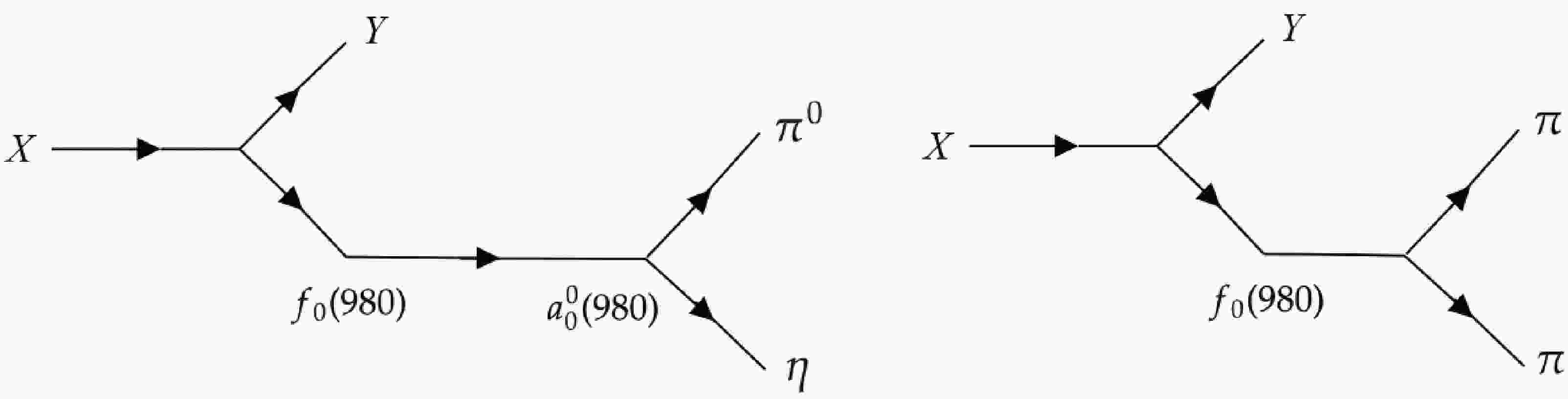
$ a_0^0(980)-f_0(980) $ mixing:$ X\to Y f_0(980) \to Y a_0^0(980) \to Y \pi^{0}\eta $ and$ X \to Y a_0^0(980) \to Y f_0(980) \to Y \pi\pi $ . These two processes correspond to two different types of mixing, namely$ f_0(980) \to a_0^0(980) $ and$ a_0^0(980) \to f_0(980) $ .As shown on the left of Fig. 1, in order to focus solely on the contribution from
$ f_0(980) \to a_0^0(980) $ , it is necessary to eliminate the influence caused by different X and Y particles, while adding the contribution shown on the right of Fig. 1. Based on the two Feynman diagrams, the mixing intensity$ \xi_{fa} $ for the transition$ f_0(980) \to a_0^0(980) $ can be defined as follows [39]: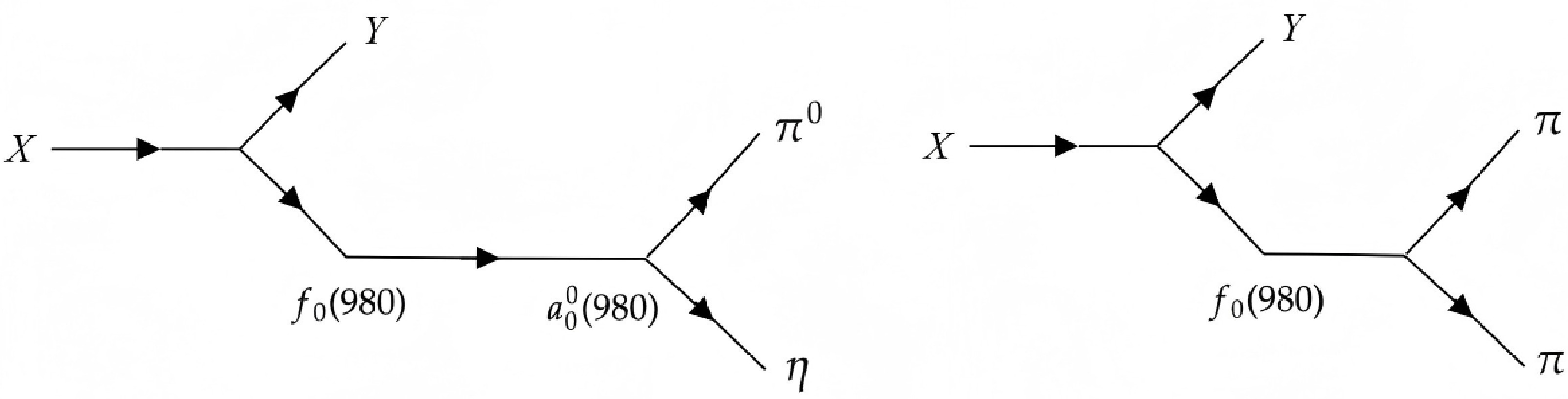
Figure 1. The Feynman diagram for
$ X\to Y f_0(980) \to Y a_0^0(980) \to Y \pi^{0}\eta $ (left) and$ X\to Y f_0(980) \to Y \pi\pi $ (right) is shown in [39].$ \begin{aligned}[b] \xi_{fa}(s)&=\frac{{\rm d} \Gamma_{X \to Y f_0(980) \to Y a_0^0(980) \to Y \pi^{0}\eta}(s)}{{\rm d}\Gamma_{X \to Y f_0(980) \to Y \pi\pi}(s)}\\ &=\frac{|D_{a_{0}f_{0}}|^{2}\Gamma^{a}_{\pi\eta}}{|D_{a_0}|^{2}\Gamma^{f}_{\pi\pi}} , \end{aligned} $
(6) where s is the invariant mass squared of the two mesons in the final state.
Similarly, for the reaction
$ X \to Y a_0^0(980) \to Y f_0(980) \to Y \pi\pi $ in Fig. 2, the mixing intensity$ \xi_{af} $ for the transition$ a_0^0(980) \to f_0(980) $ is defined as follows [39]: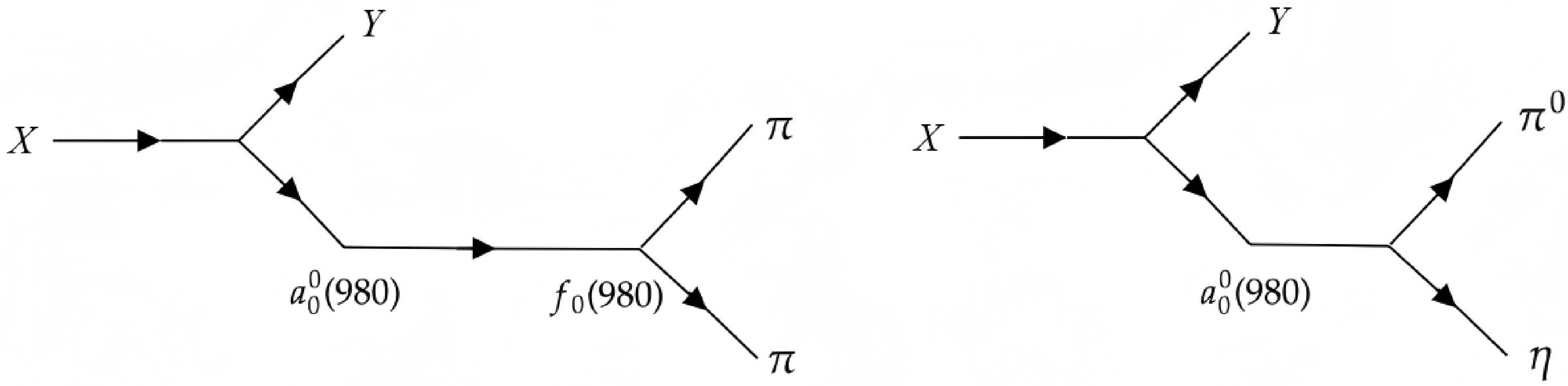
Figure 2. The Feynman diagram for
$ X \to Y a_0^0(980) \to Y f_0(980) \to Y \pi\pi $ (left) and$ X \to Y a_0^0(980) \to Y \pi^{0}\eta $ (right) is shown.$ \begin{aligned}[b] \xi_{af}(s)&=\frac{{\rm d} \Gamma_{X \to Y a_0^0(980) \to Y f_0(980) \to Y \pi\pi}(s)}{{\rm d}\Gamma_{X \to Y a_0^0(980) \to Y \pi^{0}\eta}(s)}\\ &=\frac{|D_{a_{0}f_{0}}|^{2}\Gamma^{f}_{\pi\pi}}{|D_{f_0}|^{2}\Gamma^{a}_{\pi\eta}} . \end{aligned} $
(7) However, the physical quantities that can be directly measured by experiments are the integrated mixing intensities, which are defined as [35]:
$ \overline \xi_{fa}=\int_{s'_{\text{min}}}^{s'_{\text{max}}} {\rm d}s \frac{\sqrt{s} |D_{a_{0}f_{0}}(s)|^2}{ |D_{f_0}(s) D_{a0}(s) |^2} \Gamma^a_{\pi\eta}(s) \bigg/ \int_{s_{\text{min}}}^{s_{\text{max}}} {\rm d}s \frac{\sqrt{s}}{ |D_{f_0}(s)|^2} \Gamma^f_{\pi\pi}(s), $
(8) and
$\overline \xi_{af}=\int_{s_{\text{min}}}^{s_{\text{max}}} {\rm d}s \frac{\sqrt{s} |D_{a_{0}f_{0}}(s)|^2}{ |D_{f_0}(s) D_{a_0}(s) |^2} \Gamma^f_{\pi\pi} (s) \bigg/ \int_{s'_{\text{min}}}^{s'_{\text{max}}} {\rm d}s \frac{\sqrt{s}}{ |D_{a_0}(s)|^2} \Gamma^a_{\pi\eta}(s), $
(9) where the terms
$ s^{(')}_{\text{min}} $ and$ s^{(')}_{\text{max}} $ denote the minimum and maximum values of the invariant mass cuts, respectively. -
Following the treatment of B decays in Refs. [9, 10], the total decay amplitude for the process
$ D^\pm \rightarrow f_0(980)[a_0^0(980)]\pi^\pm \rightarrow \pi^+\pi^-\pi^\pm $ , incorporating$ a_0^0(980) - f_0(980) $ mixing, can be expressed as:$ \begin{aligned}[b] \mathcal{M}(D^+\rightarrow \pi^+\pi^-\pi^+)=\;&\frac{g_{f_0\pi\pi}}{D_{f_0}}\mathcal{M}(D^+\rightarrow f_0\pi^+) \\&+\frac{g_{f_0\pi\pi}D_{a_{0}f_{0}}}{D_{a_0}D_{f_0}-D_{a_{0}f_{0}}^2}\mathcal{M}(D^+\rightarrow a_0^0\pi^+), \end{aligned}$
(10) where
$ g_{f_0\pi\pi} $ is the coupling constant, and$ \mathcal{M}(D^+\rightarrow f_0\pi^+) $ and$ \mathcal{M}(D^+\rightarrow a_0^0\pi^+) $ are the decay amplitudes of the processes$ D^+\to f_0(980)\pi^+ $ and$ D^+\to a_0(980)\pi^+ $ , respectively.For the two weak decays
$ D^+\to f_0(980)\pi^+ $ and$ D^+\to a_0(980)\pi^+ $ , the corresponding effective Hamiltonian can be expressed as [40, 41]:$ \begin{aligned}[b] H_{\Delta C=1}=\;&\frac{G_{\rm F}}{\sqrt{2}}\Bigg\{\left[\sum\limits_{q=d,s}V_{uq}V_{cq}^{\ast}\left(c_1 O^q_1 + c_2 O^q_2\right)\right]\\&-V_{ub}V_{cb}^{\ast}\sum\limits_{i=3}^{6} c_i O_i\Bigg\}+\text{h.c.}, \end{aligned} $
(11) where
$G_{\rm F}$ is the Fermi constant,$ V_{q_1q_2} $ ($ q_1 $ and$ q_2 $ represent quarks) are the CKM matrix elements,$ c_{i} $ ($ i=1,\cdots,6 $ ) are the Wilson coefficients, and the four-quark operators$ O_i $ are$ \begin{aligned}[b] O_{1}^{q}& = \bar{u}_{\alpha} \gamma_{\mu}(1-\gamma{_5})q_{\beta}\bar{q}_{\beta} \gamma^{\mu}(1-\gamma{_5}) c_{\alpha}\ , \\ O_{2}^{q}& = \bar{u} \gamma_{\mu}(1-\gamma{_5})q\bar{q} \gamma^{\mu}(1-\gamma{_5})c\ , \\ O_{3}& = \bar{u} \gamma_{\mu}(1-\gamma{_5})c \sum_{q\prime}\bar{q}^{\prime}\gamma^{\mu}(1-\gamma{_5}) q^{\prime}\ , \\ O_{4}& =\bar{u}_{\alpha} \gamma_{\mu}(1-\gamma{_5})c_{\beta} \sum_{q\prime}\bar{q}^{\prime}_{\beta}\gamma^{\mu}(1-\gamma{_5})q^{\prime}_{\alpha}\ , \\ O_{5}& =\bar{u} \gamma_{\mu}(1-\gamma{_5})c \sum_{q'}\bar{q}^ {\prime}\gamma^{\mu}(1+\gamma{_5})q^{\prime}\ , \\ O_{6}& = \bar{u}_{\alpha} \gamma_{\mu}(1-\gamma{_5})c_{\beta} \sum_{q'}\bar{q}^{\prime}_{\beta}\gamma^{\mu}(1+\gamma{_5})q^{\prime}_{\alpha}\ , \end{aligned} $
(12) with
$ O_{1-2}^{q} $ being tree operators,$ O_{3-6} $ being QCD penguin operators, α, β as color indices, and the sum over$ q' $ runs over all light flavor quarks.In our calculations, we often refer to the decay constants and form factors generally. The decay constants of the scalar meson S and the pseudoscalar meson P are defined as, respectively [42]
$ \begin{array}{l} \langle S(p)|\bar{q}_2\gamma_\mu q_1|0\rangle=\bar{f}_Sp_\mu, \; \; \; \; \; \langle P(p)|\bar{q}_2\gamma_\mu\gamma_5 q_1|0\rangle=-{\rm i}f_Pp_\mu. \end{array} $
(13) The form factors of
$ D \rightarrow S,P $ are defined by [43]:$ \begin{aligned}[b] \langle P(p')|\hat{V}_\mu|D(p)\rangle=\;&\bigg(p_\mu-\frac{m_D^2-m_P^2}{q^2}q_\mu\bigg) F_1^{DP}(q^2)\\&+\frac{m_D^2-m_P^2}{q^2}q_\mu F_0^{DP}(q^2),\\ \langle S(p')|\hat{A}_\mu|D(p)\rangle=\;&-{\rm i} \bigg[\bigg(P_\mu-\frac{m_D^2-m_S^2}{q^2}q_\mu\bigg)F_1^{DS}(q^2)\\&+\frac{m_D^2-m_S^2}{q^2}q_\mu F_0^{DS}(q^2)\bigg], \end{aligned} $
(14) where
$ P_\mu=(p+p')_\mu $ ,$ q_\mu=(p-p')_\mu $ ,$ \hat{V}_\mu $ , and$ \hat{A}_\mu $ are the weak vector and axial-vector currents, respectively.$ \hat{V}_\mu=\bar{q}_f\gamma_\mu c $ and$ \hat{A}_\mu=\bar{q}_f\gamma_\mu \gamma_5c $ , with$ q_f $ being the quarks generated from the decay of the c quark. As for the$ F(q^2) $ , we use the 3-parameter parametrization:$ F(q^2)=\frac{F(0)}{1-a(q^2/m_D^2)+b(q^2/m_D^2)^2}. $
(15) For
$ D \rightarrow SP $ decays, the relevant form factors adopted in this work are$ F_0^{DS}(q^2) $ and$ F_0^{DP}(q^2) $ .The factorization amplitudes for the
$ D \rightarrow SP $ decays are given by [42]:$ \begin{aligned}[b] X^{(DS,P)}&=\langle P(q)|(V-A)_\mu|0\rangle \langle S(p)|(V-A)^\mu|D(p_D)\rangle,\\ X^{(DP,S)}&=\langle S(q)|(V-A)_\mu|0\rangle \langle P(p)|(V-A)^\mu|D(p_D)\rangle. \end{aligned} $
(16) In the two-quark model with ideal mixing for
$ f_0(980) $ and$ \sigma(600) $ ,$ f_0(980) $ is characterized as a pure$ s\bar{s} $ state, while$ \sigma(600) $ is identified as an$ n\bar{n} $ state, where$ n\bar{n} \equiv (\bar{u}u + \bar{d}d)/\sqrt{2} $ . Nevertheless, experimental evidence suggests that$ f_0(980) $ does not consist solely of an$ s\bar{s} $ configuration. A notable example is the observation of$\Gamma(J/\psi \to f_0\omega) \approx \dfrac{1}{2}\Gamma(J/\psi \to f_0\phi)$ [44], which demonstrates unequivocally the presence of both non-strange and strange quark components within$ f_0(980) $ . Consequently, it is imperative that the isoscalar states$ \sigma(600) $ and$ f_0(980) $ exhibit a mixing phenomenon, like$ \begin{aligned}[b] |f_0(980)\rangle &= |s\bar{s}\rangle \cos \theta + |n\bar{n}\rangle \sin \theta,\\ |\sigma(600)\rangle &= -|s\bar{s}\rangle \sin \theta + |n\bar{n}\rangle \cos \theta, \end{aligned} $
(17) where θ is the mixing angle of the
$ f_0(980) $ and$ \sigma(600) $ .Within the naive factorization approach [45], the decay amplitudes of
$ D^+ \rightarrow f_0 \pi^+ $ and$ D^+ \rightarrow a_0^0 \pi^+ $ are$ \begin{aligned}[b]& \mathcal{M}(D^+\rightarrow f_0\pi^+)\\=\;&\frac{G_{\rm F}}{\sqrt{2}}\Bigg\{ V_{ud}V_{cd}^\ast\left(\frac{\alpha}{\sqrt{2}}a_1\bar{f}^d_{f_0}X^{D\pi}_{f_0}-a_2 Y^{Df_0}_{\pi}\right)\\&+V_{us}V_{cs}^\ast \beta a_1\bar{f}^s_{f_0}X^{D\pi}_{f_0}+V_{ub}V_{cb}^\ast\bigg[-a_3\Big(\frac{\alpha}{\sqrt{2}}\bar{f}^u_{f_0}X^{D\pi}_{f_0}\\&+\frac{\alpha}{\sqrt{2}}\bar{f}^d_{f_0}X^{D\pi}_{f_0}+\beta\bar{f}^s_{f_0}X^{D\pi}_{f_0}\Big)+a_4Y^{Df_0}_{\pi}\\ &-a_5\Big(\frac{\alpha}{\sqrt{2}}\bar{f}^u_{f_0}X^{D\pi}_{f_0}+\frac{\alpha}{\sqrt{2}}\bar{f}^d_{f_0}X^{D\pi}_{f_0}+\beta\bar{f}^s_{f_0}X^{D\pi}_{f_0}\Big)\\&-\frac{2m_\pi^2a_6}{(m_c+m_d)(m_u+m_d)}Y^{Df_0}_{\pi}\bigg]\Bigg\},\\ &\mathcal{M}(D^+\rightarrow a_0^0\pi^+)\\=\;&\frac{G_{\rm F}}{\sqrt{2}}\Bigg\{ V_{ud}V_{cd}^\ast\left(-\frac{1}{\sqrt{2}}a_1\bar{f}_{a_0}X^{D\pi}_{a_0}-a_2Y^{Da_0}_{\pi}\right)\\ &+V_{ub}V_{cb}^\ast\bigg[a_4Y^{Da_0}_{\pi}-\frac{2m_\pi^2a_6}{(m_c+m_d)(m_u+m_d)}Y^{Da_0}_{\pi}\bigg]\Bigg\}. \end{aligned} $
(18) Respectively,
$ (\alpha, \beta) = (\sin\theta, \cos\theta) $ ,$ f_\pi $ ,$ \bar{f}_{f_0} $ , and$ \bar{f}_{a_0} $ are the decay constants of the π,$ f_0(980) $ , and$ a_0^0(980) $ mesons, respectively.$ F_0^{D\pi} $ ,$ F_0^{Df_0} $ , and$ F_0^{Da_0} $ are the corresponding transition form factors, and$ a_i $ are built up from the Wilson coefficients$ c_i $ with the form$ a_i = c_i + c_{i\pm1}/N^{\text{eff}}_c $ . For compactness, we can use the form:$ X^{D\pi}_{f_0/a_0} = (m^2_D - m_\pi^2)F_0^{D\pi}(m_{f_0/a_0}^2) $ and$ Y^{Df_0/a_0}_{\pi} = f_\pi(m^2_D - m_{f_0/a_0}^2)F_0^{Df_0/a_0}(m_{\pi}^2) $ .For the
$\rm CP $ -conjugate process$ D^\pm \to \pi^+\pi^-\pi^\pm $ , the direct$\rm CP $ asymmetry can be expressed in the following form:$ \begin{array}{l} \begin{split} A_{\rm CP}=&\frac{\mid\mathcal{M}\mid^2-\mid\mathcal{\bar{M}}\mid^2}{\mid\mathcal{M}\mid^2+\mid\mathcal{\bar{M}}\mid^2}. \end{split} \end{array} $
(19) -
From Eqs. (6) to (9), we observe that
$ \xi_{fa/af} $ and$ \overline\xi_{fa/af} $ depend on$ g_{f_0\pi^0\pi^0} $ ,$ g_{f_0K^+K^-} $ ,$ g_{a_0\pi^0\eta} $ ,$ g_{a_0K^+K^-} $ ,$ m_{a_0} $ , and$ m_{f_0} $ . These parameters, compiled from a range of theoretical models and experimental analyses [46−57], are listed in Table 1. The resulting predictions for$ \xi_{fa} $ and$ \xi_{af} $ , evaluated at$ \sqrt{s}=991.3 $ MeV, along with the integrated quantities$ \overline\xi_{fa} $ and$ \overline\xi_{af} $ , are presented in Table 2 and are consistent with Refs. [35, 39]. The differential mixing intensity satisfies$ \xi_{fa}>\xi_{af} $ across different models, whereas the integrated quantities exhibit the opposite ordering,$ \overline{\xi}_{fa}<\overline{\xi}_{af} $ , making$ \overline{\xi}_{af} $ a more favorable observable for experimental measurement. For the decay$ D^\pm \rightarrow a_0^0(980)\pi^\pm \rightarrow f_0(980)\pi^\pm \rightarrow \pi^+\pi^-\pi^\pm $ , we focus on$ \overline{\xi}_{af} $ . The majority of theoretical predictions place$ \overline{\xi}_{af} $ in the percent range; models B and C and experiment E yield particularly large values. This also suggests that the$ a_0^0(980)-f_0(980) $ mixing mechanism may have a non-negligible impact on$\rm CP $ violation. The mesons$ f_0(980) $ and$ a_0^0(980) $ can be described within various theoretical frameworks, including conventional$ q\bar{q} $ states,$ qq\bar{q}\bar{q} $ multiquark configurations, meson-meson bound states, or even scalar glueballs. If these scalar mesons are interpreted as four-quark states, the decay process necessitates the production of an additional quark-antiquark pair compared to the two-quark scenario. Consequently, it is anticipated that the decay amplitude in the four-quark picture would be suppressed relative to that in the two-quark picture when a light scalar meson is involved. Meanwhile, a recent study on the dominance of the$ q\bar{q} $ configuration demonstrates that its underlying nature is the color transparency mechanism [58]. For this reason, we adopt the assumption that the$ q\bar{q} $ structure is dominant in our analysis.No. model/experiment $ m_{a_0} $ $ g_{a_{0}\pi\eta} $ $ g_{a_{0}K^{+}K^{-}} $ $ m_{f_0} $ $ g_{f_{0}\pi^{0}\pi^{0}} $ $ g_{f_{0}K^{+}K^{-}} $ A $ q\bar{q} $ model [46]983 2.03 1.27 975 0.64 1.80 B $ q^{2}\bar{q}^{2} $ model [46]983 4.57 5.37 975 1.90 5.37 C $ K\bar{K} $ model [47−49]980 1.74 2.74 980 0.65 2.74 D $ q\bar{q}g $ model [39]980 2.52 1.97 975 1.54 1.70 E SND [50, 51] 995 3.11 4.20 969.8 1.84 5.57 F KLOE [52, 57] 984.8 3.02 2.24 973 2.09 5.92 G BNL [53, 54] 1001 2.47 1.67 953.5 1.36 3.26 H CB [55, 56] 999 3.33 2.54 965 1.66 4.18 Table 1. Meson masses (in units of MeV) and coupling constants (in units of GeV) from various models are determined by experimental measurements.
No. $ \xi_{fa}({\text{%}}) $ $ \xi_{af}({\text{%}}) $ $ \overline \xi_{fa}(\%) $ $ \overline \xi_{af}({\text{%}}) $ This work Ref. [39] Ref. [35] This work Ref. [39] This work Ref. [35] This work A 2.24 2.30 2.20 0.94 1.00 0.04 0.90 2.19 B 6.57 6.80 6.50 5.99 6.20 0.88 1.80 10.26 C 20.47 21.00 20.10 14.85 15.00 7.77 11.10 27.21 D 0.52 0.50 ... 0.57 0.60 0.06 ... 1.08 E 8.61 8.80 8.50 8.60 8.90 1.68 2.60 14.32 F 3.24 3.40 3.20 2.39 2.50 0.57 0.80 4.30 G 1.83 1.90 1.80 1.35 1.40 0.21 0.50 2.55 H 2.61 2.70 2.60 2.17 2.30 0.40 0.70 3.97 Table 2. The mixing intensities
$ \xi_{fa}(s) $ and$ \xi_{af}(s) $ are evaluated at$ \sqrt{s}=991.3 $ MeV, which is at the center of the$ K^+K^- $ and$ K^0\bar{K}^0 $ thresholds. The integrated mixing intensities$ \bar{\xi}_{fa} $ and$ \bar{\xi}_{af} $ (in units of$ \% $ ) are evaluated using Eqs. (8) and (9), with the kinematics given in Eqs. (A1) and (A2).Substituting Eq. (18) into Eq. (10), one can obtain the total amplitude of the
$ D^\pm \rightarrow f_0(980)[a_0^0(980)]\pi^\pm \rightarrow \pi^+\pi^-\pi^\pm $ decay with the$ a_0^0(980)-f_0(980) $ mixing mechanism. Figure 3 shows the differential$\rm CP $ asymmetry as a function of$ \sqrt{s} $ for several values of the mixing angle θ. The asymmetry varies rapidly and changes sign in the vicinity of the$ f_0(980) $ resonance. For$ \theta=0^\circ $ ($ |f_0(980)\rangle = |s\bar{s}\rangle $ ),$ A_{CP} $ ranges from$ -4.40 \times 10^{-4} $ to$ 1.52 \times 10^{-4} $ ; for$ \theta=90^\circ $ ($|f_0(980)\rangle = |n\bar{n}\rangle = {1}/{\sqrt{2}}|u\bar{u} + d\bar{d}\rangle$ ), it is substantially reduced, ranging from$ -0.07 \times 10^{-4} $ to$ 0.22 \times 10^{-4} $ . In reality, the$ f_0(980) $ is a mixed state with$ n\bar{n} $ and$ s\bar{s} $ . Taking the central value provided in [59], we have examined several examples, which demonstrate that the range of$A_{\rm CP}$ is highly sensitive to the mixing angle when both$ n\bar{n} $ and$ s\bar{s} $ components are present. The ranges of$ A_{CP} $ corresponding to these central angles are summarized in Table 3. From these results, we can clearly see that the$ a_0^0(980)- f_0(980) $ mixing mechanism can relatively increase the$\rm CP $ violation, especially for$ \theta=25.1^\circ $ and$ \theta=27^\circ $ conditions, reaching$ 10^{-4} $ to$ 10^{-3} $ .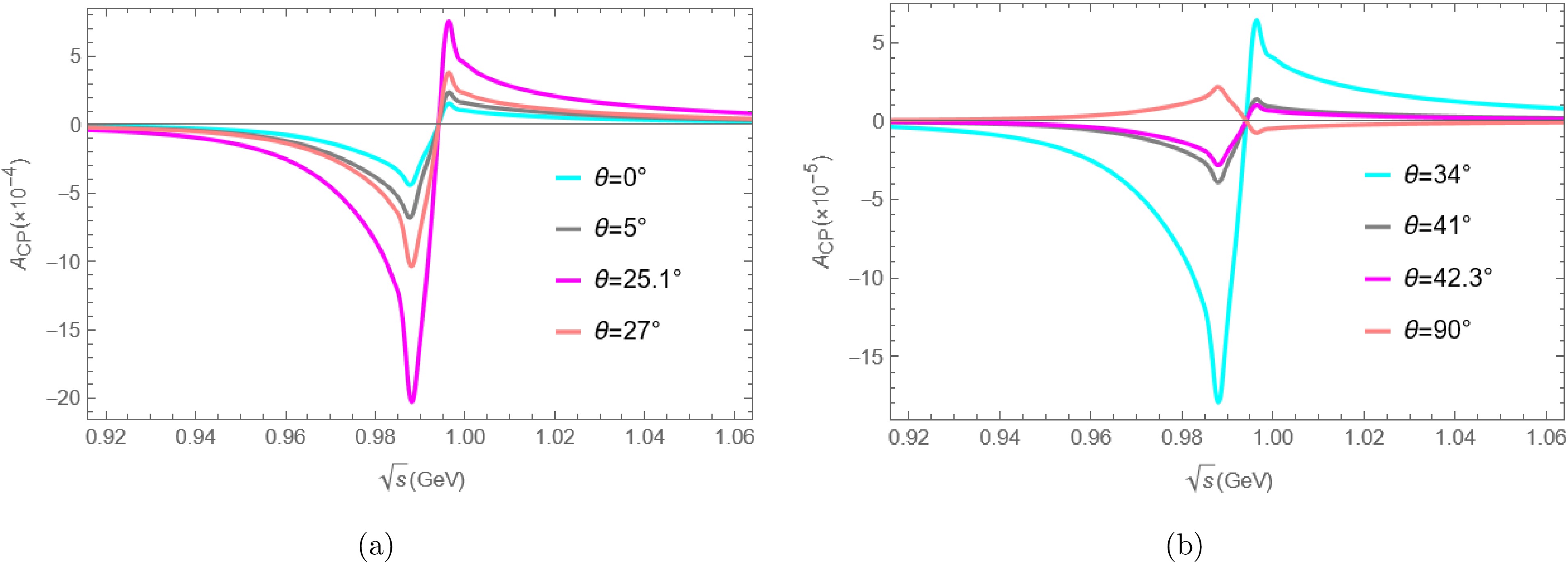
Figure 3. (color online) The differential
$\rm CP $ -violating asymmetry as a function of$ \sqrt{s} $ in the decay$ D^\pm \rightarrow f_0(980)[a_0^0(980)]\pi^\pm \rightarrow \pi^+\pi^-\pi^\pm $ .Experimental implications Mixing angle $ A_{CP} $ Reference pure $ s\bar{s} $ state$ \theta=0^{\circ} $ $ -4.40 \times 10^{-4} $ to$ 1.52 \times 10^{-4} $ ... $ \phi\to f_0\gamma,f_0\to\gamma\gamma $ $ \theta=5^{\circ} $ $ -6.78 \times 10^{-4} $ to$ 2.35 \times 10^{-4} $ [60] $ R=4.03\pm0.14 $ $ \theta=25.1^{\circ} $ $ -20.21 \times 10^{-4} $ to$ 7.55 \times 10^{-4} $ [57] QCD sum rules and $ f_0 $ data$ \theta=27^{\circ} $ $ -10.29 \times 10^{-4} $ to$ 3.76 \times 10^{-4} $ [61] $ J/\psi\to f_0\phi,f_0\omega $ $ \theta=34^{\circ} $ $ -1.79 \times 10^{-4} $ to$ 0.63 \times 10^{-4} $ [62] QCD sum rules and $ a_0 $ data$ \theta=41^{\circ} $ $ -0.39 \times 10^{-4} $ to$ 0.14 \times 10^{-4} $ [61] $ R=1.63\pm0.46 $ $ \theta=42.3^{\circ} $ $ -0.28 \times 10^{-4} $ to$ 0.10 \times 10^{-4} $ [63] pure $ n\bar{n} $ state$ \theta=90^{\circ} $ $ -0.07 \times 10^{-4} $ to$ 0.22 \times 10^{-4} $ ... Table 3. Ranges of the direct
$\rm CP $ asymmetry$A_{\rm CP}$ for different central mixing angles θ, where$ R\equiv g_{f_{0}K^{+}K^{-}}^{2}/g_{f_{0}\pi^{+}\pi^{-}}^{2} $ measures the ratio of the$ f_0(980) $ coupling to$ K^+K^- $ and$ \pi^+\pi^- $ .In the above analysis, we adopt a fixed number of colors
$ N^{\text{eff}}_c=3 $ for simplicity [42]. To improve the rigor and accuracy of the analysis, we extract the effective value of$ N^{\text{eff}}_c $ by fitting to the latest decay branching ratios [44]:$ \begin{array}{l} {\rm BR} (D^+\to f_0(980)\pi^+\to \pi^+\pi^-\pi^+)=(1.57\pm0.32)\times10^{-4}. \end{array} $
(20) Since the decay process
$ D^+ \to \pi^+\pi^-\pi^+ $ has a three-body final state, the branching fraction of this decay can be expressed as [44]$ {\rm BR}=\frac{\tau_D}{(2\pi)^516m_D^2}\int\mathrm{d}s \, |\mathbf{p}_1^*\|\mathbf{p}_3|\int\mathrm{d}\Omega_1^*\int\mathrm{d}\Omega_3|\mathcal{M}|^2, $
(21) where
$ \tau_D $ denotes the lifetime of the$ D^\pm $ meson,$ \Omega_{1}^{*} $ and$ \Omega_{3} $ are the solid angles for the final π in the$ \pi\pi $ rest frame and for the final π in the D meson rest frame, respectively, and$ |\mathbf{p}_{1}^{*}| $ and$ |\mathbf{p}_{3}| $ are the norms of the three-momenta of the final-state π in the$ \pi\pi $ rest frame and the π in the D rest frame, respectively, which take the following forms:$ |\mathbf{p}_1^*|=\frac{\sqrt{\lambda(s,m_\pi^2,m_\pi^2)}}{2\sqrt{s}}, \; \; |\mathbf{p}_3|=\frac{\sqrt{\lambda(m_D^2,m_\pi^2,s)}}{2m_D}, $
(22) where
$ \lambda(a,b,c) $ is the Källén function with the form$ \lambda(a,b,c)=a^2+b^2+c^2-2(ab+ac+bc) $ . It should be noted that$ \mathcal{M} $ in Eq. (21) refers to the amplitude of the three-body decay process$ D^+\to f_0(980)\pi^+\to \pi^+\pi^-\pi^+ $ without$ a_0^0(980) $ -$ f_0(980) $ mixing.In the fitting procedure, we use the central value
$ 1.57\times10^{-4} $ for$ \mathcal{B}(D^+\to f_0(980)\pi^+\to \pi^+\pi^-\pi^+) $ . Based on the fitted$ N^{\text{eff}}_c $ , the$\rm CP $ asymmetries for various mixing angles are obtained, which correct the theoretical deviations from the calculation with a fixed$ N^{\text{eff}}_c=3 $ . The corresponding results are presented in Table 4. It is shown that non-factorizable contributions have a considerable impact on the predicted$\rm CP $ asymmetries, which are suppressed after including these effects. With the improvement of experimental precision, constraining the range of the mixing angle can also help us further confirm the range of$\rm CP $ asymmetries.Experimental implications Mixing angle $ N^{\text{eff}}_c $ $A_{\rm CP}$ pure $ s\bar{s} $ state$ \theta=0^{\circ} $ 2.199 $ -19.94 \times 10^{-5} $ to$ 7.09 \times 10^{-5} $ $ \phi\to f_0\gamma,f_0\to\gamma\gamma $ $ \theta=5^{\circ} $ 2.216 $ -20.32 \times 10^{-5} $ to$ 7.22 \times 10^{-5} $ $ R=4.03\pm0.14 $ $ \theta=25.1^{\circ} $ 2.376 $ -19.27 \times 10^{-5} $ to$ 6.76 \times 10^{-5} $ QCD sum rules and $ f_0 $ data$ \theta=27^{\circ} $ 2.408 $ -18.72 \times 10^{-5} $ to$ 6.55 \times 10^{-5} $ $ J/\psi\to f_0\phi,f_0\omega $ $ \theta=34^{\circ} $ 2.602 $ -14.66 \times 10^{-5} $ to$ 5.07 \times 10^{-5} $ QCD sum rules and $ a_0 $ data$ \theta=41^{\circ} $ 3.172 $ -1.29\times 10^{-5} $ to$ 0.44 \times 10^{-5} $ $ R=1.63\pm0.46 $ $ \theta=42.3^{\circ} $ 3.424 $ -1.43 \times 10^{-5} $ to$ 4.22\times 10^{-5} $ pure $ n\bar{n} $ state$ \theta=90^{\circ} $ 1.771 $ -25.47 \times 10^{-5} $ to$ 9.66 \times 10^{-5} $ Table 4. The fitted values of
$ N^{\text{eff}}_c $ are based on the decay branching ratio and the recalculated$\rm CP $ asymmetries for different mixing angles. -
We have studied the direct
$\rm CP $ violation in$ D^\pm \to \pi^\pm \pi^+ \pi^- $ decay, incorporating the$ a_0^0(980)-f_0(980) $ mixing mechanism within the naive factorization approach. The integrated mixing intensity$ \bar{\xi}_{af} $ is found to be of the order of a percent for several input parameter sets, confirming that this isospin-breaking effect is phenomenologically significant. Applying the mechanism to the$\rm CP $ asymmetry calculation, we find that the differential$\rm CP $ violation is enhanced to$ \mathcal{O} $ ($ 10^{-4} $ –$ 10^{-3} $ ) depending on the$ f_0(980) $ and$ \sigma(600) $ mixing angle θ. Since different experimental and theoretical determinations of θ are not yet mutually consistent, we present results across the full range of reported central values rather than adopting a single value. After accounting for non-factorizable effects, the$\rm CP $ asymmetry is reduced but can still reach the order of$ 10^{-4} $ . The analysis demonstrates that the$ a_0^0(980)- f_0(980) $ mixing mechanism should be systematically considered in amplitude analyses of D or B meson three-body decays. -
We adopt the
$s^{(')}_{\min}$ and$s^{(')}_{\max}$ from Ref. [35]:$ s'_{\min}= [(991.3-4){\rm MeV}]^2,\;\;\; s'_{\max}= [(991.3+4){\rm MeV}]^2, $
(A1) and
$ s_{\min} = [900{\rm MeV}]^2, \;\;\; s_{\max} = [1000{\rm MeV}]^2. $
(A2) We use the Wolfenstein parameterization for the CKM matrix elements, which, up to the order of
$ \lambda^8 $ , can be expressed as [64]:$ \begin{aligned}[b] V_{ud}=\;&1-\frac{\lambda^2}{2}-\frac{\lambda^4}{8}-\frac{\lambda^6}{16}[1+8A^2(\rho^2+\eta^2)]\\&-\frac{\lambda^8}{128}[5-32A^2(\rho^2+\eta^2)],\\ V_{cd}=\;&-\lambda+\frac{\lambda^5}{2}A^2[1-2(\rho+{\rm i}\eta)]+\frac{\lambda^7}{2}A^2(\rho+{\rm i}\eta),\\ V_{us} =\;&\lambda - \frac{1}{2}A^2\lambda^7(\rho^2+\eta^2),\\ V_{cs} =\;&1-\frac{1}{2}\lambda^2-\frac{1}{8}\lambda^4(1+4A^2)\\&- \frac{1}{16}\lambda^6\left(1 - 4A^2 + 16A^2(\rho+{\rm i}\eta)\right)\\&-\frac{1}{128}\lambda^8\left(5-8A^2+16A^4\right), \\ V_{ub}=\;&\lambda^3A(\rho-{\rm i}\eta),\\ V_{cb}=\;&A\lambda^2-\frac{\lambda^8}{2}A^3(\rho^2+\eta^2), \end{aligned} $
(A3) with A, ρ, η, and λ being the Wolfenstein parameters, we use the results in Ref. [65]:
$ \begin{aligned}[b] &\lambda=0.22465\pm0.00039,\quad A=0.832\pm0.009,\\ &\bar{\rho}=0.139\pm0.016, \quad \bar{\eta}=0.346\pm0.010, \end{aligned} $
(A4) where
$ \bar{\rho}=\rho\left(1-\frac{\lambda^2}{2}\right), \quad \bar{\eta}=\eta\left(1-\frac{\lambda^2}{2}\right). $
(A5) The effective Wilson coefficients used in our calculations are taken from Ref. [6]
$ \begin{aligned}[b] &c_1=-0.6941,\quad c_2=1.3777,\quad c_3=0.0652,\\ &c_4=-0.0627,\quad c_5=0.0206,\quad c_6=-0.1355. \end{aligned} $
(A6) For the masses appearing in D decays, we use the following values [65, 59] (in units of
$ \mathrm{GeV} $ ):$ \begin{aligned}[b] &m_u=0.0035,\quad m_d=0.0063,\quad m_s=0.119, \quad m_c=1.3,\\ &m_{\eta}=0.5475,\;\; m_{\pi^\pm}=0.1396,\;\; m_{K^\pm}=0.4937,\;\; m_{K^0}=0.4977,\quad\\ &m_{D^\pm}=1.870,\quad m_{f_0(980)}=0.990,\quad m_{a_0^0(980)}=0.980. \end{aligned} $
(A7) For the widths, we use [65] (in units of GeV):
$ \Gamma_{f_0(980)}=0.074,\quad\Gamma_{a^0_0(980)}=0.092. $
(A8) As for the form factors, we use [66, 67]:
$ \begin{aligned}[b] F_0^{D\pi}(0)&=0.67, \; \text{with}\; a=0.50, b=0.01,\\ F_0^{Df_0}(0)&=0.45, \; \text{with}\; a=1.36, b=0.32,\\ F_0^{Da_0}(0)&=0.55, \; \text{with}\; a=1.06, b=0.16. \end{aligned} $
(A9) The following numerical values for the decay constants are used [42] (in units of
$ \mathrm{GeV} $ ):$ \begin{aligned}[b] f_{\pi^\pm}=0.131,\quad \bar{f}_{f_0(980)}^u= \bar{f}_{f_0(980)}^d=0.350\pm0.02,\\\bar{f}_{f_0(980)}^s=0.370\pm0.02, \quad\bar{f}_{a_0^0(980)}=0.365\pm0.02. \end{aligned} $
(A10)
Direct CP violation in ${ {\boldsymbol D}^{\bf\pm }\to {\boldsymbol\pi}^{\bf\pm} {\boldsymbol\pi}^{\bf +} {\boldsymbol\pi}^{\bf -}} $ with ${{\boldsymbol a}_{\bf 0}^{\bf 0}{\bf (980)-}{\boldsymbol f}_{\bf 0}{\bf (980)}} $ mixing
- Received Date: 2026-03-06
- Available Online: 2026-08-15
Abstract: We investigate the direct $\rm CP $ violation in the decay $ D^\pm \to \pi^\pm \pi^+ \pi^- $ incorporating the $ a_0^0(980) $-$ f_0(980) $ mixing mechanism. The integrated mixing intensities $ \overline \xi_{fa} $ and $ \overline \xi_{af} $ are calculated using meson masses and coupling constants extracted from various theoretical models and experimental data, yielding values of appreciable magnitude. We find that when the invariant mass of the $ \pi^+\pi^- $ pair lies near the $ f_0(980) $ resonance, this isospin-breaking mechanism can enhance the $\rm CP $ asymmetry. The enhancement is particularly pronounced when the $ f_0(980) $ carries a significant $ n\bar{n} $ quark component and the $ f_0(980) $ and $ \sigma(600) $ mixing angle is approximately $ 26^\circ $. After accounting for non-factorizable effects, we find these corrections tend to partially cancel the leading-order contributions, resulting in a suppression of the $\rm CP $ violations relative to the naive factorization predictions. It is emphasized that the $ a_0^0(980) $-$ f_0(980) $ mixing mechanism should be taken into account in both theoretical and experimental studies of $\rm CP $ violation in B or D meson decays.



 DownLoad: