


 Abstract
 HTML
HTML Reference
 Related
 PDF
PDF




-
The constituent quark model [1, 2], since its proposal by Gell-Mann and Zweig, has been remarkably successful in classifying hadrons and describing their spectroscopic properties. In the conventional picture, hadrons are categorized as mesons (
$ q\bar{q} $ ) and baryons ($ qqq $ or$ \bar{q}\bar{q}\bar{q} $ ). However, Quantum Chromodynamics (QCD), the fundamental theory of strong interactions, does not forbid the existence of more complex color-singlet structures. These states—collectively termed exotic hadrons—include glueballs, hybrids, and multiquark configurations (tetraquarks and pentaquarks) and have been the subject of intense theoretical and experimental interest for decades. The renaissance of hadron spectroscopy in the 21st century, driven by B-factories and the Large Hadron Collider (LHC), has provided compelling evidence for the existence of exotic hadrons. The observation of the$ X(3872) $ by the Belle Collaboration [3] marked the beginning of the$ XYZ $ era. Since then, numerous charmonium-like and bottomonium-like states, as well as multiquark states, have been reported [4−6]. Among these candidates, fully heavy tetraquark states, composed of four heavy quarks ($ Q\bar{Q}Q\bar{Q} $ , where$ Q = c, b $ ), are of particular importance. Unlike$ XYZ $ states that contain light quarks, the fully heavy system is free from light-meson exchange and chiral dynamics, offering a pristine environment to probe heavy-quark interactions in the nonperturbative regime of QCD.The search for fully charmed tetraquarks (
$ cc\bar{c}\bar{c} $ ) has primarily focused on the di-$ J/\psi $ invariant mass spectrum. In 2020, the LHCb Collaboration reported a breakthrough observation with 9 fb−1 of proton-proton collision data collected at center-of-mass energies$ \sqrt{s} = $ 7, 8, and 13 TeV [6]. A distinct, narrow structure, named$ X(6900) $ , was observed around$ 6.9 \; \text{GeV}/c^2 $ with a significance greater than$ 5\sigma $ . Following this discovery, the ATLAS and CMS collaborations confirmed the existence of$ X(6900) $ with data taken at$ \sqrt{s} = $ 13 TeV, and also reported a hint of, or evidence for, another structure near 7.2$ \text{GeV}/c^2 $ [7, 8]. The ATLAS paper [7] reports that the$ X(6400) $ (denoted as$ X_1 $ in our model) and the$ X(6600) $ (denoted as$ X_2 $ ) appear as broad enhancements near the di-$ J/\psi $ threshold, where nonresonant dynamics—such as coupled-channel effects [9], triangle singularities [10], or Pomeron exchange [11]—may contribute significantly. Consequently, these structures are not conclusively established as genuine resonances, and their interpretation as compact tetraquark states is less favored than that of the narrower$ X(6900) $ .While the existence of resonant structures in the di-
$ J/\psi $ mass spectrum is now well established, the interpretation of these states remains controversial [12−19]. The measured masses and widths of$ X(6900) $ vary among experiments, owing to differences in background modeling and possible interference effects [6−8]. Furthermore, the nature of the structures in the higher-mass region, specifically around$ 7.2 \; \text{GeV}/c^2 $ (hereafter referred to as$ X(7200) $ ), remains less well understood. Considerations of such states date back to 1976 [20, 21] and have recently attracted renewed interest [22−33]. However, non-tetraquark interpretations of this structure have also been proposed [11, 34, 35]. A recent CMS angular analysis [36] favors$ J^{PC} = 2^{++} $ , challenging molecular models (which typically expect$ 0^{++} $ ) while supporting compact tetraquark scenarios. -
The constituent quark model [1, 2], since its proposal by Gell-Mann and Zweig, has been remarkably successful in classifying hadrons and describing their spectroscopic properties. In the conventional picture, hadrons are categorized as mesons (
$ q\bar{q} $ ) and baryons ($ qqq $ or$ \bar{q}\bar{q}\bar{q} $ ). However, Quantum Chromodynamics (QCD), the fundamental theory of strong interactions, does not forbid the existence of more complex color-singlet structures. These states—collectively termed exotic hadrons—include glueballs, hybrids, and multiquark configurations (tetraquarks and pentaquarks) and have been the subject of intense theoretical and experimental interest for decades. The renaissance of hadron spectroscopy in the 21st century, driven by B-factories and the Large Hadron Collider (LHC), has provided compelling evidence for the existence of exotic hadrons. The observation of the$ X(3872) $ by the Belle Collaboration [3] marked the beginning of the$ XYZ $ era. Since then, numerous charmonium-like and bottomonium-like states, as well as multiquark states, have been reported [4−6]. Among these candidates, fully heavy tetraquark states, composed of four heavy quarks ($ Q\bar{Q}Q\bar{Q} $ , where$ Q = c, b $ ), are of particular importance. Unlike$ XYZ $ states that contain light quarks, the fully heavy system is free from light-meson exchange and chiral dynamics, offering a pristine environment to probe heavy-quark interactions in the nonperturbative regime of QCD.The search for fully charmed tetraquarks (
$ cc\bar{c}\bar{c} $ ) has primarily focused on the di-$ J/\psi $ invariant mass spectrum. In 2020, the LHCb Collaboration reported a breakthrough observation with 9 fb−1 of proton-proton collision data collected at center-of-mass energies$ \sqrt{s} = $ 7, 8, and 13 TeV [6]. A distinct, narrow structure, named$ X(6900) $ , was observed around$ 6.9 \; \text{GeV}/c^2 $ with a significance greater than$ 5\sigma $ . Following this discovery, the ATLAS and CMS collaborations confirmed the existence of$ X(6900) $ with data taken at$ \sqrt{s} = $ 13 TeV, and also reported a hint of, or evidence for, another structure near 7.2$ \text{GeV}/c^2 $ [7, 8]. The ATLAS paper [7] reports that the$ X(6400) $ (denoted as$ X_1 $ in our model) and the$ X(6600) $ (denoted as$ X_2 $ ) appear as broad enhancements near the di-$ J/\psi $ threshold, where nonresonant dynamics—such as coupled-channel effects [9], triangle singularities [10], or Pomeron exchange [11]—may contribute significantly. Consequently, these structures are not conclusively established as genuine resonances, and their interpretation as compact tetraquark states is less favored than that of the narrower$ X(6900) $ .While the existence of resonant structures in the di-
$ J/\psi $ mass spectrum is now well established, the interpretation of these states remains controversial [12−19]. The measured masses and widths of$ X(6900) $ vary among experiments, owing to differences in background modeling and possible interference effects [6−8]. Furthermore, the nature of the structures in the higher-mass region, specifically around$ 7.2 \; \text{GeV}/c^2 $ (hereafter referred to as$ X(7200) $ ), remains less well understood. Considerations of such states date back to 1976 [20, 21] and have recently attracted renewed interest [22−32]. However, non-tetraquark interpretations of this structure have also been proposed [11, 33, 34]. A recent CMS angular analysis [35] favors$ J^{PC} = 2^{++} $ , challenging molecular models (which typically expect$ 0^{++} $ ) while supporting compact tetraquark scenarios. -
The constituent quark model [1, 2], since its proposal by Gell-Mann and Zweig, has been remarkably successful in classifying hadrons and describing their spectroscopic properties. In the conventional picture, hadrons are categorized as mesons (
$ q\bar{q} $ ) and baryons ($ qqq $ or$ \bar{q}\bar{q}\bar{q} $ ). However, Quantum Chromodynamics (QCD), the fundamental theory of strong interactions, does not forbid the existence of more complex color-singlet structures. These states—collectively termed exotic hadrons—include glueballs, hybrids, and multiquark configurations (tetraquarks and pentaquarks) and have been the subject of intense theoretical and experimental interest for decades. The renaissance of hadron spectroscopy in the 21st century, driven by B-factories and the Large Hadron Collider (LHC), has provided compelling evidence for the existence of exotic hadrons. The observation of the$ X(3872) $ by the Belle Collaboration [3] marked the beginning of the$ XYZ $ era. Since then, numerous charmonium-like and bottomonium-like states, as well as multiquark states, have been reported [4−6]. Among these candidates, fully heavy tetraquark states, composed of four heavy quarks ($ Q\bar{Q}Q\bar{Q} $ , where$ Q = c, b $ ), are of particular importance. Unlike$ XYZ $ states that contain light quarks, the fully heavy system is free from light-meson exchange and chiral dynamics, offering a pristine environment to probe heavy-quark interactions in the nonperturbative regime of QCD.The search for fully charmed tetraquarks (
$ cc\bar{c}\bar{c} $ ) has primarily focused on the di-$ J/\psi $ invariant mass spectrum. In 2020, the LHCb Collaboration reported a breakthrough observation with 9 fb−1 of proton-proton collision data collected at center-of-mass energies$ \sqrt{s} = $ 7, 8, and 13 TeV [6]. A distinct, narrow structure, named$ X(6900) $ , was observed around$ 6.9 \; \text{GeV}/c^2 $ with a significance greater than$ 5\sigma $ . Following this discovery, the ATLAS and CMS collaborations confirmed the existence of$ X(6900) $ with data taken at$ \sqrt{s} = $ 13 TeV, and also reported a hint of, or evidence for, another structure near 7.2$ \text{GeV}/c^2 $ [7, 8]. The ATLAS paper [7] reports that the$ X(6400) $ (denoted as$ X_1 $ in our model) and the$ X(6600) $ (denoted as$ X_2 $ ) appear as broad enhancements near the di-$ J/\psi $ threshold, where nonresonant dynamics—such as coupled-channel effects [9], triangle singularities [10], or Pomeron exchange [11]—may contribute significantly. Consequently, these structures are not conclusively established as genuine resonances, and their interpretation as compact tetraquark states is less favored than that of the narrower$ X(6900) $ .While the existence of resonant structures in the di-
$ J/\psi $ mass spectrum is now well established, the interpretation of these states remains controversial [12−19]. The measured masses and widths of$ X(6900) $ vary among experiments, owing to differences in background modeling and possible interference effects [6−8]. Furthermore, the nature of the structures in the higher-mass region, specifically around$ 7.2 \; \text{GeV}/c^2 $ (hereafter referred to as$ X(7200) $ ), remains less well understood. Considerations of such states date back to 1976 [20, 21] and have recently attracted renewed interest [22−33]. However, non-tetraquark interpretations of this structure have also been proposed [11, 34, 35]. A recent CMS angular analysis [36] favors$ J^{PC} = 2^{++} $ , challenging molecular models (which typically expect$ 0^{++} $ ) while supporting compact tetraquark scenarios. -
The LHCb Collaboration analyzed the di-
$ J/\psi $ invariant-mass spectrum by describing the$ X(6900) $ with an independent Breit-Wigner (BW) resonance and modeling the background using two distinct approaches [6]:● A coherent fit modeling an interfering BW resonance with the non-resonant continuum yields
$ M = 6886 \pm 11\pm11 \; \text{MeV}/c^2 $ and$ \Gamma = 168 \pm 33\pm69 \; \text{MeV} $ .● An incoherent fit, treating wide peaks as isolated BW resonances superimposed on the background, yields
$ M = 6905 \pm 11 \pm 7 \; \text{MeV}/c^2 $ and$ \Gamma = 80 \pm 19 \pm 33 \; \text{MeV} $ .This dual strategy enabled systematic studies of the resonance parameters and of their model dependencies.
The ATLAS Collaboration analyzed
$ 140\; \mathrm{fb}^{-1} $ of$ 13\; \mathrm{TeV} $ $ pp $ collision data to study di-$ J/\psi $ production using two models [7]:● Signal Interference: The coherent sum of the BW amplitudes for
$ X(6400) $ ,$ X(6600) $ , and$ X(6900) $ :$ M = 6910\pm 10\pm10 \; \text{MeV}/c^2 $ ,$ \Gamma = 150\pm30\pm10 \; \text{MeV} $ .● Background Interference: The single parton scattering (SPS) background interferes with lower-mass resonances, whereas
$ X(6900) $ remains isolated:$ M = 6860\pm 30^{+10}_{-20} \; \text{MeV}/c^2 $ ,$ \Gamma = 110\pm50^{+20}_{-10} \; \text{MeV} $ .The observed
$ \sim 50\; \; \text{MeV}/c^2 $ mass shift and$ \sim 40 \; \text{MeV} $ width difference underscore the critical impact of interference modeling on resonance-parameter extraction.The CMS Collaboration analyzed
$ 135\; \mathrm{fb}^{-1} $ of$ pp $ collision data and studied the di-$ J/\psi $ spectrum using two distinct approaches [8]:● Noninterfering model: Three isolated BW resonances (
$ X(6600) $ ,$ X(6900) $ , and$ X(7200) $ ) plus a background term$ B(m) $ ● Interference Model: A coherent sum of the three resonances with relative phases.
The key findings demonstrate strong interference effects:
● The
$ X(6900) $ mass shifts from$ 6927 \pm 9\pm 4\; \; \text{MeV}/c^2 $ (no interference) to$ 6847^{+44 \, +48}_{-28 \, -20} \; \text{MeV}/c^2 $ (with interference).● The width increases from
$ 122^{+24}_{-21}\pm 18 \; \text{MeV} $ to$ 191^{+66 \, +25}_{-49 \, -17} \; \text{MeV} $ .● The
$ X(7200) $ parameters exhibit a similar model dependence.The
$ \sim80\; \; \text{MeV}/c^2 $ mass shift and the factor-of-1.6 change in width highlight the necessity of interference modeling in all-charm spectroscopy. -
The LHCb Collaboration analyzed the di-
$ J/\psi $ invariant-mass spectrum by describing the$ X(6900) $ with an independent Breit-Wigner (BW) resonance and modeling the background using two distinct approaches [6]:● A coherent fit modeling an interfering BW resonance with the non-resonant continuum yields
$ M = 6886 \pm 11\pm11 \; \text{MeV}/c^2 $ and$ \Gamma = 168 \pm 33\pm69 \; \text{MeV} $ .● An incoherent fit, treating wide peaks as isolated BW resonances superimposed on the background, yields
$ M = 6905 \pm 11 \pm 7 \; \text{MeV}/c^2 $ and$ \Gamma = 80 \pm 19 \pm 33 \; \text{MeV} $ .This dual strategy enabled systematic studies of the resonance parameters and of their model dependencies.
The ATLAS Collaboration analyzed
$ 140\; \mathrm{fb}^{-1} $ of$ 13\; \mathrm{TeV} $ $ pp $ collision data to study di-$ J/\psi $ production using two models [7]:● Signal Interference: The coherent sum of the BW amplitudes for
$ X(6400) $ ,$ X(6600) $ , and$ X(6900) $ :$ M = 6910\pm10\pm10 \; \text{MeV}/c^2 $ ,$ \Gamma = 150\pm30\pm10 \; \text{MeV} $ .● Background Interference: The single parton scattering (SPS) background interferes with lower-mass resonances, whereas
$ X(6900) $ remains isolated:$ M = 6860\pm30^{+10}_{-20} \; \text{MeV}/c^2 $ ,$ \Gamma = 110\pm50^{+20}_{-10} \; \text{MeV} $ .The observed
$ \sim 50\; \; \text{MeV}/c^2 $ mass shift and$ \sim 40 \; \text{MeV} $ width difference underscore the critical impact of interference modeling on resonance-parameter extraction.The CMS Collaboration analyzed
$ 135\; \mathrm{fb}^{-1} $ of$ pp $ collision data and studied the di-$ J/\psi $ spectrum using two distinct approaches [8]:● Noninterfering model: Three isolated BW resonances (
$ X(6600) $ ,$ X(6900) $ , and$ X(7200) $ ) plus a background term$ B(m) $ ● Interference Model: A coherent sum of the three resonances with relative phases.
The key findings demonstrate strong interference effects:
● The
$ X(6900) $ mass shifts from$ 6927 \pm 9\pm 4\; \; \text{MeV}/c^2 $ (no interference) to$ 6847^{+44 \, +48}_{-28 \, -20} \; \text{MeV}/c^2 $ (with interference).● The width increases from
$ 122^{+24}_{-21}\pm 18 \; \text{MeV} $ to$ 191^{+66 \, +25}_{-49 \, -17} \; \text{MeV} $ .● The
$ X(7200) $ parameters exhibit a similar model dependence.The
$ \sim80\; \; \text{MeV}/c^2 $ mass shift and the factor-of-1.6 change in width highlight the necessity of interference modeling in all-charm spectroscopy. -
The LHCb Collaboration analyzed the di-
$ J/\psi $ invariant-mass spectrum by describing the$ X(6900) $ with an independent Breit-Wigner (BW) resonance and modeling the background using two distinct approaches [6]:● A coherent fit modeling an interfering BW resonance with the non-resonant continuum yields
$ M = 6886 \pm 11\pm11 \; \text{MeV}/c^2 $ and$ \Gamma = 168 \pm 33\pm69 \; \text{MeV} $ .● An incoherent fit, treating wide peaks as isolated BW resonances superimposed on the background, yields
$ M = 6905 \pm 11 \pm 7 \; \text{MeV}/c^2 $ and$ \Gamma = 80 \pm 19 \pm 33 \; \text{MeV} $ .This dual strategy enabled systematic studies of the resonance parameters and of their model dependencies.
The ATLAS Collaboration analyzed
$ 140\; \mathrm{fb}^{-1} $ of$ 13\; \mathrm{TeV} $ $ pp $ collision data to study di-$ J/\psi $ production using two models [7]:● Signal Interference: The coherent sum of the BW amplitudes for
$ X(6400) $ ,$ X(6600) $ , and$ X(6900) $ :$ M = 6910\pm 10\pm10 \; \text{MeV}/c^2 $ ,$ \Gamma = 150\pm30\pm10 \; \text{MeV} $ .● Background Interference: The single parton scattering (SPS) background interferes with lower-mass resonances, whereas
$ X(6900) $ remains isolated:$ M = 6860\pm 30^{+10}_{-20} \; \text{MeV}/c^2 $ ,$ \Gamma = 110\pm50^{+20}_{-10} \; \text{MeV} $ .The observed
$ \sim 50\; \; \text{MeV}/c^2 $ mass shift and$ \sim 40 \; \text{MeV} $ width difference underscore the critical impact of interference modeling on resonance-parameter extraction.The CMS Collaboration analyzed
$ 135\; \mathrm{fb}^{-1} $ of$ pp $ collision data and studied the di-$ J/\psi $ spectrum using two distinct approaches [8]:● Noninterfering model: Three isolated BW resonances (
$ X(6600) $ ,$ X(6900) $ , and$ X(7200) $ ) plus a background term$ B(m) $ ● Interference Model: A coherent sum of the three resonances with relative phases.
The key findings demonstrate strong interference effects:
● The
$ X(6900) $ mass shifts from$ 6927 \pm 9\pm 4\; \; \text{MeV}/c^2 $ (no interference) to$ 6847^{+44 \, +48}_{-28 \, -20} \; \text{MeV}/c^2 $ (with interference).● The width increases from
$ 122^{+24}_{-21}\pm 18 \; \text{MeV} $ to$ 191^{+66 \, +25}_{-49 \, -17} \; \text{MeV} $ .● The
$ X(7200) $ parameters exhibit a similar model dependence.The
$ \sim80\; \; \text{MeV}/c^2 $ mass shift and the factor-of-1.6 change in width highlight the necessity of interference modeling in all-charm spectroscopy. -
We perform a simultaneous fit to the di-
$ J/\psi $ mass spectra from LHCb, ATLAS, and CMS. To probe the nature of the observed resonances—particularly the$ X(6900) $ and$ X(7200) $ states—we implement four distinct fit hypotheses. These models incorporate different treatments of the coherent sum of BW amplitudes, reflecting different assumptions about inter-resonance interference. The statistical significance of each state ($ X(6900) $ or$ X(7200) $ ) is determined by computing$ \Delta\chi^2 $ and$ \Delta {\rm{NDF}} $ , where$ \Delta\chi^2 $ is the difference in$ \chi^2 $ and$ \Delta {\rm{NDF}} $ is the change in degrees of freedom when including or excluding the resonance component in the fit. The fit function for each experiment combines signal components—modeled by S-wave relativistic BW amplitudes—with a nonresonant background. The background comprises two contributions: single-parton scattering (SPS) and double-parton scattering (DPS). The SPS component is modeled by an exponential function, denoted$ f_{\rm{SPS}} $ , while the DPS component,$ f_{\rm{DPS}} $ , is taken directly from the published results [6−8]. Consequently,$ f_{\rm{DPS}} $ already includes the phase-space factor and is fixed in our fit.The mass resolution is below 5
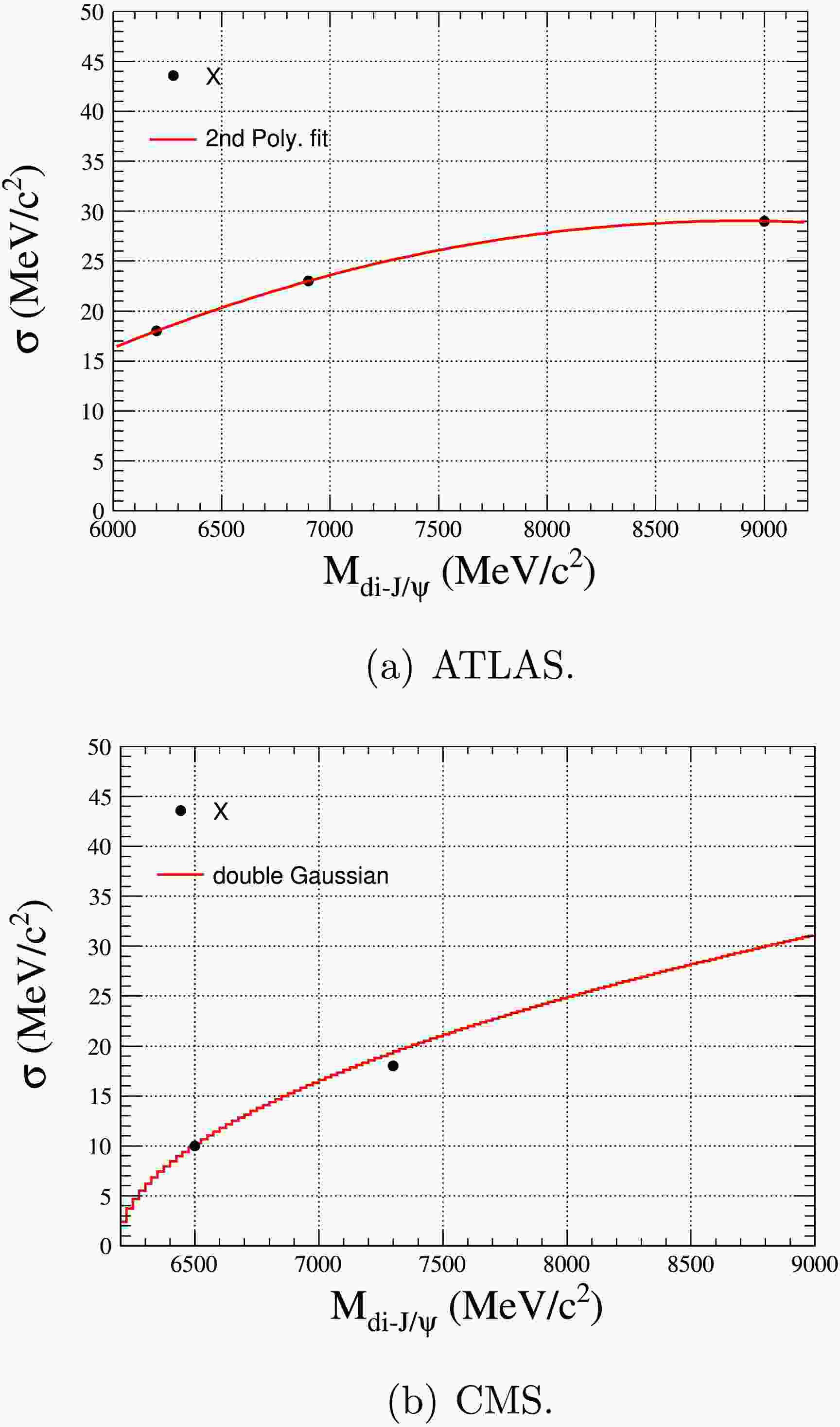
$ \text{MeV}/c^2 $ across the full mass range for LHCb [6], while it ranges from 18$ \text{MeV}/c^2 $ to 29$ \text{MeV}/c^2 $ (with an average of 23$ \text{MeV}/c^2 $ ) for ATLAS [7], and from approximately 10$ \text{MeV}/c^2 $ at 6500$ \text{MeV}/c^2 $ to 18$ \text{MeV}/c^2 $ at 7300$ \text{MeV}/c^2 $ for CMS [8]. Consequently, the mass-resolution effect is negligible for LHCb but significant for both ATLAS and CMS. The CMS resolution [37] is modeled by a double-Gaussian function, while the ATLAS resolution is derived from a second-order polynomial fit to the three available data points, as shown in Fig. 1. Mass-resolution effects are incorporated by convolving a Gaussian function,$ G(0;\sigma(m)) $ , with the signal component of the probability density function (PDF).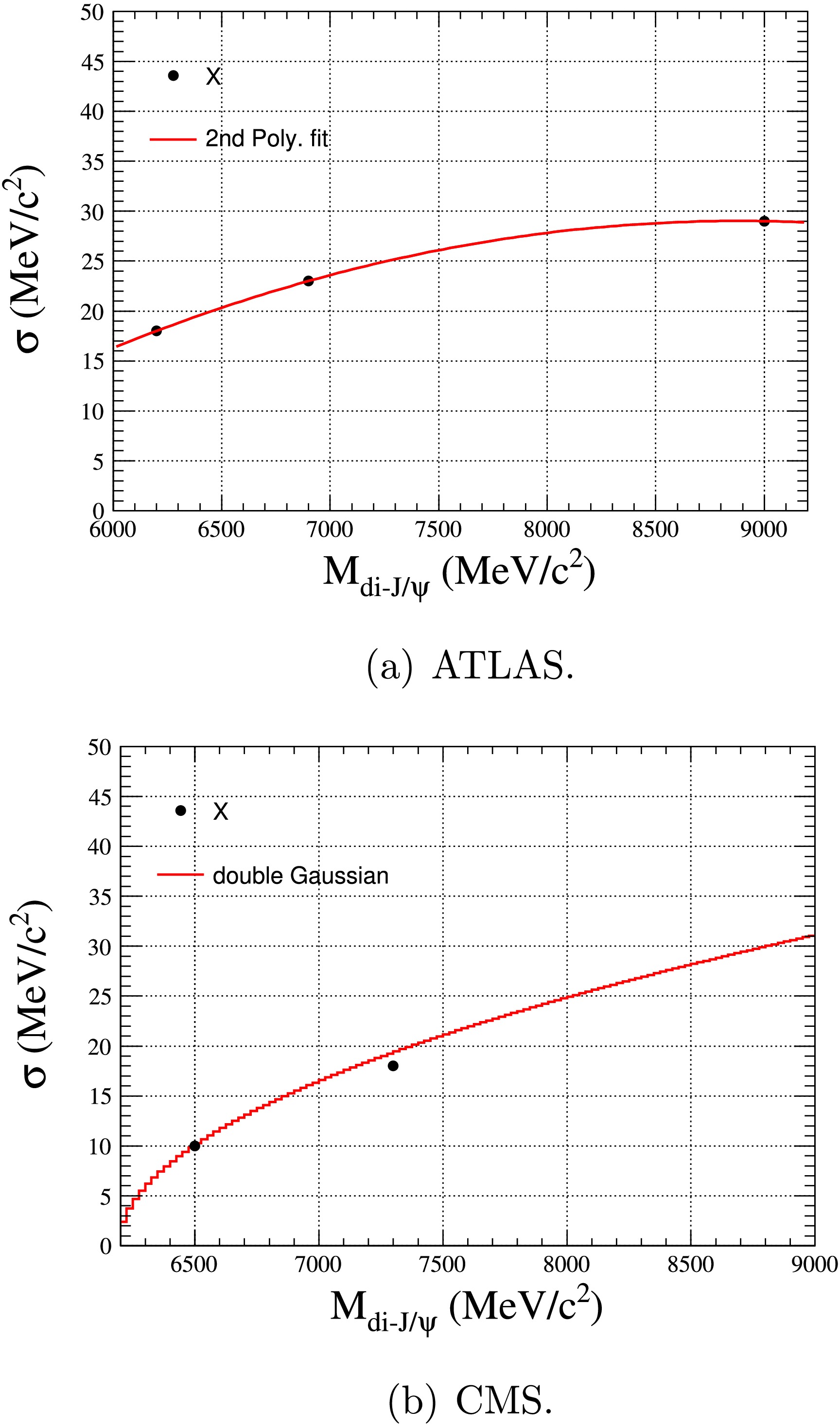
Figure 1. (color online) Mass resolutions for ATLAS and CMS.
-
We perform a simultaneous fit to the di-
$ J/\psi $ mass spectra from LHCb, ATLAS, and CMS. To probe the nature of the observed resonances—particularly the$ X(6900) $ and$ X(7200) $ states—we implement four distinct fit hypotheses. These models incorporate different treatments of the coherent sum of BW amplitudes, reflecting different assumptions about inter-resonance interference. The statistical significance of each state ($ X(6900) $ or$ X(7200) $ ) is determined by computing$ \Delta\chi^2 $ and$ \Delta {\rm{NDF}} $ , where$ \Delta\chi^2 $ is the difference in$ \chi^2 $ and$ \Delta {\rm{NDF}} $ is the change in degrees of freedom when including or excluding the resonance component in the fit. The fit function for each experiment combines signal components—modeled by S-wave relativistic BW amplitudes—with a nonresonant background. The background comprises two contributions: single-parton scattering (SPS) and double-parton scattering (DPS). The SPS component is modeled by an exponential function, denoted$ f_{\rm{SPS}} $ , while the DPS component,$ f_{\rm{DPS}} $ , is taken directly from the published results [6−8]. Consequently,$ f_{\rm{DPS}} $ already includes the phase-space factor and is fixed in our fit.The mass resolution is below 5
$ \text{MeV}/c^2 $ across the full mass range for LHCb [6], while it ranges from 18$ \text{MeV}/c^2 $ to 29$ \text{MeV}/c^2 $ (with an average of 23$ \text{MeV}/c^2 $ ) for ATLAS [7], and from approximately 10$ \text{MeV}/c^2 $ at 6500$ \text{MeV}/c^2 $ to 18$ \text{MeV}/c^2 $ at 7300$ \text{MeV}/c^2 $ for CMS [8]. Consequently, the mass-resolution effect is negligible for LHCb but significant for both ATLAS and CMS. The CMS resolution [36] is modeled by a double-Gaussian function, while the ATLAS resolution is derived from a second-order polynomial fit to the three available data points, as shown in Fig. 1. Mass-resolution effects are incorporated by convolving a Gaussian function,$ G(0;\sigma(m)) $ , with the signal component of the probability density function (PDF).
Figure 1. (color online) Mass resolutions for ATLAS and CMS.
-
We perform a simultaneous fit to the di-
$ J/\psi $ mass spectra from LHCb, ATLAS, and CMS. To probe the nature of the observed resonances—particularly the$ X(6900) $ and$ X(7200) $ states—we implement four distinct fit hypotheses. These models incorporate different treatments of the coherent sum of BW amplitudes, reflecting different assumptions about inter-resonance interference. The statistical significance of each state ($ X(6900) $ or$ X(7200) $ ) is determined by computing$ \Delta\chi^2 $ and$ \Delta {\rm{NDF}} $ , where$ \Delta\chi^2 $ is the difference in$ \chi^2 $ and$ \Delta {\rm{NDF}} $ is the change in degrees of freedom when including or excluding the resonance component in the fit. The fit function for each experiment combines signal components—modeled by S-wave relativistic BW amplitudes—with a nonresonant background. The background comprises two contributions: single-parton scattering (SPS) and double-parton scattering (DPS). The SPS component is modeled by an exponential function, denoted$ f_{\rm{SPS}} $ , while the DPS component,$ f_{\rm{DPS}} $ , is taken directly from the published results [6−8]. Consequently,$ f_{\rm{DPS}} $ already includes the phase-space factor and is fixed in our fit.The mass resolution is below 5
$ \text{MeV}/c^2 $ across the full mass range for LHCb [6], while it ranges from 18$ \text{MeV}/c^2 $ to 29$ \text{MeV}/c^2 $ (with an average of 23$ \text{MeV}/c^2 $ ) for ATLAS [7], and from approximately 10$ \text{MeV}/c^2 $ at 6500$ \text{MeV}/c^2 $ to 18$ \text{MeV}/c^2 $ at 7300$ \text{MeV}/c^2 $ for CMS [8]. Consequently, the mass-resolution effect is negligible for LHCb but significant for both ATLAS and CMS. The CMS resolution [37] is modeled by a double-Gaussian function, while the ATLAS resolution is derived from a second-order polynomial fit to the three available data points, as shown in Fig. 1. Mass-resolution effects are incorporated by convolving a Gaussian function,$ G(0;\sigma(m)) $ , with the signal component of the probability density function (PDF).
Figure 1. (color online) Mass resolutions for ATLAS and CMS.
-
This model serves as the noninterfering baseline. The total line shape is given by:
$\begin{aligned}[b] f_{I}(m) =\;& \left[\sum\limits_{j} c_j \left| \text{BW}_j(m; M_j, \Gamma_j) \right|^2\right]\\&\times \sqrt{1 - \frac{4M_{J/\psi}^2}{m^2}}\otimes G(0;\sigma(m))+B(m),\end{aligned} $
(1) where the index j runs over
$ X_1 $ ,$ X_2 $ ,$ X(6900) $ , and$ X(7200) $ ;$ c_j $ are free parameters that normalize each signal represented by a BW; and$ \sqrt{1 - \frac{4M_{J/\psi}^2}{m^2}} $ is the phase-space factor. The background$ B(m) $ accounts for contributions from SPS and DPS and is defined as$ B(m) = \sqrt{1 - \frac{4M_{J/\psi}^2}{m^2}} \cdot f_{\rm{SPS}}(m) + f_{\rm{DPS}}(m) $ . The fit result obtained under this hypothesis is shown in Fig. 2. The extracted resonance parameters of the$ X(6900) $ and$ X(7200) $ are summarized in Table 1.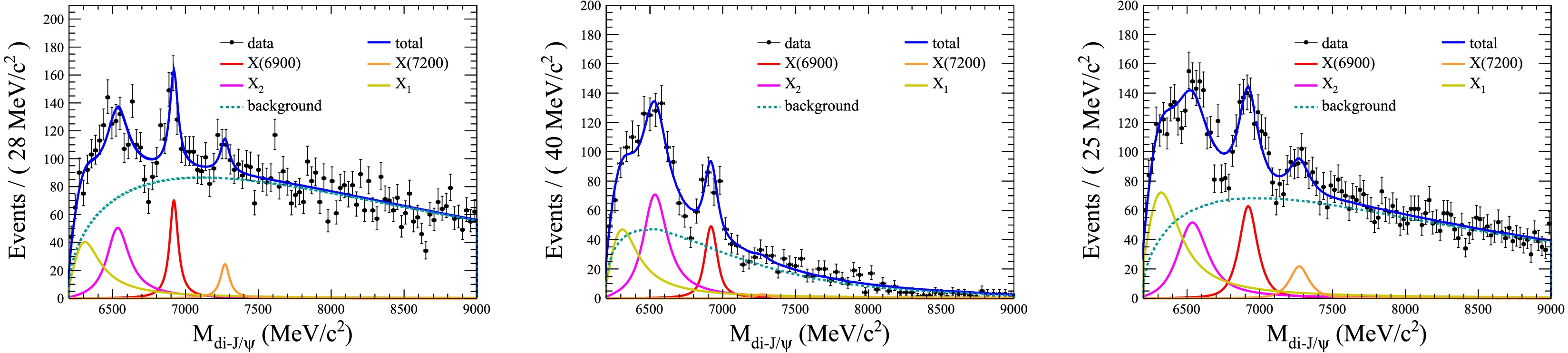
Figure 2. (color online) Fit results (Model I) for the di-
$ J/\psi $ invariant-mass distributions from LHCb (left), ATLAS (middle), and CMS (right). The blue solid curves show the best fits; the individual contributions from the resonant components (solid) and the background (dotted) are also displayed.Model I II III IV $ M_{X6900} $ ($ \text{MeV}/c^2 $ )$ 6919.27\pm2.90^{+3.5}_{-3.6} $ $ 6903.10\pm4.00^{+9.6}_{-8.9} $ $ 6911.61\pm7.60^{+7.3}_{-7.0} $ $ 6833.05\pm13.98^{+7.3}_{-7.0} $ $ \Gamma_{X6900} $ ($ \text{MeV} $ )$ 70.25\pm8.48^{+19.8}_{-18.4} $ $ 165.22\pm14.00^{+41.4}_{-36.8} $ $ 112.74\pm14.36^{+28.6}_{-26.5} $ $ 161.31\pm19.43^{+28.6}_{-26.5} $ Significance 12.5σ 15.6σ 13.1σ 14.1σ $ M_{X7200} $ ($ \text{MeV}/c^2 $ )$ 7269.97\pm9.97\pm5.0 $ $ 7263.69\pm8.59^{+41.8}_{-15.3} $ $ 7267.89\pm10.35^{+41.8}_{-15.3} $ $ 7140.79\pm23.94^{+41.0}_{-15.0} $ $ \Gamma_{X7200} $ ($ \text{MeV} $ )$ 76.94\pm25.50\pm15.4 $ $ 73.04\pm22.85^{+21.8}_{-19.6} $ $ 69.43\pm21.87^{+20.8}_{-18.6} $ $ 181.63\pm46.95^{+54.3}_{-48.7} $ Significance 4.1σ 6.5σ 3.7σ 6.6σ $ \chi^2 $ /NDF321.00/259 = 1.24 299.13/261 = 1.15 285.21/257 = 1.11 268.87/257 = 1.05 Table 1. Fitted resonance parameters for the
$ X(6900) $ and$ X(7200) $ structures are presented for four fit models. For each model, the mass (M), width (Γ), and statistical significance are reported. The$ \chi^2/\mathrm{NDF} $ values quantify the goodness of fit for each model. -
This model serves as the noninterfering baseline. The total line shape is given by:
$\begin{aligned}[b] f_{I}(m) =\;& \left[\sum\limits_{j} c_j \left| \text{BW}_j(m; M_j, \Gamma_j) \right|^2\right]\\&\times \sqrt{1 - \frac{4M_{J/\psi}^2}{m^2}}\otimes G(0;\sigma(m))+B(m),\end{aligned} $
(1) where the index j runs over
$ X_1 $ ,$ X_2 $ ,$ X(6900) $ , and$ X(7200) $ ;$ c_j $ are free parameters that normalize each signal represented by a BW; and$ \sqrt{1 - \frac{4M_{J/\psi}^2}{m^2}} $ is the phase-space factor. The background$ B(m) $ accounts for contributions from SPS and DPS and is defined as$ B(m) = \sqrt{1 - \frac{4M_{J/\psi}^2}{m^2}} \cdot f_{\rm{SPS}}(m) + f_{\rm{DPS}}(m) $ . The fit result obtained under this hypothesis is shown in Fig. 2. The extracted resonance parameters of the$ X(6900) $ and$ X(7200) $ are summarized in Table 1.
Figure 2. (color online) Fit results (Model I) for the di-
$ J/\psi $ invariant-mass distributions from LHCb (left), ATLAS (middle), and CMS (right). The blue solid curves show the best fits; the individual contributions from the resonant components (solid) and the background (dotted) are also displayed.Model I II III IV $ M_{X6900} $ ($ \text{MeV}/c^2 $ )$ 6919.27\pm2.90^{+3.5}_{-3.6} $ $ 6903.10\pm4.00^{+9.6}_{-8.9} $ $ 6911.61\pm7.60^{+7.3}_{-7.0} $ $ 6833.05\pm13.98^{+7.3}_{-7.0} $ $ \Gamma_{X6900} $ ($ \text{MeV} $ )$ 70.25\pm8.48^{+19.8}_{-18.4} $ $ 165.22\pm14.00^{+41.4}_{-36.8} $ $ 112.74\pm14.36^{+28.6}_{-26.5} $ $ 161.31\pm19.43^{+28.6}_{-26.5} $ Significance 12.5σ 15.6σ 13.1σ 14.1σ $ M_{X7200} $ ($ \text{MeV}/c^2 $ )$ 7269.97\pm9.97\pm5.0 $ $ 7263.69\pm8.59^{+41.8}_{-15.3} $ $ 7267.89\pm10.35^{+41.8}_{-15.3} $ $ 7140.79\pm23.94^{+41.0}_{-15.0} $ $ \Gamma_{X7200} $ ($ \text{MeV} $ )$ 76.94\pm25.50\pm15.4 $ $ 73.04\pm22.85^{+21.8}_{-19.6} $ $ 69.43\pm21.87^{+20.8}_{-18.6} $ $ 181.63\pm46.95^{+54.3}_{-48.7} $ Significance 4.1σ 6.5σ 3.7σ 6.6σ $ \chi^2 $ /NDF321.00/259 = 1.24 299.13/261 = 1.15 285.21/257 = 1.11 268.87/257 = 1.05 Table 1. Fitted resonance parameters for the
$ X(6900) $ and$ X(7200) $ structures are presented for four fit models. For each model, the mass (M), width (Γ), and statistical significance are reported. The$ \chi^2/\mathrm{NDF} $ values quantify the goodness of fit for each model. -
This model serves as the noninterfering baseline. The total line shape is given by:
$\begin{aligned}[b] f_{I}(m) =\;& \left[\sum\limits_{j} c_j \left| \text{BW}_j(m; M_j, \Gamma_j) \right|^2\right]\\&\times \sqrt{1 - \frac{4M_{J/\psi}^2}{m^2}}\otimes G(0;\sigma(m))+B(m),\end{aligned} $
(1) where the index j runs over
$ X_1 $ ,$ X_2 $ ,$ X(6900) $ , and$ X(7200) $ ;$ c_j $ are free parameters that normalize each signal represented by a BW; and$ \sqrt{1 - \frac{4M_{J/\psi}^2}{m^2}} $ is the phase-space factor. The background$ B(m) $ accounts for contributions from SPS and DPS and is defined as$ B(m) = \sqrt{1 - \frac{4M_{J/\psi}^2}{m^2}} \cdot f_{\rm{SPS}}(m) + f_{\rm{DPS}}(m) $ . The fit result obtained under this hypothesis is shown in Fig. 2. The extracted resonance parameters of the$ X(6900) $ and$ X(7200) $ are summarized in Table 1.
Figure 2. (color online) Fit results (Model I) for the di-
$ J/\psi $ invariant-mass distributions from LHCb (left), ATLAS (middle), and CMS (right). The blue solid curves show the best fits; the individual contributions from the resonant components (solid) and the background (dotted) are also displayed.Model I II III IV $ M_{X6900} $ ($ \text{MeV}/c^2 $ )$ 6919.27\pm2.90^{+3.5}_{-3.6} $ $ 6903.10\pm4.00^{+9.6}_{-8.9} $ $ 6911.61\pm7.60^{+7.3}_{-7.0} $ $ 6833.05\pm13.98^{+7.3}_{-7.0} $ $ \Gamma_{X6900} $ ($ \text{MeV} $ )$ 70.25\pm8.48^{+19.8}_{-18.4} $ $ 165.22\pm14.00^{+41.4}_{-36.8} $ $ 112.74\pm14.36^{+28.6}_{-26.5} $ $ 161.31\pm19.43^{+28.6}_{-26.5} $ Significance 12.5σ 15.6σ 13.1σ 14.1σ $ M_{X7200} $ ($ \text{MeV}/c^2 $ )$ 7269.97\pm9.97\pm5.0 $ $ 7263.69\pm8.59^{+41.8}_{-15.3} $ $ 7267.89\pm10.35^{+41.8}_{-15.3} $ $ 7140.79\pm23.94^{+41.0}_{-15.0} $ $ \Gamma_{X7200} $ ($ \text{MeV} $ )$ 76.94\pm25.50\pm15.4 $ $ 73.04\pm22.85^{+21.8}_{-19.6} $ $ 69.43\pm21.87^{+20.8}_{-18.6} $ $ 181.63\pm46.95^{+54.3}_{-48.7} $ Significance 4.1σ 6.5σ 3.7σ 6.6σ $ \chi^2 $ /NDF321.00/259 = 1.24 299.13/261 = 1.15 285.21/257 = 1.11 268.87/257 = 1.05 Table 1. Fitted resonance parameters for the
$ X(6900) $ and$ X(7200) $ structures are presented for four fit models. For each model, the mass (M), width (Γ), and statistical significance are reported. The$ \chi^2/\mathrm{NDF} $ values quantify the goodness of fit for each model. -
Following the LHCb Collaboration's treatment of interference, Model II couples the broad structure (described by an interfering BW) to the SPS background. By contrast, higher-mass states are modeled as isolated, noninterfering resonances:
$ \begin{aligned}[b] f_{II}(m) =\;& \Bigg[ \left| \sqrt{f_{\rm{SPS}}(m)} + c\cdot {\rm e}^{{\rm i}\phi} \text{BW}(m;M,\Gamma) \right|^2 \\ & + \left| \text{BW}_{X(6900)}(m) \right|^2 + \left| \text{BW}_{X(7200)}(m) \right|^2 \Bigg] \\ &\times \sqrt{1 - \frac{4M_{J/\psi}^2}{m^2}} \otimes G(0;\sigma(m)) + f_{\rm{DPS}}(m). \end{aligned} $
(2) This configuration tests the hypothesis that the
$ X(6900) $ and$ X(7200) $ are distinct, well-separated resonant states whose production phases are independent of the threshold enhancement. Figure 3 shows the fit results under this assumption, and Table 1 summarizes the extracted resonance parameters for both structures.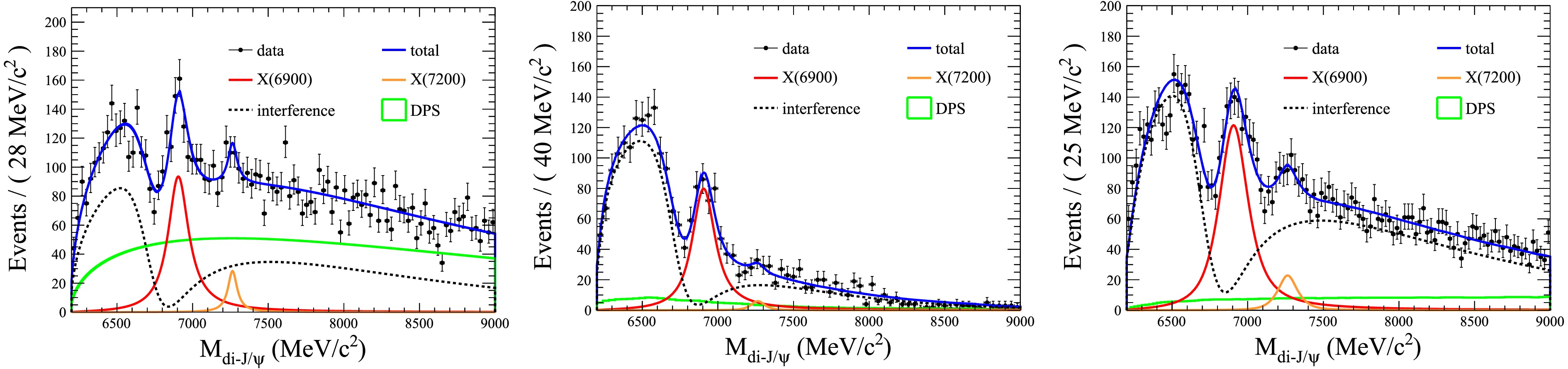
Figure 3. (color online) Fit results (Model II) for the di-
$ J/\psi $ invariant-mass distributions measured by LHCb (left), ATLAS (middle), and CMS (right). The solid blue curves represent the best fit, and the individual contributions of the resonant components and the background are also shown. -
Following the LHCb Collaboration's treatment of interference, Model II couples the broad structure (described by an interfering BW) to the SPS background. By contrast, higher-mass states are modeled as isolated, noninterfering resonances:
$ \begin{aligned}[b] f_{II}(m) =\;& \Bigg[ \left| \sqrt{f_{\rm{SPS}}(m)} + c\cdot {\rm e}^{{\rm i}\phi} \text{BW}(m;M,\Gamma) \right|^2 \\ & + \left| \text{BW}_{X(6900)}(m) \right|^2 + \left| \text{BW}_{X(7200)}(m) \right|^2 \Bigg] \\ &\times \sqrt{1 - \frac{4M_{J/\psi}^2}{m^2}} \otimes G(0;\sigma(m)) + f_{\rm{DPS}}(m). \end{aligned} $
(2) This configuration tests the hypothesis that the
$ X(6900) $ and$ X(7200) $ are distinct, well-separated resonant states whose production phases are independent of the threshold enhancement. Figure 3 shows the fit results under this assumption, and Table 1 summarizes the extracted resonance parameters for both structures.
Figure 3. (color online) Fit results (Model II) for the di-
$ J/\psi $ invariant-mass distributions measured by LHCb (left), ATLAS (middle), and CMS (right). The solid blue curves represent the best fit, and the individual contributions of the resonant components and the background are also shown. -
Following the LHCb Collaboration's treatment of interference, Model II couples the broad structure (described by an interfering BW) to the SPS background. By contrast, higher-mass states are modeled as isolated, noninterfering resonances:
$ \begin{aligned}[b] f_{II}(m) =\;& \Bigg[ \left| \sqrt{f_{\rm{SPS}}(m)} + c\cdot e^{i\phi} \text{BW}(m;M,\Gamma) \right|^2 \\ & + \left| \text{BW}_{X(6900)}(m) \right|^2 + \left| \text{BW}_{X(7200)}(m) \right|^2 \Bigg] \\ &\times \sqrt{1 - \frac{4M_{J/\psi}^2}{m^2}} \otimes G(0;\sigma(m)) + f_{\rm{DPS}}(m) \end{aligned} $
(2) This configuration tests the hypothesis that the
$ X(6900) $ and$ X(7200) $ are distinct, well-separated resonant states whose production phases are independent of the threshold enhancement. Figure 3 shows the fit results under this assumption, and Table 1 summarizes the extracted resonance parameters for both structures.
Figure 3. (color online) Fit results (Model II) for the di-
$ J/\psi $ invariant-mass distributions measured by LHCb (left), ATLAS (middle), and CMS (right). The solid blue curves represent the best fit, and the individual contributions of the resonant components and the background are also shown. -
Model III investigates the scenario in which the three lower-mass structures (
$ X_1 $ ,$ X_2 $ , and$ X(6900) $ ) share a common production mechanism (e.g., as$ J^{PC} = 0^{++} $ states). In this interpretation, spectral dips arise from destructive interference among these coherently coupled resonances, whereas$ X(7200) $ is treated as an incoherent component because its mass lies well above the threshold region, where nonresonant or multichannel effects are expected to dominate.$ \begin{aligned}[b] f_{III}(m) =\;& \left[\left| \sum\limits_{j} c_j e^{i\phi_j} \text{BW}_j(m; M_j, \Gamma_j) \right|^2 + \left| \text{BW}_{X(7200)} \right|^2\right]\\ &\times \sqrt{1 - \frac{4M_{J/\psi}^2}{m^2}}\otimes G(0;\sigma(m)) + B(m), \end{aligned} $
(3) where the index j runs over
$ X_1 $ ,$ X_2 $ , and$ X(6900) $ . The fit result obtained under this hypothesis is shown in Fig. 4. The extracted resonance parameters for$ X(6900) $ and$ X(7200) $ are summarized in Table 1.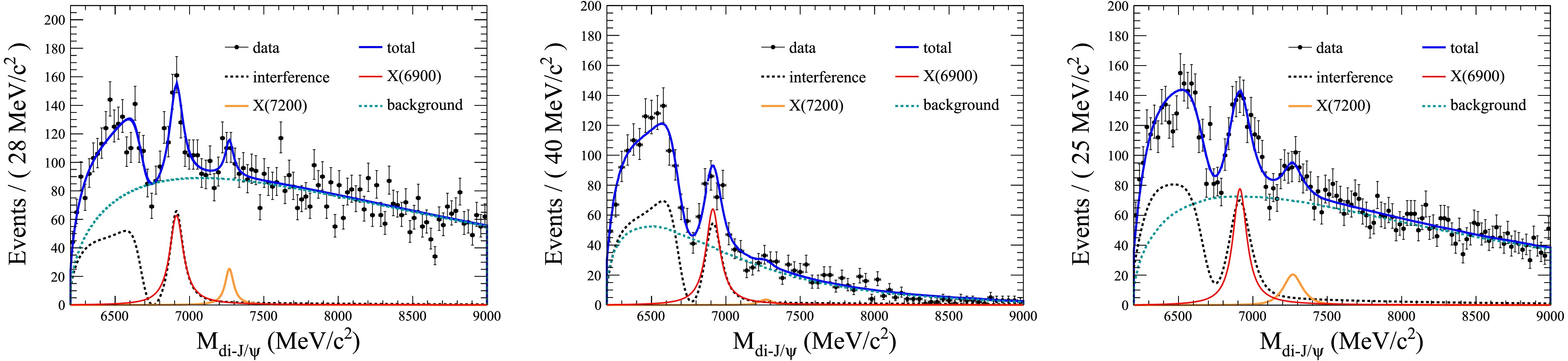
Figure 4. (color online) Fit results (Model III) for the di-
$ J/\psi $ invariant-mass distributions from LHCb (left), CMS (middle), and ATLAS (right). The blue solid curves denote the best fit; individual contributions from the resonant components and the background are also shown. -
Model III investigates the scenario in which the three lower-mass structures (
$ X_1 $ ,$ X_2 $ , and$ X(6900) $ ) share a common production mechanism (e.g., as$ J^{PC} = 0^{++} $ states). In this interpretation, spectral dips arise from destructive interference among these coherently coupled resonances, whereas$ X(7200) $ is treated as an incoherent component because its mass lies well above the threshold region, where nonresonant or multichannel effects are expected to dominate.$ \begin{aligned}[b] f_{III}(m) =\;& \left[\left| \sum\limits_{j} c_j {\rm e}^{{\rm i}\phi_j} \text{BW}_j(m; M_j, \Gamma_j) \right|^2 + \left| \text{BW}_{X(7200)} \right|^2\right]\\ &\times \sqrt{1 - \frac{4M_{J/\psi}^2}{m^2}}\otimes G(0;\sigma(m)) + B(m), \end{aligned} $
(3) where the index j runs over
$ X_1 $ ,$ X_2 $ , and$ X(6900) $ . The fit result obtained under this hypothesis is shown in Fig. 4. The extracted resonance parameters for$ X(6900) $ and$ X(7200) $ are summarized in Table 1.
Figure 4. (color online) Fit results (Model III) for the di-
$ J/\psi $ invariant-mass distributions from LHCb (left), CMS (middle), and ATLAS (right). The blue solid curves denote the best fit; individual contributions from the resonant components and the background are also shown. -
Model III investigates the scenario in which the three lower-mass structures (
$ X_1 $ ,$ X_2 $ , and$ X(6900) $ ) share a common production mechanism (e.g., as$ J^{PC} = 0^{++} $ states). In this interpretation, spectral dips arise from destructive interference among these coherently coupled resonances, whereas$ X(7200) $ is treated as an incoherent component because its mass lies well above the threshold region, where nonresonant or multichannel effects are expected to dominate.$ \begin{aligned}[b] f_{III}(m) =\;& \left[\left| \sum\limits_{j} c_j {\rm e}^{{\rm i}\phi_j} \text{BW}_j(m; M_j, \Gamma_j) \right|^2 + \left| \text{BW}_{X(7200)} \right|^2\right]\\ &\times \sqrt{1 - \frac{4M_{J/\psi}^2}{m^2}}\otimes G(0;\sigma(m)) + B(m), \end{aligned} $
(3) where the index j runs over
$ X_1 $ ,$ X_2 $ , and$ X(6900) $ . The fit result obtained under this hypothesis is shown in Fig. 4. The extracted resonance parameters for$ X(6900) $ and$ X(7200) $ are summarized in Table 1.
Figure 4. (color online) Fit results (Model III) for the di-
$ J/\psi $ invariant-mass distributions from LHCb (left), CMS (middle), and ATLAS (right). The blue solid curves denote the best fit; individual contributions from the resonant components and the background are also shown. -
Model IV is motivated by the three-resonance interference model employed by CMS [8]. In this scenario,
$ X_1 $ is interpreted not as a genuine resonance, but as a threshold enhancement arising from nonresonant dynamics—such as coupled-channel effects, triangle singularities, or Pomeron exchange—which are difficult to model precisely because of large theoretical uncertainties in this energy region. Consequently,$ X_1 $ is treated as an incoherent background component, while$ X_2 $ ,$ X(6900) $ , and$ X(7200) $ are allowed to interfere coherently as overlapping resonant states. This model tests whether$ X(7200) $ is dynamically coupled to the$ X(6900) $ structure.$ \begin{aligned}[b] f_{IV}(m) =\;& \left[\left| \text{BW}_{X_{1}} \right|^2 + \left| \sum\limits_{j} c_j\cdot e^{i\phi_j} \text{BW}_j(m; M_j, \Gamma_j )\right|^2 \right]\\ &\times \sqrt{1 - \frac{4M_{J/\psi}^2}{m^2}}\otimes G(0;\sigma(m)) + B(m), \end{aligned} $
(4) where j ranges over
$ X_2 $ ,$ X(6900) $ , and$ X(7200) $ . The fit result obtained under this hypothesis is shown in Fig. 5. The extracted resonance parameters for the$ X(6900) $ and$ X(7200) $ structures are summarized in Table 1.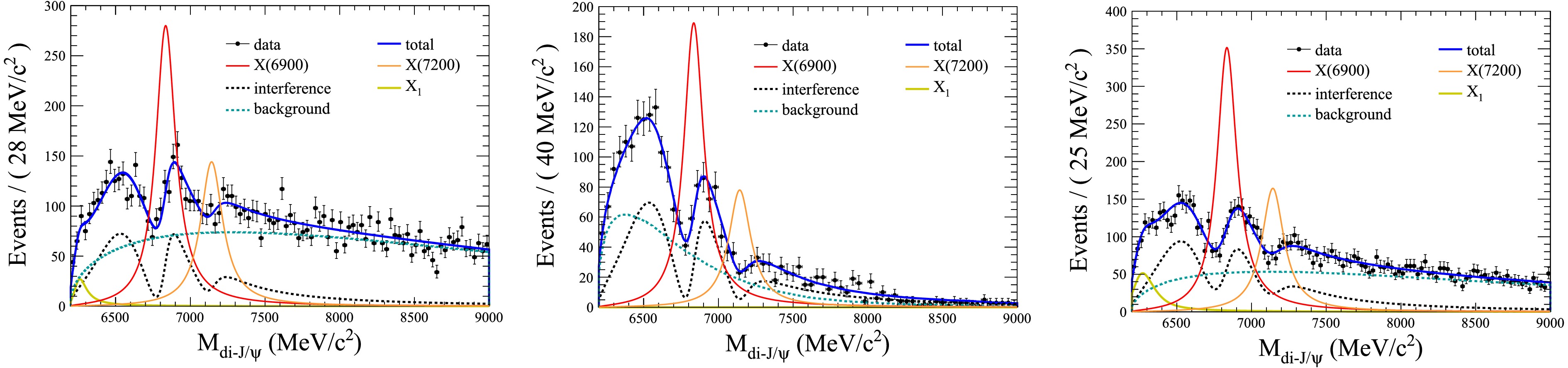
Figure 5. (color online) Fit results (Model IV) for the di-
$ J/\psi $ invariant-mass distributions measured by LHCb (left), ATLAS (middle), and CMS (right). The solid blue curves represent the best fit, and the individual contributions of the resonant components and the background are also shown.Table 1 summarizes the fitted resonance parameters of the
$ X(6900) $ and$ X(7200) $ structures obtained under the four fit hypotheses. We observe clear variations in the extracted parameters across the different models, indicating a strong sensitivity of the fit results to the treatment of interference effects. Additionally, we account for the systematic uncertainties reported by all three collaborations [6−8] using a weighted combination approach. We treat these uncertainties as mutually independent and combine them using inverse-variance weighting, with weights determined by the reported statistical uncertainties.$ \sigma_{\rm{comb}} = \sqrt{\sum\limits_i \left(w_i \sigma_{{\rm{sys}},i}\right)^2}, \quad w_i = \frac{1/\sigma_{{\rm{stat}},i}^2}{\sum\nolimits_j 1/\sigma_{{\rm{stat}},j}^2}, $
(5) where
$ \sigma_{{\rm{sys}},i} $ and$ \sigma_{{\rm{stat}},i} $ denote the systematic and statistical uncertainties for the$ i^{\rm{th}} $ experiment, respectively. -
Model IV is motivated by the three-resonance interference model employed by CMS [8]. In this scenario,
$ X_1 $ is interpreted not as a genuine resonance, but as a threshold enhancement arising from nonresonant dynamics—such as coupled-channel effects, triangle singularities, or Pomeron exchange—which are difficult to model precisely because of large theoretical uncertainties in this energy region. Consequently,$ X_1 $ is treated as an incoherent background component, while$ X_2 $ ,$ X(6900) $ , and$ X(7200) $ are allowed to interfere coherently as overlapping resonant states. This model tests whether$ X(7200) $ is dynamically coupled to the$ X(6900) $ structure.$ \begin{aligned}[b] f_{IV}(m) =\;& \left[\left| \text{BW}_{X_{1}} \right|^2 + \left| \sum\limits_{j} c_j\cdot {\rm e}^{{\rm i}\phi_j} \text{BW}_j(m; M_j, \Gamma_j )\right|^2 \right]\\ &\times \sqrt{1 - \frac{4M_{J/\psi}^2}{m^2}}\otimes G(0;\sigma(m)) + B(m), \end{aligned} $
(4) where j ranges over
$ X_2 $ ,$ X(6900) $ , and$ X(7200) $ . The fit result obtained under this hypothesis is shown in Fig. 5. The extracted resonance parameters for the$ X(6900) $ and$ X(7200) $ structures are summarized in Table 1.
Figure 5. (color online) Fit results (Model IV) for the di-
$ J/\psi $ invariant-mass distributions measured by LHCb (left), ATLAS (middle), and CMS (right). The solid blue curves represent the best fit, and the individual contributions of the resonant components and the background are also shown.Table 1 summarizes the fitted resonance parameters of the
$ X(6900) $ and$ X(7200) $ structures obtained under the four fit hypotheses. We observe clear variations in the extracted parameters across the different models, indicating a strong sensitivity of the fit results to the treatment of interference effects. Additionally, we account for the systematic uncertainties reported by all three collaborations [6−8] using a weighted combination approach. We treat these uncertainties as mutually independent and combine them using inverse-variance weighting, with weights determined by the reported statistical uncertainties.$ \sigma_{\rm{comb}} = \sqrt{\sum\limits_i \left(w_i \sigma_{{\rm{sys}},i}\right)^2}, \quad w_i = \frac{1/\sigma_{{\rm{stat}},i}^2}{\sum\nolimits_j 1/\sigma_{{\rm{stat}},j}^2}, $
(5) where
$ \sigma_{{\rm{sys}},i} $ and$ \sigma_{{\rm{stat}},i} $ denote the systematic and statistical uncertainties for the$ i^{\rm{th}} $ experiment, respectively. -
Model IV is motivated by the three-resonance interference model employed by CMS [8]. In this scenario,
$ X_1 $ is interpreted not as a genuine resonance, but as a threshold enhancement arising from nonresonant dynamics—such as coupled-channel effects, triangle singularities, or Pomeron exchange—which are difficult to model precisely because of large theoretical uncertainties in this energy region. Consequently,$ X_1 $ is treated as an incoherent background component, while$ X_2 $ ,$ X(6900) $ , and$ X(7200) $ are allowed to interfere coherently as overlapping resonant states. This model tests whether$ X(7200) $ is dynamically coupled to the$ X(6900) $ structure.$ \begin{aligned}[b] f_{IV}(m) =\;& \left[\left| \text{BW}_{X_{1}} \right|^2 + \left| \sum\limits_{j} c_j\cdot {\rm e}^{{\rm i}\phi_j} \text{BW}_j(m; M_j, \Gamma_j )\right|^2 \right]\\ &\times \sqrt{1 - \frac{4M_{J/\psi}^2}{m^2}}\otimes G(0;\sigma(m)) + B(m), \end{aligned} $
(4) where j ranges over
$ X_2 $ ,$ X(6900) $ , and$ X(7200) $ . The fit result obtained under this hypothesis is shown in Fig. 5. The extracted resonance parameters for the$ X(6900) $ and$ X(7200) $ structures are summarized in Table 1.
Figure 5. (color online) Fit results (Model IV) for the di-
$ J/\psi $ invariant-mass distributions measured by LHCb (left), ATLAS (middle), and CMS (right). The solid blue curves represent the best fit, and the individual contributions of the resonant components and the background are also shown.Table 1 summarizes the fitted resonance parameters of the
$ X(6900) $ and$ X(7200) $ structures obtained under the four fit hypotheses. We observe clear variations in the extracted parameters across the different models, indicating a strong sensitivity of the fit results to the treatment of interference effects. Additionally, we account for the systematic uncertainties reported by all three collaborations [6−8] using a weighted combination approach. We treat these uncertainties as mutually independent and combine them using inverse-variance weighting, with weights determined by the reported statistical uncertainties.$ \sigma_{\rm{comb}} = \sqrt{\sum\limits_i \left(w_i \sigma_{{\rm{sys}},i}\right)^2}, \quad w_i = \frac{1/\sigma_{{\rm{stat}},i}^2}{\sum\nolimits_j 1/\sigma_{{\rm{stat}},j}^2}, $
(5) where
$ \sigma_{{\rm{sys}},i} $ and$ \sigma_{{\rm{stat}},i} $ denote the systematic and statistical uncertainties for the$ i^{\rm{th}} $ experiment, respectively. -
For the
$ X(6900) $ state, the extracted mass ranges from$ 6833 $ to$ 6919\; \; \text{MeV}/c^2 $ across the four models, with Model IV yielding the lowest mass and a correspondingly larger width. This systematic shift indicates substantial interference effects in the$ X(6900) $ line shape. The signal significance exceeds$ 12\sigma $ in all model configurations, demonstrating the structure's robustness against varying theoretical assumptions.The
$ X(7200) $ structure displays greater model sensitivity, with both mass and width showing significant variations across different fit scenarios. Model IV produces the most pronounced deviations—a substantial downward mass shift accompanied by enlarged uncertainties. The signal significance varies from$ 3.7\sigma $ to$ 6.6\sigma $ , reflecting strong dependence on interference modeling. These observations necessitate a cautious interpretation of the physical origin of the$ X(7200) $ .All four models provide an acceptable description of the data, with
$ \chi^{2}/\mathrm{NDF} $ values close to unity. Among them, Model IV—which adopts the same three-resonance coherent interference scheme used by CMS [8]— yields the best fit (with a significance of$ 6.6\sigma $ ) and is considered the most physically representative. Moreover, the fitted relative phase between$ X(7200) $ and$ X(6900) $ in Model IV is$ \phi = -0.79 \pm 0.24 $ rad. This central value differs markedly from 0 or π, which would be expected if one of the structures were purely nonresonant or if the contributions were incoherent. Instead, the nontrivial phase is consistent with coherent interference between two overlapping resonant amplitudes, providing further support for interpreting both$ X(6900) $ and$ X(7200) $ as genuine resonant states. Crucially, the background level in Model IV is significantly reduced compared with Model III—by approximately 14% (LHCb), 19% (ATLAS), and 21% (CMS)—which directly enhances the signal-to-background ratio and thus the statistical significance.The best combined fit (Model IV) yields a mass of
$ 6833 \pm 16\,\mathrm{MeV}/c^2 $ for the$ X(6900) $ and$ 7141 \pm 48\,\mathrm{MeV}/c^2 $ for the$ X(7200) $ . These values are in good agreement with a range of theoretical approaches—including lattice QCD [38], QCD sum rules [31], and quark-model calculations [17, 19, 39]—which predict compact$ c\bar{c}c\bar{c} $ states in the$ 6.8 $ –$ 7.3\,\mathrm{GeV}/c^2 $ mass region. In particular, the mass of the$ X(6900) $ is consistent with expectations for a$ 1P $ -wave fully charmed tetraquark, while the$ X(7200) $ may correspond to a radially excited ($ 2S $ ) state, as suggested in Ref. [17]. Furthermore, our results support the quark-delocalization color-screening mechanism proposed in Ref. [15], which naturally accommodates multiple narrow tetraquark states in this energy region.In summary, while the fully incoherent model serves as a phenomenological baseline for the di-
$ J/\psi $ spectrum, our analysis establishes that coherent interference effects are essential for a physically accurate description. These effects induce significant shifts in resonance parameters—particularly for the$ X(6900) $ —and enable robust characterization of the$ X(7200) $ . The results highlight the critical role of interference modeling in resolving overlapping all-charm resonances, offering new insights into tetraquark dynamics at LHC energies. -
For the
$ X(6900) $ state, the extracted mass ranges from$ 6833 $ to$ 6919\; \; \text{MeV}/c^2 $ across the four models, with Model IV yielding the lowest mass and a correspondingly larger width. This systematic shift indicates substantial interference effects in the$ X(6900) $ line shape. The signal significance exceeds$ 12\sigma $ in all model configurations, demonstrating the structure's robustness against varying theoretical assumptions.The
$ X(7200) $ structure displays greater model sensitivity, with both mass and width showing significant variations across different fit scenarios. Model IV produces the most pronounced deviations—a substantial downward mass shift accompanied by enlarged uncertainties. The signal significance varies from$ 3.7\sigma $ to$ 6.6\sigma $ , reflecting strong dependence on interference modeling. These observations necessitate a cautious interpretation of the physical origin of the$ X(7200) $ .All four models provide an acceptable description of the data, with
$ \chi^{2}/\mathrm{NDF} $ values close to unity. Among them, Model IV—which adopts the same three-resonance coherent interference scheme used by CMS [8]— yields the best fit (with a significance of$ 6.6\sigma $ ) and is considered the most physically representative. Moreover, the fitted relative phase between$ X(7200) $ and$ X(6900) $ in Model IV is$ \phi = -0.79 \pm 0.24 $ rad. This central value differs markedly from 0 or π, which would be expected if one of the structures were purely nonresonant or if the contributions were incoherent. Instead, the nontrivial phase is consistent with coherent interference between two overlapping resonant amplitudes, providing further support for interpreting both$ X(6900) $ and$ X(7200) $ as genuine resonant states. Crucially, the background level in Model IV is significantly reduced compared with Model III—by approximately 14% (LHCb), 19% (ATLAS), and 21% (CMS)—which directly enhances the signal-to-background ratio and thus the statistical significance.The best combined fit (Model IV) yields a mass of
$ 6833 \pm 16\,\mathrm{MeV}/c^2 $ for the$ X(6900) $ and$ 7141 \pm 48\,\mathrm{MeV}/c^2 $ for the$ X(7200) $ . These values are in good agreement with a range of theoretical approaches—including lattice QCD [38], QCD sum rules [31], and quark-model calculations [17, 19, 39]—which predict compact$ c\bar{c}c\bar{c} $ states in the$ 6.8 $ –$ 7.3\,\mathrm{GeV}/c^2 $ mass region. In particular, the mass of the$ X(6900) $ is consistent with expectations for a$ 1P $ -wave fully charmed tetraquark, while the$ X(7200) $ may correspond to a radially excited ($ 2S $ ) state, as suggested in Ref. [17]. Furthermore, our results support the quark-delocalization color-screening mechanism proposed in Ref. [15], which naturally accommodates multiple narrow tetraquark states in this energy region.In summary, while the fully incoherent model serves as a phenomenological baseline for the di-
$ J/\psi $ spectrum, our analysis establishes that coherent interference effects are essential for a physically accurate description. These effects induce significant shifts in resonance parameters—particularly for the$ X(6900) $ —and enable robust characterization of the$ X(7200) $ . The results highlight the critical role of interference modeling in resolving overlapping all-charm resonances, offering new insights into tetraquark dynamics at LHC energies. -
For the
$ X(6900) $ state, the extracted mass ranges from$ 6833 $ to$ 6919\; \; \text{MeV}/c^2 $ across the four models, with Model IV yielding the lowest mass and a correspondingly larger width. This systematic shift indicates substantial interference effects in the$ X(6900) $ line shape. The signal significance exceeds$ 12\sigma $ in all model configurations, demonstrating the structure's robustness against varying theoretical assumptions.The
$ X(7200) $ structure displays greater model sensitivity, with both mass and width showing significant variations across different fit scenarios. Model IV produces the most pronounced deviations—a substantial downward mass shift accompanied by enlarged uncertainties. The signal significance varies from$ 3.7\sigma $ to$ 6.6\sigma $ , reflecting strong dependence on interference modeling. These observations necessitate a cautious interpretation of the physical origin of the$ X(7200) $ .All four models provide an acceptable description of the data, with
$ \chi^{2}/\mathrm{NDF} $ values close to unity. Among them, Model IV—which adopts the same three-resonance coherent interference scheme used by CMS [8]—yields the best fit (with a significance of$ 6.6\sigma $ ) and is considered the most physically representative. Moreover, the fitted relative phase between$ X(7200) $ and$ X(6900) $ in Model IV is$ \phi = -0.79 \pm 0.24 $ rad. This central value differs markedly from 0 or π, which would be expected if one of the structures were purely nonresonant or if the contributions were incoherent. Instead, the nontrivial phase is consistent with coherent interference between two overlapping resonant amplitudes, providing further support for interpreting both$ X(6900) $ and$ X(7200) $ as genuine resonant states. Crucially, the background level in Model IV is significantly reduced compared with Model III—by approximately 14% (LHCb), 19% (ATLAS), and 21% (CMS)—which directly enhances the signal-to-background ratio and thus the statistical significance.The best combined fit (Model IV) yields a mass of
$ 6833 \pm 16\,\mathrm{MeV}/c^2 $ for the$ X(6900) $ and$ 7141 \pm 48\,\mathrm{MeV}/c^2 $ for the$ X(7200) $ . These values are in good agreement with a range of theoretical approaches—including lattice QCD [37], QCD sum rules [31], and quark-model calculations [17, 19, 38]—which predict compact$ c\bar{c}c\bar{c} $ states in the$ 6.8 $ –$ 7.3\,\mathrm{GeV}/c^2 $ mass region. In particular, the mass of the$ X(6900) $ is consistent with expectations for a$ 1P $ -wave fully charmed tetraquark, while the$ X(7200) $ may correspond to a radially excited ($ 2S $ ) state, as suggested in Ref. [17]. Furthermore, our results support the quark-delocalization color-screening mechanism proposed in Ref. [15], which naturally accommodates multiple narrow tetraquark states in this energy region.In summary, while the fully incoherent model serves as a phenomenological baseline for the di-
$ J/\psi $ spectrum, our analysis establishes that coherent interference effects are essential for a physically accurate description. These effects induce significant shifts in resonance parameters—particularly for the$ X(6900) $ —and enable robust characterization of the$ X(7200) $ . The results highlight the critical role of interference modeling in resolving overlapping all-charm resonances, offering new insights into tetraquark dynamics at LHC energies.
Enhanced evidence of X(7200) and improved measurements of X(6900) parameters from a combined LHCb-ATLAS-CMS analysis
- Received Date: 2026-02-27
- Available Online: 2026-07-15
Abstract: We report stronger evidence for the $X(7200)$ state and markedly improved measurements of the $X(6900)$ resonance parameters based on a combined analysis of the di-$J/\psi$ mass spectrum using published data from LHCb, ATLAS, and CMS. Through simultaneous fits to the datasets from all three experiments, we observe the $X(6900)$ with overwhelming significance ($>12\sigma$) and determine its mass and width with improved precision. For the $X(7200)$, we find consistent signals across multiple interference models, with significances ranging from $3.7\sigma$ to $6.6\sigma$; in the best-fit model (the CMS three-resonance scheme), the significance reaches $6.6\sigma$, providing substantially stronger evidence for this state. Our results underscore the essential role of interference effects in fully charmed tetraquark spectroscopy and offer new constraints on their production mechanisms at the LHC.



 DownLoad: