


 Abstract
 HTML
HTML Reference
 Related
 PDF
PDF




-
In hadron physics, the study of hyperon resonances has attracted much attention as it can help to reveal the internal structure of hadrons and deepen the understanding of the non-perturbative properties of Quantum Chromodynamics in the low energy region [1]. In the strangeness
$ S=-1 $ sector, many theoretical studies have been conducted using various approaches, including the chiral unitary method [2−8], quark models [9−12], amplitude analyses [13−18], lattice QCD [19−23], and the effective Lagrangian framework [24−29]. These theoretical frameworks have successfully described many established Λ and Σ excited states and have predicted dynamically generated resonances arising from meson–baryon interactions. On the experimental side, antikaon– nucleon scattering has been proven to be a particularly valuable probe for investigating these hyperons, owing to its rich coupled-channel structure, such as$ \pi \Lambda $ ,$ \pi \Sigma $ , and$ \eta \Lambda $ channels [30−34].The
$ \Sigma(1660) $ state, listed in the Particle Data Group (PDG) with quantum numbers$ J^{P}=1/2^{+} $ and a three-star rating [35], has attracted significant interest in hadron physics. In Ref. [34], the differential cross sections and Λ polarization data for the reactions$ K^{-}n \to \pi^{-}\Lambda $ and$ K^{-}p \to \pi^{0}\Lambda $ were analyzed within the effective Lagrangian approach over the center-of-mass energy range of$ 1550-1676\ \mathrm{MeV} $ . It was concluded that the results clearly support the existence of$ \Sigma(1660) $ in these reactions. In Ref. [36], a convolutional neural network was employed to study the Σ hyperons using experimental data from the$ K^-p\to\pi^0\Lambda $ reaction, and the results supported the existence of the three-star$ \Sigma(1660) $ . Complementary support for the$ \Sigma(1660) $ resonance in the$ K_L p \to \pi^+ \Sigma^0 $ reaction was also provided in a recent work in Ref. [37]. However, in Ref. [12], the reactions$ K^-p\to\Sigma^0\pi^0 $ ,$ \Lambda\pi^0 $ , and$ \bar{K}^0n $ were studied at low energies using the chiral quark-model approach, and no clear evidence for$ \Sigma(1660) $ was found in the$ K^-p\to\Lambda\pi^0 $ reaction. Subsequently,$ \bar{K}N $ scattering was analyzed within the unitary multichannel model [13], and no evidence for the three-star state$ \Sigma(1660) $ was found. It is worth noting that, in Ref. [38], the Faddeev equations were solved within the coupled channel approach, and a peak at total energy$ \sqrt{s} = 1656 $ MeV was found in the$ \pi\pi\Sigma $ system, which was associated with$ \Sigma(1660) $ . Therefore, three-body decay channels, such as$ \pi\bar{K}N $ and$ \pi\pi\Sigma $ , might be important for establishing the existence and properties of$ \Sigma(1660) $ resonance.The total and differential cross sections of the reaction
$ K^{-}p \to \pi^{0}\pi^{0}\Sigma^{0} $ were measured with high statistics by the Crystal Ball Collaboration at incident kaon momenta from$ 514 $ to$ 750\ \mathrm{MeV}/c $ [39]. It was shown that this reaction is dominated by the$ \pi^0 \Lambda(1405) $ intermediate state. Thus, these experimental measurements offer an opportunity to study the existence and properties of$ \Sigma(1660) $ through the three-body decay mode of$ \Sigma(1660) \to \pi^0 \Lambda(1405) \to \pi^0 \pi^0 \Sigma^0 $ .In this work, we investigate the role of
$ \Sigma(1660) $ resonance in the$ K^{-}p \to \pi^{0}\pi^{0}\Sigma^{0} $ and$ K^- p \to \pi^0 \Lambda(1405) $ reactions near threshold, using the effective Lagrangian approach. These two reactions provide a relatively clean platform for studying isospin-1$ \Sigma^* $ resonances, as no isospin-0$ \Lambda^* $ resonances contribute to the$ K^- p \to \pi^0 \Lambda(1405) $ process, and the final state$ \pi^0 \pi^0\Sigma^0 $ carries isospin one. In our calculation, the s-channel is considered to include the mechanism$ \Sigma^0(1660) \to \pi^{0}\Lambda(1405) \to \pi^0\pi^{0}\Sigma^{0} $ , where we have introduced model parameters of coupling constants$ g_{\Sigma(1660)\bar{K}N} $ and$ g_{\Sigma(1660)\pi\Lambda(1405)} $ . Their values will be determined by fitting them to the total and differential cross sections of the$ K^- p \to \pi^0\pi^0\Sigma^0 $ reaction. For the u-channel, the non-resonant background contribution from nucleon pole exchange is considered. The total cross section for the$ K^-p\to\pi^0\Lambda(1405) $ process is also calculated to provide information on the complementary channel in the$ \Sigma(1660) $ resonance region.This paper is organized as follows. In Section II, the theoretical formalism for calculating the cross sections of the processes
$ K^-p \to \pi^0\pi^0\Sigma^0 $ and$ K^-p \to \pi^0\Lambda(1405) $ is presented. Numerical results and discussions are given in Section III. Finally, a short summary is given in the last section. -
In hadron physics, the study of hyperon resonances has attracted much attention as it can help to reveal the internal structure of hadrons and deepen the understanding of the non-perturbative properties of Quantum Chromodynamics in the low energy region [1]. In the strangeness
$ S=-1 $ sector, many theoretical studies have been conducted using various approaches, including the chiral unitary method [2−8], quark models [9−12], amplitude analyses [13−18], lattice QCD [19−23], and the effective Lagrangian framework [24−29]. These theoretical frameworks have successfully described many established Λ and Σ excited states and have predicted dynamically generated resonances arising from meson–baryon interactions. On the experimental side, antikaon– nucleon scattering has been proven to be a particularly valuable probe for investigating these hyperons, owing to its rich coupled-channel structure, such as$ \pi \Lambda $ ,$ \pi \Sigma $ , and$ \eta \Lambda $ channels [30−34].The
$ \Sigma(1660) $ state, listed in the Particle Data Group (PDG) with quantum numbers$ J^{P}=1/2^{+} $ and a three-star rating [35], has attracted significant interest in hadron physics. In Ref. [34], the differential cross sections and Λ polarization data for the reactions$ K^{-}n \to \pi^{-}\Lambda $ and$ K^{-}p \to \pi^{0}\Lambda $ were analyzed within the effective Lagrangian approach over the center-of-mass energy range of$ 1550-1676\ \mathrm{MeV} $ . It was concluded that the results clearly support the existence of$ \Sigma(1660) $ in these reactions. In Ref. [36], a convolutional neural network was employed to study the Σ hyperons using experimental data from the$ K^-p\to\pi^0\Lambda $ reaction, and the results supported the existence of the three-star$ \Sigma(1660) $ . Complementary support for the$ \Sigma(1660) $ resonance in the$ K_L p \to \pi^+ \Sigma^0 $ reaction was also provided in a recent work in Ref. [37]. However, in Ref. [12], the reactions$ K^-p\to\Sigma^0\pi^0 $ ,$ \Lambda\pi^0 $ , and$ \bar{K}^0n $ were studied at low energies using the chiral quark-model approach, and no clear evidence for$ \Sigma(1660) $ was found in the$ K^-p\to\Lambda\pi^0 $ reaction. Subsequently,$ \bar{K}N $ scattering was analyzed within the unitary multichannel model [13], and no evidence for the three-star state$ \Sigma(1660) $ was found. It is worth noting that, in Ref. [38], the Faddeev equations were solved within the coupled channel approach, and a peak at total energy$ \sqrt{s} = 1656 $ MeV was found in the$ \pi\pi\Sigma $ system, which was associated with$ \Sigma(1660) $ . Therefore, three-body decay channels, such as$ \pi\bar{K}N $ and$ \pi\pi\Sigma $ , might be important for establishing the existence and properties of$ \Sigma(1660) $ resonance.The total and differential cross sections of the reaction
$ K^{-}p \to \pi^{0}\pi^{0}\Sigma^{0} $ were measured with high statistics by the Crystal Ball Collaboration at incident kaon momenta from$ 514 $ to$ 750\ \mathrm{MeV}/c $ [39]. It was shown that this reaction is dominated by the$ \pi^0 \Lambda(1405) $ intermediate state. Thus, these experimental measurements offer an opportunity to study the existence and properties of$ \Sigma(1660) $ through the three-body decay mode of$ \Sigma(1660) \to \pi^0 \Lambda(1405) \to \pi^0 \pi^0 \Sigma^0 $ .In this work, we investigate the role of
$ \Sigma(1660) $ resonance in the$ K^{-}p \to \pi^{0}\pi^{0}\Sigma^{0} $ and$ K^- p \to \pi^0 \Lambda(1405) $ reactions near threshold, using the effective Lagrangian approach. These two reactions provide a relatively clean platform for studying isospin-1$ \Sigma^* $ resonances, as no isospin-0$ \Lambda^* $ resonances contribute to the$ K^- p \to \pi^0 \Lambda(1405) $ process, and the final state$ \pi^0 \pi^0\Sigma^0 $ carries isospin one. In our calculation, the s-channel is considered to include the mechanism$ \Sigma^0(1660) \to \pi^{0}\Lambda(1405) \to \pi^0\pi^{0}\Sigma^{0} $ , where we have introduced model parameters of coupling constants$ g_{\Sigma(1660)\bar{K}N} $ and$ g_{\Sigma(1660)\pi\Lambda(1405)} $ . Their values will be determined by fitting them to the total and differential cross sections of the$ K^- p \to \pi^0\pi^0\Sigma^0 $ reaction. For the u-channel, the non-resonant background contribution from nucleon pole exchange is considered. The total cross section for the$ K^-p\to\pi^0\Lambda(1405) $ process is also calculated to provide information on the complementary channel in the$ \Sigma(1660) $ resonance region.This paper is organized as follows. In Section II, the theoretical formalism for calculating the cross sections of the processes
$ K^-p \to \pi^0\pi^0\Sigma^0 $ and$ K^-p \to \pi^0\Lambda(1405) $ is presented. Numerical results and discussions are given in Section III. Finally, a short summary is given in the last section. -
In this section, we show the theoretical formalism for studying
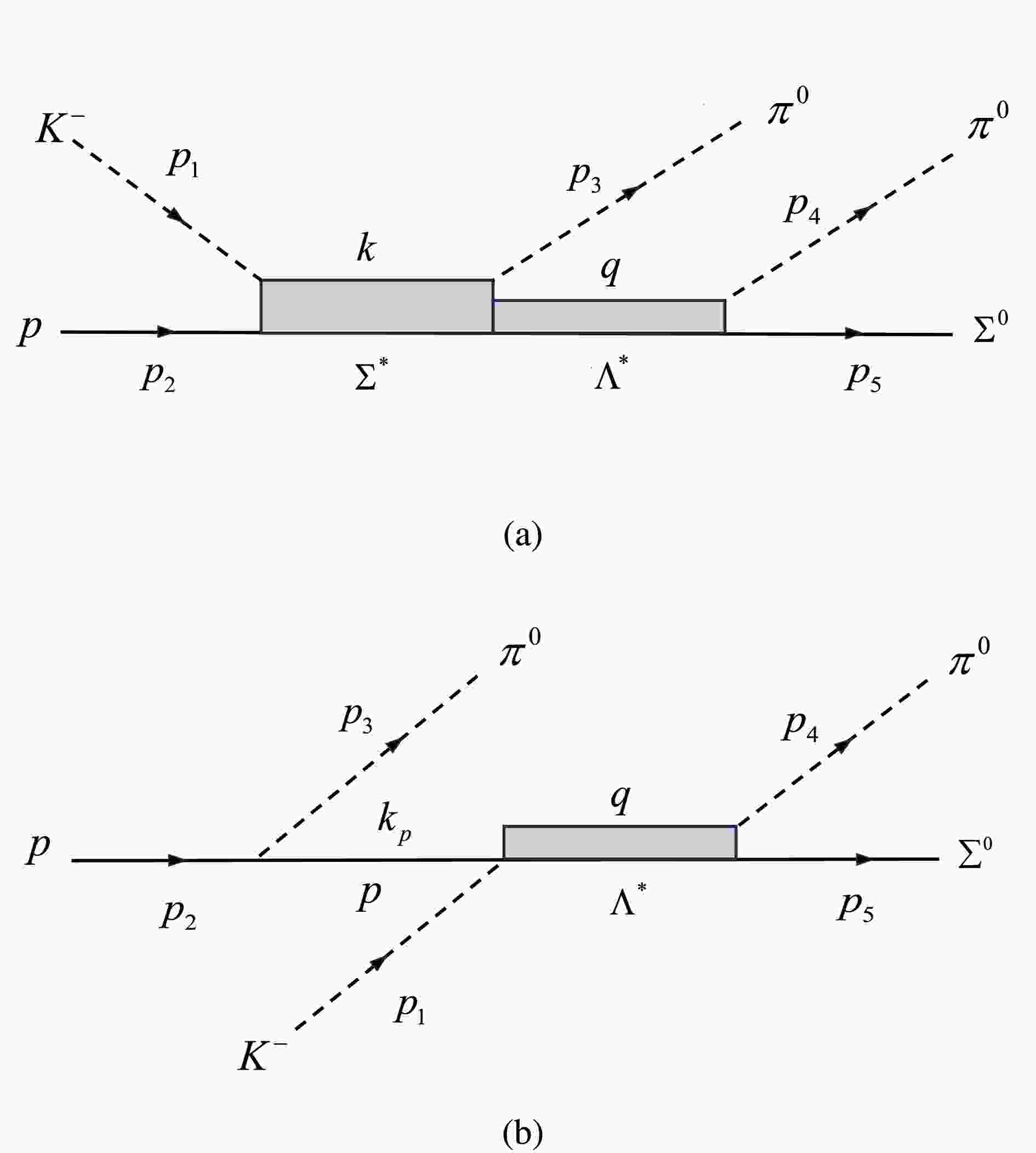
$ K^-p \to \pi^0\pi^0\Sigma^0 $ within the framework of effective Lagrangian method [28, 40−42], where these combined contributions from both the s-channel and u-channel are considered, as illustrated in Fig. 1. For the s-channel, the mechanism of$ K^-p\to\Sigma(1660)\to\pi^0\Lambda(1405)\to \pi^0\pi^0\Sigma^0 $ is analyzed, while for the u-channel, we include the contribution of the proton pole term.
Figure 1. Scattering mechanisms of the
$ K^-p\rightarrow \pi^0\pi^0\Sigma^0 $ reaction. It consists of s-channel$ \Sigma(1660) $ resonance (a) and u-channel nucleon pole term (b). We also show the definition of the kinematical variables ($ p_1 $ ,$ p_2 $ ,$ p_3 $ ,$ p_4 $ ,$ p_5 $ , k,$ k_p $ , q) used in the calculation.Here, for the
$ \pi^0 \Sigma^0 $ production, we have only considered the contributions from the$ \Lambda(1405) $ state, while that from the ground state Λ is neglected; even the$ \Sigma(1660) $ state has significant couplings to the$ \pi\Lambda $ channel. This is because its contribution is strongly suppressed due to the highly off-shell effect of the Λ propagator when the$ \pi^0 \Sigma^0 $ invariant mass is much higher than the mass of Λ. Meanwhile, for the excited states$ \Lambda(1670) $ and$ \Lambda(1600) $ , because the mass thresholds of$ \pi \Lambda(1600) $ and$ \pi \Lambda(1670) $ are above the mass of$ \Sigma(1660) $ , their contributions should be small.In addition, there are other
$ \Sigma^* $ states nearby the$ \Sigma(1660) $ resonance, for example,$ \Sigma(1620) $ and$ \Sigma(1670) $ .$ \Sigma(1620) $ is a “one star” baryon state, which means it is not a well-established resonance. For$ \Sigma(1670) $ with spin-parity$ 3/2^- $ , although it is a well established “four star” state, its contribution should be small because it couples to$ \bar{K}N $ in d-wave. Thus, in this work, we focus on the role of$ \Sigma(1660) $ in the$ K^- p \to \pi^0 \Lambda(1405) $ reaction and$ \Lambda(1405) $ decaying into the$ \pi^0\Sigma^0 $ channel.To evaluate the contribution of s-channel shown in Fig. 1 (a), the effective Lagrangian densities are introduced for these interaction vertices [26, 34, 43]:
$ {\cal{L}}_{\bar{K} N\Sigma^*} =-{\rm i} {g}_{\bar{K} N\Sigma^*}\bar{N}\gamma_5 \tau \cdot \vec{\Sigma}^* K + \text{H.c.} , $
(1) $ {\cal{L}}_{\Sigma^*\pi\Lambda^*} ={\rm i}g_{\Sigma^*\pi\Lambda^*} \bar{\Lambda}^*\vec\pi \cdot \vec\Sigma^* +\text{H.c.}, $
(2) $ {\cal{L}}_{\Lambda^*\pi\Sigma} =-{\rm i}g_{\Lambda^*\pi\Sigma} \bar{\Lambda}^*\vec{\pi}\cdot\vec{\Sigma}+\text{H.c.} , $
(3) where
$ \Sigma^* $ denotes the$ \Sigma(1660) $ resonance with spin-parity$ J^P = 1/2^+ $ and$ \Lambda^* $ denotes the$ \Lambda(1405) $ resonance. The operator τ represents the Pauli matrix (see Ref. [34]).$ g_{\bar{K} N\Sigma^*} $ ,$ g_{\Sigma^*\pi\Lambda^*} $ , and$ g_{\Lambda^*\pi\Sigma} $ are the couplings for the vertices$ \bar{K} N\Sigma^* $ ,$ \Sigma^*\pi\Lambda^* $ , and$ \Lambda^*\pi\Sigma $ , respectively. In this work, the product$ g_{\Sigma^*\bar{K} N}g_{\Sigma^*\pi\Lambda^*} $ is determined by fitting to the experimental data.Meanwhile, the non-resonant background contribution from the u-channel nucleon pole is also considered, as depicted in Fig. 1(b). The contribution of this part is calculated by following the same approach. It should be noted that the effective Lagrangian density for the
$ \Lambda^*\pi\Sigma $ vertex has been given in Eq. (3), while those for the other vertices are given by [26, 34, 43]$ {\cal{L}}_{\pi NN} =-{\rm i}{g}_{\pi NN} \bar{N}\gamma_5\vec{\pi}\cdot\tau N+\text{H.c.}, $
(4) $ {\cal{L}}_{\bar{K}N\Lambda^*} ={\rm i}g_{\bar{K} N\Lambda^*} \bar N\bar{K}{\Lambda}^*+\text{H.c.}, $
(5) where
$ g_{\pi NN} $ and$ g_{\bar{K}N\Lambda^*} $ are the coupling constants for the vertices$ \pi NN $ and$ \bar{K}N\Lambda^* $ , respectively. In our calculation, the values$ g_{\pi NN}=13.45 $ ,$ g_{\Lambda^*\pi\Sigma}=0.9 $ , and$ g_{\Lambda^*\bar{K}N}=1.51 $ are taken from Ref. [26], where these values were obtained by fitting them to the experimental data on the total cross sections of the$ K^- p \to \pi^0\Sigma^0 $ reaction.With the effective-interaction Lagrangian densities given above, we can easily construct the invariant scattering amplitudes:
$ \begin{aligned}[b] {\cal{M}}_s =\;& -g_{\Lambda^*\pi\Sigma}g_{\Sigma^* \pi \Lambda^*}g_{\bar{K} N\Sigma^*} F_{\Sigma^*}(k^2)F_{\Lambda^*}(q^2) \\ &\bar{u}(p_{5})G_{\Lambda^*}(q) G_{\Sigma^*}(k) \gamma_5u(p_{2})\\ & +(\text{exchange terms with}\; p_3\leftrightarrow p_4), \end{aligned} $
(6) $ \begin{aligned}[b] {\cal{M}}_u =\;& -g_{\Lambda^*\pi\Sigma} g_{\bar{K}N\Lambda^*}g_{\pi NN} F_{p}(k_p^2)F_{\Lambda^*}(q^2) \\& \bar{u}(p_{5})G_{\Lambda^*}(q)G_p(k_p)\gamma_5u(p_{2})\\&+(\text{exchange terms with}\; p_3\leftrightarrow p_4). \end{aligned} $
(7) In the calculation, the momentum exchange between the two final
$ \pi^0 $ mesons has been considered.$ G_R(q) $ [$ R \equiv \Sigma(1660) $ ,$ \Lambda(1405) $ or proton pole] is the propagator for a spin-${1}/{2}$ particle [41, 44]:$ G_{R}(q) =\frac{{\rm i}({\not\,q}+m_R)}{q^2-m_R^2+{\rm i}m_R\Gamma_R}, $
(8) $ m_R $ and$ \Gamma_R $ are the mass and total decay width of the intermediate resonance, respectively. We take$ m_{\Sigma(1660)} = 1660 $ MeV,$ \Gamma_{\Sigma(1660)} = 200 $ MeV,$ m_{\Lambda(1405)} = 1405 $ MeV, and$ \Gamma_{\Lambda(1405)} = 50.5 $ MeV [35]. Moreover, it is necessary to introduce the form factors to account for the off-shell behavior of the intermediate particles [45−49]. In this work, the following form factor is adopted [45, 50−52]:$ F_R(q^2)=\frac{\Lambda_R^{4}}{\Lambda_R^{4}+\left(q^{2}-m_R^2\right)^{2}}, $
(9) where
$ \Lambda_R $ ,$ m_R $ , and q are the cutoff parameter, mass, and four-momentum of the intermediate baryon, respectively. In this work, the cutoff parameters$ \Lambda_{\Sigma(1660)} $ ,$ \Lambda_{\Lambda(1405)} $ , and$ \Lambda_p $ are constrained between$ 800 $ to$ 1100 $ MeV.Using the formalism mentioned above, the differential cross section for
$ K^-p \to \pi^0\Lambda(1405) \to \pi^0\pi^0\Sigma^0 $ can be constructed as follows [48]:$ {\rm d}\sigma = \frac{|\vec{p}_{3}^{\; *}| |\vec{p}_{5}|}{2^{12} \pi^5s |\vec{p}_1| } {\rm d} m_{12} {\rm d} \Omega_1 {\rm d} \Omega_2^*\times \sum\limits_{\text{spins}}|{{\cal{M}}_{\text{total}}}|^2, $
(10) where we have considered the factor of
$ 1/2 $ accounting for the identity of the two final-state$ \pi^0 $ , as well as the factor$ 1/2 $ for averaging over the spins of the initial state.The invariant mass square of the
$ K^- p $ system can be obtained by$ s=\left(\sqrt{m_{K^-}^2+({{p}_{1}^{\text{lab}}})^2}+m_{p}\right)^2-({{p}_{1}^{\text{lab}}})^2, $
(11) where
$ {{p}_{1}^{\text{lab}}} $ is the kaon momentum in the laboratory frame.$ |{\vec{p}_3^{\; *}}| $ and$ |\vec{p}_5| $ in Eq. (10) are the momenta of$ \pi^0 $ in the rest frame of the$ \Sigma(1660) $ and$ \Lambda(1405) $ resonances, respectively, and they are given by$ |\vec{p}_3^{\; *}| = \frac{\lambda^{ \frac{1}{2}}(m_{12 }^2,m_{\pi^0}^2,m_{\pi^0}^2)}{2m_{12 }}, $
(12) $ |{\vec{p}_{5}}| = \frac{\lambda^{ \frac{1}{2}}(s,m_{\Sigma^0}^2,m_{12 }^2)}{2\sqrt{s}}, $
(13) where the Källén function
$ \lambda(x,y,z) = x^{2} + y^{2} + z^{2} - 2xy - 2xz - 2yz $ . In addition, the definition of the solid angles${\rm d}\Omega_1= {\rm d}\cos\theta_1 {\rm d}\phi_1$ and${\rm d}\Omega_2^*={\rm d}\cos\theta_2^* {\rm d}\phi_2^*$ in Eq. (10) is shown in Fig. 2.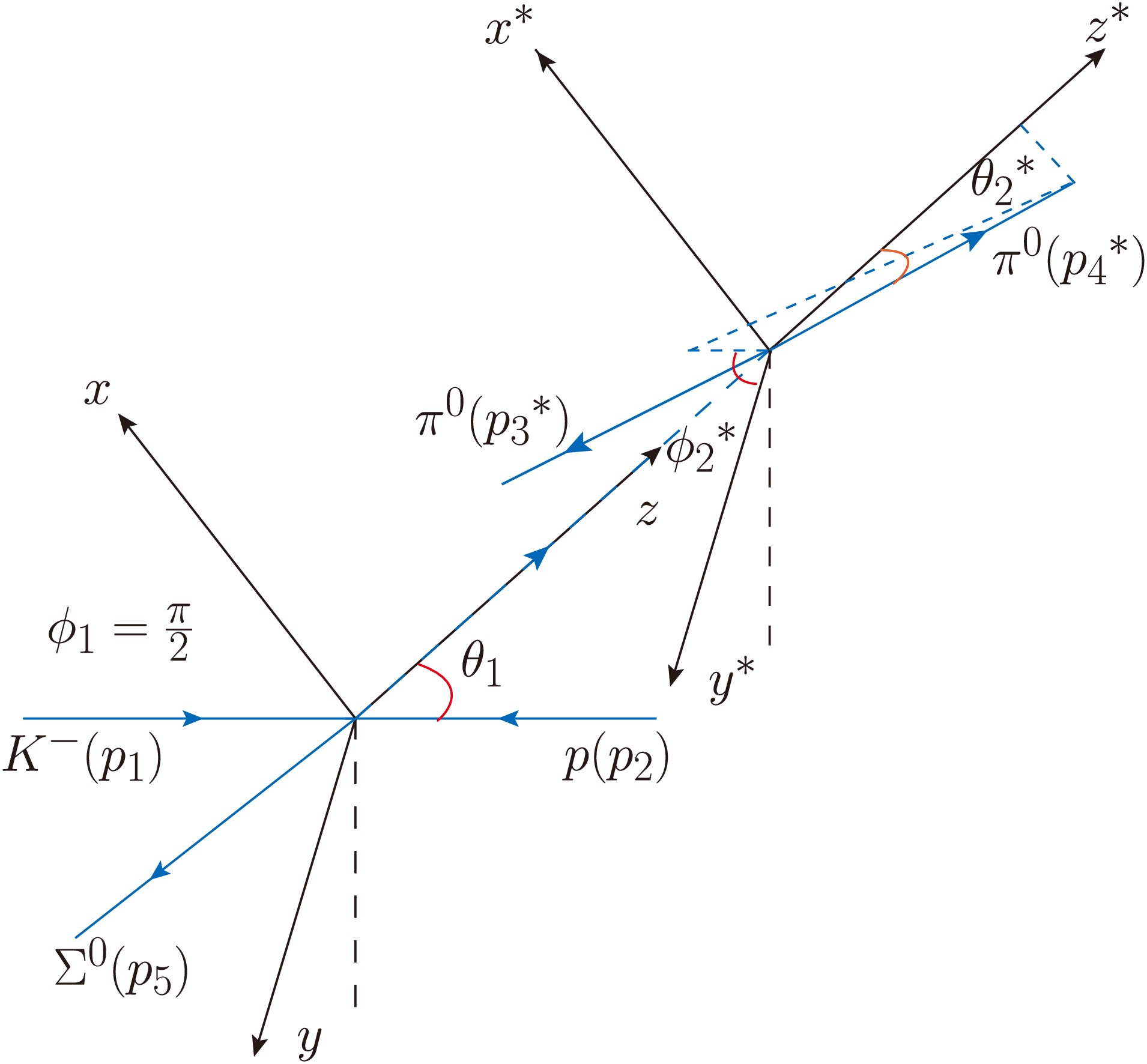
Figure 2. (color online) Definition of the three-body phase space in the
$ K^-p\rightarrow \pi^0\pi^0\Sigma^0 $ reaction.Finally, the squared modulus of the total scattering amplitude is given by
$ |{\cal{M}}_{\text{total}}|^2 = |{\cal{M}}_s+{\cal{M}}_u|^2. $
(14) -
In this section, we show the theoretical formalism for studying
$ K^-p \to \pi^0\pi^0\Sigma^0 $ within the framework of effective Lagrangian method [28, 40−42], where these combined contributions from both the s-channel and u-channel are considered, as illustrated in Fig. 1. For the s-channel, the mechanism of$ K^-p\to\Sigma(1660)\to\pi^0\Lambda(1405)\to \pi^0\pi^0\Sigma^0 $ is analyzed, while for the u-channel, we include the contribution of the proton pole term.
Figure 1. Scattering mechanisms of the
$ K^-p\rightarrow \pi^0\pi^0\Sigma^0 $ reaction. It consists of s-channel$ \Sigma(1660) $ resonance (a) and u-channel nucleon pole term (b). We also show the definition of the kinematical variables ($ p_1 $ ,$ p_2 $ ,$ p_3 $ ,$ p_4 $ ,$ p_5 $ , k,$ k_p $ , q) used in the calculation.Here, for the
$ \pi^0 \Sigma^0 $ production, we have only considered the contributions from the$ \Lambda(1405) $ state, while that from the ground state Λ is neglected; even the$ \Sigma(1660) $ state has significant couplings to the$ \pi\Lambda $ channel. This is because its contribution is strongly suppressed due to the highly off-shell effect of the Λ propagator when the$ \pi^0 \Sigma^0 $ invariant mass is much higher than the mass of Λ. Meanwhile, for the excited states$ \Lambda(1670) $ and$ \Lambda(1600) $ , because the mass thresholds of$ \pi \Lambda(1600) $ and$ \pi \Lambda(1670) $ are above the mass of$ \Sigma(1660) $ , their contributions should be small.In addition, there are other
$ \Sigma^* $ states nearby the$ \Sigma(1660) $ resonance, for example,$ \Sigma(1620) $ and$ \Sigma(1670) $ .$ \Sigma(1620) $ is a “one star” baryon state, which means it is not a well-established resonance. For$ \Sigma(1670) $ with spin-parity$ 3/2^- $ , although it is a well established “four star” state, its contribution should be small because it couples to$ \bar{K}N $ in d-wave. Thus, in this work, we focus on the role of$ \Sigma(1660) $ in the$ K^- p \to \pi^0 \Lambda(1405) $ reaction and$ \Lambda(1405) $ decaying into the$ \pi^0\Sigma^0 $ channel.To evaluate the contribution of s-channel shown in Fig. 1 (a), the effective Lagrangian densities are introduced for these interaction vertices [26, 34, 43]:
$ {\cal{L}}_{\bar{K} N\Sigma^*} =-{\rm i} {g}_{\bar{K} N\Sigma^*}\bar{N}\gamma_5 \tau \cdot \vec{\Sigma}^* K + \text{H.c.} , $
(1) $ {\cal{L}}_{\Sigma^*\pi\Lambda^*} ={\rm i}g_{\Sigma^*\pi\Lambda^*} \bar{\Lambda}^*\vec\pi \cdot \vec\Sigma^* +\text{H.c.}, $
(2) $ {\cal{L}}_{\Lambda^*\pi\Sigma} =-{\rm i}g_{\Lambda^*\pi\Sigma} \bar{\Lambda}^*\vec{\pi}\cdot\vec{\Sigma}+\text{H.c.} , $
(3) where
$ \Sigma^* $ denotes the$ \Sigma(1660) $ resonance with spin-parity$ J^P = 1/2^+ $ and$ \Lambda^* $ denotes the$ \Lambda(1405) $ resonance. The operator τ represents the Pauli matrix (see Ref. [34]).$ g_{\bar{K} N\Sigma^*} $ ,$ g_{\Sigma^*\pi\Lambda^*} $ , and$ g_{\Lambda^*\pi\Sigma} $ are the couplings for the vertices$ \bar{K} N\Sigma^* $ ,$ \Sigma^*\pi\Lambda^* $ , and$ \Lambda^*\pi\Sigma $ , respectively. In this work, the product$ g_{\Sigma^*\bar{K} N}g_{\Sigma^*\pi\Lambda^*} $ is determined by fitting to the experimental data.Meanwhile, the non-resonant background contribution from the u-channel nucleon pole is also considered, as depicted in Fig. 1(b). The contribution of this part is calculated by following the same approach. It should be noted that the effective Lagrangian density for the
$ \Lambda^*\pi\Sigma $ vertex has been given in Eq. (3), while those for the other vertices are given by [26, 34, 43]$ {\cal{L}}_{\pi NN} =-{\rm i}{g}_{\pi NN} \bar{N}\gamma_5\vec{\pi}\cdot\tau N+\text{H.c.}, $
(4) $ {\cal{L}}_{\bar{K}N\Lambda^*} ={\rm i}g_{\bar{K} N\Lambda^*} \bar N\bar{K}{\Lambda}^*+\text{H.c.}, $
(5) where
$ g_{\pi NN} $ and$ g_{\bar{K}N\Lambda^*} $ are the coupling constants for the vertices$ \pi NN $ and$ \bar{K}N\Lambda^* $ , respectively. In our calculation, the values$ g_{\pi NN}=13.45 $ ,$ g_{\Lambda^*\pi\Sigma}=0.9 $ , and$ g_{\Lambda^*\bar{K}N}=1.51 $ are taken from Ref. [26], where these values were obtained by fitting them to the experimental data on the total cross sections of the$ K^- p \to \pi^0\Sigma^0 $ reaction.With the effective-interaction Lagrangian densities given above, we can easily construct the invariant scattering amplitudes:
$ \begin{aligned}[b] {\cal{M}}_s =\;& -g_{\Lambda^*\pi\Sigma}g_{\Sigma^* \pi \Lambda^*}g_{\bar{K} N\Sigma^*} F_{\Sigma^*}(k^2)F_{\Lambda^*}(q^2) \\ &\bar{u}(p_{5})G_{\Lambda^*}(q) G_{\Sigma^*}(k) \gamma_5u(p_{2})\\ & +(\text{exchange terms with}\; p_3\leftrightarrow p_4), \end{aligned} $
(6) $ \begin{aligned}[b] {\cal{M}}_u =\;& -g_{\Lambda^*\pi\Sigma} g_{\bar{K}N\Lambda^*}g_{\pi NN} F_{p}(k_p^2)F_{\Lambda^*}(q^2) \\& \bar{u}(p_{5})G_{\Lambda^*}(q)G_p(k_p)\gamma_5u(p_{2})\\&+(\text{exchange terms with}\; p_3\leftrightarrow p_4). \end{aligned} $
(7) In the calculation, the momentum exchange between the two final
$ \pi^0 $ mesons has been considered.$ G_R(q) $ [$ R \equiv \Sigma(1660) $ ,$ \Lambda(1405) $ or proton pole] is the propagator for a spin-${1}/{2}$ particle [41, 44]:$ G_{R}(q) =\frac{{\rm i}({\not\,q}+m_R)}{q^2-m_R^2+{\rm i}m_R\Gamma_R}, $
(8) $ m_R $ and$ \Gamma_R $ are the mass and total decay width of the intermediate resonance, respectively. We take$ m_{\Sigma(1660)} = 1660 $ MeV,$ \Gamma_{\Sigma(1660)} = 200 $ MeV,$ m_{\Lambda(1405)} = 1405 $ MeV, and$ \Gamma_{\Lambda(1405)} = 50.5 $ MeV [35]. Moreover, it is necessary to introduce the form factors to account for the off-shell behavior of the intermediate particles [45−49]. In this work, the following form factor is adopted [45, 50−52]:$ F_R(q^2)=\frac{\Lambda_R^{4}}{\Lambda_R^{4}+\left(q^{2}-m_R^2\right)^{2}}, $
(9) where
$ \Lambda_R $ ,$ m_R $ , and q are the cutoff parameter, mass, and four-momentum of the intermediate baryon, respectively. In this work, the cutoff parameters$ \Lambda_{\Sigma(1660)} $ ,$ \Lambda_{\Lambda(1405)} $ , and$ \Lambda_p $ are constrained between$ 800 $ to$ 1100 $ MeV.Using the formalism mentioned above, the differential cross section for
$ K^-p \to \pi^0\Lambda(1405) \to \pi^0\pi^0\Sigma^0 $ can be constructed as follows [48]:$ {\rm d}\sigma = \frac{|\vec{p}_{3}^{\; *}| |\vec{p}_{5}|}{2^{12} \pi^5s |\vec{p}_1| } {\rm d} m_{12} {\rm d} \Omega_1 {\rm d} \Omega_2^*\times \sum\limits_{\text{spins}}|{{\cal{M}}_{\text{total}}}|^2, $
(10) where we have considered the factor of
$ 1/2 $ accounting for the identity of the two final-state$ \pi^0 $ , as well as the factor$ 1/2 $ for averaging over the spins of the initial state.The invariant mass square of the
$ K^- p $ system can be obtained by$ s=\left(\sqrt{m_{K^-}^2+({{p}_{1}^{\text{lab}}})^2}+m_{p}\right)^2-({{p}_{1}^{\text{lab}}})^2, $
(11) where
$ {{p}_{1}^{\text{lab}}} $ is the kaon momentum in the laboratory frame.$ |{\vec{p}_3^{\; *}}| $ and$ |\vec{p}_5| $ in Eq. (10) are the momenta of$ \pi^0 $ in the rest frame of the$ \Sigma(1660) $ and$ \Lambda(1405) $ resonances, respectively, and they are given by$ |\vec{p}_3^{\; *}| = \frac{\lambda^{ \frac{1}{2}}(m_{12 }^2,m_{\pi^0}^2,m_{\pi^0}^2)}{2m_{12 }}, $
(12) $ |{\vec{p}_{5}}| = \frac{\lambda^{ \frac{1}{2}}(s,m_{\Sigma^0}^2,m_{12 }^2)}{2\sqrt{s}}, $
(13) where the Källén function
$ \lambda(x,y,z) = x^{2} + y^{2} + z^{2} - 2xy - 2xz - 2yz $ . In addition, the definition of the solid angles${\rm d}\Omega_1= {\rm d}\cos\theta_1 {\rm d}\phi_1$ and${\rm d}\Omega_2^*={\rm d}\cos\theta_2^* {\rm d}\phi_2^*$ in Eq. (10) is shown in Fig. 2.
Figure 2. (color online) Definition of the three-body phase space in the
$ K^-p\rightarrow \pi^0\pi^0\Sigma^0 $ reaction.Finally, the squared modulus of the total scattering amplitude is given by
$ |{\cal{M}}_{\text{total}}|^2 = |{\cal{M}}_s+{\cal{M}}_u|^2. $
(14) -
To further constrain the model and provide complementary information, the related two-body scattering process
$ K^-p \to \pi^0\Lambda(1405) $ is also investigated within the same framework. The relevant reaction diagrams are shown in Fig. 3. Based on the effective Lagrangian densities for the relevant vertices in Eqs. (1), (2), (4), and (5), the scattering amplitudes for the$ K^-p \to \pi^0\Lambda(1405) $ reaction are written as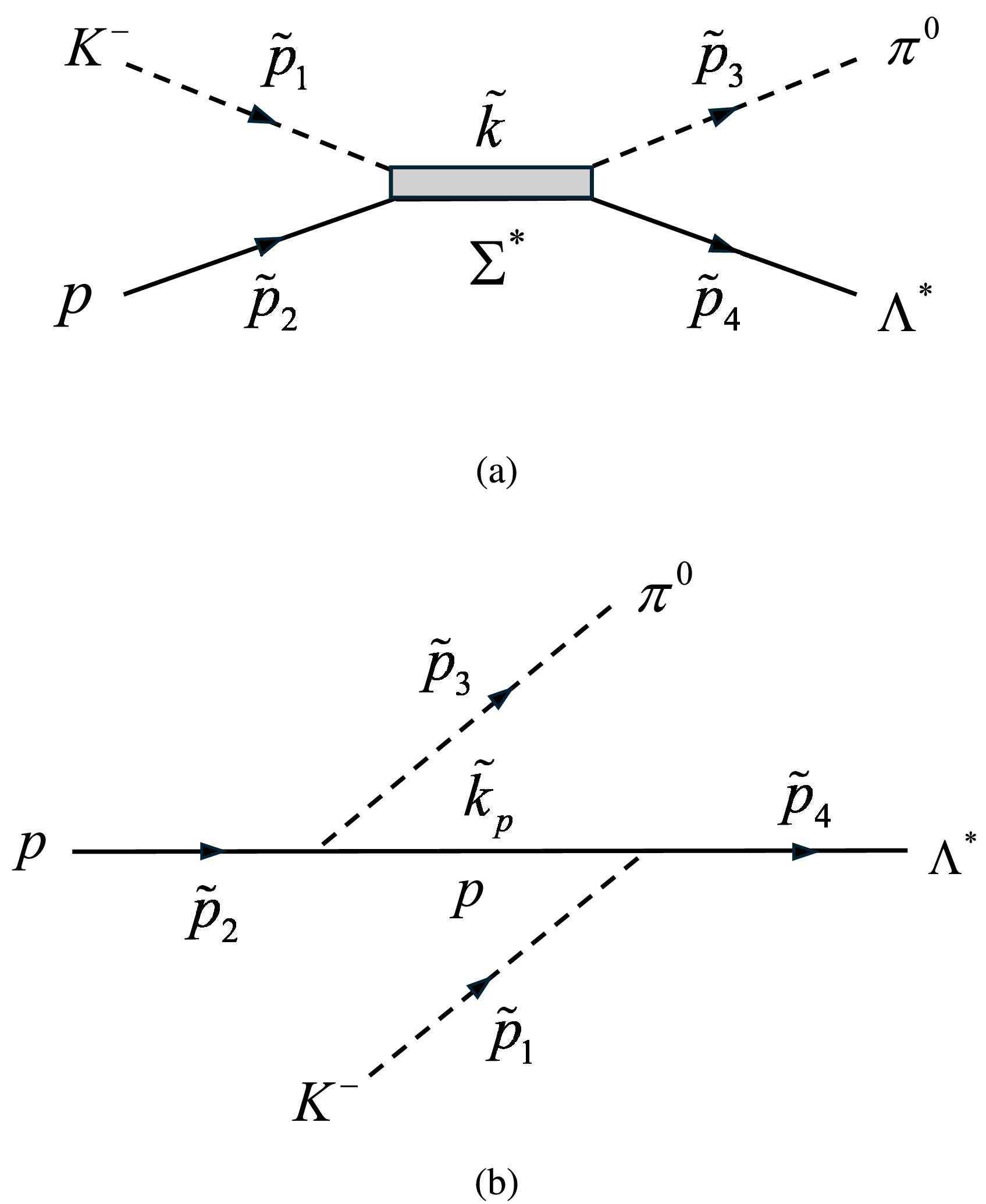
Figure 3. Scattering mechanisms for the
$ K^-p \to \pi^0\Lambda(1450) $ reaction. (a): s-channel, (b): u-channel.$ \tilde{{\cal{M}}}_{s} = - g_{\Sigma^*\pi\Lambda^*}g_{\bar{K} N\Sigma^*}F_{\Sigma^*}(\tilde{k}^2) \bar{u}(\tilde{p}_4) G_{\Sigma^*} (\tilde{k})\gamma_5 u(\tilde{p}_2), $
(15) $ \tilde{{\cal{M}}}_u = -g_{\bar{K}N\Lambda^*}g_{\pi NN}F_{p}(\tilde{k}_p^2) \bar{u}(\tilde{p}_4)G_p(\tilde{k}_p)\gamma_5u(\tilde{p}_2). $
(16) Then, the differential cross section for the
$ K^-p\rightarrow \pi^0\Lambda(1405) $ reaction is given by [35]$ {\rm d}\sigma = \frac{|\vec{\tilde{p}}_3|}{64\pi{|\vec{\tilde{p}}_1|}s } \sum\limits_{\text{spins}} |\tilde{{\cal{M}}}_s+\tilde{{\cal{M}}}_u|^2 {\rm d}{\rm cos}{\tilde\theta}, $
(17) where
$ |\vec{\tilde{p}}_1| $ and$ {|\vec{\tilde{p}}_3|} $ are the momenta of the kaon and$ \pi^0 $ mesons in the center-of-mass frame for the process$ K^-p\to\pi^0\Lambda(1405) $ , respectively, and$ \tilde{\theta} $ is the scattering angle of the outgoing$ \pi^0 $ meson. -
To further constrain the model and provide complementary information, the related two-body scattering process
$ K^-p \to \pi^0\Lambda(1405) $ is also investigated within the same framework. The relevant reaction diagrams are shown in Fig. 3. Based on the effective Lagrangian densities for the relevant vertices in Eqs. (1), (2), (4), and (5), the scattering amplitudes for the$ K^-p \to \pi^0\Lambda(1405) $ reaction are written as
Figure 3. Scattering mechanisms for the
$ K^-p \to \pi^0\Lambda(1450) $ reaction. (a): s-channel, (b): u-channel.$ \tilde{{\cal{M}}}_{s} = - g_{\Sigma^*\pi\Lambda^*}g_{\bar{K} N\Sigma^*}F_{\Sigma^*}(\tilde{k}^2) \bar{u}(\tilde{p}_4) G_{\Sigma^*} (\tilde{k})\gamma_5 u(\tilde{p}_2), $
(15) $ \tilde{{\cal{M}}}_u = -g_{\bar{K}N\Lambda^*}g_{\pi NN}F_{p}(\tilde{k}_p^2) \bar{u}(\tilde{p}_4)G_p(\tilde{k}_p)\gamma_5u(\tilde{p}_2). $
(16) Then, the differential cross section for the
$ K^-p\rightarrow \pi^0\Lambda(1405) $ reaction is given by [35]$ {\rm d}\sigma = \frac{|\vec{\tilde{p}}_3|}{64\pi{|\vec{\tilde{p}}_1|}s } \sum\limits_{\text{spins}} |\tilde{{\cal{M}}}_s+\tilde{{\cal{M}}}_u|^2 {\rm d}{\rm cos}{\tilde\theta}, $
(17) where
$ |\vec{\tilde{p}}_1| $ and$ {|\vec{\tilde{p}}_3|} $ are the momenta of the kaon and$ \pi^0 $ mesons in the center-of-mass frame for the process$ K^-p\to\pi^0\Lambda(1405) $ , respectively, and$ \tilde{\theta} $ is the scattering angle of the outgoing$ \pi^0 $ meson. -
With the formalism and ingredients given above, the total and differential cross sections versus the
$ K^- $ momentum$ {p}_{1}^{\text{lab}} $ for the$ K^-p \to \pi^0\pi^0 \Sigma^0 $ reaction are calculated. Because the experimental data are limited and have large uncertainties, we should aim to reduce the number of free theoretical parameters. In this work, to minimize the number of free parameters, the cutoff parameters$ \Lambda_{\Sigma(1660)} $ ,$ \Lambda_{\Lambda(1405)} $ , and$ \Lambda_p $ are taken as equal ($ \Lambda_R $ ), and their values are fixed in the range of$ 800 - 1100 $ MeV. The masses and widths of these involved particles are taken as the nominal values quoted in the PDG [35]. Among these values, by considering that$ \Sigma(1660) $ is a broad state and its width has not yet been established [35], the center value$ \Gamma_{\Sigma(1660)}=200 $ MeV is adopted. Then, there is only one free parameter$ g_{\Sigma^*\bar{K}N}g_{\Sigma^*\pi\Lambda^*} $ in our model, which corresponds to the combined coupling strength of the$ \Sigma(1660)\bar{K} N $ and$ \Sigma(1660)\pi\Lambda(1405) $ vertices. Its value is determined by a combined fit to the data for the total and differential cross sections of the$ K^-p \to \pi^0\pi^0\Sigma^0 $ process and the total cross section of the$ K^-p \to \pi^0 \Lambda(1405) $ reaction. There are a total of 77 data points. The fitted parameters are compiled in Table 1, from where it is found that, with$ \Lambda_R = 900 $ MeV, the value of$ g_{\Sigma^*\bar{K}N}g_{\Sigma^*\pi\Lambda^*} $ is determined as$ 2.30 \pm 0.11 $ , with a reasonable small$ \chi^2/ \rm{d.o.f} = 1.44 $ . Following, we will show the theoretical results obtained with$ \Lambda_R = 900 $ MeV.$ \Lambda_R $ /MeV$ g_{\bar{K} N \Sigma^*} g_{\Sigma^* \pi \Lambda^*} $ $ \chi^2 / {\rm d.o.f } $ $ 800 $ $ 2.79 \pm 0.11 $ $ 2.07 $ $ 900 $ $ 2.30 \pm 0.11 $ $ 1.44 $ $ 1000 $ $ 1.81 \pm 0.10 $ $ 1.46 $ $ 1100 $ $ 1.28 \pm 0.24 $ $ 2.19 $ Table 1. Values of some of the parameters used or determined in this work.
The theoretical fitted total cross sections for the
$ K^-p \to \pi^0\pi^0\Sigma^0 $ process are shown in Fig. 4, where the kaon momentum$ {p}_{1}^{\text{lab}} $ ranges from$ 0.4 $ to$ 1.0 $ GeV, corresponding to a center-of-mass energy$ \sqrt{s} $ ranging from$ 1.52 $ to$ 1.79 $ GeV. The green-dashed curve represents the contribution from the s-channel$ \Sigma(1660) $ resonance. The yellow-dotted curve stands for the contribution from the u-channel proton pole. The black-solid curve corresponds to their total contributions. One can see that the u-channel nucleon pole is dominant.1 This is in agreement with the theoretical results of Refs. [2, 31], where only the u-channel proton pole exchange mechanism was taken into account, and the total cross section of$ K^-p \to \pi^0\pi^0\Sigma^0 $ reaction can be reproduced.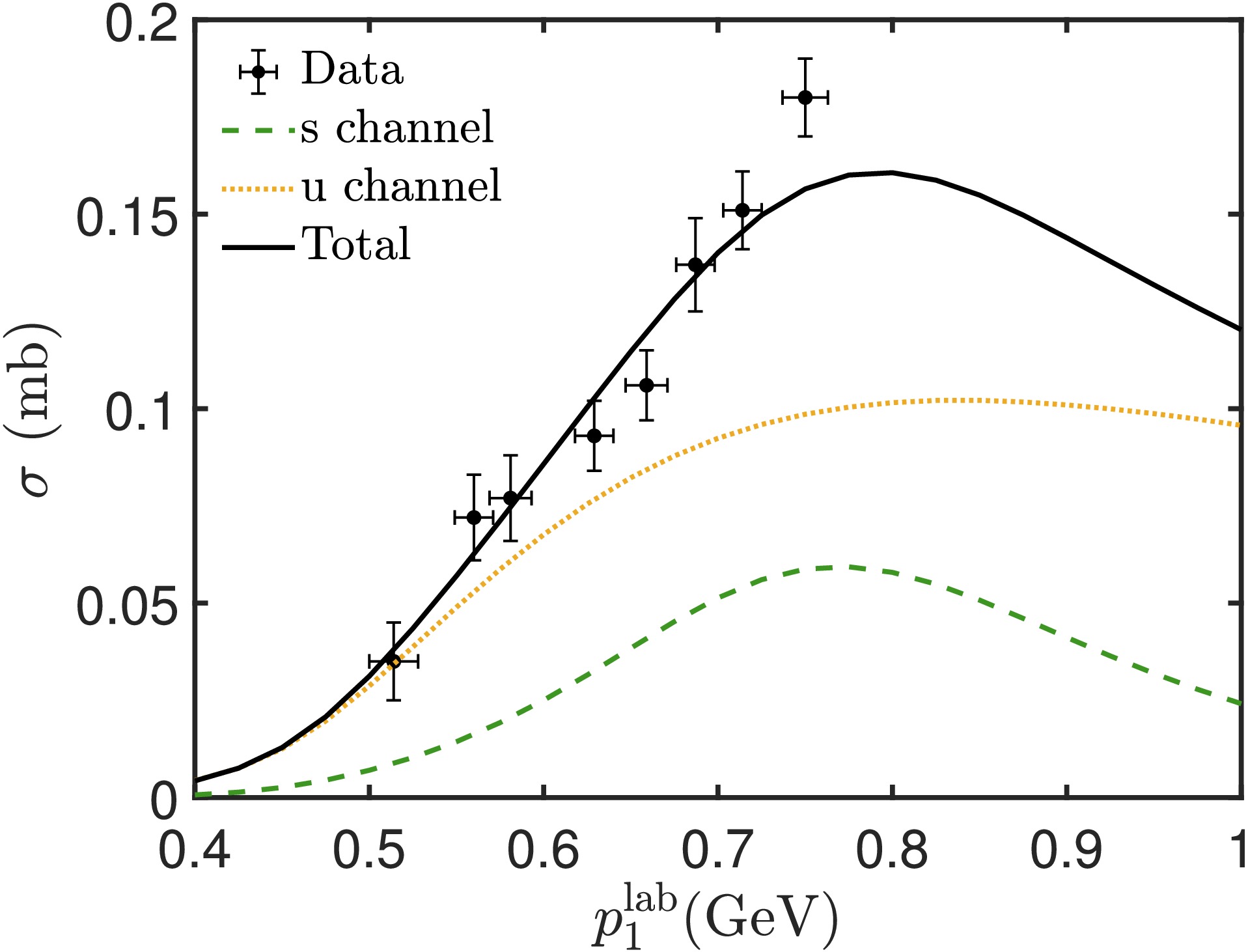
Figure 4. (color online) Total cross section for the
$ K^-p \rightarrow $ $ \pi^0\pi^0\Sigma^0 $ reaction. The experimental data are taken from Ref. [39].The possible broad structure around
$ {p}_{1}^{\text{lab}}=0.8 $ GeV is also observed, which is contributed by the$ \Sigma(1660) $ resonance. In other words, the$ \Sigma(1660) $ contributes to the high-energy region of the total cross section of the$ K^-p \to \pi^0 \pi^0 \Sigma^0 $ reaction and may play an important role in this reaction.Note that in this work, the
$ \Sigma(1660) $ resonance is treated as a Breit–Wigner state with fixed mass and width. Given the large uncertainty of its width$ \Gamma_{\Sigma(1660)} = 200 \pm 100 $ MeV [35], we have explored the effect of varying the width$ \Gamma_{\Sigma(1660)} $ and found only tiny changes in the fitted results. In fact, adopting a smaller value of$ \Gamma_{\Sigma(1660)} $ leads to slightly better agreement with the experimental data.It is worth emphasizing that if experimental measurements in the high-energy region become available, the width of
$ \Sigma(1660) $ could be extracted more precisely, allowing for a further confirmation of its role in the$ K^- p \to \pi^0 \pi^0 \Sigma^0 $ reaction and properties of the$ \Sigma(1660) $ state. We expect that further experimental measurements will help to verify our predictions and lead to a better understanding of the properties of the$ \Sigma(1660) $ resonance.The differential cross sections for the
$ K^- p \to \pi^0 \pi^0 \Sigma^0 $ process are also calculated and compared with the available experimental data. We first show the angular distributions for kaon momenta$ {p}_{1}^{\text{lab}}=581, \; 687, \; 714, \; 750 $ MeV in Fig. 5, where$ \theta_1 $ denotes the angle between the combined momentum direction of the two outgoing pions and the incoming$ K^- $ meson direction. It can be seen that our results are in fair agreement with the experimental measurements from the Crystal Ball Collaboration [39].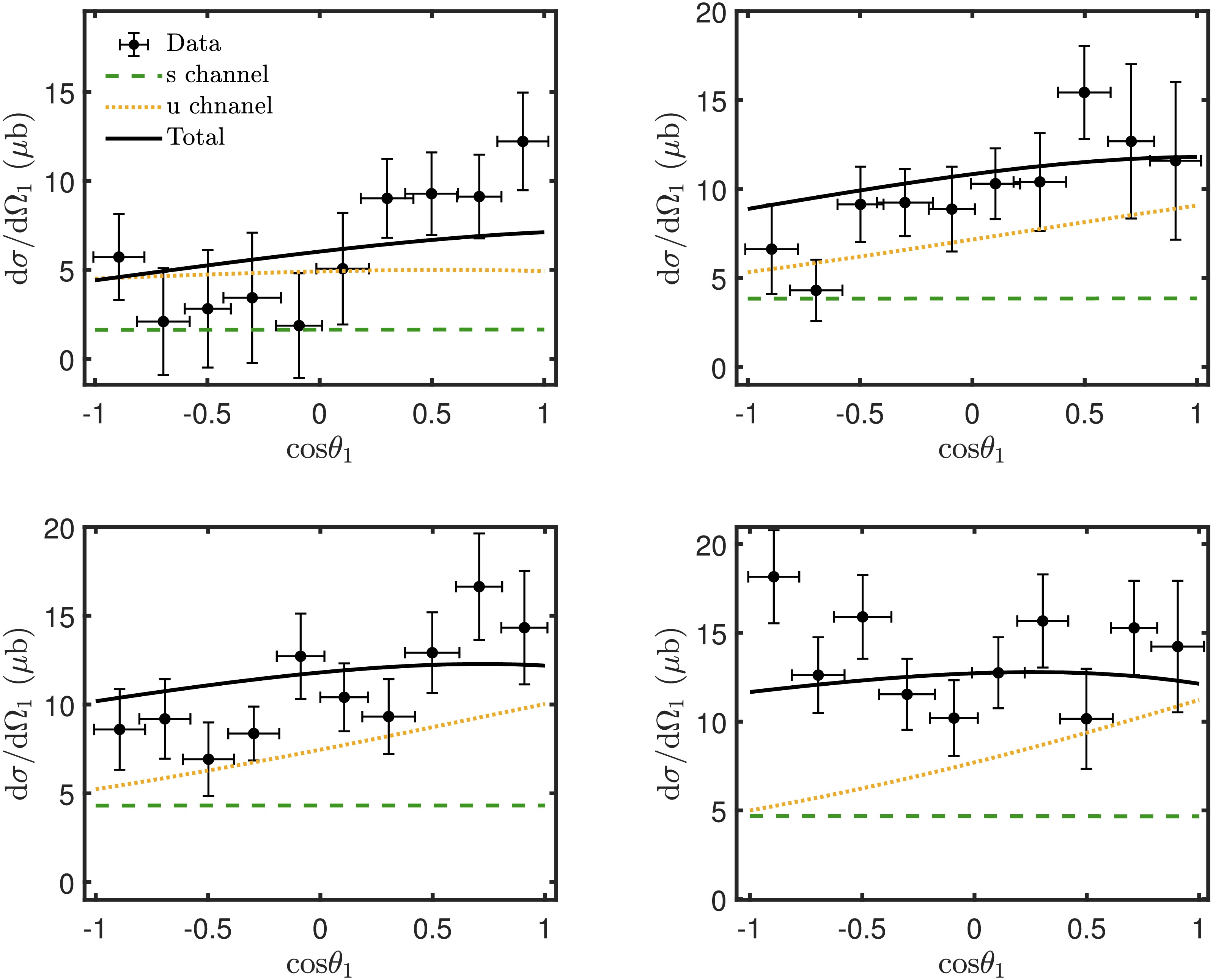
Figure 5. (color online) Differential cross sections of
$ K^-p\rightarrow \pi^0\pi^0\Sigma^0 $ reaction for$ {p}_{1}^{\text{lab}}=581 $ (upper left), 687 (upper right), 714 (lower left), and 750 MeV (lower right). The experimental data are taken from Ref. [39].Then we show the invariant mass distributions of
$ \pi^0 \Sigma^0 $ at$ p^{\rm lab}_1 = 581 $ ,$ 687 $ ,$ 714 $ , and$ 750 $ MeV in Fig. 6. It is found that as the$ K^- $ momenta increases-for example, at$ p^{\rm lab}_1 = 0.75 $ GeV-the$ \pi^0\Sigma^0 $ invariant mass distribution exhibits a double bump structures, because there are two identical$ \pi^0 $ in the final state and larger phase space. It is expected these theoretical calculations can be tested by future experimental measurements.2 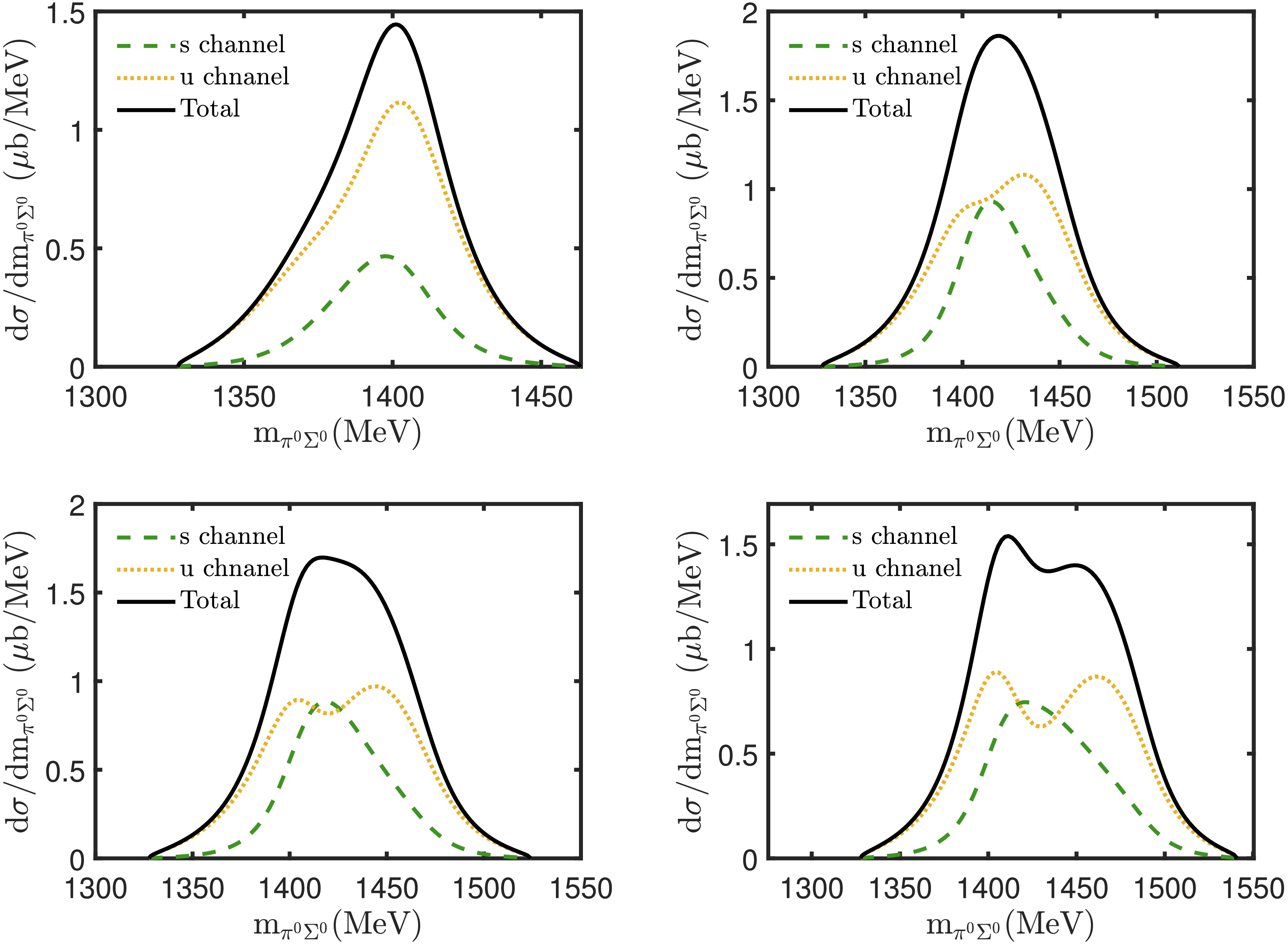
Figure 6. (color online)
$ \pi^0\Sigma^0 $ invariant mass distributions of$ K^-p \to \pi^0 \pi^0 \Sigma^0 $ reaction for$ {p}_{1}^{\text{lab}}=581 $ (upper left), 687 (upper right), 714 (lower left), and 750 MeV (lower right).From Fig. 6, one can see that around the energy region of
$ p^{\rm lab}_{1} $ = 0.75 GeV, the invariant mass of the$ \pi^0\Sigma^0 $ system is still below$ 1550 $ MeV. Thus, it is expected that the contributions from$ \Lambda(1670) $ and$ \Lambda(1600) $ resonances can be neglected.For the
$ K^-p \to \pi^0\pi^0 \Sigma^0 $ reaction, the contribution from scalar meson$ f_0(500) $ should be important, as the principle decay of$ f_0(500) $ is into two pions. However, the meson$ f_0(500) $ is a very broad state, and the current data are limited; thus, we leave the study of the meson$ f_0(500) $ contribution for future studies when more experimental data are available. In fact, it was noted that the contribution from the$ f_0(500) $ meson to the$ K^-p \to \pi^0 \pi^0 \Sigma^0 $ is insignificant in the experimental paper [39].To provide information on the complementary channel, the total cross section for the
$ K^-p \to \pi^0\Lambda(1405) $ reaction has been analyzed, with the results presented in Fig. 7. Here,$ {p}_{1}^{\text{lab}} $ ranges from$ 0.5 $ to$ 2.0 $ GeV, corresponding to$ \sqrt{s} $ from$ 1.56 $ to$ 2.23 $ GeV. A significant peak is observed around$ {p}_{1}^{\text{lab}}=0.75 $ GeV. However, it is found that the available experimental data are mainly concentrated in the higher-energy region of this reaction, whereas the signal associated with the$ \Sigma(1660) $ state lies in the lower-energy region. Consequently, data in the low-energy region of this reaction are crucial for confirming the properties of$ \Sigma(1660) $ .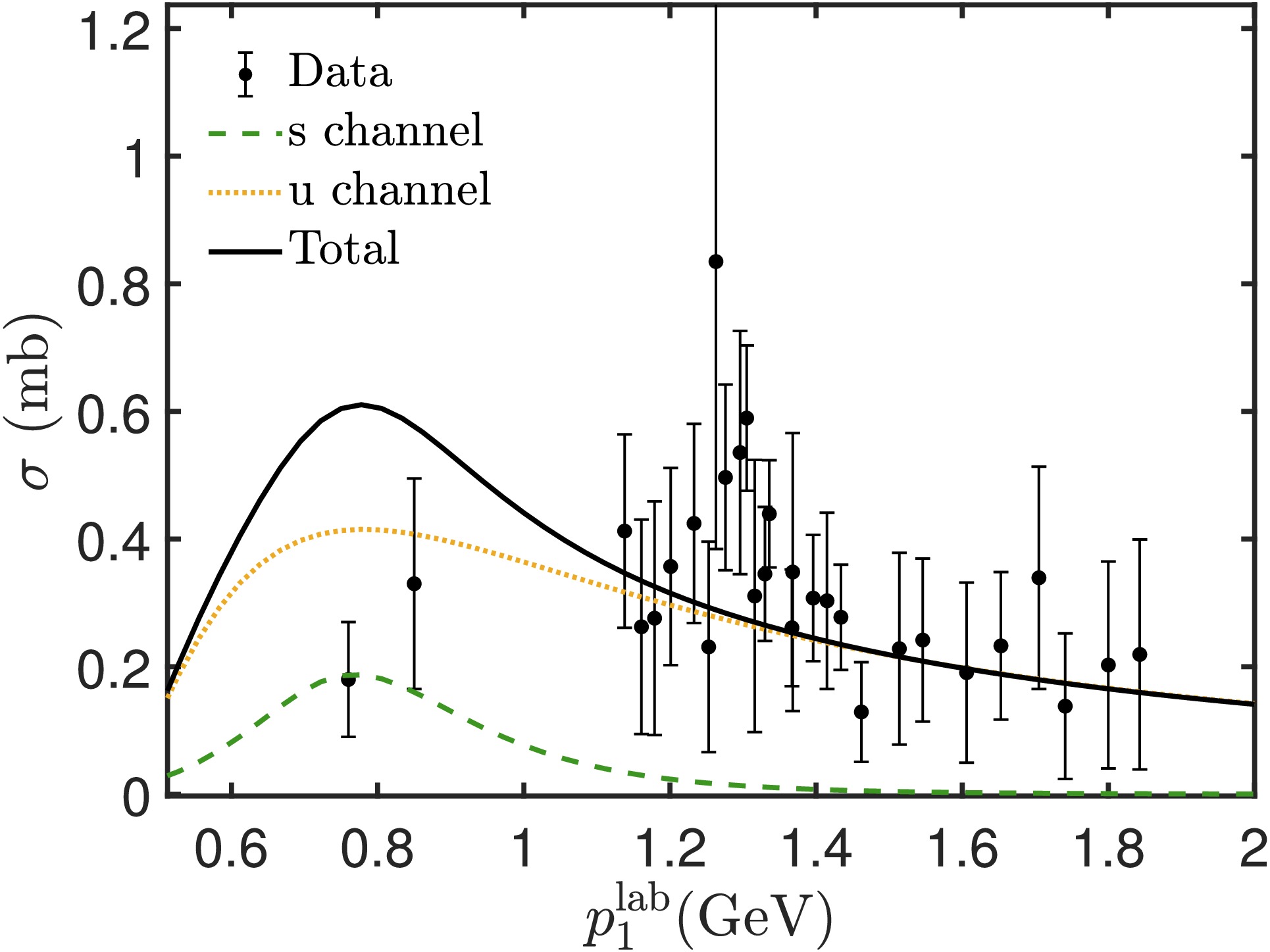
Note that, within the chiral unitary approach and by considering the two pole structures of the
$ \Lambda(1405) $ state [3, 5, 57−62], it has been shown that the$ K^-p \to \pi^0 \pi^0 \Sigma^0 $ reaction is particularly suited for probing the properties of the higher-energy, narrower second pole of the$ \Lambda(1405) $ resonance. This is because the process is largely dominated by a mechanism in which one$ \pi^0 $ is emitted before the$ K^- p \to \pi^0 \Sigma^0 $ transition, and the$ K^- p \to \pi^0 \Sigma^0 $ scattering amplitude is strongly dependent on the second pole. Nevertheless, more precise experimental data are required to draw definitive conclusions.Next, we turn to the strong couplings of
$ \Sigma(1660) $ to$ \bar{K}N $ and$ \pi\Lambda(1405) $ channels. With the effective interactions shown in Eq. (1), one can easily obtain the value of$ g_{\Sigma^*\bar{K}N} $ using the relevant partial decay width:$ \Gamma_{\Sigma(1660) \to \bar{K}N}=\frac {g^2_{\Sigma^*\bar{K}N}}{2\pi} \frac{|\vec{\tilde{p}}_1|}{m_{\Sigma^*}}{(E_ p-m_p)}, $
(18) where
$ E_p $ and$ |\vec{\tilde{p}}_1| $ are the energy of the proton and momentum of$ K^- $ in the$ \Sigma(1660) $ rest frame, respectively. With the experimental data of$ {\cal{B}}[\Sigma(1660) \to \bar{K}N] = 0.10 \pm 0.05 $ and$ m_{\Sigma^*} = 1660 \pm 20 $ MeV and$ \Gamma_{\Sigma^*} = 200 \pm 100 $ MeV, we can obtain the coupling constant:$ g_{\Sigma^* \bar{K}N} =2.49\pm0.88, $
(19) where its uncertainty is calculated from the errors of mass and width of
$ \Sigma(1660) $ and also the branching ratio of$ {\cal{B}}[\Sigma(1660) \to \bar{K}N] $ .Subsequently, with
$ g_{\Sigma^*\bar{K}N}g_{\Sigma^*\pi\Lambda^*} = 2.30 \pm 0.11 $ , one can obtain$ g_{\Sigma^*\pi\Lambda^*} = 0.92 \pm0.32. $
(20) Then, with the obtained strong coupling constant
$ g_{\Sigma^*\pi\Lambda^*} $ , we have evaluated the branching fraction of$ \Sigma(1660)\to \pi \Lambda(1405) $ as$ \begin{aligned}[b]{\cal{B}}[\Sigma(1660)\to \pi\Lambda(1405)] =\;& \frac{\Gamma_{\Sigma(1660) \to \pi \Lambda(1405)}}{\Gamma_{\Sigma(1660)}} \\ =\;& \frac {g^2_{\Sigma^*\pi\Lambda^*}}{4\pi\Gamma_{\Sigma^*}} \frac{|\vec{\tilde{p}}_3|}{m_{\Sigma^*}}(E_{\Lambda^*} +m_{\Lambda^*}). \end{aligned}$
(21) This yields
$ {\cal{B}}[\Sigma(1660)\to\pi^0\Lambda(1405)] = (11.5 \pm 10.1) $ %, which is consistent with the PDG value$ {\cal{B}}[\Sigma(1660)\to \pi^0\Lambda(1405)] = (4.0 \pm 2.0) $ % within uncertainties. -
With the formalism and ingredients given above, the total and differential cross sections versus the
$ K^- $ momentum$ {p}_{1}^{\text{lab}} $ for the$ K^-p \to \pi^0\pi^0 \Sigma^0 $ reaction are calculated. Because the experimental data are limited and have large uncertainties, we should aim to reduce the number of free theoretical parameters. In this work, to minimize the number of free parameters, the cutoff parameters$ \Lambda_{\Sigma(1660)} $ ,$ \Lambda_{\Lambda(1405)} $ , and$ \Lambda_p $ are taken as equal ($ \Lambda_R $ ), and their values are fixed in the range of$ 800 - 1100 $ MeV. The masses and widths of these involved particles are taken as the nominal values quoted in the PDG [35]. Among these values, by considering that$ \Sigma(1660) $ is a broad state and its width has not yet been established [35], the center value$ \Gamma_{\Sigma(1660)}=200 $ MeV is adopted. Then, there is only one free parameter$ g_{\Sigma^*\bar{K}N}g_{\Sigma^*\pi\Lambda^*} $ in our model, which corresponds to the combined coupling strength of the$ \Sigma(1660)\bar{K} N $ and$ \Sigma(1660)\pi\Lambda(1405) $ vertices. Its value is determined by a combined fit to the data for the total and differential cross sections of the$ K^-p \to \pi^0\pi^0\Sigma^0 $ process and the total cross section of the$ K^-p \to \pi^0 \Lambda(1405) $ reaction. There are a total of 77 data points. The fitted parameters are compiled in Table 1, from where it is found that, with$ \Lambda_R = 900 $ MeV, the value of$ g_{\Sigma^*\bar{K}N}g_{\Sigma^*\pi\Lambda^*} $ is determined as$ 2.30 \pm 0.11 $ , with a reasonable small$ \chi^2/ \rm{d.o.f} = 1.44 $ . Following, we will show the theoretical results obtained with$ \Lambda_R = 900 $ MeV.$ \Lambda_R $ /MeV$ g_{\bar{K} N \Sigma^*} g_{\Sigma^* \pi \Lambda^*} $ $ \chi^2 / {\rm d.o.f } $ $ 800 $ $ 2.79 \pm 0.11 $ $ 2.07 $ $ 900 $ $ 2.30 \pm 0.11 $ $ 1.44 $ $ 1000 $ $ 1.81 \pm 0.10 $ $ 1.46 $ $ 1100 $ $ 1.28 \pm 0.24 $ $ 2.19 $ Table 1. Values of some of the parameters used or determined in this work.
The theoretical fitted total cross sections for the
$ K^-p \to \pi^0\pi^0\Sigma^0 $ process are shown in Fig. 4, where the kaon momentum$ {p}_{1}^{\text{lab}} $ ranges from$ 0.4 $ to$ 1.0 $ GeV, corresponding to a center-of-mass energy$ \sqrt{s} $ ranging from$ 1.52 $ to$ 1.79 $ GeV. The green-dashed curve represents the contribution from the s-channel$ \Sigma(1660) $ resonance. The yellow-dotted curve stands for the contribution from the u-channel proton pole. The black-solid curve corresponds to their total contributions. One can see that the u-channel nucleon pole is dominant.1 This is in agreement with the theoretical results of Refs. [2, 31], where only the u-channel proton pole exchange mechanism was taken into account, and the total cross section of$ K^-p \to \pi^0\pi^0\Sigma^0 $ reaction can be reproduced.
Figure 4. (color online) Total cross section for the
$ K^-p \rightarrow $ $ \pi^0\pi^0\Sigma^0 $ reaction. The experimental data are taken from Ref. [39].The possible broad structure around
$ {p}_{1}^{\text{lab}}=0.8 $ GeV is also observed, which is contributed by the$ \Sigma(1660) $ resonance. In other words, the$ \Sigma(1660) $ contributes to the high-energy region of the total cross section of the$ K^-p \to \pi^0 \pi^0 \Sigma^0 $ reaction and may play an important role in this reaction.Note that in this work, the
$ \Sigma(1660) $ resonance is treated as a Breit–Wigner state with fixed mass and width. Given the large uncertainty of its width$ \Gamma_{\Sigma(1660)} = 200 \pm 100 $ MeV [35], we have explored the effect of varying the width$ \Gamma_{\Sigma(1660)} $ and found only tiny changes in the fitted results. In fact, adopting a smaller value of$ \Gamma_{\Sigma(1660)} $ leads to slightly better agreement with the experimental data.It is worth emphasizing that if experimental measurements in the high-energy region become available, the width of
$ \Sigma(1660) $ could be extracted more precisely, allowing for a further confirmation of its role in the$ K^- p \to \pi^0 \pi^0 \Sigma^0 $ reaction and properties of the$ \Sigma(1660) $ state. We expect that further experimental measurements will help to verify our predictions and lead to a better understanding of the properties of the$ \Sigma(1660) $ resonance.The differential cross sections for the
$ K^- p \to \pi^0 \pi^0 \Sigma^0 $ process are also calculated and compared with the available experimental data. We first show the angular distributions for kaon momenta$ {p}_{1}^{\text{lab}}=581, \; 687, \; 714, \; 750 $ MeV in Fig. 5, where$ \theta_1 $ denotes the angle between the combined momentum direction of the two outgoing pions and the incoming$ K^- $ meson direction. It can be seen that our results are in fair agreement with the experimental measurements from the Crystal Ball Collaboration [39].
Figure 5. (color online) Differential cross sections of
$ K^-p\rightarrow \pi^0\pi^0\Sigma^0 $ reaction for$ {p}_{1}^{\text{lab}}=581 $ (upper left), 687 (upper right), 714 (lower left), and 750 MeV (lower right). The experimental data are taken from Ref. [39].Then we show the invariant mass distributions of
$ \pi^0 \Sigma^0 $ at$ p^{\rm lab}_1 = 581 $ ,$ 687 $ ,$ 714 $ , and$ 750 $ MeV in Fig. 6. It is found that as the$ K^- $ momenta increases-for example, at$ p^{\rm lab}_1 = 0.75 $ GeV-the$ \pi^0\Sigma^0 $ invariant mass distribution exhibits a double bump structures, because there are two identical$ \pi^0 $ in the final state and larger phase space. It is expected these theoretical calculations can be tested by future experimental measurements.2
Figure 6. (color online)
$ \pi^0\Sigma^0 $ invariant mass distributions of$ K^-p \to \pi^0 \pi^0 \Sigma^0 $ reaction for$ {p}_{1}^{\text{lab}}=581 $ (upper left), 687 (upper right), 714 (lower left), and 750 MeV (lower right).From Fig. 6, one can see that around the energy region of
$ p^{\rm lab}_{1} $ = 0.75 GeV, the invariant mass of the$ \pi^0\Sigma^0 $ system is still below$ 1550 $ MeV. Thus, it is expected that the contributions from$ \Lambda(1670) $ and$ \Lambda(1600) $ resonances can be neglected.For the
$ K^-p \to \pi^0\pi^0 \Sigma^0 $ reaction, the contribution from scalar meson$ f_0(500) $ should be important, as the principle decay of$ f_0(500) $ is into two pions. However, the meson$ f_0(500) $ is a very broad state, and the current data are limited; thus, we leave the study of the meson$ f_0(500) $ contribution for future studies when more experimental data are available. In fact, it was noted that the contribution from the$ f_0(500) $ meson to the$ K^-p \to \pi^0 \pi^0 \Sigma^0 $ is insignificant in the experimental paper [39].To provide information on the complementary channel, the total cross section for the
$ K^-p \to \pi^0\Lambda(1405) $ reaction has been analyzed, with the results presented in Fig. 7. Here,$ {p}_{1}^{\text{lab}} $ ranges from$ 0.5 $ to$ 2.0 $ GeV, corresponding to$ \sqrt{s} $ from$ 1.56 $ to$ 2.23 $ GeV. A significant peak is observed around$ {p}_{1}^{\text{lab}}=0.75 $ GeV. However, it is found that the available experimental data are mainly concentrated in the higher-energy region of this reaction, whereas the signal associated with the$ \Sigma(1660) $ state lies in the lower-energy region. Consequently, data in the low-energy region of this reaction are crucial for confirming the properties of$ \Sigma(1660) $ .
Note that, within the chiral unitary approach and by considering the two pole structures of the
$ \Lambda(1405) $ state [3, 5, 57−62], it has been shown that the$ K^-p \to \pi^0 \pi^0 \Sigma^0 $ reaction is particularly suited for probing the properties of the higher-energy, narrower second pole of the$ \Lambda(1405) $ resonance. This is because the process is largely dominated by a mechanism in which one$ \pi^0 $ is emitted before the$ K^- p \to \pi^0 \Sigma^0 $ transition, and the$ K^- p \to \pi^0 \Sigma^0 $ scattering amplitude is strongly dependent on the second pole. Nevertheless, more precise experimental data are required to draw definitive conclusions.Next, we turn to the strong couplings of
$ \Sigma(1660) $ to$ \bar{K}N $ and$ \pi\Lambda(1405) $ channels. With the effective interactions shown in Eq. (1), one can easily obtain the value of$ g_{\Sigma^*\bar{K}N} $ using the relevant partial decay width:$ \Gamma_{\Sigma(1660) \to \bar{K}N}=\frac {g^2_{\Sigma^*\bar{K}N}}{2\pi} \frac{|\vec{\tilde{p}}_1|}{m_{\Sigma^*}}{(E_ p-m_p)}, $
(18) where
$ E_p $ and$ |\vec{\tilde{p}}_1| $ are the energy of the proton and momentum of$ K^- $ in the$ \Sigma(1660) $ rest frame, respectively. With the experimental data of$ {\cal{B}}[\Sigma(1660) \to \bar{K}N] = 0.10 \pm 0.05 $ and$ m_{\Sigma^*} = 1660 \pm 20 $ MeV and$ \Gamma_{\Sigma^*} = 200 \pm 100 $ MeV, we can obtain the coupling constant:$ g_{\Sigma^* \bar{K}N} =2.49\pm0.88, $
(19) where its uncertainty is calculated from the errors of mass and width of
$ \Sigma(1660) $ and also the branching ratio of$ {\cal{B}}[\Sigma(1660) \to \bar{K}N] $ .Subsequently, with
$ g_{\Sigma^*\bar{K}N}g_{\Sigma^*\pi\Lambda^*} = 2.30 \pm 0.11 $ , one can obtain$ g_{\Sigma^*\pi\Lambda^*} = 0.92 \pm0.32. $
(20) Then, with the obtained strong coupling constant
$ g_{\Sigma^*\pi\Lambda^*} $ , we have evaluated the branching fraction of$ \Sigma(1660)\to \pi \Lambda(1405) $ as$ \begin{aligned}[b]{\cal{B}}[\Sigma(1660)\to \pi\Lambda(1405)] =\;& \frac{\Gamma_{\Sigma(1660) \to \pi \Lambda(1405)}}{\Gamma_{\Sigma(1660)}} \\ =\;& \frac {g^2_{\Sigma^*\pi\Lambda^*}}{4\pi\Gamma_{\Sigma^*}} \frac{|\vec{\tilde{p}}_3|}{m_{\Sigma^*}}(E_{\Lambda^*} +m_{\Lambda^*}). \end{aligned}$
(21) This yields
$ {\cal{B}}[\Sigma(1660)\to\pi^0\Lambda(1405)] = (11.5 \pm 10.1) $ %, which is consistent with the PDG value$ {\cal{B}}[\Sigma(1660)\to \pi^0\Lambda(1405)] = (4.0 \pm 2.0) $ % within uncertainties. -
In this work, the process
$ K^-p \to \pi^0 \pi^0 \Sigma^0 $ was analyzed within the effective Lagrangian approach. The contributions from the s-channel involving$ \Sigma(1660) $ and the non-resonant background from the u-channel proton pole were considered. The total cross section and angular distributions for the$ K^-p \to \pi^0 \pi^0\Sigma^0 $ process have been presented. Meanwhile, the total cross section for the$ K^-p \to \pi^0\Lambda(1405) $ reaction was also studied within the same model parameters. Our results are in good agreement with the experimental data and may support the conclusion that the$ \Sigma(1660) $ resonance plays an important role in the$ K^-p \to \pi^0 \pi^0 \Sigma^0 $ process with its decaying into the$ \pi \Lambda(1405) $ channel. Furthermore, a significant peak was predicted in the total cross section of$ K^-p \to \pi^0 \Lambda(1405) $ around$ {p}_{1}^{\text{lab}}=0.75 $ GeV, arising from the intermediate$ \Sigma(1660) $ .However, it should be noted that the experimental data on the
$ K^-p \to \pi^0 \pi^0 \Sigma^0 $ reaction remain limited. In addition, experimental uncertainties remain large, and experimental data in the low-energy region of the total cross section for$ K^-p \to \pi^0 \Lambda(1405) $ are not yet available. Such key information is essential for confirming the properties of the$ \Sigma(1660) $ resonance. Therefore, future high-precision measurements of these processes are strongly encouraged, for instance, by the KLF Collaboration at JLab using the GlueX spectrometer [63] and by the possible Huizhou Hadron Spectrometer at HIAF [64]. These measurements would be crucial for elucidating the properties of the$ \Sigma(1660) $ resonance and for determining the coupling strength for$ \Sigma(1660) \to \pi\Lambda(1405) $ . -
In this work, the process
$ K^-p \to \pi^0 \pi^0 \Sigma^0 $ was analyzed within the effective Lagrangian approach. The contributions from the s-channel involving$ \Sigma(1660) $ and the non-resonant background from the u-channel proton pole were considered. The total cross section and angular distributions for the$ K^-p \to \pi^0 \pi^0\Sigma^0 $ process have been presented. Meanwhile, the total cross section for the$ K^-p \to \pi^0\Lambda(1405) $ reaction was also studied within the same model parameters. Our results are in good agreement with the experimental data and may support the conclusion that the$ \Sigma(1660) $ resonance plays an important role in the$ K^-p \to \pi^0 \pi^0 \Sigma^0 $ process with its decaying into the$ \pi \Lambda(1405) $ channel. Furthermore, a significant peak was predicted in the total cross section of$ K^-p \to \pi^0 \Lambda(1405) $ around$ {p}_{1}^{\text{lab}}=0.75 $ GeV, arising from the intermediate$ \Sigma(1660) $ .However, it should be noted that the experimental data on the
$ K^-p \to \pi^0 \pi^0 \Sigma^0 $ reaction remain limited. In addition, experimental uncertainties remain large, and experimental data in the low-energy region of the total cross section for$ K^-p \to \pi^0 \Lambda(1405) $ are not yet available. Such key information is essential for confirming the properties of the$ \Sigma(1660) $ resonance. Therefore, future high-precision measurements of these processes are strongly encouraged, for instance, by the KLF Collaboration at JLab using the GlueX spectrometer [63] and by the possible Huizhou Hadron Spectrometer at HIAF [64]. These measurements would be crucial for elucidating the properties of the$ \Sigma(1660) $ resonance and for determining the coupling strength for$ \Sigma(1660) \to \pi\Lambda(1405) $ .
Role of Σ(1660) in the K −p → π0π0Σ0 reaction
- Received Date: 2026-01-12
- Available Online: 2026-06-15
Abstract: The processes of $ K^-p \to \pi^0 \pi^0 \Sigma^0 $ and $ K^- p \to \pi^0 \Lambda(1405) $ are studied within the effective Lagrangian approach. In addition to the “background” contribution from the u-channel nucleon pole term, the contribution from the $ \Sigma(1660) $ resonance with spin-parity $ J^P=1/2^+ $ is also considered. For the $ K^-p \to \pi^0 \pi^0 \Sigma^0 $ reaction, we perform a calculation for the total and differential cross sections by considering the contribution from the $ \Sigma(1660) $ intermediate resonance decaying into $ \pi^0 \Lambda(1405) $ with $ \Lambda(1405) $ decaying into $ \pi^0 \Sigma^0 $. With our model parameters, the available experimental data on both the $ K^-p \to \pi^0 \pi^0 \Sigma^0 $ and $ K^- p \to \pi^0 \Lambda(1405) $ reactions can be fairly well reproduced. It is shown that the contribution from the $ \Sigma(1660) $ resonance is necessary, and that these experimental measurements could be used to determine some properties of the $ \Sigma(1660) $ resonance.



 DownLoad: